Bridging the Gap: A Comprehensive Guide to Validating Protoplast Screening Predictions in Whole Plants
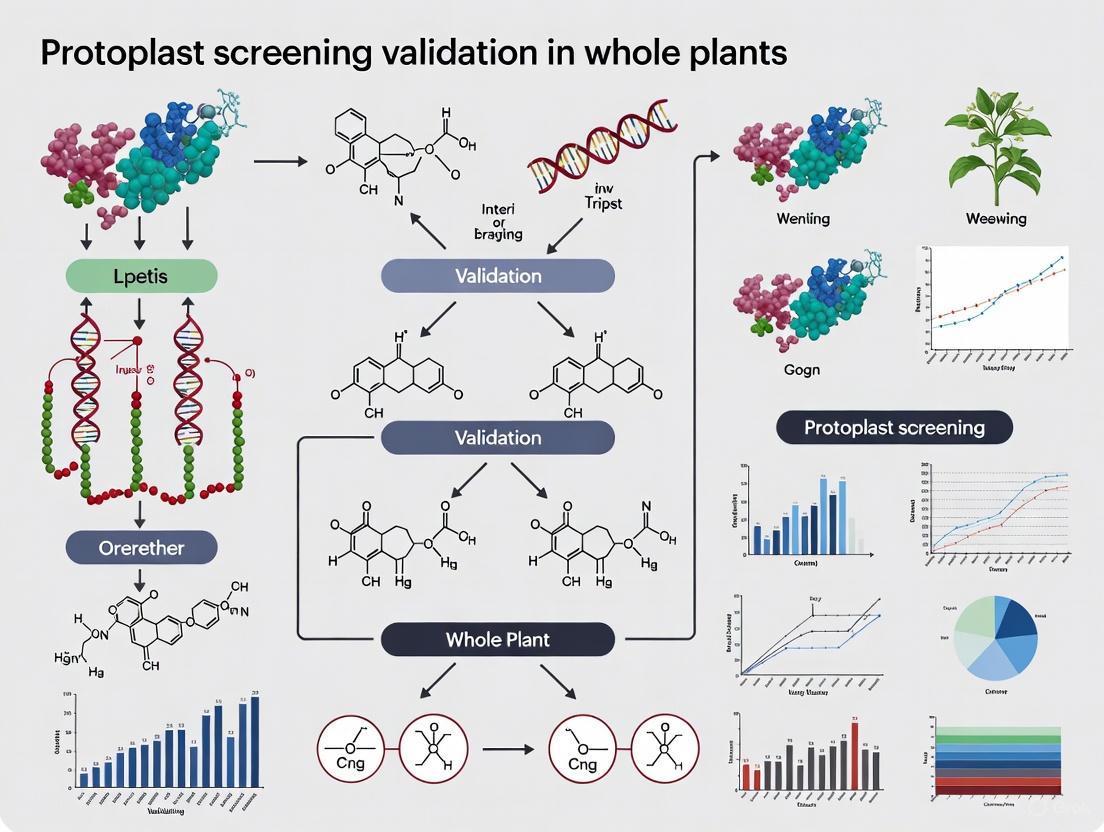
This article provides a systematic framework for researchers and scientists in plant biology and biotechnology to validate findings from high-throughput protoplast screens in whole plants.
Bridging the Gap: A Comprehensive Guide to Validating Protoplast Screening Predictions in Whole Plants
Abstract
This article provides a systematic framework for researchers and scientists in plant biology and biotechnology to validate findings from high-throughput protoplast screens in whole plants. It explores the foundational principles of protoplast systems as predictive models, details advanced methodological applications in CRISPR validation and effector screening, addresses key troubleshooting and optimization challenges in regeneration and genotyping, and establishes robust comparative analysis techniques. By synthesizing current protocols and validation studies, this guide aims to enhance the reliability and translational impact of protoplast-based research for accelerated crop improvement and functional genomics.
The Protoplast Model System: Principles, Potentials, and Predictive Power
In plant biology, the protoplast is defined as the living plant cell that has had its rigid cell wall removed, resulting in a spherical, "naked" cell surrounded only by the plasma membrane [1] [2]. This term, coined by Hanstein in 1880, refers to the entire functional unit of the cell, excluding the inert cell wall [1]. The removal of this barrier is what unlocks the protoplast's versatility, making it a fundamental tool for a vast array of biotechnological applications, from genetic engineering and somatic hybridization to the study of fundamental cellular processes [3] [4].
This guide focuses on the role of protoplasts as a screening platform within the broader context of whole-plant research. The central thesis is that transient assays using protoplasts provide an unparalleled, high-throughput system for the rapid pre-evaluation of genetic constructs and editing tools. However, the ultimate validation of any finding must occur at the whole-plant level. We will objectively compare the performance of protoplast systems against other transformation methodologies, providing the experimental data and protocols that underpin their value and define their limitations in the research workflow.
The Protoplast as a Comparative Screening Tool
Protoplasts occupy a unique niche in the plant researcher's toolkit. To appreciate their value, it is essential to compare their performance against other common genetic transformation and analysis platforms.
Table 1: Comparison of Plant Genetic Research Platforms
| Feature | Protoplast Transient System | Stable Plant Transformation | Callus/Cell Suspension Culture |
|---|---|---|---|
| Timeframe | Hours to days [5] [6] | Months to years [5] [6] | Weeks to months |
| Primary Use | Rapid screening, gene function analysis (e.g., localization, editing efficiency) [3] [5] | Generation of stably inherited traits for breeding | Study of undifferentiated cells; some screening |
| Key Advantage | High efficiency and throughput; applicable across species [3] [6] | Provides stable, whole-plant system | Relatively simpler culture than whole plants |
| Key Disadvantage | Transient expression; requires regeneration for whole plants [2] | Genotype-dependent, labor-intensive, and slow [6] | Does not represent differentiated tissue biology |
| Regeneration Requirement | Needed for whole-plant validation, can be difficult [2] | Integral to the process | Possible but can be genotype-dependent |
| Ideal Application | Pre-screening gRNAs for gene editing [6], promoter activity studies, protein localization | Development of genetically modified crops | Production of metabolites, study of cell physiology |
The data demonstrates that protoplasts are not a replacement for whole-plant studies but rather a powerful complementary tool. Their standout performance metric is speed. For instance, a protoplast-based assay can confirm the mutagenic efficiency of CRISPR/Cas9 guide RNAs (gRNAs) in a matter of days, as shown in a 2025 study on tea plants [6]. In contrast, establishing a stable, genetically transformed tea plant through traditional methods can take 8-12 months [6]. This dramatic reduction in initial validation time allows researchers to quickly iterate and optimize constructs before committing to lengthy and costly whole-plant transformation experiments.
Experimental Data: Quantitative Performance Across Species
The efficacy of protoplast systems is highly dependent on the isolation and transfection protocols, which are optimized for specific plant species and tissues. The following quantitative data, compiled from recent research, highlights both the potential and the variability of this platform.
Table 2: Protoplast Isolation and Transformation Efficiency Across Plant Species
| Plant Species | Tissue Source | Enzymes Used (Concentration) | Yield (per gram Fresh Weight) | Viability | Transformation Efficiency | Application Demonstrated |
|---|---|---|---|---|---|---|
| Toona ciliata [5] | Leaf (in vitro) | Cellulase R-10 + Macerozyme R-10 (1.5% each) | 89.17 × 10⁶ | 92.62% | 29.02% | Subcellular localization of DXS protein |
| Tea Plant cv. Kolkhida [6] | Young Leaf (in vivo) | Cellulase R-10 + Macerozyme R-10 (1.5% + 0.4%) | Not Specified | Not Specified | >28% (Transfection) | CRISPR/Cas9 genome editing validation |
| Brassica oleracea [3] | Leaf | Cellulase + Pectinase (2% + 0.1%) | 60.00 × 10⁶ | 95.0% | Not Specified | Protoplast isolation protocol |
| Camellia oleifera [3] | Flower Petal | Cellulase + Macerozyme (3% + 1%) | 14.20 × 10⁶ | 88.69% | Not Specified | Comparative isolation efficiency |
| Ginkgo biloba [3] | Leaf | Cellulase + Pectinase + Macerozyme (2% + 0.25% + 1.5%) | 5.39 × 10⁶ | 80.23% | Not Specified | Protoplast isolation from gymnosperm |
The data in Table 2 reveals key performance differentiators. Isolation yield and viability are paramount for successful downstream experiments. For example, Brassica oleracea protocols achieve exceptionally high yield and viability [3], making it a robust system. In contrast, woody plants like Ginkgo biloba present more challenge, showing lower yields and viability [3]. A critical performance metric for screening is transformation efficiency. The 29.02% efficiency achieved in Toona ciliata [5] and the >28% transfection rate sufficient for multi-gRNA editing in tea [6] demonstrate that protoplast systems can provide the throughput needed for statistically significant results in pre-screening assays.
Core Methodologies: Isolation and Transient Transformation
A standardized, yet adaptable, protocol is the backbone of any reliable protoplast system. The following workflow, corroborated by multiple recent studies, outlines the key stages from tissue to analysis.
Diagram 1: Generalized workflow for protoplast isolation and transient transformation.
Detailed Experimental Protocol
The following steps provide a generalized protocol based on methodologies from [5] and [6], which can be adapted for specific plant species.
Step 1: Preparation of Plant Material
- Source: Select young, healthy tissues such as leaves from in vitro seedlings, callus, or petals. Younger tissues generally yield protoplasts with higher viability and yield [3] [5].
- Pre-treatment: Sterilize the tissue and cut it into thin strips (0.5-1.0 mm) to maximize surface area for enzyme action [5] [6]. A pre-plasmolysis step in an osmoticum (e.g., mannitol solution) for about 1 hour is often beneficial to shrink the protoplast away from the cell wall [7].
Step 2: Enzymatic Digestion of Cell Walls
- Enzyme Solution: The solution is a critical component. A typical combination includes:
- Cellulase R-10 (1.5-2.0%): Degrades cellulose microfibrils [5] [6].
- Macerozyme R-10 (0.4-1.5%): Degrades pectins in the middle lamella [5] [6].
- Osmoticum (0.5-0.6 M Mannitol/Sorbitol): Prevents protoplast rupture by maintaining osmotic balance [5].
- Buffer (10-20 mM MES, pH 5.7): Maintains optimal enzyme activity [5].
- Salts (e.g., CaCl₂): Helps maintain membrane integrity [5].
- Incubation: Digestion occurs in the dark at 20-27°C for 4-16 hours with gentle shaking [5] [6] [7].
- Enzyme Solution: The solution is a critical component. A typical combination includes:
Step 3: Purification and Viability Assessment
- Filtration & Centrifugation: The digestate is filtered through a 40-100 μm mesh to remove undigested debris [6]. Protoplasts are pelleted by gentle centrifugation (100-700 g for 5-10 min) and often purified by flotation on a sucrose or sucrose/mannitol density gradient [6] [7].
- Viability Check: Viability is commonly assessed using Fluorescein Diacetate (FDA) staining, where viable protoplasts metabolize FDA to produce green fluorescence [4]. A count with a hemocytometer is used to determine yield [6].
Step 4: Transient Transformation (PEG-Mediated Transfection)
- Process: Purified protoplasts are resuspended in a transformation buffer. Plasmid DNA is added, followed by a carefully optimized Polyethylene Glycol (PEG) solution (e.g., 40% PEG 4000) [5]. PEG facilitates DNA uptake by the protoplasts.
- Incubation: The mixture is incubated in the dark for 15-30 minutes, after which the reaction is stopped by diluting with a washing solution [5] [6]. The transformed protoplasts are then cultured in an appropriate osmoticum-containing medium for 16-48 hours before analysis [5].
Essential Research Reagents and Solutions
The consistency of protoplast experiments relies heavily on the quality and appropriateness of the research reagents. The following table details key solutions and their functions.
Table 3: The Scientist's Toolkit: Key Reagents for Protoplast Work
| Research Reagent | Function & Role in Experimentation | Example Composition / Notes |
|---|---|---|
| Enzyme Mixture | Digests the cell wall to release protoplasts. The core of the isolation. | Cellulase R-10 (1.5%) + Macerozyme R-10 (0.4-1.5%) in osmoticum [5] [6]. |
| Osmoticum | Prevents osmotic shock and lysis of the fragile, wall-less protoplasts. | 0.5-0.6 M Mannitol or Sorbitol; metabolically inert [5] [4]. |
| PEG Solution | Induces membrane fusion and permeabilization for DNA uptake during transfection. | 40% PEG 4000/6000 in mannitol and MgCl₂ solution [5] [6]. |
| W5 or WS Solution | Used for washing, purifying, and resuspending protoplasts; provides ionic balance. | Contains salts like NaCl, KCl, CaCl₂ in MES buffer [6]. |
| Culture Medium | Supports protoplast viability, cell wall regeneration, and initial cell divisions. | Often a diluted MS or B5 medium with osmoticum and growth regulators [2] [7]. |
Applications in Functional Gene Validation
Validating protoplast-based predictions in whole plants is a critical step. The following case studies illustrate this pipeline, from initial screening in protoplasts to functional confirmation.
Case Study 1: Pre-evaluation of CRISPR/Cas9 Constructs in Tea [6]
- Protoplast Screening: Researchers designed gRNAs targeting three candidate genes in tea. These constructs were transfected into protoplasts in a transient Cas9/gRNA system.
- Performance Data: High mutagenic efficiency was observed for two of the three target genes within the protoplasts. The system successfully induced precise deletions between target motifs, especially when transfection efficiency exceeded 28%.
- Validation Path: This protoplast platform serves as a critical screening step. The efficient gRNAs identified here are now candidates for more laborious stable transformation experiments to generate edited whole tea plants, thereby validating the pest-resistant phenotype.
Case Study 2: Subcellular Localization in Toona ciliata [5]
- Protoplast Screening: To determine the function of the TcDXS enzyme, a key enzyme in terpenoid biosynthesis, its gene was fused to a fluorescent reporter and expressed in T. ciliata protoplasts.
- Performance Data: The established protoplast system achieved a transformation efficiency of 29.02%, allowing for clear microscopic visualization. This confirmed the subcellular localization of the TcDXS protein.
- Validation Path: This localization information, rapidly acquired in a near-native cellular environment, provides a foundational hypothesis for the enzyme's function and its role in attracting insect pests, guiding subsequent whole-plant metabolic engineering strategies.
Protoplasts have firmly established their role as a versatile and powerful tool in modern plant biology. As the comparative data shows, their primary strength lies in providing a rapid, high-throughput, and accessible system for the initial phases of research—be it gene editing, protein localization, or promoter analysis. The quantitative data from recent studies on species ranging from tea to Toona ciliata confirms that robust protocols can yield viable protoplasts suitable for demanding screening applications.
However, the final arbiter of biological relevance remains the whole plant. The true power of the protoplast system is realized only when it is integrated into a larger research workflow, where its predictions are rigorously tested and validated in the complex context of a whole organism. Emerging technologies, such as droplet-based microfluidics for single-protoplast analysis [7], promise to further enhance the resolution and throughput of this already indispensable platform. By continuing to refine protoplast regeneration and integrating these advanced analytical tools, researchers can bridge the gap between single-cell predictions and whole-plant reality more effectively than ever before.
In the pursuit of efficient and predictive drug discovery and plant biotechnology, high-throughput screening (HTS) platforms are indispensable. This guide objectively compares the performance of a cutting-edge tool: the droplet-based microfluidic protoplast screening platform. We pit this emerging technology against traditional bulk protoplast culture and conventional HTS workcells, evaluating them on the core metrics of speed, scalability, and single-cell resolution. The analysis is framed within the critical context of validating protoplast-based predictions in whole-plant systems, a key challenge in translational plant biology. Data synthesized from recent studies demonstrates that the microfluidic platform offers transformative advantages in miniaturization and analytical resolution, while also acknowledging the current maturity and throughput of established HTS systems.
Performance Comparison: Protoplast Screening Platforms vs. Alternatives
The following tables provide a quantitative and qualitative comparison of the droplet-based microfluidic protoplast platform against two common alternatives.
Table 1: Quantitative Performance Metrics
| Metric | Droplet-Based Microfluidic Platform [7] | Traditional Bulk Protoplast Culture [8] [9] | Conventional HTS Workcell (for context) [10] |
|---|---|---|---|
| Assay Volume | Nanoliter-scale (120-300 nL) droplets | Milliliter-scale culture wells | Microliter-scale (1,536-well plates) |
| Viability & Yield | High viability maintained (Species-dependent, e.g., tobacco showed highest viability) | Viable, but sensitive to culture density; yields of 10⁵ - 10⁷ cells/g FW reported [8] [9] | N/A (Not a direct cell viability measure) |
| Analytical Resolution | Near single-cell, longitudinal tracking | Population-average data | Population-average data, high-content imaging available |
| Temporal Resolution | Dynamic tracking over extended culture | Typically endpoint or limited time-point measurements | High temporal resolution possible |
| Cost & Scalability | Low reagent consumption, high parallelization | Moderate reagent use, limited by flask/plate number | High initial capital expenditure (up to ~$5M [10]) |
| Reported Transfection Efficiency | Data not available in search results for this platform | 23% - 75.4% (PEG-mediated) [8] | N/A |
Table 2: Qualitative Advantages and Limitations
| Aspect | Droplet-Based Microfluidic Platform | Traditional Bulk Protoplast Culture | Conventional HTS Workcell |
|---|---|---|---|
| Key Advantage | Unparalleled single-cell resolution and controlled microenvironments | Protocol simplicity and established methodology | Extreme throughput and high-level automation |
| Primary Limitation | Emerging technology, requires specialized equipment and expertise | Susceptible to paracrine signaling and population averaging | High capital cost, significant infrastructure and skilled staff needed [10] |
| Best Suited For | Dose-response screening, fundamental cell biology, rare event analysis | Large-scale transfections, functional genomics, routine culture | Industrial-scale drug discovery, primary screening of massive compound libraries |
Experimental Protocols for Protoplast Screening
To ensure reproducibility and provide a clear view of the methodologies behind the data, here are detailed protocols for key experiments.
This protocol is used for long-term observation and chemical stimulation of protoplasts at a near single-cell level.
- Protoplast Isolation: Isolate protoplasts from leaves (e.g., Nicotiana tabacum, Brassica juncea) via enzymatic digestion using a solution containing 1.6% cellulase and 0.8% macerozyme. Incubate for 15-17 hours at 27°C in darkness.
- Droplet Generation:
- Setup: Use a 6-port manifold microfluidic system with flow rates controlled by a multi-syringe pump.
- Process: Introduce the protoplast suspension and cell culture medium into the droplet generator. Encapsulate protoplasts within aqueous droplets (120-300 nL) dispersed in a PP9 carrier oil phase.
- Flow Rates: Typically ~20 µL/min for the aqueous phase and ~30 µL/min for the oil phase.
- Droplet Incubation and Imaging: Transfer the generated droplets into thin-walled PTFE incubation tubing. Incubate the sealed tubes in darkness at 24°C for the duration of the experiment. The system allows for dynamic tracking of individual droplets over time.
- Dose-Response Investigation: Introduce chemical effectors (e.g., growth regulators like BAP and NAA at concentrations of 20–80 µg·L⁻¹) directly into the aqueous stream during droplet generation to create a gradient of conditions across the droplet population.
This standard PEG-mediated transfection protocol is used to validate genome editing constructs, a critical step before stable plant transformation.
- Protoplast Transfection:
- Materials: Mix 50,000 protoplasts in 200 µL with plasmid DNA (5 µg of each plasmid in 20 µL water).
- PEG Addition: Add 220 µL of PEG solution (40% PEG 6000, 0.5 M mannitol, 15 mM MgCl₂).
- Incubation: Incubate the mixture in the dark for 30 minutes.
- Reaction Stop: Stop the transfection by adding 1 mL of WS solution, then centrifuge at 50 g for 5 minutes.
- Culture and Analysis: Resuspend the transfected protoplasts in an appropriate culture medium and incubate. Analyze transfection efficiency or genome editing outcomes after 48-96 hours using microscopy, fluorescence measurement, or DNA sequencing.
Visualizing the Screening Workflow
The following diagram illustrates the streamlined workflow of the droplet-based microfluidic platform, from protoplast isolation to data analysis.
The Scientist's Toolkit: Essential Research Reagents
Successful protoplast screening relies on a suite of specialized reagents and materials. The following table details key components and their functions.
Table 3: Key Reagents for Protoplast Isolation and Screening
| Reagent / Material | Function | Application Example |
|---|---|---|
| Cellulase R-10 | Enzyme that hydrolyzes cellulose in the plant cell wall. | Core component of enzymatic digestion mix for protoplast isolation [5] [7] [9]. |
| Macerozyme R-10 | Enzyme that degrades pectins in the plant cell wall middle lamella. | Used in combination with cellulase for efficient tissue digestion [5] [7]. |
| Pectolyase Y-23 | A potent pectinase, often used for more recalcitrant tissues. | Included in some protocols to enhance digestion efficiency [5] [9]. |
| Mannitol | An osmoticum. Maintains osmotic pressure in the solution to prevent isolated protoplasts from bursting. | Standard component of enzyme solutions, washing buffers, and culture media [6] [5] [7]. |
| MES Buffer | A pH buffering agent. Maintains a stable acidic pH optimal for enzyme activity during digestion. | Added to enzyme solutions and washing buffers [5] [9]. |
| Polyethylene Glycol (PEG) | A polymer that induces membrane crowding and fusion, facilitating the uptake of DNA into protoplasts. | The most common agent for transient transfection (transformation) of protoplasts [6] [8]. |
| Murashige and Skoog (MS) Medium | A nutrient-rich plant growth medium. Provides essential vitamins and minerals for protoplast survival and division. | Used as a base for enzyme solutions or, with modifications, as a culture medium [6] [7] [9]. |
The journey from a protoplast-based prediction to a validated phenotype in a whole plant remains the critical benchmark for this technology. The droplet-based microfluidic platform accelerates this path by providing higher-quality, single-cell data early in the screening process, de-risking the selection of leads for costly whole-plant studies. For instance, a CRISPR/gRNA construct validated for high mutagenic efficiency in a protoplast system [6] is a much stronger candidate for stable plant transformation.
While traditional HTS workcells currently outperform in raw throughput for industrial applications, the comparative data shows that microfluidic protoplast screening is unrivaled for experiments demanding physiological relevance at single-cell resolution. The ongoing integration of AI and machine learning into HTS data analysis [11] [10] promises to further enhance the extraction of meaningful patterns from the rich datasets generated by these advanced platforms, solidifying their role in the future of predictive biology and drug discovery.
Protoplasts, plant cells devoid of cell walls, have emerged as a versatile and high-throughput screening platform in biotechnology. Their unique properties enable everything from rapid testing of CRISPR genome-editing reagents to the discovery of novel pathogen effector-immune receptor pairs. This guide objectively compares the performance of protoplast-based screening against alternative methods, providing supporting experimental data. The content is framed within the critical context of validating protoplast screening predictions in whole plants, a necessary step for translating cellular findings into biologically meaningful outcomes.
Performance Comparison: Protoplast Screening vs. Alternative Methods
The tables below present quantitative performance data comparing protoplast systems to other common research platforms.
Table 1: Performance Comparison for CRISPR Reagent Testing
| Performance Metric | Protoplast System | Stable Plant Transformation | In Vitro Cleavage Assay |
|---|---|---|---|
| Experimental Timeline | 2-7 days [12] | 3-6 months [12] | 1-2 days |
| Mutagenesis Efficiency | Up to 50% in tobacco NtPDS [12] | Variable, dependent on transformation | Not applicable (does not measure cellular mutation) |
| Suitability for High-Throughput Screening | High [13] [12] | Very Low | High |
| Cost per Test | Low | High | Low |
| Key Advantage | Rapid functional data in a cellular context | Provides whole-organism data | Rapid biochemical confirmation |
Table 2: Performance in Effector-Immune Receptor Discovery
| Performance Metric | Pooled Protoplast Screening [14] | Agroinfiltration (in planta) | Pairwise Protoplast Assay |
|---|---|---|---|
| Screening Throughput | ~700 effectors per experiment [14] | Low (one-by-one) | Low (one-by-one) |
| Time to Identify Avr Gene | Rapid (outlined in 24h RNA-seq) [14] | Labor-intensive and slow | Labor-intensive and slow |
| Multiplicity of Transfection (MOT) | 0.14 million molecules/cell (optimized) [14] | Not Applicable | Typically high |
| Identification Accuracy | Correctly identified AvrSr50 and AvrSr27-2 [14] | High | High |
Detailed Experimental Protocols
Protocol 1: Testing CRISPR/Cas9 Reagent Efficiency in Protoplasts
This protocol is adapted from methods used to mutagenize the NtPDS gene in tobacco [12].
- Protoplast Isolation: Isolate protoplasts from plant tissues. For monocots like rice and wheat, a longitudinal cutting method increases yield (e.g., 4.8 × 10^6 protoplasts/g FW in rice) [12]. For dicots like Arabidopsis, the "Tape-Arabidopsis Sandwich" method is effective, achieving transfection efficiencies over 67% [12] [15].
- Protoplast Transfection: Transfect protoplasts with CRISPR/Cas9 constructs (as DNA, mRNA, or preassembled Ribonucleoprotein complexes) using a polyethylene glycol (PEG)-mediated method.
- Culture and Analysis: Culture transfected protoplasts for 2-24 hours. To assess mutagenesis efficiency:
- Bulk Analysis: Extract genomic DNA from the entire protoplast pool. Amplify the target region by PCR and analyze using next-generation sequencing (NGS) or T7 endonuclease I (T7E1) assay [12].
- Single-Cell Analysis (for regeneration-competent species): Culture protoplasts in a thin alginate layer to immobilize them and allow for cell division and callus formation. Regenerate individual plants from single protoplasts and genotype them to determine the exact mutations in each regenerant [12].
Protocol 2: Pooled Effector Library Screening in Protoplasts
This protocol is used for discovering novel Avr genes and is based on the platform validated for wheat stem rust [14].
- Library and Receptor Delivery: Co-transform plant protoplasts with two components:
- An expression construct for the plant immune receptor (R gene) of interest.
- A pooled library of pathogen effector gene constructs. Each effector is delivered at a low Multiplicity of Transfection (MOT of 0.14 million molecules/cell) to ensure most transformed cells express only one effector [14].
- Incubation and Selection: Incubate the protoplasts for approximately 24 hours. During this time, protoplasts that express an effector (Avr gene) recognized by the co-expressed immune receptor will undergo cell death.
- RNA-seq and Analysis: Extract total RNA from the surviving living protoplasts and perform RNA-seq. Effectors that are recognized by the immune receptor will be depleted in the living cell population. Identify candidate Avr genes by conducting differential gene expression analysis, comparing their abundance to a control transformation with an empty vector [14].
Signaling Pathways and Experimental Workflows
Protoplast Signaling Pathway in Defense
Diagram 1: Defense signaling cascade in protoplasts. Upon recognition of a pathogen effector (Avr) by a specific immune receptor (R), early signaling events including ion fluxes, ROS production, and MAPK activation occur within the protoplast [13]. These signals converge to activate transcription factors, leading to defense gene expression and culminating in a hypersensitive response (HR) cell death, which is the measurable output in screening assays [14].
Pooled Effector Screening Workflow
Diagram 2: Workflow for pooled effector screening. A library of effector genes and a single immune receptor (R) gene are co-delivered to a population of protoplasts [14]. Recognition events cause death in specific subpopulations. RNA-seq of surviving cells reveals depleted effectors (potential Avr genes) as candidates for validation [14].
The Scientist's Toolkit: Key Research Reagent Solutions
This table details essential materials and their functions for the experiments discussed.
Table 3: Essential Reagents for Protoplast Applications
| Research Reagent | Function / Rationale | Example Application |
|---|---|---|
| Cellulase R10 & Macerozyme R10 | Enzyme mixture for digesting plant cell walls to release protoplasts. | Standard protoplast isolation from various plant species [12]. |
| Polyethylene Glycol (PEG) | Agent that mediates the uptake of DNA and other macromolecules into protoplasts. | Transfection of CRISPR/Cas9 constructs or effector/R gene libraries [12]. |
| Alginate Hydrogel | Polymer for immobilizing protoplasts; supports cell division and reduces aggregation-induced death. | Culture for regeneration of whole plants from single, genome-edited protoplasts [15]. |
| CROP-seq-CAR Vector | Lentiviral vector to co-deliver a CAR and a guide RNA (gRNA) for pooled CRISPR screens. | Genome-wide screens for gene knockouts that enhance CAR T cell efficacy in primary human T cells [16]. |
| MMC Solution (MES, Mannitol, Calcium) | Protoplast washing and resuspension solution; maintains osmotic stability. | Washing and purification of isolated protoplasts before transfection [15]. |
Validation in Whole Plants: Bridging the Cellular-Organismal Gap
The ultimate test for any discovery made in protoplasts is its validation in whole plants, a core thesis of this guide.
- CRISPR Reagent Validation: Mutagenesis efficiency measured in protoplasts must be confirmed in regenerated plants. For example, in tobacco, protoplasts transfected with NtPDS targeting reagents were regenerated into whole plants. Genotyping confirmed that all four alleles of NtPDS were mutated in the amphidiploid plant, proving the effectiveness of the reagents in a whole-organism context [12].
- Effector-Receptor Pair Validation: Avr candidates identified via pooled protoplast screening require confirmation in whole plants. The recognized standard is transient co-expression in plant leaves via agroinfiltration or stable transformation of the Avr gene into a plant genotype with the corresponding R gene to observe the expected hypersensitive response and resistance phenotype [14].
Protoplasts offer an unparalleled platform for high-throughput screening, significantly accelerating the initial phases of discovery in genome engineering and plant-pathogen interactions. The quantitative data clearly shows their advantages in speed, scalability, and cost-effectiveness over whole-plant methods. However, protoplasts are a starting point, not an endpoint. A robust research pipeline requires validating protoplast-based predictions through whole-plant studies, ensuring that cellular discoveries translate into genuine biological function and therapeutic or agricultural application.
Protoplasts, defined as plant cells that have been artificially removed of their cell walls, represent a unique and powerful experimental system in plant biotechnology and molecular biology [13]. The development of enzymatic isolation methods, pioneered by Cocking in 1960, revolutionized the field by enabling researchers to obtain large quantities of uniform single cells from various plant tissues and species [17]. These wall-less cells provide a prime access point to the plasma membrane and an unobstructed view into intracellular processes, making them particularly valuable for studying early stress signaling events, protein interactions, and genetic transformations [13]. The most significant advantage of protoplasts lies in their experimental tractability—they can be synchronously treated, efficiently transformed, and monitored at the individual cell level, overcoming many challenges associated with whole-plant studies [13].
However, as with any isolated system, protoplasts exist in an artificially simplified environment that lacks the complex tissue-level organization and cell-to-cell communication networks of intact organisms. This article critically examines the inherent limitations of protoplast-based systems by comparing their physiological responses to those observed in whole plants, with the goal of establishing best practices for validating protoplast screening predictions in complex organisms. We will analyze experimental data highlighting the physiological gaps between isolated cells and intact systems, provide detailed methodologies for key comparison experiments, and offer a framework for researchers to contextualize protoplast-derived findings within whole-organism physiology.
Physiological and Functional Comparisons: Protoplasts vs. Whole Plants
Cell Wall Regeneration and Developmental Trajectory
The very process of protoplast isolation creates an immediate physiological gap through the removal of the cell wall, a defining structure of plant cells that influences development, signaling, and environmental response. Isolated protoplasts must initiate cell wall regeneration to survive and divide, a process that varies significantly across species and experimental conditions.
Table 1: Comparative Analysis of Protoplast Regeneration Capacity Across Species
| Plant Species | Regeneration Outcome | Time to First Division | Microcallus Formation | Whole Plant Regeneration | Key Limiting Factors |
|---|---|---|---|---|---|
| Cabbage (Brassica oleracea) | Partial to full regeneration | 3-7 days | 3 weeks | Achieved in some cultivars [18] | Genotype, culture medium, growth regulators [18] |
| Cannabis (Cannabis sativa) | Partial regeneration only | ~6 days | 3 weeks | Not achieved [8] | Culture density, oxidative stress, signaling pathways [8] |
| Tobacco (Nicotiana tabacum) | Successful regeneration | 2-3 days | 2-3 weeks | Routinely achieved [19] | Cell density, immobilization method, medium composition [19] |
| Toona ciliata | Not attempted/assessed | N/R | N/R | N/R | Focus on transient transformation only [5] |
The data in Table 1 reveals significant species-specific variation in regenerative capacity. While tobacco protoplasts reliably progress through division and regeneration, cannabis protoplasts exhibit only partial regeneration despite showing initial division markers such as proliferating cell nuclear antigen (PCNA) gene expression [8]. This limitation fundamentally constrains the application of protoplast technologies in species with poor regenerative capacity, as findings from transient assays cannot be advanced to stable lines or whole plants.
Stress Response Signaling Pathways
Protoplasts are extensively used to study early stress signaling events, but their responses often differ quantitatively and qualitatively from those in intact tissues due to the absence of tissue-level coordination and the trauma of isolation.
Table 2: Stress Response Comparisons Between Protoplasts and Whole Plants
| Stress Type | Parameter Measured | Protoplast Response | Whole Plant Response | Physiological Gap |
|---|---|---|---|---|
| Isolation Stress | Oxidative Stress Markers | Significant ROS accumulation, stress marker expression [8] | Not applicable | Baseline stress affects all subsequent experiments |
| Abiotic Stress | Ion Fluxes | Direct access to plasma membrane, rapid measurements possible [13] | Compartmentalized at tissue and organ levels | Lacks tissue-level buffering capacity |
| Biotic Stress | Immune Recognition | Preserved R-Avr recognition (e.g., Sr50-AvrSr50) [14] | Integrated systemic signaling | Absence of distal signaling and intercellular communication |
| * Hormonal Signaling* | Marker Gene Expression | Altered ABA, auxin pathway gene expression [8] | Complex gradient-dependent responses | Disrupted spatial hormone distribution |
The isolation process itself induces significant stress, as evidenced by transcriptomic analyses of cannabis protoplasts showing elevated expression of abscisic acid (ABA) signaling components and late embryogenesis abundant (LEA) genes [8]. While protoplasts retain fundamental recognition capabilities, such as the specific cell death response when the wheat Sr50 resistance protein recognizes the corresponding AvrSr50 effector from stem rust [14], they lack the tissue-level integration that characterizes whole-plant immunity.
Diagram 1: Comparative stress response pathways in whole plants versus protoplasts. While both systems share early signaling components, protoplasts lack the tissue context and systemic coordination of intact plants.
Experimental Approaches for Bridging the Physiological Gap
Protocol Standardization and Viability Assessment
The reliability of protoplast-based data hinges on isolation methods that maximize yield and viability while minimizing experimental artifacts. The following protocol provides a framework for consistent protoplast preparation:
Detailed Protocol: Protoplast Isolation and Viability Assessment
Plant Material Preparation: Use 1-2-week-old leaves from in vitro-grown seedlings for optimal results [8]. For cabbage, leaves from 4-week-old in vitro plants yield the highest protoplast viability (≥93%) [18].
Enzyme Solution Optimization: The enzyme composition must be tailored to each species. For Toona ciliata, the optimal combination is 1.5% Cellulase R-10 + 1.5% Macerozyme R-10 in 0.6 M mannitol [5]. For cabbage, 0.5% Cellulase Onozuka RS with 0.1% Macerozyme R-10 proved superior to combinations with Pectolyase Y-23 [18].
Digestion Conditions: Incubate tissue in enzyme solution in the dark at room temperature with gentle shaking (50 rpm) for 10-16 hours [5]. Digestion time requires optimization as excessive duration reduces viability.
Purification and Viability Assessment: Purify protoplasts by centrifugation through a sucrose gradient [18]. Assess viability using fluorescein diacetate (FDA) staining, where viable cells with intact membranes will show fluorescence [18].
Culture Conditions: Culture protoplasts at optimal density (2×10^5 cells/mL for cannabis [8]) in appropriate medium supplemented with plant growth regulators, typically auxins and cytokinins [19].
Quantitative Single-Cell Tracking
Advanced microscopy approaches enable quantitative assessment of protoplast growth and development, providing direct comparisons between isolated cells and their in planta counterparts:
Detailed Protocol: Single-Cell Tracking Analysis [19]
Protoplast Immobilization: Embed freshly isolated protoplasts in low-melting-point agarose in multi-well plates, creating a monolayer for individual cell tracking.
Automated Microscopy: Use high-throughput automated microscopy to capture bright-field and fluorescence images at regular intervals over several days.
Image Processing Pipeline: Develop computational tools to convert time-lapse images into quantitative data on cell area changes, division events, and viability.
Comparative Analysis: Compare growth parameters (expansion rates, division timing) between protoplasts and cells in intact tissues when possible.
This approach revealed that tobacco protoplasts expressing Arabidopsis BAG4 showed increased growth rates and proliferation compared to wild-type, demonstrating the method's sensitivity to detect phenotypic differences [19].
Validation Workflow for Protoplast-Based Predictions
To ensure protoplast-derived findings have relevance to whole-plant physiology, implement a multi-tier validation strategy:
Table 3: Validation Framework for Protoplast Studies
| Validation Tier | Experimental Approach | Key Readouts | Interpretation Guidelines |
|---|---|---|---|
| In-Plate Controls | Include known R-Avr pairs as positive controls [14] | Cell death percentage, reporter expression | System functionality verification |
| Multi-System Cross-Check | Compare protoplast data with agroinfiltration or stable transformation | Response magnitude, timing, specificity | Conservation of response across systems |
| Whole-Plant Phenotyping | Regenerate plants when possible; use transient assays otherwise | Growth phenotype, stress tolerance, marker expression | Functional significance in context |
| Molecular Deep Dive | Transcriptomics, proteomics comparing systems | Pathway activation, stress marker expression | Identification of system-specific artifacts |
The Scientist's Toolkit: Essential Research Reagents
Table 4: Key Research Reagents for Protoplast Studies
| Reagent Category | Specific Examples | Function | Considerations |
|---|---|---|---|
| Cell Wall-Digesting Enzymes | Cellulase Onozuka RS, Macerozyme R-10, Pectolyase Y-23 [18] [5] | Digest cellulose, pectins, and hemicellulose in plant cell walls | Concentration and combination require species-specific optimization |
| Osmotic Stabilizers | Mannitol (0.6 M), sorbitol [5] | Maintain osmotic balance in wall-less cells | Critical for protoplast integrity and viability |
| Viability Stains | Fluorescein diacetate (FDA), propidium iodide [18] | Distinguish live vs. dead cells | FDA stains live cells; PI stains dead cells |
| Transformation Reagents | Polyethylene glycol (PEG), purified plasmid DNA [14] | Facilitate DNA uptake into protoplasts | PEG concentration affects transformation efficiency |
| Reporter Systems | Firefly luciferase, GFP, YFP, RFP [14] [19] | Visualize and quantify gene expression | Enable high-throughput screening |
| Culture Medium Supplements | Auxins (NAA), cytokinins (BAP), phytosulfokines [18] | Support protoplast division and regeneration | Balance and concentration critical for success |
Diagram 2: Recommended workflow for protoplast screening with integrated validation steps to address physiological gaps. This iterative approach ensures findings from isolated cells are confirmed in increasingly complex systems.
Protoplasts remain an invaluable tool for plant biotechnology, particularly for high-throughput screening applications such as testing CRISPR components, identifying novel R-Avr pairs, and studying early signaling events [17] [14]. Their experimental tractability and synchronization capabilities provide unique advantages over whole-plant systems for specific applications. However, the physiological gap between isolated protoplasts and intact organisms necessitates careful interpretation of protoplast-derived data and systematic validation in whole plants.
The key to successful application of protoplast technology lies in recognizing both its power and its limitations. Species-specific regeneration constraints, isolation-induced stress, and the absence of tissue-level context fundamentally influence protoplast physiology and responses. By implementing the standardized protocols, quantitative tracking methods, and multi-tier validation framework outlined here, researchers can more effectively bridge the gap between isolated cells and complex organisms, ensuring that predictions from protoplast screens yield meaningful insights into whole-plant biology.
Protoplasts, plant cells devoid of cell walls, have emerged as a versatile and efficient platform for rapid gene functional analysis, particularly in species where stable transformation remains challenging. These isolated cells serve as a critical bridge between in vitro assays and whole-plant systems, enabling researchers to validate genome editing reagents, study protein localization, and analyze regulatory networks within a cellular context. For plant species with long life cycles, complex genetics, or recalcitrant regeneration systems—including many economically important woody and medicinal crops—protoplast-based transient assays provide an invaluable tool for accelerating functional genomics research. The foundational workflow from protoplast isolation to transient assay represents a standardized approach to generate reproducible, high-quality data that can effectively predict how genetic constructs will perform in whole plants. This guide objectively compares the performance of protoplast systems across diverse plant species, providing researchers with experimental data and methodologies to establish robust protocols for their specific applications, thereby advancing the validation of screening predictions in whole plant research.
Comparative Performance of Protoplast Systems Across Species
Table 1: Protoplast Isolation Efficiency Across Plant Species
| Plant Species | Tissue Source | Yield (protoplasts/g FW) | Viability (%) | Key Enzymes Used | Reference |
|---|---|---|---|---|---|
| Cannabis sativa ('Finola') | Leaf | 2.2 × 10⁶ | 78.8% | 0.5% Cellulase R-10, 0.1% Pectolyase Y-23 | [20] |
| Toona ciliata | Leaf (2-month seedlings) | 89.17 × 10⁶ | 92.6% | 1.5% Cellulase R-10, 1.5% Macerozyme R-10 | [5] |
| Populus spp. ('741') | Leaf (3-4 week in vitro) | 11.7-25.6 × 10⁶ | 93.9% | 1.5% Cellulase R-10, 0.5% Macerozyme R-10 | [21] |
| Vitis vinifera ('Chardonnay') | Young leaf | ~75 × 10⁶ | 91% | Not specified | [22] |
| Camellia sinensis ('Kolkhida') | Young leaf | Not specified | Not specified | 1.5% Cellulase R10, 0.4% Macerozyme R10 | [6] |
Table 2: Transient Transformation Efficiency and Applications
| Plant Species | Transformation Method | Efficiency | Primary Applications Demonstrated | Reference |
|---|---|---|---|---|
| Cannabis sativa | PEG-mediated | 28% | Transient expression, cell wall resynthesis (56.1%), cell division (15.8% plating) | [20] |
| Toona ciliata | PEG-mediated (40% PEG) | 29.0% | Subcellular localization of DXS enzyme in terpenoid pathway | [5] |
| Populus spp. ('741') | PEG-mediated | 49.6% | High-throughput screening, protein-protein interaction studies | [21] |
| Vitis vinifera | PEG-mediated | 87% | Genome editing reagent validation, callus formation | [22] |
| Camellia sinensis | PEG-mediated | >28% (co-transfection) | CRISPR/Cas9 genome editing with multiple gRNAs | [6] |
Detailed Experimental Protocols for Protoplast Workflows
Protoplast Isolation from Leaf Tissue
The following protocol synthesizes the most effective methods from multiple plant systems, with particular emphasis on cannabis, Toona ciliata, and poplar [20] [5] [21]:
Plant Material Preparation: Use young, expanding leaves from 3-4 week old in vitro plants (poplar, cannabis) or 2-month-old seedlings (Toona ciliata). For cannabis, 'Finola' and 'Futura 75' cultivars yielded optimal results when donor plants were grown at 24±2°C with an 18/6h photoperiod [20].
Plasmolysis Pre-treatment: Cut leaves into 0.5-1.0mm thin strips using a sharp razor blade. Incubate tissue in CPW salt solution containing 0.5-0.6M mannitol for 1 hour to induce plasmolysis [20] [22].
Enzymatic Digestion: Use an enzyme solution containing:
- 1.0-1.5% Cellulase R-10
- 0.4-0.5% Macerozyme R-10 (or 0.1% Pectolyase Y-23 for cannabis)
- 0.6M mannitol
- 10-20mM MES buffer (pH 5.6-5.8)
- 5-20mM CaCl₂
- 0.1% BSA (optional)
Incubate with gentle shaking (40-50rpm) in darkness for 10-16 hours at 20-27°C [20] [5] [6].
Protoplast Purification: Filter the digested mixture through 40-100μm mesh to remove debris. Centrifuge filtrate at 100×g for 10 minutes. Purify protoplasts using a sucrose gradient (20% sucrose overlay) or directly wash with W5 solution (154mM NaCl, 125mM CaCl₂, 5mM KCl, 2mM MES, pH 5.7) [21] [6].
PEG-Mediated Transient Transformation
The optimized transformation protocol achieves high efficiency across diverse species:
Protoplast Preparation: Resuspend purified protoplasts at a density of 1.5-2.0×10⁵ cells/mL in MMg solution (0.6M mannitol, 15mM MgCl₂, 4mM MES, pH 5.7) [20] [22].
DNA-Protoplast Mixture: For each transformation, mix 50,000-100,000 protoplasts in 200μL with 5-30μg of plasmid DNA. The optimal plasmid concentration varies by species, with 30μg/μL working well for Toona ciliata [5].
PEG Transformation: Add 220μL of PEG solution (40% PEG 4000, 0.6M mannitol, 15mM MgCl₂) and mix gently by inversion. Incubate for 20-30 minutes in darkness [6] [22].
Reaction Termination: Dilute the mixture with 1-2mL of WS or culture medium. Centrifuge at 50-100×g for 5 minutes and carefully remove supernatant [6].
Culture and Analysis: Resuspend transformed protoplasts in appropriate culture medium (e.g., MS medium with 0.6M mannitol and plant growth regulators). Analyze transformation efficiency after 24-48 hours using fluorescence microscopy for GFP or other reporter genes [20] [5].
Essential Research Reagent Solutions
Table 3: Key Reagents for Protoplast Isolation and Transformation
| Reagent Category | Specific Products | Function | Optimization Notes |
|---|---|---|---|
| Cell Wall Digestion Enzymes | Cellulase R-10, Macerozyme R-10, Pectolyase Y-23 | Digest cellulose, hemicellulose, and pectin in cell walls | Concentration varies by species: 0.5-2.0% cellulase, 0.1-0.5% macerozyme [20] [5] [21] |
| Osmotic Stabilizers | Mannitol, Sorbitol | Maintain osmotic balance, prevent bursting | 0.5-0.6M concentration in all solutions; critical for viability [20] [6] |
| Buffer Systems | MES, CaCl₂ | Maintain optimal pH (5.6-5.8), membrane stability | 10-20mM MES, 5-20mM CaCl₂ enhances transformation [20] [5] |
| Transformation Polymers | PEG 4000, PEG 6000 | Facilitate DNA uptake through membrane permeabilization | 40% PEG concentration optimal for multiple species [5] [6] [22] |
| Culture Additives | 2,4-D, BAP, NAA | Promote cell wall regeneration and division | Species-dependent; 2mg/L 2,4-D + 0.5mg/L BA promoted microcalli in grapevine [22] |
Workflow Visualization and Experimental Integration
The following diagram illustrates the complete protoplast workflow from isolation to transient assay, highlighting key validation checkpoints:
Protoplast Workflow from Isolation to Validation
The integration of protoplast-derived data with whole-plant studies follows a logical validation pathway, as visualized below:
Protoplast-to-Whole Plant Validation Pipeline
Discussion: Applications in Genome Editing and Regeneration Challenges
Protoplast systems have demonstrated exceptional utility in genome editing applications, serving as a critical preliminary screening platform. In tea plants, researchers successfully achieved targeted modifications of three candidate genes using CRISPR/Cas9 delivered via protoplast transfection, with high mutagenic efficiency observed when transfection efficiency exceeded 28% [6]. This approach enables rapid validation of guide RNA efficiency and editing patterns before committing to lengthy stable transformation processes. Similarly, grapevine protoplast systems have achieved remarkable 87% transformation efficiency, providing an ideal platform for testing genome editing reagents in a difficult-to-transform species [22].
A significant challenge across most plant species remains the regeneration of whole plants from protoplasts. While cannabis protoplasts demonstrated cell wall resynthesis (56.1%) and cell division (15.8% plating efficiency) leading to microcallus formation, complete plant regeneration has not yet been achieved [20]. Similarly, grapevine protoplasts formed microcalli when cultured on solid MS media with 2mg/L 2,4-D and 0.5mg/L BA, but failed to regenerate roots or shoots [22]. These regeneration bottlenecks highlight the importance of protoplast systems primarily for transient assays while continued optimization of regeneration protocols is underway.
The species-specific nature of protoplast systems necessitates careful optimization of protocols for each new plant species or cultivar. The multi-genotype poplar study revealed striking variations in protoplast viability (11.28-93.87%) and transformation efficiency (37.14-49.55%) across different taxonomic sections, with Sect. Leuce varieties outperforming others significantly [21]. This genotype dependency underscores the importance of systematic optimization of enzyme combinations, osmotic stabilizers, and culture conditions for each new system.
The establishment of a robust protoplast workflow from isolation to transient assay provides researchers with a powerful platform for accelerating functional genomics research. The comparative data presented in this guide demonstrates that while specific parameters vary across species, the fundamental principles of careful plant material selection, optimized enzymatic digestion, and efficient PEG-mediated transformation remain consistent. Protoplast systems offer unparalleled advantages for rapid screening of genome editing reagents, studies of subcellular localization, and analysis of regulatory networks. As regeneration protocols continue to improve, particularly for recalcitrant species, protoplast-based approaches will increasingly serve as a critical bridge between in vitro assays and whole-plant validation, ultimately accelerating the development of improved crop varieties with enhanced traits and resilience.
Advanced Methodologies: From Protoplast Transfection to Whole-Plant Regeneration
Protopasts serve as a versatile tool in plant biotechnology, enabling everything from transient gene expression and genome editing to somatic hybridization. The efficacy of these applications is fundamentally dependent on the initial quality, yield, and viability of the isolated protoplasts. However, the recalcitrant nature of many plant species, particularly woody and medicinal plants, presents a significant challenge, as no single isolation protocol is universally applicable. The optimization process is multifaceted, requiring careful consideration of the donor plant's genotype and physiological status, the composition of the enzyme solution, and the osmotic environment. This guide objectively compares recently optimized protoplast isolation protocols across a range of economically important species, including Cannabis sativa, Toona ciliata, Eucommia ulmoides, and Pinus densiflora. By synthesizing experimental data on leaf material, enzyme solutions, and osmotic stabilizers, this review serves as a strategic resource for researchers aiming to validate protoplast-based screening predictions, such as gene function or genome editing efficiency, in whole-plant systems.
Comparative Analysis of Isolation Performance
The performance of an isolation protocol is primarily judged by the yield and viability of the resulting protoplasts. These metrics are directly influenced by the specific optimization strategies employed for different species. The following table summarizes key outcomes from recently published, optimized protocols.
Table 1: Comparative Performance of Optimized Protoplast Isolation Protocols
| Plant Species | Optimal Donor Material | Protoplast Yield (per gram FW) | Protoplast Viability | Key Application Demonstrated | Source |
|---|---|---|---|---|---|
| Cannabis sativa 'Finola' | 15-day-old leaves & petioles (in vitro) | 2.2 × 10⁶ | 78.8% | Transient transfection (28% efficiency); microcallus formation | [20] [9] |
| Toona ciliata | Leaves from 2-month-old seedlings | 89.17 × 10⁶ | 92.6% | Subcellular localization of DXS enzyme | [5] |
| Eucommia ulmoides | Stems of 1-week-old seedlings | 1.13 × 10⁷ | 94.8% | PEG-mediated transient GFP expression | [23] |
| Pinus densiflora | Split cotyledons (1-month-old, in vitro) | 1.2 × 10⁷ | >86% | High-efficiency GFP transformation (94.1%) | [24] |
The data reveals significant interspecies variability in protoplast yield and viability. Herbaceous species like Cannabis sativa, while offering a valuable system, can show lower yields compared to fast-growing tree seedlings like Toona ciliata and Eucommia ulmoides. A critical commonality among all successful protocols is the use of young, metabolically active tissue from controlled growth environments (in vitro or young seedlings), which minimizes secondary metabolites and structural barriers that impede enzymolysis.
Detailed Experimental Protocols
This section outlines the specific methodologies that yielded the results summarized in Table 1, providing a replicable framework for researchers.
Protocol forCannabis sativaL.
The optimized protocol for cannabis emphasizes the critical nature of donor material age and a tailored enzyme solution [20] [9].
- Plant Material: Protoplasts were isolated from leaves and petioles of 15-day-old in vitro-grown plants of cultivars 'Finola' and 'Futura 75'. The use of young material was identified as crucial for high yield [9].
- Enzyme Solution: The most effective isolation was achieved using a ½ ESIV solution, composed of 0.5% (w/v) cellulase Onozuka R-10, 0.05% (w/v) pectolyase Y-23, 20 mM MES, 5 mM MgCl₂, and 0.5 M mannitol, with a pH of 5.6 [20] [9].
- Isolation & Culture: For digestion, 300 mg of finely sliced material was first plasmolyzed for 1 hour. This was followed by a long enzymolysis treatment for 16 hours with gentle shaking. After purification through filtration and centrifugation, the protoplasts were embedded in a culture medium at a density of 8 × 10⁵ protoplasts/mL, which supported cell wall re-synthesis and division with a plating efficiency of 15.8% [20] [9].
Protocol forToona ciliata
This protocol demonstrates a high-yield isolation system from leaf material [5].
- Plant Material: The isolation used 0.3 g of leaves from 2-month-old sterile seedlings, with leaves cut into thin strips (1–2 mm) parallel to the main vein [5].
- Enzyme Solution: The optimal enzyme solution contained 1.5% (w/v) Cellulase R-10, 1.5% (w/v) Macerozyme R-10, 0.6 M mannitol, 10 mM MES, 1 mM CaCl₂, and 0.1% BSA (pH 5.7) [5].
- Isolation & Transfection: Enzymatic digestion was carried out in the dark at room temperature with gentle shaking (50 rpm) for 10 hours. For transient transformation, the optimal conditions involved 40% PEG, a plasmid concentration of 30 μg/μL, and a 30-minute incubation, achieving a transformation efficiency of 29.0% [5].
Protocol forEucommia ulmoidesOliver
This protocol is notable for its successful isolation from stem tissue, a more challenging material [23].
- Plant Material: Stems from 1-week-old seedlings were cut into 0.2–0.4 mm segments for protoplast isolation [23].
- Enzyme Solution: The optimized enzyme mixture contained 2.5% Cellulase R-10, 0.6% Macerozyme R-10, 2.5% pectinase, 0.5% hemicellulase, and 0.6 M mannitol [23].
- Isolation & Transfection: The stem segments were subjected to a 30-minute vacuum infiltration in the enzyme solution before being digested for 10 hours at 25°C with gentle shaking (40–50 rpm). The isolated protoplasts were successfully transfected with a GFP plasmid using a PEG-mediated method [23].
Protocol forPinus densiflora(Korean red pine)
This protocol overcomes significant challenges associated with gymnosperm tissues, such as resins and thick cell walls [24].
- Plant Material: The highest mesophyll protoplast yield was obtained from split cotyledons of 1-month-old in vitro seedlings [24].
- Enzyme Solution: The optimized enzyme mixture for cotyledons was 4.5% cellulase, 0.7% pectinase, and 3% hemicellulase in a solution of 0.4 M mannitol, 20 mM KCl, 20 mM MES, 10 mM CaCl₂, and 0.1% BSA [24].
- Isolation & Transfection: Tissues were vacuum-infiltrated for 30 minutes and then digested with gentle shaking for 1-12 hours. For developing xylem and whole stems, a 17% sucrose gradient was effective for purifying protoplasts. This protocol achieved a remarkably high transfection efficiency of 94.1% for GFP [24].
The Scientist's Toolkit: Essential Research Reagents
The comparative analysis of these protocols allows for the identification of key reagents that form the backbone of successful protoplast isolation.
Table 2: Key Research Reagent Solutions and Their Functions
| Reagent Category | Specific Examples | Function in Protoplast Isolation |
|---|---|---|
| Cell Wall-Degrading Enzymes | Cellulase R-10, Macerozyme R-10, Pectolyase Y-23, Pectinase, Hemicellulase | Work synergistically to break down the primary cell wall components (cellulose, pectin, hemicellulose). The specific combination and concentration are species-dependent. |
| Osmotic Stabilizers | Mannitol (0.4-0.6 M), Sucrose | Provide an isotonic environment to prevent the fragile protoplasts from bursting due to osmotic pressure. |
| Buffer Components | MES (pH 5.5-5.8), CaCl₂ (5-25 mM), MgCl₂ | Maintain a stable pH optimal for enzyme activity. Ca²⁺ ions help stabilize the plasma membrane. |
| Transfection Agents | Polyethylene Glycol (PEG, 40%) | Mediates the delivery of foreign DNA, proteins, or other molecules through the protoplast membrane. |
Workflow for Protoplast-Based Functional Screening
The following diagram illustrates a generalized experimental workflow, from protoplast isolation to the validation of screening results in whole plants, contextualizing the protocols discussed in this guide.
The optimized protocols detailed herein underscore that while the core principles of protoplast isolation are consistent, successful implementation demands a species-tailored approach. Key to this is the selection of juvenile explant material, the empirical determination of the correct enzyme cocktail and concentration, and the maintenance of a stable osmotic environment. The high transfection efficiencies achieved in systems like Pinus densiflora and Toona ciliata demonstrate that protoplasts are an exceptionally powerful platform for the rapid, high-throughput analysis of gene function and editing strategies. For the broader research objective of validating protoplast-based predictions in whole plants, the subsequent challenge lies in bridging the regeneration gap, particularly for recalcitrant species like Cannabis sativa. Future work must focus on integrating these robust isolation and transfection systems with advanced regeneration protocols to fully realize the potential of protoplasts in plant biotechnology and drug development.
The delivery of genetic material into plant cells is a cornerstone of modern plant biotechnology, enabling functional genomics and precision breeding. Among the various strategies available, polyethylene glycol (PEG)-mediated transfection stands out for its simplicity and effectiveness in introducing foreign nucleic acids and proteins into plant protoplasts. This technique is particularly valuable for validating protoplast screening predictions in whole plants research, serving as a critical bridge between initial in vitro assays and stable plant transformation. As plant biotechnology advances toward more precise DNA-free editing methods, the choice between delivering plasmid DNA or pre-assembled ribonucleoprotein (RNP) complexes via PEG transfection has become increasingly significant. This guide provides an objective comparison of these two dominant approaches, supported by recent experimental data and protocol details to inform researchers' experimental design.
Technical Comparison: Plasmid vs. RNP Delivery
The selection of cargo type—either plasmid DNA encoding CRISPR components or pre-assembled RNP complexes—profoundly influences transfection efficiency, editing precision, and downstream applications. The table below summarizes the key characteristics of each approach based on current research findings.
Table 1: Comparison of PEG-mediated plasmid DNA versus RNP delivery
| Parameter | Plasmid DNA Delivery | RNP Delivery |
|---|---|---|
| Transfection Efficiency | 59 ± 2.64% in pea protoplasts [25] | Up to 13.5% in conifer protoplasts [26] |
| Editing Efficiency | 97% mutagenesis in pea protoplasts [25] | 2.1% in Pinus taeda, 0.3% in Abies fraseri [26]; 19% in raspberry [27] |
| Optimal PEG Concentration | 20% in pea [25] | 20% in pea (validation study) [25] |
| Incubation Time | 15 minutes in pea [25] | Similar protocol parameters as plasmid [26] |
| Cargo Form | DNA plasmid encoding Cas9 and gRNA | Pre-assembled Cas9 protein and gRNA complex |
| Key Advantages | High editing efficiency; established protocols [25] | DNA-free editing; minimal off-target effects; rapid degradation [26] [28] |
| Limitations | Potential for random integration; longer cellular presence [28] | Lower editing efficiency in some systems; protein stability concerns [26] |
| Ideal Applications | High-throughput screening when DNA integration is not a concern [25] | Species with strict GMO regulations; clinical applications [28] [29] |
Experimental Protocols and Methodologies
Protoplast Isolation and Transfection Workflow
The foundation of successful PEG-mediated transfection begins with high-quality protoplast isolation. The following diagram illustrates the generalized workflow from tissue preparation to transfection, with species-specific modifications detailed in subsequent sections.
Species-Specific Isolation Protocols
Protoplast isolation requires careful optimization for different plant species. The table below summarizes key parameters from recently published protocols across various horticulturally important species.
Table 2: Species-specific protoplast isolation and transfection parameters
| Plant Species | Tissue Source | Enzyme Solution Composition | Yield | Viability | Reference |
|---|---|---|---|---|---|
| Pea (Pisum sativum) | Leaves (2-4 weeks) | Cellulase R-10 (1-2.5%), Macerozyme R-10 (0-0.6%), Mannitol (0.3-0.6 M) | Not specified | Not specified | [25] |
| Cannabis (Cannabis sativa) | Leaves and petioles (15-day-old) | Cellulase Onozuka R-10 (0.5-2.5%), Pectolyase Y-23 (0.05-0.3%) | 2.2 × 10^6/g FW | 78.8% | [9] |
| Blueberry (Vaccinium corymbosum) | Callus (30-day culture) | Cellulase R-10 (1.2%), Macerozyme R-10 (0.8%), Mannitol (0.5 M) | 2.95 × 10^6/g FW | 90.4% | [30] |
| Conifers (Pinus taeda, Abies fraseri) | Somatic embryos | Not specified | 2 × 10^6/g tissue | Not specified | [26] |
PEG Transfection Optimization
The efficiency of PEG-mediated transfection depends critically on several parameters. Research in pea protoplasts demonstrated that optimal transfection efficiency (59 ± 2.64%) was achieved using 20% PEG, with 20 µg plasmid DNA, and 15 minutes of incubation [25]. Similarly, in blueberry callus protoplasts, a transformation efficiency of 40.4% was obtained when 35-40 µg plasmids were mixed with 100 µL protoplasts and incubated with 45% PEG for 35 minutes [30]. These findings highlight the importance of optimizing PEG concentration, DNA amount, and incubation time for each specific experimental system.
Molecular Mechanisms and Cargo Delivery Pathways
The intracellular journey of plasmid DNA versus RNP complexes involves distinct cellular processes that ultimately impact editing outcomes. The following diagram illustrates these divergent pathways and their functional consequences.
The Scientist's Toolkit: Essential Research Reagents
Successful implementation of PEG-mediated transfection requires specific reagents optimized for different aspects of the protocol. The table below catalogues key solutions and their functions based on current methodologies.
Table 3: Essential research reagents for protoplast isolation and transfection
| Reagent Category | Specific Examples | Function | Protocol Specifications |
|---|---|---|---|
| Cell Wall-Digesting Enzymes | Cellulase R-10, Macerozyme R-10, Pectolyase Y-23 | Degrade cellulose and pectin components of plant cell walls | Concentration range: 0.5-2.5% cellulase, 0-0.8% macerozyme [25] [9] [30] |
| Osmotic Stabilizers | Mannitol (0.3-0.6 M) | Maintain protoplast integrity by preventing lysis | Concentration varies by species [25] [30] |
| Transfection Polymer | Polyethylene glycol (PEG) 4000 | Facilitate membrane fusion and cargo delivery | Working concentration: 20-45% [25] [30] |
| Buffer Systems | MES, KCl, CaCl₂, BSA | Maintain optimal pH and ionic conditions | MES (20 mM, pH 5.7), KCl (20 mM), CaCl₂ (10 mM), BSA (0.1%) [25] |
| Purification Solutions | Sucrose/MES solution, W5 solution | Purify and concentrate viable protoplasts | Sucrose/MES for flotation; W5 for washing [9] |
Applications in Functional Genomics and Crop Improvement
The application of PEG-mediated transfection, particularly with RNP complexes, extends beyond basic research to address pressing agricultural challenges. In conifer species, researchers have successfully edited genes involved in lignin biosynthesis (Phenylalanine ammonia-lyase in Pinus taeda) and herbicide tolerance (phytoene desaturase in Abies fraseri), achieving editing efficiencies of 2.1% and 0.3% respectively [26]. These modest efficiency rates nevertheless demonstrate proof-of-concept for DNA-free genome editing in recalcitrant species with large genomes.
In horticultural crops like raspberry, RNP delivery via PEG transfection achieved 19% editing efficiency in the phytoene desaturase gene, establishing a foundation for precision breeding in this heterozygous, clonally propagated species [27]. This approach enables the improvement of elite cultivars without introducing foreign DNA, potentially streamlining regulatory approval and consumer acceptance.
PEG-mediated transfection represents a versatile and efficient method for delivering both plasmid DNA and RNP complexes into plant protoplasts. The choice between these cargo types involves important trade-offs: plasmid DNA often enables higher editing efficiencies, while RNPs offer the advantage of DNA-free editing with reduced off-target effects. As the field of plant biotechnology advances, optimized RNP delivery protocols are likely to play an increasingly important role in functional genomics and precision breeding, particularly for species where transgenic concerns present significant barriers to commercialization. The protocols and data presented here provide researchers with a foundation for selecting and optimizing transfection strategies that align with their specific experimental goals and regulatory environments.
In the decade since its implementation in plants, CRISPR/Cas-mediated genome editing has revolutionized functional genomics and crop breeding [31]. However, a significant bottleneck persists: the validation of guide RNA (gRNA) efficiency. Traditional stable transformation methods are notoriously time-consuming, often requiring months to generate and characterize edited plants, only to potentially discover that the selected gRNA has poor editing activity [32]. This delay is particularly problematic for crops with long life cycles or recalcitrant transformation systems.
Protoplast-based transient transfection assays have emerged as a powerful solution to this challenge. By using plant cells with their cell walls removed, researchers can rapidly deliver CRISPR/Cas reagents and quantitatively assess gRNA efficiency within days rather than months [17] [32]. This guide provides a comprehensive comparison of this platform against traditional methods, detailing experimental protocols, key applications, and the critical link between protoplast screening predictions and whole-plant editing outcomes.
Protoplast Screening vs. Alternative Validation Methods
The primary methods for validating gRNA efficiency involve either direct plant transformation or pre-screening in protoplast systems. The table below compares their core characteristics.
Table 1: Comparison of gRNA Validation Methods
| Feature | Protoplast Transient Assay | Stable Plant Transformation |
|---|---|---|
| Time Required | Days to 2-3 weeks [33] [32] | Several months to over a year [17] |
| Throughput | High-throughput, capable of screening dozens of gRNAs simultaneously [32] | Low-throughput, labor-intensive for multiple gRNAs |
| Technical Expertise | Requires expertise in protoplast isolation and culture [17] [34] | Requires expertise in plant transformation and regeneration |
| Key Advantage | Rapid feedback on gRNA efficiency before committing to lengthy transformation [32] | Direct observation of phenotypic consequences in whole plants |
| Major Limitation | No direct plant regeneration in many systems; requires a separate transformation step [33] | Extremely time-consuming if initial gRNAs are ineffective |
| Editing Detection | Targeted deep sequencing of pooled protoplasts [32] | Sequencing of individual plant lines |
Optimized Workflow for Protoplast-Based gRNA Validation
A generalized, optimized workflow for protoplast isolation, transfection, and analysis is summarized in the diagram below. This protocol synthesizes key steps from successful implementations in crops like sorghum, maize, and pea [33] [25] [32].
Protoplast Isolation and Purification
The first critical step is obtaining a high yield of viable protoplasts.
- Plant Material and Pre-treatment: The choice of plant material is species-specific. For sorghum, cultivating plants in continuous darkness for 3 days after an initial 7-day light/dark cycle significantly increases the yield of viable protoplasts [32]. In maize, using etiolated seedlings and employing a vertical leaf-cutting technique enhances protoplast recovery and viability [33]. For many dicots like pea and Brassica carinata, fully expanded young leaves from 3-4 week-old seedlings are ideal [35] [25].
- Enzymatic Digestion: The enzyme solution is crucial for digesting the cell wall without damaging the protoplasts. A typical solution includes Cellulase Onozuka R10 (1-2.5%) and Macerozyme R10 (0.2-0.6%) dissolved in an osmoticum such as mannitol (0.3-0.6 M) to prevent bursting [35] [25] [32]. Incubation is carried out in the dark for several hours (4-16 hours) with gentle shaking [35] [32].
- Purification and Viability Check: After digestion, the protoplast mixture is filtered through a 40-70 μm mesh and purified by centrifugation, often using a sucrose gradient [32]. Viability can be checked using Evans blue dye, where dead cells take up the dye and live cells remain unstained [32].
Transfection with CRISPR/Cas Components
The purified protoplasts are then transfected with the CRISPR machinery.
- Delivery Methods: Polyethylene glycol (PEG)-mediated transfection is the most common method [34]. The optimal PEG concentration can vary; for example, pea protoplasts achieve the best transfection efficiency (59%) with 20% PEG [25].
- CRISPR Delivery Formats: Transfection can be done with two main types of reagents, each with distinct advantages.
- Plasmid DNA: A plasmid carrying genes for Cas9 and the gRNA is delivered. This method is highly accessible. In sorghum, this method has achieved indel frequencies of up to 77.8% [32].
- Ribonucleoprotein (RNP) Complexes: Pre-assembled complexes of purified Cas9 protein and gRNA are delivered. This is a DNA-free method that minimizes off-target effects and avoids integration of foreign DNA, which is beneficial from a regulatory standpoint [17] [34]. In sorghum, RNP delivery has achieved 18.5% indel frequency [32].
Analysis of Editing Efficiency
After a suitable incubation period (e.g., 48-72 hours), genomic DNA is extracted from the transfected protoplast population.
- Mutation Detection: The target region is amplified by PCR and analyzed by targeted deep sequencing (amplicon sequencing) [32]. This method provides a quantitative measure of efficiency by revealing the spectrum and frequency of insertions and deletions (indels) introduced at the target site by the error-prone non-homologous end joining (NHEJ) repair pathway.
- Efficiency Calculation: Editing efficiency is calculated as the percentage of sequencing reads that contain indels at the target site.
Case Studies and Performance Data
The protoplast screening platform has been successfully implemented across a wide range of economically important crops. The table below summarizes quantitative performance data from recent studies.
Table 2: Performance Metrics of Protoplast gRNA Screening in Various Crops
| Crop Species | Transfection Efficiency | Editing Efficiency (Indel Frequency) | Key Optimized Parameter | Citation |
|---|---|---|---|---|
| Sorghum | Not specified | Up to 77.8% (Plasmid), 18.5% (RNP) | 3-day dark pretreatment of plants | [32] |
| Pea (Pisum sativum) | 59 ± 2.64% (with GFP) | Up to 97% (for PsPDS with multiplex gRNAs) | 20% PEG, 20 µg DNA, 15 min incubation | [25] |
| Brassica carinata | 40% (with GFP) | Protocol developed for DNA-free editing | Five-stage regeneration protocol with specific PGRs | [35] |
| Maize (Tzi8 line) | ~50% (Plasmid) | 0.4% to 23.7% (varies by gRNA/target) | Etiolated seedlings, vertical leaf cutting | [33] |
| Solanum genus (e.g., Tomato, Potato) | Varies by species | High efficiency reported | Use of RNP complexes for transgene-free editing | [34] |
The Scientist's Toolkit: Essential Reagents for Protoplast Workflows
Table 3: Key Research Reagent Solutions for Protoplast Experiments
| Reagent / Solution | Function / Purpose | Example from Literature |
|---|---|---|
| Cellulase Onozuka R10 | Digest cellulose in plant cell walls. | Used at 1.5% (w/v) for Brassica carinata [35] and 1-2.5% for pea [25]. |
| Macerozyme R10 | Digest pectin in plant cell walls. | Used at 0.6% (w/v) for Brassica carinata [35] and 0-0.6% for pea [25]. |
| Mannitol | Osmoticum to maintain protoplast stability and prevent lysis. | Used across species at 0.3-0.6 M [35] [25] [32]. |
| Polyethylene Glycol (PEG) | Facilitates the delivery of CRISPR reagents into protoplasts. | Optimized at 20% concentration for pea protoplast transfection [25]. |
| W5 Solution | Washing and short-term storage solution for protoplasts. | Used to wash and resuspend protoplasts after enzymatic digestion in maize and sorghum [35] [32]. |
Bridging the Gap: From Protoplast Predictions to Whole Plants
The ultimate validation of a protoplast screening system is its ability to predict editing outcomes in regenerated whole plants. While protoplasts provide a rapid, initial efficiency readout, the final proof comes from stable plant lines.
- Correlation of Efficiency: A high indel frequency in protoplasts is a strong indicator of high editing efficiency in regenerated plants. For instance, in pea, a protoplast assay showing 97% mutagenesis for the PsPDS gene is a powerful predictor of successful knockout in regenerated plants, which would exhibit an albino phenotype [25].
- Overcoming Regeneration Hurdles: A major challenge is that many protoplast systems, especially for monocots like maize and sorghum, do not currently enable efficient plant regeneration [33] [32]. However, the data from protoplasts remains invaluable for selecting the best gRNAs before investing in more complex and time-consuming transformation methods like Agrobacterium-mediated transformation of embryogenic callus, as demonstrated in banana [36].
- Avoiding Chimerism: A key advantage of regeneration from edited protoplasts (when possible) is that it helps eliminate chimerism, leading to more uniform, non-chimeric edited plants and enabling a more precise assessment of gene editing outcomes [25].
Protoplast-based gRNA efficiency testing has firmly established itself as an indispensable tool in the plant CRISPR workflow. By providing rapid, quantitative data on gRNA performance, it empowers researchers to make informed decisions, prioritize the most effective constructs, and dramatically accelerate the pace of gene validation and crop improvement. While challenges like plant regeneration persist for some species, the continuous optimization of protoplast isolation, transfection, and DNA-free editing protocols is expanding the scope of this technology. Integrating this rapid screening step is now a strategic imperative for any efficient plant genome editing program.
Pooled Library Screening in Protoplasts for High-Throughput Gene Discovery
In the quest for accelerated crop improvement, pooled library screening in protoplasts has emerged as a transformative high-throughput technology that bridges the gap between genetic discovery and functional validation. This innovative approach addresses a critical bottleneck in plant pathology and resistance breeding: the rapid identification of pathogen avirulence (Avr) genes that correspond to plant resistance (R) genes [14]. Traditional methods for identifying these interacting gene pairs have been hampered by their labor-intensive, one-by-one screening nature, significantly limiting throughput [14]. The pooled library screening platform revolutionizes this process by enabling the systematic interrogation of hundreds to thousands of putative effectors simultaneously in a single experiment.
The fundamental principle underlying this technology leverages the unique advantages of plant protoplasts—isolated plant cells devoid of cell walls—which can easily uptake foreign DNA and provide a reproducible, cell-autonomous experimental system [5] [37]. When applied to disease resistance research, the platform operates on the premise that upon co-delivery of a known R gene and a pooled effector library into protoplasts, those cells expressing a recognized Avr gene will undergo effector-triggered immunity, often resulting in cell death [14]. This selective cell death subsequently causes depletion of the corresponding Avr gene transcripts in the surviving cell population, enabling identification through RNA sequencing and differential expression analysis [14].
This guide provides an objective comparison of this emerging platform against established alternatives, presenting supporting experimental data and detailed methodologies to assist researchers in selecting appropriate gene discovery approaches for their specific applications, particularly within the context of validating protoplast-based predictions in whole-plant systems.
Technology Comparison: Pooled Protoplast Screening Versus Alternatives
Comparative Analysis of Screening Platforms
The following table summarizes the key performance characteristics of pooled protoplast screening alongside other established gene discovery platforms:
Table 1: Performance Comparison of Gene Discovery Platforms
| Screening Platform | Throughput | Time Required | Key Advantages | Major Limitations |
|---|---|---|---|---|
| Pooled Protoplast Screening [14] | High (696 constructs per library) | Days to weeks | Rapid identification of R-Avr pairs; enables Avr gene discovery in pathogens with large genomes; molecular surveillance of virulence evolution | Requires protoplast isolation expertise; cell death must be cell-autonomous; regeneration to whole plants needed for full validation |
| Agrobacterium-Mediated Transient Expression (Leaf Infiltration) [14] | Low (pairwise combinations) | Weeks to months | Established protocol; works in leaf tissue context; no specialized equipment needed | Labor-intensive sequential assays; limited scalability; potential plant-to-plant variation |
| Lentiviral Pooled Screening (Mammalian Systems) [38] | Very High (up to 12,000 constructs) | Weeks | Extremely high throughput; well-established protocols; high fold representation maintained | Limited application in plant systems; requires viral transduction compatibility; specialized biosafety considerations |
| Transcription Factor ORF Over-Expression (AtTORF-Ex) [39] | Medium (30-60 TFs per pool) | Months (transgenic generation) | In planta context; heritable mutations; developmental phenotype assessment | Limited to transformed species; lengthy process; 25% wild-type seeds in stocks enlarge screening scale |
Key Differentiators of Pooled Protoplast Screening
The pooled protoplast platform demonstrates distinct advantages in specific application scenarios. For pathogens with large genomes, such as rust fungi (with genomes ranging from ~150 Mbp to over 1.0 Gbp), this technology enables comprehensive screening of thousands of putative effectors that would be impractical with pairwise approaches [14]. The platform's scalability was validated in wheat stem rust (Puccinia graminis f. sp. tritici), where it successfully identified novel Avr genes after screening a designed library of putative effectors against individual R genes [14] [40].
A critical performance parameter established for this system is the multiplicity of transfection (MOT), defined as the number of plasmid molecules per protoplast in a transformation reaction. Research has demonstrated that an MOT of 0.14 million molecules per cell represents an optimal balance between independent transformation frequency, detectable cell death response, and library complexity, allowing approximately 700 constructs to be delivered at a total MOT of 100 million molecules per cell [14].
From a practical implementation perspective, the entire workflow—from protoplast isolation to candidate identification—can be completed within days, compared to traditional methods requiring months of sequential assays. This accelerated timeline enables researchers to respond more rapidly to emerging pathogen threats and make data-driven decisions for R gene stacking and deployment strategies [14] [40].
Experimental Protocols and Methodologies
Protoplast Isolation and Transformation
The foundation of successful pooled library screening begins with high-quality protoplast isolation. While specific protocols vary by plant species, the core methodology shares common elements across systems:
Table 2: Key Research Reagent Solutions for Protoplast Screening
| Reagent Category | Specific Examples | Function in Protocol |
|---|---|---|
| Cell Wall-Degrading Enzymes | Cellulase R-10, Macerozyme R-10, Pectolyase Y-23 [6] [5] [9] | Digest cell wall components to release protoplasts |
| Osmotic Stabilizers | Mannitol (0.5-0.6 M), Sucrose, MgCl₂ [6] [5] | Maintain osmotic balance to prevent protoplast rupture |
| Transfection Agents | Polyethylene glycol (PEG, 40%), [5] [9] | Facilitates plasmid DNA uptake through membrane fusion |
| Culture Media | MS-based media, WS solution, F-PCN medium [7] [9] | Supports protoplast viability and cell wall regeneration |
| Viability Assessment | Propidium iodide, Fluorescein diacetate [14] [7] | Distinguishes living from dead cells for quality control |
A robust protocol for cannabis protoplast isolation demonstrates the importance of reagent optimization, where the enzyme solution ½ ESIV (containing specific concentrations of cellulase Onozuka R-10 and pectolyase Y-23) combined with long enzymolysis (16 hours) yielded 2.2 × 10⁶ protoplasts/1 g of fresh weight with 78.8% viability [9]. Similar optimization was reported for Toona ciliata, where a combination of 15 g/L Cellulase R-10 + 15 g/L Macerozyme R-10 + 0.6 M mannitol resulted in yields of (89.17 ± 7.21) × 10⁶ protoplasts per gram of fresh weight with 92.62% viability [5].
For transformation, PEG-mediated transfection has proven highly effective across species. In cannabis, this approach achieved 28% transfection efficiency while maintaining 17% plating efficiency in 10-day cultures [9]. In Toona ciliata, optimal transformation conditions (40% PEG, plasmid concentration of 30 μg/μL, 30 min incubation) resulted in transformation efficiency of 29.02 ± 6.13% [5].
Pooled Library Screening Workflow
The complete workflow for pooled effector library screening involves multiple critical steps, each requiring careful optimization:
Diagram 1: Pooled screening workflow.
Step 1: Library design and preparation. The process begins with the design and synthesis of expression constructs for putative effectors. In the validated wheat stem rust platform, 696 effectors were included in the library [14]. Each effector construct is typically cloned under the control of a strong constitutive promoter such as the maize ubiquitin 1 promoter (Ubi1p) to ensure high expression.
Step 2: Protoplast isolation and quality control. Mesophyll tissue from young leaves is most commonly used, with the age of donor material significantly impacting yield and viability [8] [9]. For cannabis, 1-2-week-old leaves from in vitro-grown seedlings proved optimal [8], while for tea plants (Camellia sinensis), young tender upper leaves were selected [6]. Viability assessment using fluorescein diacetate or propidium iodide is critical before proceeding to transformation.
Step 3: Co-transfection with R gene and pooled library. The protoplasts are co-transfected with the R gene of interest and the pooled effector library. The MOT must be carefully calibrated—0.14 million molecules per cell for each library construct was determined as optimal to balance independent transformation frequency and cell death response detection [14]. The total MOT is maintained at 100 million molecules per cell, allowing approximately 700 constructs to be screened simultaneously.
Step 4: Incubation and cell death response. Transfected protoplasts are incubated for 24-48 hours to allow for protein expression and potential cell death activation. In validation experiments using known R-Avr pairs (Sr50-AvrSr50, Sr27-AvrSr27-2, Sr35-AvrSr35), a significant decrease in the proportion of YFP-positive protoplasts was observed in living cell populations when matching pairs were expressed compared to controls [14].
Step 5: RNA isolation and sequencing. RNA is extracted from the surviving protoplast population at 24 hours post-transformation. Library-specific RNA-seq is then performed to quantify effector expression levels.
Step 6: Differential expression analysis. Bioinformatic analysis identifies effectors showing significantly reduced expression when co-expressed with specific R genes relative to empty vector controls. In validation experiments, AvrSr50 expression was substantially reduced when co-expressed with Sr50 but not with Sr27, demonstrating the specificity of the approach [14].
Validation of Protoplast Screening Predictions in Whole Plants
Bridging the Protoplast-to-Plant Gap
A critical consideration in employing pooled protoplast screening is the translation of findings from isolated cells to whole-plant systems. The regenerative capacity of protoplasts provides a pathway for this validation, though complete regeneration remains challenging in some species.
Recent advances have improved regeneration protocols across species. In cannabis, which has proven recalcitrant to complete regeneration, significant progress has been made with protoplast-derived microcalli successfully proliferating on regeneration media containing various concentrations of 6-benzylaminopurine and thidiazuron, exhibiting further proliferation and greening within two months [9]. Similarly, early protoplast culture and partial regeneration has been demonstrated in cannabis with cultivation in a modified medium developed for Arabidopsis thaliana supporting initial cell divisions and microcallus formation [8].
The molecular events during protoplast culture provide insights into the regeneration process. Transcriptomic analyses of cannabis protoplast cultures revealed that cultured protoplasts were viable, re-entered the cell cycle, and exhibited oxidative and abiotic stress resilience [8]. Marker genes such as proliferating cell nuclear antigen (PCNA) indicated cell division activation, while stress response markers like late embryogenesis abundant (LEA) genes and protein phosphatases 2C (PP2C) provided evidence of adaptive responses to the isolation stress [8].
Integrated Validation Pipeline
A comprehensive approach to validating protoplast screening predictions involves multiple confirmation steps:
Diagram 2: Validation pipeline.
Transient validation in leaf tissue: Candidates identified in protoplast screens can be rapidly tested using Agrobacterium-mediated transient expression in leaves. This approach maintains a cellular context while providing quicker results than stable transformation.
Stable transformation and gene editing: For definitive validation, stable plant transformation remains the gold standard. The development of efficient gene editing protocols in protoplasts [6] [37] enables direct modification of regenerated plants, creating opportunities for functional characterization of candidate genes.
Molecular phenotyping: Comprehensive analysis of gene expression, protein interactions, and metabolic profiles in regenerated plants provides mechanistic insights into the discovered gene functions.
Pooled library screening in protoplasts represents a significant advancement in high-throughput gene discovery for plant science, particularly in the identification of pathogen Avr genes and their corresponding R genes. This platform offers distinct advantages in throughput, speed, and scalability compared to traditional pairwise screening methods, enabling the systematic interrogation of hundreds of effectors simultaneously.
When selecting a gene discovery platform, researchers must consider their specific objectives, timeline, and technical capabilities. Pooled protoplast screening excels in scenarios requiring rapid screening of numerous candidate genes, particularly for pathogens with large genomes. However, the technology requires specialized expertise in protoplast isolation and transformation, and findings must ultimately be validated in whole-plant systems to confirm biological relevance.
As regeneration protocols continue to improve across species and genome editing tools become more sophisticated, the integration of pooled protoplast screening with downstream validation pipelines will likely become an increasingly powerful approach for accelerating crop improvement and understanding plant-pathogen interactions.
A fundamental question in plant biology is whether a single somatic cell can regenerate an entire organism. While the totipotency of plant cells is a cornerstone of plant biotechnology, the precise cellular origins of regeneration are a active area of research. This guide compares the key experimental findings that both support and challenge the concept of single-cell embryogenesis, providing a structured overview of the regenerative pathways and the methodologies used to investigate them.
Emerging evidence reveals a more complex picture than the classical single-cell model. A 2020 study on tobacco shoot regeneration directly contested the single-cell hypothesis, concluding that shoot regeneration does not occur from a single cell but from a group of cells [41]. The researchers observed that while cell division began rapidly on regeneration medium, only specific clusters of cells developed into shoot primordia, with no identifiable single founder cell in the early stages [41]. This highlights a critical divergence in the field, where the regenerative pathway may depend on the species, explant type, or specific inductive cues.
Comparative Analysis of Regeneration Pathways
The following table synthesizes experimental findings from key studies to compare the cellular origins and molecular requirements for plant regeneration.
Table 1: Comparative Experimental Data on Plant Regeneration Pathways
| Experimental System | Cellular Origin / Type | Key Inductive Cues & Genes | Primary Readout / Evidence | Reported Origin |
|---|---|---|---|---|
| Arabidopsis Cotyledon Somatic Embryogenesis [42] | Stomatal-lineage cells (Meristemoid Mother Cells, MMCs) | Transcription factor LEC2; Local auxin biosynthesis (TAA1, YUC4) | Time-resolved conversion into totipotent somatic embryo founder cells | Single Cell |
| Tobacco Leaf Segment Shoot Regeneration [41] | A group of cells from the leaf segment | Cytokinin-rich medium; Knotted gene family members; Cell cycle regulators | Formation of shoot primordia after 4-5 days on induction medium | Multicellular |
| Arabidopsis Root Tip Regeneration [43] | Multiple tissues (endodermis, pericycle, stele) | Embryonic root progenitor transcriptome; Auxin & cytokinin domain interaction | De novo stem cell niche formation after tip excision | Multicellular |
| Cotton Hypocotyl Somatic Embryogenesis [44] | Primary vascular cells (e.g., cambium) | Hormone response genes (LAX2, LAX1, LOX3); Transcription factors | Cell fate transition and callus proliferation in highly regenerable genotypes | Single Cell (Primary vascular cell) |
Detailed Experimental Protocols for Key Studies
Protocol: Time-Resolved Reprogramming of Single Somatic Cells
This protocol, based on the seminal Cell study, details the induction of totipotency in single stomatal-lineage cells in Arabidopsis [42].
- Key Objective: To trace the reprogramming of a differentiated somatic cell into a totipotent somatic embryo founder cell (SEFC).
- Materials:
- Arabidopsis thaliana plants, typically 5-7 day old seedlings.
- Genetically modified lines: Inducible LEC2 overexpression system (e.g., pLEC2>>LEC2:GR); Fluorescent reporters for SPCH, auxin response, and cell boundaries.
- Standard plant growth media and somatic embryogenesis induction media containing auxin (e.g., 2,4-D) and potentially a glucocorticoid (e.g., dexamethasone) for transgene induction.
- Methodology:
- Induction: Transfer seedlings to induction medium containing dexamethasone to activate the LEC2 transcription factor.
- Time-Course Live Imaging: Mount living samples and image at high resolution over a period of 24-120 hours using confocal microscopy. This captures the dynamic morphological changes of the same cell.
- Single-Nucleus RNA-Seq (snRNA-seq): At defined time points (e.g., 0, 12, 24, 48 hours post-induction), harvest tissues and isolate nuclei. Perform snRNA-seq to profile the transcriptome of individual cells, identifying the "GMC-auxin intermediate" state.
- Spatial LCM-RNA-Seq: Use Laser Capture Microdissection (LCM) to isolate specific cell types (e.g., MMCs, GMCs) from frozen tissue sections for RNA-seq, validating the snRNA-seq findings with spatial context.
- Genetic Validation: Confirm the functional necessity of identified genes (e.g., TAA1, YUC4) using loss-of-function mutants, which are expected to fail in SEFC specification.
- Data Interpretation: The combination of live imaging and single-cell transcriptomics reveals a direct lineage bifurcation where a stomatal precursor is reprogrammed into an embryonic pathway via a defined auxin-driven trajectory.
Protocol: Assessing Multicellular Shoot Regeneration in Tobacco
This protocol outlines the approach used to demonstrate that shoot regeneration is a multicellular event in tobacco [41].
- Key Objective: To determine the minimal inductive period for shoot regeneration and characterize the cellular origin of shoot primordia.
- Materials:
- Tobacco (Nicotiana tabacum L. cv. SR1) plants.
- Sterilization reagents: Sodium hypochlorite (0.5%).
- Media: Half-strength MS medium for plant growth; Regeneration (Reg) medium supplemented with auxin (4.57 μΜ IAA) and cytokinins (9.29 μΜ Kinetin, 4.56 μM Zeatin); Control medium without growth regulators.
- Methodology:
- Explant Preparation: Surface-sterilize seeds and grow plants in vitro. Detach leaves from clean plants, remove the midrib, and cut the blade into 25 mm² segments.
- Induction Timing Experiments: Place leaf segments on Reg medium. For the critical induction period test, transfer subsets of explants from Reg medium to basal MS medium after 1, 2, 3, 4, 5, 6, 7, and 8 days. Score the regeneration of shoots after 30-32 days.
- Histological Analysis: Fix leaf segments from various time points in FAA (Formalin-Acetic Acid-Alcohol). Dehydrate samples through an ethanol series, embed in paraffin, and section to 12 µm thickness. Stain sections with Safranin and Fast Green FCF to visualize cell structures and divisions under a light microscope.
- Gene Expression Analysis: Isolate total RNA from leaf segments during the early days (0-5) on Reg medium. Perform microarray analysis or RT-PCR to track expression changes in gene families like Knotted, Wuschel, NAC, and cell cycle regulators.
- Data Interpretation: The study found that a 4-5 day induction period was crucial. Histology showed cell division began quickly, but only groups of cells, not single cells, developed into identifiable shoot primordia. Transcriptomic data showed no single candidate gene or expression pattern was solely responsible for the early inductive events [41].
Visualization of Key Signaling Pathways
LEC2-Mediated Single-Cell Reprogramming
The following diagram illustrates the molecular pathway that reprograms a stomatal lineage cell into a totipotent somatic embryo founder cell, as revealed by time-resolved analysis [42].
Hormonal Crosstalk in Shoot Regeneration
This diagram outlines the core hormonal and regulatory interactions in the shoot regeneration pathway, which involves competence acquisition, induction, and differentiation phases [41] [45].
The Scientist's Toolkit: Essential Research Reagents
This table details key reagents and their applications for studying single-cell regeneration and embryogenesis.
Table 2: Key Research Reagent Solutions for Regeneration Studies
| Reagent / Material | Function in Experimentation | Example Application |
|---|---|---|
| Inducible Gene Expression System (e.g., Dexamethasone-inducible LEC2) | Enables precise temporal control over gene expression to initiate reprogramming. | Defining the initial trigger for somatic embryogenesis in single stomatal-lineage cells [42]. |
| Fluorescent Reporter Lines (e.g., for SPCH, auxin response) | Visualizes specific cell types, developmental stages, and signaling activity in live tissue. | Live imaging of cell identity transitions and auxin accumulation during reprogramming [42]. |
| Single-Nucleus RNA-Seq (snRNA-seq) | Profiles gene expression at single-cell resolution from complex tissues, revealing heterogeneity and trajectories. | Identifying the "GMC-auxin" intermediate state and transcriptional rewiring during totipotency acquisition [42] [44]. |
| Laser Capture Microdissection (LCM) | Isolates pure populations of specific cell types from tissue sections for downstream omics analysis. | Validating cell-type-specific transcriptomes with spatial context [42]. |
| Somatic Embryogenesis Induction Media | Typically contains auxin (e.g., 2,4-D) to trigger cell dedifferentiation and embryogenic pathway. | Inducing callus formation and subsequent embryo development from somatic tissues [44] [45]. |
| Shoot Regeneration Media | Characterized by a high cytokinin-to-auxin ratio to promote shoot organogenesis from callus. | Inducing shoot primordia from multicellular groups in tobacco leaf segments [41] [45]. |
The experimental data presents a dual reality for plant regeneration. On one hand, powerful examples like LEC2-driven reprogramming demonstrate that a fully differentiated somatic cell can be redirected towards a totipotent, embryonic state, validating the principle of single-cell origin [42]. On the other hand, commonly used regeneration protocols, such as shoot induction from leaf segments, often proceed through a multicellular origin [41].
This comparison underscores that the regenerative pathway is not universal but is profoundly influenced by the initial cell type, the specific inductive signals, and the broader cellular environment. For researchers validating protoplast screenings, this is a critical consideration. A positive regenerative signal in an isolated single protoplast must be confirmed in the context of whole-plant tissues, where intercellular communication and positional cues may override or modulate cell-autonomous potential. Future research leveraging single-cell technologies across more plant species and regenerative systems will be essential to build a unified, predictive model of plant cell totipotency.
Troubleshooting Translation: Overcoming Discrepancies Between Protoplast and Whole-Plant Systems
Addressing Regeneration Recalcitrance in Recalcitrant Species
Regeneration recalcitrance presents a significant bottleneck in the application of advanced biotechnologies for many plant species, particularly medicinal plants like Cannabis sativa L. This limitation impedes progress in genetic improvement through techniques such as CRISPR-Cas9 genome editing, which often requires efficient protoplast regeneration systems [20] [46]. The challenge is particularly pronounced in cannabis, where despite its high medicinal and industrial value, complete plant regeneration from protoplasts has not yet been reliably achieved [20] [9]. This guide objectively compares current experimental approaches addressing regeneration recalcitrance, with a specific focus on validating protoplast screening predictions in whole plant research. By examining optimized protocols, genotype-dependent responses, and novel enabling technologies, we provide researchers with a comprehensive framework for advancing regeneration systems in recalcitrant species.
Comparative Analysis of Regeneration Approaches
Protoplast Isolation and Culture Efficiency
Table 1: Comparison of Protoplast Isolation and Culture Efficiency in Cannabis sativa
| Parameter | Protocol A (2025) | Protocol B (Previous) | Improvement Factor |
|---|---|---|---|
| Protoplast Yield (per 1g fresh weight) | 2.2 × 10⁶ | Not specified | Baseline |
| Protoplast Viability | 78.8% | Not specified | Baseline |
| Cell Wall Re-synthesis | 56.1% of viable cells | Not specified | Baseline |
| Plating Efficiency (cell division) | 15.8% | Not specified | Baseline |
| Transfection Efficiency (PEG-mediated) | 28% | Not specified | Baseline |
| Critical Factors | Age of donor material, enzyme composition, enzymolysis duration | Variable | Significant |
| Embedding Technique | Essential for microcallus formation | Not consistently applied | Critical improvement |
The data reveals that recent protocol optimizations have established quantifiable benchmarks for cannabis protoplast isolation and culture [20] [9]. The high yield and viability rates demonstrate substantial progress in overcoming initial isolation barriers that have historically hampered regeneration research.
Whole Plant Regeneration Challenges
Table 2: Regeneration Recalcitrance in Different Experimental Systems
| Experimental System | Regeneration Success | Key Limitations | Genotype Dependency |
|---|---|---|---|
| Protoplast-to-Plant | Microcallus formation, somatic embryo-like structures | No complete plant regeneration achieved | High - significant variation between cultivars |
| Leaf Explant Organogenesis | 96.6% response rate (single study), average 12.3 shoots per culture | Non-replicable across genotypes; callus necrosis in follow-up studies | Extreme - protocol worked only on specific accession |
| Meristem-Based Multiplication | 70-100% success; 9-13 shoots per nodal segment | Limited to existing meristems; does not enable genetic modification | Moderate - relatively consistent across genotypes |
| Callus Proliferation | Successful across 10 genotypes | Does not progress to shoot organogenesis | High - 6-fold difference in callus production between genotypes |
The comparative analysis highlights a critical discrepancy between reported success in isolated studies and reproducible regeneration across multiple genotypes [46]. This validation gap between protoplast systems and whole plant regeneration underscores the necessity for genotype-independent protocols.
Experimental Protocols for Addressing Recalcitrance
Optimized Protoplast Isolation and Culture
Plant Material Preparation:
- Seeds sterilization: Sequential treatment with distilled water (40°C for 30 min), 0.2% Bravo fungicide (30 min with shaking), and 20% chloramin T (30 min) [20] [9]
- Between steps, rinse with 70% ethanol for 30 seconds followed by three sterile water washes (5 min each) [20]
- Germinate on MS30 medium (MS salts, 30 g/L sucrose, 0.6% plant agar, pH 5.8) at 24±2°C in dark for 3 days [20] [9]
- Transfer seedlings to fresh MS30 medium under 18/6 h photoperiod at 200 µmol m⁻² s⁻¹ light intensity [20]
- Use leaves from 15-day-old plants for optimal protoplast isolation efficiency [9]
Protoplast Isolation:
- Plasmolyze tissue in PSII solution (0.5 M mannitol, pH 5.6) for 1 hour at 26°C in dark [20]
- Enzyme digestion using ½ ESIV solution (0.5% cellulase Onozuka R-10, 0.05% pectolyase Y-23, 20 mM MES, 5 mM MgCl₂·6H₂O, 0.5 M mannitol, pH 5.6) [20]
- Perform long enzymolysis for 16 hours with gentle shaking (35 rpm) at 26°C [9]
- Purify protoplasts through filtration (100 μm sieve) and centrifugation (100 × g, 5 min) [9]
- Employ sucrose/MES solution gradient centrifugation (145 × g, 10 min) for separation [9]
Protoplast Culture and Transfection:
- Adjust density to 8 × 10⁵ protoplasts per mL culture medium [9]
- Use embedding technique in rich culture medium with plant growth regulators [20] [9]
- PEG-mediated transfection for transient transformation [20]
- Culture embedded protoplasts in appropriate osmoticum conditions [9]
Regeneration from Non-Meristematic Tissues
Callus Induction:
- Use young, fully expanded leaves from in vitro shoots (no lower than 3 nodes below apical tip) [46]
- Employ LT-C medium: MS nutrients, 3% sucrose, 0.8% agar, 0.5 μM NAA, 1.0 μM TDZ, pH 5.7 [46]
- Maintain cultures in controlled environment with 16-hour photoperiod at 25°C [46]
Shoot Organogenesis:
- Transfer callus to shoot induction medium (LT medium): MS nutrients, 3% sucrose, 0.8% agar, 0.5 μM TDZ, pH 5.7 [46]
- Monitor for shoot primordia development over 4-6 weeks [46]
- Subculture developing shoots to fresh medium every 4-6 weeks [46]
Rooting:
- Transfer shoots to rooting medium: half-strength MS salts, 2.5 μM IBA [46]
- Acclimate rooted plantlets to ex vitro conditions [46]
Signaling Pathways and Experimental Workflows
Figure 1: Protoplast Screening and Validation Workflow. This diagram illustrates the experimental pathway from protoplast isolation to whole plant validation, highlighting key efficiency metrics and the critical barrier at complete plant regeneration.
Figure 2: Factors Influencing Regeneration Recalcitrance. This diagram maps the multidimensional factors contributing to regeneration challenges and their current success limitations in different experimental systems.
The Scientist's Toolkit: Essential Research Reagents
Table 3: Key Research Reagents for Regeneration Studies
| Reagent Category | Specific Examples | Function | Protocol-Specific Optimization |
|---|---|---|---|
| Enzyme Solutions | Cellulase Onozuka R-10, Pectolyase Y-23, Macerozyme R-10 | Cell wall digestion for protoplast isolation | Concentration critical: 0.5-2.5% cellulase, 0.05-0.3% pectolyase [20] |
| Osmoticum | Mannitol (0.4-0.55 M), Sucrose | Maintain protoplast integrity during isolation | Concentration varies by protocol; essential for viability [20] [9] |
| Plant Growth Regulators | Thidiazuron (TDZ), 6-Benzylaminopurine (BAP), α-Naphthaleneacetic Acid (NAA), Indole-3-butyric acid (IBA) | Direct cell fate toward organogenesis | TDZ (0.5-1.0 μM) + NAA (0.5 μM) for callogenesis [46] |
| Culture Media | MS (Murashige & Skoog), DKW (Driver and Kuniyuki Walnut) | Nutrient support for cell division and differentiation | MS most common; DKW for meristem maintenance [46] |
| Transfection Agents | Polyethylene Glycol (PEG) | Facilitate DNA uptake in protoplasts | 28% efficiency achieved in optimized protocol [20] |
| Morphogenic Regulators | GRF/GIF chimeric proteins | Enhance regenerative capacity in recalcitrant species | Novel approach from other recalcitrant species [47] |
| Antioxidants | Phytosulfokine, 2-aminoindane-2-phosphonic acid | Reduce oxidative stress in culture | Included in advanced protoplast culture media [20] |
Discussion: Bridging the Protoplast-Whole Plant Validation Gap
The comparative data reveals a significant disconnect between successful protoplast manipulation and complete plant regeneration in recalcitrant species like cannabis. While protoplast isolation and transfection efficiencies have reached practically applicable levels (78.8% viability and 28% transfection) [20], the transition from microcalli to fully regenerated plants remains elusive. This validation gap represents the central challenge in leveraging protoplast screening for whole plant research.
Genotypic dependency emerges as a critical factor across all regeneration approaches. The failure of highly successful leaf-based regeneration protocols (96.6% response rate) to translate across multiple genotypes [46] underscores the limitation of single-genotype studies. This variability necessitates the development of genotype-flexible protocols or customized approaches for specific cultivars. The expansion of genetic diversity in regeneration studies represents a crucial step toward predictive validation.
Recent advances in morphogenic gene technologies (GRF/GIF chimeras) and nanoparticle-based delivery systems offer promising avenues for overcoming recalcitrance [47]. These approaches, successfully applied in other recalcitrant species, may provide the breakthrough needed to bridge the protoplast-whole plant validation gap in cannabis. By integrating these novel technologies with optimized protoplast culture systems, researchers may finally achieve the reliable regeneration necessary for applied biotechnology.
The path forward requires a multidisciplinary approach that combines optimized protoplast systems, genotype-specific customization, and novel enabling technologies. Only through this integrated strategy can researchers establish robust validation pipelines that effectively translate protoplast screening predictions into regenerated whole plants with desired genetic traits.
Within plant biotechnology, protoplast-based screening has emerged as a powerful tool for rapid gene function analysis and early-stage selection of genetic variants. A critical challenge, however, lies in validating that the genomic characteristics observed at the single-cell protoplast level—such as ploidy stability and mutation fidelity—are faithfully maintained throughout the process of whole plant regeneration. This guide objectively compares established and emerging methodologies for confirming these essential parameters, providing researchers with the experimental data and protocols necessary to bridge the gap between protoplast predictions and whole-plant outcomes.
Comparative Analysis of Ploidy Detection Methods
Ploidy, the number of sets of chromosomes in a cell, is a fundamental aspect of genomic stability. Aneuploidy or polyploidy shifts in regenerated plants can have profound effects on phenotype, fertility, and research reproducibility. Several methods are available for ploidy determination, each with varying requirements for equipment, expertise, and success rates.
The table below compares three common cytogenetic ploidy detection methods, with performance data derived from a study on rainbow trout, which provides a clear comparison of their relative effectiveness [48].
Table 1: Comparison of Common Ploidy Detection Methods
| Method | Principle | Advantages | Limitations | Reported Success Rate |
|---|---|---|---|---|
| Chromosome Counting | Direct microscopic enumeration of chromosomes in metaphase cells. | Considered the gold standard; provides direct evidence. | Technically challenging; low success rate; requires cell division and expert interpretation. | 6/32 (Gynogenesis group) [48] |
| Erythrocyte Nuclear Size Comparison | Measures the size of erythrocyte nuclei, which scales with ploidy. | Simple, inexpensive, and relatively fast. | Nuclear size not always precisely 1.5x; affected by anticoagulant, sample preservation, and preparation [48]. | 19/32 (Gynogenesis group) [48] |
| Silver Staining of NORs | Stains nucleolar organizing regions (NORs), whose number correlates with ploidy. | Cost-effective, simple, highly reliable, and does not require cell division [48]. | Requires optimization of staining protocol; specific to NOR-bearing chromosomes. | 32/32 (Gynogenesis group) [48] |
Other advanced methods not featured in the table include flow cytometry, which quantifies DNA content by measuring fluorescence intensity of stained nuclei, and Kmer analysis from next-generation sequencing data, which infers ploidy from sequence read depth and heterozygosity.
Assessing Mutation Fidelity in Genome Editing
Mutation fidelity refers to the accuracy with which intended genetic modifications are introduced and maintained, without accumulating undesirable off-target mutations or exhibiting genetic instability. This is crucial for interpreting functional genomics data and for developing commercial crop varieties.
Measuring DNA Polymerase Fidelity In Vitro
In molecular biology, fidelity is often first encountered in the context of the enzymes used for PCR amplification. High-fidelity DNA polymerases are essential for accurate amplification of target sequences prior to sequencing or cloning. Fidelity is typically expressed in relative terms compared to the error-prone Taq DNA polymerase, or as an absolute error rate [49].
Table 2: Comparison of High-Fidelity DNA Polymerases
| Product Name (Supplier) | Polymerase Fidelity (Relative to Taq) | Typical Error Rate | Maximum Amplicon Length |
|---|---|---|---|
| Q5 High-Fidelity DNA Polymerase (NEB) | ~280X | Not Specified | 20 kb |
| Phusion High-Fidelity DNA Polymerase (NEB) | 39X | Not Specified | 20 kb |
| PfuUltra II Fusion HS (Agilent) | 20X | Not Specified | 19 kb |
| KOD DNA Polymerase (EMD) | 12X | Not Specified | 6 kb |
Assays for measuring polymerase fidelity include the lacZα-based mutation screening in M13 bacteriophage, denaturing gradient gel electrophoresis, and full lacZ gene PCR followed by cloning and sequencing to score errors that disrupt gene function [49].
Quantifying Mutagenesis In Vivo and In Planta
For whole organisms, mutation rates can be directly quantified using Mutation Accumulation (MA) line experiments. In this approach, lines are propagated through repeated single-seed descent to minimize natural selection, allowing neutral mutations to accumulate. The genomes of these lines are then sequenced to identify and count de novo mutations [50].
A striking application of this method demonstrated the role of the plant-specific MSH1 gene in organelle genome stability. In Arabidopsis thaliana, disruption of the MSH1 gene led to a massive increase in organelle mutation rates, with 124 single nucleotide variants (SNVs) detected in msh1 MA lines compared to zero in wild-type controls, elevating mutation rates to levels exceeding those of many animals [50]. This underscores the critical role of DNA repair machinery in maintaining mutation fidelity.
Experimental Protocols for Validation
Protocol: Ploidy Determination by Silver Staining of NORs
This protocol is adapted from a study in rainbow trout and can be adapted for plant cells [48].
- Sample Collection: Obtain a small piece of tissue (e.g., fin clip, root tip, or leaf segment). For plants, meristematic tissue is ideal.
- Slide Preparation: Place the tissue on a clean microscope slide with a few drops of 50% acetic acid. Shear the tissue thoroughly using a scalpel or needle. Allow the slide to air-dry completely at room temperature.
- Staining Solution Preparation:
- Solution A: Dissolve 0.5 g of gelatin in 25 ml of double-distilled water. Add 0.25 ml of formic acid (containing 2% final concentration of formaldehyde). Store in the dark.
- Solution B: Dissolve 5 g of silver nitrate in 10 ml of double-distilled water. Store in the dark.
- Staining: Pipette 50 µl of Solution A and 100 µl of Solution B onto the slide. Mix gently with the side of a pipette tip. Place the slide on a hot plate at 60°C, covered to create darkness. Monitor until the solution turns a golden brown.
- Washing and Analysis: Remove the slide and gently rinse under running double-distilled water. Air-dry the slide. Observe under a light microscope at high magnification (1000x). Diploid cells will typically display two NORs, while triploid cells will display three.
Protocol: Protoplast Transfection and Cell Death Assay for R-Avr Screening
This protocol, validated in wheat stem rust research, can be adapted to screen for genomic instability triggers [14].
- Protoplast Isolation: Isolate protoplasts from plant tissue of interest using appropriate cell wall-digesting enzymes (e.g., cellulase and macerozyme).
- DNA Preparation: Prepare plasmid DNA for a resistance (R) gene of interest and a pooled library of candidate avirulence (Avr) effector genes. A reporter gene (e.g., YFP) under a constitutive promoter is also required.
- Transfection with Low MOT: Transfect protoplasts using polyethylene glycol (PEG)-mediated transformation. A key parameter is the Multiplicity of Transfection (MOT), defined as the number of plasmid molecules per protoplast. To ensure independent expression of library constructs, use a low MOT (e.g., 0.14 million molecules per cell for each Avr construct) to minimize co-transformation [14].
- Incubation and Analysis: Incubate transfected protoplasts for 16-24 hours. Use flow cytometry to analyze the proportion of YFP-positive cells within the living (propidium iodide-negative) population.
- Interpretation: A significant decrease in the proportion of YFP-positive protoplasts co-transfected with a specific R-Avr pair, compared to a control, indicates R-mediated cell death. This depletion can be used to identify Avr genes from a pooled library via RNA-seq of the surviving cells [14].
The Scientist's Toolkit: Essential Research Reagents
Table 3: Key Reagents for Ploidy and Fidelity Research
| Reagent / Solution | Function / Application |
|---|---|
| Colchicine | A mitotic inhibitor used in chromosome preparation protocols to arrest cells in metaphase, allowing for chromosome visualization and counting [48]. |
| Silver Nitrate (AgNO₃) | The active component in staining solutions used to visualize Nucleolar Organizing Regions (NORs) for ploidy determination [48]. |
| Cellulase R10 & Macerozyme R10 | Enzyme mixtures used for the efficient digestion of plant cell walls to release protoplasts for transfection and screening assays [12]. |
| Polyethylene Glycol (PEG) | A chemical used to facilitate the transfection of DNA, RNA, or ribonucleoprotein (RNP) complexes into protoplasts [51]. |
| Ribonucleoprotein (RNP) Complexes | Pre-assembled complexes of Cas9 protein and guide RNA used for DNA-free genome editing in protoplasts, avoiding transgene integration [51]. |
Integrated Workflow from Protoplast to Validated Whole Plant
The following diagram synthesizes the key methods discussed into a cohesive workflow for validating protoplast screening predictions in whole plants, highlighting critical checkpoints for ploidy and mutation fidelity.
The journey from a screened protoplast to a genetically stable whole plant requires rigorous validation of ploidy and mutation fidelity. As demonstrated, a suite of complementary methods exists—from the classic cytogenetic approach of silver staining to the modern precision of NGS-based mutation accumulation experiments. The choice of method depends on the specific research question, available resources, and required throughput. By integrating these validation checkpoints into the regeneration workflow, as outlined in the provided protocols and diagrams, researchers can significantly enhance the reliability and impact of their protoplast-based screening platforms, ensuring that promising early-stage results translate into robust and reproducible whole-plant outcomes.
Optimizing Culture Media and Plant Growth Regulators for Robust Development
In plant biotechnology, protoplast-based systems have emerged as powerful high-throughput screening platforms for rapidly assessing gene function, editing efficiency, and chemical treatments. However, a significant translational gap often exists between promising in vitro results and functional validation in whole plants. This disconnect frequently stems from suboptimal culture media and plant growth regulator (PGR) formulations that fail to support the transition from single cells to fully regenerated organisms. This guide provides a comparative analysis of media and PGR optimization strategies to bridge this critical validation gap, enabling researchers to design robust experimental pipelines that effectively connect protoplast screening predictions with whole-plant phenotypic outcomes.
Comparative Analysis of Culture Media and PGR Formulations
The following tables synthesize experimental data from recent studies across diverse plant species, highlighting optimized formulations for different developmental stages from protoplast culture to plant regeneration.
Table 1: Culture Media Composition for Protoplast Development and Regeneration
| Media Name / Type | Key Ionic Components & Concentrations | Species Tested | Developmental Outcome | Key Findings / Association |
|---|---|---|---|---|
| OMc1 [52] | High NO₃⁻, NH₄⁺, K⁺; Moderate Mg²⁺, SO₄²⁻ | Olive (O. europaea 'Arbequina', 'Picual') | Significantly increased somatic embryo formation and callus weight [52] | Positive correlation with embryogenic parameters; optimal for callogenesis [52] |
| OMc (Basal Comparison) [52] | High Ca²⁺ and Cl⁻ | Olive (O. europaea) | Negatively associated with embryogenic parameters [52] | High Ca²⁺/Cl⁻ had a negative association with embryogenic rates [52] |
| Modified Arabidopsis Medium [8] | Not Specified | Cannabis (C. sativa) | Supported initial cell divisions and microcallus formation [8] | Effective for early protoplast development in a recalcitrant species [8] |
| MS-based [22] | Standard MS Macronutrients | Grapevine (V. vinifera 'Chardonnay') | Supported microcalli formation on solid medium; calli development in liquid [22] | Regeneration into roots/shoots not achieved, indicating need for further optimization [22] |
Table 2: Plant Growth Regulator Optimization for Specific Outcomes
| PGR Type | Concentration & Ratio | Species / System | Experimental Outcome | Function in Validation Pipeline |
|---|---|---|---|---|
| Auxin (2,4-D) & Cytokinin (BA) | 2.0 mg/L 2,4-D + 0.5 mg/L BA [22] | Grapevine Protoplast Culture | Supported microcalli formation from protoplasts [22] | Induces sustained cell division and callus proliferation from transformed protoplasts. |
| Cytokinin (2iP) & Auxin (IBA) | 2.5 µM 2iP + 25 µM IBA (Induction); Reduced to 2.5 µM IBA (Expression) [52] | Olive Somatic Embryogenesis | Effective for callus induction and subsequent embryogenic structure formation [52] | Sequential application crucial for phase transition from undifferentiated callus to organized embryogenic structures. |
| Jasmonates (Experimental Elicitor) | Not Specified (Exogenous Application) [53] | Artemisia annua | Boosts artemisinin biosynthesis [53] | Validates protoplast screening predictions of secondary metabolite pathway regulation in whole plants. |
| Auxin & Cytokinin Combination | Not Specified (General Principle) | Cannabis Protoplast [8] | Induces chromatin decondensation and re-entry into the cell cycle [8] | Fundamental for triggering dedifferentiation and establishing regenerative potential in isolated cells. |
Detailed Experimental Protocols for Key Validation Stages
Protocol: Olive Somatic Embryogenesis for Regeneration
This protocol demonstrates the critical interplay between media ions and PGRs for successful regeneration from somatic tissues [52].
- Plant Material: Radicle explants excised from disinfected seeds of Olea europaea cultivars 'Arbequina' and 'Picual'.
- Callus Induction Medium: Use OMc1 medium, supplemented with 2.5 µM 6-(ɣ,ɣ-dimethylallylamino) purine (2iP), 25 µM indole-3-butyric acid (IBA), and 2% sucrose. Solidify with 0.3% Phytagel. pH is adjusted to 5.7.
- Culture Conditions: Incubate explants in darkness at 25 ± 2°C for three weeks.
- Embryogenic Expression Medium: After three weeks, transfer explants to fresh OMc1 medium, omitting 2iP and reducing IBA to 2.5 µM.
- Subculturing: Transfer explants to fresh expression medium every four weeks for three months to promote the development of somatic embryos.
Protocol: Efficient Grapevine Protoplast Isolation and Transformation
This optimized protocol yields highly viable protoplasts suitable for transient transformation assays to screen genome editing constructs [22].
- Plant Material: Young leaves from in vitro grown Vitis vinifera L. cv. Chardonnay.
- Pre-treatment: Incubate strip-cut leaves in 0.6 M mannitol solution.
- Enzymatic Digestion: Digest pre-treated leaves in an enzyme solution composed of Cellulase R-10 and Macerozyme R-10, dissolved in a solution of 0.6 M mannitol, 10 mM MES, and 1 mM CaCl₂ (pH 5.7). Incubate in the dark with gentle shaking (50 rpm) for 16 hours.
- Protoplast Purification: Filter the digestate through a 40 μm mesh. Purify protoplasts by centrifugation and resuspension in a sucrose gradient.
- Transformation: Incubate ~75x10⁶ protoplasts with 10 μg of plasmid DNA and 40% PEG for 30 minutes. This protocol achieves a transformation efficiency of 87% [22].
The Scientist's Toolkit: Essential Research Reagent Solutions
The following reagents are critical for successfully navigating from protoplast screening to whole-plant validation.
Table 3: Essential Reagents for Protoplast and Tissue Culture Workflows
| Research Reagent | Function in Experimental Pipeline | Key Considerations for Validation |
|---|---|---|
| Cellulase R-10 & Macerozyme R-10 [5] [22] | Enzymatic hydrolysis of cell walls to release viable protoplasts. | Batch-to-batch variability can affect yield; requires concentration optimization for each species. |
| Mannitol (0.6 M) [5] [22] | Osmotic stabilizer to prevent protoplast lysis during and after isolation. | Critical for maintaining protoplast viability before culture establishment. |
| PEG (Polyethylene Glycol) [5] [22] | Mediates direct DNA uptake into protoplasts for transient transformation. | Concentration (e.g., 40%) and molecular weight are critical for efficiency and cytotoxicity. |
| Agarose-Based Feeder Layer [22] | Supports protoplast division and microcallus formation in low-density cultures. | Provides conditioned environment and physical support for developing cells. |
| Temporary Immersion Bioreactors (e.g., RITA) [54] | Automates liquid media delivery for scaled-up shoot multiplication. | Reduces hyperhydricity and improves aeration compared to static liquid culture. |
Visualizing the Protoplast-to-Plant Validation Workflow
The following diagram outlines the complete experimental workflow, from initial protoplast screening to the final validation of predictions in regenerated whole plants.
Protoplasts, isolated plant cells devoid of cell walls, serve as a versatile experimental system for a wide range of biotechnological applications, including genetic transformation, somatic hybridization, and functional genomics studies [37]. Their lack of cell walls facilitates efficient uptake of DNA, proteins, and other molecules, making them particularly valuable for high-throughput screening and genome editing techniques like CRISPR-Cas [26]. However, researchers frequently encounter phenotypic discrepancies between observations made in protoplast systems and outcomes in whole plants, creating significant challenges for predicting in planta functionality based on protoplast screening.
This comparison guide objectively examines the performance of protoplast-based screening systems alongside whole-plant studies, providing experimental data that highlights both concordance and divergence. We analyze the underlying causes of phenotypic discrepancies and present validated methodologies to enhance the predictive value of protoplast systems, with particular emphasis on selecting appropriate protoplast sources, understanding epigenetic influences, and accounting for cell-type-specific differences in protein localization and gene expression.
Mechanisms Underlying Phenotypic Discrepancies
Cellular Identity and Dedifferentiation
A fundamental misconception in protoplast research is the assumption that all protoplasts are equivalent and undergo immediate dedifferentiation. Experimental evidence demonstrates that freshly isolated protoplasts retain their original cellular identity and tissue-specific characteristics for substantial periods. In a pivotal study, petunia petal protoplasts maintained tissue-specific promoter activity within the 48-hour timeframe typical for transient expression experiments [55]. The DFRa promoter, which drives anthocyanin biosynthesis specifically in epidermal cells in intact plants, remained active exclusively in protoplasts derived from petal epidermis, while showing no activity in mesophyll-derived protoplasts from either petals or leaves [55].
Table 1: Retention of Cellular Identity in Freshly Isolated Protoplasts
| Experimental System | Tissue-Specific Marker | Expression in Source Tissue Protoplasts | Expression in Non-Source Tissue Protoplasts | Timeframe |
|---|---|---|---|---|
| Petunia petal epidermis | DFRa:GFP-GUS reporter | Maintained (800 cells observed) | Absent | 48 hours |
| Petunia leaf mesophyll | DFRa:GFP-GUS reporter | Absent | Absent | 48 hours |
| Petunia petal epidermis | ALEU-GFP vacuolar marker | Small vacuole-like structures | Large central vacuole (mesophyll) | 48 hours |
Epigenetic Modifications and DNA Methylation
Protoplast isolation triggers significant epigenetic reprogramming that contributes to phenotypic divergence. DNA methylation dynamics during protoplast isolation and culture differ substantially between regenerable and non-regenerable systems [56]. Non-regenerable ponkan mandarin mesophyll protoplasts exhibited a 3.98% increase in DNA methylation levels immediately after isolation, followed by fluctuating patterns during culture [56]. In contrast, regenerable ponkan callus protoplasts and tobacco mesophyll protoplasts showed decreased methylation after isolation (1.75% and 2.33%, respectively), with distinct patterns during subsequent culture [56].
These epigenetic changes are not uniform across the genome. MSAP analysis revealed that ponkan mesophyll protoplasts primarily underwent hypermethylation accompanied by limited demethylation, while callus protoplasts were dominated by demethylation changes with some hypermethylation events [56]. This differential epigenetic reprogramming can significantly alter gene expression patterns and contribute to phenotypic discrepancies between protoplast-derived calls and whole plants.
Cell-Type-Specific Protein Localization and Function
The intracellular localization of proteins can vary dramatically depending on the protoplast source tissue, leading to incorrect conclusions when using inappropriate protoplast systems. Research demonstrates that the chimeric protein ALEU-GFP, which contains the sorting sequence of aleurain, localizes to distinct compartments in different cell types [55]. In petal epidermal cells and derived protoplasts, ALEU-GFP accumulates in small vacuole-like structures distinct from the anthocyanin-accumulating central vacuole [55]. In contrast, the same protein targets to the large central vacuole in leaf epidermal cells and mesophyll-derived protoplasts [55].
Diagram 1: Mechanisms driving phenotypic divergence between protoplasts and whole plants. Cellular identity retention supports correlation, while epigenetic changes, specialized protein localization, and dedifferentiation promote divergence.
Experimental Approaches to Bridge the Gap
Source Tissue Selection and Validation
The choice of protoplast source tissue critically influences experimental outcomes and their relevance to whole-plant physiology. Different tissues vary significantly in their regeneration capacity, gene expression patterns, and epigenetic stability [37]. Embryonic tissues generally demonstrate superior regeneration capability compared to mature mesophyll cells [37]. For studies targeting specific cell types, protoplasts should be isolated from tissues that express the genes or pathways of interest in the intact plant.
Table 2: Strategic Selection of Protoplast Source Tissues for Different Research Applications
| Research Objective | Recommended Source Tissue | Advantages | Validation Requirements |
|---|---|---|---|
| Developmental studies | Target tissue (e.g., petals, roots) | Retains tissue-specific expression | Confirm marker expression in source tissue |
| Subcellular localization | Multiple relevant tissues | Identifies cell-type-specific differences | Compare with intact tissue localization |
| Genome editing (regeneration) | Embryonic callus, meristems | High regeneration capacity | Assess editing efficiency and plant recovery |
| Metabolic studies | Tissue with high metabolic activity | Preserves metabolic pathways | Verify metabolic profile similarity |
Methodologies for Protoplast Isolation and Transfection
Standardized protocols for protoplast isolation, purification, and transfection enhance reproducibility and reduce stress-induced artifacts that contribute to phenotypic discrepancies. The following optimized protocol for banana protoplasts illustrates key considerations applicable across plant species [57]:
Protoplast Isolation from Embryogenic Cell Suspensions (ECS):
- Sieve ECS through 250 µm mesh one day prior to protoplast isolation
- Plasmolyze cells for 1 hour in protoplast isolation buffer (PIB)
- Apply heat shock at 45°C for 5 minutes, followed by cooling on ice
- Digest cell walls using enzyme solution (cellulase "Onozuka" R-10 + macerozyme R-10) dissolved in PIB
- Incubate in dark at 23±2°C for 16-20 hours without agitation [57]
Protoplast Purification:
- Stop enzyme reaction by adding protoplast wash buffer (PWB)
- Sieve sequentially through 100, 70, and 25 µm screens
- Centrifuge at 60× g for 6 minutes
- Wash three times with PWB
- Assess viability via cytoplasmic streaming observation [57]
Transfection and Regeneration:
- Use PEG-mediated transfection for DNA or RNP delivery
- Employ conditioned media or nurse cultures to support regeneration
- Culture in agarose beads with optimized medium supplements
- Monitor regeneration efficiency and phenotypic normality [57]
Antioxidant supplementation during isolation significantly improves protoplast viability and yield. The addition of an antioxidant mixture (ascorbic acid, citric acid, L-cysteine) with 0.01% BSA increased banana protoplast yield approximately threefold [57]. Similar approaches have been successfully applied to conifer species, with transfection efficiencies reaching 13.5% and editing efficiencies of 2.1% for P. taeda PAL gene targeting [26].
Diagram 2: Optimized experimental workflow for protoplast isolation, transfection, and validation to minimize phenotypic discrepancies.
Metabolic Phenotyping and Validation Techniques
Phenotype Microarray (PM) technology adapted for plant protoplasts enables high-throughput metabolic characterization that can bridge the gap between cellular and whole-plant phenotypes [58]. This approach uses colorimetric reactions of tetrazolium dyes during cellular respiration to monitor metabolic activity across different substrates and conditions [58]. When combined with Alamar Blue dye, which functions as an oxidation-reduction indicator, PM technology provides quantitative data on metabolic responses in real time [58].
Key applications of metabolic phenotyping include:
- Comparative analysis of wild-type and genome-edited lines at cellular level
- Stress response profiling under different environmental conditions
- Metabolic pathway validation following genetic modifications
- Predictive screening for whole-plant performance [58]
This methodology offers significant advantages over traditional metabolomics by enabling real-time monitoring of metabolic activity and high-throughput screening of multiple conditions simultaneously [58].
Research Reagent Solutions for Protoplast Studies
Table 3: Essential Research Reagents for Protoplast Isolation, Transfection, and Analysis
| Reagent/Category | Specific Examples | Function | Application Examples |
|---|---|---|---|
| Cell Wall Digestion Enzymes | Cellulase "Onozuka" R-10, Macerozyme R-10, Driselase, Pectinase | Enzymatic degradation of cell wall components | Protoplast isolation from various tissues [57] |
| Antioxidant Supplements | Ascorbic acid, citric acid, L-cysteine, NaHSO₃, BSA | Reduce oxidative stress, improve viability and yield | Enhanced protoplast yield in banana (3-fold increase) [57] |
| Transfection Reagents | Polyethylene glycol (PEG), Lipofectamine | Facilitate DNA/protein uptake through membrane | PEG-mediated RNP delivery in conifers [26] |
| Viability and Metabolic Indicators | Alamar Blue, Tetrazolium dyes, Fluorescein diacetate | Assess cell viability, metabolic activity | Phenotype Microarray analysis [58] |
| Culture Supplements | Conditioned media, Nurse cells, Feeder layers | Support cell division, regeneration | Banana protoplast regeneration [57] |
Protoplast systems remain invaluable tools for plant biotechnology, particularly with advancing genome editing technologies like CRISPR-Cas RNP delivery [26]. However, their predictive value for whole-plant phenotypes depends critically on recognizing and addressing sources of discrepancy. Through strategic source tissue selection, optimized isolation protocols that minimize stress, understanding of epigenetic dynamics, and implementation of appropriate validation methodologies, researchers can significantly enhance the correlation between protoplast-based screening and whole-plant outcomes.
The integration of high-throughput metabolic phenotyping [58] with molecular validation creates a comprehensive framework for evaluating protoplast-to-plant predictability. As protoplast technologies continue to evolve, their role in accelerating crop improvement while reducing reliance on whole-plant screening will expand, particularly when these fundamental principles of experimental design and validation are consistently applied.
Protoplast systems have emerged as a powerful tool for plant research, enabling high-throughput screening, genetic engineering, and functional genomics. These isolated plant cells, devoid of cell walls, serve as versatile experimental platforms for studying diverse biological processes from immune signaling to cell wall regeneration. However, the transition from protoplast-based predictions to whole-plant phenotypes presents significant validation challenges that require sophisticated experimental design and cross-validation strategies. Strategic cross-validation provides a critical framework for ensuring that high-throughput data from protoplast systems generates biologically meaningful and translatable predictions for complex organisms.
The integration of machine learning in analyzing designed experiments has grown notably, yet the application of cross-validation in structured experimental designs remains contentious within the scientific community. This guide examines systematic approaches for validating protoplast screening predictions, comparing methodological frameworks, and providing experimental protocols to enhance predictive success in plant research and biotechnology applications.
Cross-Validation in Experimental Design: Theoretical Framework
The Challenge of Structured Data
Traditional statistical wisdom has often cautioned against using cross-validation in small, structured experimental designs due to concerns about increased variability in prediction error estimates. As highlighted in recent statistical literature, "when the design matrix is fixed (as is the case in DOE settings), using cross-validation yields more variable prediction error estimates for so-called unstable model selection procedures" [59]. This challenge is particularly relevant to protoplast research where experimental constraints often limit sample sizes while generating high-dimensional data.
Despite these concerns, empirical evidence suggests that leave-one-out cross-validation (LOOCV) can be effective in small, structured designs as it better preserves the experimental structure compared to k-fold approaches [59]. The key is aligning validation strategies with specific experimental goals—whether focused on prediction accuracy in response surface modeling or factor selection in screening experiments.
The standard k-fold cross-validation procedure involves:
- Randomly partitioning data into k subsets (folds)
- Holding out the first fold as a validation set
- Fitting the model on the remaining k-1 folds
- Predicting the validation fold and calculating root mean squared prediction error (RMSPE)
- Repeating the process for each fold
- Averaging the RMSPE values across all folds [59]
For protoplast experiments with limited samples, LOOCV (where k=n) often provides more reliable error estimates by maximizing training data in each iteration while systematically testing each observation.
Protoplast Screening Platforms: Experimental Design and Workflow
Pooled Library Screening in Protoplasts
Recent advances in protoplast screening have enabled rapid identification of plant-pathogen interactions through pooled effector library approaches. This innovative platform allows researchers to screen hundreds of candidate avirulence (Avr) genes from pathogens against plant resistance (R) genes in a high-throughput manner [14] [60].
The fundamental principle involves co-delivering an R gene of interest and a pooled effector library to protoplasts. When a protoplast expresses both a functional R gene and its corresponding Avr gene, immune recognition occurs, triggering cell death and subsequent depletion of that specific Avr gene transcript from the living cell population. RNA-seq analysis then identifies Avr candidates showing reduced expression when co-expressed with specific R genes compared to empty vector controls [14].
Optimizing Transformation Efficiency
A critical parameter in protoplast screening is the multiplicity of transfection (MOT), defined as the number of plasmid molecules per protoplast in a transformation reaction. Research demonstrates that an MOT of approximately 0.14 million molecules per cell represents an optimal balance, enabling sufficient independent transformation while maintaining selectable cell death responses necessary for effective library screening [14] [60]. This careful calibration allows delivery of approximately 700 constructs at a total MOT of 100 million molecules per cell, providing sufficient library complexity for comprehensive screening.
Below is the experimental workflow for implementing pooled effector library screening in protoplast systems:
Comparative Analysis of Protoplast Screening Platforms
Platform Performance Metrics
Table 1: Comparison of Protoplast Screening and Validation Approaches
| Screening Method | Throughput | Key Advantages | Limitations | Validation Requirements |
|---|---|---|---|---|
| Pooled effector library screening [14] | High (∼700 constructs) | Identifies novel R-Avr pairs; enables genome-wide effector screening | Requires optimized MOT; specialized protoplast preparation | Whole-plant pathogen assays; virulence phenotyping |
| Protoplast regeneration systems [15] | Medium | Enables DNA-free genome editing; whole plant regeneration | Species-dependent efficiency; lengthy process | Phenotypic characterization; molecular confirmation of edits |
| Biosensor-integrated systems [61] | Low to medium | Continuous monitoring; closed-loop feedback | Limited to detectable molecules; implementation complexity | Correlation with traditional assays; dose-response validation |
Validation Hierarchy for Protoplast Predictions
Establishing a robust validation framework is essential for translating protoplast screening results to biologically meaningful conclusions. The following validation hierarchy provides a systematic approach:
- Technical Validation: Assess reproducibility through experimental replicates and control constructs
- In Planta Validation: Confirm phenotypes in whole-plant systems through pathogen assays or phenotypic characterization
- Molecular Validation: Verify interactions through complementary methods like co-immunoprecipitation or additional functional assays
For genome editing applications using protoplast regeneration, validation includes molecular confirmation of edits and comprehensive phenotypic characterization of regenerated plants [51] [15].
Experimental Protocols for Protoplast Screening and Validation
Protoplast Isolation and Transformation
Materials and Reagents:
- Enzyme solution: Contains cellulases, pectinases, and hemicellulases for cell wall digestion
- Osmotic stabilizer: 0.6M mannitol or sucrose to maintain protoplast integrity
- MMC solution: 10mM MES, 0.47M mannitol, 10mM calcium chloride, pH 5.8
- Polyethylene glycol (PEG): Mediates DNA uptake during transformation [62] [15]
Isolation Protocol:
- Harvest 10-day-old Arabidopsis seedlings or other source tissue
- Pre-plasmolyze in 0.5M mannitol for 1 hour at 22-23°C
- Digest cell walls with enzyme solution for 12-16 hours in the dark with gentle shaking
- Filter through 40μm mesh to remove undigested debris
- Purify protoplasts by centrifugation through sucrose cushion
- Adjust density to 1-2 × 10^6 protoplasts/mL for transformation [15]
Pooled Library Screening Protocol
Transformation and Screening:
- Mix protoplasts with pooled effector library and R gene construct
- Adjust total MOT to 100 million molecules per cell, with individual constructs at ∼0.14 million molecules per cell
- Add PEG solution to final concentration of 20-40% to facilitate DNA uptake
- Incubate transformation mixture for 15-30 minutes
- Dilute with protoplast culture medium and incubate for 20-24 hours
- Harvest protoplasts for RNA extraction and library preparation
- Perform RNA-seq and differential expression analysis to identify depleted Avr candidates [14]
Research Reagent Solutions for Protoplast Research
Table 2: Essential Research Reagents for Protoplast Screening and Validation
| Reagent/Category | Specific Examples | Function in Protoplast Research | Considerations for Experimental Design |
|---|---|---|---|
| Protoplast Isolation Enzymes | Viscozyme L, Celluclast 1.5L, Pectinex Ultra SP-L [15] | Digest plant cell wall components (cellulose, hemicellulose, pectin) | Concentration and combination must be optimized for specific plant species and tissue type |
| Osmotic Stabilizers | Mannitol, sucrose, MgSO₄, KCl [62] | Maintain osmotic balance and protoplast integrity | Concentration typically 0.5-0.6M; affects protoplast viability and transformation efficiency |
| Transformation Reagents | Polyethylene glycol (PEG), lipofection reagents [14] | Facilitate plasmid DNA uptake through membrane destabilization | PEG concentration critical for efficiency vs. toxicity balance |
| Cell Culture Media | Alginate embedding systems, MS media, phytohormones [15] | Support protoplast viability, cell division, and regeneration | Alginate hydrogels improve regeneration efficiency by preventing aggregation |
| Selection Agents | Antibiotics, herbicides [51] | Select for successfully transformed protoplasts | Must be optimized to balance selection strength with protoplast health |
| Detection Reagents | Fluorescent proteins, luciferase reporters, propidium iodide [14] | Visualize transformation efficiency and cell death responses | Enable quantitative assessment of immune responses and screening outcomes |
Advanced Applications and Integration with New Technologies
Integration with Genome Editing
Protoplast systems have been successfully combined with CRISPR/Cas9 technologies for precise genome editing. The delivery of preassembled ribonucleoprotein (RNP) complexes into protoplasts offers a DNA-free editing approach that prevents integration of foreign genetic material [51]. This combination enables rapid evaluation of editing efficiency and streamlined regeneration of edited plants, significantly accelerating crop improvement programs.
Biosensor Development and Protoplast Screening
Recent advances in biosensor technology using reprogrammable plant hormone receptors as scaffolds create new opportunities for protoplast-based screening [63]. These systems can be adapted to monitor specific cellular responses in protoplasts, providing real-time readouts of signaling events or metabolic changes. When integrated with pooled screening approaches, biosensor-enabled protoplast systems offer powerful platforms for identifying components of signaling pathways or characterizing metabolic engineering outcomes.
The relationship between biosensor systems and experimental validation follows this logical pathway:
Strategic cross-validation in protoplast experimental design requires careful consideration of multiple factors, including transformation efficiency, appropriate controls, replication strategies, and validation hierarchies. The integration of pooled screening approaches with systematic validation frameworks enables researchers to maximize the potential of protoplast systems while ensuring biological relevance.
As protoplast technologies continue to evolve—incorporating advances in single-cell genomics, biosensor development, and genome editing—the principles of robust experimental design and validation remain paramount. By implementing the comparative frameworks and methodological guidelines presented here, researchers can enhance the predictive success of their protoplast screening initiatives and accelerate the translation of cellular findings to whole-plant applications.
Validation and Comparative Analysis: Ensuring Predictive Fidelity from Cell to Organism
The application of CRISPR/Cas9 technology in plant biology has revolutionized functional genomics and crop breeding. A critical phase in this process is the validation that edits designed in vitro and tested in preliminary systems, such as protoplasts, are successfully created and inherited in regenerated whole plants. This case study examines experimental approaches from recent research that successfully navigated the path from protoplast screening to the regeneration of fully edited plants, comparing the efficiency of different CRISPR/Cas9 delivery methods and their outcomes in the final regenerants.
Comparative Analysis of Editing and Regeneration Outcomes
Studies across diverse plant species demonstrate varied success rates in achieving heritable mutations, influenced by the delivery method and the plant's regenerative capacity. The following table summarizes key experimental outcomes from recent research.
Table 1: Comparison of CRISPR/Cas9 Editing and Regeneration Outcomes Across Plant Species
| Plant Species | Delivery Method | Target Gene(s) | Editing Efficiency in Protoplasts/Initial Screen | Regeneration Efficiency / Mutation in Regenerants | Key Findings |
|---|---|---|---|---|---|
| Chicory (Root chicory) | RNPs (Protoplast) | CiGAS gene family [64] | High number of INDELs [64] | Non-transgenic, biallelic mutants regenerated; No off-target mutations [64] | Most suitable method: high editing, no plasmid integration, non-transgenic plants [64] |
| Pea (Pisum sativum L.) | Plasmid (PEG-Mediated Protoplast Transfection) | PsPDS (Phytoene desaturase) [25] | Up to 97% targeted mutagenesis [25] | Protocol established; Aims for transgene-free plants [25] | Optimized system for in-vivo CRISPR reagent testing; Eliminates chimerism [25] |
| Rapeseed (Brassica napus L.) | Plasmid (PEG-Mediated Protoplast Transfection) | BnGTR (Glucosinolate transporter) [65] | High mutation frequency [65] | Mutated plants regenerated with targeted mutations [65] | First rapid/efficient protoplast transfection & regeneration protocol for rapeseed gene editing [65] |
| Black Wolfberry (Lycium ruthenicum) | Agrobacterium (Stable Transformation) | fw2.2 (Fruit weight QTL) [66] | N/A (Stable transformation) | 95.45% of transgenic lines had mutations; Homozygous & biallelic mutants obtained [66] | Efficient regeneration/transformation system established; High editing efficiency in regenerants [66] |
| Larch | Plasmid (Protoplast Transient Transformation) | Endogenous Promoter Evaluation [67] | >90% active cells; 40% transient transformation efficiency [67] | N/A (System evaluated in protoplasts) [67] | Developed LarPE004::STU-Cas9, a highly efficient system for single/multiple gene editing [67] |
Detailed Experimental Protocols for Validation
Protoplast-Based Screening and Regeneration
The protoplast system serves as a high-throughput platform to validate gRNA efficiency before embarking on lengthy stable transformation and regeneration processes. The following workflow outlines the key stages from protoplast isolation to the confirmation of edits in regenerated plants.
Diagram 1: Workflow for protoplast-based genome editing and plant regeneration.
Protoplast Isolation and Transfection
- Plant Material: Young, fully expanded leaves from 3- to 4-week-old in vitro-grown plants are typically used. For rice, somatic embryo-derived embryogenic callus with a friable, pale yellow consistency is optimal [68] [65].
- Enzymatic Digestion: Leaf strips or calli are digested in an enzyme solution. A common formulation includes 1.5% Cellulase Onozuka R-10 and 0.75% Macerozyme R-10 in an osmoticum (e.g., 0.4-0.6 M mannitol), incubated for 14-20 hours in the dark at 28°C with gentle shaking [68] [25] [65].
- Purification: The digested mixture is filtered through a 40 μm mesh, and protoplasts are purified by centrifugation in W5 solution (154 mM NaCl, 125 mM CaCl₂, 5 mM KCl, 2 mM MES, pH 5.7) [25] [65].
- Transfection: For plasmid delivery, Polyethylene Glycol (PEG)-mediated transfection is standard. An optimized protocol for pea uses 20% PEG, 20 µg plasmid DNA, and a 15-minute incubation, achieving ~59% transfection efficiency [25]. For DNA-free editing, preassembled Ribonucleoprotein (RNP) complexes of Cas9 protein and sgRNA are delivered directly into protoplasts [64].
Regeneration of Whole Plants from Protoplasts
Regeneration is a major bottleneck, requiring precise control of hormones and culture conditions.
- Cell Wall Formation and Division: Transfected protoplasts are embedded in alginate beads or cultured in liquid media. For rapeseed, initial culture in MI medium containing 0.5 mg/L NAA and 0.5 mg/L 2,4-D was essential for sustained cell division [65].
- Shoot Induction: After cell wall formation and microcalli development, tissues are transferred to solid shoot induction media. In rapeseed, a combination of 2.2 mg/L TDZ and 0.5 mg/L NAA yielded up to 45% shoot regeneration [65]. For black wolfberry, the best shoot induction was on MS medium with 0.2 mg/L 6-BA and 0.05 mg/L NAA [66].
- Rooting and Acclimatization: Developed shoots are transferred to rooting medium (often ½ MS without hormones) and eventually acclimatized in a greenhouse [68] [66].
Stable Transformation and Regeneration
For species where protoplast regeneration is difficult, Agrobacterium-mediated stable transformation is a primary method.
- Vector Design: The CRISPR/Cas9 construct often uses strong, constitutive promoters like the CaMV 35S or maize Ubiquitin (Ubi1) promoter for Cas9 expression, and U6 promoters for sgRNA expression [69] [70]. Recent work in larch showed that an endogenous promoter, LarPE004, drove Cas9 expression more efficiently than common constitutive promoters [67].
- Transformation and Selection: Explants (e.g., leaves, callus) are co-cultivated with Agrobacterium, followed by selection on antibiotic-containing media. For black wolfberry, optimal conditions were an OD₆₀₀ of 0.2, 10 minutes of infection, and 2 days of co-cultivation with 200 μmol/L acetosyringone [66].
- Molecular Identification of Edits: Primary transformants (T0) are screened via PCR and sequencing of the target locus. Tools like DSDecode help decode Sanger sequencing chromatograms of heterogenous edits [70]. Fluorescent proteins like sGFP can be incorporated into the T-DNA to visually identify positive transformants and, in subsequent generations, transgene-free edited plants based on the absence of fluorescence [70].
The Scientist's Toolkit: Essential Research Reagents
Successful validation of CRISPR edits relies on a suite of specialized reagents and tools. The following table details key solutions used in the featured experiments.
Table 2: Key Research Reagent Solutions for CRISPR Validation in Plants
| Reagent / Solution | Function / Application | Specific Examples |
|---|---|---|
| Cellulase & Macerozyme | Enzymatic digestion of plant cell walls for protoplast isolation. | 1.5% Cellulase Onozuka R-10, 0.75% Macerozyme R-10 [68] [65] |
| Osmoticum & Purification Solutions | Maintain protoplast osmotic stability; purify protoplasts post-digestion. | 0.4-0.6 M Mannitol; W5 solution (154 mM NaCl, 125 mM CaCl₂, 5 mM KCl) [25] [65] |
| Delivery Vectors & RNPs | Delivery of CRISPR/Cas9 machinery into plant cells. | pKSE401G plasmid (with sGFP marker) [70]; Preassembled Ribonucleoprotein (RNP) complexes [64] |
| Plant Growth Regulators (PGRs) | Direct protoplast regeneration and organogenesis. | Auxins: NAA, 2,4-D; Cytokinins: TDZ, 6-BA [66] [65] |
| Selection Agents | Selection of successfully transformed plant cells. | Antibiotics (e.g., Hygromycin) [66] |
| Validation Tools | Molecular confirmation of genetic edits. | PCR; Sanger Sequencing; DSDecode software for decoding edits [70] |
Discussion: From Protoplast Predictions to Whole-Plant Reality
The journey from validating edits in protoplasts to securing stable, heritable mutations in regenerated plants involves critical strategic decisions. The integrated workflow below depicts the complete pathway, highlighting key decision points and validation stages.
Diagram 2: Integrated pathway for validating CRISPR edits from initial screening to stable lines.
Bridging the Efficiency Gap: A core challenge is that high editing efficiency in protoplasts does not always guarantee the same in regenerated plants due to chimerism, where only some cell lineages carry the edit [68]. Protoplast regeneration, being largely single-cell originated, effectively circumvents this issue, leading to more uniformly edited, non-chimeric plants [25]. Research in chicory directly compared delivery methods and found RNP delivery to protoplasts was optimal, producing non-transgenic plants with a high editing efficiency and no off-target mutations, while Agrobacterium-mediated transformation often resulted in chimerism [64].
Method Selection and Optimization: The choice between delivery methods involves trade-offs.
- Protoplast + RNPs/Plasmid: Ideal for generating non-chimeric, transgene-free edits but is highly genotype-dependent and requires a robust regeneration protocol [64] [65].
- Agrobacterium-mediated Transformation: More widely applicable across species but can lead to chimerism and requires segregation to obtain transgene-free lines [64] [66]. Optimizing vector design, as demonstrated in Arabidopsis by using the RPS5A promoter and bipartite nuclear localization signals (NLS), can drastically increase germline mutation rates, reducing the population size needed to find multi-gene knockouts [71].
Comprehensive Validation in Regenerants: Final validation in regenerated plants must confirm:
- On-target efficiency: The presence of intended mutations (homozygous, biallelic, or heterozygous) at the target locus [66].
- Absence of transgenes: For RNP-based editing, this is inherent. For plasmid-based methods, Southern blotting or fluorescence screening (e.g., loss of GFP) in the T1/T2 generation can identify transgene-free mutants [70].
- Off-target analysis: Sequencing potential off-target sites (e.g., those with sequence similarity to the gRNA) is crucial. Studies in chicory found no off-target mutations in six potential sites when using RNP delivery [64].
This case study demonstrates that the successful validation of CRISPR edits in regenerated plants hinges on a tightly integrated workflow. The process begins with efficient gRNA design and preliminary screening in protoplasts, proceeds through a carefully optimized regeneration protocol that minimizes chimerism, and culminates in rigorous molecular confirmation of the edit in whole plants. While Agrobacterium-mediated transformation remains a powerful and versatile tool, the emerging paradigm favors DNA-free methods like RNP delivery into protoplasts. This approach directly addresses regulatory and public concerns by producing non-transgenic edited plants, thereby streamlining the path from laboratory validation to the development of improved crop varieties.
This guide objectively compares the performance of protoplast screening with other common methods for identifying plant disease resistance components, focusing on the validation of screening predictions in whole plants. We present a direct performance comparison using quantitative data from key studies, detailing the experimental protocols that underpin these methods. The analysis is framed within the broader thesis that protoplast systems provide a high-fidelity, high-throughput bridge between genetic discovery and the development of disease-resistant crops.
Method Performance Comparison
The table below summarizes the core performance metrics of protoplast screening against other established techniques for identifying and validating plant immune receptors (NLRs) and their matching pathogen avirulence effectors (AVRs).
Table 1: Performance Comparison of Methods for Identifying R-Avr Pairs
| Method | Throughput | Time Required | Key Advantage | Key Limitation | Validation Success Rate in Whole Plants |
|---|---|---|---|---|---|
| Protoplast Screening | High (100s of effectors) [14] | ~24 hours [14] [72] | Homologous system; quantitative cell death readout [13] [72] | Requires optimized transformation efficiency [14] | High (Confirmed for Sr50/AvrSr50) [14] [72] |
| Agrobacterium-mediated Transfection (Nicotiana benthamiana) | Medium | 2-4 days [72] | Convenient; widely used [72] | Heterologous system often causes false negatives/positives [72] [73] | Variable (e.g., Mla9/AVRa9 failed) [72] |
| Stable Plant Transformation | Very Low | Several months [72] | Provides definitive in-plant validation | Extremely time-consuming and laborious [72] | High, but low throughput [72] |
| Virus-Mediated Overexpression (VOX) | Medium | 1-2 weeks [72] | Systemic expression in host plant | Limited by insert size and host susceptibility [72] | Not widely demonstrated for NLR/AVR screening |
Featured Experimental Protocol: Pooled Effector Library Screening in Protoplasts
The following workflow, detailed in a 2024 Nature Plants study, demonstrates a high-throughput method for discovering novel AVR genes [14].
The diagram below illustrates the key stages of the pooled protoplast screening process.
Detailed Methodology
Step 1: Protoplast Isolation and Transfection
- Plant Material: Mesophyll protoplasts are isolated from young leaves of in vitro cultivated plants (e.g., wheat, barley, tobacco) by enzymatic digestion of the cell wall using solutions containing Cellulase R-10 and Macerozyme R-10 [72] [19] [74].
- Transfection: A pooled library of putative AVR effector genes and a single Resistance (R) gene are co-delivered to protoplasts via polyethylene glycol (PEG)-mediated transfection [14] [13]. A critical optimized parameter is the Multiplicity of Transfection (MOT), defined as the number of plasmid molecules per protoplast. An MOT of 0.14 million molecules per cell for each library construct was found to be ideal, balancing independent transfection of individual constructs and sufficient expression to trigger cell death [14].
Step 2: Selection and Cell Death Assay
- In cells that receive both the R gene and its matching AVR gene, effector-triggered immunity (ETI) is activated, leading to a hypersensitive response (HR) and cell death [75] [72].
- This selectively depletes the AVR gene transcript from the pool of living cells. Cell death can be quantified using a luciferase (LUC) or fluorescent protein reporter, where a significant decrease in reporter activity indicates cell death [14] [72].
Step 3: RNA Sequencing and Hit Identification
- After ~24 hours of incubation, RNA is extracted from the surviving protoplasts and subjected to library-specific RNA sequencing [14].
- Differential gene expression analysis is performed comparing the R gene transfection to an empty vector control. AVR genes recognized by the R gene show significantly reduced expression due to the depletion of the cells that expressed them [14].
Step 4: Validation
- Candidate effectors identified from the screen are validated in one-by-one protoplast transfections with the matching R gene to confirm they induce cell death [14] [72].
- The final and definitive step is to validate the interaction in whole plants, for example, by generating stable transgenics or using transient expression in the host species to confirm disease resistance [14].
Biological Basis: Plant Immune Signaling
The cell death readout measured in protoplast screens is the culmination of a sophisticated plant immune signaling pathway. The following diagram outlines this process, from pathogen detection to defense activation.
Pathogen Sensing: Plants use cell-surface receptors like Pattern Recognition Receptors (PRRs) and Wall-Associated Kinases (WAKs) to detect pathogen/damage signals (PAMPs/DAMPs), initiating PAMP-Triggered Immunity (PTI) [75]. Pathogens counter this by secreting effectors into plant cells. Intracellular NLR receptors directly or indirectly recognize these effectors, launching Effector-Triggered Immunity (ETI) [75] [72].
Signal Integration: Both PTI and ETI activate overlapping signaling cascades, involving ion fluxes, activation of mitogen-activated protein kinases (MAPKs), production of reactive oxygen species (ROS), and defense hormone signaling [75] [13]. ETI is typically stronger and is associated with the hypersensitive response (HR)—a rapid, localized cell death that restricts pathogen growth [75] [72]. This HR is the key phenotype quantified in protoplast cell death assays.
The Scientist's Toolkit
The table below lists essential reagents and their functions for establishing and executing a protoplast screening pipeline.
Table 2: Key Research Reagent Solutions for Protoplast Screening
| Reagent / Solution | Function / Role | Example from Literature |
|---|---|---|
| Cellulase R-10 / Macerozyme R-10 | Enzymatic digestion of plant cell walls to release protoplasts. | Optimized at 2.5% (w/v) Cellulase and 0.3% (w/v) Macerozyme for Cannabis [74]. |
| Osmoticum (Mannitol) | Maintains osmotic balance to prevent protoplast rupture after cell wall removal. | Used at 0.7 M concentration in digestion and transfection media [74]. |
| Polyethylene Glycol (PEG) | Facilitates the delivery of plasmid DNA into protoplasts by inducing membrane fusion. | PEG-mediated transfection is the standard method [14] [13] [74]. |
| Reporter Genes (LUC, GFP) | Serves as a measurable marker for transformation efficiency and cell viability. | Luciferase (LUC) activity used as a proxy for viability in cell death assays [72]. |
| Plasmid Vectors with Constitutive Promoters | Drives high-level, consistent expression of cloned genes (e.g., NLRs, AVRs). | Maize Ubiquitin 1 (Ubi1p) promoter used for R and Avr gene expression [14]. |
| Viability Stains (Propidium Iodide) | Distinguishes live cells from dead cells in flow cytometry analysis. | Used to identify the living (propidium iodide-negative) cell population [14]. |
The ultimate test for any in vitro screening platform is its predictive power in whole-plant systems. Successfully validated cases include:
- Sr50/AvrSr50 from Wheat Stem Rust: Identified and validated in protoplasts, this pair has been confirmed in whole-plant interactions, demonstrating the pipeline's fidelity [14] [72].
- Overcoming Hormonal Trade-offs: Research on salicylic acid, a key defense hormone, shows that its growth-suppressive effects can be mitigated by modulating cold-regulated genes, leading to plants with both enhanced disease resistance and normal growth—a critical consideration for translating resistance into viable crops [76].
Protoplast screening stands out as a robust, high-throughput method that effectively bridges the gap between gene discovery and the development of disease-resistant plants, providing data with high predictive value for whole-plant performance.
In plant biotechnology, protoplast-based screening has emerged as a powerful high-throughput platform for analyzing gene function, validating genome-editing reagents, and studying cellular signaling pathways. Isolated plant cells devoid of cell walls, protoplasts allow researchers to rapidly test hypotheses at the cellular level. However, a critical challenge remains: translating findings from protoplast systems to whole-plant physiology. This validation relies heavily on molecular tools including DNA sequencing, reverse transcription quantitative PCR (RT-qPCR), and Southern blotting. This guide objectively compares the performance of these essential validation technologies within the context of confirming protoplast screening predictions in whole plants.
Technology Performance Comparison
The table below summarizes the key characteristics and performance metrics of the three molecular validation techniques.
Table 1: Performance Comparison of Molecular Validation Tools
| Feature | DNA Sequencing | RT-qPCR | Southern Blotting |
|---|---|---|---|
| Primary Application | Detecting precise nucleotide changes (SNPs, INDELs), off-target effects [77] [78] | Quantifying gene expression levels (mRNA) [79] | Determining transgene integration copy number, pattern, and large structural variations [78] |
| Quantitative Capability | High (via amplicon sequencing frequency) [77] | High (relative or absolute quantification) | Semi-quantitative [80] [81] |
| Sensitivity | Very High (can detect rare variants) [77] | High (can detect low abundance transcripts) [79] | Moderate (requires microgram amounts of DNA) [81] |
| Throughput | High to Very High | High | Low [80] [81] |
| Key Performance Metric | Mutagenesis frequency, read depth | T/S ratio (for telomeres), Ct (cycle threshold) value, fold-change [80] [81] | Telomere Restriction Fragment (TRF) length in kilobases [80] [81] |
| Data Output | Exact DNA sequence changes, frequency data | Relative expression levels (T/S ratio, fold-change) | Absolute length of DNA fragments (kb) [80] |
| Correlation with Southern Blot | Information complementary to Southern | Varies; one study showed R² = .27 for telomere length [80], while another showed strong correlation (r=0.896) after optimization [81] | Gold standard for certain applications [81] |
Experimental Protocols for Validation
DNA Sequencing for Genome Editing Validation
Purpose: To confirm the presence and frequency of targeted mutations (e.g., INDELs) in genome-edited plants initially screened in protoplasts [77].
Method (Amplicon Sequencing):
- DNA Extraction: Isolate genomic DNA from regenerated whole plants or protoplasts.
- PCR Amplification: Design primers flanking the target site amplified from protoplast transfection experiments. Amplify the target region from test and control samples.
- Library Preparation & Sequencing: Prepare sequencing libraries from the purified PCR amplicons. Use high-throughput sequencing platforms (e.g., Illumina) to sequence the amplicons.
- Data Analysis: Process the sequencing reads through a bioinformatics pipeline to align them to a reference genome and identify insertion/deletion mutations (INDELs) around the target site. Calculate the mutagenesis frequency as the percentage of reads containing INDELs versus total aligned reads [77].
RT-qPCR for Transcriptional Regulation Validation
Purpose: To verify changes in gene expression levels of candidate target genes in whole plant tissues, following initial identification via protoplast transient expression assays like PER-seq [79].
Method:
- RNA Extraction: Extract total RNA from the relevant plant tissue (e.g., kernels at 20 days after pollination) of both mutant and wild-type plants.
- cDNA Synthesis: Synthesize complementary DNA (cDNA) using reverse transcriptase.
- Quantitative PCR: Perform qPCR reactions using gene-specific primers for the candidate targets and reference genes. The reaction uses SYBR Green or TaqMan chemistry on a real-time PCR instrument.
- Data Analysis: Use the comparative Ct (ΔΔCt) method to calculate the relative expression fold-change of target genes in mutant versus wild-type plants. A significant decrease in expression in the mutant, as demonstrated in Opaque2 target validation, confirms the regulatory prediction from the protoplast screen [79].
Southern Blotting for Transgene Integration Analysis
Purpose: To determine the integration pattern and copy number of a transgene or T-DNA in the plant genome, providing crucial data for molecular characterization required for regulatory approval [78].
Method:
- DNA Digestion: Digest a significant amount (e.g., 5-10 µg) of genomic DNA with one or more restriction enzymes.
- Gel Electrophoresis: Separate the digested DNA fragments by size using agarose gel electrophoresis.
- Blotting: Transfer the denatured DNA fragments from the gel onto a nylon membrane.
- Hybridization: Incubate the membrane with a labeled (e.g., digoxigenin) DNA probe specific to the transgene or vector sequence.
- Detection: Use chemiluminescence or colorimetry to detect the probe bound to specific DNA fragments on the membrane. The number and size of the detected bands reveal the copy number and integration context of the transgene [78].
Research Reagent Solutions
The table below lists essential reagents and their functions for the experiments discussed.
Table 2: Key Research Reagents and Their Functions
| Reagent / Kit | Function / Application |
|---|---|
| Cellulase R-10 & Macerozyme R-10 | Enzymatic digestion of plant cell walls for protoplast isolation [5] [22] |
| Polyethylene Glycol (PEG) | Facilitates the delivery of DNA, RNA, or proteins into protoplasts during transfection [5] [22] |
| pMOD Vectors (e.g., pMOD_C3001) | Modular plasmid system for assembling expression constructs for genome editing (e.g., Cas9, gRNA) [77] [22] |
| TeloTAGGG Telomere Length Assay Kit | Commercial kit for performing Southern blot analysis of telomere length [81] |
| DNeasy Blood & Tissue Kit | Silica-membrane based kit for high-quality DNA extraction, crucial for Southern blotting and sequencing [81] |
| SYBR Green I | Fluorescent dye that intercalates with double-stranded DNA, used for detection in qPCR [81] |
Workflow for Validating Protoplast Predictions in Whole Plants
The following diagram illustrates the logical workflow for using these molecular tools to validate protoplast screening predictions, leading to confirmed findings in whole plants.
Validating Protoplast Predictions in Whole Plants
The transition from protoplast predictions to validated whole-plant results demands a strategic, multi-tool molecular approach. DNA sequencing is unparalleled for confirming the precision of genome edits, RT-qPCR offers sensitive and quantitative verification of transcriptional changes, and Southern blotting remains critical for characterizing complex transgene integration events. By understanding the distinct performance metrics, optimal applications, and experimental requirements of each tool, researchers can design robust validation pipelines. This ensures that high-throughput data from simplified protoplast systems accurately translates into reliable genetic and phenotypic outcomes in whole plants, ultimately accelerating crop improvement and functional genomics research.
A central challenge in modern plant science and breeding is bridging the gap between high-throughput cellular assays and complex whole-plant agronomic performance. The ability to accurately predict field-level traits from in vitro systems significantly accelerates research and development cycles. This guide objectively compares protoplast-based screening systems—a leading cellular assay technology—with alternative validation approaches, evaluating their effectiveness in predicting ultimately valuable agronomic traits. Within the broader thesis of validating protoplast screening predictions in whole plants, we examine experimental data, methodological details, and practical considerations to provide researchers with a clear framework for selecting appropriate validation strategies.
Experimental Platforms for Phenotypic Validation
Protoplast-Based Screening Systems
Protoplasts, plant cells devoid of cell walls, provide a unique experimental system for investigating biological questions at the individual cell level. They offer prime access to the plasma membrane and an original view of the cell's interior, making them particularly useful for addressing essential biological questions regarding stress response, including protein signaling, ion fluxes, ROS production, and plasma membrane dynamics [13].
Key Experimental Protocol: Protoplast Transient Expression Assays
- Protoplast Isolation: Mesophyll tissues or cultured cells are digested with enzymatic solutions (typically containing cellulases and pectinases) to remove cell walls. Yields typically range from 4.9 × 10^5 · g^−1 FW in optimized Brassica systems to comparable amounts in other species [82].
- Transfection: Protoplasts are transfected with plasmid DNA containing genes of interest using polyethylene glycol (PEG) and calcium or electroporation methods. The multiplicity of transfection (MOT) is critical—approximately 0.14 million molecules per cell enables independent expression of library constructs while maintaining sufficient expression levels for phenotypic detection [14].
- Incubation & Analysis: Transfected protoplasts are incubated for 2-24 hours before analysis. For cell death assays, a fluorescent protein reporter (e.g., YFP) is co-expressed, and the proportion of positive cells in the living population is quantified by flow cytometry [14].
- Applications: Protoplast systems are particularly valuable for functional screening of proteins across large families (e.g., MAPK, CDPK, transcription factors), ion flux measurements, and rapid validation of gene function before whole-plant studies [13].
Recent advancements include pooled effector library screening in protoplasts, which enables rapid identification of interacting R-Avr pairs. This approach allows screening of hundreds of putative effectors against individual resistance genes simultaneously through transcript depletion analysis [14].
Whole-Plant Phenotypic Validation
Whole-plant validation represents the gold standard for confirming the agronomic relevance of cellular findings. High-throughput phenotyping platforms (HTPs) equipped with non-invasive imaging technologies have revolutionized this approach by capturing dynamic growth traits throughout development [83].
Key Experimental Protocol: High-Throughput Phenotyping for Agronomic Trait Validation
- Plant Material: Diverse germplasm collections (e.g., 288 wheat lines with wide genomic diversity) are cultivated under controlled conditions with biological replicates [83].
- Image Acquisition: Plants are monitored throughout the growing season using automated HTP systems capturing multiple views (e.g., side-view pictures) at key developmental stages from seedling to grain filling [83].
- Trait Extraction: Image analysis software extracts morphological and texture features (i-traits), such as total projected area (TPA), height of bounding rectangle (H), green projected area ratio (GPAR), and fractal dimension [83].
- Agronomic Measurement: Traditional agronomic traits are measured at harvest, including spike length, kernel number per spike, thousand kernel weight, and biomass [83].
- Data Integration: Growth parameters are derived from exponential models, and association analyses link i-traits with final yield parameters through genome-wide association studies (GWAS) [83].
Genomic Validation Approaches
Genomic methods provide a complementary validation strategy by identifying genetic loci underlying both cellular and whole-plant traits.
Key Experimental Protocol: Genome-Wide Association Studies
- Genotyping: Diverse panels are whole-genome resequenced to identify high-density markers (e.g., 12.64 million SNPs in wheat) [83].
- Phenotyping: Both image-based traits and agronomic traits are collected as described above [83].
- Association Analysis: Marker-trait associations are detected through GWAS, identifying quantitative trait loci (QTLs) [83].
- Pleiotropy Assessment: Pleiotropic QTLs controlling multiple traits at different growth stages reveal temporal genetic controls [83].
Advanced multivariate association methods like adaptive sum of powered scores (aSPU) tests and unified score association tests (metaUSAT) enable simultaneous analysis of multiple phenotypes, improving power to detect shared genetic effects [84].
Comparative Performance Analysis
Table 1: Comparison of Phenotypic Validation Platforms
| Parameter | Protoplast Screening | Whole-Plant Phenotyping | Genomic Validation |
|---|---|---|---|
| Throughput | High (96-well formats; 700+ constructs per library) [13] [14] | Moderate (hundreds of lines, multiple time points) [83] | High (thousands of markers across diverse panels) [83] |
| Time Scale | Hours to days (2-36 hours for TEA) [13] [14] | Weeks to months (full growing season) [83] | Months (including genotyping and analysis) [83] |
| Trait Relevance | Cellular processes (signaling, stress responses) [13] | Direct agronomic relevance (yield, biomass) [83] | Genetic architecture of complex traits [83] |
| Key Strengths | Rapid functional screening; Controlled environment; Access to cellular processes [13] | Direct field relevance; Captures developmental dynamics; Non-invasive [83] | Identifies natural variation; Reveals pleiotropy; Breeding applications [83] |
| Limitations | Limited tissue context; Removal of cell wall effects; May not capture whole-plant physiology [13] | Environmental influence; Lower throughput; Complex data analysis [83] | Correlation not causation; Population structure confounding; Functional validation needed [83] |
| Predictive Accuracy for Field Traits | Variable (depends on trait complexity) [13] | High (direct measurement) [83] | Moderate to high (depends on trait heritability) [83] |
Table 2: Validation of Protoplast Predictions in Whole Plants - Experimental Evidence
| Protoplast Finding | Whole-Plant Validation | Correlation Strength | Key Supporting Evidence |
|---|---|---|---|
| Immune Recognition (R-Avr pairs) | Disease resistance phenotypes | Strong | Wheat stem rust Avr genes (AvrSr27, AvrSr35, AvrSr50) identified in protoplasts confer race-specific resistance in plants [14] |
| Transcription Factor Function | Stress-responsive gene expression | Moderate to Strong | Arabidopsis MAPK and CDPK screens in protoplasts identified regulators of stress-responsive promoters confirmed in transgenic plants [13] |
| Signaling Pathways | Stress tolerance phenotypes | Variable | Early signaling events (ROS, ion fluxes) show conservation, but systemic responses may differ [13] |
| Gene Editing Efficiency | Stable mutation rates | Strong | CRISPR/Cas9 validation in Brassica protoplasts accurately predicts editing efficiency in regenerated plants [82] |
| Growth Regulations | Biomass and yield traits | Moderate | QTLs identified through HTP show pleiotropy with yield traits (52 pleiotropic QTLs detected in wheat) [83] |
Signaling Pathways and Experimental Workflows
Protoplast Stress Signaling Pathway
Protoplast Stress Signaling Pathway
Integrated Phenotypic Validation Workflow
Integrated Phenotypic Validation Workflow
Research Reagent Solutions
Table 3: Essential Research Reagents for Phenotypic Validation
| Reagent/Category | Function | Example Applications | Considerations |
|---|---|---|---|
| Cell Wall Digesting Enzymes | Protoplast isolation from plant tissues | All protoplast-based assays; Species-specific formulations available [13] [82] | Optimization required for different tissue types and species |
| PEG Transformation Solution | Delivery of DNA into protoplasts | Transient expression assays; CRISPR vector validation [14] [82] | Concentration critical for efficiency and viability |
| Fluorescent Reporters | Visualization of gene expression and cell death | YFP, RFP for flow cytometry; Luciferase for population assays [14] | Different reporters suitable for various detection methods |
| HTP Imaging Systems | Non-invasive trait monitoring throughout growth | Dynamic growth trait capture; Multi-spectral imaging [83] | Requires specialized equipment and analysis software |
| Genotyping Platforms | High-density marker identification | GWAS; QTL mapping; Pleiotropy detection [83] [85] | Cost-benefit balance between density and population size |
| Phenotypic Data Standards | Semantic similarity analysis of phenotypic data | GA4GH Phenopackets v2; Beacon v2; HPO terms [86] | Enables data sharing and cross-study comparisons |
The integration of protoplast-based cellular assays with whole-plant phenotypic validation represents a powerful approach for accelerating plant research and breeding. Protoplast systems excel in rapid, high-throughput functional screening of genes and pathways, particularly for early stress signaling events and immune recognition. Whole-plant phenotyping provides essential context for validating the agronomic relevance of cellular findings, with high-throughput platforms now enabling comprehensive trait dynamics analysis throughout development. Genomic approaches offer complementary validation through identification of natural variation and pleiotropic effects. The most effective strategy combines these approaches, using protoplast screening for rapid hypothesis testing followed by whole-plant validation to ensure agronomic relevance. This integrated framework maximizes both throughput and predictive accuracy, ultimately accelerating the translation of basic research findings into improved crop varieties.
Validating the predictive accuracy of protoplast screening systems is a critical step in plant biotechnology. Protoplasts, plant cells devoid of cell walls, serve as versatile cellular models for rapid gene functional analysis, genome editing reagent validation, and signaling pathway dissection. However, their ultimate utility depends on how reliably results from these isolated cell systems predict outcomes in whole plants. This guide objectively compares performance metrics across different protoplast systems and provides a structured framework for quantifying their predictive success in whole-plant research, offering researchers a standardized approach for protocol validation.
Performance Metrics for Predictive Accuracy
Table 1: Key Performance Metrics Across Protoplast Systems
| Metric Category | Specific Parameter | Typical Range | Gold Standard | Application in Predictive Accuracy |
|---|---|---|---|---|
| Isolation Efficiency | Protoplast Yield (per gram FW) | 2.2×10^6 - 75×10^6 [22] [9] | >5.0×10^6 | Ensures sufficient material for statistical significance |
| Protoplast Viability | 78.8% - 91% [22] [9] | >85% | Indicates physiological relevance for stress responses | |
| Transformation Efficiency | PEG-mediated Transfection | 28% - 87% [22] [9] | >70% | Critical for functional genomics assays |
| Editing Efficiency (CRISPR) | 0.4% - 23.7% [33] | Varies by target | Direct measure of reagent performance | |
| Functional Response | Cell Death Induction | Significant depletion [14] | Reproducible response | Validates immune signaling pathways |
| Regulatory Element Activity | Fold-change in reporter [13] | Consistent with literature | Confirms promoter-reporter fidelity | |
| Regeneration Capacity | Microcalli Formation | 15.8% plating efficiency [9] | Species-dependent | Links cellular events to organismal phenotypes |
Experimental Protocols for Metric Validation
Protoplast Isolation and Viability Assessment
The foundation of predictive screening begins with high-quality protoplast isolation. An optimized protocol for grapevine (Vitis vinifera L. cv. Chardonnay) achieves yields of approximately 75×10^6 protoplasts per gram of leaf material with 91% viability through critical parameter optimization [22]:
- Donor Material: Young leaves from plants grown under controlled conditions (17°C night/25°C day, 16h photoperiod)
- Enzymatic Digestion: Custom enzyme solutions containing cellulase, macerozyme, and pectolyase in concentrations optimized for specific species
- Critical Factors: Leaf age, cutting method (strip-cutting superior to random cutting), mannitol pre-treatment, and digestion time (4-20h tested)
- Viability Assessment: Fluorescein diacetate (FDA) staining or propidium iodide exclusion followed by hemocytometer counting
Transient Transformation and Editing Efficiency
Protoplast transfection efficiency directly impacts assay sensitivity and predictive value. In maize, an optimized system achieves ~50% transfection efficiency using 10µg of plasmid DNA, with higher DNA inputs not providing significant gains [33]. The methodology includes:
- DNA Delivery: PEG-mediated transformation with optimized PEG concentration and incubation time
- Multiplicity of Transfection (MOT) Optimization: 0.14 million plasmid molecules per protoplast ideal for library screening [14]
- Efficiency Quantification: Flow cytometry for fluorescent protein reporters or sequencing-based assessment of editing outcomes
Pooled Library Screening for R-Avr Pairs
A breakthrough platform for rapid identification of interacting resistance (R) and avirulence (Avr) gene pairs uses pooled effector library screening in protoplasts [14]:
- Library Design: 696 putative effectors delivered as pooled constructs
- Selection Mechanism: Co-expression of R gene and effector library induces cell death in recognizing cells, depleting corresponding Avr transcripts
- Identification: RNA-seq and differential expression analysis identifies depleted effectors
- Validation: Individual pairwise validation using cell death assays in protoplasts and whole plants
Visualizing Experimental Workflows
Protoplast Validation Pipeline
Pooled Library Screening Mechanism
The Scientist's Toolkit: Essential Research Reagents
Table 2: Key Reagent Solutions for Protoplast Experiments
| Research Reagent | Function | Application Example | Consideration for Predictive Accuracy |
|---|---|---|---|
| Cellulase R-10 | Cell wall digestion | Cannabis protoplast isolation [9] | Concentration affects viability and wall regeneration |
| Macerozyme R-10 | Pectin degradation | Maize and rye protoplast systems [87] | Optimize ratio with cellulase for specific tissues |
| Pectolyase Y-23 | Enhanced pectin removal | Grapevine protoplast isolation [22] | Critical for tissues with complex wall structures |
| Polyethylene Glycol (PEG) | Membrane fusion inducer | DNA transformation [22] [9] | Molecular weight and concentration affect efficiency |
| Mannitol Solution | Osmotic stabilization | Protoplast isolation and culture [22] | Maintains structural integrity during manipulation |
| Fluorescent Reporters | Transformation markers | GFP, YFP, RFP constructs [14] | Enable rapid efficiency quantification and sorting |
| Enzyme Inhibitors | Prevent browning/polyphenols | Woody plant protoplasts [88] | Particularly important for recalcitrant species |
Comparative Analysis of System Performance
Transformation Efficiency Across Species
Transformation efficiency varies significantly across plant species and directly impacts predictive accuracy by determining the percentage of cells contributing to experimental readouts. Grapevine (Vitis vinifera L. cv. Chardonnay) demonstrates exceptional transformation efficiency of 87% under optimized conditions [22], while cannabis (Cannabis sativa L.) protocols achieve 28% transfection efficiency [9]. Maize systems reach approximately 50% efficiency with 10µg of plasmid DNA [33]. These differences highlight the necessity for species-specific protocol optimization and the importance of reporting transformation efficiency when making predictive claims.
Predictive Accuracy in Genome Editing
Protoplast systems enable rapid assessment of CRISPR guide RNA (gRNA) activity, reducing evaluation time from months to days [33]. In maize, editing efficiencies of nine gRNAs targeting three floral repressors ranged from 0.4% to 23.7%, with variation observed between gRNAs and genotypes [33]. This demonstrates the utility of protoplast systems for ranking gRNA performance before committing to lengthy plant transformation experiments. For Fraxinus mandshurica, CRISPR/Cas9 editing in protoplasts achieved 8.6% efficiency, while base editing approaches reached 1.05% to 3.4% [88], providing crucial pre-screen data for prioritizing editing constructs.
Cell Death Assays for Immune Signaling
Protoplast systems successfully recapitulate immune recognition events, with significant reduction in viable reporter-positive cells observed when co-expressing matching R-Avr pairs (Sr50-AvrSr50, Sr27-AvrSr27-2, Sr35-AvrSr35) [14]. This cell death response provides a quantifiable metric for immune function that correlates with whole-plant resistance responses. The platform enables screening of hundreds of effectors in pooled formats, dramatically increasing throughput for identifying novel Avr genes [14].
Establishing standardized metrics for predictive accuracy in protoplast-to-plant research requires systematic quantification across multiple parameters. Isolation efficiency, transformation rates, functional responses, and ultimately regeneration capacity collectively determine the predictive value of protoplast systems. The experimental frameworks and metrics presented here provide researchers with validated approaches for quantifying these parameters across species and applications. As protoplast technologies continue to evolve, particularly through integration with single-cell omics and advanced genome editing tools, these metrics will enable more reliable translation of cellular findings to whole-plant improvements, accelerating crop enhancement and functional genomics research.
Conclusion
Protoplast systems offer an unparalleled platform for rapid, high-throughput functional genomics and genome editing validation, dramatically accelerating the initial phases of plant research. Successfully bridging the gap from protoplast predictions to whole-plant phenotypes hinges on meticulous optimization of regeneration protocols, rigorous molecular and phenotypic validation, and a clear understanding of the system's inherent limitations. Future advancements in protoplast regeneration for recalcitrant species, combined with single-cell omics technologies, will further solidify the role of protoplasts as a central and predictive tool. This integrated approach promises to significantly shorten breeding cycles, enable more precise genetic modifications, and ultimately contribute to the development of improved, climate-resilient crops, with profound implications for agricultural sustainability and security.
References
- 1. Protoplast [https://en.wikipedia.org/wiki/Protoplast]
- 2. Protoplast culture: from single cells to whole plants [https://labassociates.com/protoplast-culture-from-single-cells-to-whole-plants]
- 3. Isolation, Purification, and Application of Protoplasts and ... [https://pmc.ncbi.nlm.nih.gov/articles/PMC10706244/]
- 4. Protoplasts: Importance, Isolation, Culture and Regeneration [https://www.biologydiscussion.com/protoplasts/protoplasts-importance-isolation-culture-and-regeneration/10666]
- 5. Protoplast Isolation and Transient Expression in the ... [https://www.sciencedirect.com/science/article/pii/S0176161725002172]
- 6. Targeted genome modification in protoplasts of a tea ... [https://pmc.ncbi.nlm.nih.gov/articles/PMC12550894/]
- 7. Droplet-based microfluidics platform for investigation of ... [https://www.nature.com/articles/s41598-025-28956-w]
- 8. Early protoplast culture and partial regeneration in ... [https://www.frontiersin.org/journals/plant-science/articles/10.3389/fpls.2025.1609413/full]
- 9. A novel protocol for protoplast isolation, transfection, and ... [https://bmcplantbiol.biomedcentral.com/articles/10.1186/s12870-025-07686-1]
- 10. High-throughput Screening Market Size & Share Analysis [https://www.mordorintelligence.com/industry-reports/high-throughput-screening-market]
- 11. High Throughput Screening Market Forecast, 2025-2032 [https://www.coherentmarketinsights.com/industry-reports/high-throughput-screening-market]
- 12. Application of protoplast technology to CRISPR/Cas9 ... [https://pmc.ncbi.nlm.nih.gov/articles/PMC5999315/]
- 13. Protoplast: A Valuable Toolbox to Investigate Plant Stress ... [https://pmc.ncbi.nlm.nih.gov/articles/PMC8523952/]
- 14. Pooled effector library screening in protoplasts rapidly ... [https://www.nature.com/articles/s41477-024-01641-y]
- 15. Optimization of protoplast regeneration in the model plant ... [https://plantmethods.biomedcentral.com/articles/10.1186/s13007-021-00720-x]
- 16. Systematic discovery of CRISPR-boosted CAR T cell ... [https://www.nature.com/articles/s41586-025-09507-9]
- 17. Protoplasts: From Isolation to CRISPR/Cas Genome ... [https://pmc.ncbi.nlm.nih.gov/articles/PMC8525356/]
- 18. Improvements in Protoplast Isolation Protocol and ... [https://www.mdpi.com/2223-7747/12/17/3074]
- 19. Determination of protoplast growth properties using ... [https://plantmethods.biomedcentral.com/articles/10.1186/s13007-022-00895-x]
- 20. A novel protocol for protoplast isolation, transfection, and ... [https://pmc.ncbi.nlm.nih.gov/articles/PMC12642208/]
- 21. Establishment and application of efficient protoplast ... [https://www.sciencedirect.com/science/article/abs/pii/S0168945225004352]
- 22. Establishing a reliable protoplast system for grapevine [https://pmc.ncbi.nlm.nih.gov/articles/PMC12535509/]
- 23. Establishment of an Efficient Protoplast Isolation and ... [https://www.imrpress.com/journal/FBL/29/5/10.31083/j.fbl2905187/htm]
- 24. Optimized and Reliable Protoplast Isolation for Transient ... [https://www.mdpi.com/1999-4907/16/9/1373]
- 25. Efficient protoplast isolation and transfection for CRISPR ... [https://link.springer.com/article/10.1007/s11240-025-03198-w]
- 26. A Protoplast System for CRISPR-Cas Ribonucleoprotein ... [https://pmc.ncbi.nlm.nih.gov/articles/PMC11990275/]
- 27. DNA-free CRISPR genome editing in raspberry (Rubus ... [https://www.frontiersin.org/journals/genome-editing/articles/10.3389/fgeed.2025.1589431/full]
- 28. CRISPR/Cas9 Delivery Systems to Enhance Gene Editing ... [https://www.mdpi.com/1422-0067/26/9/4420]
- 29. Safer and efficient base editing and prime editing via ... [https://www.nature.com/articles/s41551-024-01296-2]
- 30. Efficient Protoplast Isolation and PEG-mediated ... [https://www.sciencedirect.com/science/article/pii/S0304423824010689]
- 31. CRISPR/Cas-mediated plant genome editing [https://www.sciencedirect.com/science/article/pii/S1360138523001644]
- 32. A streamlined guide RNA screening system for genome ... [https://plantmethods.biomedcentral.com/articles/10.1186/s13007-023-01058-2]
- 33. Rapid assessment of CRISPR gRNAs with optimized ... [https://pubmed.ncbi.nlm.nih.gov/40938388/]
- 34. Optimized protocols for protoplast isolation, transfection, and ... [https://applbiolchem.springeropen.com/articles/10.1186/s13765-024-00870-1]
- 35. Development of a highly efficient protoplast regeneration ... [https://www.frontiersin.org/journals/plant-science/articles/10.3389/fpls.2025.1604283/full]
- 36. Efficient CRISPR/Cas9-mediated genome editing of ... [https://www.frontiersin.org/journals/plant-science/articles/10.3389/fpls.2025.1677409/full]
- 37. Advancing plant protoplasts: innovative techniques and ... [https://link.springer.com/article/10.1007/s11816-025-00957-1]
- 38. Custom Pooled Lentiviral Screening Libraries [https://horizondiscovery.com/en/screening-libraries/gene-modulation/custom-pooled-lentiviral-screening-libraries]
- 39. Frontiers | Molecular Screening Tools to Study Arabidopsis ... [https://www.frontiersin.org/journals/plant-science/articles/10.3389/fpls.2011.00068/full]
- 40. Pooled effector library screening in protoplasts rapidly ... [https://pubmed.ncbi.nlm.nih.gov/38409291/]
- 41. Shoot Regeneration Is Not a Single Cell Event - PMC [https://pmc.ncbi.nlm.nih.gov/articles/PMC7823732/]
- 42. Time-resolved reprogramming of single somatic cells into ... [https://www.sciencedirect.com/science/article/pii/S0092867425010207]
- 43. Root regeneration triggers an embryo-like sequence guided ... [https://pmc.ncbi.nlm.nih.gov/articles/PMC4912400/]
- 44. Single-cell resolution analysis reveals the preparation for ... [https://genomebiology.biomedcentral.com/articles/10.1186/s13059-023-03032-6]
- 45. Shoot regeneration: a journey from acquisition of ... [https://www.sciencedirect.com/science/article/abs/pii/S136952661730095X]
- 46. Recalcitrance of Cannabis sativa to de novo regeneration [https://pmc.ncbi.nlm.nih.gov/articles/PMC8363012/]
- 47. insights from other recalcitrant species [https://pubmed.ncbi.nlm.nih.gov/38652155/]
- 48. of different Comparison detection ploidy in Oncorhynchus... methods [https://fas.biomedcentral.com/articles/10.1186/s41240-017-0074-8]
- 49. How is Fidelity Measured? [https://www.neb.com/en-us/applications/dna-amplification-pcr-and-qpcr/pcr/high-fidelity-pcr/how-is-fidelity-measured?srsltid=AfmBOoodRMABNmKgvITEbYFI50oVmH4N54NnOslxv0H334Uh91EvjWp3]
- 50. Flipping the switch on some of the slowest mutating genomes [https://pmc.ncbi.nlm.nih.gov/articles/PMC12225983/]
- 51. Establishing a cutting-edge protoplast technology platform ... [https://www.sciencedirect.com/science/article/pii/S1871678425001049]
- 52. Optimization of culture media and environmental ... [https://link.springer.com/article/10.1007/s44447-025-00037-4]
- 53. Plant growth regulator studies and emerging ... [https://www.sciencedirect.com/science/article/abs/pii/S0254629925002078]
- 54. The Future of Plant Tissue Culture: Inside the Rise ... [https://plantcelltechnology.com/blogs/blog/the-future-of-plant-tissue-culture-inside-the-rise-of-automation-and-robotics?srsltid=AfmBOoobQeq1n5bGLr2NSS70RsfWMxUZsJ_XKDh0Jw2lv3tTZtd6TBOX]
- 55. One Protoplast Is Not the Other! - PMC - PubMed Central [https://pmc.ncbi.nlm.nih.gov/articles/PMC3177251/]
- 56. A Comparison of DNA-Methylation during Protoplast ... [https://www.mdpi.com/2223-7747/13/20/2878]
- 57. An Improved Approach to Protoplast Regeneration and ... [https://www.mdpi.com/2813-0464/4/3/42]
- 58. Phenotype microarray-based assessment of metabolic ... [https://pmc.ncbi.nlm.nih.gov/articles/PMC12060552/]
- 59. The Use of Cross-Validation in the Analysis of Designed ... [https://arxiv.org/html/2506.14593v1]
- 60. Pooled effector library screening in protoplasts rapidly ... [https://pmc.ncbi.nlm.nih.gov/articles/PMC11035141/]
- 61. Biosensor-Integrated Drug Delivery Systems as New ... [https://pmc.ncbi.nlm.nih.gov/articles/PMC9496590/]
- 62. Optimization of Protoplast Preparation Conditions in ... [https://pmc.ncbi.nlm.nih.gov/articles/PMC11678723/]
- 63. Rapid biosensor development using plant hormone ... [https://www.nature.com/articles/s41587-022-01364-5]
- 64. A comparison of three different delivery methods for ... [https://pmc.ncbi.nlm.nih.gov/articles/PMC10131283/]
- 65. Efficient Protoplast Regeneration Protocol and CRISPR/ ... [https://www.frontiersin.org/journals/plant-science/articles/10.3389/fpls.2021.680859/full]
- 66. A highly efficient regeneration, genetic transformation system ... [https://plantmethods.biomedcentral.com/articles/10.1186/s13007-021-00774-x]
- 67. Development and activity evaluation of a highly efficient ... [https://www.sciencedirect.com/science/article/pii/S2468014125001190]
- 68. Protoplast-Based Regeneration Enables CRISPR/Cas9 ... [https://pmc.ncbi.nlm.nih.gov/articles/PMC12251794/]
- 69. CRISPR/Cas Genome Editing Technologies for Plant ... [https://pmc.ncbi.nlm.nih.gov/articles/PMC9736268/]
- 70. Development and Validation of an Effective CRISPR/Cas9 ... [https://www.frontiersin.org/journals/plant-science/articles/10.3389/fpls.2018.01533/full]
- 71. Increasing experimental efficiency in plant genome editing [https://www.eurekalert.org/news-releases/1045634]
- 72. A cell death assay in barley and wheat protoplasts for ... [https://plantmethods.biomedcentral.com/articles/10.1186/s13007-019-0502-0]
- 73. Single-cell methods for the discovery of disease resistance ... [https://patents.google.com/patent/WO2024132581A1/en]
- 74. Development of a robust transient expression screening ... [https://link.springer.com/article/10.1007/s11627-021-10178-0]
- 75. Disease Resistance Mechanisms in Plants - PMC [https://pmc.ncbi.nlm.nih.gov/articles/PMC6071103/]
- 76. Researchers separate plant growth and disease resistance [https://research.uga.edu/news/researchers-separate-plant-growth-and-disease-resistance/]
- 77. Evaluation of Methods to Assess in vivo Activity ... [https://www.frontiersin.org/journals/plant-science/articles/10.3389/fpls.2019.00110/full]
- 78. Unintended Genomic Outcomes in Current and Next ... [https://www.mdpi.com/2223-7747/11/21/2997]
- 79. A simple method to screen transcriptional regulation in plants [https://pmc.ncbi.nlm.nih.gov/articles/PMC10756751/]
- 80. Comparison between southern blots and qPCR ... - PubMed [https://pubmed.ncbi.nlm.nih.gov/23946336/]
- 81. Validation of quantitative polymerase chain reaction with ... [https://pmc.ncbi.nlm.nih.gov/articles/PMC5905642/]
- 82. An efficient and universal protoplast-based transient gene ... [https://www.sciencedirect.com/science/article/pii/S2468014124000931]
- 83. Deciphering genetic basis of developmental and agronomic ... [https://pmc.ncbi.nlm.nih.gov/articles/PMC10502759/]
- 84. Comparison of adaptive multiple phenotype association ... [https://pmc.ncbi.nlm.nih.gov/articles/PMC8283209/]
- 85. Association analysis of agronomic traits and construction ... [https://www.nature.com/articles/s41598-023-42182-2]
- 86. Pheno-Ranker: a toolkit for comparison of phenotypic data ... [https://bmcbioinformatics.biomedcentral.com/articles/10.1186/s12859-024-05993-2]
- 87. Robust estimation of heritability and predictive accuracy in ... [https://bmcgenomics.biomedcentral.com/articles/10.1186/s12864-019-6429-z]
- 88. Development of a xylem protoplast expression system for ... [https://www.sciencedirect.com/science/article/pii/S0926669024024233]