CarveMe vs gapseq vs KBase: A Comprehensive 2024 Guide to Genome-Scale Metabolic Reconstruction Tools
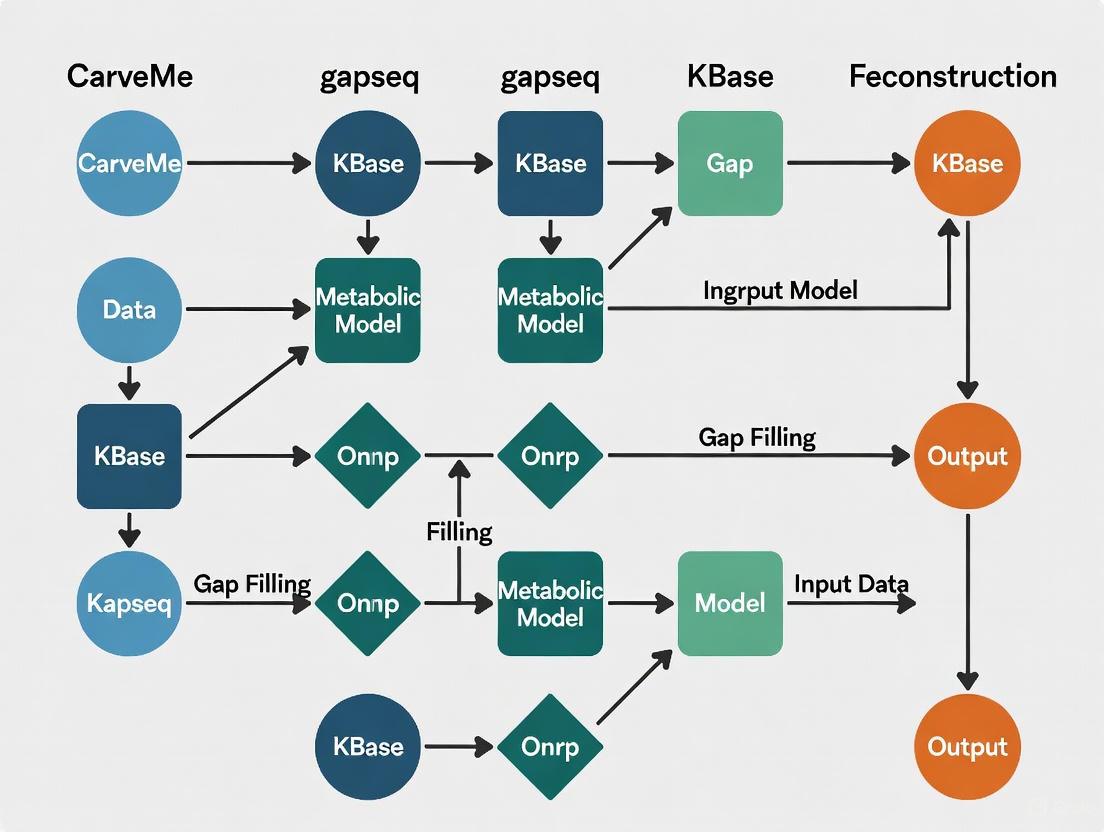
This article provides a systematic comparative analysis of three prominent automated genome-scale metabolic model (GEM) reconstruction tools: CarveMe, gapseq, and KBase.
CarveMe vs gapseq vs KBase: A Comprehensive 2024 Guide to Genome-Scale Metabolic Reconstruction Tools
Abstract
This article provides a systematic comparative analysis of three prominent automated genome-scale metabolic model (GEM) reconstruction tools: CarveMe, gapseq, and KBase. Tailored for researchers, scientists, and drug development professionals, it explores the foundational principles, databases, and algorithms underpinning each tool. The scope extends to practical application guidelines, troubleshooting common issues like dead-end metabolites and flux inconsistencies, and validation based on recent performance benchmarks for predicting enzyme activity, carbon source utilization, and microbial community interactions. The synthesis offers actionable insights for selecting and optimizing reconstruction tools to advance biomedical research, from probing host-microbiome interactions to identifying novel drug targets.
Core Principles and Databases: Understanding the Engines of CarveMe, gapseq, and KBase
Genome-scale metabolic models (GEMs) are powerful computational tools that predict the metabolic capabilities of microorganisms from their genetic sequences. The accuracy and utility of these models are fundamentally shaped by the reconstruction philosophy that guides their creation. The two predominant paradigms are the top-down approach, which starts from a universal template and removes elements without genomic support, and the bottom-up approach, which builds the network by assembling individual components based on genomic evidence [1]. This guide provides a comparative analysis of three leading automated reconstruction tools—CarveMe, gapseq, and KBase (which utilizes the ModelSEED framework)—evaluating their performance, underlying methodologies, and suitability for different research scenarios.
Comparative Analysis of Reconstruction Tools
The choice of reconstruction tool significantly impacts the structural characteristics and predictive performance of the resulting metabolic models. The following tables summarize key comparative data.
Table 1: Structural Characteristics of Metabolic Models (Based on 105 Marine Bacterial MAGs) [1]
| Reconstruction Tool | Reconstruction Philosophy | Average Number of Genes | Average Number of Reactions | Average Number of Metabolites | Number of Dead-End Metabolites |
|---|---|---|---|---|---|
| CarveMe | Top-Down | Highest | Medium | Medium | Low |
| gapseq | Bottom-Up | Lowest | Highest | Highest | Highest |
| KBase (ModelSEED) | Bottom-Up | Medium | Low | Low | Medium |
Table 2: Computational Performance and Predictive Accuracy [1] [2] [3]
| Tool | Compute Time (for 10 models) | False Negative Rate (Enzyme Activity) | True Positive Rate (Enzyme Activity) | Accuracy (Carbon Source Prediction) |
|---|---|---|---|---|
| CarveMe | ~30 seconds | 32% | 27% | Medium |
| gapseq | ~5.5 hours | 6% | 53% | High |
| KBase | ~3 minutes | 28% | 30% | Medium |
Key Insights from Comparative Data:
- gapseq models are the most biochemically comprehensive (highest reaction/metabolite counts) and show superior accuracy in predicting enzyme activities and carbon source utilization [1] [2].
- CarveMe offers the best computational efficiency, making it suitable for high-throughput studies involving thousands of genomes [1] [3].
- Model structure varies significantly; models built from the same genome with different tools show low Jaccard similarity for reactions (average ~0.24) and metabolites (average ~0.37), indicating that the choice of tool introduces substantial bias [1].
Experimental Protocols and Methodologies
To ensure the reproducibility of comparative studies, the following outlines a standard experimental workflow for evaluating reconstruction tools.
Protocol 1: Model Reconstruction and Structural Analysis
Objective: To generate and structurally compare metabolic models from the same set of genomic inputs using different automated pipelines.
Input Preparation:
Model Reconstruction:
- Execute each reconstruction tool with default parameters.
- CarveMe: Use the
carvecommand with a universal template (e.g.,builtin_gramneg.xml) [1]. - gapseq: Run the
gapseqdoallcommand to generate draft models, followed by thefillcommand for gap-filling using a defined minimal medium [2] [3]. - KBase: Use the "Build Metabolic Model" app in the KBase narrative interface [3].
Data Extraction and Analysis:
Protocol 2: Phenotypic Prediction Accuracy Validation
Objective: To benchmark the predictive power of models against empirical data.
Data Curation:
- Collect experimental data for validation. Key datasets include:
In Silico Simulation:
- Enzyme Activity: A reaction is considered present if the model contains the associated enzyme commission (EC) number [2].
- Carbon Source Growth: Use Flux Balance Analysis (FBA). Simulate growth on a single carbon source in a minimal medium. A growth rate above a defined threshold (e.g., >0.001 h⁻¹) predicts a positive phenotype [2] [3].
- Gene Essentiality: Perform in silico gene knockout simulations. Predict a gene as essential if its deletion leads to zero growth under defined conditions [3].
Statistical Evaluation:
- Compare model predictions against experimental data using confusion matrices.
- Calculate standard metrics: Accuracy, True Positive Rate (Sensitivity), and False Negative Rate [2].
The Scientist's Toolkit: Research Reagent Solutions
This table details the essential computational "reagents" and resources required for metabolic reconstruction and analysis.
Table 3: Essential Resources for Metabolic Model Reconstruction
| Resource Name | Type | Function / Description |
|---|---|---|
| BacDive | Database | Provides curated experimental data for bacterial phenotypes, used for model validation [2]. |
| UniProt & TCDB | Database | Source of reference protein sequences for functional annotation and transporter identification [2]. |
| ModelSEED/BiGG Biochemistry | Database | Core biochemical databases that define metabolites, reactions, and stoichiometries for model building [1] [2]. |
| FASTA File | Input Data | Standard format for inputting nucleotide or protein sequences of the target genome[s] [2]. |
| COMMIT | Software Tool | A community modeling tool used for gap-filling metabolic models in a multi-species context [1]. |
| Flux Balance Analysis (FBA) | Algorithm | A constraint-based optimization method used to predict metabolic flux distributions and growth phenotypes [2]. |
Reconstruction Workflow Diagrams
The core difference between top-down and bottom-up approaches is visualized in the following workflow. The consensus method, which aims to mitigate the biases of individual tools, is also shown.
Tool Selection and Consensus Strategy
The choice between these philosophies involves a direct trade-off between speed and comprehensiveness. The top-down approach (CarveMe) is fast and efficient, ideal for high-throughput studies [1] [3]. The bottom-up approach (gapseq, KBase) is more computationally intensive but often yields more accurate and detailed models, with gapseq demonstrating particularly high phenotypic accuracy [2].
To mitigate the biases inherent in any single tool, a consensus approach is recommended. This involves generating models using multiple tools and merging them. Evidence shows that consensus models retain a larger number of unique reactions and metabolites while reducing the number of dead-end metabolites, leading to enhanced functional capability and a more comprehensive representation of the community's metabolic potential [1].
Genome-scale metabolic models (GEMs) are fundamental tools in systems biology that mathematically represent cellular metabolism, enabling researchers to predict metabolic capabilities, growth phenotypes, and organismal responses to genetic and environmental perturbations [4]. The construction of high-quality GEMs relies heavily on underlying biochemical databases that provide curated information on metabolites, reactions, and metabolic pathways. Among the most prominent databases supporting metabolic reconstruction are BiGG (Biochemical Genetic and Genomic) and ModelSEED, which serve as comprehensive knowledge bases of biochemical transformations and their relationships to genomic content [5] [6]. These resources provide the essential "building blocks" from which organism-specific metabolic networks are constructed, either through manual curation or automated reconstruction pipelines such as CarveMe, gapseq, and KBase.
Biochemical databases function as universal models or templates of metabolism, capturing the collective knowledge of biochemical reactions across diverse organisms. They vary significantly in scope, content organization, and curation philosophy, which directly influences the structure and predictive accuracy of resulting genome-scale models [1]. The BiGG database is distinguished by its focus on manually curated, high-quality metabolic models that utilize standardized nomenclature and are directly usable for constraint-based modeling approaches like Flux Balance Analysis (FBA) [6]. In contrast, ModelSEED employs a more automated approach with extensive biochemistry spanning over 33,000 compounds and 36,000 reactions, serving as the foundation for both the ModelSEED and KBase reconstruction platforms [5]. Understanding the characteristics, strengths, and limitations of these foundational resources is essential for selecting appropriate tools and interpreting computational predictions in metabolic research and drug development.
Comparative Analysis of Database Architectures and Content
Core Database Characteristics and Curation Approaches
The structural and philosophical differences between biochemical databases significantly influence their application in metabolic reconstruction. The table below summarizes the key characteristics of BiGG and ModelSEED databases:
Table 1: Comparison of Core Features between BiGG and ModelSEED Databases
| Feature | BiGG Models | ModelSEED Biochemistry |
|---|---|---|
| Primary Focus | High-quality, manually-curated genome-scale metabolic models | Comprehensive biochemistry database supporting automated reconstruction |
| Year Established | 2010 | 2020 (current version) |
| Content Scale | >75 manually curated models | 33,978 compounds and 36,645 reactions |
| Curation Approach | Manual curation of entire network models | Automated integration of multiple sources with community extensibility |
| Standardization | Strict namespace standardization across models | Functions as biochemical "Rosetta Stone" for mapping across databases |
| Key Integration | Connections to genome annotations and external databases | Integrates KEGG, MetaCyc, BiGG, and other resources |
| Transport Reactions | Included in curated models | Identified, parsed, and integrated from source databases |
| Thermodynamic Data | Not explicitly mentioned | Computed for compounds and reactions |
| Accessibility | Web interface and API for model access and visualization | Available via GitHub and searchable online |
BiGG employs a quality-over-quantity approach, with each model undergoing manual curation to ensure biochemical accuracy and network functionality [6]. This meticulous process results in a smaller number of highly reliable models that serve as gold standards in the field. The database employs strict standardization of reaction and metabolite identifiers across all models, enabling direct comparison and integration of models for different organisms. BiGG also provides extensive visualization capabilities and links models to relevant genomic annotations and external databases, creating a knowledge base that supports both exploration and systematic analysis [6].
In contrast, ModelSEED prioritizes comprehensiveness and interoperability, integrating biochemical data from over 20 sources including KEGG, MetaCyc, and BiGG [5]. Rather than focusing on curated organism-specific models, ModelSEED provides a foundational biochemistry that can be leveraged by automated reconstruction pipelines. A distinctive feature is its design as a biochemical "Rosetta Stone" that facilitates mapping between different biochemical namespaces, addressing a significant challenge in metabolic modeling. The database also includes computed thermodynamic properties for compounds and reactions, which enables additional constraints for metabolic simulations. Furthermore, ModelSEED's storage on GitHub with continuous integration testing allows for community contributions and extensibility, making it a dynamic resource that can incorporate newly discovered biochemistry [5].
Universal Model Construction and Reaction Balancing
Both databases serve as sources for "universal models" or template networks that form the starting point for organism-specific reconstruction. However, their approaches to constructing these reference networks differ substantially. BiGG's universal model is essentially the union of its manually curated organism-specific models, ensuring that all components have been validated in the context of functional metabolic networks [4]. This approach provides high confidence in the biochemical accuracy of the template but may lack coverage of metabolic functions not represented in the curated models.
The gapseq tool, which builds upon ModelSEED biochemistry, employs a universal model comprising 15,150 reactions (including transporters) and 8,446 metabolites, derived from the ModelSEED biochemistry database but with additional curation to remove energy-generating thermodynamically infeasible reaction cycles [2]. This balance between comprehensive coverage and thermodynamic plausibility represents a hybrid approach that leverages ModelSEED's extensive content while addressing critical quality issues that can compromise predictive accuracy.
Reaction balancing represents another key differentiator between database approaches. ModelSEED explicitly documents the balancing status of each reaction, with a status field of "OK" indicating that the reaction is both mass-balanced and charge-balanced [5]. This transparency allows reconstruction tools to filter for balanced reactions, addressing a common source of metabolic network artifacts. The database uses Marvin from ChemAxon to protonate molecular structures at pH 7, enabling more accurate calculation of reaction properties including proton stoichiometry and Gibbs energy change [5].
Performance Comparison of Reconstruction Tools
Reconstruction Approaches and Database Dependencies
Automated reconstruction tools leverage biochemical databases through distinct methodological approaches, primarily categorized as top-down or bottom-up strategies. CarveMe employs a top-down approach, beginning with a universal model from the BiGG database and removing unnecessary reactions based on genomic evidence and network context [4] [1]. In contrast, gapseq and KBase utilize bottom-up approaches, building draft models by mapping annotated genomic sequences to biochemical reactions from their respective databases (ModelSEED for both, with gapseq additionally incorporating MetaCyc and other resources) [1] [2].
These methodological differences directly influence the structural and functional properties of resulting models. A comparative analysis of models reconstructed from the same metagenome-assembled genomes (MAGs) revealed substantial variations in model content and gene-reaction associations [1]. The table below summarizes the performance characteristics of these tools based on experimental validation studies:
Table 2: Performance Metrics of Reconstruction Tools Based on Experimental Validation
| Tool | Approach | Primary Database | Enzyme Activity Prediction (TP Rate) | Carbon Source Utilization Accuracy | Gene Essentiality Prediction | Dead-End Metabolites |
|---|---|---|---|---|---|---|
| CarveMe | Top-down | BiGG | 27% | Moderate | Variable | Lower |
| gapseq | Bottom-up | ModelSEED/Multi-source | 53% | Higher | Improved with curation | Higher in draft models |
| ModelSEED | Bottom-up | ModelSEED | 30% | Moderate | Variable | Moderate |
| KBase | Bottom-up | ModelSEED | Similar to ModelSEED | Similar to ModelSEED | Similar to ModelSEED | Similar to ModelSEED |
The choice of biochemical database significantly impacts model structure and function. Models built using the same genomes but different tools show remarkably low similarity, with Jaccard similarity for reactions ranging between 0.23-0.24 for comparative analyses [1]. This indicates that less than a quarter of reactions are shared between models reconstructed from the same genome using different tools, highlighting the database-specific biases in metabolic network representation.
Experimental Validation of Predictive Accuracy
Large-scale validation studies using experimental data provide critical insights into the real-world performance of reconstruction approaches. gapseq demonstrates superior performance in predicting enzyme activities, achieving a 53% true positive rate compared to 27% for CarveMe and 30% for ModelSEED when tested against 10,538 enzyme activity records from the Bacterial Diversity Metadatabase (BacDive) [2]. This substantial performance difference highlights how database content and reconstruction algorithms collectively influence predictive accuracy.
For metabolic phenotype predictions, consensus approaches that combine models from multiple tools have shown promising results. GEMsembler, a framework for building consensus models, demonstrates that combined models can outperform even gold-standard manually curated models in predicting auxotrophy and gene essentiality [4]. This suggests that each tool captures different aspects of metabolic capability, and integration approaches can mitigate individual database and algorithm limitations.
The presence of dead-end metabolites—compounds that can be produced but not consumed or vice versa in the metabolic network—represents another important quality metric. gapseq models tend to include more dead-end metabolites, reflecting their more comprehensive inclusion of reactions from biochemical databases without stringent network context validation [1]. While this may initially appear problematic, these apparently "dead-end" metabolites may become functional when models are simulated in community contexts where metabolic cross-feeding occurs.
Experimental Protocols for Tool Evaluation
Protocol for Enzyme Activity Prediction Validation
Objective: To quantitatively assess the accuracy of enzyme activity predictions from genome-scale metabolic models reconstructed using different tools and databases.
Materials:
- Genomic sequences in FASTA format
- Bacterial Diversity Metadatabase (BacDive) enzyme activity dataset
- Reconstruction tools: CarveMe, gapseq, ModelSEED
- Reference protein sequence databases for each tool
Methodology:
- Model Reconstruction:
- Reconstruct metabolic models for all organisms in the BacDive dataset using each tool with default parameters [2].
- For CarveMe, use the built-in universal model based on BiGG biochemistry.
- For gapseq and ModelSEED, use their respective biochemistry databases and reconstruction pipelines.
Enzyme Activity Mapping:
- Map EC numbers from experimental tests to reactions in each model's biochemistry namespace.
- For gapseq, this includes checking against multiple biochemistry databases and pathway structures [2].
Prediction Validation:
- For each enzyme test, check if the model contains at least one reaction associated with the tested EC number.
- Classify predictions as true positive (model contains reaction and experimental test positive), false positive (model contains reaction but experimental test negative), true negative (model lacks reaction and experimental test negative), and false negative (model lacks reaction but experimental test positive).
- Account for potential overrepresentation of frequently tested enzymes (e.g., catalase 1.11.1.6, cytochrome oxidase 1.9.3.1) by sampling equal numbers of test data for each EC number [2].
Statistical Analysis:
- Calculate precision, recall, and F1-score for each tool.
- Compare performance across tools using appropriate statistical tests.
This protocol leverages the comprehensive experimental data in BacDive, which includes 10,538 enzyme activities across 3,017 organisms and 30 unique enzymes, providing robust statistical power for tool evaluation [2].
Protocol for Consensus Model Construction with GEMsembler
Objective: To integrate multiple automatically reconstructed models into a consensus model with improved predictive performance.
Materials:
- Multiple genome-scale metabolic models for the same organism reconstructed using different tools
- GEMsembler Python package
- Reference genome for gene identifier standardization
- Growth media composition for functional validation
Methodology:
- Feature Conversion:
Supermodel Construction:
- Assemble all converted models into a single supermodel object.
- Store origin information for each metabolic feature (metabolites, reactions, genes).
- Maintain features that could not be converted in a separate "not_converted" field [4].
Consensus Model Generation:
- Generate consensus models with different agreement thresholds (e.g., core4 requires presence in all 4 input models).
- Assign reaction attributes (e.g., directionality) based on majority agreement.
- Create new Gene-Protein-Reaction (GPR) rules based on logical expressions from original models [4].
Functional Validation:
- Compare consensus models against experimental data for auxotrophy and gene essentiality.
- Identify metabolic pathways with uncertain representation for targeted experimental validation.
- Export models in SBML format for further analysis with COBRA tools.
This approach enables researchers to harness the complementary strengths of different reconstruction tools and databases, potentially outperforming even manually curated gold-standard models in specific prediction tasks [4].
Diagram Title: Metabolic Reconstruction Workflow and Database Integration
Table 3: Essential Research Reagents and Computational Tools for Metabolic Reconstruction
| Resource | Type | Primary Function | Application Context |
|---|---|---|---|
| BiGG Models | Biochemical Database | Provides manually curated, standardized metabolic models | Reference for high-quality models; namespace standardization |
| ModelSEED Biochemistry | Biochemical Database | Comprehensive biochemical reaction database with mapping capabilities | Automated model reconstruction; cross-database integration |
| CarveMe | Reconstruction Tool | Top-down model reconstruction from universal template | Rapid generation of draft models from genome sequences |
| gapseq | Reconstruction Tool | Bottom-up model reconstruction with informed gap-filling | Accurate prediction of metabolic pathways and phenotypes |
| GEMsembler | Consensus Tool | Integration of multiple models into consensus networks | Improving model quality and predictive accuracy |
| COBRA Toolbox | Modeling Framework | Flux balance analysis and constraint-based modeling | Simulation of metabolic network behavior |
| MEMOTE | Quality Assessment | Automated testing and quality assessment of metabolic models | Model validation and standardization |
| MetaNetX | Namespace Mapping | Mapping of metabolic identifiers across databases | Solving interoperability issues between tools |
| BacDive Database | Experimental Data | Repository of microbial biological data | Validation of model predictions against experimental results |
This toolkit represents essential resources for researchers engaged in metabolic reconstruction and model-based analysis. The biochemical databases (BiGG and ModelSEED) provide the foundational knowledge, while the reconstruction tools translate genomic information into functional metabolic networks. Quality assessment tools like MEMOTE ensure model reliability, and namespace mappers like MetaNetX address interoperability challenges that arise from the use of different biochemical databases [4]. Experimental databases like BacDive serve as crucial validation resources, enabling quantitative assessment of predictive accuracy [2].
For researchers focusing on microbial communities, additional tools such as COMMIT enable gap-filling of community metabolic models, accounting for metabolic interactions between organisms [1]. The APOLLO resource, which contains 247,092 microbial genome-scale metabolic reconstructions, provides pre-computed models for large-scale microbiome studies [7]. These resources collectively support diverse research applications from basic microbial metabolism to host-microbiome interactions and metabolic engineering.
Gene-Protein-Reaction (GPR) Association and Network Inference Logic
Genome-scale metabolic models (GEMs) are pivotal computational frameworks for predicting the metabolic capabilities of an organism from its genomic data. The process of constructing these models hinges on the accurate inference of Gene-Protein-Reaction (GPR) associations, which are logical rules connecting genes to the metabolic reactions they enable through enzyme complexes. The choice of automated reconstruction tool significantly influences the structure, content, and predictive power of the resulting GEM, as each tool employs distinct databases, algorithms, and network inference logic. This guide provides a comparative analysis of three prominent reconstruction tools—CarveMe, gapseq, and KBase (which implements the ModelSEED pipeline)—focusing on their approaches to GPR association and network inference. Understanding these core methodologies is essential for researchers, scientists, and drug development professionals to select the appropriate tool for applications ranging from microbial community ecology to personalized medicine.
Core Reconstruction Tool Comparison
The fundamental differences in the design philosophy and technical implementation of CarveMe, gapseq, and KBase lead to variations in the GEMs they generate. The table below summarizes their key characteristics.
Table 1: Core Characteristics and GPR Association Logic of Automated Reconstruction Tools
| Feature | CarveMe | gapseq | KBase (ModelSEED) |
|---|---|---|---|
| Reconstruction Approach | Top-down network carving [1] | Bottom-up pathway-centric [2] | Bottom-up database-driven [8] |
| Primary Database | BiGG [9] | Curated ModelSEED-derived & multiple pathway databases [2] | ModelSEED Biochemistry [2] [10] |
| GPR Inference Basis | Universal template model and curated GPRs [1] | Sequence homology to comprehensive protein reference database [2] | Annotated genomic features and database homology [8] |
| Gap-Filling Strategy | Context-specific during reconstruction [1] | LP-based algorithm informed by homology & topology [2] | Biomass-oriented for a defined medium [2] |
| Key Strength | Speed, production of ready-to-use models [1] [2] | Accurate prediction of metabolic phenotypes [2] [9] | Integration within a powerful web platform [8] |
| Reported Limitation | Potential for overestimated genes; universal database not actively maintained [9] [10] | Long computation time (hours per model) [9] [3] | Web interface limits high-throughput analysis [9] [10] |
Quantitative Performance and Experimental Data
Independent studies have benchmarked these tools against experimental data and against each other, revealing performance differences rooted in their underlying logic.
Model Content and Phenotypic Prediction
A comparative analysis of models for Klebsiella pneumoniae strain KPPR1 demonstrated clear variations in model content and predictive performance [9] [10].
Table 2: Performance Comparison for K. pneumoniae KPPR1 Model
| Tool / Model | Gene Count | Reaction Count | Substrate Usage Accuracy | Gene Essentiality Accuracy |
|---|---|---|---|---|
| Bactabolize (KpSC pan) | 1,702 | 2,443 | 0.97 | 0.83 |
| CarveMe (universal) | 2,172 | 2,342 | 0.95 | 0.77 |
| gapseq | 2,550 | 3,188 | 0.95 | 0.80 |
| KBase (ModelSEED) | 1,016 | 1,765 | 0.94 | 0.85 |
| Manually Curated (iKp1289) | 1,289 | 1,897 | 0.96 | 0.87 |
The Bactabolize model, which uses a reference-based approach, achieved the highest accuracy for predicting substrate usage [9] [10]. While gapseq produced the largest model in terms of gene and reaction content, it matched CarveMe's substrate usage accuracy (0.95) and showed better gene essentiality prediction [9].
Structural Analysis of Community Metabolic Models
A 2024 study reconstructed GEMs from metagenome-assembled genomes (MAGs) of marine bacterial communities using CarveMe, gapseq, KBase, and a consensus approach [1]. The analysis revealed that the reconstruction tool had a more significant impact on model structure than the specific bacterial community being studied.
Table 3: Structural Characteristics of Community Metabolic Models from Marine MAGs [1]
| Reconstruction Tool | Number of Genes (Relative to CarveMe) | Number of Reactions & Metabolites | Number of Dead-End Metabolites | Jaccard Similarity of Reactions (gapseq vs. KBase) |
|---|---|---|---|---|
| CarveMe | Highest | Lower than gapseq | Lower than gapseq | ~0.24 |
| gapseq | Lowest | Highest | Highest | ~0.24 |
| KBase | Intermediate | Intermediate | Intermediate | ~0.24 |
| Consensus | High (similar to CarveMe) | Largest | Reduced | N/A |
The study found that gapseq models contained the most reactions and metabolites but also the highest number of dead-end metabolites, which can indicate gaps in the network or incomplete pathways [1]. Despite using the same MAGs as input, the Jaccard similarity for reactions between tools was low (e.g., ~0.24 between gapseq and KBase), highlighting that different tools produce markedly different networks from the same genomic data [1].
Detailed Experimental Protocols
To ensure reproducibility and provide context for the data, here are the detailed methodologies from key experiments cited in this guide.
Protocol 1: Comparative Analysis of Community Metabolic Models
This protocol is derived from the 2024 study that compared CarveMe, gapseq, and KBase using marine bacterial MAGs [1].
- Step 1: Input Data Preparation. A collection of 105 high-quality Metagenome-Assembled Genomes (MAGs) from coral-associated and seawater bacterial communities was used as the common input for all reconstruction tools [1].
- Step 2: Draft Model Reconstruction. For each MAG, three separate draft genome-scale metabolic models (GEMs) were generated using the default settings and databases of CarveMe (v1.5.1), gapseq (v1.2), and KBase (as of the study date) [1].
- Step 3: Consensus Model Generation. Draft models from the three tools for the same MAG were merged into a draft consensus model using a dedicated pipeline. Subsequently, gap-filling of these draft community models was performed using the COMMIT tool to ensure network functionality and biomass production [1].
- Step 4: Model Structural Analysis. The final models from each approach were analyzed and compared based on quantitative metrics, including the total number of genes, reactions, metabolites, and dead-end metabolites. The Jaccard similarity index was calculated to compare the sets of reactions, metabolites, and genes between models derived from the same MAG[sitation:1].
- Step 5: Functional and Interaction Analysis. The models were used to predict metabolic functionalities and the potential for metabolite exchange between community members, assessing the influence of the reconstruction approach on the predicted microbial interactions [1].
Protocol 2: Benchmarking with Experimental Phenotype Data
This protocol outlines the methodology used to validate tools like gapseq and Bactabolize against empirical data [2] [9].
- Step 1: Model Construction for Benchmarking Strains. Genome-scale metabolic models are constructed for a set of bacterial strains for which high-quality experimental phenotype data is available. This data can include carbon source utilization, gene essentiality from transposon mutant libraries, and enzyme activity assays [2] [9].
- Step 2: In Silico Phenotype Prediction. Simulations, primarily using Flux Balance Analysis (FBA), are run to predict growth on specific carbon sources or the impact of gene knockouts. For enzyme activity, the presence of the corresponding reaction and its GPR association in the model is taken as a prediction of activity [2].
- Step 3: Data Comparison and Accuracy Calculation. The model predictions are compared against the experimental data. Accuracy, precision, recall (true positive rate), and other statistical measures are calculated for each tool. For example, a true positive for carbon utilization is recorded when the model predicts growth and the experiment confirms it [2] [9].
Workflow and Logical Relationships
The network inference process, from genome to a functional metabolic model, follows a logical sequence that is shared among tools but differs in key implementation details. The following diagram illustrates the generalized workflow and highlights the critical decision points where tool-specific logic is applied.
The following table details key databases, software, and resources that form the foundation of metabolic reconstruction and GPR inference.
Table 4: Key Resources for Metabolic Reconstruction and GPR Inference
| Resource Name | Type | Primary Function in Reconstruction |
|---|---|---|
| BiGG Database [9] | Biochemical Database | A knowledgebase of curated metabolic reactions, metabolites, and GPR associations; serves as the template for CarveMe [1]. |
| ModelSEED Biochemistry [2] [8] | Biochemical Database | A comprehensive database of reactions, compounds, and roles; foundational for KBase and the starting point for gapseq's curated database [2]. |
| UniProt & TCDB [2] | Protein Sequence Database | Source of reference protein sequences used by gapseq for sequence homology searches to establish evidence for GPR rules [2]. |
| COBRApy [9] [10] | Software Library | A Python toolbox for constraint-based reconstruction and analysis; used by Bactabolize and many other tools for model simulation [9]. |
| COMMIT [1] | Software Tool | A method used for gap-filling community metabolic models in a step-wise manner, accounting for metabolite exchange [1]. |
| MEMOTE [9] | Software Tool | A tool for assessing and ensuring the quality of genome-scale metabolic models [9]. |
| AGORA2 [8] | Resource of Curated Models | A resource of 7,302 manually curated GEMs of human microbes; serves as a gold standard for personalized medicine studies [8]. |
Genome-scale metabolic models (GEMs) are computational representations of the metabolic network of an organism, mathematically connecting genotype to phenotype through Gene-Protein-Reaction (GPR) associations [11] [12]. The reconstruction of high-quality, 'ready-to-use' GEMs—models that can immediately be employed for flux balance analysis (FBA) and other constraint-based simulations—remains a significant challenge in systems biology [2]. The choice of reconstruction tool directly impacts model structure, predictive accuracy, and suitability for specific research applications such as drug target identification [11], metabolic engineering [12], and host-microbiome interaction studies [8].
This guide provides an objective comparison of three prominent GEM reconstruction tools—CarveMe, gapseq, and KBase (ModelSEED)—focusing on their performance characteristics, underlying methodologies, and practical applications. Understanding the structural differences in their outputs is essential for researchers, scientists, and drug development professionals to select the most appropriate tool for their specific research context.
Tool Methodologies and Reconstruction Approaches
Fundamental Workflow Differences
The three tools employ distinct reconstruction philosophies that significantly impact their output models. CarveMe utilizes a top-down approach, starting with a universal, curated template model and removing reactions without genomic evidence [1]. In contrast, gapseq and KBase employ bottom-up strategies, building models by mapping annotated genomic sequences to biochemical databases [1]. gapseq enhances this process with informed pathway prediction and a novel gap-filling algorithm that considers sequence homology and network topology [2].
Reconstruction Workflow Visualization
The following diagram illustrates the core reconstruction processes shared by these tools, with key differences noted in their specific implementations:
Diagram Title: Core GEM Reconstruction Workflow and Tool Variations
Performance Comparison: Quantitative Metrics
Structural and Predictive Accuracy
Independent comparative analyses reveal significant differences in model properties and predictive performance across the three tools. The following table summarizes key performance metrics based on experimental validation studies:
Table 1: Structural and Predictive Performance Comparison of GEM Reconstruction Tools
| Performance Metric | CarveMe | gapseq | KBase (ModelSEED) | Validation Context |
|---|---|---|---|---|
| Enzyme Activity Prediction (True Positive Rate) | 27% | 53% | 30% | 10,538 enzyme activities across 3,017 organisms [2] |
| Carbon Source Utilization Prediction | Moderate accuracy | Highest accuracy | Moderate accuracy | Large-scale phenotype data sets [2] |
| False Positive Prediction Rate | Higher | Lower | Higher | Substrate usage analysis [3] |
| Computational Time (per model) | 20-31 seconds | 4.55-6.28 hours | ~183 seconds | 10 bacterial genomes [3] |
| Flux Consistent Reactions | Highest fraction | Lower fraction | Moderate fraction | Community model analysis [1] |
| Dead-end Metabolites | Fewer | More | Moderate | Community model analysis [1] |
Model Content and Structural Characteristics
The underlying databases and algorithms produce models with distinct structural properties, impacting their application potential:
Table 2: Model Content and Structural Characteristics
| Characteristic | CarveMe | gapseq | KBase (ModelSEED) |
|---|---|---|---|
| Primary Reconstruction Approach | Top-down | Bottom-up | Bottom-up |
| Core Database | BiGG (no longer maintained) [3] | Curated ModelSEED-derived database [2] | ModelSEED biochemistry [8] |
| Reaction Coverage | Moderate | Highest | Moderate |
| Gene Inclusion | Highest number | Lower number | Moderate number |
| Dead-end Metabolites | Fewer | More | Moderate |
| Gap-filling Strategy | Minimal reactions for growth | LP-based considering multiple evidences [2] | Medium-specific |
Experimental Protocols for Tool Evaluation
Benchmarking Methodology
The performance data cited in this guide were derived from standardized evaluation protocols. Key experimental approaches include:
Enzyme Activity Validation: Using 10,538 experimentally determined enzyme activities from the Bacterial Diversity Metadatabase (BacDive) spanning 3,017 organisms and 30 unique enzymes [2]. Models generated by each tool were evaluated for their ability to predict these known enzymatic capabilities.
Carbon Source Utilization Testing: Comparison of predicted versus experimentally verified growth capabilities across hundreds of bacterial species on different carbon sources [2]. This assessed the tools' accuracy in predicting metabolic phenotypes.
Community Metabolic Interaction Analysis: Evaluation of models in predicting metabolite exchange and cross-feeding interactions within microbial communities, using metagenomic data from coral-associated and seawater bacterial communities [1].
Gene Essentiality Predictions: Comparison of computational predictions versus experimental gene essentiality data to assess biological relevance of reconstructed networks [3].
Consensus Modeling Approach
Recent research has proposed a consensus approach that combines reconstructions from multiple tools to reduce individual biases [1]. This method:
- Merges draft models from CarveMe, gapseq, and KBase
- Retains a larger number of reactions and metabolites
- Reduces dead-end metabolites
- Incorporates stronger genomic evidence support for reactions
- Demonstrates enhanced functional capability in community contexts [1]
Table 3: Key Resources for GEM Reconstruction and Analysis
| Resource Name | Type | Function in GEM Research | Availability |
|---|---|---|---|
| BRENDA Database | Kinetic parameter database | Source of enzyme kinetic data (kcat values) for ecGEM construction [13] | Publicly available |
| COBRA Toolbox | MATLAB package | Constraint-based reconstruction and analysis simulation environment [14] | Open source |
| MEMOTE | Quality testing suite | Automated quality assessment of genome-scale metabolic models [15] | Open source |
| BiGG Models | Curated metabolic database | Repository of standardized, curated genome-scale metabolic models [16] | Publicly available |
| AGORA2 | Microbial GEM resource | Collection of 7,302 curated genome-scale metabolic reconstructions of human microorganisms [8] | Publicly available |
| UniProtKB | Protein sequence database | Source of annotated protein sequences for functional annotation [16] | Publicly available |
| SBML | Model format standard | Exchange format for computational models in systems biology [16] | Open standard |
Application Contexts and Tool Recommendations
Strategic Implementation Guide
The optimal tool selection depends on research goals, computational resources, and target organisms:
For high-throughput studies (100-1000+ genomes): CarveMe provides the best balance of speed and reasonable accuracy, with computation times of ~20-31 seconds per model [3].
For maximal predictive accuracy: gapseq demonstrates superior performance in predicting enzyme activities (53% true positive rate vs. 27-30% for others) and carbon source utilization, despite longer computation times [2].
For community modeling: Consensus approaches that combine multiple tools show promise in reducing individual tool biases and improving prediction of metabolite exchanges [1].
For human microbiome studies: AGORA2 provides manually curated models for 7,302 microbial strains, outperforming automated tools in predicting drug metabolism capabilities [8].
Emerging Trends and Future Directions
The field is evolving toward more sophisticated modeling frameworks that incorporate additional biological constraints:
Enzyme-constrained GEMs (ecGEMs): Tools like GECKO 2.0 enhance traditional GEMs with enzymatic constraints using kinetic and proteomics data, improving predictions of metabolic fluxes [13].
Metabolic and gene Expression models (ME-models): These integrated models incorporate detailed representations of transcription and translation processes, providing insights into resource allocation [11] [16].
Strain-specific contextualization: Tools like Bactabolize enable generation of strain-specific models using pan-genome references, improving accuracy for clinical isolates [3].
The structure of a 'ready-to-use' genome-scale metabolic model is fundamentally shaped by the reconstruction tool that generates it. CarveMe offers speed and efficiency for large-scale studies, gapseq provides superior predictive accuracy for detailed phenotypic investigations, and KBase serves as an accessible web-based platform. The emerging consensus across comparative studies is that the choice of reconstruction tool involves inherent tradeoffs between computational efficiency, model completeness, and predictive accuracy. Researchers must strategically select tools based on their specific application requirements, while the development of consensus approaches and integrated frameworks points toward more robust modeling paradigms for future metabolic research.
From Genome to Model: A Step-by-Step Guide to Tool Implementation
Comparative Analysis of CarveMe, gapseq, and KBase Reconstruction Tools
Genome-scale metabolic models (GEMs) are computational representations of the metabolic network of an organism, enabling the prediction of phenotypic behavior from genotypic data [17]. The reconstruction of high-quality GEMs is a critical step for simulating microbial growth, predicting gene essentiality, and understanding host-microbiome interactions [8] [2]. Several automated tools have been developed to accelerate the reconstruction process, with CarveMe, gapseq, and KBase emerging as widely used options [17] [10].
These tools employ different reconstruction philosophies, database resources, and gap-filling algorithms, leading to variations in the structure and predictive performance of the resulting models [17] [2]. This guide provides an objective comparison of these three tools, supported by experimental data from comparative studies, to assist researchers in selecting the appropriate tool for their specific applications.
Core Characteristics and Reconstruction Approaches
The table below summarizes the fundamental characteristics and reconstruction methodologies of CarveMe, gapseq, and KBase.
Table 1: Core Characteristics and Reconstruction Methodologies
| Feature | CarveMe | gapseq | KBase |
|---|---|---|---|
| Reconstruction Approach | Top-down using a universal model [17] | Bottom-up from genomic evidence [17] [2] | Bottom-up, often associated with ModelSEED [17] [10] |
| Primary Database | BiGG universal model (reportedly no longer actively maintained) [10] | Curated database derived from ModelSEED, UniProt, and TCDB [2] | ModelSEED biochemistry database [17] [8] |
| Key Methodology | Carves a species-agnostic network based on genomic evidence [17] | Uses pathway prediction informed by sequence homology and network topology [2] | Automated reconstruction pipeline with subsequent refinement potential [8] |
| Gap-Filling Strategy | Context-specific during reconstruction [10] | Novel LP-based algorithm considering homology and network context [2] | Often performed during the reconstruction process [8] |
| Handling of Uncharacterized Reactions | Limited to reference template | Can incorporate novel reactions based on genomic evidence | Depends on the underlying biochemical database |
Reconstruction Workflow
The following diagram illustrates the conceptual workflow shared by these automated reconstruction tools, highlighting their distinct starting points and processes.
Performance Comparison and Experimental Data
Model Structure and Content
A comparative analysis of community models reconstructed from the same set of 105 marine bacterial MAGs revealed significant differences in model structure and content [17].
Table 2: Model Structural Statistics from Marine Bacterial MAGs Analysis [17]
| Metric | CarveMe | gapseq | KBase | Consensus Approach |
|---|---|---|---|---|
| Number of Genes | Highest | Lower than CarveMe and KBase | Intermediate | High, with strong genomic evidence support |
| Number of Reactions | Intermediate | Highest | Lower than gapseq | Largest number, aggregating from individual tools |
| Number of Metabolites | Intermediate | Highest | Lower than gapseq | Largest number |
| Dead-End Metabolites | Lower than gapseq | Highest | Lower than gapseq | Reduced number |
| Jaccard Similarity (Reactions) | Low (approx. 0.23-0.24 vs. gapseq/KBase) | Higher similarity to KBase (approx. 0.23-0.24) | Higher similarity to gapseq (approx. 0.23-0.24) | Higher similarity to CarveMe (0.75-0.77 for genes) |
The consensus approach, which combines outputs from multiple reconstruction tools, demonstrated advantages in encompassing more reactions and metabolites while reducing dead-end metabolites, thereby creating more comprehensive and functional metabolic networks [17].
Phenotypic Prediction Accuracy
Enzyme Activity and Carbon Source Utilization
Large-scale validation using scientific literature and experimental data for 14,931 bacterial phenotypes showed that gapseq outperformed both CarveMe and ModelSEED (which is implemented in KBase) in predicting enzyme activity [2].
Table 3: Enzyme Activity Prediction Performance (Based on 10,538 Tests) [2]
| Tool | True Positive Rate | False Negative Rate |
|---|---|---|
| gapseq | 53% | 6% |
| CarveMe | 27% | 32% |
| ModelSEED (KBase) | 30% | 28% |
For carbon source utilization predictions, a study on Klebsiella pneumoniae models showed that a Bactabolize-derived model (a reference-based tool) performed comparatively or better than CarveMe and gapseq across 507 substrate predictions, though the specific accuracy metrics for each tool were not provided [10].
Computational Performance
For researchers working with large datasets, computational efficiency is a critical consideration.
Table 4: Computational Performance Comparison (Based on K. pneumoniae Analysis) [10]
| Tool | Average Compute Time per Genome | Suitability for Large-Scale Analysis (100s-1000s genomes) |
|---|---|---|
| CarveMe | 20-30 seconds | Excellent |
| Bactabolize | ~98 seconds | Good |
| KBase | ~183 seconds (including upload) | Moderate (web interface limitation) |
| gapseq | ~5.5 hours (draft model only) | Poor |
Experimental Protocols and Methodologies
Typical Reconstruction Workflow
The following detailed experimental protocol is synthesized from the methodologies described in the search results for comparative analyses of reconstruction tools [17] [2].
Input Requirements:
- Genome sequence in FASTA format (annotated or unannotated)
- For some tools: pre-computed genome annotations (e.g., from RAST)
Procedure:
- Tool Installation and Setup
- Install CarveMe, gapseq, or set up KBase narrative interface
- Configure appropriate environment and dependencies
Draft Model Reconstruction
- Run each tool with standardized input data
- Use default parameters for unbiased comparison
- For KBase: utilize the ModelSEED reconstruction app
Model Gap-Filling
- Perform gap-filling using a consistent minimal medium across all tools
- For community modeling: use approaches like COMMIT for gap-filling [17]
Model Validation and Analysis
- Convert models to standardized format (SBML)
- Analyze model properties: reactions, metabolites, genes, dead-ends
- Validate predictions against experimental phenotype data
Consensus Building (Optional)
- Integrate models from different tools using pipelines
- Resolve namespace conflicts for metabolites and reactions [17]
Validation Methodologies
Comparative studies typically employ these validation approaches:
Growth Phenotype Validation:
- Compare in silico growth predictions with experimental data from BIOLOG assays or defined media [10] [2]
- Assess accuracy, precision, recall, and F1-score for binary growth predictions
Gene Essentiality Validation:
- Simulate single-gene knockouts and compare with transposon mutagenesis data [10]
- Calculate true positive/negative rates for essential gene predictions
Enzyme Activity Validation:
- Use databases like BacDive containing experimental enzyme activity tests [2]
- Map EC numbers to model reactions and compare presence/absence
Community Interaction Validation:
- Predict metabolite exchange in microbial communities [17]
- Compare with experimental data on cross-feeding interactions
Research Reagent Solutions
Table 5: Essential Materials and Resources for Metabolic Reconstruction
| Resource Type | Specific Examples | Function/Purpose |
|---|---|---|
| Genome Annotation Tools | RAST, Prokka | Generate initial gene annotations from sequence data |
| Biochemical Databases | ModelSEED, BiGG, VMH | Provide standardized reaction and metabolite information |
| Reference Models | AGORA2 (7,302 microbial reconstructions) [8] | Serve as curated templates for reconstruction |
| Analysis Toolboxes | COBRA Toolbox, COBRApy | Enable FBA and other constraint-based analyses |
| Quality Assessment Tools | MEMOTE | Evaluate model quality and standard compliance |
| Community Modeling Frameworks | COMMIT | Gap-fill and simulate microbial community models [17] |
| Phenotype Data Resources | BacDive, NJC19 | Provide experimental data for model validation [8] [2] |
Discussion and Recommendations
Tool Selection Guidelines
Based on the comparative data, tool selection should be guided by research priorities:
- For high-throughput reconstruction of numerous genomes: CarveMe offers the best balance of speed and reasonable accuracy [10].
- For maximum prediction accuracy of metabolic capabilities: gapseq demonstrates superior performance, particularly for enzyme activity and carbon source utilization, despite longer compute times [2].
- For users preferring a web-based interface: KBase provides an accessible platform with integrated analysis tools, though it may be less suitable for large-scale studies [10].
- For critical applications requiring robust models: A consensus approach combining multiple tools can provide more comprehensive coverage while reducing tool-specific biases [17].
Emerging Trends and Future Directions
The field continues to evolve with several promising developments:
- Reference-based tools like Bactabolize show potential for rapid, accurate strain-specific modeling when high-quality pan-models are available [10] [9].
- Expanded reconstruction resources such as AGORA2 (7,302 strains) [8] and APOLLO (247,092 diverse human microbes) [7] are pushing the boundaries of scale and application.
- Improved curation pipelines like DEMETER demonstrate how automated drafts can be refined through manual curation using comparative genomics and literature data [8].
Researchers should consider these emerging resources alongside the established tools discussed in this comparison, selecting approaches that best align with their specific modeling objectives, dataset scales, and accuracy requirements.
Genome-scale metabolic models (GEMs) are crucial for simulating the metabolic capabilities of microorganisms, with applications ranging from microbiome research to drug development. Several tools exist for reconstructing these models, primarily falling into two categories: command-line operations and web platform interfaces. This guide provides a comparative analysis of three prominent tools—CarveMe, gapseq, and KBase—focusing on their workflows, performance, and optimal use cases.
The table below summarizes the core features and reconstruction methodologies of the three tools.
Table 1: Overview of Metabolic Reconstruction Tools
| Feature | CarveMe | gapseq | KBase |
|---|---|---|---|
| Interface | Command-line [1] [3] | Command-line [2] [3] | Web platform [3] [18] |
| Primary Approach | Top-down ("carving" from a universal model) [1] | Bottom-up (reaction mapping from genomic sequences) [1] [2] | Bottom-up (leveraging the ModelSEED database) [1] [8] |
| Reconstruction Speed | Fast (seconds to minutes per genome) [3] [9] | Slow (several hours per genome) [3] [9] | Moderate (minutes per genome, subject to queue times) [3] |
| Key Database | BiGG Universal Model [9] | Curated gapseq database [2] | ModelSEED [1] [8] |
| Ideal Use Case | High-throughput reconstruction of large genome datasets [3] [9] | Projects requiring high accuracy in phenotypic predictions [2] [3] | Users preferring a graphical interface and integrated analytics [8] [18] |
Performance and Experimental Data Comparison
Independent studies have benchmarked these tools against experimental data and against each other. The following tables summarize key performance metrics.
Prediction Accuracy for Metabolic Phenotypes
A critical validation of any GEM is its ability to accurately predict an organism's metabolic capabilities, such as enzyme activity and carbon source utilization.
Table 2: Benchmarking of Prediction Accuracy Against Experimental Data
| Phenotype Tested | CarveMe | gapseq | KBase/ModelSEED | Notes |
|---|---|---|---|---|
| Enzyme Activity (True Positive Rate) | 27% [2] | 53% [2] | 30% [2] | Based on 10,538 tests for 30 unique enzymes [2] |
| Enzyme Activity (False Negative Rate) | 32% [2] | 6% [2] | 28% [2] | gapseq demonstrated superior sensitivity [2] |
| Carbon Source & Gene Essentiality | Lower overall accuracy than Bactabolize (a reference-based tool) [9] | High accuracy, but with more false positives than Bactabolize [9] | Lower overall accuracy than Bactabolize [9] | Benchmarking performed on K. pneumoniae; KBase model was an outlier with low gene/reaction content [9] |
Structural Properties of Generated Models
The structure of a metabolic model—including its number of reactions, metabolites, and genes—can vary significantly depending on the reconstruction tool, which influences its functional coverage.
Table 3: Structural Comparison of Models from Different Tools
| Structural Property | CarveMe | gapseq | KBase | Notes |
|---|---|---|---|---|
| Number of Reactions | Lower than gapseq [1] | Highest among the three tools [1] | Lower than gapseq [1] | Comparison based on models from the same metagenome-assembled genomes (MAGs) [1] |
| Number of Metabolites | Lower than gapseq [1] | Highest among the three tools [1] | Lower than gapseq [1] | gapseq and KBase showed higher similarity due to shared ModelSEED database use [1] |
| Number of Genes | Highest among the three tools [1] | Lower than CarveMe and KBase [1] | Intermediate between CarveMe and gapseq [1] | A higher gene count does not necessarily equate to more reactions or metabolites [1] |
| Flux Consistency | High (reactions removed by design) [8] | Lower than AGORA2 and CarveMe [8] | Lower than AGORA2 and CarveMe [8] | Flux-inconsistent reactions can lead to unrealistic energy generation [8] |
Experimental Protocols and Methodologies
To ensure reproducible results, the following section outlines the standard experimental protocols for benchmarking and applying these reconstruction tools, as cited in the literature.
Protocol for Comparative Tool Analysis
This protocol is adapted from studies that performed systematic comparisons of reconstruction tools [1] [3].
- Input Genome Preparation: Obtain high-quality genome sequences in FASTA or GenBank format. For metagenomic studies, use high-quality Metagenome-Assembled Genomes (MAGs) [1].
- Model Reconstruction:
- Model Structure Analysis: For each generated model, extract and compare key metrics:
- Phenotypic Validation:
- Carbon Source Utilization: Use Flux Balance Analysis (FBA) to predict growth on a defined set of carbon sources. Compare predictions against experimentally validated phenotype data (e.g., from BacDive or Biolog) [2] [9].
- Gene Essentiality: Perform in silico single-gene knockout simulations and compare the predictions with experimental gene essentiality data [9].
- Data Analysis: Compute standard performance metrics such as accuracy, true positive rate, and false positive rate to objectively evaluate each tool's predictive power [2] [9].
Protocol for Building Community Metabolic Models
This protocol describes how to move from single-species models to models of interacting microbial communities, a common application in microbiome research [7] [1].
- Individual Reconstruction: Reconstruct GEMs for each member of the microbial community using one or more of the tools described above [7] [1].
- Community Integration: Combine the individual models into a community model. Common approaches include:
- Gap-Filling with COMMIT: Use the COMMIT tool to perform community-driven gap-filling on the integrated model. This step adds missing reactions necessary for the community to achieve a defined objective (e.g., biomass production) in a specific medium [1].
- Simulation and Analysis: Apply constraint-based modeling techniques to the community model to simulate metabolic interactions, such as cross-feeding of metabolites [7] [1].
Workflow Visualization with DOT Scripts
The following diagrams, described in DOT language, illustrate the typical workflows for each reconstruction tool.
CarveMe Reconstruction Workflow
gapseq Reconstruction Workflow
KBase Reconstruction Workflow
The Scientist's Toolkit
This section details key reagents, software, and data resources essential for conducting metabolic reconstructions and analyses.
Table 4: Essential Research Reagents and Resources
| Item Name | Type | Function in Workflow |
|---|---|---|
| BacDive Database [2] | Data Resource | Provides experimental data on bacterial phenotypes (e.g., enzyme activity, carbon source use) for model validation. |
| BiGG Universal Model [9] | Data Resource | A knowledgebase of metabolic reactions and models; serves as the template for the CarveMe reconstruction pipeline. |
| ModelSEED Database [1] [8] | Data Resource | A biochemistry database and core model template used by the KBase and gapseq platforms for reaction mapping. |
| COMMIT [1] | Software Tool | A gap-filling tool designed specifically for microbial community models to ensure metabolic functionality. |
| COBRApy [9] [10] | Software Library | A Python toolbox for constraint-based modeling and simulation of genome-scale metabolic models. |
| MEMOTE [9] | Software Tool | A community-developed tool for standardized quality control and reporting of genome-scale metabolic models. |
| Standard Growth Media Formulations (e.g., M9) [2] [3] | Protocol | Defined chemical environments used during the model gap-filling process to ensure network functionality and comparability. |
In the field of systems biology, genome-scale metabolic models (GEMs) serve as powerful computational frameworks for predicting the metabolic capabilities of microorganisms from their genetic blueprint. The construction of these models relies on automated reconstruction tools such as CarveMe, gapseq, and KBase, which transform annotated genome sequences into stoichiometric metabolic networks. A critical phase in this process is model customization, where draft models are refined by setting specific biomass objectives and applying environmental constraints to ensure biological functionality and accurate phenotypic prediction. This process, often referred to as gap-filling, ensures the model can produce essential biomass precursors and generate energy (ATP) in a defined simulated environment. The approaches and databases used by different tools significantly impact the final model's structure and predictive power, making the choice of tool crucial for specific research applications [2] [1] [8].
Comparative Performance of Reconstruction Tools
Independent comparative studies have benchmarked CarveMe, gapseq, and KBase against large-scale experimental datasets to evaluate their accuracy in predicting metabolic phenotypes.
Quantitative Benchmarking of Predictive Accuracy
The table below summarizes the performance of these tools in predicting enzyme activity and carbon source utilization, two key metrics of model quality.
Table 1: Benchmarking results for automated reconstruction tools
| Tool | Enzyme Activity Prediction (True Positive Rate) | Carbon Source Utilization (AUC) | Key Strengths | Noted Limitations |
|---|---|---|---|---|
| gapseq | 53% [2] | 0.81 (AGORA2) to 0.84 [8] | Superior prediction of enzyme activities and fermentation products [2] | Long computation time (hours per model) [10] [19] |
| CarveMe | 27% [2] | 0.72 (AGORA2) [8] | Fast model generation (seconds per model) [1] [10] | Potential for false-positive predictions; reliance on a universal template [10] [19] |
| KBase (ModelSEED) | 30% [2] | Information missing | User-friendly web interface [1] | Lower gene and reaction counts in output models [19] |
Structural Differences in Generated Models
An analysis of models reconstructed from the same metagenome-assembled genomes (MAGs) revealed significant structural differences attributable to the underlying algorithms and databases of each tool.
Table 2: Structural characteristics of GEMs from different reconstruction tools
| Tool | Number of Reactions | Number of Metabolites | Number of Genes | Dead-End Metabolites |
|---|---|---|---|---|
| gapseq | Highest count [1] [20] | Highest count [1] [20] | Lowest count [1] [20] | Higher numbers, indicating potential network gaps [1] |
| CarveMe | Lower than gapseq [1] [20] | Lower than gapseq [1] [20] | Highest count [1] [20] | Information missing |
| KBase | Information missing | Information missing | Intermediate between CarveMe and gapseq [1] [20] | Information missing |
These structural differences translate into variations in predicted metabolic functions and metabolite exchange in community modeling, suggesting that the reconstruction tool can introduce a bias in the conclusions drawn from in silico analyses [1].
Experimental Protocols for Tool Evaluation
The benchmarking data presented above were generated through rigorous experimental protocols. The following workflow outlines the key steps for a standardized evaluation of reconstruction tools.
Diagram 1: Workflow for benchmarking reconstruction tools.
Detailed Experimental Methodology
The workflow can be broken down into the following specific steps:
- Model Reconstruction: Input the same, high-quality reference genome (e.g., Escherichia coli K-12 or a complete metagenome-assembled genome) into each tool (CarveMe, gapseq, KBase) using their standard commands and default databases to generate draft genome-scale metabolic models [1] [10].
- Model Customization (Gap-Filling): This is the core of setting biomass objectives and environmental constraints.
- Biomass Objective: The tool's algorithm defines a biomass reaction representing the composition of macromolecules needed for cell growth. This reaction is set as the objective function to be maximized during Flux Balance Analysis (FBA) [21].
- Environmental Constraints: A chemically defined growth medium (e.g., M9 minimal medium with a single carbon source) is specified. This step involves constraining the uptake and secretion of metabolites in the model to reflect the available nutrients [10] [8]. The gap-filling algorithm then adds missing biochemical reactions from a reference database to the model to enable biomass production under these defined conditions [2] [22].
- Phenotype Prediction: Use the customized models to run in silico experiments:
- Model Validation: Calculate performance metrics such as accuracy, true positive rate, and area under the curve (AUC) by comparing the computational predictions with the independent experimental datasets [2] [8].
The following table details key resources used in the development and benchmarking of metabolic reconstruction tools.
Table 3: Key research reagents and resources for metabolic reconstruction
| Item Name | Function/Description | Relevance in Research |
|---|---|---|
| Biolog Phenotype MicroArrays | High-throughput experimental system for profiling microbial growth on hundreds of carbon sources. [10] | Provides gold-standard experimental data for validating model predictions of carbon source utilization. |
| BacDive Database | A bacterial metadatabase providing curated data on morphology, physiology, and metabolism, including enzyme activity tests. [2] | Used for large-scale validation of enzyme activity predictions (e.g., for catalase and cytochrome oxidase). |
| AGORA2 & DEMETER | A resource of 7,302 manually curated metabolic reconstructions of human gut microbes and the pipeline used to build them. [8] | Serves as a high-quality benchmark for comparing the predictive performance of automated tools. |
| COMMIT | A community modeling and gap-filling tool that integrates multiple individual models. [1] [20] | Used for gap-filling consensus community models and studying metabolic interactions between species. |
| UniProt & TCDB | Protein sequence database (UniProt) and Transporter Classification Database (TCDB). [2] | Provide the reference protein sequences used by tools like gapseq for homology-based reaction prediction. |
| ModelSEED / BiGG Biochemistry Databases | Curated databases of biochemical reactions, metabolites, and pathways. [2] [8] | Form the core "universal" biochemistry knowledge base that reconstruction tools draw upon. |
Consensus Modeling: An Emerging Approach
Given the variability between tools, an emerging strategy is to build consensus models. This approach integrates reactions and genes from models of the same organism generated by different tools (e.g., CarveMe, gapseq, and KBase). Studies have shown that consensus models encompass a larger number of reactions and metabolites while reducing the number of dead-end metabolites. They also incorporate more genes, indicating stronger genomic evidence support, which enhances the model's functional capability and provides a more comprehensive view of the metabolic network, especially in a community context [1] [20].
Comparative analysis of CarveMe gapseq KBase reconstruction tools
Genome-scale metabolic models (GEMs) have emerged as powerful computational frameworks for predicting the metabolic capabilities of microorganisms from genomic data. In biomedical research, particularly in drug target identification and microbiome studies, these models enable researchers to decipher host-microbiome interactions, identify novel antimicrobial targets, and predict off-target effects of pharmaceuticals on commensal bacteria. The reconstruction of high-quality GEMs is a critical first step in these applications, yet the choice of reconstruction tool can significantly influence downstream predictions and biological conclusions.
Several automated reconstruction tools have been developed to address the challenge of building metabolic models from genomic data. Among these, CarveMe, gapseq, and KBase have gained prominence in the research community. Each tool employs distinct reconstruction philosophies, draws from different biochemical databases, and implements unique gap-filling algorithms, leading to variations in the resulting metabolic networks. This comparative analysis examines the performance of these three tools in the context of biomedical applications, with particular emphasis on drug target identification and microbiome modeling.
Fundamental approaches and technical specifications
The three tools employ fundamentally different approaches to metabolic reconstruction. CarveMe utilizes a top-down methodology, beginning with a manually curated universal model of bacterial metabolism that is subsequently "carved" down to organism-specific models based on genomic evidence [23]. This approach preserves the network connectivity and thermodynamic consistency of the original universal model. In contrast, gapseq and KBase employ bottom-up strategies, building models from scratch by mapping annotated genomic sequences to biochemical reactions from reference databases [1] [2].
These methodological differences are reflected in their technical implementations. CarveMe prioritizes speed and simulation readiness, generating functional models that maintain network consistency. gapseq emphasizes comprehensive pathway prediction through its curated reaction database and informed gap-filling algorithm that incorporates sequence homology evidence. KBase offers an integrated platform that combines reconstruction capabilities with other bioinformatics analyses within a user-friendly web interface [24].
Table 1: Fundamental characteristics of the reconstruction tools
| Tool | Reconstruction Approach | Core Database | Key Innovation | Primary Output |
|---|---|---|---|---|
| CarveMe | Top-down | BiGG | Universal model carving | Simulation-ready models |
| gapseq | Bottom-up | ModelSEED (curated) | Homology-informed gap-filling | Functionally validated models |
| KBase | Bottom-up | ModelSEED | Integrated platform | Community-scale models |
Biochemical databases and curation practices
The biochemical databases underlying each tool significantly influence the content and functionality of the resulting models. CarveMe builds upon the BiGG database, which contains manually curated, atomically balanced reactions [23]. gapseq utilizes a customized version of the ModelSEED database that has undergone additional curation to remove energy-generating thermodynamically infeasible reaction cycles [2]. KBase similarly employs the ModelSEED database but without the extensive additional curation implemented in gapseq [1].
These database differences manifest in model statistics. A comparative analysis revealed that gapseq models typically encompass more reactions and metabolites compared to CarveMe and KBase models, though they also contain a larger number of dead-end metabolites [1]. CarveMe models generally include the highest number of genes associated with metabolic reactions, while KBase models fall between the other two tools in terms of gene, reaction, and metabolite counts [1].
Performance comparison in biomedical applications
Phenotype prediction accuracy
Accurate prediction of metabolic phenotypes is crucial for biomedical applications, particularly in assessing microbial responses to pharmaceuticals and identifying potential drug targets. Experimental validations against large-scale phenotype datasets have revealed significant performance differences among the tools.
In predicting enzyme activities based on genomic data, gapseq demonstrated superior performance with a false negative rate of only 6%, compared to 32% for CarveMe and 28% for ModelSEED (the reconstruction core of KBase) [2]. Similarly, gapseq achieved a true positive rate of 53%, substantially outperforming CarveMe (27%) and ModelSEED (30%) across 10,538 enzyme activity tests spanning 3,017 organisms and 30 unique enzymes [2].
For carbon source utilization predictions—a critical capability in microbiome modeling and understanding microbial ecology—gapseq also showed enhanced accuracy, though all tools exhibited room for improvement. These performance advantages likely stem from gapseq's comprehensive pathway prediction algorithm and its homology-informed gap-filling approach, which incorporates evidence from sequence similarity to reference proteins [2].
Table 2: Performance metrics for phenotype prediction
| Prediction Task | CarveMe | gapseq | KBase | Validation Basis |
|---|---|---|---|---|
| Enzyme activity (False Negative Rate) | 32% | 6% | 28% | 10,538 tests across 3,017 organisms |
| Enzyme activity (True Positive Rate) | 27% | 53% | 30% | 10,538 tests across 3,017 organisms |
| Carbon source utilization | Intermediate | Highest | Intermediate | Experimental phenotype data |
| Gene essentiality prediction | Good | Good | Good | Model organisms |
Community metabolic modeling
In microbiome research, the accurate prediction of metabolic interactions between community members is essential for understanding community stability, function, and responses to perturbations such as antibiotic treatments. Comparative analyses have revealed that the set of exchanged metabolites predicted by community metabolic models is more strongly influenced by the choice of reconstruction tool than by the specific bacterial community being studied [1]. This finding suggests a potential bias in predicting metabolite interactions using community GEMs that researchers must consider when interpreting results.
Consensus approaches that combine reconstructions from multiple tools have shown promise in mitigating tool-specific biases. Consensus models encompass a larger number of reactions and metabolites while concurrently reducing the presence of dead-end metabolites compared to individual reconstructions [1]. Additionally, consensus models demonstrate enhanced functional capability and stronger genomic evidence support for reactions, making them particularly valuable for assessing the functional potential of complex microbial communities [1].
Experimental protocols for tool evaluation
Standardized model reconstruction workflow
To ensure fair comparisons between tools, researchers should implement a standardized reconstruction workflow using the same input genomes across all tools. The protocol begins with high-quality genome sequences as input, preferably metagenome-assembled genomes (MAGs) or isolate genomes that have undergone quality assessment. For CarveMe, the recommended approach involves using the carve command with the appropriate template (e.g., Gram-negative or Gram-positive) based on the organism's characteristics [23]. For gapseq, the gapseq pipeline should be run with consistent parameters, utilizing the -c flag to ensure comprehensive pathway prediction [2]. In KBase, the "Build Metabolic Model" app provides a guided interface for model reconstruction, with options to specify media conditions and gap-filling parameters [24].
Following reconstruction, models should be converted to a standardized format (preferably SBML) and evaluated using common metrics, including the number of reactions, metabolites, genes, dead-end metabolites, and network connectivity. Simulation capabilities should be assessed through flux balance analysis under identical media conditions with consistent biomass objectives [1].
Phenotype validation methodology
Experimental validation of model predictions requires carefully designed assays comparing computational predictions with empirical observations. For enzyme activity predictions, growth assays or enzymatic activity tests can be performed using established protocols from resources such as the Bacterial Diversity Metadatabase (BacDive) [2]. Carbon source utilization should be evaluated using phenotype microarray systems or customized growth assays in minimal media supplemented with individual carbon sources [2].
For drug-microbiome interaction studies, in vitro growth inhibition assays provide valuable validation data. The protocol involves cultivating representative microbial strains under anaerobic conditions, exposing them to pharmaceutical compounds at physiologically relevant concentrations, and measuring growth kinetics optically over time [25]. Machine learning approaches that integrate chemical properties of drugs with genomic features of microbes can further enhance prediction accuracy for drug-microbiome interactions [25].
Figure 1: Workflow for comparative tool evaluation
Emerging innovations and future directions
Artificial intelligence in metabolic modeling
Recent advances in artificial intelligence are beginning to address persistent challenges in metabolic reconstruction, particularly for incomplete genomes derived from metagenomic studies. The DNNGIOR (Deep Neural Network Guided Imputation of Reactomes) approach uses deep learning trained on more than 11,000 bacterial species to predict missing reactions in draft reconstructions [26]. This method demonstrates particular strength for reactions present in over 30% of training genomes, achieving an average F1 score of 0.85 [26]. When applied to gap-filling, DNNGIOR-guided approaches show 14 times greater accuracy for draft reconstructions and 2-9 times improvement for curated models compared to unweighted gap-filling methods [26].
Machine learning frameworks that integrate chemical properties of drugs with genomic features of microbes have also shown remarkable success in predicting drug-microbiome interactions. These models achieve an area-under-the-curve (AUC) of 0.972 in predicting growth inhibition when tested using tenfold cross-validation, successfully identifying strain-specific drug effects that align with experimental observations [25].
Consensus approaches for improved prediction
The development of consensus reconstruction methods represents a promising strategy for mitigating tool-specific biases and improving prediction accuracy. By combining reconstructions from multiple tools, consensus models capture a more comprehensive view of an organism's metabolic potential while reducing artifacts introduced by individual reconstruction approaches [1]. Comparative analyses have demonstrated that consensus models retain the majority of unique reactions and metabolites from the original models while reducing the presence of dead-end metabolites that can limit network functionality [1].
In community modeling applications, consensus approaches have proven particularly valuable, as they incorporate stronger genomic evidence support for reactions and demonstrate enhanced functional capabilities compared to models generated by individual tools [1]. The integration of consensus reconstructions with advanced simulation frameworks such as COMMIT (Community Metabolic Modeling Tool) enables more accurate prediction of metabolic interactions in complex microbial communities [1].
The scientist's toolkit
Table 3: Key research reagents and resources for metabolic modeling
| Resource | Type | Function | Application Context |
|---|---|---|---|
| BiGG Database | Biochemical database | Manually curated metabolic reactions | Reaction network definition |
| ModelSEED | Biochemical database | Comprehensive reaction collection | Draft reconstruction |
| KEGG | Pathway database | Metabolic pathway reference | Functional annotation |
| BacDive | Phenotype database | Experimental phenotype data | Model validation |
| COMMIT | Modeling framework | Community metabolic modeling | Microbial interaction studies |
| DNNGIOR | AI tool | Reaction prediction | Gap-filling incomplete genomes |
| SBML | Format standard | Model exchange and sharing | Interoperability |
Figure 2: Machine learning framework for predicting drug-microbiome interactions
The comparative analysis of CarveMe, gapseq, and KBase reveals distinct strengths and limitations for each tool in biomedical research applications. CarveMe offers advantages in simulation readiness and rapid reconstruction, making it suitable for high-throughput applications. gapseq demonstrates superior performance in predicting enzymatic activities and carbon source utilization, valuable for phenotype prediction tasks. KBase provides an integrated platform that combines reconstruction with other bioinformatics analyses, beneficial for researchers seeking a comprehensive workflow environment.
For critical applications in drug target identification and microbiome modeling, a consensus approach that leverages multiple reconstruction tools shows significant promise in mitigating individual tool biases and providing more robust predictions. The integration of artificial intelligence methods with traditional constraint-based approaches represents an exciting frontier that may further enhance the accuracy and scope of metabolic modeling in biomedical research. As these tools continue to evolve, their capacity to illuminate the metabolic underpinnings of health and disease will undoubtedly expand, offering new opportunities for therapeutic discovery and personalized medicine.
Solving Common Reconstruction Challenges: From Gap-Filling to Community Modeling
Addressing Network Gaps and Dead-End Metabolites
Genome-scale metabolic models (GEMs) are mathematical representations of an organism's metabolism that enable the prediction of physiological states and metabolic capabilities from genomic information [1]. The reconstruction of these models, however, is frequently hampered by network gaps—disconnections in metabolic pathways that manifest as dead-end metabolites, which are compounds that can be produced but not consumed, or vice versa, within the network [27]. These gaps arise from incomplete genomic annotations, misannotated genes, unknown enzyme functions, and limitations in biochemical knowledge [28], ultimately resulting in blocked reactions that cannot carry flux under steady-state conditions [27].
The presence of dead-end metabolites presents a significant challenge for constraint-based modeling approaches, such as Flux Balance Analysis (FBA), as they prevent the simulation of feasible metabolic states and compromise prediction accuracy [27]. Consequently, gap-filling has emerged as an essential computational process for identifying and resolving these network inconsistencies, enabling the creation of functional metabolic models that better reflect biological reality [28]. This comparative guide examines how three prominent automated reconstruction tools—CarveMe, gapseq, and KBase—address the critical challenge of network gaps and dead-end metabolites, providing researchers with experimental data and methodological insights to inform their tool selection.
Comparative Analysis of Reconstruction Tools
CarveMe employs a top-down reconstruction philosophy, beginning with a manually curated universal template model and subsequently "carving out" reactions without genetic evidence from the target organism [1] [29]. This approach prioritizes network functionality and generates immediately usable models for flux balance analysis. CarveMe utilizes the BiGG database and includes built-in gap-filling algorithms that add a minimal set of reactions to enable core metabolic functions like biomass production [29].
gapseq implements a bottom-up approach that constructs metabolic networks directly from genomic annotations through a multi-step process involving pathway prediction, transporter identification, and comprehensive gap-filling [2]. Unlike other tools, gapseq incorporates an extensive manually curated reaction database spanning 15,150 reactions and 8,446 metabolites, and employs a novel Linear Programming-based gap-filling algorithm that integrates sequence homology and network topology to predict and fill metabolic gaps [2].
KBase (utilizing ModelSEED) operates as an integrated web-based platform that combines genome annotation, reconstruction, and modeling within a unified environment [29]. The reconstruction process begins with RAST annotation, followed by draft model construction from the ModelSEED biochemistry database, and finally gap-filling to ensure biomass production under specified medium conditions [29]. KBase's strength lies in its user-friendly interface and collaborative narrative system that tracks the reconstruction workflow.
Table 1: Fundamental Characteristics of Automated Reconstruction Tools
| Feature | CarveMe | gapseq | KBase (ModelSEED) |
|---|---|---|---|
| Approach | Top-down | Bottom-up | Bottom-up |
| Core Database | BiGG | Custom-curated | ModelSEED |
| Gap-filling Strategy | Minimal reaction addition | LP-based with homology support | Medium-specific |
| Primary Advantage | Speed, functionality | Accuracy, comprehensiveness | Integration, user interface |
| Execution Environment | Command-line | Command-line | Web-based platform |
Performance Comparison and Experimental Validation
Comparative analyses reveal significant differences in how these tools handle network gaps and dead-end metabolites, with direct implications for model quality and predictive accuracy.
A systematic assessment of reconstruction tools demonstrated that gapseq achieves superior accuracy in predicting enzyme activities, with a false negative rate of just 6% compared to 32% for CarveMe and 28% for ModelSEED (KBase) [2]. Correspondingly, gapseq showed a 53% true positive rate for enzyme activity prediction, substantially outperforming CarveMe (27%) and ModelSEED (30%) [2]. This enhanced performance stems from gapseq's comprehensive biochemical database and informed gap-filling approach that incorporates genomic evidence beyond simple growth requirements.
In benchmark studies utilizing metagenomics data from marine bacterial communities, gapseq models consistently contained more reactions and metabolites than those generated by CarveMe or KBase [1]. However, this comprehensiveness came with a trade-off: gapseq models also exhibited higher numbers of dead-end metabolites, potentially affecting network functionality [1]. CarveMe models, in contrast, contained the highest number of genes associated with metabolic reactions, though these did not necessarily translate to greater reaction coverage [1].
When evaluating carbon source utilization predictions—a key metric for assessing metabolic network completeness—gapseq again demonstrated superior performance [2]. This capability is particularly crucial for predicting metabolic interactions in microbial communities, where the accurate prediction of metabolic byproducts directly influences simulated cross-feeding relationships [2].
Table 2: Quantitative Performance Metrics Across Reconstruction Tools
| Performance Metric | CarveMe | gapseq | KBase (ModelSEED) |
|---|---|---|---|
| False Negative Rate (Enzyme Activity) | 32% | 6% | 28% |
| True Positive Rate (Enzyme Activity) | 27% | 53% | 30% |
| Reaction Coverage | Medium | High | Medium |
| Dead-end Metabolites | Low | High | Medium |
| Computational Speed | Fast (minutes) | Slow (hours) | Medium |
Independent validation in the Bactabolize study confirmed these trends, showing that while CarveMe and gapseq both produced high numbers of true-positive and true-negative growth predictions, they also exhibited comparatively higher false-positive predictions than reference-based approaches [3]. This highlights a common challenge in automated reconstruction: balancing comprehensiveness against specificity, particularly when leveraging universal models without manual curation.
Advanced Gap-Filling Methodologies and Experimental Protocols
Algorithmic Approaches to Gap-Filling
The three tools employ distinct algorithmic strategies for identifying and resolving network gaps:
CarveMe's gap-filling process prioritizes the addition of reactions with strong genetic evidence, implementing a top-down gap-filling strategy that leverages its universal template [29]. This approach efficiently produces functional models but may overlook organism-specific metabolic capabilities not represented in the template database.
gapseq's comprehensive gap-filling combines multiple evidence sources through a Linear Programming-based algorithm that identifies and resolves pathway gaps while enabling biomass formation [2]. A key innovation in gapseq is its ability to incorporate sequence homology to reference proteins during gap-filling, allowing it to predict and fill gaps for metabolic functions that may be relevant in environments different from the gap-filling medium [2]. This reduces medium-specific bias and increases model versatility.
KBase's ModelSEED gap-filling employs a biomass-centric approach, adding a minimal set of reactions from its reference database to enable biomass production under user-specified medium conditions [29]. While efficient, this method can introduce medium-specific biases that may limit model accuracy when simulating different environmental conditions.
Experimental Protocols for Validation
Robust validation protocols are essential for assessing how effectively reconstruction tools address network gaps. The following experimental approaches provide standardized methodologies for tool evaluation:
Enzyme Activity Validation Protocol:
- Data Collection: Retrieve experimental enzyme activity data from specialized databases like BacDive (Bacterial Diversity Metadatabase) covering a wide taxonomic range [2]
- Model Reconstruction: Generate metabolic models for the same organisms using each tool under evaluation
- Reaction Mapping: Check for the presence of reactions corresponding to the validated enzymes in each model
- Statistical Analysis: Calculate true positive, true negative, false positive, and false negative rates for each tool [2]
Carbon Source Utilization Protocol:
- Phenotypic Data Curation: Compile experimental growth data on various carbon sources from literature or laboratory experiments
- In Silico Growth Prediction: Simulate growth on each carbon source using the reconstructed models with appropriate medium constraints
- Accuracy Assessment: Compare predicted growth capabilities with experimental observations across multiple organisms [2]
Community Metabolic Interaction Protocol:
- Metagenomic Data Processing: Obtain high-quality metagenome-assembled genomes (MAGs) from environmental samples [1]
- Multi-Species Model Reconstruction: Build metabolic models for all community members using each tool
- Metabolite Exchange Prediction: Simulate community metabolism and predict cross-feeding relationships
- Validation: Compare predicted metabolite exchanges with experimental metabolomics data or known ecological relationships [1]
Figure 1: Workflow for Metabolic Reconstruction and Gap-Filling
Successful reconstruction and gap-filling require access to comprehensive biochemical databases and computational resources. The following table details essential components of the metabolic reconstruction toolkit:
Table 3: Essential Research Resources for Metabolic Reconstruction and Gap-Filling
| Resource Name | Type | Function in Gap-Filling | Tool Implementation |
|---|---|---|---|
| BiGG Database | Biochemical Database | Reaction stoichiometry, metabolite information | CarveMe primary resource |
| ModelSEED Biochemistry | Biochemical Database | Comprehensive reaction database for draft reconstruction | KBase primary resource |
| gapseq Custom Database | Manually Curated Database | 15,150 reactions free of energy-generating cycles | gapseq exclusive resource |
| UniProt | Protein Sequence Database | Reference sequences for homology-based gap-filling | Used extensively by gapseq |
| KEGG | Pathway Database | Reference pathways for gap identification | Referenced by multiple tools |
| BacDive | Phenotypic Database | Experimental data for model validation | Used for benchmarking |
| COMMIT | Algorithm | Community model gap-filling with iterative medium updates | Used in consensus approaches |
| CHESHIRE | Machine Learning Tool | Deep learning-based reaction prediction using topology | Advanced gap-filling |
Emerging Approaches and Future Directions
Consensus Reconstruction and Machine Learning
Recent research demonstrates that consensus approaches, which combine reconstructions from multiple tools, can mitigate individual tool limitations and produce more comprehensive metabolic networks [1]. Comparative analyses reveal that consensus models encompass larger numbers of reactions and metabolites while simultaneously reducing dead-end metabolites compared to single-tool reconstructions [1]. This strategy effectively leverages the complementary strengths of different reconstruction methods, with evidence showing that consensus models retain the majority of unique reactions from individual tools while improving functional coherence.
Machine learning methods represent another frontier in gap-filling, with approaches like CHESHIRE (CHEbyshev Spectral HyperlInk pREdictor) demonstrating the ability to predict missing reactions in metabolic networks using purely topological features without requiring experimental data as input [30]. These methods frame the gap-filling problem as a hyperlink prediction task on hypergraphs, where each reaction connects multiple metabolite nodes [30]. Validation studies show that CHESHIRE outperforms other topology-based methods in recovering artificially removed reactions and improves phenotypic predictions for draft reconstructions [30].
Experimental Integration and Knowledge Gaps
While computational methods continue to advance, integration with experimental data remains crucial for accurate gap resolution. High-throughput phenotyping experiments, including Biolog assays and mutant fitness screens, provide essential validation data for identifying model-phenotype inconsistencies that indicate network gaps [28]. Additionally, specialized gap-filling algorithms like GLOBALFIT can simultaneously match both growth and non-growth data sets during the gap-filling process, producing more biologically accurate models [28].
Important knowledge gaps persist in metabolic reconstruction, particularly regarding promiscuous enzyme activities and underground metabolic pathways that may bypass more common routes [28]. Future methodological developments will need to incorporate better representations of these alternative metabolic strategies, potentially through improved integration of structural biology information and enzyme kinetics data.
The comparative analysis of CarveMe, gapseq, and KBase reveals distinct strengths and limitations in how each tool addresses the critical challenge of network gaps and dead-end metabolites. gapseq demonstrates superior accuracy in predicting enzyme activities and carbon source utilization but requires substantially more computational time [2] [3]. CarveMe offers exceptional speed and efficiency for high-throughput applications but may produce models with reduced organism-specific precision [1] [29]. KBase provides an integrated environment that simplifies the reconstruction process but may introduce medium-specific biases during gap-filling [29].
For researchers seeking optimal balance between accuracy and comprehensiveness, consensus approaches that combine multiple tools show significant promise for reducing dead-end metabolites while maximizing metabolic coverage [1]. Additionally, incorporating emerging machine learning methods like CHESHIRE alongside traditional gap-filling algorithms may further enhance network completeness, particularly for non-model organisms with limited experimental data [30].
The choice of reconstruction tool should ultimately align with research objectives: high-throughput studies may prioritize CarveMe's speed, while detailed mechanistic investigations might justify gapseq's computational demands. As the field advances, increased integration of experimental data and continued refinement of biochemical databases will remain essential for addressing the persistent challenge of network gaps in metabolic reconstruction.
Identifying and Resolving Thermodynamically Infeasible Futile Cycles
Genome-scale metabolic models (GEMs) are computational representations of the biochemical reaction networks within organisms, enabling the prediction of metabolic phenotypes from genomic data [2]. A fundamental challenge in constructing functional GEMs is the presence of thermodynamically infeasible futile cycles—energy-dissipating loops in metabolic networks that can generate artificial ATP without nutrient input, compromising model accuracy [8]. These cycles arise from network inconsistencies where reactions are incorrectly connected, creating thermodynamically impossible energy generation pathways.
The reconstruction tools CarveMe, gapseq, and KBase employ distinct strategies for identifying and resolving these cycles, significantly impacting their predictive performance. Understanding these approaches is crucial for researchers selecting appropriate tools for drug target identification, host-microbiome interactions, and metabolic engineering. This guide provides an objective comparison of how these prevalent tools address futile cycles, supported by experimental data and methodological analysis.
Comparative Mechanism Analysis: How Reconstruction Tools Address Futile Cycles
Database Curation and Reconstruction Philosophies
Each tool employs a distinct foundational approach to minimize futile cycles:
gapseq utilizes a manually curated reaction database specifically designed to be free of energy-generating thermodynamically infeasible reaction cycles [2]. This preventative approach addresses the problem at its source by ensuring that the biochemical building blocks themselves do not introduce cycles. The tool employs a novel Linear Programming-based gap-filling algorithm that identifies and resolves network gaps to enable biomass formation while maintaining thermodynamic consistency.
CarveMe implements a top-down reconstruction strategy that starts with a universal model and carves away reactions without genomic evidence [17]. By design, CarveMe removes all flux inconsistent reactions from metabolic reconstructions during this carving process, directly eliminating potential futile cycles [8]. This approach prioritizes network functionality but may remove some genuine metabolic capabilities.
KBase (which implements ModelSEED) employs a bottom-up approach, constructing draft models through mapping reactions based on annotated genomic sequences [17]. Studies have identified that KBase models, along with those from other resources, can produce unrealistically high ATP yields (up to 1,000 mmol gDW⁻¹ h⁻¹) on complex media, indicating the potential presence of undetected futile cycles where ATP production is limited only by reaction upper bounds rather than thermodynamic constraints [8].
Table 1: Core Approaches to Futile Cycle Management in Reconstruction Tools
| Tool | Reconstruction Approach | Primary Cycle Handling Strategy | Database Characteristics |
|---|---|---|---|
| gapseq | Bottom-up | Preventive database curation | Manually curated database free of infeasible cycles |
| CarveMe | Top-down | Removal of flux-inconsistent reactions | Universal template (BiGG) |
| KBase | Bottom-up | Post-reconstruction validation | ModelSEED biochemistry |
Experimental Performance Validation
Large-scale comparative analyses provide empirical evidence of how effectively these tools handle futile cycles:
In a systematic evaluation of flux consistency across reconstruction resources, CarveMe demonstrated the highest fraction of flux-consistent reactions among automated tools, surpassed only by manually curated reconstructions from the BiGG database [8]. This indicates its strong performance in eliminating thermodynamically infeasible cycles.
The AGORA2 resource, which uses a semi-automated curation pipeline (DEMETER) building upon KBase drafts, showed significantly improved flux consistency compared to the original KBase reconstructions, despite having larger metabolic content [8]. This demonstrates that post-processing can effectively address cycles in KBase-generated models.
gapseq has shown superior performance in predicting enzyme activity with the lowest false negative rate (6%) compared to CarveMe (32%) and ModelSEED/KBase (28%) [2]. Accurate enzyme prediction correlates with better pathway representation and reduced network inconsistencies.
Table 2: Experimental Performance Metrics in Comparative Studies
| Performance Metric | gapseq | CarveMe | KBase/ModelSEED |
|---|---|---|---|
| False Negative Enzyme Prediction | 6% | 32% | 28% |
| True Positive Enzyme Prediction | 53% | 27% | 30% |
| Flux Consistency Ranking | Not top-ranked | Second to manual curation | Lower than CarveMe and AGORA2 |
| ATP Overproduction Issues | Not reported | Not reported | Observed in subset |
Methodological Protocols for Identifying and Resolving Futile Cycles
Flux Consistency Analysis Protocol
The following experimental protocol, adapted from comparative studies, allows researchers to evaluate futile cycles in reconstructed models:
Objective: Identify thermodynamically infeasible cycles by assessing flux consistency in genome-scale metabolic models.
Methodology:
- Model Acquisition: Generate models using each tool's standard protocol from a common genomic dataset
- Medium Definition: Implement a chemically defined minimal medium to avoid unrealistic energy sources
- Flax Variability Analysis:
- Set all exchange reactions to simulate a nutrient-limited condition
- Calculate the minimum and maximum possible flux for each reaction
- Identify reactions capable of carrying flux in the absence of carbon sources
- ATP Yield Assessment:
- Measure maximum ATP production flux in a glucose-minimal medium
- Flag models producing abnormally high ATP (>100 mmol gDW⁻¹ h⁻¹) as potentially containing futile cycles
- Cycle Identification:
- Use metabolic network analysis tools to detect closed loops that can operate without nutrient input
- Verify thermodynamic infeasibility through energy balance calculations
This protocol was applied in a large-scale comparison of 7,302 AGORA2 reconstructions against CarveMe, gapseq, and other resources, revealing significant differences in flux consistency [8].
Consensus Modeling to Mitigate Futile Cycles
Recent research demonstrates that consensus approaches that integrate reconstructions from multiple tools can reduce network gaps and minimize thermodynamically infeasible metabolites. Comparative analysis revealed that consensus models encompassed larger numbers of reactions and metabolites while concurrently reducing the presence of dead-end metabolites, which are often associated with network gaps that can contribute to futile cycles [17].
The COMMIT pipeline enables systematic integration of models from different reconstruction tools, leveraging the strengths of each approach while mitigating their individual limitations in handling thermodynamically challenging network structures [17].
Table 3: Essential Computational Tools for Metabolic Reconstruction Validation
| Tool/Resource | Function | Application in Cycle Detection |
|---|---|---|
| COBRA Toolbox | Constraint-based reconstruction and analysis | Flux balance analysis and flux variability testing |
| MEMOTE | Model quality testing | Automated checks for thermodynamic consistency |
| GUROBI Optimizer | Mathematical optimization solver | Solving linear programming problems in FBA |
| Virtual Metabolic Human (VMH) | Metabolic database with standardized nomenclature | Ensuring consistent metabolite and reaction representation |
| BiGG Models | Curated metabolic reconstructions | Reference for comparing reaction connectivity |
| DEMETER Pipeline | Data-driven metabolic network refinement | Semi-automated curation of draft reconstructions |
Thermodynamically infeasible futile cycles remain a significant challenge in metabolic model reconstruction, with CarveMe, gapseq, and KBase employing fundamentally different strategies with varying success. Evidence indicates that CarveMe's top-down approach with removal of flux-inconsistent reactions provides superior flux consistency, while gapseq's curated database minimizes incorporation of cycle-prone reactions. KBase models may require additional curation to address ATP overproduction issues.
For researchers requiring high metabolic coverage for non-model organisms, gapseq provides excellent pathway prediction with its informed database. For large-scale analyses where computational efficiency and flux consistency are prioritized, CarveMe offers advantages. For all applications, consensus approaches that leverage multiple tools show promise in mitigating the limitations of individual methods while providing more comprehensive metabolic network coverage with reduced dead-end metabolites.
Future directions should focus on developing standardized validation protocols specifically for futile cycle detection and creating more sophisticated integration frameworks that preserve metabolic functionality while ensuring thermodynamic feasibility. As metabolic modeling continues to expand into personalized medicine and drug development, robust handling of thermodynamically infeasible cycles becomes increasingly critical for generating biologically meaningful predictions.
Genome-scale metabolic models (GEMs) are powerful computational frameworks that simulate organism metabolism by linking genomic information to biochemical reactions [17]. For researchers studying microbial communities, drug targets, or host-microbiome interactions, these models provide critical insights into metabolic capabilities and vulnerabilities. Several automated reconstruction tools have been developed to generate GEMs, with CarveMe, gapseq, and KBase representing three widely used approaches [17] [2].
A fundamental challenge, however, is that these tools rely on different biochemical databases and reconstruction algorithms, which significantly influence the resulting models [17] [4]. Studies reveal that when different tools are applied to the same genomic data, they produce models with varying numbers of genes, reactions, and metabolic functionalities [17] [31]. This tool-specific variation introduces bias, particularly in predicting metabolite interactions in microbial communities, where exchanged metabolites are more influenced by the reconstruction approach than by the specific bacterial community being studied [17].
The consensus approach addresses this challenge by combining reconstructions from multiple tools, creating unified models that leverage the strengths of each method while mitigating individual shortcomings [17] [4]. This guide provides a detailed comparison of CarveMe, gapseq, and KBase, and demonstrates how consensus modeling enhances completeness while reducing reconstruction bias.
Tool Comparison: Database Foundations and Reconstruction Philosophies
Fundamental Differences in Reconstruction Approaches
The three major reconstruction tools employ distinct philosophical approaches and database resources, leading to systematic variations in their outputs [17] [4].
CarveMe utilizes a top-down approach, beginning with a comprehensive, curated universal model from the BiGG database and systematically removing reactions without genomic evidence [17] [2]. This method prioritizes network functionality and speed, generating ready-to-use models quickly [17] [9].
gapseq employs a bottom-up strategy, building models from the ground up by mapping annotated genes to reactions from multiple biochemical databases, including ModelSEED and MetaCyc [17] [4] [2]. It incorporates a specialized gap-filling algorithm that considers network topology and sequence homology, potentially capturing more organism-specific pathways [2].
KBase also follows a bottom-up approach but primarily leverages the ModelSEED database through a web interface, which can limit its utility for high-throughput analyses of hundreds to thousands of bacterial genomes [17] [9] [10].
Table 1: Core Architectural Differences Between Reconstruction Tools
| Tool | Reconstruction Approach | Primary Database | Key Characteristics | Best Application Context |
|---|---|---|---|---|
| CarveMe | Top-down | BiGG | Fast execution; maintains network functionality; universal model dependency | High-throughput studies; community modeling |
| gapseq | Bottom-up | ModelSEED, MetaCyc | Comprehensive biochemistry; informed gap-filling; longer computation time | Detailed organism-specific studies; pathway prediction |
| KBase | Bottom-up | ModelSEED | Web interface limitation; integrated analysis platform | Users preferring GUI; educational applications |
Performance Comparison Across Functional Predictions
Experimental validations across multiple studies demonstrate significant variations in how these tools perform across different prediction tasks.
In enzyme activity prediction based on 10,538 tests from the Bacterial Diversity Metadatabase (BacDive), gapseq achieved a 53% true positive rate with only 6% false negatives, substantially outperforming CarveMe (27% true positive, 32% false negative) and ModelSEED/KBase (30% true positive, 28% false negative) [2].
For carbon source utilization predictions, gapseq maintained superior accuracy (62% true positive rate) compared to CarveMe (35%) and ModelSEED (41%) when tested against experimental data from 14,931 bacterial phenotypes [2]. However, CarveMe models typically include more genes, while gapseq models encompass more reactions and metabolites, though they may also contain more dead-end metabolites [17].
Table 2: Quantitative Performance Metrics Across Reconstruction Tools
| Performance Metric | CarveMe | gapseq | KBase/ModelSEED | Experimental Basis |
|---|---|---|---|---|
| True Positive Enzyme Prediction | 27% | 53% | 30% | 10,538 enzyme tests [2] |
| False Negative Enzyme Prediction | 32% | 6% | 28% | 10,538 enzyme tests [2] |
| Carbon Source Utilization Accuracy | 35% | 62% | 41% | 14,931 bacterial phenotypes [2] |
| Typical Gene Coverage | Highest | Intermediate | Intermediate | Marine bacterial communities [17] |
| Typical Reaction Coverage | Intermediate | Highest | Lower | Marine bacterial communities [17] |
| Dead-End Metabolites | Fewer | More | Intermediate | Marine bacterial communities [17] |
The Consensus Approach: Methodology and Workflow
Theoretical Basis for Consensus Modeling
Consensus modeling addresses the inherent limitations of individual reconstruction tools by combining their outputs to create unified metabolic models [17] [4]. The fundamental premise is that reactions supported by multiple tools and databases have higher confidence, while tool-specific reactions represent areas of uncertainty or database-specific bias [17]. Studies demonstrate that consensus models retain the majority of unique reactions and metabolites from individual reconstructions while reducing dead-end metabolites, resulting in enhanced functional capability [17].
Two primary approaches for consensus modeling have emerged:
Feature Agreement Workflow (implemented in GEMsembler): Generates "coreX" consensus models containing features present in at least X number of input models [4]. This approach systematically assigns confidence levels to metabolic network components based on cross-tool agreement [4].
Iterative Gap-Filling Approach (used in COMMIT): Employs an abundance-based order for incorporating metagenome-assembled genomes into community models, with permeable metabolites from earlier reconstructions augmenting the medium for subsequent gap-filling [17].
Experimental Protocol for Consensus Reconstruction
The following workflow represents a standardized methodology for constructing consensus models from multiple automated reconstructions, based on established protocols from recent studies [17] [4]:
Step-by-Step Protocol:
Parallel Reconstruction: Generate separate metabolic models for the same target organism(s) using CarveMe, gapseq, and KBase with standardized parameters [17]. For high-quality results, ensure input genomes are complete or high-quality metagenome-assembled genomes.
Feature Conversion to Common Nomenclature: Convert metabolite and reaction identifiers from all models to a unified namespace (typically BiGG IDs) using mapping resources like MetaNetX [4]. This critical step enables direct comparison of model components across different database origins.
Supermodel Construction: Combine all converted models into a single "supermodel" containing the union of metabolites, reactions, and genes from all input reconstructions [4]. The supermodel maintains provenance information tracking the origin of each feature.
Agreement-Based Filtering: Generate consensus models by applying agreement thresholds. For example, a "core2" model includes only features present in at least 2 of 3 input models, while "core3" represents the highest-confidence features present in all tools [4].
Functional Validation: Validate consensus models against experimental data for growth capabilities, nutrient utilization, and gene essentiality. Comparative analysis against individual tool outputs assesses performance improvements [17] [4].
Impact of Iterative Order in Community Modeling
For microbial community models, the order in which individual organism models are gap-filled can influence the resulting metabolic network. Research evaluating abundance-based iterative order found only negligible correlation (r = 0-0.3) between species abundance and the number of added reactions during gap-filling [17]. This suggests that iterative order has minimal impact on consensus network structure, supporting the robustness of this approach across different community configurations.
Comparative Analysis: Consensus vs. Individual Tool Performance
Structural Completeness and Network Gaps
Comparative studies on marine bacterial communities reveal distinct structural advantages of consensus models. When analyzing models from 105 metagenome-assembled genomes from coral-associated and seawater bacteria, consensus models encompassed larger numbers of reactions and metabolites while concurrently reducing dead-end metabolites [17]. This combination suggests that consensus approaches effectively integrate comprehensive coverage with improved network functionality.
The Jaccard similarity analysis demonstrates that despite being reconstructed from the same genomes, different tools produce markedly different models. gapseq and KBase show higher similarity in reaction and metabolite composition (Jaccard similarity ~0.24) due to their shared use of the ModelSEED database, while CarveMe models are more distinct [17]. Consensus models show higher similarity to CarveMe models (Jaccard similarity 0.75-0.77) in gene content, indicating that the majority of genes in consensus models originate from CarveMe reconstructions [17].
Predictive Performance for Biological Applications
Consensus models demonstrate enhanced predictive accuracy for critical biological applications:
Gene Essentiality Predictions: Optimized gene-protein-reaction (GPR) rules from consensus models improve gene essentiality predictions, sometimes even outperforming manually curated gold-standard models [4]. This has significant implications for drug target identification in pathogens, where accurate essentiality predictions can prioritize experimental validation.
Auxotrophy Predictions: GEMsembler-curated consensus models built from four automatically reconstructed models of Lactiplantibacillus plantarum and Escherichia coli outperform gold-standard models in predicting nutrient requirements [4].
Metabolic Interaction Inference: In microbial community modeling, consensus approaches reduce tool-specific bias in predicting metabolite exchanges, providing more reliable identification of cross-feeding relationships [17].
Implementation Tools and Research Reagents
Software Solutions for Consensus Modeling
Table 3: Research Reagent Solutions for Consensus Modeling
| Tool/Resource | Function | Key Features | Application Context |
|---|---|---|---|
| GEMsembler [4] | Consensus model assembly | Cross-tool GEM comparison; Agreement-based curation; GPR optimization | Flexible consensus modeling with customizable agreement thresholds |
| COMMIT [17] | Community modeling & gap-filling | Iterative gap-filling; Abundance-based ordering; Medium augmentation | Microbial community metabolic modeling |
| MetaNetX [4] | Database integration | Metabolite/reaction mapping; Namespace conversion | Essential pre-processing for cross-tool comparisons |
| Bactabolize [9] [10] | Reference-based reconstruction | Pan-genome reference models; Rapid draft generation | High-throughput strain-specific modeling |
| APOLLO [7] | Large-scale reconstruction resource | 247,092 microbial reconstructions; Community model building | Access to pre-computed models for human microbiome |
Visualizing Consensus Model Benefits
The comparative advantages of consensus models can be visualized through their impact on network quality and functional predictions:
The evidence consistently demonstrates that consensus approaches address fundamental limitations in automated metabolic reconstruction by combining complementary strengths of individual tools. While CarveMe offers speed and network functionality, gapseq provides comprehensive biochemistry and accurate phenotype predictions, and KBase supplies an accessible platform—each introduces database-specific biases that affect downstream biological interpretations [17] [2].
For researchers pursuing metabolic modeling in drug development or microbial ecology, the consensus approach provides a robust framework for reducing tool-specific bias while enhancing model completeness and predictive accuracy [17] [4]. The implementation of consensus workflows using tools like GEMsembler or COMMIT represents a best practice for maximizing reconstruction quality, particularly for applications requiring high confidence in metabolic predictions, such as drug target identification and community interaction modeling.
Future directions in the field include the development of more sophisticated weighting algorithms that incorporate tool performance metrics for specific prediction tasks, expanded database integration to capture emerging biochemical knowledge, and standardized benchmarking against experimental datasets to continuously validate and improve consensus approaches.
Genome-scale metabolic models (GEMs) have emerged as powerful computational frameworks for predicting the metabolic capabilities of microorganisms based on their genomic information. These models provide valuable insights into the functional potential of community members and facilitate the exploration of complex microbial interactions [1]. For microbial communities, metabolic models enable researchers to simulate the exchange of metabolites—a fundamental mechanism governing community assembly, stability, and function [32] [33]. The accuracy of these predictions, however, fundamentally depends on the quality of the individual metabolic reconstructions that comprise the community model [2].
Several automated reconstruction tools have been developed to generate GEMs, with CarveMe, gapseq, and KBase (which implements ModelSEED) representing three widely used approaches [1] [10]. These tools employ different reconstruction philosophies, leverage distinct biochemical databases, and implement unique gap-filling algorithms, resulting in models with varying predictive capabilities [1] [2]. This comparative analysis examines the performance of these tools specifically in the context of modeling microbial communities, with a focus on their strengths and limitations in predicting metabolite exchange and interactions.
The three tools represent different approaches to metabolic reconstruction. CarveMe utilizes a top-down strategy, starting with a universal model and "carving out" reactions based on genomic evidence to produce a strain-specific model [1]. In contrast, both gapseq and KBase employ bottom-up approaches, building models by mapping annotated genomic sequences to biochemical reactions in their respective databases [1]. These fundamental philosophical differences impact not only the reconstruction process but also the resulting model structure and predictive capabilities.
KBase operates primarily through a web interface, which can limit its utility for high-throughput analyses, whereas CarveMe and gapseq are command-line tools suitable for large-scale reconstruction projects [10] [9]. A critical differentiator between these tools is their underlying biochemical databases. While KBase and gapseq both utilize the ModelSEED database, they apply different curation procedures, with gapseq employing additional manual curation to remove energy-generating thermodynamically infeasible reaction cycles [2]. CarveMe relies on the BiGG universal model, which, as noted in community forums, may no longer be actively maintained [10].
Table 1: Fundamental Characteristics of Metabolic Reconstruction Tools
| Tool | Reconstruction Approach | Core Database | Interface | Key Differentiator |
|---|---|---|---|---|
| CarveMe | Top-down | BiGG | Command-line | Rapid reconstruction via model carving |
| gapseq | Bottom-up | Curated ModelSEED | Command-line | Informed prediction with comprehensive gap-filling |
| KBase | Bottom-up | ModelSEED | Web-based | Integrated platform with analysis tools |
Structural and Functional Comparison of Generated Models
Model Structure and Composition
A comparative analysis of models reconstructed from the same metagenome-assembled genomes (MAGs) revealed significant structural differences between tools. Models generated by gapseq generally encompassed more reactions and metabolites compared to those from CarveMe and KBase [1]. However, this comprehensive coverage came with a trade-off: gapseq models also exhibited a larger number of dead-end metabolites, which can affect functional predictions [1].
In terms of gene content, CarveMe models typically contained the highest number of genes, followed by KBase and gapseq [1]. The similarity analysis between models generated from the same MAGs showed notably low Jaccard similarity indices (0.23-0.24 for reactions and 0.37 for metabolites), underscoring that different reconstruction approaches yield substantially different models even when starting with identical genomic input [1]. This structural variation inevitably translates to differences in functional predictions and inferred microbial interactions.
Predictive Performance for Metabolic Phenotypes
Experimental validation against large-scale phenotypic datasets provides critical insights into the predictive accuracy of each tool. When evaluated using enzymatic data from the Bacterial Diversity Metadatabase (BacDive), gapseq demonstrated superior performance with a false negative rate of just 6%, significantly outperforming CarveMe (32%) and ModelSEED/KBase (28%) [2]. Similarly, for carbon source utilization predictions, gapseq achieved the highest accuracy (0.97) compared to CarveMe (0.84) and ModelSEED (0.79) [2].
For the specific application of predicting gene essentiality, a study on Klebsiella pneumoniae models found that CarveMe with a universal model and gapseq both resulted in high numbers of true-positive and true-negative predictions, but also produced comparatively higher numbers of false positives than the Bactabolize tool (which uses a reference-based approach) [9]. This suggests potential challenges with specificity in ortholog assignment when using universal models without manual curation.
Table 2: Performance Metrics of Reconstruction Tools Against Experimental Data
| Performance Metric | gapseq | CarveMe | KBase/ModelSEED |
|---|---|---|---|
| False Negative Rate (Enzyme Activity) | 6% | 32% | 28% |
| Accuracy (Carbon Source Utilization) | 0.97 | 0.84 | 0.79 |
| Computation Time (per genome) | ~5.5 hours | ~20-30 seconds | ~3 minutes |
| True Positive Rate (Enzyme Activity) | 53% | 27% | 30% |
Impact on Microbial Community Interaction Predictions
Prediction of Metabolite Exchange
The choice of reconstruction tool significantly influences predictions of metabolite exchange in microbial communities. A comparative analysis of community models revealed that the set of exchanged metabolites was more influenced by the reconstruction approach than by the specific bacterial community being studied [1]. This finding suggests a potential bias in predicting metabolite interactions using community GEMs, as the tool selection may predetermine the possible interactions rather than capturing genuine biological variation between communities.
This tool-dependent bias has important implications for ecological inference. If the reconstruction method rather than the underlying biology primarily drives the prediction of metabolic interactions, conclusions about community assembly rules and metabolic cross-feeding may reflect methodological artifacts rather than biological reality. The study found that consensus approaches that combine models from different reconstruction tools can help mitigate this bias by encompassing a larger number of reactions and metabolites while reducing dead-end metabolites [1].
Specialized Tools for Community Modeling
Beyond the core reconstruction tools, specialized algorithms have been developed specifically for analyzing microbial interactions. The COMMA algorithm, for instance, provides a constraint-based modeling framework for predicting whether shared metabolites between two microbes will lead to competitive, commensal, or mutualistic interactions [32]. Unlike methods that require defining community-level objective functions, COMMA performs systematic analyses of flux distribution space to identify trade-offs for common substrates [32].
Another approach, COMMIT, implements an iterative gap-filling process for community models that starts with a minimal medium and dynamically updates the medium based on metabolites predicted to be secreted by community members [1]. Research has shown that the order of organism incorporation in this iterative process does not significantly influence the number of added reactions, suggesting robustness in the gap-filling solution [1].
Diagram 1: Workflow for Microbial Community Metabolic Modeling. This diagram illustrates the process from genomic input through reconstruction to community interaction prediction, highlighting the roles of different tools and algorithms.
Consensus and Resource-Integrated Approaches
Consensus Modeling
To address the limitations and biases of individual reconstruction tools, consensus approaches that combine models from different reconstruction methods have been proposed [1]. These integrated models retain the majority of unique reactions and metabolites from the original models while reducing the presence of dead-end metabolites [1]. Additionally, consensus models incorporate a greater number of genes, indicating stronger genomic evidence support for the included reactions [1].
The practical implementation of consensus modeling involves generating draft models for the same organism using multiple tools (CarveMe, gapseq, and KBase), then merging these models to create a draft consensus model [1]. Subsequent gap-filling using community modeling tools like COMMIT produces a final community model that demonstrates enhanced functional capability and more comprehensive metabolic network representation [1].
Beyond the general-purpose reconstruction tools, specialized resources and tools have been developed for specific applications. The AGORA2 resource provides 7,302 manually curated microbial metabolic reconstructions focused on human microbiome species, demonstrating high accuracy (0.72-0.84) against experimental datasets [8]. This curated resource includes strain-resolved drug degradation and biotransformation capabilities for 98 drugs, enabling personalized modeling of host-microbiome metabolic interactions [8].
For large-scale studies requiring thousands of models, Bactabolize offers a reference-based approach that rapidly produces strain-specific metabolic models [10] [9]. In performance evaluations, Bactabolize-generated models matched or exceeded the accuracy of CarveMe and gapseq across substrate usage and knockout mutant growth predictions while offering significantly faster computation times than gapseq [10]. This tool is particularly valuable for population-level studies where genetic diversity necessitates numerous strain-specific models.
Table 3: Specialized Resources and Tools for Community Modeling
| Resource/Tool | Type | Key Feature | Application Context |
|---|---|---|---|
| AGORA2 | Curated Resource | 7,302 manually curated reconstructions | Host-microbiome interactions, personalized medicine |
| Bactabolize | Reconstruction Tool | Rapid, reference-based model generation | High-throughput studies, population-level diversity |
| APOLLO | Resource | 247,092 reconstructions from human microbiome | Stratification by disease state, age, body site |
| COMMA | Algorithm | Predicts interaction types from shared metabolites | Ecological interaction networks |
Experimental Protocols for Tool Evaluation
Standardized Evaluation Framework
Rigorous comparison of reconstruction tools requires standardized evaluation protocols. The methodology employed in comparative studies typically involves several key steps. First, researchers select a set of high-quality genomes or metagenome-assembled genomes (MAGs) as input for all tools [1]. For coral-associated and seawater bacterial communities, this involved 105 high-quality MAGs to ensure consistent starting material [1].
The reconstruction phase generates models using each tool with their default parameters and databases. Critical evaluation metrics include structural characteristics (number of reactions, metabolites, dead-end metabolites, and genes) [1], computational requirements (time and memory usage) [10], and predictive accuracy against experimental data [2]. For community-level analysis, researchers typically integrate individual models using compartmentalization approaches that combine multiple GEMs into a single stoichiometric matrix with distinct compartments for each species [1] [32].
Validation Against Experimental Data
Validation represents a crucial step in assessing tool performance. For metabolic phenotype prediction, comparative studies utilize several types of experimental data. Enzyme activity data from resources like BacDive provide information on 30 unique enzymes across thousands of organisms [2]. Carbon source utilization data from phenotypic arrays test the models' ability to predict growth on specific substrates [2]. Gene essentiality data from transposon mutant libraries validate knockout growth predictions [10].
For community-level predictions, validation becomes more challenging. Researchers often use well-characterized synthetic cocultures, such as the syntrophic partnership between Desulfovibrio vulgaris and Methanococcus maripaludis, to test predictions of metabolic interactions [32]. For more complex natural communities, such as the honeybee gut microbiome or leaf phyllosphere bacteria, correlation of predicted interactions with population dynamics provides indirect validation [32].
Table 4: Key Research Reagents and Resources for Metabolic Reconstruction
| Resource Category | Specific Examples | Function and Application |
|---|---|---|
| Biochemical Databases | ModelSEED, BiGG, VMH | Provide standardized reaction and metabolite databases for network reconstruction |
| Experimental Phenotype Data | BacDive, Phenotype Microarray (Biolog) | Serve as validation datasets for model predictions |
| Reference Models | AGORA2, APOLLO, BiGG universal model | Provide curated starting points for reconstruction |
| Analysis Tools | COBRApy, MEMOTE | Enable model simulation and quality assessment |
| Community Modeling Algorithms | COMMIT, COMMA, OptCom | Facilitate simulation of multi-species communities |
Diagram 2: Experimental Framework for Tool Comparison. This diagram outlines the key components of a rigorous evaluation methodology for metabolic reconstruction tools, including input data, evaluation metrics, and validation approaches.
The comparative analysis of CarveMe, gapseq, and KBase reveals that the choice of reconstruction tool significantly impacts predictions of metabolite exchange and interactions in microbial communities. Each tool presents distinct strengths and limitations: gapseq demonstrates superior predictive accuracy for metabolic phenotypes but requires substantial computational time; CarveMe offers rapid reconstruction suitable for high-throughput studies but may lack specificity; and KBase provides an integrated platform but is less suitable for large-scale analyses due to its web-based interface [1] [10] [2].
For researchers focusing on accurate prediction of metabolic interactions in microbial communities, several recommendations emerge from this analysis. When prediction accuracy is the primary concern, gapseq should be the tool of choice, particularly for its demonstrated performance in predicting enzyme activities and carbon source utilization [2]. For large-scale studies involving hundreds or thousands of genomes, CarveMe provides the best balance of speed and reasonable accuracy [1] [10]. For human microbiome applications, leveraging pre-curated resources like AGORA2 may provide the most reliable starting point [8].
Perhaps most importantly, researchers should consider consensus approaches that integrate models from multiple reconstruction tools, as these have been shown to reduce individual tool biases and provide more comprehensive metabolic network coverage [1]. As the field advances, the development of tool-agnostic community modeling frameworks that can leverage the strengths of each reconstruction approach while mitigating their individual limitations will further enhance our ability to accurately predict metabolite exchange and interactions in complex microbial communities.
Benchmarking Performance: Accuracy, Speed, and Predictive Power in 2024
Genome-scale metabolic models (GEMs) are computational representations of the metabolic network of an organism, enabling the prediction of physiological traits and metabolic capabilities from genomic information [2]. The reconstruction of high-quality GEMs is a critical step for investigating microbial ecology, host-microbiome interactions, and metabolic engineering [1] [8]. Several automated reconstruction tools have been developed to generate GEMs from genomic data, with CarveMe, gapseq, and KBase representing three widely used approaches [1] [31].
These tools employ different reconstruction algorithms and rely on distinct biochemical databases, which can lead to variations in the structure and predictive capacity of the resulting models [1] [2]. Understanding these structural differences—specifically in terms of gene, reaction, and metabolite content, as well as the presence of dead-end metabolites—is essential for researchers to select the appropriate tool for their specific application. This guide provides an objective comparison of the model structures generated by these three tools, supported by experimental data from comparative studies.
Structural Composition of GEMs from Different Tools
A comparative analysis of community models reconstructed from the same set of metagenome-assembled genomes (MAGs) revealed significant structural differences between tools [1]. The table below summarizes the key structural characteristics of models generated by each tool.
Table 1: Structural characteristics of metabolic models from different reconstruction tools
| Reconstruction Tool | Number of Genes | Number of Reactions | Number of Metabolites | Dead-End Metabolites | Reconstruction Approach | Primary Database |
|---|---|---|---|---|---|---|
| CarveMe | Highest [1] | Intermediate [1] | Intermediate [1] | Lower than gapseq [1] | Top-down [1] | BiGG [9] [10] |
| gapseq | Lowest [1] | Highest [1] | Highest [1] | Highest [1] | Bottom-up [1] | Curated ModelSEED [2] |
| KBase | Intermediate [1] | Intermediate [1] | Intermediate [1] | Information missing | Bottom-up [1] | ModelSEED [1] [10] |
The underlying reconstruction philosophy influences model content. CarveMe employs a top-down approach, starting with a universal template and removing reactions without genomic evidence [1]. In contrast, gapseq and KBase employ bottom-up approaches, building models by mapping annotated genomic sequences to reactions [1]. The choice of biochemical database also critically impacts model structure; for instance, the shared use of ModelSEED by gapseq and KBase contributes to their higher similarity in reaction and metabolite sets compared to CarveMe [1].
Quantitative Experimental Comparisons
Comparative Analysis of Marine Bacterial Communities
A 2024 study directly compared models for 105 marine bacterial MAGs reconstructed using CarveMe, gapseq, KBase, and a consensus approach [1] [31]. The investigation quantified model components and assessed their functional coherence.
Table 2: Jaccard similarity indices between model components from different tools
| Model Components | gapseq vs. KBase | gapseq vs. CarveMe | CarveMe vs. KBase | Consensus vs. CarveMe |
|---|---|---|---|---|
| Reactions | 0.23 - 0.24 [1] | Information missing | Information missing | Information missing |
| Metabolites | 0.37 [1] | Information missing | Information missing | Information missing |
| Genes | Information missing | Information missing | 0.42 - 0.45 [1] | 0.75 - 0.77 [1] |
The low Jaccard similarity across all component types indicates that different tools produce markedly different models from the same genomic input [1]. The higher similarity between gapseq and KBase models is attributed to their shared use of the ModelSEED database [1]. Furthermore, the high gene set similarity between consensus and CarveMe models suggests that CarveMe contributes a majority of genes to the consensus [1].
Phenotypic Prediction Accuracy
Beyond model structure, predictive performance is a key metric. The following table compiles performance data from independent evaluations against experimental datasets, including enzyme activity and carbon source utilization.
Table 3: Performance comparison of automated reconstruction tools
| Tool | Enzyme Activity Prediction (True Positive Rate) | Carbon Source Utilization (Accuracy) | Computational Speed |
|---|---|---|---|
| gapseq | 53% [2] | Outperformed CarveMe & ModelSEED [2] | Slow (hours per model) [9] [3] |
| CarveMe | 27% [2] | Lower than gapseq [2] | Fast (seconds per model) [9] [10] |
| KBase (ModelSEED) | 30% [2] | Lower than gapseq [2] | Intermediate (minutes per model, web-based) [10] |
gapseq demonstrated superior accuracy in predicting enzyme activities and carbon source utilization in a benchmark based on the Bacterial Diversity Metadatabase (BacDive) [2]. However, this accuracy comes at the cost of computational time, taking several hours per model compared to seconds for CarveMe and minutes for KBase [9] [3] [10].
Methodologies for Comparative Studies
Workflow for Model Reconstruction and Comparison
The typical methodology for comparing reconstruction tools involves standardized inputs and evaluation metrics, as illustrated in the following workflow.
Consensus Modeling to Mitigate Tool Bias
Given the tool-specific biases, a consensus reconstruction method has been proposed to combine outcomes from different tools [1] [31]. This approach involves generating draft models from the same MAG using multiple tools (e.g., CarveMe, gapseq, KBase) and merging them into a single draft consensus model [1]. The merged model then undergoes gap-filling using a tool like COMMIT, which employs an iterative approach based on MAG abundance to create a functional community model [1].
Studies show that consensus models encompass a larger number of reactions and metabolites while reducing the presence of dead-end metabolites, thus providing a more comprehensive and functionally robust representation of the community's metabolic potential [1] [31].
The AGORA2 Framework for Curated Reconstructions
An alternative to fully automated tools is the use of manually curated reference resources. The AGORA2 project provides 7,302 curated genome-scale metabolic reconstructions of human gut microorganisms [8]. These reconstructions are generated using a semi-automated curation pipeline (DEMETER) that refines automated drafts from KBase with extensive manual curation based on comparative genomics and literature data [8].
When evaluated against experimental data, AGORA2 reconstructions achieved a prediction accuracy of 0.72 to 0.84, surpassing purely automated resources [8]. This highlights the value of curation but also the significant resource investment required.
Table 4: Essential resources for metabolic model reconstruction and analysis
| Resource Name | Type | Primary Function | Relevance |
|---|---|---|---|
| CarveMe [1] | Software Tool | High-speed, top-down model reconstruction | Generating parsimonious models quickly for large-scale studies [1] [10] |
| gapseq [2] | Software Tool | Pathway-informed bottom-up model reconstruction | Producing highly accurate models for detailed phenotypic analysis [2] |
| KBase [8] | Web Platform | Integrated model reconstruction and analysis | User-friendly interface leveraging ModelSEED for draft reconstruction [8] |
| AGORA2 [8] | Model Resource | Manually curated library of microbial GEMs | Studying host-microbiome interactions with curated models [8] |
| BacDive Database [2] | Data Resource | Source of experimental phenotypic data | Benchmarking and validating model predictions [2] |
| COMMIT [1] | Software Tool | Gap-filling of community metabolic models | Refining draft community models to ensure metabolic functionality [1] |
The choice between CarveMe, gapseq, and KBase involves a fundamental trade-off between computational speed and predictive accuracy, heavily influenced by their underlying structural composition.
- CarveMe is optimal for high-throughput studies where speed is critical, producing models with the highest gene content but intermediate reaction and metabolite counts [1] [10].
- gapseq is preferable when prediction accuracy is the priority, despite longer computation times, generating the most comprehensive reaction networks but also the most dead-end metabolites [1] [2].
- KBase offers a balanced approach with a user-friendly interface, suitable for users less comfortable with command-line tools [10].
For the highest reliability, consensus approaches that integrate multiple tools or the use of manually curated resources like AGORA2 can mitigate individual tool biases and provide more robust metabolic models for advanced applications in drug development and systems biology [1] [8] [31].
Genome-scale metabolic models (GEMs) are powerful computational frameworks that simulate the metabolic capabilities of microorganisms by linking genomic information to biochemical reactions [34]. For researchers and drug development professionals, the predictive accuracy of these models is paramount, as in silico predictions often guide experimental design and hypothesis generation. Models that fail to recapitulate known biology can lead to costly erroneous conclusions, particularly in studies of microbial communities or host-microbiome interactions where error propagation can occur [34].
The reconstruction tools CarveMe, gapseq, and KBase (which implements the ModelSEED pipeline) represent prominent approaches for automated GEM generation. However, these tools employ distinct reconstruction algorithms and biochemical databases, resulting in models with varying predictive capabilities [17]. This guide provides an objective, data-driven comparison of these tools, focusing specifically on their performance against two critical validation metrics: enzyme activity and carbon source utilization. We summarize quantitative benchmark data, detail experimental methodologies, and provide workflow visualizations to inform tool selection for specific research applications.
Performance Benchmarking: Quantitative Comparison of Predictive Accuracy
Independent benchmark studies have evaluated the performance of automated reconstruction tools against extensive experimental datasets. The tables below consolidate key findings on enzyme activity prediction, carbon source utilization, and computational performance.
Table 1: Performance in Predicting Enzyme Activities and Carbon Source Utilization
| Tool | Database/Approach | Enzyme Activity Prediction (True Positive Rate) | Carbon Source Utilization (Accuracy vs. Biolog Data) | Key Strengths |
|---|---|---|---|---|
| gapseq | Custom database derived from ModelSEED, manually curated; incorporates pathway topology and homology [34]. | 53% (vs. 10,538 tests) [34] | Superior accuracy demonstrated in benchmarks [34] | Highest accuracy in predicting enzyme activities and fermentation products [34]. |
| CarveMe | Universal model (BiGG); top-down, reaction-carving approach [17] [34]. | 27% (vs. 10,538 tests) [34] | Good accuracy, but may have higher false-positive predictions [9] | Fast computation speed; readily functional models [17] [10]. |
| KBase (ModelSEED) | ModelSEED biochemistry database; automated pipeline [17] [8]. | 30% (vs. 10,538 tests) [34] | Good accuracy, but may have higher false-positive predictions [9] | User-friendly web interface; integrated analysis platform [17] [3]. |
Table 2: Model Properties and Computational Performance
| Tool | Typical Model Construction Time | Model Characteristics | Notable Considerations |
|---|---|---|---|
| gapseq | Several hours per genome [10] [3] [9] | Larger models with more reactions/metabolites; fewer dead-end metabolites [17] [34] | Computationally intensive; may be impractical for large-scale studies (1000s of genomes) [3] [9] |
| CarveMe | ~20-30 seconds per genome [10] [3] | Fewer genes than gapseq; may contain flux inconsistencies [17] [8] | Universal database may no longer be actively maintained [10] [9] |
| KBase (ModelSEED) | ~3 minutes per genome (via batch analysis) [3] | Web-based application limits high-throughput analysis [10] [9] | Enables community modeling through the AGORA2 resource [8] |
Experimental Protocols: Methodologies for Benchmarking
The quantitative data presented above originates from rigorous, large-scale validation efforts. The following sections detail the experimental and computational methodologies employed.
Protocol for Validating Enzyme Activity Predictions
A. Objective: To assess the accuracy of a metabolic model in predicting the presence of specific enzyme activities based on genomic evidence.
B. Data Source: The Bacterial Diversity Metadatabase (BacDive), which compiles laboratory enzyme activity tests for microbial strain characterization [34].
C. Methodology:
- Data Curation: Retrieve a large dataset of experimental results from BacDive. A benchmark study used 10,538 enzyme activity tests spanning 3,017 organisms and 30 unique enzymes (e.g., catalase EC 1.11.1.6 and cytochrome oxidase EC 1.9.3.1) [34].
- Model Reconstruction: Generate genome-scale metabolic models for the same organisms using the tools being compared (e.g., gapseq, CarveMe, ModelSEED/KBase).
- In Silico Prediction: For each model, determine the presence of the enzyme-specific reaction in the network. The reaction's presence is considered a positive prediction of enzyme activity.
- Validation: Compare the model's prediction against the experimental ground truth from BacDive. Categorize outcomes as:
- True Positive (TP): The reaction is present in the model and the enzyme activity is experimentally confirmed.
- False Positive (FP): The reaction is present, but no activity is detected experimentally.
- True Negative (TN): The reaction is absent, and no activity is detected.
- False Negative (FN): The reaction is absent, but enzyme activity is experimentally confirmed [34].
D. Outcome Measurement: Calculate the True Positive Rate (Sensitivity) = TP / (TP + FN), which reflects the tool's ability to correctly identify active enzymes.
Protocol for Validating Carbon Source Utilization
A. Objective: To evaluate a model's ability to correctly predict growth on specific carbon substrates.
B. Data Source: Phenotypic microarray data, such as from Biolog plates, which provide experimental growth profiles on hundreds of carbon sources [10] [9].
C. Methodology:
- Model Preparation: Generate a metabolic model for a target organism with a well-characterized phenotypic growth profile.
- Media Definition: Simulate a minimal medium in silico, then add a single carbon source to the medium definition.
- Flux Balance Analysis (FBA): For each carbon source, perform FBA with biomass production as the objective function. Growth is predicted if the calculated biomass flux is non-zero.
- Validation: Compare the binary growth/no-growth prediction against the experimental data for all tested substrates.
- Accuracy Calculation: Determine the overall accuracy as the proportion of correct predictions (both positive and negative) across all substrates. For example, a benchmark on Klebsiella pneumoniae compared predictions across 507 substrates [9].
The following diagram illustrates the logical workflow for this validation process.
Tool Selection and Application Workflow
Choosing the appropriate tool depends on the specific goals and constraints of a research project. The following diagram outlines a decision-making workflow and the process of generating validated, sample-specific models, applicable to areas like personalized medicine.
The Scientist's Toolkit: Essential Reagents and Databases
Table 3: Key Reagents and Resources for Metabolic Reconstruction and Validation
| Item Name | Type | Function in Reconstruction/Validation |
|---|---|---|
| Biolog Phenotype Microarrays | Experimental Assay | Provides high-throughput experimental data on carbon source utilization, which serves as the gold standard for validating model predictions [10] [9]. |
| BacDive (Bacterial Diversity Metadatabase) | Database | A core resource for obtaining experimental data on enzyme activities and other physiological traits used to validate the metabolic functions encoded in models [34]. |
| BiGG Models Database | Knowledgebase | A curated repository of metabolic reactions and metabolites. Serves as the namespace for CarveMe and a reference for manual curation [10] [8]. |
| ModelSEED Biochemistry Database | Database | A comprehensive biochemistry database that underpins the KBase reconstruction pipeline and is also used by gapseq as a starting point [34] [10]. |
| AGORA2 Resource | Model Resource | A curated resource of over 7,300 genome-scale metabolic reconstructions of human microbes, useful as a reference or for community modeling [8]. |
| COBRA Toolbox | Software Package | A fundamental MATLAB toolbox for performing Constraint-Based Reconstruction and Analysis, including simulation techniques like FBA [35] [8]. |
| MEMOTE | Software Tool | A tool for assessing and comparing the quality of genome-scale metabolic models, providing a standardized quality score [8]. |
Discussion and Future Directions
The benchmark data clearly demonstrates a performance-accuracy trade-off. gapseq currently achieves the highest prediction accuracy for enzyme activities and carbon source utilization, making it an excellent choice for deep, mechanistic studies of individual organisms or small communities where prediction quality is the foremost concern [34]. In contrast, CarveMe offers unparalleled speed, making it the pragmatic choice for generating models for thousands of genomes in population-level studies, albeit with a potential cost in accuracy and specificity [10] [3] [9]. KBase provides an accessible, web-based ecosystem that integrates reconstruction with other analysis tools and is the foundation for large-scale, curated resources like AGORA2 [17] [8].
Future developments are likely to focus on consensus approaches, which integrate models from multiple tools. Evidence suggests that consensus models can encompass more metabolic functions while reducing network gaps (dead-end metabolites), potentially mitigating the biases inherent in any single tool [17]. Furthermore, the field is moving toward large-scale, curated resources like APOLLO and AGORA2, which combine automated reconstruction with manual curation to provide high-quality, validated models for personalized medicine and large-scale ecological studies [7] [8]. As these resources expand, they will provide an increasingly solid foundation for reliable in silico predictions in basic research and drug development.
Genome-scale metabolic models (GEMs) are computational tools that represent the entire biochemical network of an organism as a stoichiometric matrix, enabling the prediction of metabolic phenotypes such as growth rates and gene essentiality through methods like Flux Balance Analysis (FBA) [36] [9]. The reconstruction of high-quality GEMs is a critical first step in this process, and several automated tools have been developed to generate strain-specific models from genomic data. CarveMe, gapseq, and KBase (which implements the ModelSEED pipeline) are among the most widely used automated reconstruction tools, each employing distinct algorithms and biochemical databases [1] [2] [9]. CarveMe uses a top-down approach, carving models from a universal template, while gapseq and KBase employ bottom-up strategies, building models by mapping annotated genomic sequences to reaction databases [1]. More recently, Bactabolize has emerged as a reference-based tool that leverages species-specific pan-models for rapid reconstruction [9] [10].
This guide provides an objective comparison of these tools based on published benchmarking studies, focusing on their performance in predicting two key phenotypic outcomes: growth rates on various substrates and gene essentiality. Accurate prediction of these phenotypes is crucial for applications in metabolic engineering, drug target identification, and understanding microbial ecology [36] [9]. We summarize quantitative performance metrics, detail experimental methodologies from key studies, and provide visual workflows to aid researchers in selecting appropriate tools for their specific applications.
The following tables consolidate key performance metrics from published comparative evaluations of CarveMe, gapseq, KBase (ModelSEED), and Bactabolize.
Table 1: Comparative performance of reconstruction tools in predicting growth phenotypes and gene essentiality for *K. pneumoniae KPPR1*
| Performance Metric | Bactabolize | CarveMe | gapseq | KBase (ModelSEED) | Manually Curated Model |
|---|---|---|---|---|---|
| Substrate Usage Accuracy | 0.89 | 0.82 | 0.85 | 0.79 | 0.90 |
| Gene Essentiality Accuracy | 0.84 | 0.80 | 0.82 | Information Missing | 0.85 |
| Gene Essentiality Precision | 0.65 | 0.56 | 0.59 | Information Missing | Information Missing |
| Gene Essentiality Specificity | 0.86 | 0.83 | 0.84 | Information Missing | Information Missing |
Table 2: Computational performance and model characteristics for different reconstruction tools
| Feature | Bactabolize | CarveMe | gapseq | KBase (ModelSEED) |
|---|---|---|---|---|
| Reconstruction Approach | Reference-based (pan-model) | Top-down (universal model) | Bottom-up | Bottom-up |
| Mean Compute Time (seconds) | ~98 | ~20 (KpSC pan) / ~30 (universal) | ~19,656 (5.46 hours) | ~184 |
| Number of Reactions (KPPR1) | 2,356 | 2,443 | 2,617 | 1,719 |
| Number of Metabolites (KPPR1) | 1,835 | 1,665 | 1,829 | 1,616 |
| Number of Genes (KPPR1) | 1,288 | 1,429 | 1,346 | 1,019 |
Detailed Experimental Protocols from Benchmarking Studies
To ensure reproducibility and provide context for the performance metrics, this section details the experimental methodologies employed in the key benchmarking studies cited.
Benchmarking of Bactabolize, CarveMe, gapseq, and KBase
A comprehensive evaluation was performed using Klebsiella pneumoniae KPPR1 as a benchmark strain [9] [10] [3].
- Model Reconstruction: Draft models of KPPR1 were generated using each tool. Bactabolize used the KpSC pan-model v1 as a reference. CarveMe was run with both its default universal model and the KpSC pan-model. gapseq was executed using its
doallcommand with an unannotated genome, followed by gap-filling against a custom M9 medium. The KBase model was constructed via the web interface using an annotated GenBank file [3]. - Phenotype Prediction: The generated models were used to predict growth on 507 different substrates and gene essentiality for 2317 genes. Predictions were compared against empirical data derived from laboratory growth experiments and gene essentiality screens [9].
- Performance Calculation: Accuracy for substrate usage was calculated as the proportion of correct predictions (both positive and negative) across all tested substrates. For gene essentiality, standard classification metrics (Accuracy, Precision, Specificity) were computed by comparing in silico knockout predictions with experimental essentiality data [9] [3].
- Computational Performance: The time required to build draft models for 10 different KpSC genomes was recorded on a high-performance computing cluster (Intel Xeon Gold 6150 CPU @ 2.70GHz, 155 GB RAM) [3].
Comparative Analysis of Community Model Reconstruction
This study compared tools (CarveMe, gapseq, KBase) in the context of building models for microbial communities from metagenome-assembled genomes (MAGs) [1].
- Model Generation: 105 high-quality MAGs from coral-associated and seawater bacterial communities were used as input. Draft GEMs were generated for each MAG using CarveMe, gapseq, and KBase.
- Structural Analysis: The resulting models were compared based on structural characteristics, including the number of reactions, metabolites, dead-end metabolites, and genes. The Jaccard similarity index was used to quantify the overlap in reactions, metabolites, and genes between models reconstructed from the same MAG by different tools [1].
- Functional Assessment: The community models' functional capabilities were analyzed to determine the impact of the reconstruction tool on predicting metabolic interactions and exchanged metabolites within the community [1].
Evaluation of Enzyme Activity and Carbon Source Utilization
gapseq was benchmarked against CarveMe and ModelSEED (the algorithm behind KBase) using large-scale phenotypic data sets [2].
- Enzyme Activity Prediction: Models for 3017 organisms were constructed using the three tools. Their ability to predict the presence of 30 unique enzymes was tested against 10,538 experimentally determined enzyme activities from the Bacterial Diversity Metadatabase (BacDive). True positive, false positive, true negative, and false negative rates were calculated for each tool [2].
- Carbon Source Utilization: The predictive power for carbon source usage was evaluated by comparing model predictions with experimental data on carbon source utilization for a wide range of bacteria [2].
Workflow and Conceptual Diagrams
The following diagrams illustrate the core workflows and conceptual frameworks of the phenotype prediction pipelines discussed in this guide.
FlowGAT: Integrating FBA with Graph Neural Networks
Diagram Title: FlowGAT Workflow for Gene Essentiality Prediction
The FlowGAT methodology represents a hybrid FBA-machine learning approach for predicting gene essentiality [36]. It starts with a Genome-scale Metabolic Model (GEM) from which a wild-type flux distribution is computed using Flux Balance Analysis (FBA). This flux solution is converted into a Mass Flow Graph (MFG), where nodes are reactions and edges represent the directed flow of metabolites. Flow-based features are calculated for each node, and the graph structure and features are fed into a Graph Neural Network (GNN) with an attention mechanism. This model is trained on knockout fitness data to learn patterns that predict gene essentiality directly from wild-type metabolic phenotypes, without assuming optimality of deletion strains [36].
High-Throughput Model Reconstruction with Bactabolize
Diagram Title: Bactabolize Draft Model Reconstruction Pipeline
Bactabolize employs a reference-based, reductive approach for high-throughput generation of strain-specific models [9] [10]. The pipeline begins with an input genome assembly (annotated or unannotated), a species-specific pan-reference model, and the reference's gene/protein sequences. If the input is unannotated, coding sequences (CDS) are predicted using Prodigal. Orthologs are identified by comparing input sequences to the reference sequences. A draft model is created by including only the genes, reactions, and metabolites from the reference model that have a corresponding ortholog in the input genome. This draft model undergoes automatic gap-filling to ensure it can simulate growth on a user-defined medium, resulting in a functional, strain-specific model ready for FBA simulations [9].
The Scientist's Toolkit: Key Research Reagents and Solutions
This section lists essential computational tools, data resources, and databases used in the field of metabolic modeling and phenotype prediction.
Table 3: Essential resources for metabolic model reconstruction and analysis
| Resource Name | Type | Primary Function | Relevance to Phenotype Prediction |
|---|---|---|---|
| CarveMe [1] | Software Tool | Automated GEM reconstruction using a top-down, universal model approach. | Generates strain-specific models ready for FBA simulations of growth and gene essentiality. |
| gapseq [2] | Software Tool | Automated GEM reconstruction and pathway prediction using a curated reaction database. | Known for high accuracy in predicting enzyme activity and carbon source utilization. |
| KBase/ModelSEED [1] [9] | Web Platform / Algorithm | Integrated environment for GEM reconstruction and analysis using the ModelSEED biochemistry database. | A community standard for model reconstruction; provides comparative context for other tools. |
| Bactabolize [9] [10] | Software Tool | High-throughput, reference-based generation of strain-specific GEMs. | Enables rapid generation of models with high accuracy for large genomic datasets. |
| COBRApy [9] [10] | Software Library | Python toolbox for constraint-based modeling of metabolic networks. | The simulation engine underlying many tools (including Bactabolize) for performing FBA. |
| BiGG Models [9] | Database | A knowledgebase of curated GEMs and standardized biochemical components. | Provides a consistent namespace for reactions and metabolites, crucial for model sharing and comparison. |
| MEMOTE [9] | Software Tool | Community-standard tool for assessing and comparing the quality of GEMs. | Generates quality reports to ensure model integrity before phenotype simulation. |
| Phenotype Microarray Data (e.g., Biolog) [9] | Experimental Data | High-throughput empirical data on substrate utilization and chemical sensitivity. | Serves as the gold-standard validation dataset for benchmarking in silico growth predictions. |
Genome-scale metabolic models (GEMs) are crucial computational tools for simulating an organism's metabolism. For researchers studying human health and disease, selecting the right resource or tool is critical. This guide objectively compares two prominent solutions: AGORA2, a curated resource of ready-made models for the human microbiome, and Bactabolize, a tool for high-throughput generation of custom, strain-specific models.
At a Glance: Tool Profiles and Design Philosophies
AGORA2 and Bactabolize are designed for different primary use cases, which is reflected in their core architectures.
| Feature | AGORA2 | Bactabolize |
|---|---|---|
| Primary Function | Curated resource of pre-built models [8] | Tool for generating strain-specific models [9] [10] |
| Core Approach | Data-driven, semi-automated curation & refinement (DEMETER pipeline) [8] | Reference-based, reductive drafting from a pan-model [9] [10] |
| Typical Output | A community-standardized collection of models [8] | Custom, individual models from user-provided genomes [10] |
| Key Database/Reference | Virtual Metabolic Human (VMH) namespace [8] [37] | BiGG nomenclature & user-provided pan-reference model [9] [10] |
Performance and Validation
Both platforms have been rigorously validated against experimental data and compared to other tools like CarveMe and gapseq.
Predictive Accuracy Against Experimental Data
AGORA2's strength lies in its extensive curation. It was validated against three independent experimental datasets (NJC19, Madin, and BacDive), achieving accuracies between 0.72 and 0.84 for predicting metabolite uptake and secretion, surpassing other semi-automated reconstruction resources [8]. Its models also predicted known microbial drug transformations with an accuracy of 0.81 [8] [37].
Bactabolize was validated using Klebsiella pneumoniae strain KPPR1. Its performance was assessed by comparing predictions of growth on 507 different substrates and 2,317 gene knockout mutants against empirical data [9] [10]. The tool performed comparably to or better than CarveMe and gapseq in these tests [9].
Key Experimental Protocols
The following methodologies are central to the validation of these tools:
AGORA2 Curation and Validation Protocol [8]:
- Data Collection & Integration: Genomic sequences for 7,302 strains were retrieved. An extensive manual literature search of 732 papers and reference textbooks was conducted to gather experimental data on metabolic capabilities.
- Draft Reconstruction & Refinement: Draft models were generated in KBase and subsequently refined using the DEMETER pipeline. This involved manual validation of gene functions, gap-filling, and debugging.
- Validation Against Independent Datasets: The predictive potential of the final models was tested against three datasets (NJC19, Madin, BacDive) not used during the curation process, calculating accuracy as the fraction of correctly predicted growth phenotypes.
Bactabolize Model Generation and Testing Protocol [9] [10]:
- Input and Drafting: A complete genome assembly and a species-specific pan-reference model (e.g., for K. pneumoniae) are provided to Bactabolize. The tool uses a reductive approach to create a draft model containing only the genes and reactions present in the reference that are also found in the input genome.
- Gap-Filling: The draft model undergoes an automated gap-filling process to add any missing reactions essential for growth in a user-specified condition.
- Phenotype Prediction Validation: The generated model is used to run Flux Balance Analysis (FBA) simulations to predict growth on hundreds of substrates and the impact of gene knockouts. These predictions are then compared to experimental data to calculate accuracy.
Direct Comparison with Other Tools
Both AGORA2 and Bactabolize have been benchmarked against established tools like CarveMe and gapseq.
| Tool | Basis of Comparison | Performance Outcome |
|---|---|---|
| AGORA2 [8] | Flux consistency & prediction accuracy vs. CarveMe, gapseq, MAGMA, BiGG | Surpassed gapseq & MAGMA in flux consistency; showed higher predictive accuracy than KBase, CarveMe, & gapseq on independent datasets. |
| Bactabolize [9] [10] | Growth prediction accuracy vs. CarveMe & gapseq | Matched or exceeded the accuracy of CarveMe and gapseq for substrate usage and knockout mutant growth predictions. |
The Scientist's Toolkit: Essential Research Reagents
The table below lists key resources mentioned in the research surrounding these tools.
| Reagent / Resource | Function in Research |
|---|---|
| KBase (Platform) [8] | An online bioinformatics platform used to generate the initial draft reconstructions for AGORA2. |
| DEMETER (Pipeline) [8] [38] | A semi-automated, data-driven refinement pipeline used to curate and improve the draft models for AGORA2. |
| COBRApy (Library) [9] [10] | A Python library for constraint-based reconstruction and analysis; the core computational engine used by Bactabolize. |
| Pan-Reference Model [9] [10] | A comprehensive metabolic model encompassing the known genetic diversity of a species complex; serves as the template for Bactabolize's reductive modeling. |
| VMH (Virtual Metabolic Human) [8] [38] | A database and namespace for metabolic reactions and metabolites; used to standardize all AGORA2 reconstructions for compatibility with human metabolic models. |
| BiGG Database [8] [9] | A knowledgebase of biochemically, genetically, and genomically structured metabolic models; used for nomenclature in Bactabolize and for comparison with curated models. |
The choice between AGORA2 and Bactabolize is dictated by the research question.
Choose AGORA2 if: Your work focuses on the human gut microbiome and you need a ready-to-use, highly curated resource to study community metabolism, host-microbiome interactions, and especially microbial drug metabolism [8] [38] [39]. It is ideal for generating hypotheses and simulations directly from metagenomic data.
Choose Bactabolize if: You require high-throughput generation of strain-specific models for a particular bacterial pathogen (like K. pneumoniae) or species group [9] [10]. It is optimal for comparative studies of metabolic diversity within a species, investigating virulence, or antimicrobial resistance across hundreds of isolates.
For researchers embarking on large-scale metabolic modeling, AGORA2 offers unparalleled depth for the human gut, while Bactabolize provides exceptional flexibility and speed for pathogen-specific studies.
Conclusion
The choice between CarveMe, gapseq, and KBase is not one-size-fits-all but depends on the specific research goals. Evidence confirms that reconstruction tools introduce a significant bias, influencing the predicted set of exchanged metabolites in microbial communities, often more than the biological differences between communities themselves. While gapseq often demonstrates superior accuracy in predicting enzyme activities and carbon sources, CarveMe offers speed for large-scale studies, and KBase provides a user-friendly platform. The emerging consensus is that leveraging a consensus approach, which integrates models from multiple tools, can provide a more comprehensive and less biased view of metabolic potential by encompassing more reactions and reducing dead-end metabolites. Future directions point towards the increased use of manually curated resources like AGORA2 for personalized medicine, the development of strain-specific pan-models with tools like Bactabolize for pathogen studies, and the tighter integration of metabolic models with clinical and metagenomic data to predict individual-specific drug metabolism and identify novel therapeutic targets.
References
- 1. Comparative analysis of metabolic models of microbial ... [https://pmc.ncbi.nlm.nih.gov/articles/PMC11116368/]
- 2. gapseq: informed prediction of bacterial metabolic pathways ... [https://genomebiology.biomedcentral.com/articles/10.1186/s13059-021-02295-1]
- 3. A tool for high-throughput generation of bacterial strain ... [https://elifesciences.org/reviewed-preprints/87406/reviews]
- 4. GEMsembler: consensus model assembly and structural ... [https://pmc.ncbi.nlm.nih.gov/articles/PMC12542698/]
- 5. The ModelSEED Biochemistry Database for the integration of ... [https://pmc.ncbi.nlm.nih.gov/articles/PMC7778927/]
- 6. BiGG Models - Database Commons [https://ngdc.cncb.ac.cn/databasecommons/database/id/1768]
- 7. A genome-scale metabolic reconstruction resource of ... [https://www.sciencedirect.com/science/article/pii/S2405471225000298]
- 8. Genome-scale metabolic reconstruction of 7302 human ... [https://www.nature.com/articles/s41587-022-01628-0]
- 9. Bactabolize: A tool for high-throughput generation of ... [https://elifesciences.org/reviewed-preprints/87406]
- 10. Bactabolize is a tool for high-throughput generation of ... [https://pmc.ncbi.nlm.nih.gov/articles/PMC10564454/]
- 11. Genome-Scale Metabolic Modeling Enables In-Depth ... [https://pmc.ncbi.nlm.nih.gov/articles/PMC8778254/]
- 12. Current status and applications of genome-scale metabolic ... [https://genomebiology.biomedcentral.com/articles/10.1186/s13059-019-1730-3]
- 13. Reconstruction of a catalogue of genome-scale metabolic ... [https://www.nature.com/articles/s41467-022-31421-1]
- 14. Path to improving the life-cycle and quality of genome- ... [https://pmc.ncbi.nlm.nih.gov/articles/PMC8480436/]
- 15. Genome scale metabolic models in SBML format [https://github.com/m-jahn/genome-scale-models]
- 16. A Protocol for Generating and Exchanging (Genome-Scale ... [https://pmc.ncbi.nlm.nih.gov/articles/PMC5618332/]
- 17. Comparative analysis of metabolic models of microbial ... [https://www.nature.com/articles/s41540-024-00384-y]
- 18. Comparative Genomics & Phylogenetic Analysis [https://docs.kbase.us/workflows/comparative-genomics]
- 19. Peer review in Bactabolize is a tool for high-throughput generation of bacterial strain-specific metabolic models | eLife [https://elifesciences.org/articles/87406v1/peer-reviews]
- 20. Comparative analysis of metabolic models of microbial communities reconstructed from automated tools and consensus approaches | Research Square [https://www.researchsquare.com/article/rs-3839946/v1]
- 21. State-of the-Art Constraint-Based Modeling of Microbial ... [https://www.mdpi.com/2076-2607/11/12/2987]
- 22. A gap-filling algorithm for prediction of metabolic interactions ... [https://pmc.ncbi.nlm.nih.gov/articles/PMC8584699/]
- 23. Fast automated reconstruction of genome-scale metabolic ... [https://pmc.ncbi.nlm.nih.gov/articles/PMC6125623/]
- 24. Learn How KBase Can Help You [https://www.kbase.us/learn/]
- 25. A data-driven approach for predicting the impact of drugs ... [https://www.nature.com/articles/s41467-023-39264-0]
- 26. Improving genome-scale metabolic models of incomplete ... [https://www.sciencedirect.com/science/article/pii/S2589004224025744]
- 27. Solving gap metabolites and blocked reactions in genome ... [https://pmc.ncbi.nlm.nih.gov/articles/PMC3819652/]
- 28. Advances in gap-filling genome-scale metabolic models ... [https://www.sciencedirect.com/science/article/abs/pii/S0958166917302045]
- 29. A systematic assessment of current genome-scale metabolic ... [https://genomebiology.biomedcentral.com/articles/10.1186/s13059-019-1769-1]
- 30. Teasing out missing reactions in genome-scale metabolic ... [https://www.nature.com/articles/s41467-023-38110-7]
- 31. Comparative analysis of metabolic models of microbial ... [https://pubmed.ncbi.nlm.nih.gov/38783065/]
- 32. GEM-based computational modeling for exploring ... [https://pmc.ncbi.nlm.nih.gov/articles/PMC11218945/]
- 33. An updated view of metabolic handoffs in microbiomes [https://www.sciencedirect.com/science/article/pii/S0966842X25002203]
- 34. gapseq: informed prediction of bacterial metabolic pathways ... [https://pmc.ncbi.nlm.nih.gov/articles/PMC7949252/]
- 35. Reconstruction and application of a genome-scale metabolic ... [https://bmcgenomics.biomedcentral.com/articles/10.1186/s12864-025-12195-4]
- 36. Integration of graph neural networks and genome-scale ... [https://www.nature.com/articles/s41540-024-00348-2]
- 37. AGORA2: The Key to Personalized Medicine through ... [https://cbirt.net/agora2-the-key-to-personalized-medicine-through-genome-wide-metabolic-reconstruction-of-human-microbes/]
- 38. Personalized gut microbial community modeling by ... [https://www.sciencedirect.com/science/article/abs/pii/S0958166924001848]
- 39. Researchers report on a genome-wide reconstruction of ... [https://www.news-medical.net/news/20230126/Researchers-report-on-a-genome-wide-reconstruction-of-human-microbes-to-develop-personalized-therapies.aspx]