Comparative Analysis of E. coli, S. cerevisiae, B. subtilis, C. glutamicum, and P. putida for Biomanufacturing and Drug Development
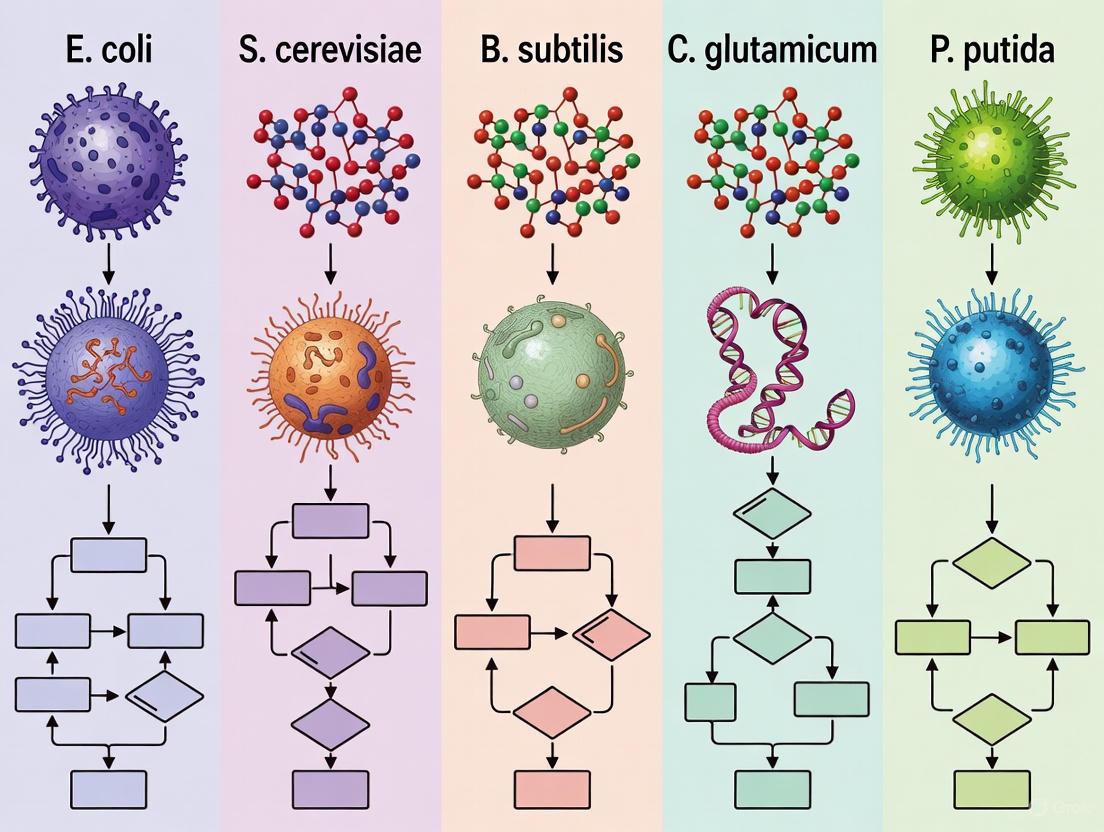
This article provides a comprehensive comparison of five pivotal microbial hosts—Escherichia coli, Saccharomyces cerevisiae, Bacillus subtilis, Corynebacterium glutamicum, and Pseudomonas putida—targeted at researchers, scientists, and drug development professionals.
Comparative Analysis of E. coli, S. cerevisiae, B. subtilis, C. glutamicum, and P. putida for Biomanufacturing and Drug Development
Abstract
This article provides a comprehensive comparison of five pivotal microbial hosts—Escherichia coli, Saccharomyces cerevisiae, Bacillus subtilis, Corynebacterium glutamicum, and Pseudomonas putida—targeted at researchers, scientists, and drug development professionals. It explores foundational biology, methodological applications, troubleshooting strategies, and validation techniques to guide organism selection for bioprocessing, metabolic engineering, and therapeutic production, with implications for accelerating biomedical innovations.
Core Biology and Industrial Relevance of E. coli, S. cerevisiae, B. subtilis, C. glutamicum, and P. putida
Escherichia coli stands as a cornerstone organism in biotechnology and industrial microbiology. This guide provides a systematic comparison of E. coli's performance against other major microbial workhorses—Saccharomyces cerevisiae, Bacillus subtilis, Corynebacterium glutamicum, and Pseudomonas putida. Through objective analysis of experimental data and functional characteristics, we illuminate the strategic position E. coli occupies in the microbial host landscape and provide researchers with evidence-based selection criteria for specific applications.
E. coli is a Gram-negative, facultative anaerobic bacterium that serves as the most widely utilized prokaryotic model organism. Its well-characterized genetics, rapid growth, and extensive molecular toolkit library have cemented its status as a biotechnological powerhouse.
The table below summarizes the fundamental characteristics of E. coli compared to other common microbial hosts:
Table 1: Fundamental Characteristics of Microbial Chassis Organisms
| Organism | Gram Stain / Type | Primary Biotech Applications | Growth Rate (Generation Time) | Genetic Manipulation Efficiency |
|---|---|---|---|---|
| Escherichia coli | Gram-negative, Bacterium | Recombinant protein production, metabolic engineering, basic research | Very Fast (20-30 min) | Excellent (Extensive tools, high efficiency) |
| Saccharomyces cerevisiae | Eukaryote, Yeast | Ethanol production, eukaryotic protein expression, synthetic biology | Moderate (90-120 min) | Good (Well-developed eukaryotic tools) |
| Bacillus subtilis | Gram-positive, Bacterium | Secretory protein production, enzyme industry | Fast (30-60 min) | Moderate (Tools less extensive than E. coli) |
| Corynebacterium glutamicum | Gram-positive, Bacterium | Industrial amino acid production (L-lysine, L-threonine) | Moderate (60-90 min) | Good (Established tools for amino acid production) |
| Pseudomonas putida | Gram-negative, Bacterium | Bioremediation, biocatalysis, stress resistance | Fast (30-60 min) | Moderate (Tools advancing, lower efficiency) |
Performance Comparison in Key Applications
Recombinant Protein Production
The selection of a microbial host for protein production hinges on the target protein's properties and final application requirements. The experimental data below highlights critical performance differences.
Table 2: Comparative Performance as Protein Expression Hosts
| Host Organism | Key Advantages | Key Limitations | Optimal Use Cases |
|---|---|---|---|
| Escherichia coli | High growth rate, high protein yields, low cost cultivation, extensive genetic tools [1] | Formation of inclusion bodies, inability for complex PTMs, endotoxin (LPS) contamination [1] | Non-glycosylated proteins, research enzymes, commodity proteins |
| Bacillus subtilis | High secretory capability, GRAS status, no endotoxin production [1] | Lower yields for some proteins, protease activity in medium, less advanced genetic tools [1] | Secreted industrial enzymes, proteins for food/pharma |
| Saccharomyces cerevisiae | Eukaryotic PTM capability, GRAS status, robust fermentation | Lower yields, hyperglycosylation, metabolic burden on prenylation | Eukaryotic proteins requiring glycosylation, metabolic engineering |
Experimental Data: A direct comparison of E. coli BL21(DE3) and P. putida KT2440 expressing three autodisplayed cellulases demonstrated that while recombinant E. coli showed higher cell growth rates, the P. putida cell factory exhibited superior enzyme bioactivity and remarkable biochemical characteristics across a broad pH (4-10) and temperature (30-100°C) range [2].
Metabolic Engineering and Metabolite Production
E. coli's flexible metabolism makes it a premier host for producing a wide array of biochemicals. The comparative analysis of L-threonine production showcases its capabilities versus other industrial hosts.
Table 3: L-Threonine Production Profile in E. coli and C. glutamicum
| Parameter | Escherichia coli | Corynebacterium glutamicum |
|---|---|---|
| Reported High Yield | 170.3 g/L [3] | 75.1 g/L [3] |
| Metabolic Physiology | Facultative anaerobe, flexible metabolism [3] | Obligate aerobe, specialized for amino acid synthesis [3] |
| Tolerance | Poor tolerance to high L-threonine concentrations [3] | High native tolerance, advantageous for production [3] |
| Safety & Downstream | Endotoxin contamination requires costly removal [3] | Non-pathogenic, no endotoxins, simpler purification [3] |
| Production Challenges | Product inhibition, acetate formation, endotoxin removal | Thick cell wall restricts efflux, higher biomass, longer growth cycle [3] |
Pathway Diagram: L-Threonine Biosynthesis from Central Metabolism The diagram below illustrates the core metabolic pathway for L-threonine synthesis in E. coli, highlighting key nodes and engineering targets.
Substrate Utilization and Bioconversion
Microbial hosts differ significantly in their ability to consume alternative feedstocks, impacting process economics for waste valorization.
Experimental Protocol: Crude Glycerol Fermentation to Ethanol
- Objective: To compare the performance of E. coli and S. cerevisiae in valorizing crude glycerol (a biodiesel byproduct) into ethanol.
- Strains: E. coli K-12 SMG123 and S. cerevisiae (commercial strain) [4].
- Culture Conditions:
- Media: Fermentation in 250 mL reactors with pure or acid-pretreated crude glycerol as carbon source at concentrations of 10, 20, and 30 g/L [4].
- Conditions: Microaerobic conditions for E. coli; anaerobic conditions for S. cerevisiae.
- Analytical Methods:
- Growth monitoring via optical density or cell counting.
- Ethanol quantification via HPLC or GC-MS.
- Glycerol consumption tracking.
- Key Results:
- With pure glycerol, ethanol production was comparable between E. coli (0.17-0.45 g/L) and S. cerevisiae (0.49-0.60 g/L) [4].
- E. coli consumed crude and pure glycerol at equal rates and tolerated high impurity concentrations [4].
- S. cerevisiae showed better fermentation performance on crude glycerol versus pure glycerol, achieving up to 0.73 g/L ethanol in a 7L reactor scale-up [4].
Molecular and Systems-Level Analysis
Core Metabolic Conservation
Comparative genomics reveals a conserved evolutionary core between prokaryotes and eukaryotes. Analysis shows that 271 small molecule metabolic enzymes are common to both E. coli and S. cerevisiae, involving 384 E. coli gene products and 390 yeast gene products [5]. This represents between one-half and two-thirds of the gene products dedicated to small molecule metabolism in each organism [5]. Approximately 70% of these common enzymes consist entirely of homologous domains, underscoring deep functional conservation [5].
Signaling Pathway Divergence
Despite using homologous proteins, E. coli and B. subtilis have evolved different regulatory circuits to control chemotaxis, demonstrating that network architecture can diverge while maintaining core function [6].
Diagram: Comparative Chemotaxis Pathways in E. coli and B. subtilis
The Scientist's Toolkit: Essential Research Reagents
Table 4: Key Reagent Solutions for E. coli Research and Engineering
| Reagent / Material | Function / Application | Examples / Notes |
|---|---|---|
| Cloning & Expression Vectors | Gene insertion, protein expression, metabolic pathway construction | pET series (T7-driven expression), pBAD (arabinose-inducible), pACYC (compatible low-copy) |
| E. coli BL21(DE3) | Protein expression workhorse | DE3 phage integration provides T7 RNA polymerase for high-yield expression [2] |
| E. coli K-12 Strains | Metabolic engineering, pathway prototyping | MG1655 (wild-type), JW strains (Keio collection, single-gene knockouts) |
| CRISPR-Cas9 Systems | Genome editing, gene knockout, transcriptional regulation | Plasmid-based systems for efficient, marker-free genome modifications |
| Specialized Media | Selective growth, phenotype induction, high-density fermentation | LB (general growth), M9 (defined minimal media), TB (high-density protein expression) |
| Enzyme Assay Kits | Quantifying metabolic flux, enzyme activity, pathway efficiency | Commercial kits for dehydrogenases, kinases, metabolomics sample prep |
| Antibiotics & Selective Agents | Plasmid maintenance, selective pressure for engineered strains | Ampicillin, kanamycin, chloramphenicol, antibiotic-free selection systems |
Strategic Host Selection Framework
The optimal microbial host depends on the specific requirements of the target product or application. The following decision framework summarizes key selection criteria:
Select E. coli when:
- Maximum protein yield is critical and the protein is of prokaryotic origin [1]
- Rapid process development and scale-up are prioritized [1]
- The application does not require eukaryotic post-translational modifications [1]
- Endotoxin contamination can be managed or is not a concern [3]
Consider alternative hosts when:
- S. cerevisiae: Eukaryotic glycosylation is required, or GRAS status is essential [4]
- B. subtilis: High-level protein secretion is needed, and endotoxins must be avoided [1]
- C. glutamicum: Industrial amino acid production is the focus, leveraging its native high tolerance [3]
- P. putida: Robust biocatalysis under stressful conditions or bioremediation is the goal [2]
E. coli remains the default starting point for most biotechnological applications due to its unparalleled genetic tractability, rapid growth, and extensive toolkit. However, strategic consideration of project-specific requirements often justifies investment in alternative platforms that may offer superior performance for specialized applications.
Within the systematic comparison of Escherichia coli, Saccharomyces cerevisiae, Bacillus subtilis, Corynebacterium glutamicum, and Pseudomonas putida, the yeast S. cerevisiae occupies a unique niche as a premier eukaryotic host. It combines the cultivation simplicity of a unicellular microbe with the advanced functional capabilities of a eukaryotic cell [7] [8]. This guide objectively analyzes the performance of S. cerevisiae against other microbial systems, focusing on its proven advantages for producing complex, eukaryotic proteins—particularly those requiring precise folding or post-translational modifications (PTMs) for biological activity. The following sections, supported by experimental data and comparative tables, will delineate the specific contexts in which S. cerevisiae provides a critical production advantage.
Performance Comparison: S. cerevisiae vs. Alternative Hosts
The selection of a microbial host is a critical determinant in the success of a recombinant protein production campaign. The table below provides a comparative overview of the key characteristics of major production hosts, including the prokaryotic workhorse E. coli and other yeast systems.
Table 1: Comprehensive Comparison of Microbial Hosts for Recombinant Protein Production
| Host Organism | E. coli | S. cerevisiae | K. phaffii (P. pastoris) | Y. lipolytica |
|---|---|---|---|---|
| Cell Type | Prokaryote | Eukaryote | Eukaryote | Eukaryote |
| GRAS Status | No | Yes (GRAS) | Yes (GRAS) | Yes (GRAS) |
| Post-Translational Modifications | Limited or none; no glycosylation | Eukaryotic PTMs, including N- and O-linked glycosylation (high-mannose) | Eukaryotic PTMs; shorter glycan chains | Eukaryotic PTMs |
| Typical Yield | High for simple proteins | Moderate to High | High | High for native/secreting proteins |
| Secretion Efficiency | Low; often requires optimization | High; well-developed secretory pathway | Very High | Very High |
| Glycosylation Authenticity | Not applicable | Hyperglycosylation; can be humanized via engineering | Less hyperglycosylation; can be humanized | Can be engineered |
| Handling & Cultivation | Simple, rapid, low-cost | Simple, rapid, low-cost | Simple; high-density fermentation | Simple; can utilize diverse carbon sources |
| Genetic Tools | Extensive and highly advanced | Extensive and highly advanced | Increasingly advanced | Developing |
| Ideal Protein Types | Non-glycosylated proteins, enzymes, proteins for structural biology | Complex eukaryotic proteins, vaccines, therapeutics, membrane proteins | High-yield secreted proteins, enzymes, therapeutics | Lipases, proteases, industrial enzymes |
Key Insights from Comparative Performance:
- Versus E. coli: The primary advantage of S. cerevisiae lies in its eukaryotic protein processing machinery. While E. coli remains dominant for prokaryotic and simple eukaryotic proteins, it often fails to produce functional forms of complex proteins like monoclonal antibodies or G-protein coupled receptors (GPCRs) due to an inability to glycosylate and a tendency to form insoluble inclusion bodies [8] [9]. S. cerevisiae provides the correct folding environment and essential PTMs for these challenging targets.
- Versus Other Yeasts: While non-conventional yeasts like Komagataella phaffii (formerly P. pastoris) offer benefits like higher biomass yields and less hyperglycosylation, S. cerevisiae currently holds a significant lead in the availability of advanced genetic tools, well-annotated genome, and a vast repository of publicly available -omics data [7] [10]. This makes S. cerevisiae exceptionally tractable for sophisticated metabolic engineering and high-throughput strain development programs.
Quantitative Analysis of Production Yields
Direct comparisons of protein titers across different hosts and experiments provide a tangible metric for evaluation. The following table summarizes reported yields for various protein classes produced in S. cerevisiae and other common hosts.
Table 2: Representative Protein Yields in S. cerevisiae and Other Microbial Systems
| Protein | Host | Yield | Experimental Context | Citation |
|---|---|---|---|---|
| Vanillin-β-glucoside | S. cerevisiae S288c | Up to 10-fold higher than CEN.PK | Continuous cultivation; de novo pathway | [11] |
| Alkaline Extracellular Protease | Y. lipolytica (native) | 1–2 g/L | Secretion by wild-type strains | [7] |
| Recombinant Proteins | S. cerevisiae | Up to 49.3% (w/w) of total cellular protein | General maximum capacity reported | [10] |
| Various Biopharmaceuticals | S. cerevisiae | Market-level production | Insulin, hepatitis B vaccine, human serum albumin | [7] [9] |
| Talaromyces emersonii Glucoamylase | S. cerevisiae | 3.3-fold increase in extracellular activity | Codon-optimized gene (temG-Opt) vs. native | [10] |
Analysis of Quantitative Data: The data underscores several key points. First, the strain background within S. cerevisiae itself can have a dramatic impact on yield, as evidenced by the 10-fold difference in vanillin-β-glucoside production between S288c and CEN.PK strains [11]. This highlights the necessity of early strain selection in project planning. Second, the ability of S. cerevisiae to achieve very high recombinant protein levels—up to nearly 50% of its cellular protein content—demonstrates its immense capacity as a cell factory [10]. Finally, successful codon optimization, as shown with the glucoamylase gene, can lead to substantial yield improvements, a strategy that is particularly effective in the genetically tractable S. cerevisiae environment [10].
Experimental Protocols for Protein Production in S. cerevisiae
Protocol: Benchmarking Strain Performance in a Bioreactor
This protocol is adapted from a study comparing the production of vanillin-β-glucoside in S288c and CEN.PK strain backgrounds [11].
- Strain Engineering: Integrate the heterologous pathway genes (e.g., 3DSD, ACAR, EntD, HsOMT, UGT) into a phenotypically neutral site (e.g., chromosome XII) of both S. cerevisiae S288c and CEN.PK using a standardized integration platform (e.g., USER cloning).
- Elimination of Auxotrophies: Backcross the engineered strains to their corresponding wild-type strains to eliminate any auxotrophic markers that could confound physiological comparisons.
- Batch Fermentation:
- Medium: Use a defined mineral medium with glucose as the sole carbon source.
- Conditions: Maintain a fixed temperature (e.g., 30°C), pH (e.g., 5.0), and dissolved oxygen tension.
- Monitoring: Track biomass formation (OD600), substrate consumption, and product formation over time.
- Continuous Cultivation:
- Setup: After batch growth, switch to a continuous mode with a fixed dilution rate.
- Steady-State Analysis: Maintain the culture for at least 5 volume changes to achieve steady state. Collect samples for analysis of biomass, metabolites, and recombinant product yield under respiratory growth conditions.
- Analytical Quantification: Use HPLC or LC-MS to quantify the final product concentration (e.g., vanillin-β-glucoside) and calculate volumetric and specific yields.
Protocol: Enhancing Yield via Codon Optimization and Secretion
This methodology outlines a standard workflow for optimizing the production of a heterologous enzyme in S. cerevisiae [10].
- Codon Optimization: For the gene of interest (e.g., Talaromyces emersonii glucoamylase, temG), perform in silico codon optimization. Replace rare codons with those preferred by S. cerevisiae, adjust GC content, and avoid sequence elements like internal restriction sites or secondary structures that could impair mRNA stability or translation.
- Vector Construction: Clone the native and codon-optimized gene versions into a yeast expression vector under the control of a strong, inducible promoter (e.g., GAL1). Fuse the gene to a suitable secretion signal peptide (e.g., the alpha-factor pre-pro leader).
- Strain Transformation: Introduce the constructed plasmids into a suitable S. cerevisiae secretion host strain (e.g., BJ3505).
- Small-Scale Production:
- Inoculate transformants in selective medium with raffinose.
- Induce protein expression by adding galactose.
- Culture for a defined period (e.g., 48-72 hours).
- Activity Assay:
- Separate cells from the culture supernatant by centrifugation.
- Use the supernatant (containing the secreted enzyme) in a specific activity assay (e.g., measuring glucose release from starch for glucoamylase).
- Compare the extracellular enzymatic activity of strains expressing the native versus the codon-optimized gene.
Visualization of Key Pathways and Workflows
S. cerevisiae Eukaryotic Protein Secretion Pathway
The following diagram illustrates the engineered secretory pathway in S. cerevisiae, which is a cornerstone of its utility for producing complex proteins.
Experimental Workflow for Strain Benchmarking
This workflow outlines the key steps for a systematic comparison of production performance across different genetic backgrounds, as described in the experimental protocol.
The Scientist's Toolkit: Research Reagent Solutions
Table 3: Essential Research Reagents for S. cerevisiae Protein Production
| Reagent / Tool | Function & Application | Examples / Notes |
|---|---|---|
| Expression Plasmids | Vectors for carrying the gene of interest. | YEp (high-copy episomal), YCp (low-copy centromeric), YIp (stable chromosomal integration). Choice depends on needed copy number and stability [10]. |
| Promoters | Regulate the transcription level of the recombinant gene. | Constitutive: PGK1, TEF1, GPD. Inducible: GAL1 (galactose), CUP1 (copper). Inducible systems are preferred for toxic proteins [7] [10]. |
| Secretion Signals | Direct the recombinant protein for secretion into the culture medium, simplifying purification. | Alpha-factor pre-pro leader: The most widely used and efficient signal for secreting heterologous proteins [10] [12]. |
| Host Strains | The background strain for protein production; choice is critical for yield. | S288c derivatives: Well-annotated, good for genetics. CEN.PK series: Popular for physiology and metabolic engineering. BJ3505, HBY114: Specialized for enhanced protein secretion [11] [10]. |
| Codon Optimization Tools | In silico services to redesign gene sequences for optimal translation in S. cerevisiae. | Software algorithms that replace rare codons, adjust GC content, and remove destabilizing motifs to maximize protein expression levels [10]. |
| Gene Editing Systems | Enable precise genomic integration of expression cassettes. | CRISPR-Cas9: Allows for targeted, multiplexed integration of pathway genes into neutral chromosomal loci [13] [10]. |
| Culture Systems | Scalable platforms for protein production. | Shake flasks, Stirred-tank Bioreactors (for controlled batch/continuous cultivation with precise control over pH, DO, and feeding) [11]. |
Bacillus subtilis is a Gram-positive soil bacterium that has emerged as a premier microbial cell factory for industrial production of enzymes, biochemicals, and therapeutic proteins. Its significance stems from two fundamental advantages: its Generally Recognized as Safe (GRAS) status designated by the U.S. Food and Drug Administration, and its highly efficient protein secretion system that enables direct release of proteins into the culture medium [14] [15]. These characteristics make B. subtilis particularly suitable for large-scale industrial applications where safety and downstream processing efficiency are paramount. Unlike Gram-negative bacteria such as E. coli, B. subtilis lacks lipopolysaccharides (endotoxins), which simplifies product purification and reduces potential pyrogenic reactions in therapeutic applications [15]. The absence of an outer membrane allows direct secretion of proteins into the extracellular space, significantly reducing the complexity and cost of downstream processing compared to systems where proteins accumulate intracellularly or require disruption of multiple cellular membranes [15].
The combination of GRAS status, exceptional secretion capacity, and well-characterized genetics has established B. subtilis as a preferred host for industrial enzyme production, with applications spanning detergents, food processing, agriculture, and biofuel production [14]. This review systematically examines the secretory capabilities of B. subtilis in comparison to other common production hosts, provides experimental methodologies for assessing secretion efficiency, and outlines engineering strategies to enhance industrial scale-up potential.
Comparative Analysis of Microbial Production Hosts
Key Characteristics of Industrial Microorganisms
Table 1: Comparison of major microbial platforms for recombinant protein production
| Characteristic | B. subtilis | E. coli | S. cerevisiae | C. glutamicum | P. putida |
|---|---|---|---|---|---|
| GRAS Status | Yes [14] | Some strains [16] | Yes [17] | Yes | Limited |
| Secretion Efficiency | High (extracellular) [15] | Low (mainly periplasmic) [16] | Moderate (extracellular) [12] | Moderate (extracellular) | Variable |
| Growth Rate | Fast (48h fermentation) [14] | Very fast | Moderate (180h fermentation) [14] | Fast | Fast |
| Downstream Processing | Simple [15] | Complex [16] | Intermediate | Intermediate | Complex |
| Genetic Tools | Advanced [14] | Extensive | Advanced [12] | Developing | Developing |
| Post-translational Modifications | Limited | Limited | Extensive [12] | Limited | Limited |
| Codon Bias | Minimal [14] | Moderate | Significant [12] | Moderate | Moderate |
| Protease Activity | High (but engineerable) [18] | Low | Low | Low | Variable |
| Typical Product Titer | High (e.g., 80g/L LNT) [19] | Very high | Moderate | High | Moderate |
Secretion Capability Analysis
The protein secretion capability of B. subtilis represents one of its most significant advantages for industrial applications. B. subtilis employs the Sec-dependent protein translocation pathway as its primary secretion mechanism [15]. Proteins destined for secretion are synthesized with N-terminal signal peptides that direct them to the translocase complex in the membrane. These signal peptides display structural conservation with three distinct regions: a positively charged N-terminal region, a central hydrophobic H-region, and a hydrophilic C-region with a signal peptidase recognition site [15].
In contrast, E. coli faces substantial limitations in secretory production due to its Gram-negative cell envelope structure, which includes both inner and outer membranes [16]. While E. coli can achieve high cytoplasmic expression levels, secretion into the extracellular space requires traversing multiple barriers, making efficient secretion challenging. The presence of lipopolysaccharides (LPS) in the outer membrane poses additional complications for pharmaceutical applications due to endotoxin concerns [16].
S. cerevisiae offers eukaryotic protein processing capabilities, including glycosylation, but exhibits slower growth rates and more complex secretion pathways compared to B. subtilis [14] [17]. The fermentation cycle for S. cerevisiae is approximately 180 hours, significantly longer than the typical 48-hour cycle for B. subtilis [14]. This difference substantially impacts production economics in industrial settings.
Table 2: Secretion pathway components comparison across microbial hosts
| Secretion Component | B. subtilis | E. coli | S. cerevisiae |
|---|---|---|---|
| Translocation Channel | SecYEG [15] | SecYEG [16] | Sec61 complex |
| Translocation Motor | SecA [15] | SecA [16] | Sec63/Sec72 complex |
| Signal Peptidases | SipS-SipW [15] | LepB | Signal peptidase complex |
| Membrane Chaperones | SpoIIIJ/YqjG [15] | YidC [16] | - |
| Folding Catalysts | PrsA, BdbB-D [15] | DsbA/C, FkpA | PDI, Ero1 |
| Quality Control Proteases | HtrA-C, WprA [15] | DegP, Protease III | - |
Experimental Assessment of Secretion Efficiency
Standard Protocol for Secretion Analysis
Objective: To quantitatively assess the secretion efficiency of recombinant proteins in B. subtilis and compare with other expression hosts.
Materials:
- B. subtilis expression strain (e.g., WB800N protease-deficient) [18]
- Expression vector with inducible promoter (e.g., Psubtilin) [20]
- Centrifugation equipment for cell separation
- SDS-PAGE apparatus and Western blotting system
- His-tag immunodetection reagents [20]
- Protease inhibitor cocktail
Methodology:
- Strain Preparation: Transform B. subtilis with expression vector containing gene of interest fused to C-terminal 6His-tag [20].
- Cultivation: Grow transformed strain to mid-exponential phase (OD600 ≈ 0.6-0.8) in appropriate medium.
- Induction: Induce expression with subtilin (for subtilin-inducible promoter) or other appropriate inducer.
- Sampling: Collect samples at 30 minutes post-induction for transcriptome analysis (if applicable) and at 2 hours for protein detection [20].
- Fractionation: Separate culture into whole-cell, membrane, cytoplasm, and medium fractions by centrifugation and ultracentrifugation [20].
- Analysis:
- Perform SDS-PAGE analysis of all fractions
- Conduct immunodetection using His-tag antibodies
- Quantify band intensities to determine distribution across cellular compartments
Expected Results: For efficiently secreted proteins like NprE and XynA, the majority of the protein should be detected in the medium fraction [20]. Proteins with secretion bottlenecks may accumulate in cell wall or membrane fractions.
Protocol for Assessing Transcriptional Response to Secretion Stress
Objective: To identify cellular responses to protein overproduction stress using transcriptome analysis.
Materials:
- DNA microarrays or RNA-seq capabilities
- Appropriate bioinformatics tools
- Samples from protein overproduction strains
Methodology:
- Strain Construction: Create strains overproducing proteins with different subcellular localizations (membrane, lipoprotein, secreted) [20].
- Cultivation and Induction: Grow strains to mid-exponential phase and induce overexpression.
- RNA Extraction: Isolate mRNA 30 minutes post-induction.
- Transcriptome Analysis: Compare mRNA levels of overproducing strains with control strain using DNA microarrays [20].
- Data Analysis: Identify genes with at least 2.5-fold upregulation or downregulation in response to overproduction.
Key Findings: This approach has revealed that B. subtilis activates specific stress responses depending on the type of protein being overproduced. For example:
- Overproduction of secreted proteins upregulates
cssRS,htrA, andhtrB[20] - Membrane protein overproduction activates
sigWand SigW-regulated genes [20] - General stress responses include upregulation of
groES/ELand CtsR-regulated genes [20]
Engineering Strategies for Enhanced Secretion
Genetic Toolbox for B. subtilis Engineering
Figure 1: Genetic engineering tools available for B. subtilis strain improvement
Secretion Pathway Engineering
Figure 2: B. subtilis secretion pathway with identified bottlenecks
The Scientist's Toolkit: Essential Research Reagents
Table 3: Key research reagents for B. subtilis protein production studies
| Reagent / Tool | Function | Example Applications |
|---|---|---|
| Protease-deficient Strains (WB600, WB700, WB800, WB800N) [18] | Reduce target protein degradation | Production of protease-sensitive proteins |
| Inducible Promoter Systems (Psubtilin, Pxyl) [20] | Controlled gene expression | Timing of protein production to minimize stress |
| Integration Vectors (pNZ8901, pNZ8902) [20] | Chromosomal gene integration | Stable expression without antibiotic selection |
| Signal Peptide Libraries [15] | Optimization of secretion efficiency | Screening for optimal secretion of heterologous proteins |
| CRISPR-Cas9 Tools [14] | Precise genome editing | Gene knockouts, pathway engineering |
| 6His-Tag Vectors [20] | Protein detection and purification | Tracking protein localization and quantification |
| Transcriptome Analysis Tools | Gene expression profiling | Identifying cellular responses to production stress |
Case Study: Industrial-Scale Production of Human Milk Oligosaccharides
A recent breakthrough demonstrates the industrial potential of engineered B. subtilis for high-value product manufacturing. Researchers achieved unprecedented production of Lacto-N-tetraose (LNT), an important human milk oligosaccharide with prebiotic benefits, using engineered B. subtilis [19].
Engineering Strategy:
- Pathway Construction: Identified and expressed three key enzymes: β-1,3-galactosyltransferase, β-1,3-N-acetylglucosaminyltransferase, and β-galactoside permease for complete LNT biosynthesis [19].
- Metabolic Engineering: Disrupted competing pathways and enhanced UDP-GlcNAc/Gal precursor supply [19].
- CRISPRi Regulation: Implemented a cost-effective CRISPR interference system to downregulate essential competing genes (
zwf,pfkA,murAB) [19].
Performance Metrics:
- Initial yield: 1.42 g/L in shake-flask cultures
- After engineering: 7.83 g/L (5.5-fold increase)
- Fed-batch bioreactors: 80.48 g/L - the highest documented LNT titer [19]
This case study exemplifies how B. subtilis can be engineered as a scalable biomanufacturing platform with precise metabolic regulation, highlighting its potential for industrial production of high-value compounds.
B. subtilis presents a compelling combination of safety, secretion efficiency, and genetic tractability that positions it as a superior host for industrial bioproduction. Its GRAS status and direct extracellular secretion capability provide distinct advantages over both Gram-negative alternatives like E. coli and eukaryotic systems such as S. cerevisiae, particularly for applications requiring high volumetric productivity and simplified downstream processing.
Future development of B. subtilis as a production platform will likely focus on several key areas: (1) further minimization of genomes to create specialized "mini-Bacillus" chassis with reduced metabolic burden; (2) expansion of the non-classical secretion routes to bypass Sec-pathway bottlenecks; and (3) integration of systems biology approaches with machine learning to predict and optimize secretion efficiency. The continuing advancement of CRISPR-based tools will accelerate these engineering efforts, making B. subtilis an increasingly versatile cell factory for both bulk enzyme production and high-value specialty chemicals.
The proven success in industrial-scale production of compounds like LNT at titers exceeding 80 g/L demonstrates that B. subtilis can compete effectively with traditional production hosts while offering the additional benefits of extracellular secretion and regulatory safety approval [19]. As synthetic biology tools continue to mature, B. subtilis is poised to expand its role as a cornerstone of industrial biotechnology.
Corynebacterium glutamicum stands as a cornerstone of industrial biotechnology, renowned for its role as a microbial workhorse for the large-scale production of amino acids. Since its discovery over 70 years ago, this Gram-positive soil bacterium has been engineered for the annual production of millions of tons of L-glutamate and L-lysine [21] [22]. Its reputation extends beyond traditional amino acid synthesis to a rapidly expanding portfolio of high-value compounds. This review objectively assesses the performance of C. glutamicum in amino acid biosynthesis against other established microbial hosts like Escherichia coli, Bacillus subtilis, Saccharomyces cerevisiae, and Pseudomonas putida. We focus on its intrinsic physiological advantages, quantitative production metrics, and the sophisticated engineering strategies that underpin its industrial prowess, providing a comparative guide for researchers and process developers in the field.
Performance Comparison:C. glutamicumvs. Alternative Microbial Chassis
The selection of an appropriate microbial host is critical for efficient amino acid production. The table below provides a comparative overview of the key characteristics of several industrially relevant microorganisms.
Table 1: Comparison of Microbial Chassis for Amino Acid and Aromatic Compound Production
| Organism | Key Advantages | Production Examples (Titer, Yield) | Primary Industrial Applications |
|---|---|---|---|
| Corynebacterium glutamicum | High tolerance to aromatic compounds [23] [24]; GRAS status; Utilizes diverse carbon sources [21] [22]; Robust cell wall; Mature engineering tools [22]. | L-Valine: 150 g/L, Yield 0.57 g/g [22]; L-Leucine: 38.1 g/L [22]; Shikimate: 141 g/L [24]. | Amino acids (L-Glutamate, L-Lysine, BCAAs), Aromatic chemicals, Diamines, Organic acids. |
| Escherichia coli | Fast growth; Highly developed genetic tools [23]; Extensive -omics databases; Well-understood physiology. | Isobutanol (engineered) [25]; Aromatic Amino Acids [23]. | Recombinant proteins, Organic acids, Biofuels, Aromatic compounds. |
| Pseudomonas putida | High intrinsic tolerance to solvents and toxic compounds [25]; Versatile metabolism for organic pollutants. | Isobutanol: Low yield vs. C. glutamicum and E. coli [25]; cis,cis-Muconate [25]. | Bioremediation, cis,cis-Muconate, Biofuels. |
| Bacillus subtilis | Strong protein secretion capacity; GRAS status. | — (Information not available in search results) | Industrial enzymes, Heterologous protein production. |
| Saccharomyces cerevisiae | GRAS status; High tolerance to low pH and organic acids; Eukaryotic protein processing. | — (Information not available in search results) | Ethanol, Recombinant proteins, Organic acids. |
A more detailed comparison of production performance for specific compounds highlights the superior titers often achieved with C. glutamicum.
Table 2: Comparative Production Metrics for Selected Compounds in C. glutamicum
| Compound | C. glutamicum Strain Genotype | Titer | Yield (g/g Glucose) | Reference |
|---|---|---|---|---|
| L-Valine | ΔldhA Δppc Δpta ΔackA ΔctfA ΔavtA_ilvNGEC + gapA + pyk + pfkA + pgi + tpi + pCRB-BNGEC + pCRB-DLD | 150.0 g/L | 0.57 | [22] |
| L-Leucine | ML1-9 (ΔilvA ΔalaT Δldh ΔltbR ΔpanBC) + leuAR (feedback-resistant) | 38.1 g/L | 0.30 | [22] |
| L-Isoleucine | IWJ001 + pDXW‐8‐gnd‐fbp‐pgl | 29.0 g/L | 0.14 | [22] |
| Shikimate (SA) | ΔaroK, Δpts, ΔqsuB, ΔqsuD + plasmid aroGBDE | 141 g/L | — | [24] |
| γ-Aminobutyrate (GABA) | ΔargB ΔproB ΔdapA + gad plk | 70.6 g/L | — | [22] |
The Metabolic Toolkit: Biosynthetic Pathways and Regulation
The exceptional production capability of C. glutamicum is rooted in its central metabolism and the shikimate pathway. A key advantage is its high tolerance to aromatic compounds, such as hydroxybenzoic acids, which surpasses that of other bacteria like Pseudomonas putida [24]. This trait is partly attributed to its unique cell wall, rich in mycolic acids, which acts as a permeability barrier [24].
The Shikimate Pathway for Aromatic Amino Acids
Aromatic amino acids (AAAs)—L-phenylalanine (Phe), L-tyrosine (Tyr), and L-tryptophan (Trp)—are synthesized in bacteria, yeasts, fungi, and plants via the shikimate pathway [23]. The pathway begins with the condensation of phosphoenolpyruvate (PEP) from glycolysis and erythrose-4-phosphate (E4P) from the pentose phosphate pathway, catalyzed by DAHP synthase (DAHPS) [23]. The pathway is tightly regulated at the level of enzyme activity and gene expression.
- Regulation by Feedback Inhibition: In C. glutamicum, carbon flow into the shikimate pathway is controlled by feedback inhibition of DAHPS isozymes. The dominant isozyme, AroG, is moderately inhibited by Trp, while AroF is inhibited by both Phe and Tyr [23]. This is in contrast to E. coli, which has three dedicated isozymes (AroF, AroG, AroH) inhibited specifically by Tyr, Phe, and Trp, respectively [23]. Furthermore, C. glutamicum possesses a unique complex formation between its major DAHPS (AroG) and chorismate mutase (CM), which is essential for CM activity and is inhibited by Phe [23].
- Transcriptional Regulation: AAA biosynthesis is also controlled transcriptionally. In E. coli, the transcriptional regulators TyrR and TrpR repress the expression of DAHPS genes in the presence of their corresponding AAAs [23]. The regulatory mechanisms in C. glutamicum are complex and an area of active research.
The following diagram illustrates the shikimate pathway and its key regulatory mechanisms in C. glutamicum.
Diagram 1: Aromatic amino acid biosynthesis via the shikimate pathway in C. glutamicum, highlighting key feedback inhibition mechanisms. Abbreviations: DAHP (3-deoxy-D-arabino-heptulosonate-7-phosphate), DAHPS (DAHP synthase), CM (chorismate mutase), PDT (prephenate dehydratase), PDH (prephenate dehydrogenase).
Branched-Chain Amino Acid (BCAA) Biosynthesis
The biosynthetic pathways for the branched-chain amino acids (BCAAs)—L-valine, L-leucine, and L-isoleucine—are interconnected and share several enzymes. They all originate from the central metabolite pyruvate [26]. A crucial and highly regulated enzyme in this pathway is acetohydroxy acid synthase (AHAS), which catalyzes the first committed step in the synthesis of all three BCAAs.
- Feedback Inhibition of AHAS: AHAS is a tetramer composed of catalytic (IlvB) and regulatory (IlvN) subunits. The accumulation of BCAAs, particularly L-valine, inhibits AHAS activity [26]. The IC₅₀ values for L-valine, L-leucine, and L-isoleucine are 0.110, 0.790, and 0.410 g/L, respectively [26].
- Engineering to Relieve Inhibition: A major metabolic engineering strategy involves modifying AHAS to relieve this feedback inhibition. For example, mutating amino acids G-I-I at positions 20-22 of the regulatory subunit IlvN to D-D-F generated a mutant (M13) that resisted feedback inhibition, leading to an increase in L-leucine titer from 3.46 g/L to 7.21 g/L [26].
Experimental Protocols for Engineering and Analysis
This section outlines standard methodologies used for metabolic engineering and performance evaluation of C. glutamicum strains, providing a template for reproducible research.
Protocol for Relieving Feedback Inhibition in BCAA Production
Objective: To construct a C. glutamicum strain producing high levels of BCAAs by engineering a feedback-resistant AHAS enzyme.
- Gene Identification and Mutagenesis: Identify the genes encoding the AHAS enzyme, specifically the regulatory subunit ilvN. Perform site-directed mutagenesis (e.g., using overlap extension PCR or a commercial kit) to introduce specific point mutations (e.g., G20D, I21D, I22F) known to confer resistance to feedback inhibition by valine, leucine, and isoleucine [26].
- Plasmid Construction: Clone the mutated ilvBNC operon (including the catalytic subunit ilvB and the mutated regulatory subunit ilvN) into an appropriate E. coli/C. glutamicum shuttle vector under the control of a strong, constitutive promoter.
- Strain Transformation: Introduce the constructed plasmid into a selected C. glutamicum production host. Alternatively, integrate the mutated gene(s) into the chromosome via homologous recombination.
- Fermentation and Analysis:
- Inoculate the engineered strain into a defined medium with glucose as the primary carbon source.
- Conduct fed-batch fermentation in a bioreactor, controlling parameters such as pH (~7.0), temperature (30°C), and dissolved oxygen.
- Monitor cell growth (OD₆₀₀) and glucose consumption throughout the fermentation.
- Analyze BCAA concentrations in the culture supernatant at regular intervals using High-Performance Liquid Chromatography (HPLC) [26].
Protocol for Shikimate Production from Mixed Sugars
Objective: To engineer a C. glutamicum strain for high-level shikimate production from glucose and pentose sugars (xylose/arabinose).
- Host Strain Engineering:
- Delete Shikimate Kinase: Inactivate the aroK gene to block the conversion of shikimate to shikimate-3-phosphate, making the strain auxotrophic for aromatic amino acids and para-aminobenzoate (PABA) [24].
- Block Competing Pathways: Delete genes qsuB (dehydroshikimate dehydratase) and qsuD (quinate/shikimate dehydrogenase) to prevent degradation of pathway intermediates [24].
- Modulate Sugar Uptake: Eliminate the phosphotransferase system (PTS) to increase intracellular phosphoenolpyruvate (PEP) availability, a precursor for the shikimate pathway [24].
- Enable Pentose Utilization: Introduce heterologous genes for xylose isomerase (xylA) and xylulokinase (xylB) to enable xylose catabolism [21].
- Pathway Amplification: Introduce a plasmid for the episomal expression of the aroG, aroB, aroD, and aroE genes, encoding the first four enzymes of the shikimate pathway [24].
- High-Density Fermentation:
- Cultivate the engineered strain in a bioreactor using a medium containing a mixture of glucose, xylose, and arabinose, supplemented with aromatic amino acids and PABA.
- Employ a fed-batch strategy with high cell density to achieve high titers.
- Quantify shikimate and pathway intermediate accumulation using HPLC [24].
The Scientist's Toolkit: Essential Research Reagents
The table below lists key reagents and genetic tools essential for the metabolic engineering of C. glutamicum.
Table 3: Essential Research Reagents for C. glutamicum Metabolic Engineering
| Reagent / Tool | Function / Description | Example Use Case |
|---|---|---|
| PTS-Null Chassis | C. glutamicum strain with disabled phosphotransferase system (PTS) for glucose uptake. | Increases intracellular PEP availability, enhancing flux into the shikimate pathway for aromatic compound production [24]. |
| Feedback-Resistant ilvN | Mutated regulatory subunit of AHAS (e.g., G20D, I21D, I22F). | Relieves feedback inhibition by BCAAs, enabling high-level production of valine, leucine, and isoleucine [26]. |
| Feedback-Resistant aroG | Mutated DAHP synthase gene. | Resists feedback inhibition by aromatic amino acids, increasing carbon flux into the shikimate pathway [23] [24]. |
| pMKEx2 / pEKEx3 Vectors | Family of E. coli/C. glutamicum shuttle plasmids with inducible promoters (e.g., Ptac). | Used for heterologous expression of pathway enzymes, such as polyketide synthases or plant phenylpropanoid pathway enzymes [22]. |
| PhdR Deregulated Strain | C. glutamicum strain with deletion of the phdR repressor gene. | Enables efficient co-metabolism of p-hydroxycinnamates (e.g., from lignin) for production of cis,cis-muconate [27]. |
| Xylose Utilization Cassette | Heterologous genes xylA (xylose isomerase) and xylB (xylulokinase). | Allows C. glutamicum to utilize xylose from hemicellulosic hydrolysates as a carbon source [21]. |
C. glutamicum demonstrates a compelling profile as a microbial cell factory, distinguished by its robust physiology, high native tolerance to toxic compounds, and remarkable metabolic versatility. Quantitative comparisons show that engineered strains of C. glutamicum achieve top-tier performance in the production of both proteinogenic and non-proteinogenic amino acids, as well as a growing range of aromatic fine chemicals. While organisms like E. coli offer faster growth and more extensive genetic toolkits, and P. putida provides exceptional solvent tolerance, C. glutamicum occupies a unique and valuable niche. Its proven industrial track record, combined with advanced genome-scale models and ever-improving engineering protocols, solidifies its status as a premier chassis for the sustainable production of amino acids and related high-value compounds in a bio-based economy.
The soil bacterium Pseudomonas putida has emerged as a robust platform for biotechnological applications, distinguished from traditional workhorses like Escherichia coli, Bacillus subtilis, Saccharomyces cerevisiae, and Corynebacterium glutamicum by its unique metabolic capabilities and exceptional stress tolerance. This non-pathogenic bacterium possesses a versatile metabolism that enables efficient degradation of environmental pollutants and synthesis of valuable chemicals, making it an ideal candidate for both bioremediation and industrial biotechnology [28]. Its natural competence for horizontal gene transfer and availability of advanced molecular tools have facilitated its development as a premier synthetic biology chassis, particularly the strain KT2440, which has been extensively engineered for diverse applications [28]. Unlike more specialized microbes, P. putida demonstrates remarkable resilience to physicochemical stresses, including organic solvents and oxidative damage, allowing it to perform catalytic functions under conditions that would inhibit other microbial hosts [29]. This article provides a systematic comparison of P. putida against other common microbial platforms, highlighting its distinctive advantages through experimental data and methodological protocols.
Comparative Analysis of Microbial Chassis Properties
P. putida occupies a unique niche among standard microbial hosts due to its metabolic versatility and environmental robustness. The table below provides a comparative analysis of key characteristics across common microbial platforms.
Table 1: Comparative Analysis of Microbial Chassis Properties
| Characteristic | P. putida | E. coli | B. subtilis | S. cerevisiae | C. glutamicum |
|---|---|---|---|---|---|
| Natural Habitat | Soil, rhizosphere | Mammalian gut | Soil | Fermented materials, plant exudates | Soil |
| Gram Reaction | Negative | Negative | Positive | - (Fungus) | Positive |
| Pathogenicity | Non-pathogenic | Some pathogenic strains | Non-pathogenic | Non-pathogenic | Non-pathogenic |
| Metabolic Versatility | High | Moderate | Moderate | Moderate | Moderate |
| Stress Tolerance | High (solvents, oxidative stress) | Moderate | High (heat, ethanol) | High (ethanol, acidic pH) | Moderate |
| Genetic Tools | Advanced | Extensive | Advanced | Extensive | Advanced |
| Typical Applications | Bioremediation, biocatalysis | Molecular biology, protein production | Enzyme production, sporulation studies | Eukaryotic protein production, metabolic engineering | Amino acid production |
The distinctive value proposition of P. putida lies in its exceptional metabolic capabilities, enabling it to degrade aromatic compounds and toxic chemicals that inhibit other microorganisms [28] [30]. This capability stems from its efficient redox metabolism and sophisticated stress response systems. Unlike E. coli, which thrives in nutrient-rich environments, P. putida demonstrates superior performance in minimal media and can utilize a wide range of carbon sources [31]. Compared to B. subtilis, which is prized for protein secretion and sporulation mechanisms, P. putida offers greater catalytic versatility for industrial biotransformations [32]. While S. cerevisiae provides eukaryotic protein modification systems, it lacks the metabolic flexibility for efficient aromatic compound degradation [33]. C. glutamicum, though excellent for amino acid production, doesn't match P. putida's capacity for metabolizing complex pollutant mixtures [31].
Bioremediation Capabilities: Comparative Performance Data
Degradation of Environmental Pollutants
The bioremediation potential of P. putida has been extensively documented across various pollutant classes. Experimental data demonstrate its superior performance compared to other bacterial species in degrading complex contaminants.
Table 2: Bioremediation Performance of P. putida Compared to Other Microorganisms
| Pollutant/Application | Microorganism | Experimental Conditions | Performance Metrics | Time Frame | Citation |
|---|---|---|---|---|---|
| Thiamethoxam (neonicotinoid) | P. putida | 70 mg/L in aqueous media, 30°C | 65% removal | 24 days | [34] |
| P. fluorescens | Same as above | 67% removal | 24 days | [34] | |
| E. coli | Same as above | 60% removal | 14 days | [34] | |
| S. lactis | Same as above | 12% removal | 14 days | [34] | |
| Petroleum Hydrocarbons | P. putida MHF 7109 | Oil-contaminated environments | Efficient degradation of petroleum hydrocarbons | Variable | [30] |
| Phenolic Compounds | P. putida | Wastewater treatment | Up to 93% COD reduction | Variable | [30] |
| Naphthalene | P. putida G7 | Soil bioremediation | Efficient degradation | Variable | [30] |
| Contrasting Oils | P. putida F1 (pUCD607) | Soil spiked with crude oils | General increase in metabolic activity | 119 days | [35] |
Experimental Protocols for Bioremediation Assessment
Protocol 1: Hydrocarbon Degradation Assay This protocol assesses the capability of P. putida to degrade petroleum hydrocarbons, based on methodologies described in the search results [35] [30].
- Culture Preparation: Grow P. putida overnight in LB medium at 30°C with shaking at 200 rpm.
- Experimental Setup: Transfer bacterial cells to minimal salt medium containing 1% (v/v) petroleum hydrocarbons as the sole carbon source.
- Incubation: Maintain cultures at 30°C with continuous shaking for 7-14 days.
- Sampling and Analysis: Collect samples at regular intervals and extract hydrocarbons using dichloromethane. Analyze extracts by gas chromatography-mass spectrometry (GC-MS) to quantify residual hydrocarbons.
- Control Setup: Include sterile controls to account for abiotic degradation.
Protocol 2: Pesticide Degradation Kinetics This protocol evaluates the kinetics of pesticide degradation by P. putida, adapted from thiamethoxam removal studies [34].
- Culture Conditions: Grow P. putida in minimal medium with 70 mg/L thiamethoxam as sole carbon or nitrogen source.
- Temperature Optimization: Conduct parallel experiments at 2°C, 22°C, and 30°C to determine optimal degradation conditions.
- Sampling: Collect aliquots at 0, 2, 4, 7, 14, and 24 days for analysis.
- Analytical Methods: Quantify thiamethoxam concentration using high-performance liquid chromatography (HPLC).
- Kinetic Analysis: Calculate first-order degradation rate constants from concentration-time data.
Synthetic Biology and Metabolic Engineering Applications
Engineering Microbial Consortia with P. putida
P. putida serves as an excellent platform for constructing synthetic microbial consortia with division-of-labor strategies. Recent work has established stable synthetic consortia between P. putida KT2440 and Corynebacterium glutamicum ATCC13032, implementing various interaction modes including commensal relationships (+/0 and 0/+) and mutualistic cross-feeding (+/+) [31]. These consortia leverage the complementary strengths of both organisms: P. putida provides robust environmental stress tolerance and aromatic compound degradation, while C. glutamicum contributes efficient amino acid production capabilities. The consortia successfully produced γ-glutamylated amines including theanine (up to 2.6 g/L) and γ-glutamyl-isopropylamide (GIPA, up to 2.8 g/L), demonstrating the production potential of engineered cocultures [31].
Table 3: Performance of Engineered P. putida Strains in Biotechnology Applications
| Application | Strain | Engineering Strategy | Key Outcomes | Reference |
|---|---|---|---|---|
| Theanine Production | P. putida Thea1 | Expression of γ-glutamyl-methylamide synthetase (GMAS) | Production of theanine from glutamate and monoethylamine | [31] |
| Genome Streamlining | P. putida BGR4 | Targeted reduction of nonessential genetic components | 1.4×10⁵-fold increase in electroporation efficiency; enhanced stress tolerance and substrate utilization | [29] |
| Industrial Chassis | P. putida KT2440 | Development as synthetic biology platform | Robust redox metabolism, wide substrate range, tolerance to physicochemical stresses | [28] |
| Synthetic Consortia | P. putida + C. glutamicum | Arginine auxotrophy/overproduction and formamide utilization | Stable mutualistic consortium for value-added compound production | [31] |
Experimental Protocol: Establishing Synthetic Microbial Consortia
Protocol 3: Constructing P. putida-C. glutamicum Consortia This protocol details the establishment of synthetic microbial consortia between P. putida and C. glutamicum [31].
Strain Engineering:
- Engineer P. putida for arginine overproduction by amplifying native arginine biosynthesis genes.
- Introduce formamidase gene into C. glutamicum to enable utilization of formamide as nitrogen source.
Consortium Establishment:
- Inoculate both strains in nitrogen-limited minimal medium containing formamide as sole nitrogen source.
- Use initial inoculation ratios of 1:1, 1:2, and 2:1 (P. putida:C. glutamicum) to determine optimal partnership.
Stability Monitoring:
- Track population dynamics by flow cytometry using species-specific fluorescent markers.
- Sample consortium at 12-hour intervals for 5 days to assess stability.
Production Analysis:
- Induce theanine production by adding monoethylamine (50 mM) during mid-exponential phase.
- Quantify theanine yield using HPLC with UV detection.
Agricultural Applications: Biocontrol and Plant Growth Promotion
Comparative Efficacy in Plant Disease Management
P. putida demonstrates significant potential as a plant growth-promoting rhizobacterium (PGPR) with biocontrol capabilities against various plant pathogens. In studies examining the management of disease complex in beetroot caused by Meloidogyne incognita, Pectobacterium betavasculorum, and Rhizoctonia solani, P. putida application resulted in significant increases in plant growth parameters and defense enzyme activities [36]. When used in combination with B. subtilis, the biocontrol efficacy was enhanced synergistically, with maximum reduction in nematode multiplication and galling observed with the mixed culture treatment [36]. The combination also reduced soft rot and root rot indices from a rating of 5 (severe infection) to 1-2 (mild symptoms) in plants inoculated with multiple pathogens [36].
Table 4: Biocontrol Efficacy of P. putida Against Beetroot Disease Complex
| Treatment | Pathogen Challenge | Gall Reduction (%) | Disease Index (0-5 scale) | Plant Growth Enhancement |
|---|---|---|---|---|
| P. putida alone | M. incognita | 68.2% | - | Significant improvement |
| B. subtilis alone | M. incognita | 54.7% | - | Moderate improvement |
| P. putida + B. subtilis | M. incognita | 82.5% | - | Maximum improvement |
| P. putida + B. subtilis | P. betavasculorum | - | Reduction from 3 to 1 | Significant improvement |
| P. putida + B. subtilis | Multiple pathogens | - | Reduction from 5 to 2-3 | Significant improvement |
Experimental Protocol: Evaluating Biocontrol Efficacy
Protocol 4: Rhizosphere Competence and Biocontrol Assessment This protocol evaluates the plant growth-promoting and biocontrol activities of P. putida in greenhouse conditions [36].
Bacterial Inoculum Preparation:
- Grow P. putida in King's B medium for 48 hours at 28°C.
- Centrifuge cells and resuspend in sterile phosphate buffer to 10^8 CFU/mL.
Plant Inoculation:
- Treat beetroot seeds with bacterial suspension for 30 minutes before sowing.
- Apply soil drench with bacterial suspension at 2-day post-germination.
Pathogen Challenge:
- Inoculate with 2000 juveniles of M. incognita at 7 days post-emergence.
- Co-inoculate with P. betavasculorum and R. solani as per experimental design.
Disease Assessment:
- Evaluate gall formation 60 days after nematode inoculation.
- Rate soft rot and root rot on a 0-5 scale at regular intervals.
- Measure plant growth parameters (shoot length, root length, fresh weight, dry weight).
Defense Enzyme Analysis:
- Assay peroxidase, polyphenol oxidase, and phenylalanine ammonia-lyase activities in plant tissues.
The Scientist's Toolkit: Essential Research Reagents
Table 5: Essential Research Reagents for P. putida Studies
| Reagent/Resource | Function/Application | Examples/Specifications |
|---|---|---|
| Strains | Basic microbial chassis for experimentation | KT2440 (standard lab strain), BIRD-1 (abiotic stress resistance), G7 (naphthalene degradation) |
| Plasmids | Genetic manipulation and pathway engineering | pUTK21 (naphthalene responsive), pOS25 (isopropylbenzene responsive), pGEc74/pJAMA7 (octane responsive) |
| Selection Antibiotics | Maintenance of plasmids and selection of transformants | Kanamycin, tetracycline, ampicillin (concentration varies by plasmid system) |
| Specialized Growth Media | Physiological studies and selection | LB (routine growth), MSgg (biofilm and sporulation studies), M9 (minimal defined medium) |
| Reporter Systems | Gene expression monitoring and promoter characterization | LuxAB luciferase, GFP and variants, lacZ β-galactosidase |
| CRISPR/Cas9 Systems | Genome editing and metabolic engineering | Plasmid-based or chromosomal integration systems tailored for P. putida |
| Analytical Standards | Quantification of metabolites and pollutants | Naphthalene, phenol, thiamethoxam standards for HPLC/GC calibration |
Visualization: Microbial Interactions and Experimental Workflows
P. putida in Synthetic Consortia Design
Synthetic Microbial Consortium Design
Bioremediation Experimental Workflow
Bioremediation Assessment Workflow
P. putida stands as a remarkably versatile microbial platform with demonstrated efficacy in bioremediation, synthetic biology, and agricultural biotechnology. The experimental data and comparative analysis presented confirm its distinctive advantages over traditional microbial hosts, particularly in handling toxic compounds and stressful environmental conditions. Future research directions will likely focus on further genome streamlining to enhance metabolic efficiency [29], development of more sophisticated genetic tools for pathway engineering [28], and design of complex synthetic consortia that leverage the complementary capabilities of multiple microbial specialists [31]. As biotechnology continues to prioritize sustainability and environmental compatibility, P. putida is positioned to play an increasingly significant role in green manufacturing, environmental restoration, and sustainable agriculture.
Practical Strategies for Engineering and Deploying Microbial Hosts in Research
The selection of an optimal microbial expression system is a critical determinant of success in both academic research and industrial biomanufacturing. This guide provides a detailed, objective comparison of five prominent systems—Escherichia coli, Saccharomyces cerevisiae, Bacillus subtilis, Corynebacterium glutamicum, and Pseudomonas putida—framed within the context of yield, protocol efficiency, and applicability for drug development [37] [38]. These prokaryotic and eukaryotic hosts serve as versatile platforms for producing a wide array of recombinant proteins, including enzymes, therapeutic molecules, and functional food ingredients [37]. The rising global demand for sustainable and scalable protein production has intensified the need for clear, data-driven comparisons to guide researchers in selecting the most appropriate host for their specific project requirements [37] [39]. This article synthesizes current information on genetic tools, experimental protocols, and performance metrics to facilitate informed decision-making.
Comparative Analysis of Host Systems
Each microbial host offers a unique combination of advantages and limitations, heavily influencing its suitability for specific protein types and applications. The core characteristics of the five systems are summarized in the table below.
Table 1: Key Features of Recombinant Protein Expression Systems
| Host System | Key Advantages | Key Limitations | Post-Translational Modifications | Typical Protein Localization | Cost Efficiency |
|---|---|---|---|---|---|
| E. coli | Rapid growth, easy genetic manipulation, low cost, high yield potential [40] [41] | Limited PTMs, inclusion body formation, endotoxin contamination [40] [42] | Minimal to none [40] [42] | Intracellular (often as inclusion bodies) [40] [41] | Very Low [41] |
| S. cerevisiae | GRAS status, performs eukaryotic PTMs (e.g., glycosylation), well-studied [37] [42] | Hyper-glycosylation, lower secretion efficiency, moderate yields [42] | Yes, but with hyper-glycosylation patterns [42] | Intracellular / Limited secretion [42] | Low to Moderate [41] |
| B. subtilis | High protein secretion, GRAS status, no endotoxin production, soluble proteins [38] [41] | Limited PTMs, production of proteases that can degrade target proteins [42] [38] | Minimal to none [41] | Extracellular (secreted) [41] | Low to Moderate [41] |
| C. glutamicum | GRAS status, efficient secretion, low extracellular protease activity, grows on cheap substrates [37] [38] | Limited PTMs, genetic toolbox less extensive than E. coli [37] [38] | Minimal to none [38] | Extracellular (secreted) [38] | Low [38] |
| P. putida | Robust metabolism, tolerates harsh conditions, versatile in using carbon sources, potential for continuous bioprocessing [38] | Limited PTMs, not as commonly used or characterized for standard protein production [38] | Minimal to none [38] | Periplasmic / Extracellular [38] | Moderate |
System Selection and Applications
- Choosing a System: The choice of host depends heavily on the properties of the target protein and the intended application [42] [41]. For simple, non-glycosylated proteins where high yield and low cost are paramount, E. coli is often the preferred starting point [40]. However, if the protein requires eukaryotic post-translational modifications (e.g., glycosylation for therapeutic antibodies), a yeast system like S. cerevisiae is necessary, though its tendency for hyper-glycosylation must be considered [42]. For industrial enzymes where high-level secretion simplifies downstream processing, B. subtilis or C. glutamicum are excellent choices due to their efficient secretion pathways and GRAS status [38] [41].
- Advanced Engineering: Current research focuses on overcoming the inherent limitations of each system through advanced genetic engineering. Strategies include engineering yeast for humanized glycosylation patterns, modifying E. coli to facilitate disulfide bond formation and reduce inclusion body formation, and knocking out extracellular proteases in B. subtilis to enhance protein stability [37] [38]. The integration of synthetic biology, CRISPR-based tools, and AI-assisted design is accelerating the development of next-generation cell factories [37] [39].
Genetic Elements and Experimental Protocols
Key Genetic Regulatory Elements
The efficiency of protein production is governed by a suite of genetic elements that control transcription, translation, and protein localization. The design of these elements is host-specific.
Table 2: Common Genetic Elements for Different Microbial Hosts [37]
| Host System | Common Promoters | Common Secretion Signals | Common Selection Markers |
|---|---|---|---|
| E. coli | T7, lac, trc, araBAD, tac [37] [40] | PelB, OmpA, DsbA, MalE [37] | Ampicillin, Kanamycin, Chloramphenicol |
| S. cerevisiae | GAL1, TEF1, ADH1, CUP1, PGK1 [37] | α-factor (MFα1), SUC2 [37] | URA3, LEU2, HIS3 |
| B. subtilis | P43, aprE, spoVG, xylA [37] [38] | AmyQ signal peptide, SacB leader [37] | Kanamycin, Chloramphenicol, Erythromycin |
| C. glutamicum | tac, lac, synthetic promoters [37] | PorB, CgpS [38] | Kanamycin, Chloramphenicol |
| P. putida | lac, tac, host-native inducible promoters [38] | Endoxylanase, OprF [38] | Kanamycin, Gentamicin |
Representative Experimental Protocols
A. High-Yield Protein Production inE. coli
This protocol is adapted for producing isotopically labeled proteins for structural biology but is applicable for high-yield production in general [43].
- Vector and Strain Selection: Subclone the target gene into a pET vector (or similar with T7/lac promoter). Transform into a derivative of E. coli BL21(DE3), such as BL21(DE3)-RIL, which supplies rare tRNAs and is deficient in lon and ompT proteases to minimize degradation [40] [43].
- Colony Selection: Pick several colonies from a fresh transformation plate to inoculate small-scale starter cultures. This step helps identify clones with the highest expression potential and minimizes issues with plasmid loss [43].
- High-Cell-Density Cultivation:
- Inoculate a main culture of optimized autoinduction medium [43] or rich medium like LB with the starter culture.
- Grow at 37°C with vigorous shaking (200-250 rpm) to an OD600 of 3-7.
- For induction, switch cells to a defined minimal medium, culture for 1-1.5 hours, and then induce with 0.1-1.0 mM IPTG [43]. Alternatively, use autoinduction media where induction occurs automatically as carbon sources shift [43].
- Lower the temperature post-induction (e.g., to 18°C) and continue incubation overnight (16-20 hours) to promote proper protein folding and solubility [40].
- Cell Harvest and Lysis: Harvest cells by centrifugation. Lyse cells using physical (e.g., sonication) or enzymatic methods. If the protein is in inclusion bodies, these can be purified and then subjected to solubilization and refolding protocols [40].
B. Secretory Production inB. subtilis
This protocol leverages the natural secretion capability of B. subtilis [38] [41].
- Vector Design: Clone the target gene downstream of a strong, inducible promoter (e.g., PxylA) and a suitable secretion signal peptide (e.g., AmyQ or SacB leader) into an appropriate B. subtilis integration or shuttle vector [37] [38].
- Strain Transformation: Transform the constructed vector into a protease-deficient B. subtilis strain (e.g., WB600) to prevent degradation of the secreted recombinant protein [38].
- Cultivation and Induction:
- Grow the transformed strain in a rich medium to mid-log phase.
- Induce expression by adding the relevant inducer (e.g., xylose for the PxylA promoter).
- Continue cultivation for 24-48 hours post-induction to allow for protein secretion into the medium.
- Protein Harvest: Remove cells by centrifugation or filtration. The target protein is now in the clarified supernatant, simplifying subsequent purification steps [41].
The following workflow diagram generalizes the process of recombinant protein production, highlighting key decision points and steps that are common across different microbial systems.
Yield Comparisons and Performance Data
Quantitative yield data is essential for comparing the practical performance of different expression systems. However, yields are highly protein-dependent, and the figures below should be considered as representative ranges.
Table 3: Representative Protein Yields and Performance Metrics
| Host System | Representative Yield Range | Induction Agent | Typical Cultivation Time | Key Influencing Factors |
|---|---|---|---|---|
| E. coli | 14 - 34 mg per 50 mL culture (unlabeled) [43] / Up to 50% of total cellular protein [40] | IPTG, Arabinose, Autoinduction [40] [43] | 1-2 days [40] [43] | Codon usage, strain background, induction temperature [40] [43] |
| S. cerevisiae | Low - High (varies significantly) [40] | Galactose, Copper, Methanol (for P. pastoris) [37] [42] | 2-3 days | Promoter strength, gene copy number, glycosylation engineering [37] |
| B. subtilis | Varies; generally high for secreted soluble proteins [41] | Xylose, IPTG [37] [38] | 1-2 days | Signal peptide efficiency, protease deficiency, medium composition [38] |
| C. glutamicum | High g/L ranges reported for industrial enzymes [38] | IPTG [38] | 1-3 days | Signal peptide, secretion pathway engineering [38] |
| P. putida | Data is limited and highly protein-specific [38] | IPTG [38] | 1-2 days | Promoter and RBS strength, cultivation temperature [38] |
The Scientist's Toolkit: Essential Reagents and Materials
Successful recombinant protein production relies on a suite of specialized reagents and tools.
Table 4: Key Research Reagent Solutions and Their Functions
| Reagent / Material | Function | Examples & Notes |
|---|---|---|
| Expression Vectors | Plasmid backbone containing regulatory elements to control target gene expression. | pET series (for E. coli with T7 promoter) [40], pPICZ (for P. pastoris) [37], integrative vectors for B. subtilis [37]. |
| Specialized Host Strains | Engineered cells optimized for protein expression (e.g., protease-deficient, supplying rare tRNAs). | BL21(DE3)-RIL for E. coli [40] [43], protease-deficient B. subtilis strains [38], glyco-engineered P. pastoris [37]. |
| Induction Agents | Chemicals that trigger transcription of the target gene. | IPTG (for lac/T7 promoters) [40], Arabinose (for araBAD) [37], Methanol (for AOX1 in P. pastoris) [42]. |
| Affinity Chromatography Resins | Matrices for purifying proteins based on a fused tag. | Ni-NTA (for His-tag purification) [40], Strep-Tactin resin (for Strep-tag II) [44], Protein A/G (for antibodies). |
| Detergents / Nanodiscs | Solubilize and stabilize membrane proteins for structural and functional studies. | DDM (n-dodecyl-β-D-maltoside) [45], SMALPs (Styrene Maleic Acid copolymers) [44]. |
| Cell Lysis Reagents | Break open cells to release intracellular proteins. | Lysozyme (for bacterial cells), mechanical methods (sonication, French press). |
| Protease Inhibitors | Prevent proteolytic degradation of the target protein during extraction and purification. | Added to lysis and purification buffers, especially critical in hosts with high protease activity. |
The choice of a recombinant protein expression system involves a careful balance of multiple factors, including the molecular biology of the target protein, required yield, time constraints, and cost. E. coli remains the workhorse for rapid, high-yield production of proteins that do not require complex eukaryotic modifications. For proteins requiring secretion and simplified purification, B. subtilis and C. glutamicum are powerful alternatives. When glycosylation is necessary, yeast systems like S. cerevisiae are indispensable, though their glycosylation patterns differ from humans. P. putida presents a robust option for specific applications involving harsh conditions or specialized substrates. Ultimately, the optimal system is project-specific, but the continued advancement of genetic engineering tools, including CRISPR and AI-assisted design, is steadily expanding the capabilities and yields of all microbial cell factories, paving the way for more efficient production of next-generation biologics [37] [39].
Metabolic Engineering Techniques for Drug Precursor Synthesis
Metabolic engineering serves as a powerful discipline for the sustainable production of valuable compounds, including pharmaceutical precursors. By strategically modifying microbial metabolism through recombinant DNA technology, scientists can create efficient cell factories that convert renewable resources into high-value drugs and their precursors. This approach offers a sustainable alternative to traditional chemical synthesis, which often relies on fossil fuels and involves complex processes with environmental concerns. The field has progressed significantly from simple heterologous gene expression to sophisticated systems metabolic engineering that integrates multi-omics analysis and rational design to optimize production hosts. This guide provides a comparative analysis of five major microbial workhorses—Escherichia coli, Saccharomyces cerevisiae, Bacillus subtilis, Corynebacterium glutamicum, and Pseudomonas putida—for drug precursor synthesis, highlighting their unique capabilities, performance metrics, and optimal applications within pharmaceutical biotechnology.
Performance Comparison of Microbial Hosts for Drug Precursor Production
The table below summarizes recent advances in drug precursor production using various engineered microorganisms, demonstrating their diverse capabilities and performance metrics.
Table 1: Comparative Performance of Engineered Microbial Hosts for Drug Precursor Synthesis
| Host Organism | Target Compound | Titer (g/L) | Yield | Key Engineering Strategies | Year |
|---|---|---|---|---|---|
| Corynebacterium glutamicum | L-pipecolic acid (chiral drug precursor) | 93 | 562 mmol/mol | Pathway switching from L-lysine 6-dehydrogenase to L-lysine 6-aminotransferase; systems metabolic engineering | 2023 [46] [47] |
| Escherichia coli | Dopamine (neurotransmitter) | 22.58 | 3.37% (C-mol) | Plasmid-free system; promoter optimization; FADH2-NADH supply module; two-stage pH fermentation | 2025 [48] |
| Escherichia coli | Actinocin (antitumor precursor) | 0.719 | N/A | Kynurenine pathway optimization; competing pathway deletion; SAM cofactor supply enhancement | 2024 [49] |
| Saccharomyces cerevisiae | Psilocybin (psychoactive pharmaceutical) | 0.627 | N/A | Heterologous pathway expression; cytochrome P450 reductase supplementation | 2020 [50] |
| Saccharomyces cerevisiae | Taxadiene (taxol precursor) | 0.528 | N/A | Mevalonate pathway balancing; combinatorial plasmid design; upstream/downstream pathway optimization | 2024 [51] |
| Pseudomonas putida | para-Hydroxy benzoic acid (paraben precursor) | 1.73 | 18.1% (C-mol) | Chorismate lyase route; deletion of competing pathways; hexR repressor knockout | 2016 [52] |
| Bacillus subtilis | Poly-γ-glutamic acid (emerging biopolymer) | 14.46 | N/A | By-product pathway deletion (bdhA, alsSD, pta, yvmC, cypX); precursor supply enhancement | 2023 [53] |
Experimental Protocols in Metabolic Engineering
Pathway Construction and Optimization
The foundational step in metabolic engineering involves introducing heterologous biosynthetic pathways into host organisms. For L-pipecolic acid production in C. glutamicum, researchers initially expressed the L-lysine 6-dehydrogenase pathway but discovered incompatibility with the cellular environment through multi-omics analysis. This led to a strategic switch to the L-lysine 6-aminotransferase pathway, which ultimately achieved superior performance [46] [47]. Similarly, for taxadiene production in S. cerevisiae, engineers created 16 different episomal plasmids containing combinations of four key genes (tHMGR, ERG20, GGPPS, and TS) to identify optimal expression balances [51].
Host Engineering for Enhanced Precursor Supply
Increasing carbon flux toward target pathways is a common metabolic engineering strategy. In B. subtilis for poly-γ-glutamic acid production, researchers deleted genes involved in by-product formation (bdhA, alsSD, pta, yvmC, and cypX), which redirected carbon flux toward the target product and resulted in a 3.7-fold production increase [53]. For E. coli dopamine production, engineers implemented a multi-pronged approach including increasing carbon flux through the synthesis pathway, elevating key enzyme gene copy numbers, and constructing FADH2-NADH supply modules [48].
Cofactor Balancing and Regeneration
Cofactor availability often limits pathway efficiency. In E. coli strains engineered for actinocin production, researchers enhanced intracellular supply of S-adenosyl-L-methionine (SAM) and pyridoxal 5'-phosphate (PLP), both essential cofactors for the biosynthesis pathway [49]. P. putida naturally provides advantages for NADPH-dependent pathways due to its Entner-Doudoroff pathway, which generates more NADPH compared to other central metabolic routes [52].
Fermentation Process Optimization
Advanced fermentation strategies significantly improve final titers. For dopamine production in E. coli, researchers developed a two-stage pH fermentation strategy where the first stage supports normal growth and the second stage maintains low pH to reduce dopamine degradation. This was combined with Fe²⁺ and ascorbic acid feeding to prevent oxidation [48]. Fed-batch processes were crucial for achieving high titers of L-pipecolic acid in C. glutamicum [46] and PHBA in P. putida [52].
Metabolic Pathways for Drug Precursor Synthesis
Diagram 1: Metabolic Pathways and Engineering Strategies for Drug Precursor Synthesis
Microbial Host Characteristics and Applications
Host Organism Specialization
Each microbial host offers distinct advantages for specific pharmaceutical applications:
E. coli: This gram-negative bacterium remains a preferred host for many pathway prototypes due to its fast growth, well-characterized genetics, and extensive molecular toolkit. E. coli has demonstrated success in producing dopamine [48] and kynurenine pathway derivatives [49]. However, challenges include difficulty expressing cytochrome P450 proteins [51] and accumulation of acetate as a by-product [52].
S. cerevisiae: As a eukaryotic GRAS (generally recognized as safe) organism, S. cerevisiae excels at expressing eukaryotic proteins and performing post-translational modifications, making it ideal for complex natural products like taxadiene [51] and psilocybin [50]. Its industrial familiarity and acid tolerance provide additional advantages for scalable production.
C. glutamicum: This organism is particularly valuable for amino acid-derived compounds, as demonstrated by the remarkable 93 g/L titer of L-pipecolic acid [46] [47]. Its GRAS status and extensive history in industrial amino acid production make it suitable for pharmaceutical applications requiring high purity and safety.
B. subtilis: As a GRAS organism with inherent resilience, B. subtilis offers advantages for industrial-scale production, including high enzyme secretion capacity and the ability to utilize diverse carbon sources [53] [54]. Its natural isoprene production makes it promising for terpenoid synthesis [54].
P. putida: This bacterium exhibits remarkable resistance to toxic compounds, making it suitable for producing aromatic molecules like PHBA that inhibit other microbes [52]. Its Entner-Doudoroff pathway provides superior NADPH regeneration, beneficial for NADPH-dependent biosynthesis routes.
The Scientist's Toolkit: Essential Research Reagents
Table 2: Key Research Reagents and Their Applications in Metabolic Engineering
| Reagent/Category | Function | Example Applications |
|---|---|---|
| Promoter Systems | Control gene expression levels | T7, trc, M1-93 promoters in E. coli dopamine pathway [48] |
| Pathway Enzymes | Catalyze specific biochemical reactions | L-lysine 6-aminotransferase in C. glutamicum; chorismate lyase (UbiC) in P. putida [46] [52] |
| Cofactor Regeneration Systems | Maintain supply of essential cofactors | FADH2-NADH supply modules in E. coli; SAM enhancement in kynurenine pathway [48] [49] |
| Gene Deletion Tools | Remove competing pathways | CRISPR-Cas9, recombinase systems for deleting by-product genes in B. subtilis [53] |
| Analytical Standards | Quantify target compounds and metabolites | LC-MS, GC-MS for metabolome analysis [46] [49] |
| Fermentation Additives | Enhance product stability and yield | Fe²⁺ and ascorbic acid feeding to prevent dopamine oxidation [48] |
The strategic selection of microbial hosts for drug precursor synthesis depends on multiple factors including target molecule complexity, pathway requirements, and production scale. E. coli provides rapid prototyping capabilities, S. cerevisiae excels with eukaryotic enzymes, C. glutamicum achieves remarkable titers for amino acid-derived compounds, B. subtilis offers industrial robustness, and P. putida demonstrates superior tolerance to toxic compounds. Future advances will likely involve further integration of multi-omics data, machine learning-guided pathway optimization, and development of increasingly sophisticated dynamic control systems to balance microbial growth with product formation. The continuous improvement of these microbial workhorses underscores the tremendous potential of metabolic engineering to revolutionize pharmaceutical production through sustainable, bio-based manufacturing processes.
Fermentation and Bioreactor Optimization for Scale-Up Production
The selection of an appropriate microbial host is a foundational step in developing an efficient biomanufacturing process. Within the context of industrial fermentation, Escherichia coli, Saccharomyces cerevisiae, Bacillus subtilis, Corynebacterium glutamicum, and Pseudomonas putida represent a group of extensively studied and widely applied microbial chassis [55] [56]. Each organism possesses a unique set of physiological and metabolic characteristics that make it particularly suited for specific product classes or process conditions [55]. E. coli and S. cerevisiae are often considered the classic model systems, prized for their rapid growth and well-established genetic toolkits [56]. Conversely, non-model microbes like B. subtilis, C. glutamicum, and P. putida offer distinct advantages, such as superior protein secretion, robust industrial performance, and high tolerance to xenobiotics, making them increasingly valuable for specialized applications [56]. The optimal choice of host is not universal but depends heavily on the target molecule and the constraints of the intended scale-up process. This guide provides a comparative analysis of these five microorganisms, focusing on their performance in fermentation and the critical methodologies for bioreactor optimization during scale-up.
Comparative Analysis of Microbial Chassis
A rational selection of a microbial host requires a systematic comparison of its inherent properties. The following table summarizes the key characteristics, advantages, and common industrial applications of the five chassis organisms.
Table 1: Comparative Overview of Microbial Chassis in Bioprocessing
| Microorganism | Gram/Type | Key Advantages | Common Industrial Applications |
|---|---|---|---|
| Escherichia coli | Gram-negative | Short doubling time, high productivity, extensive genetic tools [56] | Recombinant proteins, primary metabolites, biofuels [56] |
| Saccharomyces cerevisiae | Eukaryote (Yeast) | Robust, Generally Recognized As Safe (GRAS), well-developed tools [56] | Ethanol, recombinant proteins, organic acids [55] |
| Bacillus subtilis | Gram-positive | High protein secretion, non-pathogenic, industrial robustness [56] | Enzyme production, heterologous protein secretion [56] |
| Corynebacterium glutamicum | Gram-positive | Natural amino acid producer, non-pathogenic, high yield [57] | L-Lysine, L-glutamate, and other amino acids [55] [57] |
| Pseudomonas putida | Gram-negative | Metabolic versatility, high stress tolerance, biotransformation [56] | Bioremediation, complex secondary metabolites, fine chemicals [56] |
Beyond these general characteristics, the innate metabolic capacity of a strain to produce a target chemical is a crucial quantitative metric for selection. Genome-scale metabolic models (GEMs) can calculate theoretical maximum yields to evaluate this potential [55].
Table 2: Comparison of Maximum Theoretical Yields (YT) for Selected Chemicals under Aerobic Conditions with D-Glucose [55]
| Target Chemical | E. coli | S. cerevisiae | B. subtilis | C. glutamicum | P. putida |
|---|---|---|---|---|---|
| L-Lysine (mol/mol glucose) | 0.7985 | 0.8571 | 0.8214 | 0.8098 | 0.7680 |
| L-Glutamate | Data not available in search results | Highest YT for most chemicals [55] | Data not available in search results | Natural producer [57] | Data not available in search results |
| Pimelic Acid | Data not available in search results | Data not available in search results | Clear host-specific superiority [55] | Data not available in search results | Data not available in search results |
It is important to note that while S. cerevisiae shows the highest yield for many chemicals, including L-lysine, a few products display clear host-specific superiority [55]. Furthermore, for more than 80% of 235 bio-based chemicals analyzed, fewer than five heterologous reactions were needed to construct functional biosynthetic pathways across these hosts, indicating a broad engineering potential [55].
Bioreactor Optimization: From Laboratory to Industrial Scale
Transitioning a fermentation process from the laboratory to an industrial scale requires careful optimization and control of critical parameters to maintain performance and efficiency.
Key Fermentation Upstream Parameters
Optimizing upstream parameters is essential for maximizing product titer, yield, and productivity. The following case study on L-lysine production with C. glutamicum illustrates a systematic approach to optimization [58] [57].
Table 3: Optimized Upstream Parameters for L-Lysine Production by C. glutamicum in a 5-L Bioreactor [58] [57]
| Parameter | Optimum for Free Cells | Optimum for Immobilized Cells |
|---|---|---|
| Fermentation Time | 72 h | 96 h |
| pH | 7.5 | 7.5 |
| Temperature | 30 °C | 30 °C |
| Glucose Concentration | 80 g/L | 90 g/L |
| Aeration Rate (Airflow) | 1.25 vvm | 1.0 vvm |
| Agitation Speed | 300 rpm | 200 rpm |
| L-Lysine Production | 26.34 g/L | 31.58 g/L |
This comparative study demonstrates that immobilized cells not only tolerate a higher glucose concentration but also operate efficiently at lower aeration and agitation rates, resulting in a nearly 20% increase in L-lysine production compared to free cells [58].
Statistical and Methodological Optimization
Advanced statistical methods are widely employed to efficiently identify optimal fermentation conditions. A common workflow is illustrated below:
This methodology was successfully applied to enhance edible oil production by Rhodotorula glutinis using palm date waste hydrolysate [59]. The process began with initial screening, followed by OVAT optimization, which increased biomass and lipid production by 4.4-fold and 6-fold, respectively [59]. Subsequent Plackett–Burman and Box–Behnken designs led to a 16.7-fold improvement in lipid titer [59]. Finally, validation in a 7-L bioreactor under controlled pH and a fed-batch strategy further elevated performance to 27.0 g/L biomass and 14.7 g/L lipid titer, a 26.3-fold improvement over initial conditions [59].
Similarly, for laccase production by the white-rot fungus Ganoderma lucidum, a Plackett–Burman design identified temperature, aeration ratio, and agitation speed as the most significant factors [60]. Subsequent optimization via Box–Behnken RSM established that a lower agitation speed (100 rpm) was optimal, achieving a maximum laccase activity of 214,185 U/L in a 200 L fermenter [60]. The study highlighted dissolved oxygen (DO) as a critical factor, with peak enzyme activity coinciding with a rebound in pH after a period of stable DO [60].
Scale-Up Challenges and Methodologies
Scaling a fermentation process from laboratory to industrial volumes introduces significant challenges, primarily due to the emergence of physicochemical gradients.
Understanding Scale-Up Gradients
In large-scale bioreactors, mixing is less efficient, leading to longer mixing times (from seconds in lab-scale to hundreds of seconds in industrial scale) [61]. This can create gradients in substrate concentration, dissolved oxygen (DO), and pH [61]. Cells circulating through the bioreactor experience fluctuating conditions, which can negatively impact key performance indicators (KPIs) like biomass yield and productivity [61]. For example, scaling up a β-galactosidase process with E. coli from 3 L to 9000 L resulted in a 20% reduction in biomass yield, and a separate baker's yeast process saw a 7% increase in final biomass when scaled-down from 120 m³ to 10 L, highlighting the performance loss at large scale [61].
The relationship between these challenges and their consequences can be visualized as follows:
Scale-Down and Scale-Up Methodologies
To address these challenges, "scale-down" bioreactors are used to mimic large-scale gradients at laboratory scale, allowing researchers to study cellular responses and design mitigation strategies without incurring high costs [61]. For actual scale-up, several empirical criteria are used, though no single method is perfect. A review of E. coli and yeast processes highlighted that scale-up calculations are often based on maintaining constant agitation tip speed, gassed power per unit volume, or mixing time [62]. The review also noted that scale-up from an intermediate pilot scale (e.g., 280 L) often provides more reliable predictions than scaling directly from small laboratory fermentors (e.g., 30 L) [62].
The Scientist's Toolkit: Essential Reagents and Materials
The following table lists key reagents, their functions, and examples from the cited research to serve as a reference for experimental design.
Table 4: Key Research Reagent Solutions for Fermentation Optimization
| Reagent / Material | Function in Fermentation | Application Example |
|---|---|---|
| Corn Steep Liquor / Yeast Extract | Complex nitrogen source, provides amino acids, vitamins, and growth factors [60] | Component of laccase production medium for Ganoderma lucidum [60] |
| Ammonium Sulfate ((NH₄)₂SO₄) | Inorganic nitrogen source for biomass and product synthesis [57] | Used at 30 g/L in L-lysine fermentation with C. glutamicum [57] |
| Calcium Alginate | Polymer for cell immobilization, enhancing stability and productivity [58] | Used to entrap C. glutamicum cells for improved L-lysine production [58] |
| Rhodamine B / Sudan Black B | Lipophilic dyes for staining and detecting intracellular lipid droplets [59] | Screening of oleaginous yeast Rhodotorula glutinis for lipid accumulation [59] |
| Antifoam Agent | Suppresses foam formation to prevent overflow and contamination [60] | Critical for controlling foam in fungal fermentations, especially at scale [60] |
| Plackett-Burman & Box-Behnken Designs | Statistical designs for efficient screening and optimization of multiple variables [59] [60] | Used to optimize parameters for lipid and laccase production [59] [60] |
The journey from a laboratory concept to an industrially viable fermentation process hinges on the rational selection of a microbial chassis and the systematic optimization of the bioreactor environment. As this guide has detailed, the five organisms—E. coli, S. cerevisiae, B. subtilis, C. glutamicum, and P. putida—each offer a unique portfolio of strengths suited to different products and processes. The path to successful scale-up is fraught with challenges, primarily stemming from physicochemical gradients inherent in large vessels. Employing scale-down methodologies and robust statistical optimization of critical parameters such as temperature, aeration, and agitation are proven strategies to de-risk this scale-up journey. By leveraging comparative metabolic data, structured experimental protocols, and a deep understanding of bioreactor engineering principles, researchers can effectively bridge the gap between promising microbial potential and efficient industrial production.
The development of microbial cell factories is a cornerstone of modern industrial biotechnology, facilitating the sustainable production of biopharmaceuticals, including therapeutic proteins, vaccines, and high-value active pharmaceutical ingredients [55] [56]. Selecting an appropriate microbial host is a critical first step, as it significantly impacts the yield, cost, and efficiency of the production process. This guide provides a comparative analysis of five predominant microorganisms—Escherichia coli, Saccharomyces cerevisiae, Bacillus subtilis, Corynebacterium glutamicum, and Pseudomonas putida—evaluating their performance based on key metrics such as yield, titer, productivity, and specific application suitability [55]. We present experimental data and case studies to offer an objective resource for researchers and scientists in drug development, enabling informed decision-making for biopharmaceutical production.
Comparative Performance of Microbial Chassis
The selection of a host strain requires careful consideration of its metabolic characteristics, genetic stability, safety, and performance under industrial fermentation conditions [55]. The table below summarizes the general strengths and primary applications of the five microbial chassis in biopharmaceutical production.
Table 1: Overview of Microbial Chassis and Their Biopharmaceutical Applications
| Microbial Chassis | Classification | Key Advantages | Primary Biopharmaceutical Applications | Notable Products |
|---|---|---|---|---|
| Escherichia coli | Gram-negative Bacterium | Well-understood genetics, high growth rate, high yield, simple cultivation [63] | Recombinant peptides, hormones, enzymes, fusion proteins, antibody fragments, vaccines [63] | Insulin, human growth hormone, interferon [63] |
| Saccharomyces cerevisiae | Yeast (Eukaryote) | Proper eukaryotic protein folding, secretion, some post-translational modifications, GRAS status [64] | Insulin, hepatitis vaccines, virus-like particle vaccines, human serum albumin [64] | Insulin analogs, HPV vaccines (e.g., Gardasil, Cervarix) [64] |
| Bacillus subtilis | Gram-positive Bacterium | High protein secretion capacity, non-pathogenic, no endotoxin production, genetic competence [65] [56] | Production of secreted enzymes, antigens for vaccines [65] | Staphylococcal antigens [65] |
| Corynebacterium glutamicum | Gram-positive Bacterium | GRAS status, robust growth, high stress tolerance, versatile carbon source utilization [22] | High-value amino acids, plant polyphenols, terpenoids, extremolytes [22] | L-Valine, L-Leucine, Salidroside, Resveratrol [22] |
| Pseudomonas putida | Gram-negative Bacterium | High metabolic versatility, exceptional tolerance to toxic compounds and organic solvents [66] [56] | Biotransformation, synthesis of complex secondary metabolites, utilization of C1 feedstocks [66] [56] | Engineered for formatotrophy and methylotrophy [66] |
Quantitative Yield Comparison for Selected Products
Theoretical and achievable yields are critical for assessing the metabolic capacity of a chassis. The following table presents a quantitative comparison of maximum yields for selected products, calculated from genome-scale metabolic models under aerobic conditions with glucose as a carbon source [55].
Table 2: Maximum Theoretical (YT) and Achievable (YA) Yields in mol/mol Glucose [55]
| Product | E. coli | S. cerevisiae | B. subtilis | C. glutamicum | P. putida |
|---|---|---|---|---|---|
| L-Lysine | YT: 0.7985 | YT: 0.8571 | YT: 0.8214 | YT: 0.8098 | YT: 0.7680 |
| L-Glutamate | YT: 0.8182 | YT: 0.8571 | YT: 0.8182 | YT: 0.8182 | YT: 0.7813 |
| Ornithine | YT: 0.7273 | YT: 0.8000 | YT: 0.7619 | YT: 0.7500 | YT: 0.7143 |
| Pimelic Acid | YT: 0.5000 | YT: 0.5000 | YT: 0.5455 | YT: 0.5000 | YT: 0.4615 |
| Sebacic Acid | YT: 0.6667 | YT: 0.7500 | YT: 0.7143 | YT: 0.7059 | YT: 0.6667 |
| Putrescine | YT: 0.7500 | YT: 0.8000 | YT: 0.7826 | YT: 0.7727 | YT: 0.7333 |
Experimental Protocols and Case Studies
Case Study: Production of L-Valine inCorynebacterium glutamicum
L-Valine, a branched-chain amino acid, is used in nutraceuticals and pharmaceuticals. An engineered C. glutamicum strain achieved an industrial-scale titer of 150 g/L from glucose [22].
- Experimental Protocol:
- Host Strain Engineering: The base strain was engineered with deletions in competing pathways (
ΔldhA,Δppc,Δpta,ΔackA,ΔctfA,ΔavtA) to minimize byproduct formation. - Introduction of Feedback-Resistant Mutations: The native
ilvNGECoperon was replaced with a mutant (ilvNGEC) encoding a feedback-resistant acetohydroxyacid synthase, preventing inhibition by L-valine. - Overexpression of Glycolytic Genes: Key glycolytic genes (
gapA,pyk,pfkA,pgi,tpi) were overexpressed to enhance carbon flux toward pyruvate, the precursor for L-valine. - Fermentation Conditions: Fed-batch fermentation was conducted under aerobic conditions with controlled glucose feeding and dissolved oxygen levels. The temperature was maintained at 30°C, and pH was controlled at 7.0.
- Analytical Methods: L-Valine concentration was quantified using High-Performance Liquid Chromatography (HPLC). Cell density was monitored by measuring optical density at 600 nm (OD₆₀₀).
- Host Strain Engineering: The base strain was engineered with deletions in competing pathways (
Case Study: Recombinant Protein Production inSaccharomyces cerevisiae
S. cerevisiae is a premier host for producing complex biopharmaceuticals like insulin and vaccines, owing to its advanced protein secretion pathways [64].
- Experimental Protocol for Insulin Precursor Production:
- Vector Construction: A gene encoding an insulin precursor was cloned into an expression vector under the control of a strong, constitutive promoter (e.g.,
pTPI1orpTEF1). - Leader Sequence Fusion: The insulin precursor gene was fused to a synthetic leader sequence or the α-factor leader sequence to direct secretion into the culture medium.
- Strain Transformation: The expression vector was introduced into a S. cerevisiae host strain (e.g., a
Δtpi1strain with a complementing marker for plasmid stability). - Fed-Batch Fermentation: Production was carried out in a bioreactor with a defined medium. A carbon source like glucose was fed incrementally to maintain high cell density and induce protein production.
- Engineering the Secretory Pathway: To further enhance yield, key components of the secretory pathway, such as
SEC1andSLY1(involved in vesicle trafficking), were overexpressed, resulting in a ~30% increase in insulin precursor secretion [64]. - Product Analysis: The secreted insulin precursor in the culture supernatant was quantified using HPLC or ELISA, and its identity was confirmed by mass spectrometry.
- Vector Construction: A gene encoding an insulin precursor was cloned into an expression vector under the control of a strong, constitutive promoter (e.g.,
Figure 1: Generalized workflow for recombinant protein production in yeast, highlighting key engineering targets.
Case Study: Synthetic Methylotrophy inPseudomonas putida
Engineering non-model hosts to utilize alternative feedstocks is a key metabolic engineering strategy. P. putida has been engineered for growth on methanol, a sustainable C1 substrate [66].
- Experimental Protocol:
- Pathway Implementation: The linear reductive glycine pathway (rGlyP) was installed in P. putida to enable methanol and formate assimilation.
- Enzyme Engineering: A methanol dehydrogenase from Cupriavidus necator was engineered and integrated into the chromosome to convert methanol to formaldehyde.
- Adaptive Laboratory Evolution (ALE): The initial engineered strain was subjected to ALE under selective pressure with methanol as the sole carbon source to force metabolic optimization.
- Genome Analysis: Evolved clones were sequenced to identify key mutations that enhanced methylotrophy, often in promoter regions of pathway genes or native genomic loci.
- Growth Assessment: The final engineered strain, P. putida rG·M, was characterized in bioreactors, achieving a doubling time of approximately 24 hours on methanol.
The Scientist's Toolkit: Essential Research Reagents and Solutions
Successful metabolic engineering relies on a suite of molecular tools and reagents. The following table details essential components for constructing and optimizing microbial cell factories.
Table 3: Key Research Reagent Solutions for Microbial Metabolic Engineering
| Reagent/Solution | Function | Application Examples |
|---|---|---|
| Genome-Scale Metabolic Models (GEMs) | In silico prediction of metabolic fluxes, yield calculations, and identification of gene knockout targets [55]. | Used to calculate maximum theoretical and achievable yields for 235 chemicals across five hosts, guiding strain selection [55]. |
| CRISPR/Cas Systems | Precise genome editing, gene knockouts, transcriptional regulation [56]. | CRISPR/Cas9-coupled recombineering in C. glutamicum; CRISPR/Cas9n for multiplex editing in B. subtilis [56]. |
| Specialized Shuttle Vectors & Promoters | Plasmid-based gene expression across different hosts; controlled gene expression [22]. | Use of strong promoters (pTDH3, pPGK1) in S. cerevisiae; inducible and constitutive promoters in C. glutamicum and E. coli [64] [22]. |
| Biosensors | Translate intracellular metabolite levels into measurable outputs (e.g., fluorescence) for high-throughput screening [22]. | Screening C. glutamicum libraries for superior production phenotypes of amino acids or high-value molecules [22]. |
| Adaptive Laboratory Evolution (ALE) | Non-rational strain improvement through serial passaging under selective pressure to enrich for beneficial mutations [66]. | Optimizing growth of engineered P. putida on formate and methanol [66]. |
Figure 2: Categorization of microbial chassis, highlighting the distinction between model and non-model organisms.
The ideal microbial chassis for biopharmaceutical production does not exist; rather, selection is dictated by the specific product and process requirements. E. coli remains unmatched for the high-yield production of simple, non-glycosylated proteins. S. cerevisiae is the preferred eukaryotic host for secreted proteins requiring eukaryotic folding. B. subtilis excels in the secretion of enzymes and antigens. C. glutamicum demonstrates remarkable prowess in synthesizing high-value amino acids and plant-derived natural products. Finally, P. putida emerges as an exceptionally robust chassis for utilizing non-conventional feedstocks and producing compounds toxic to other hosts. The continued development of synthetic biology tools and a deeper systems-level understanding of microbial metabolism will further empower researchers to tailor these biological workhorses for the next generation of biopharmaceuticals.
Overcoming Common Challenges in Microbial Cultivation and Engineering
Preventing Contamination and Ensuring Strain Purity in Cultures
In industrial biotechnology and pharmaceutical development, the integrity of microbial cultures is paramount. Contamination or genetic drift in production strains can lead to significant reductions in yield, consistency, and product quality, ultimately impacting economic viability and regulatory compliance. For the five cornerstone microorganisms in research and production—Escherichia coli, Saccharomyces cerevisiae, Bacillus subtilis, Corynebacterium glutamicum, and Pseudomonas putida—the strategies for maintaining strain purity are as diverse as their applications. This guide provides a comparative analysis of contemporary methods for preventing contamination and ensuring strain purity, supported by experimental data and practical protocols. The ability to rigorously maintain and verify these cultures underpins everything from basic research to large-scale drug development, making effective strain purity protocols an essential component of the scientist's toolkit.
Comparative Analysis of Strain Purity Methods
The table below summarizes the primary purity control and monitoring techniques employed for each model organism, highlighting the specific challenges and solutions relevant to each microbe.
Table 1: Strain Purity and Contamination Control Methods Across Model Organisms
| Microorganism | Key Purity/Contamination Challenges | Primary Genotyping/Monitoring Methods | Industrial Application Context |
|---|---|---|---|
| Saccharomyces cerevisiae | Genetic drift in production strains, differentiation of closely related strains. | Inter-delta PCR: Standard fingerprinting. SNP-based AS-PCR: For highly similar strains [67]. | Wine fermentation, recombinant protein production [67] [68]. |
| Bacillus subtilis | Maintaining production stability during long-term fermentation. | Single-cell analysis of growth and cell cycle parameters, replication origin quantification [69]. | Biocontrol agent, enzyme and antibiotic production [70]. |
| Corynebacterium glutamicum | Physiological changes and reduced proliferation in biofilm reactors during long-term fermentation [71]. | Flow cytometry for cell division and DNA content, genomic sequencing of evolved clones [71] [72]. | Amino acid production (L-lysine, L-glutamate), industrial biofilm fermentation [71] [73] [72]. |
| Pseudomonas putida | Interference from host-intrinsic enzymatic background during biocatalysis [74]. | Genome-scale metabolic models (GEMs) to predict capabilities, analytical chemistry (HPLC) [74] [75]. | Biocatalysis of nitroaromatics, bioremediation, synthesis of added-value products [74] [75]. |
| Escherichia coli | Formation of inactive inclusion bodies, host-enzyme interference with target reactions [68] [74]. | Protein solubility and activity assays, sequencing, HPLC for product analysis [68] [74]. | Recombinant protein production, biocatalysis [68] [74]. |
Detailed Methodologies for Strain Identification and Verification
SNP-Based Genotyping forSaccharomyces cerevisiae
Principle: For genetically similar S. cerevisiae strains that cannot be distinguished by conventional inter-delta PCR, a highly specific method based on Single Nucleotide Polymorphisms (SNPs) can be employed. This approach uses Allele-Specific (AS) PCR primers designed to amplify only in the presence of a unique, strain-specific SNP variant [67].
Experimental Protocol:
- Computational Identification of SNPs: The first step requires Next-Generation Sequencing (NGS) of the closely related strains. Perform a comparative genomic analysis to identify strain-specific SNPs that are unique to each strain of interest [67].
- Primer Design: For each target SNP, design two competing forward primers: one specific for the wild-type allele and one for the SNP variant allele. The 3'-end of each primer must match its respective target allele perfectly. A destabilizing mismatch is often introduced at the -2 position from the 3'-end to enhance allele specificity. Both primer pairs should produce amplicons of differing sizes (e.g., differing by at least 200 bp) for easy differentiation by gel electrophoresis [67].
- DNA Extraction: Culture yeast cells and extract genomic DNA using a commercial kit (e.g., ZYMO RESEARCH Quick-DNA Fungal/Bacterial Kit). Assess DNA quality and concentration via NanoDrop and agarose gel electrophoresis [67].
- Multiplex AS-PCR: Set up PCR reactions using ~20 ng of purified DNA as template. The reaction should include both the wild-type and SNP-specific primer sets. Standard PCR conditions are used, with optimization of annealing temperature as needed [67].
- Analysis: Analyze PCR products by agarose gel electrophoresis. A strain is positively identified by the presence of the amplification band from its specific SNP primer and the absence of the wild-type band [67].
The following diagram illustrates the core workflow and principle of this SNP-based identification method:
Monitoring Physiological Changes inCorynebacterium glutamicumBiofilms
Principle: During long-term fermentation, C. glutamicum biofilm cells undergo physiological changes, such as slowed cell division and enlarged cell size, which can impact production stability. Monitoring these changes is crucial for ensuring the health and purity of the culture over time [71].
Experimental Protocol:
- Biofilm Cultivation: Grow C. glutamicum in a customized biofilm fermentation system. For repeated-batch fermentation, use a production medium containing glucose, yeast extract, salts, urea, and essential trace elements like biotin and vitamins [71].
- Cell Staining: To assess cell viability and physiological state, harvest biofilm cells and stain them with fluorescent dyes.
- Viability Staining: Use a combination of Annexin V-FITC and Propidium Iodide (PI). Annexin V binds to phosphatidylserine exposed on the outer leaflet of the plasma membrane in apoptotic cells, while PI stains the DNA of cells with compromised membrane integrity. This allows for the differentiation between healthy, apoptotic, and necrotic cells within the biofilm population [71].
- DNA Staining: Use dyes like DAPI to stain chromosomal DNA, facilitating the analysis of DNA content per cell via flow cytometry [71].
- Flow Cytometry Analysis: Analyze the stained cells using a flow cytometer. This provides quantitative data on the percentage of apoptotic cells, membrane integrity, and relative DNA content across the population [71].
- Morphological Analysis: Use microscopy (e.g., phase-contrast) to monitor changes in cell size and morphology over the course of the fermentation [71].
Evaluating Host-Enzyme Interference inPseudomonas putida
Principle: When using recombinant P. putida for biocatalysis, native host enzymes can interfere with the desired reaction, for example, by reducing a target aldehyde back to its alcohol or converting nitro groups to inhibiting amines. The suitability of a host strain must be evaluated for each specific process [74].
Experimental Protocol:
- Strain and Culture Preparation: Compare the performance of the recombinant biocatalyst in different hosts (e.g., E. coli JM101, P. putida DOT-T1E). Grow strains in an appropriate mineral medium (e.g., M9* or RB medium) with glucose as a carbon source. Induce expression of the recombinant enzyme (e.g., Xylene Monooxygenase, XMO) during the mid-exponential growth phase [74].
- Whole-Cell Biotransformation: Harvest the cells and resuspend them in phosphate buffer. Incubate the cell suspension with the substrate of interest (e.g., m-nitrotoluene). Perform the biotransformation on a small scale (e.g., 1 ml) in a rotary shaker [74].
- Analysis of Products and By-products:
- RP-HPLC: Use Reversed-Phase High-Performance Liquid Chromatography to separate and quantify the expected products (e.g., m-nitrobenzyl alcohol, m-nitrobenzaldehyde, m-nitrobenzoic acid) in the aqueous phase [74].
- Detection of Aromatic Amines: Monitor for the formation of undesired aromatic amines (e.g., m-toluidine) resulting from the reduction of the nitro group by native host enzymes. This can be detected using specific colorimetric assays with reagents like Ehrlich's reagent [74].
- Comparative Analysis: Calculate the initial activities for the desired reactions and compare the levels of inhibitory by-product formation between different host strains to select the most suitable one [74].
The Scientist's Toolkit: Essential Research Reagent Solutions
Table 2: Key Reagents and Kits for Strain Purity Experiments
| Reagent / Kit Name | Function / Application | Example Use Case |
|---|---|---|
| Quick-DNA Fungal/Bacterial Kit (ZYMO RESEARCH) | Genomic DNA extraction from yeast and bacteria. | Preparing high-quality DNA template for SNP-based AS-PCR or inter-delta PCR [67]. |
| Annexin V-FITC / Propidium Iodide (PI) Kit | Apoptosis detection and cell viability analysis. | Differentiating healthy, apoptotic, and necrotic cells in C. glutamicum biofilm populations during long-term fermentation [71]. |
| Ehrlich's Reagent | Colorimetric detection of primary aromatic amines. | Identifying the formation of inhibitory amine by-products in P. putida or E. coli biocatalysis assays [74]. |
| Custom Allele-Specific Primers | Targeting strain-specific SNPs in PCR. | Discriminating between closely related S. cerevisiae strains with identical inter-delta patterns [67]. |
| NanoDrop Spectrophotometer | Rapid assessment of nucleic acid concentration and purity. | Quality control of extracted DNA before PCR or sequencing [67]. |
Ensuring strain purity and preventing contamination is not a one-size-fits-all endeavor. As this guide demonstrates, the optimal approach depends heavily on the specific microorganism and its industrial or research context. The field is moving beyond traditional fingerprinting methods toward highly specific SNP-based assays, sophisticated single-cell physiological monitoring, and the predictive power of genome-scale modeling. For researchers and drug development professionals, selecting the right combination of techniques from this toolkit is critical for maintaining the integrity of microbial cultures, thereby guaranteeing the reproducibility, efficiency, and safety of biotechnological processes. Future developments will likely integrate these methods into automated, real-time monitoring systems, further strengthening our control over the microbial workhorses of industry and science.
The selection of an appropriate microbial host and the optimization of its growth environment are fundamental to the success of bioprocesses in pharmaceutical and industrial biotechnology. The performance of microbial cell factories is intrinsically linked to the precise formulation of growth media and the control of cultivation parameters. This guide provides a comparative analysis of five cornerstone microorganisms—Escherichia coli, Saccharomyces cerevisiae, Bacillus subtilis, Corynebacterium glutamicum, and Pseudomonas putida—focusing on their growth requirements and performance in producing valuable compounds. By synthesizing current experimental data, we aim to deliver an objective resource to aid researchers, scientists, and drug development professionals in selecting and optimizing the most suitable microbial system for their applications.
Comparative Analysis of Microbial Performance
The optimal performance of a microbial chassis is a function of its inherent metabolism, resilience to process stresses, and adaptability to defined culture conditions. Below, we compare the five model organisms based on key performance indicators reported in recent literature.
E. coli remains a widely engineered host due to its fast growth and well-characterized genetics, but it can be susceptible to product toxicity, as seen with p-hydroxybenzoic acid (PHBA) [76]. P. putida exhibits remarkable resistance to toxic aromatic compounds, making it a promising host for producing phenols and other inhibitory molecules [76]. Its metabolism primarily uses the Entner-Doudoroff pathway, generating a high supply of NADPH, which is advantageous for biosynthesis requiring this cofactor [76]. C. glutamicum has been extensively engineered for high yield production of amino acids and organic acids, demonstrating exceptional performance in shikimate and 1,5-pentanediol production [77] [78]. S. cerevisiae and B. subtilis offer alternatives as generally recognized as safe (GRAS) organisms, with the latter being a prolific secretor of enzymes [77].
Table 1: Comparative Production of Monocyclic Aromatic Compounds by Engineered Microbes
| Product | Primary Applications | Chassis | Substrate | Titer (g/L) | Rate (g/L/h) | Yield (mol/mol or g/g) | Reference |
|---|---|---|---|---|---|---|---|
| Shikimate | Crucial intermediate for antiviral drugs | E. coli | Glucose | 126 | 2.63 | 0.50 g/g | [77] |
| C. glutamicum | Glucose | 141 | 2.94 | 0.51 mol/mol | [77] | ||
| B. subtilis | Glucose | 4.67 | 0.11 | 5.63 g/g | [77] | ||
| S. cerevisiae | Glucose | 2.5 | 0.0275 | 54.4 mg/g | [77] | ||
| p-Hydroxybenzoate (PHBA) | Preservative; monomer for bioplastics | E. coli | Glucose | 12 | 0.17 | 0.13 mol/mol | [77] |
| C. glutamicum | Glucose | 36.6 | 1.53 | 0.41 mol/mol | [77] | ||
| P. putida | Glucose | 1.73 | 0.05 | 0.18 mol/mol | [77] [76] | ||
| Catechol | Reagent for photography, dyes, and plastics | E. coli | Glucose | 17.7 | 5.9 | - | [77] |
| 1,5-Pentanediol (1,5-PDO) | Industrial diol | C. glutamicum | Glucose | 43.4 | - | - | [78] |
The data in Table 1 illustrates the distinct strengths of each chassis. C. glutamicum achieves the highest titers and yields for shikimate and PHBA, while E. coli shows superior volumetric productivity for shikimate. The high titer of 1,5-PDO in C. glutamicum highlights its growing role as a platform for commodity chemicals [78]. It is noteworthy that P. putida, while showing a lower PHBA titer in one study, possesses a natural high resistance to this compound, which can be leveraged in process optimization [76].
Experimental Protocols for Media Optimization and Strain Engineering
Robust experimental protocols are essential for the development and fair comparison of microbial production strains. This section outlines key methodologies for media formulation and strain engineering.
Chemically Defined Media Formulation and Adaptation
Chemically defined (CD) media, composed of known concentrations of pure compounds, are critical for achieving reproducible results and understanding microbial physiology [79] [80]. A large-scale study on E. coli growth utilized CD media formulated from 44 pure compounds, with concentrations varied on a logarithmic scale to systematically probe population dynamics [80].
Protocol: High-Throughput Growth Assay in Chemically Defined Media [80]
- Stock Preparation: Prepare and sterilize stock solutions for each of the 44 chemical compounds. Heat-stable compounds can be autoclaved, while heat-sensitive compounds require filter sterilization.
- Medium Formulation: Mix the stock solutions according to the desired combination pattern just before the growth assay to prevent degradation.
- Inoculation: Inoculate E. coli stocks from a glycerol bank into the defined media at a standard dilution factor (e.g., 1,000-fold).
- Cultivation and Monitoring: Load the culture into 96-well microplates. Incubate in a plate reader at 37°C with continuous shaking. Monitor growth by measuring optical density at 600 nm (OD600) every 30 minutes for 18-48 hours.
- Data Analysis: Calculate key growth parameters, including maximum growth rate (r) and carrying capacity (K), from the resulting growth curves.
For transitioning cells to new media, a gradual adaptation (GA) protocol is recommended over direct adaptation to minimize cellular stress. This involves incrementally increasing the proportion of the new CD medium while decreasing the original medium over several passages [79].
Metabolic Engineering for Pathway Optimization
The high production of 1,5-pentanediol in C. glutamicum exemplifies a systematic metabolic engineering approach.
Protocol: Engineering C. glutamicum for 1,5-PDO Production [78]
- Pathway Construction: Introduce the 5-hydroxyvaleric acid (5-HV) biosynthesis pathway into C. glutamicum using genes from Pseudomonas putida (e.g., davB, davA, davT) and E. coli (e.g., yahK).
- Precursor Conversion: Engineer the conversion of 5-HV to 1,5-PDO. A CoA-independent pathway utilizing a carboxylic acid reductase (CAR) from Mycobacterium avium (MAP1040) and an aldehyde reductase (e.g., E. coli yqhD) has proven highly effective.
- Enzyme Engineering: Screen natural CAR variants and employ rational engineering (e.g., generating the MAP1040_M296E mutant) to enhance enzyme activity and specificity.
- Cofactor Balancing: Address NADPH limitations by introducing genes like Gluconobacter oxydans GOX1801 to optimize cofactor supply.
- Fermentation: Perform fed-batch fermentation with optimized feeding strategies to achieve high-titer production, as demonstrated by the final titer of 43.4 g/L [78].
The diagram below summarizes the logic and workflow for developing a microbial production process, from host selection to scaled-up production.
The Scientist's Toolkit: Essential Research Reagents and Materials
Successful microbial engineering and cultivation rely on a suite of specialized reagents and materials. The following table details key solutions used in the experiments cited in this guide.
Table 2: Key Research Reagent Solutions for Microbial Cultivation and Engineering
| Item | Function/Benefit | Example Application in Context |
|---|---|---|
| Chemically Defined Media | Provides a fully defined, reproducible environment for growth and production; eliminates variability of complex extracts. | Systematic analysis of E. coli growth across 1,029 different media formulations [80]. |
| Human Platelet Lysate (hPL) | Xeno-free, growth factor-rich supplement for cell culture; reduces ethical concerns and immunogenicity. | Serves as an effective alternative to fetal bovine serum for culturing mesenchymal stem cells [81]. |
| Chorismate Lyase (UbiC) | Key enzyme that converts chorismate to PHBA, enabling production via the shikimate pathway. | Engineering P. putida for PHBA production from glucose [76]. |
| Carboxylic Acid Reductase (CAR) | Enzyme that catalyzes the reduction of carboxylic acids to aldehydes, a key step in diol synthesis. | Engineered from Mycobacterium avium for converting 5-HV to 5-hydroxyvaleraldehyde in 1,5-PDO production [78]. |
| Granule Media Format | Dry media format with enhanced solubility, uniformity, and lower storage/transportation costs. | Preferred format for large-scale manufacturing processes in biopharmaceuticals [82]. |
| Feedback-resistant DAHP Synthase (aroGD146N) | A key, deregulated enzyme in the shikimate pathway that prevents feedback inhibition, increasing flux to aromatic compounds. | Overexpressed in P. putida to enhance precursor supply for PHBA production [76]. |
The optimization of growth parameters through precise media formulation and strain engineering is a cornerstone of modern microbial biotechnology. As the data and protocols presented here demonstrate, the choice between E. coli, S. cerevisiae, B. subtilis, C. glutamicum, and P. putida is not a matter of identifying a single superior organism, but rather of matching the inherent strengths of each chassis to the specific demands of the target product and process. C. glutamicum excels in high-yield production of organic acids and diols, P. putida shows exceptional tolerance to toxic compounds, and E. coli remains a versatile and rapid producer. The future of the field lies in the continued development of sophisticated, chemically defined systems and the application of systematic metabolic engineering strategies to unlock the full potential of these microbial workhorses.
Addressing Metabolic Burden and Toxicity in Engineered Strains
Metabolic burden is a critical challenge in metabolic engineering, where the diversion of cellular resources toward heterologous pathways inhibits host growth and productivity. This phenomenon arises from the energetic costs of maintaining and replicating plasmid vectors, producing recombinant proteins, and the potential toxicity of pathway intermediates or products [83]. The resulting resource competition between native and engineered functions can significantly impact the efficiency of microbial cell factories. Furthermore, toxicity exacerbation occurs when harmful intermediates from synthetic pathways accumulate, creating a combined stress that severely compromises cell viability and bioprocess yields [83]. Understanding and mitigating these interconnected issues is paramount for developing robust industrial bioprocesses.
This guide provides a comparative analysis of how five major microbial chassis—Escherichia coli, Saccharomyces cerevisiae, Bacillus subtilis, Corynebacterium glutamicum, and Pseudomonas putida—address these challenges, offering objective performance data and experimental methodologies to inform strain selection and optimization strategies.
Comparative Analysis of Microbial Chassis Performance
Table 1: Systematic Comparison of Microbial Chassis for Metabolic Engineering
| Microbial Chassis | Key Advantages | Tolerance Mechanisms | Documented Limitations | Exemplary Product / Titre |
|---|---|---|---|---|
| Escherichia coli | Rapid growth, extensive genetic tools, well-characterized physiology [83] | Efflux pumps, membrane modifications [84] | High metabolic burden from strong overexpression systems, acetate formation [83] [85] | Succinate (1.67 mol/mol glucose) [85] |
| Saccharomyces cerevisiae | GRAS status, eukaryotic protein processing, high stress tolerance | Metabolic reshuffling, homeostasis maintenance [86] | Lower growth rates and protein yields compared to bacteria, redox imbalances [86] | Recombinant β-glucosidase (no detected metabolic burden) [86] |
| Bacillus subtilis | GRAS status, high protein secretion, sporulation capability, no codon bias [18] [87] | Robust cell wall, endogenous stress-resistant spores [18] | Protease degradation of target proteins, plasmid instability, competence challenges [18] | High-density biomass (6.12 × 10¹⁰ CFU/mL) [87] |
| Corynebacterium glutamicum | GRAS status, robust cell wall, high stress and toxin tolerance, diverse carbon source utilization [85] [22] [88] | Native tolerance to toxic compounds, efficient export systems [22] [88] | Limited anaerobic growth, requires extensive engineering for novel pathways [85] | Succinate (1.13 M in 53 h), L-Lysine (million-ton scale) [85] [88] |
| Pseudomonas putida | Innate solvent tolerance, metabolic versatility, robust central metabolism | Efflux pumps (e.g., TtgABC, TtgGHI), metabolic flux reshuffling [84] [89] | Strong metabolic control on carbon and energy flux during heterologous production [89] | Fluorescent proteins (model for flux studies) [89] |
Table 2: Quantitative Comparison of Tolerance and Performance under Stress
| Chassis | Stress Condition | Impact on Growth Rate | Impact on Product Yield | Key Metabolic Response |
|---|---|---|---|---|
| E. coli | TCP toxicity & protein overexpression [83] | Significant reduction observed | Reduced biodegradation efficiency | Toxicity exacerbation and resource depletion |
| S. cerevisiae | Lignocellulosic inhibitors [86] | Largely unaffected in engineered strain | Unaffected ethanol production & yield | Significant metabolomic fingerprint alteration |
| B. subtilis | Heterologous protein production [18] | Varies; wild-types often superior | Suboptimal expression common | Protease secretion, improper protein folding |
| C. glutamicum | DPA (1.6 g/L) [88] | Reduction to half-maximal | N/A for native metabolism | Native robustness maintains functionality |
| P. putida | Toluene (0.1% v/v) [84] | Strain-dependent reduction | N/A for native metabolism | Central metabolite changes (e.g., ornithine accumulation) |
| P. putida | Heterologous protein load [89] | Inhibited once free capacity is exceeded | Decoupling of catabolism and anabolism | Carbon flux reshuffled to sustain energy production |
Detailed Experimental Protocols for Assessing Burden and Toxicity
To ensure reproducible research, this section outlines standard protocols for evaluating metabolic burden and toxicity, as demonstrated in the literature.
Growth Profiling and Toxicity Assay
Objective: To quantify the impact of a heterologous pathway or toxic compound on microbial growth kinetics and viability [83] [84].
Materials:
- Strains: Engineered strain (e.g., E. coli deg31) and control strain (e.g., E. coli host with empty plasmid) [83].
- Media: Lysogeny Broth (LB) or defined minimal medium (e.g., CGXII for C. glutamicum) with appropriate carbon sources and antibiotics [83] [85].
- Inducer: Isopropyl β-D-1-thiogalactopyranoside (IPTG) at varying concentrations (e.g., 0, 0.01, 0.05, 0.2, 1 mM) [83].
- Toxicant: Compound of interest (e.g., TCP, toluene) [83] [84].
- Equipment: Spectrophotometer, incubator shaker, centrifuge, anaerobic chamber (if required).
Procedure:
- Pre-culture: Inoculate strains from glycerol stocks into medium with antibiotics and incubate overnight.
- Main Culture: Dilute pre-culture into fresh, pre-warmed medium to a standard optical density (OD600 ~0.1).
- Induction & Stress: At mid-exponential phase, divide the culture. Induce one part with IPTG and keep another as an uninduced control. For toxicity tests, add the toxic compound directly to the medium or via gas phase [84].
- Monitoring: Periodically measure OD600 to track growth. For C. glutamicum under anaerobic conditions, monitor glucose consumption and product formation via HPLC [85].
- Viability Assessment: At key time points, perform serial dilution of culture samples, spot on Plate Count Agar (PCA), incubate, and count Colony Forming Units (CFU/mL) [83].
Metabolomic Fingerprinting via FT-IR Spectroscopy
Objective: To rapidly detect phenotypic alterations and metabolic reshuffling in response to stress, which may occur even in the absence of observable growth defects [86] [84].
Materials:
- Cell Pellets: Harvested from control and stressed cultures.
- Solution: Sterile physiological saline (0.9% NaCl).
- Equipment: Fourier-Transform Infrared (FT-IR) Spectrometer, 96-well silicon sample plates, centrifuge.
Procedure:
- Sample Preparation: Harvest cells by centrifugation. Wash cell pellets twice with saline to remove medium residues [84].
- Normalization: Resuspend pellets in saline to a standardized OD600 to ensure uniform cell density per sample.
- Data Acquisition: Spot normalized suspensions onto a silicon plate, dry in a desiccator, and acquire FT-IR spectra according to manufacturer protocols [86] [84].
- Data Analysis: Use multivariate analysis (e.g., Principal Component - Discriminant Function Analysis, PC-DFA) to identify spectral differences corresponding to metabolic changes between conditions [84].
Key Mechanisms and Pathways for Mitigation
The following diagrams illustrate the core cellular processes involved in metabolic burden and toxicity, and a key strategy for mitigating burden.
The Scientist's Toolkit: Essential Research Reagents and Solutions
Table 3: Key Reagents and Materials for Metabolic Burden Research
| Reagent / Material | Function / Application | Exemplary Use Case |
|---|---|---|
| pET Plasmid System | High-level, IPTG-inducible heterologous protein expression in E. coli [83]. | Inducing metabolic burden via recombinant pathway expression [83]. |
| IPTG (Inducer) | Non-metabolizable inducer for lac- and T7-based promoters. | Titrating metabolic load in expression studies (e.g., 0.01-1 mM) [83]. |
| FT-IR Spectroscopy | High-throughput metabolic fingerprinting of whole cells. | Detecting phenotypic and metabolomic changes under stress [86] [84]. |
| GC-MS / HPLC | Metabolic profiling and quantification of substrates/products. | Analyzing central metabolites, by-products, and target compound titers [85] [84]. |
| Protease-Deficient Strains | Host chassis to minimize degradation of recombinant proteins. | B. subtilis WB800N for improved heterologous protein yield [18]. |
| Growth-Coupled Selection | Engineering strategy linking essential genes to product formation. | Enforcing stable pathway operation in E. coli [90]. |
Enhancing Plasmid Stability and Gene Expression Efficiency
The choice of microbial host is a foundational decision in genetic engineering, profoundly influencing the stability of genetic constructs and the efficiency of recombinant protein production. Escherichia coli, Saccharomyces cerevisiae, Bacillus subtilis, Corynebacterium glutamicum, and Pseudomonas putida represent key chassis organisms, each with distinct advantages and limitations. These hosts vary in their cellular machinery, stress responses, and genetic stability, leading to significant differences in plasmid maintenance and gene expression performance. Understanding these differences is critical for selecting the optimal host for specific applications, from recombinant protein synthesis to metabolic engineering and bioremediation. This guide provides a comparative analysis of plasmid stability and gene expression efficiency across these five industrially relevant microorganisms, supported by experimental data and detailed methodologies.
Comparative Analysis of Plasmid and Gene Expression Performance
Table 1: Comparative Host Organism Characteristics for Genetic Engineering
| Host Organism | Optimal Growth Temp. (°C) | Key Genetic Tools Available | Preferred Plasmid Origins | Key Advantages | Primary Limitations |
|---|---|---|---|---|---|
| E. coli | 37 | λRed/Cas9 recombineering, classical plasmids | pMB1, p15A, pSC101 | Well-characterized genetics, high transformation efficiency | Inclusion body formation, endotoxin production |
| S. cerevisiae | 28-30 | CRISPR/Cas9, surface display plasmids | 2μ, CEN/ARS | Eukaryotic PTMs, GRAS status | Lower yields, hyperglycosylation |
| B. subtilis | 37 | IscB/enIscB systems, CRISPR/Cas9 | pUB110, pE194 | High secretion capacity, GRAS status | Competence development, protease activity |
| C. glutamicum | 30 | pECXT, pVWEx vectors, CRISPR | pBL1, pGA1, pHM1519 | Low protease activity, GRAS status | Lower transformation efficiency |
| P. putida | 30 | RK2, pBBR1, RSF1010 origins, CRISPR/Cas9 | RK2, pBBR1, RSF1010 | Solvent tolerance, diverse metabolism | Larger genome, complex regulation |
Table 2: Quantitative Plasmid and Expression Performance Metrics
| Host Organism | Typical Plasmid Copy Number | Reported Fold Induction Range | Transformation Efficiency (CFU/μg) | Reported Protein Yield | Genetic Stability (Generations) |
|---|---|---|---|---|---|
| E. coli | pUC: 500-700; p15A: 10-12 | IPTG-inducible: ~80-fold [91] | 10⁷-10⁹ | High cytoplasmic accumulation | Varies with origin and insert size |
| S. cerevisiae | 2μ: 40-60; CEN/ARS: 1-2 | Galactose: >1000-fold | 10⁴-10⁶ | Varies with secretion efficiency | Moderate to high with CEN/ARS |
| B. subtilis | pUB110: ~50 | Xylose-inducible: varies | 10⁵-10⁷ | High secretory capability | IscB editing: 100% efficiency [92] |
| C. glutamicum | pHM1519: ~800 [93] | IPTG-inducible: ~20-fold | 10³-10⁵ | gfpUV: High with strong promoters | Stable with chromosomal integration |
| P. putida | RK2: ~5; RSF1010: ~20-30; pBBR1: ~25 [91] | IPTG: 4-fold; Improved: 80-fold [91] | 10⁵-10⁷ | Moderate with GC-rich genes | Stable with BHR origins |
Critical Factors Influencing Plasmid Stability
Genetic and Environmental Determinants
Plasmid stability is governed by a complex interplay of genetic and environmental factors that vary significantly across host organisms. The replication origin substantially influences copy number control and segregation stability, with different origins exhibiting host-specific performance [91] [94]. Transcription-replication conflicts represent a major source of plasmid instability, particularly when highly expressed genes are oriented against replication direction [95] [96]. These conflicts can be modulated by environmental conditions, with studies demonstrating improved plasmid persistence at lower temperatures (20°C) compared to optimal growth temperatures (37°C) in E. coli [96].
The metabolic burden imposed by plasmid maintenance and heterologous expression significantly impacts host fitness and plasmid stability. This burden stems from resource diversion for plasmid replication, transcription, translation, and protein folding [97]. The extent of this burden varies by host organism, with streamlined genomes like C. glutamicum often exhibiting better tolerance than complex organisms like P. putida. Plasmid design elements including gene syntax—the spatial arrangement of genes—strongly influence expression stability and cell-to-cell variation [95]. Adjacent genes in divergent orientation often exhibit mutual suppression, while genes aligned with replication direction typically show higher expression.
Host-Specific Stability Mechanisms
Each host organism possesses unique mechanisms that influence plasmid stability. In E. coli, transcription-replication conflicts can be mitigated by silencing antibiotic resistance gene expression, significantly improving plasmid persistence under non-selective conditions [96]. B. subtilis benefits from its efficient homologous recombination system, which can be harnessed for stable chromosomal integration via controlled recA expression [98].
S. cerevisiae employs sophisticated surface display systems that require precise integration of secretion signals and anchoring domains for stable surface expression [99]. The α-factor secretion signal and SAG1 anchoring domain have demonstrated effective stable display of heterologous proteins in natural yeast strains. C. glutamicum exhibits remarkable plasmid stability with high-copy-number origins like the mutated pHM1519, maintaining approximately 800 copies per cell without significant loss [93]. P. putida's broad host range origins maintain different relative copy numbers than observed in E. coli, requiring host-specific copy number optimization [91].
Experimental Protocols for Stability Assessment
Plasmid Stability Assay Under Non-Selective Conditions
Objective: Quantify plasmid retention over multiple generations without selective pressure.
Methodology:
- Inoculate plasmid-bearing cells into selective medium and grow to mid-log phase.
- Wash cells and transfer to non-selective medium at a 1:1000 dilution (approximately 10 generations per transfer).
- Repeat serial transfers for at least 100 generations, plating appropriate dilutions on both selective and non-selective agar at each transfer point.
- Calculate plasmid-bearing fraction by comparing colony counts on selective versus non-selective plates.
- For temperature effect studies, perform parallel experiments at optimal and suboptimal growth temperatures [96].
Key Parameters:
- Dilution factor: 1:100 to 1:10,000 to vary population bottleneck size [96]
- Sampling frequency: Every 10-20 generations
- Control strains: Plasmid-free and plasmid-bearing under selective conditions
Gene Expression Variability Analysis with Dual-Fluorescent System
Objective: Quantify gene expression means, noise, and cell-to-cell variation across different plasmid designs.
Methodology:
- Construct dual-reporter plasmids with identical promoters and RBS sequences controlling sfGFP and mScarlet-I genes.
- Systematically vary gene syntax parameters: orientation (convergent, divergent, tandem), order, and distance.
- Transform constructs into host cells (E. coli NEB 10-beta) and grow in controlled continuous culture systems (e.g., Chi.Bio) at constant OD600.
- Analyze single-cell fluorescence via flow cytometry, collecting data from at least 10,000 cells per sample.
- Calculate expression mean, variance, and noise characteristics (intrinsic/extrinsic) using fluorescence distributions [95].
Key Parameters:
- Culture conditions: Modified M63 medium, steady-state growth at OD600 0.5
- Upstream sequence: Identical 120bp upstream of transcription start site
- Termination: Strong terminators to prevent transcriptional read-through
Gene Expression Optimization Strategies
Transcriptional Tuning Approaches
Effective transcriptional control is fundamental to optimizing gene expression across host systems. Promoter engineering has yielded significant improvements, with synthetic promoters like H36 in C. glutamicum demonstrating 16-fold stronger activity than conventional Ptrc promoters [93]. In P. putida, modifying the lacI expression system by replacing its native promoter with weaker alternatives increased the fold induction of IPTG-inducible systems from 4-fold to 80-fold [91].
Inducible systems offer temporal control but vary in performance across hosts. S. cerevisiae benefits from the tightly regulated GAL system, providing high induction ratios, while constitutive promoters like PTDH3 (GAPDH promoter) enable stable expression without inducers [99]. For B. subtilis, xylose-inducible systems provide reliable control, though efficiency depends on the specific genetic context and host strain [92].
Table 3: Gene Expression Optimization Tools and Their Applications
| Optimization Strategy | Host Organisms | Key Elements | Performance Improvement |
|---|---|---|---|
| Promoter Engineering | C. glutamicum, E. coli, S. cerevisiae | Synthetic promoters (H36), sigma factor-specific promoters | 16-fold stronger than Ptrc in C. glutamicum [93] |
| RBS Optimization | All hosts | Shine-Dalgarno sequence optimization, RBS calculators | Variable translation initiation efficiency |
| Copy Number Engineering | P. putida, E. coli, Agrobacterium | BBR1, RK2, pVS1 origin mutations | 60-390% improvement in transformation efficiency [94] |
| Chromosomal Integration | B. subtilis, S. cerevisiae | recA-controlled homologous recombination, CRISPR/Cas9 | Stable maintenance over 110 generations [98] |
| Secretion Pathway Engineering | S. cerevisiae | α-factor signal, SAG1 anchor, Golgi engineering | Enhanced surface display and secretion [99] |
Host-Specific Expression Enhancements
Each host organism requires tailored approaches for optimal gene expression. In S. cerevisiae, surface display systems benefit from fusion proteins containing secretion signals (α-factor) and cell wall anchoring domains (SAG1, Aga2p) [99]. Engineering the secretory pathway through protein folding, glycosylation modification, and vesicle trafficking further enhances functional protein production.
B. subtilis has been successfully engineered using novel genome editing tools like IscB/enIscB systems, which enable efficient gene deletions (13.3-100% efficiency) and large genomic fragment manipulations [92]. The "BacAmp" system provides stable gene integration and copy number amplification through a reversible recA switch, maintaining an average gene copy number of 10 over 110 generations [98].
C. glutamicum expression benefits strongly from copy number optimization, with the pECXT99A vector containing a mutated pHM1519 origin maintaining approximately 800 copies per cell [93]. Combining strong constitutive promoters (PgapA, Ptuf) with high-copy-number origins synergistically enhances protein production.
Visualization of Experimental Workflows
Plasmid Stability Assessment Protocol
Dual-Fluorescent Reporter System Design
The Scientist's Toolkit: Essential Research Reagents
Table 4: Key Research Reagent Solutions for Plasmid and Expression Studies
| Reagent/Kit | Primary Function | Host Application | Key Features |
|---|---|---|---|
| Chi.Bio Continuous Culture System | Maintain constant cell density at mid-log phase | E. coli, other bacteria | Automated growth control, real-time monitoring [95] |
| Dual-Fluorescent Protein System (sfGFP/mScarlet-I) | Quantify gene expression and cell-to-cell variation | All hosts | Identical promoters/RBS, strong terminators [95] |
| pBsuIscB/pBsuenIscB Systems | Genome editing with miniature nucleases | B. subtilis | 13.3-100% deletion efficiency, large fragment deletion [92] |
| pGAL-YSD and pGAP-YSD Plasmids | Yeast surface display with inducible/ constitutive expression | S. cerevisiae | α-factor secretion signal, SAG1 anchor domain [99] |
| pECXT99A with Mutated pHM1519 | High-copy-number expression | C. glutamicum | ~800 copies/cell, IPTG-inducible [93] |
| pBBR1, RK2, RSF1010 Origins | Broad host range replication | P. putida, Agrobacterium | Varying copy numbers, stable maintenance [91] [94] |
| BacAmp System | Stable gene integration and amplification | B. subtilis | recA-controlled homologous recombination [98] |
The comparative analysis presented in this guide demonstrates that optimal host selection for plasmid stability and gene expression efficiency depends on application-specific requirements. For maximum protein yield with E. coli, high-copy-number origins with optimized gene syntax and promoter systems are recommended. S. cerevisiae excels in eukaryotic protein production when secretory pathways are properly engineered. B. subtilis offers superior secretion capability and stable genome integration through systems like BacAmp. C. glutamicum provides high stability with its high-copy-number vectors, while P. putida's broad metabolic capabilities and solvent tolerance make it ideal for specialized applications.
Future directions in host engineering will likely focus on further refining copy number control, minimizing metabolic burden through genome integration, and developing orthogonal genetic systems that function independently of host physiology. The continuing advancement of CRISPR-based technologies, synthetic biology tools, and high-throughput screening methods will enable more precise optimization of plasmid stability and gene expression across all host systems.
Benchmarking Performance: A Head-to-Head Comparison of Microbial Hosts
Comparative Analysis of Growth Kinetics and Biomass Productivity
Microbial growth kinetics and biomass productivity are fundamental to optimizing bioprocesses in industrial biotechnology, from pharmaceutical development to sustainable protein production. The physiological capabilities of production hosts directly determine the efficiency and economic viability of fermentation processes. This guide provides a comparative analysis of five key microorganisms: Escherichia coli, Saccharomyces cerevisiae, Bacillus subtilis, Corynebacterium glutamicum, and Pseudomonas putida. Understanding their distinct growth kinetics, substrate consumption rates, biomass yields, and response to environmental conditions enables researchers to select the optimal microbial platform for specific applications. We synthesize experimental data and modeling approaches to objectively compare performance across these industrially relevant organisms, providing a foundation for informed decision-making in strain selection and process optimization.
Comparative Performance Analysis
Growth Kinetics and Physiological Parameters
Table 1: Comparative growth kinetics and biomass yield across microbial platforms
| Microorganism | Maximum Growth Rate (μmax, h⁻¹) | Specific Substrate Consumption Rate (qS, mmol/gDW/h) | Biomass Yield (YX/S, gDW/gsubstrate) | Optimal Growth Conditions | Key Applications |
|---|---|---|---|---|---|
| Escherichia coli | 1.04 (minimal media) [100] | Model-predicted with enzyme kinetics [101] | Varies with strain and conditions [101] | Glucose minimal media, 37°C [101] | Recombinant protein production, metabolic engineering |
| Saccharomyces cerevisiae | Strain-specific variations [102] | 13C-MFA determined fluxes [102] | Computed from biosynthesis routes [103] | Aerobic, glucose-limited chemostats [103] | Bioethanol, pharmaceutical proteins, metabolic modeling |
| Bacillus subtilis | 0.25 (optimal for surfactin production) [104] | Controlled via exponential feeding [104] | 14.29 g/L DCW achieved in optimized media [105] | Fed-batch with exponential feeding, 37°C [104] | Surfactin production, probiotic formulations, single-cell protein |
| Corynebacterium glutamicum | 0.67 (with BHI supplementation) [100] | 6.9 (with 1 g/L BHI) [100] | ~18 gCDW C-mol⁻¹ [100] | Complex medium supplementation [100] | Amino acid production (L-lysine, L-glutamate), industrial biotechnology |
| Pseudomonas putida | Determined by fluorescent staining [106] | Naphthalene degradation studies [106] | Calculated from growth curves [106] | Specific to naphthalene biodegradation [106] | Bioremediation, biodegradation of aromatics |
Advanced Analytical and Modeling Approaches
Table 2: Modeling approaches and single-cell analysis techniques
| Technique/Method | Application Scope | Key Parameters Measured | Implementation Examples |
|---|---|---|---|
| Microfluidic cultivation with single-cell analysis [107] | E. coli physiology at single-cell level | Single-cell dry weight, mass density, substrate uptake kinetics | Quantification of physiological parameters in picoliter batch reactors |
| Genome-scale kinetic models (K-FIT) [102] | S. cerevisiae strain comparisons | Metabolic fluxes, kinetic parameters, enzyme activities | Parameterization of 306-reaction models for CEN.PK and BY4741 strains |
| Proteome-constrained models (pcYeast8) [103] | S. cerevisiae with respiratory impairment | Energy costs, proteome investments, metabolic strategies | Prediction of increased ATP costs in mitochondrial mutants |
| Metabolic Modeling with Enzyme Kinetics (MOMENT) [101] | E. coli growth rate prediction across media | Metabolic flux rates, enzyme concentrations, growth rates | Integration of enzyme turnover numbers and molecular weights |
| Response Surface Methodology [105] | B. subtilis biomass optimization | Biomass yield, interactive effects of medium components | Central Composite Design for media optimization |
Experimental Methodologies
Microfluidic Single-Cell Cultivation and Analysis
Objective: Quantify growth kinetics and stoichiometry with single-cell resolution in E. coli [107].
Cultivation Systems:
- Agarose pads: Prepared with M9 medium supplemented with low-melt agarose (1.5% w/v) and varying glucose concentrations (10⁻⁶% to 1% w/v). Cell suspension applied at OD₆₀₀ = 0.08.
- Mother Machine microfluidics: PDMS-based growth channels (1.5 μm width × 0.85 μm height) between parallel supply channels for continuous perfusion.
- Picoliter batch reactors: Enable biomass synthesis quantification at defined substrate amounts.
Analytical Measurements:
- Quantitative phase imaging: Non-invasive optical cell mass determination with sub-picogram sensitivity.
- Single-cell dry weight: Calculated from optical measurements.
- Specific growth rates: Determined from biomass increase over time.
- Substrate affinity constants: Derived from chemostat cultivations.
Key Outputs: Specific kinetics of substrate uptake, growth stoichiometry, and biomass synthesis rates with single-cell resolution.
Growth Rate-Controlled Fed-Batch Fermentation
Objective: Determine correlation between growth rate and surfactin production in B. subtilis BMV9 [104].
Bioreactor Setup:
- Strain: Bacillus subtilis BMV9 (spo0A3; trp+; sfp+; ΔmanPA).
- Reactor: 30 L fermenter with 12 L batch medium.
- Conditions: 37°C, pH 7.0, dissolved oxygen maintained at ≥50%.
- Feeding Strategy: Exponential feeding at controlled growth rates (0.075, 0.15, 0.2, 0.25, 0.3, and 0.4 h⁻¹).
Analytical Measurements:
- Biomass concentration: Tracked throughout fermentation.
- Surfactin titer: Quantified via HPLC or other chromatographic methods.
- Substrate and metabolites: Glucose and acetate concentrations monitored.
- Production yields: YP/S (g surfactin/g substrate) and YP/X (g surfactin/g biomass).
Key Outputs: Optimal growth rate for maximum surfactin production (0.25 h⁻¹), overflow metabolism thresholds.
Metabolic Flux Analysis and Kinetic Parameterization
Objective: Develop strain-specific kinetic models for S. cerevisiae strains [102].
Experimental Framework:
- Strains: S. cerevisiae CEN.PK 113-7D and BY4741 (isogenic to S288c).
- Cultivation: Chemostat or batch systems with defined media.
- 13C Metabolic Flux Analysis (13C-MFA): Performed on wild-type and eight single-gene deletion mutants.
Model Development:
- Network scope: 306 reactions, 230 metabolites, 119 substrate-level regulatory interactions.
- Kinetic formalism: Michaelis-Menten kinetics with allosteric regulation.
- Parameter estimation: K-FIT algorithm for large-scale kinetic parameterization.
Key Outputs: Strain-specific kinetic parameters, identification of key enzymes driving metabolic differences (TCA cycle, glycolysis, arginine and proline metabolism).
Visualization of Experimental Workflows
Microbial Growth Kinetics Analysis Pipeline
Figure 1: Comprehensive workflow for microbial growth kinetics analysis, encompassing strain selection, cultivation methods, data collection, kinetic parameter determination, and model development
Metabolic Network Modeling Relationships
Figure 2: Relationship between data types, modeling approaches, and applications in microbial growth kinetics and metabolic network analysis
The Scientist's Toolkit: Research Reagent Solutions
Table 3: Essential research reagents and materials for growth kinetics studies
| Reagent/Material | Function/Application | Example Use Cases | Key Considerations |
|---|---|---|---|
| Microfluidic Cultivation Devices [107] | Single-cell analysis, environmental control | E. coli physiological parameter determination | Enables picoliter batch reactors, perfusion cultivations |
| Quantitative Phase Imaging Systems [107] | Non-invasive cell mass determination | Single-cell dry weight measurements | Sub-picogram sensitivity, compatible with live-cell imaging |
| 13C-Labeled Substrates [102] | Metabolic flux analysis | 13C-MFA in S. cerevisiae | Enables precise flux determination through metabolic networks |
| Enzyme Kinetic Databases [101] | Kinetic parameter source for modeling | MOMENT implementation for E. coli | BRENDA, SABIO-RK provide turnover numbers, Km values |
| Statistical Design Software [105] | Medium optimization experimental design | RSM for B. subtilis biomass optimization | Plackett-Burman, Central Composite Design capabilities |
| Complex Medium Supplements [100] | Growth enhancement studies | BHI supplementation in C. glutamicum | Identifies "goodies" for improved growth kinetics |
| Specialized Bioreactor Systems [104] | Controlled growth rate studies | Fed-batch surfactin production in B. subtilis | Precise exponential feeding control, dissolved oxygen management |
| Fluorescent Stains & Microscopy [106] | Viable cell enumeration | P. putida growth in biodegradation studies | Differentiates living cells for accurate growth rate calculation |
This comparative analysis reveals distinctive growth kinetic profiles and biomass productivity patterns across five industrially relevant microorganisms. E. coli demonstrates the most rapid growth in minimal media, while C. glutamicum achieves significant growth enhancement through medium supplementation. B. subtilis shows optimized product formation at specific controlled growth rates, and S. cerevisiae exhibits strain-specific metabolic differences captured through kinetic modeling. P. putida serves specialized roles in biodegradation contexts. The selection of an appropriate microbial platform depends on the specific application requirements, whether prioritizing maximum growth rate, biomass yield, or product formation. Advanced analytical techniques including microfluidic cultivation, single-cell analysis, and multi-scale modeling provide powerful tools for quantifying and predicting microbial growth kinetics, enabling more efficient bioprocess design and optimization across pharmaceutical, industrial biotechnology, and environmental applications.
Efficiency in Recombinant Protein Yield and Post-Translational Modifications
This guide provides a comparative analysis of five microbial hosts—Escherichia coli, Saccharomyces cerevisiae, Bacillus subtilis, Corynebacterium glutamicum, and Pseudomonas putida—for recombinant protein production. The focus is on evaluating protein yield capabilities and the capacity for post-translational modifications (PTMs), critical factors in selecting expression systems for industrial and pharmaceutical applications. The data, synthesized in the tables below, offer researchers a foundation for selecting the most appropriate host based on their specific project requirements for quantity, quality, and biological activity of the target protein.
Table 1: Comparative Overview of Microbial Hosts for Recombinant Protein Production
| Host Microorganism | Protein Yield Potential | Key Advantages | Key Limitations | Common Applications |
|---|---|---|---|---|
| Escherichia coli | Very High (for simple proteins) | Rapid growth, high yield, extensive genetic tools, cost-effective [37] | Limited PTMs, protein misfolding, endotoxin contamination [108] [109] | Industrial enzymes, non-glycosylated therapeutics [37] |
| Saccharomyces cerevisiae | Moderate to High | GRAS status, eukaryotic PTMs (glycosylation), strong secretion [109] | Hypermannosylation (complex glycosylation), lower yields than some prokaryotes [109] | Therapeutics (e.g., insulin), vaccines, food enzymes [109] |
| Bacillus subtilis | High (for secretion) | Efficient protein secretion, GRAS status, no endotoxins [37] [110] | High protease activity, less genetic tools than E. coli [110] | Detergent enzymes, food-grade proteins [110] |
| Corynebacterium glutamicum | High (for metabolites & proteins) | GRAS status, no endotoxins, no β-oxidation (FA accumulation) [111] [112] | Fewer tools for protein expression compared to E. coli [37] | Amino acid production, metabolic engineering [112] |
| Pseudomonas putida | Emerging Host | Robust metabolism, tolerates harsh conditions, uses diverse feedstocks [113] | Less established for recombinant protein, pathogen relative [113] | Synthesis of complex small molecules, biocatalysis [113] |
Table 2: Capacity for Post-Translational Modifications (PTMs) and Functional Protein Production
| Host Microorganism | Glycosylation | Disulfide Bond Formation | Secretion Efficiency | Other Notable PTMs |
|---|---|---|---|---|
| E. coli | No native N- or O-linked glycosylation [109] | Requires engineered strains (e.g., origami) [108] | Generally poor; often requires fusion tags or specific signals [37] | Phosphorylation, acetylation, deamidation occur [114] |
| S. cerevisiae | Native N- & O-linked glycosylation; often hypermannosylation [109] | Efficient in oxidizing environments (e.g., endoplasmic reticulum) [109] | High; well-established secretion signals (e.g., α-factor) [109] | Native acetylation, phosphorylation [109] |
| B. subtilis | No significant glycosylation | Efficient for secreted proteins [110] | Very high; major advantage for extracellular production [110] | - |
| C. glutamicum | Limited information, not a primary strength | Supported [37] | Engineered systems available [37] | - |
| P. putida | Not typically available | Supported | Can be engineered [113] | - |
Detailed Host Analysis and Experimental Approaches
Escherichia coli
As a prokaryotic workhorse, E. coli remains the default choice for rapid, high-level production of proteins that do not require eukaryotic-specific PTMs. Its dominance is supported by a vast array of well-characterized genetic elements, such as the T7, lac, and tac promoters, which allow for precise control of expression [37]. However, its inability to perform complex glycosylation and its tendency to produce endotoxins limit its use for many therapeutic proteins. Furthermore, the bacterial cytoplasm is reducing, which can impede the correct formation of disulfide bonds essential for the activity of many eukaryotic proteins [108] [109]. Proteomic studies have confirmed that E. coli possesses a range of PTMs like phosphorylation and acetylation, though their functional roles are less defined than in eukaryotes [114].
Saccharomyces cerevisiae
This yeast combines the growth simplicity of a microbe with the ability to perform key eukaryotic PTMs. It is particularly noted for its strong secretory pathway, making it ideal for producing extracellular proteins [109]. The primary drawback is its tendency to add large, immunogenic mannose chains (hypermannosylation) during glycosylation, which can reduce the efficacy and serum half-life of therapeutic proteins. Despite this, it is successfully used for producing a range of biologics, including hormones and vaccines [109].
Bacillus subtilis
This Gram-positive bacterium is a premier host for secreted protein production. Its lack of an outer membrane allows for efficient release of proteins directly into the culture medium, significantly simplifying downstream purification [110]. As a GRAS (Generally Recognized as Safe) organism that does not produce endotoxins, it is well-suited for producing enzymes for the food and detergent industries. A key challenge is its high native protease activity, which can degrade the recombinant product; this is often mitigated by using protease-deficient engineered strains [110].
Corynebacterium glutamicum
Traditionally used for industrial amino acid production, C. glutamicum is emerging as a promising protein production host [112]. Its GRAS status and absence of endotoxins are significant advantages. A unique metabolic feature is its lack of a β-oxidation pathway, preventing the degradation of fatty acids and allowing for their high-level accumulation, which is useful for producing fatty acid-derived products [111]. Genetic tools, such as specific promoters and secretion systems, are being rapidly developed to expand its application in recombinant protein synthesis [37].
Pseudomonas putida
Valued for its metabolic robustness and tolerance to solvents and stressors, P. putida is a versatile chassis for engineering complex pathways, such as those for polyketide synthesis [113]. It can utilize a wide range of carbon sources, including agricultural and industrial waste streams, aligning with goals for sustainable bioprocesses [113]. While its application for standard recombinant protein production is less common, its potential lies in expressing complex multi-enzyme systems for the synthesis of high-value unnatural molecules [113].
Essential Experimental Protocols for Host Evaluation
Protocol 1: Evaluating Recombinant Protein Secretion inBacillus subtilis
Objective: To determine the efficiency of protein secretion by measuring the proportion of the target recombinant protein found in the culture supernatant versus retained within the cells.
- Strain Transformation: Transform B. subtilis with an expression vector containing the target gene fused to a strong, native secretion signal (e.g., AmyQ or SacB leader sequence) [110].
- Culture and Induction: Inoculate transformed colonies into liquid LB medium with appropriate antibiotics. Grow cultures to mid-exponential phase and induce protein expression using the relevant inducer (e.g., IPTG or xylose).
- Sample Harvest: Post-induction, chill cultures on ice. Separate cells from supernatant by centrifugation (e.g., 10,000 × g for 15 minutes at 4°C).
- Fraction Preparation:
- Whole-Cell Fraction: Resuspend the cell pellet in lysis buffer and disrupt cells via sonication or bead-beating. Clarify the lysate by centrifugation to obtain the soluble intracellular protein fraction.
- Extracellular Fraction: Concentrate and desalt the cell-free supernatant using trichloroacetic acid (TCA) precipitation or ultrafiltration.
- Analysis: Analyze both fractions by SDS-PAGE and Western Blotting using an antibody specific to the target protein. Quantify band intensity to calculate the secretion efficiency (percentage of total target protein found in the extracellular fraction).
Protocol 2: Analyzing N-Linked Glycosylation inSaccharomyces cerevisiae
Objective: To confirm and characterize the glycosylation pattern of a recombinant protein produced in S. cerevisiae.
- Protein Production and Purification: Express the target protein in S. cerevisiae using a strong constitutive (e.g., TEF1) or inducible (e.g., GAL1) promoter [109]. Purify the protein from the culture supernatant or lysate using affinity chromatography.
- Enzymatic Deglycosylation: Treat identical aliquots of the purified protein with two different enzymes:
- Endoglycosidase H (Endo H): Cleaves high-mannose and hybrid oligosaccharides.
- PNGase F: Removes almost all types of N-linked glycans.
- Include a no-enzyme control.
- SDS-PAGE Shift Assay: Run the treated and untreated protein samples on an SDS-PAGE gel. A visible increase in electrophoretic mobility (downward shift) in the enzyme-treated samples compared to the control indicates the protein was glycosylated. The differential shift between Endo H and PNGase F can provide initial insights into the glycan type.
- Mass Spectrometry (MS) Analysis: For detailed characterization, subject the purified protein to liquid chromatography-mass spectrometry (LC-MS). MS can determine the molecular weight of the glycan structures attached and identify the glycosylation sites, confirming whether the pattern is the desired simple glycosylation or problematic hypermannosylation [109].
Visualizing Host Selection and Engineering
The following diagrams illustrate the logical workflow for selecting a microbial host and a key engineering strategy for enhancing protein production.
The Scientist's Toolkit: Key Research Reagent Solutions
Table 3: Essential Genetic Tools and Reagents for Microbial Engineering
| Reagent / Tool | Function | Example Hosts |
|---|---|---|
| pET Expression Vectors | High-level, inducible expression driven by T7 promoter | E. coli [37] |
| pXMJ19 Vector | IPTG-inducible expression vector | C. glutamicum [111] |
| AOX1 Promoter System | Strong, methanol-inducible promoter for high-level expression | Komagataella phaffii [37] [109] |
| GAL1 Promoter | Strong, galactose-inducible promoter | S. cerevisiae [37] [109] |
| α-Factor Signal Peptide | Directs secretion of recombinant proteins into the culture medium | S. cerevisiae [37] [109] |
| CRISPR-Cas9 Tools | Enables precise genome editing for gene knockout, knock-in, and regulation | E. coli, S. cerevisiae, C. glutamicum [37] [115] |
In industrial biotechnology and pharmaceutical development, microbial cell factories are frequently exposed to harsh conditions that can inhibit growth and reduce production yields. Understanding and assessing the inherent stress tolerance of common production hosts is therefore crucial for selecting the appropriate chassis for specific bioprocesses. This guide provides a comparative analysis of five key microorganisms—Escherichia coli, Saccharomyces cerevisiae, Bacillus subtilis, Corynebacterium glutamicum, and Pseudomonas putida—focusing on their resilience to three major stress types: solvent toxicity, osmotic pressure, and pH extremes. By synthesizing experimental data and molecular mechanisms, this assessment aims to support researchers in making evidence-based decisions for strain selection and engineering.
Comparative Stress Tolerance Profiles
Quantitative Tolerance Thresholds
The following table summarizes the operational thresholds for each organism under specific stress conditions, based on experimental data.
Table 1: Documented Stress Tolerance Thresholds of Microbial Chassis
| Organism | Solvent Tolerance | Osmotic Tolerance | pH Tolerance | Key Tolerated Compounds / Conditions |
|---|---|---|---|---|
| E. coli | Moderate | High (12% glucose, 30 g/L disodium succinate) [116] | Neutral range | Cu(I) under osmotic stress [116] |
| S. cerevisiae | Moderate (Ethanol producer) [117] | Moderate | Narrow (Optimal pH 4.0-6.0) [118] | Low pH, high ethanol [118] |
| B. subtilis | Low | High (1 M NaCl) [119] | Alkaline (pH 8.0) [119] | High salinity, alkaline conditions [119] |
| C. glutamicum | High (Isobutanol, Aromatics) [120] [121] | Inherently high [121] | Moderate | Aromatics, high osmotic pressure, thermal stress [120] [121] |
| P. putida | High (Aromatics, BTX) [117] [121] | Moderate | Broad (pH 4.5-?) [122] | Sodium benzoate, urea, low temperature [122] |
Qualitative Mechanistic Strengths
Beyond simple thresholds, each organism employs distinct strategies to cope with environmental stresses.
Table 2: Innate Strengths and Tolerance Mechanisms
| Organism | Principal Strengths and Key Tolerance Mechanisms |
|---|---|
| E. coli | - Osmotolerance: Utilizes the CusSR two-component system to activate the CusCFBA efflux pump, expelling toxic Cu(I) ions that accumulate under osmotic stress [116].- General: Adjusts cytoplasmic amounts of water and solutes to manage turgor pressure [123]. |
| S. cerevisiae | - Acid Tolerance: Employs complex regulation including vitamin B1/B6 biosynthesis, amino acid metabolism, DNA repair, and the General Stress Response (GSR) pathway [118].- Ethanol Production: Naturally tolerant to high ethanol concentrations, but suffers from product toxicity at very high titers [117]. |
| B. subtilis | - Metabolic Plasticity: Shows culture condition-specific metabolic changes; enhances production of proline (an osmolyte), furans, and sugars under high salt stress [119].- Alkaline pH: Metabolic shifts favor production of fatty acid derivatives and specific leucine-derived volatiles at pH 8.0 [119]. |
| C. glutamicum | - Solvent & Aromatic Tolerance: Possesses an outer membrane rich in mycolic acids, acting as a permeability barrier against cytotoxic aromatic compounds [121].- Cross-Tolerance: Adaptive Laboratory Evolution (ALE) under thermal stress can confer concurrent tolerance to solvents like isobutanol [120]. |
| P. putida | - Multidrug Resistance: Native efflux pumps and a robust outer membrane provide intrinsic tolerance to aromatics and solvents [117].- Multi-Stress Resistance: Key mechanisms include membrane barrier adaptation, phosphate uptake, intracellular pH maintenance, and translational control [122]. |
Experimental Protocols for Assessment
Standardized protocols are essential for consistent evaluation and comparison of microbial stress tolerance. Below are detailed methodologies for key assays cited in this guide.
Protocol: Assessing Acid Tolerance in Yeast
This protocol is adapted from research on S. cerevisiae's response to inorganic acid stress [118].
- 1. Cultivation Media: Use YPD medium (1% yeast extract, 2% peptone, 2% glucose). For fermentation assays, use YPD130 medium (same composition but with 130 g/L glucose).
- 2. pH Control: Adjust the medium to the target pH (e.g., pH 2.5 for severe stress, pH 4.5 for control) using inorganic acids like H₂SO₄ or HCl. Use a pH probe for accurate adjustment.
- 3. Fermentation Conditions: Inoculate 50 mL of medium in a flask and incubate at 30°C with orbital shaking. Conduct batch fermentations for a set duration (e.g., 48 hours).
- 4. Sampling and Analysis:
- Growth: Monitor optical density (OD600) at regular intervals.
- Glucose Consumption: Measure residual glucose concentration in the supernatant using HPLC or glucose assay kits.
- Product Formation: Quantify ethanol and glycerol concentrations via HPLC.
- 5. Calculation: Determine key performance indicators like glucose consumption rate (g/(L·h)), ethanol production rate (g/(L·h)), and ethanol yield (% of theoretical maximum based on consumed glucose).
Protocol: Evaluating Osmotolerance in E. coli via Genetic Mutation
This protocol is based on the study of the cusS mutation's impact on osmotolerance [116].
- 1. Strain Construction:
- Introduce the
cusS(G629T) point mutation into the target E. coli strain (e.g., Suc-T110 or wild-type ATCC 8739) via genetic engineering. - Include the parental strain without the mutation as a control.
- Introduce the
- 2. Cultivation Conditions:
- Normal Osmolarity: Use a defined minimal medium with 5% glucose (approx. 278 mosmol).
- High Osmolarity: Use the same base medium with either:
- 12% glucose (approx. 667 mosmol), or
- 5% glucose supplemented with 30 g/L disodium succinate.
- 3. Growth and Production Analysis: Inoculate strains in test media and incubate anaerobically at 37°C.
- Cell Growth: Track culture density (OD600) over time to determine maximum cell mass.
- Succinate Production: Quantify succinate titer in the culture supernatant using HPLC after a defined fermentation period.
- 4. Comparative Analysis: Compare the maximum cell mass and succinate titer of the mutant strain against the parental control under high osmotic conditions to quantify the improvement.
Protocol: Metabolic Profiling of B. subtilis under pH and Osmotic Stress
This protocol outlines the metabolomic approach to study B. subtilis stress responses [119].
- 1. Culture Conditions: Grow B. subtilis strain 168 in a leucine-enriched medium under three conditions:
- Control (BC): Standard conditions.
- Alkaline pH (BP): Adjust medium to pH 8.0.
- High Salt (BS): Supplement medium with 1 M NaCl.
- 2. Sampling: Harvest samples at three growth phases: exponential phase (Phase I), early stationary phase (Phase II), and later stationary phase (Phase III).
- 3. Metabolite Extraction:
- Intracellular Primary Metabolites: Centrifuge culture, wash cell pellet, and quench metabolism. Extract metabolites using cold methanol/water solvents.
- Extracellular Secondary Volatile Metabolites: Collect culture medium supernatant after cell separation.
- 4. Metabolite Analysis:
- Primary Metabolites: Analyze derivatized extracts using GC–TOF/MS (Gas Chromatography–Time of Flight/Mass Spectrometry) to identify and quantify sugars, amino acids, organic acids, etc.
- Secondary Volatile Metabolites: Analyze supernatant samples using GC–MS (Gas Chromatography–Mass Spectrometry) to profile acids, alcohols, esters, ketones, etc.
- 5. Data Processing: Use multivariate statistical analysis like PCA (Principal Component Analysis) and OPLS-DA (Orthogonal Projections to Latent Structures-Discriminant Analysis) to identify metabolites that are significantly different between stress and control conditions.
Signaling Pathways and Stress Response Mechanisms
The following diagrams, created using DOT language, visualize key signaling pathways and logical relationships in microbial stress responses.
E. coli CusSR Osmosensing Pathway
S. cerevisiae Integrated Stress Response
The Scientist's Toolkit: Research Reagent Solutions
Table 3: Essential Reagents and Materials for Stress Tolerance Assays
| Reagent / Material | Function in Experimental Context | Example Application / Note |
|---|---|---|
| Defined Minimal Medium | Serves as a base for precise control of osmotic and nutrient conditions. | Used in E. coli osmotolerance assays to accurately adjust glucose/succinate concentrations [116]. |
| Inorganic Acids (H₂SO₄, HCl) | Used to create low-pH stress conditions in growth media. | Critical for studying the molecular response of S. cerevisiae to inorganic acid stress [118]. |
| High NaCl Concentrations | Imposes ionic and osmotic stress on microbial cells. | Applied at 1 M concentration to investigate metabolic shifts in B. subtilis [119]. |
| Disodium Succinate | An organic acid salt used to impose specific osmotic and ionic stress. | Supplemented in E. coli cultures to simulate high osmotic pressure from fermentation products [116]. |
| Methanol/Water Solvents | Used for efficient quenching of metabolism and extraction of intracellular metabolites. | Essential for preparing samples for GC–TOF/MS analysis in B. subtilis metabolomics studies [119]. |
| GC–TOF/MS & GC–MS | Analytical platforms for identifying and quantifying a wide range of primary and volatile secondary metabolites. | Key tools for mapping global metabolic changes in response to stresses like pH and osmosis [119]. |
| Signature-Tagged Transposon Mutant Library | Enables genome-wide screening for genes essential for growth under specific stress conditions. | Utilized in P. putida to identify mandatory genes for coping with cold, acid, and chaotropic stress [122]. |
The selection of a microbial host for producing recombinant proteins for clinical use is a critical decision that hinges on the rigorous application of validation techniques. These techniques—encompassing analytics, assays, and regulatory compliance—ensure that the final biotherapeutic is safe, efficacious, and consistent. The microbial hosts Escherichia coli, Saccharomyces cerevisiae, Bacillus subtilis, Corynebacterium glutamicum, and Pseudomonas putida each present a unique profile of advantages and limitations that must be systematically validated [37]. This guide provides an objective comparison of these five industrial workhorses, framing their performance within the essential context of the analytical methods and assays used to evaluate them and the regulatory pathways they must navigate for clinical approval. As the industry shifts towards more human-based validation technologies and embraces AI-driven tools, the validation landscape is evolving, making a clear understanding of these platforms more vital than ever [124] [125] [126].
Comparative Analysis of Microbial Hosts for Clinical Protein Production
The choice of microbial host dictates the entire downstream workflow, from genetic engineering strategies to the battery of purity assays required. The table below summarizes the key characteristics of the five hosts, with a focus on attributes relevant to validation and compliance.
Table 1: Comparison of Microbial Hosts for Clinical Protein Production
| Feature | E. coli | S.. cerevisiae | B. subtilis | C. glutamicum | P. putida |
|---|---|---|---|---|---|
| Typical Yield | High (1-3 g/L) | Moderate to High (0.5-2 g/L) | High (1-3 g/L) | High (1-3 g/L) | Moderate (0.5-1.5 g/L) [37] [127] |
| Secretion Efficiency | Low to Moderate | Moderate (α-factor) | Very High (AmyQ, SacB) | High (Native signals) | Moderate (Native pathways) [37] |
| Post-Translational Modifications | None | Simple glycosylation, disulfide bonds | Limited, disulfide bonds | Limited, disulfide bonds | Limited, disulfide bonds [37] |
| Endotoxin Risk | High (LPS) | None | Low | Low | Medium (LPS) |
| Typical Titer (g/L) | 1-3 | 0.5-2 | 1-3 | 1-3 | 0.5-1.5 [37] [127] |
| Editing Precision (CRISPR) | 50-90% | 50-90% | 50-90% | 50-90% | 50-90% [127] |
| Key Analytical Assay | Host Cell Protein (HCP), DNA, Endotoxin (LAL) | HCP, DNA, Glycan Analysis | HCP, DNA, Protease Activity | HCP, DNA | HCP, DNA, Endotoxin (LAL) |
Performance Data and Validation Implications
- E. coli: Despite its high productivity and well-characterized genetics, the high endotoxin load of E. coli necessitates extensive and costly purification and validation steps. The Limulus Amebocyte Lysate (LAL) assay for endotoxin is a critical and mandatory release test for products from this host [37]. Furthermore, its inability to perform complex glycosylation limits its use for proteins where this is a critical quality attribute (CQA).
- S. cerevisiae: As a eukaryotic host, it offers a more familiar protein folding environment and secretes proteins effectively using the α-factor leader peptide. However, its glycosylation pattern is high-mannose and immunogenic in humans, making detailed glycan profiling a essential analytical assay [37]. Validation must ensure consistency in this heterogenous post-translational modification.
- B. subtilis: This host's primary validation advantage is its high secretion efficiency and low endotoxin level, belonging to the Generally Recognized As Safe (GRAS) category. This simplifies downstream purification and reduces the burden on endotoxin testing. A key validation challenge is monitoring and controlling the activity of extracellular proteases, which requires specific activity assays [37] [127].
- C. glutamicum: Also a GRAS organism, it is a workhorse for industrial amino acid production and is increasingly engineered for protein production. Its validation profile is similar to B. subtilis, with low endotoxin and high secretion capability, but requires host-specific HCP and DNA assays [37].
- P. putida: This host is valued for its metabolic versatility and robustness, particularly in handling toxic compounds. Its medium endotoxin level means that LAL testing is still required, placing its validation requirements somewhere between E. coli and the Gram-positive hosts [127].
Experimental Protocols for Key Validation Assays
To generate comparable data across different microbial platforms, standardized experimental protocols are essential. The following are detailed methodologies for key assays cited in the comparison.
Protocol: Limulus Amebocyte Lysate (LAL) Assay for Endotoxin Detection
Principle: This test detects and quantifies bacterial endotoxins from Gram-negative bacteria like E. coli and P. putida by measuring the gel-clot, turbidity, or colorimetric reaction of a lysate derived from horseshoe crab blood [37].
Methodology:
- Sample Preparation: Dilute the protein sample in endotoxin-free water to fall within the standard curve range of the LAL assay kit (e.g., 0.01 to 10 EU/mL). Ensure all tubes and pipette tips are certified endotoxin-free.
- Standard Curve Preparation: Reconstitute the Control Standard Endotoxin (CSE) and prepare a series of doubling dilutions.
- Reaction: Pipette 100 µL of each standard and sample into a pyrogen-free reaction tube. Add 100 µL of LAL reagent to each tube, mix gently, and incubate at 37°C for 60 minutes.
- Detection (Kinetic Chromogenic Method): Measure the absorbance at 405 nm every 30 seconds for 90 minutes. The time required to reach a predetermined absorbance threshold is inversely proportional to the endotoxin concentration.
- Calculation: Generate a standard curve from the log of the endotoxin concentration versus the log of the reaction time. Calculate the endotoxin concentration in the sample from this curve.
Protocol: Host Cell Protein (HCP) ELISA
Principle: An enzyme-linked immunosorbent assay (ELISA) using polyclonal antibodies raised against a generic preparation of the host cell's proteins to detect and quantify residual process-related impurities.
Methodology:
- Coating: Coat a 96-well plate with an anti-HCP polyclonal antibody specific to the production host (e.g., anti-E. coli HCP antibody). Incubate overnight at 4°C.
- Blocking: Block the plate with a protein-based buffer (e.g., 1% BSA in PBS) for 1-2 hours at room temperature to prevent non-specific binding.
- Sample & Standard Addition: Add the purified protein sample and a dilution series of the HCP standard to the wells. Incubate for 1-2 hours.
- Detection Antibody Addition: Add a biotinylated anti-HCP detection antibody. Incubate for 1-2 hours.
- Streptavidin-Enzyme Conjugate: Add streptavidin conjugated to Horseradish Peroxidase (HRP). Incubate for 30-60 minutes.
- Substrate Development: Add a colorimetric HRP substrate (e.g., TMB). Incubate in the dark for a fixed time.
- Stop and Read: Stop the reaction with an acid and measure the absorbance at 450 nm. The HCP concentration in the sample is interpolated from the standard curve.
Protocol: CRISPR-Cas9 Genome Editing for Knock-In
Principle: This protocol enables precise, site-specific integration of a gene of interest into the host genome, a common requirement for creating stable production strains. The precision of this tool (50-90%) is a key performance differentiator from older methods (10-40%) and must be validated [127].
Methodology:
- gRNA and Donor DNA Design: Design a guide RNA (gRNA) sequence targeting the desired genomic integration site (e.g., amyE locus in B. subtilis, AOX1 in K. phaffii). Synthesize a donor DNA template containing the gene of interest flanked by homology arms (500-1000 bp) complementary to the target site.
- Vector Construction: Clone the gRNA expression cassette (driven by a host-specific promoter like P~j23119 for E. coli) and the Cas9 gene into a plasmid or create a linear DNA fragment for transformation.
- Transformation: Introduce the CRISPR-Cas9 construct and the donor DNA template into competent cells of the microbial host via electroporation or chemical transformation.
- Selection and Screening: Plate cells on selective media. Screen colonies by colony PCR using primers that flank the integration site to distinguish between wild-type and correctly edited genomes.
- Sequencing Validation: Sanger sequence the PCR-amplified target region from positive clones to confirm the precise integration of the gene of interest without off-target mutations.
Visualization of Workflows and Pathways
The following diagrams, generated using Graphviz DOT language, illustrate core experimental and regulatory pathways.
Microbial Protein Production Workflow
Regulatory Compliance Pathway
The Scientist's Toolkit: Essential Research Reagent Solutions
The following table details key reagents and materials required for the experiments and validations described in this guide.
Table 2: Essential Research Reagents and Materials
| Reagent/Material | Function | Example in Context |
|---|---|---|
| CRISPR-Cas9 System | Precision genome editing for strain engineering. | A plasmid system expressing Cas9 and a host-specific gRNA for gene knockout in B. subtilis [127]. |
| LAL Assay Kit | Quantification of bacterial endotoxins. | A kinetic chromogenic kit used to validate the safety of a therapeutic protein purified from E. coli [37]. |
| Host Cell Protein (HCP) ELISA Kit | Detection and quantification of residual host cell proteins. | An anti-E. coli HCP ELISA kit used as a lot-release test for a recombinant biotherapeutic [37]. |
| Expression Vector | Plasmid for carrying and expressing the gene of interest. | A pET vector with a T7 promoter for high-level, inducible expression in E. coli [37]. |
| Chromatography Resins | Purification of the target protein from complex lysates. | Ni-NTA resin for immobilised metal affinity chromatography (IMAC) of His-tagged proteins [37]. |
| Synthetic Promoters/RBS | Fine-tuning transcriptional and translational control. | A library of synthetic promoters (e.g., P~grac01) and RBSs for optimizing expression levels in B. subtilis [37]. |
| Cell Culture Media | Support growth and protein production in fermentation. | A defined minimal medium for high-density fermentation of K. phaffii using the AOX1 methanol-inducible system [37]. |
Conclusion
This comparison highlights E. coli's rapid growth and genetic tractability, S. cerevisiae's eukaryotic protein processing, B. subtilis's secretion efficiency, C. glutamicum's specialized metabolite production, and P. putida's metabolic flexibility. Future directions involve integrating synthetic biology and multi-omics approaches to develop next-generation microbial chassis for personalized medicine and sustainable drug development, ultimately reducing time-to-market for therapeutics.
References
- 1. What Are the Differences Between Bacillus subtilis and E. ... [https://synapse.patsnap.com/article/what-are-the-differences-between-bacillus-subtilis-and-e-coli-as-expression-hosts]
- 2. The workability of Escherichia coli BL21 (DE3) and ... [https://pubmed.ncbi.nlm.nih.gov/29675801/]
- 3. Recent advances on engineering Escherichia coli and ... [https://www.sciencedirect.com/science/article/abs/pii/S1096717625000278]
- 4. Saccharomyces cerevisiae vs Escherichia coli in the ... [https://www.sciencedirect.com/science/article/abs/pii/S2589014X23003055]
- 5. Comparison of the Small Molecule Metabolic Enzymes of ... [https://pmc.ncbi.nlm.nih.gov/articles/PMC313875/]
- 6. A Comparative Study in Escherichia coli and Bacillus subtilis [https://journals.plos.org/plosbiology/article?id=10.1371/journal.pbio.0020049]
- 7. Comparison of Yeasts as Hosts for Recombinant Protein Production - PMC [https://www.ncbi.nlm.nih.gov/pmc/articles/PMC6027275/]
- 8. Frontiers | Playing catch-up with Escherichia coli: using yeast to increase success rates in recombinant protein production experiments [https://www.frontiersin.org/journals/microbiology/articles/10.3389/fmicb.2014.00085/full]
- 9. Playing catch-up with Escherichia coli: using yeast to increase success rates in recombinant protein production experiments - PMC [https://www.ncbi.nlm.nih.gov/pmc/articles/PMC3942658/]
- 10. Engineering strategies for enhanced heterologous protein ... [https://microbialcellfactories.biomedcentral.com/articles/10.1186/s12934-024-02299-z]
- 11. Benchmarking two commonly used Saccharomyces ... [https://pmc.ncbi.nlm.nih.gov/articles/PMC8193238/]
- 12. Engineering Saccharomyces cerevisiae for efficient ... [https://www.sciencedirect.com/science/article/pii/S2667370323000541]
- 13. Engineering Genetic Elements for Microbial Protein ... [https://www.sciencedirect.com/science/article/pii/S2405805X2500170X]
- 14. Bacillus subtilis: a universal cell factory for industry, agriculture ... [https://pmc.ncbi.nlm.nih.gov/articles/PMC7650271/]
- 15. Recombinant protein secretion by Bacillus subtilis and ... [https://pmc.ncbi.nlm.nih.gov/articles/PMC8314018/]
- 16. Secretion of recombinant proteins from E. coli - PMC [https://pmc.ncbi.nlm.nih.gov/articles/PMC6999260/]
- 17. Saccharomyces cerevisiae and its industrial applications [https://pmc.ncbi.nlm.nih.gov/articles/PMC7099199/]
- 18. Engineering Bacillus subtilis for high-value bioproduction [https://pmc.ncbi.nlm.nih.gov/articles/PMC12341298/]
- 19. Industrial-scale production of Lacto-N-tetraose in ... [https://www.sciencedirect.com/science/article/abs/pii/S1096717625001673]
- 20. Comparative transcriptional analysis of Bacillus subtilis cells ... [https://pmc.ncbi.nlm.nih.gov/articles/PMC3514339/]
- 21. Metabolic engineering of Corynebacterium glutamicum aimed ... [https://pmc.ncbi.nlm.nih.gov/articles/PMC3962153/]
- 22. Advances in metabolic engineering of Corynebacterium ... [https://pmc.ncbi.nlm.nih.gov/articles/PMC8313993/]
- 23. Production of aromatic amino and their derivatives by... acids [https://pmc.ncbi.nlm.nih.gov/articles/PMC11802643/]
- 24. Engineering of Corynebacterium glutamicum for the synthesis ... [https://pmc.ncbi.nlm.nih.gov/articles/PMC12125101/]
- 25. Engineering Pseudomonas putida KT2440 for the production ... [https://pmc.ncbi.nlm.nih.gov/articles/PMC7447888/]
- 26. Metabolic engineering of Corynebacterium glutamicum for ... [https://microbialcellfactories.biomedcentral.com/articles/10.1186/s12934-021-01721-0]
- 27. Metabolic engineering of Corynebacterium glutamicum for ... [https://www.sciencedirect.com/science/article/pii/S1096717625001235]
- 28. Pseudomonas putida as a synthetic biology chassis and ... [https://www.sciencedirect.com/science/article/pii/S0958166923001350]
- 29. Genome streamlining of Pseudomonas putida B6-2 for ... [https://pubmed.ncbi.nlm.nih.gov/39530686/]
- 30. Pseudomonas putida: A Versatile Microbe in Modern ... [https://www.indogulfbioag.com/post/pseudomonas-putida-application]
- 31. Establishment of synthetic microbial consortia with ... [https://pmc.ncbi.nlm.nih.gov/articles/PMC10832564/]
- 32. Inhibition of Cell Differentiation in Bacillus subtilis by ... [https://pmc.ncbi.nlm.nih.gov/articles/PMC4455266/]
- 33. Pseudomonas-Saccharomyces Interactions [https://pmc.ncbi.nlm.nih.gov/articles/PMC545695/]
- 34. Bioremediation potential of select bacterial species for the ... [https://www.sciencedirect.com/science/article/pii/S014765132031650X]
- 35. Comparison of response of six different luminescent ... [https://pubmed.ncbi.nlm.nih.gov/11523441/]
- 36. Potential of Pseudomonas putida, Bacillus subtilis, and their ... [https://ejbpc.springeropen.com/articles/10.1186/s41938-019-0174-0]
- 37. Engineering genetic elements for microbial protein ... [https://pmc.ncbi.nlm.nih.gov/articles/PMC12629926/]
- 38. Advancing recombinant protein production by bacteria [https://www.sciencedirect.com/science/article/pii/S2590262825000735]
- 39. Protein Expression Technology Market Growth 2025-2035 [https://www.futuremarketinsights.com/reports/protein-expression-technology-market]
- 40. Strategies to Optimize Protein Expression in E. coli - PMC [https://pmc.ncbi.nlm.nih.gov/articles/PMC7162232/]
- 41. Compare microbial systems for protein expression [https://cultiply.net/en/comparing-microbial-expression-systems/]
- 42. Protein Expression Systems: Advantages & Limitations [https://53biologics.com/blog/advantages-limitations-protein-expression/]
- 43. Practical protocols for production of very high yields ... [https://pmc.ncbi.nlm.nih.gov/articles/PMC2771296/]
- 44. Recombinant Protein Production - Part 1 - 2025 Archive [https://www.chi-peptalk.com/25/protein-expression-production]
- 45. Microbial expression systems for membrane proteins [https://www.sciencedirect.com/science/article/pii/S1046202317303778]
- 46. Systems metabolic engineering upgrades Corynebacterium glutamicum for selective high-level production of the chiral drug precursor and cell-protective extremolyte L-pipecolic acid - ScienceDirect [https://www.sciencedirect.com/science/article/pii/S1096717623000472]
- 47. Systems metabolic engineering upgrades ... [https://pubmed.ncbi.nlm.nih.gov/36931556/]
- 48. Metabolic engineering of Escherichia coli for high-yield ... [https://pmc.ncbi.nlm.nih.gov/articles/PMC12175537/]
- 49. Efficient production of an antitumor precursor actinocin and ... [https://www.sciencedirect.com/science/article/abs/pii/S1096717623001726]
- 50. Metabolic engineering of Saccharomyces cerevisiae for the ... [https://www.sciencedirect.com/science/article/pii/S109671761930401X]
- 51. Metabolic engineering of Saccharomyces cerevisiae for enhanced taxadiene production | Microbial Cell Factories | Full Text [https://microbialcellfactories.biomedcentral.com/articles/10.1186/s12934-024-02512-z]
- 52. Metabolic Engineering of Pseudomonas putida KT2440 for the ... [https://pmc.ncbi.nlm.nih.gov/articles/PMC5124731/]
- 53. Metabolic engineering of B. subtilis 168 for increased ... [https://www.frontiersin.org/journals/food-science-and-technology/articles/10.3389/frfst.2023.1111571/full]
- 54. Metabolic engineering of Bacillus subtilis for terpenoid ... [https://pmc.ncbi.nlm.nih.gov/articles/PMC4628092/]
- 55. Comprehensive evaluation of the capacities of microbial ... [https://pmc.ncbi.nlm.nih.gov/articles/PMC11933384/]
- 56. Microbial chassis engineering drives heterologous ... [https://www.sciencedirect.com/science/article/abs/pii/S0734975022000623]
- 57. Optimization of fermentation upstream parameters and ... [https://link.springer.com/article/10.1007/s13205-014-0252-7]
- 58. Optimization of fermentation upstream parameters and ... [https://pubmed.ncbi.nlm.nih.gov/28324555/]
- 59. Statistical optimization and scaled-up bioreactor ... [https://www.nature.com/articles/s41598-025-22643-6]
- 60. Optimization of the scale-up production process for high-yield ... [https://pmc.ncbi.nlm.nih.gov/articles/PMC12394975/]
- 61. Scale-down bioreactors—comparative analysis of configurations [https://pmc.ncbi.nlm.nih.gov/articles/PMC12460589/]
- 62. Scale-up methodologies for Escherichia coli and yeast ... [https://pubmed.ncbi.nlm.nih.gov/16233642/]
- 63. Escherichia coli in the production of biopharmaceuticals [https://pubmed.ncbi.nlm.nih.gov/39245907/]
- 64. Production of biopharmaceutical proteins by yeast [https://pmc.ncbi.nlm.nih.gov/articles/PMC3728191/]
- 65. Bacillus subtilis, a Swiss Army Knife in Science and ... [https://pmc.ncbi.nlm.nih.gov/articles/PMC10210981/]
- 66. Synthetic C1 metabolism in Pseudomonas putida enables ... [https://pubmed.ncbi.nlm.nih.gov/40824035/]
- 67. A Novel PCR-Based Tool to Trace Oenological ... [https://pmc.ncbi.nlm.nih.gov/articles/PMC12248937/]
- 68. Saccharomyces cerevisiae as a superior host for ... [https://pmc.ncbi.nlm.nih.gov/articles/PMC8244417/]
- 69. Control of Bacillus subtilis Replication Initiation during ... [https://pmc.ncbi.nlm.nih.gov/articles/PMC6918070/]
- 70. Biocontrol Effects on Fruit Fungal Pathogens and Dynamic ... [https://pmc.ncbi.nlm.nih.gov/articles/PMC5861295/]
- 71. Physiological changes and growth behavior of ... [https://pmc.ncbi.nlm.nih.gov/articles/PMC9468548/]
- 72. Adaptive laboratory evolution of Corynebacterium ... [https://www.nature.com/articles/s41598-017-17014-9]
- 73. Review of the Proteomics and Metabolic Properties of ... [https://pmc.ncbi.nlm.nih.gov/articles/PMC11356982/]
- 74. Suitability of Recombinant Escherichia coli and ... [https://pmc.ncbi.nlm.nih.gov/articles/PMC1287633/]
- 75. High‐quality genome‐scale metabolic modelling of ... [https://pmc.ncbi.nlm.nih.gov/articles/PMC7078882/]
- 76. Metabolic Engineering of Pseudomonas putida KT2440 for ... [https://www.frontiersin.org/journals/bioengineering-and-biotechnology/articles/10.3389/fbioe.2016.00090/full]
- 77. Microbial engineering for monocyclic aromatic compounds ... [https://pmc.ncbi.nlm.nih.gov/articles/PMC11837758/]
- 78. Metabolic Engineering of Corynebacterium glutamicum for ... [https://pmc.ncbi.nlm.nih.gov/articles/PMC11967857/]
- 79. Chemically-defined medium formulation and adaptation ... [https://www.nature.com/articles/s41598-025-19226-w]
- 80. Population Dynamics of Escherichia coli Growing under ... [https://www.nature.com/articles/s41597-025-05356-3]
- 81. Comparison of culture media supplements identifies serum ... [https://pmc.ncbi.nlm.nih.gov/articles/PMC12382287/]
- 82. Cell Culture Media Manufacturing Controls for Bio- ... [https://ispe.org/pharmaceutical-engineering/may-june-2024/cell-culture-media-manufacturing-controls-bio]
- 83. Computational Modelling of Metabolic Burden and ... [https://pmc.ncbi.nlm.nih.gov/articles/PMC6921056/]
- 84. Metabolic analysis of the response of Pseudomonas putida ... [https://pmc.ncbi.nlm.nih.gov/articles/PMC4916193/]
- 85. Toward Homosuccinate Fermentation - PMC - NIH [https://pmc.ncbi.nlm.nih.gov/articles/PMC3346441/]
- 86. Metabolomic Alterations Do Not Induce Metabolic Burden in ... [https://pmc.ncbi.nlm.nih.gov/articles/PMC6893308/]
- 87. comprehensive characterization of Bacillus subtilis YZ01 ... [https://www.frontiersin.org/journals/microbiology/articles/10.3389/fmicb.2025.1624208/full]
- 88. Metabolic Engineering of Corynebacterium glutamicum for ... [https://www.mdpi.com/2076-2607/10/4/730]
- 89. Metabolic impact of heterologous protein production in ... [https://www.sciencedirect.com/science/article/pii/S1096717623001453]
- 90. Escherichia coli selection strains for growth-coupled ... [https://www.sciencedirect.com/science/article/pii/S0167779925002525]
- 91. Genetic tools for reliable gene expression and ... [https://pmc.ncbi.nlm.nih.gov/articles/PMC6161825/]
- 92. Highly efficient genome editing in Bacillus subtilis via ... [https://pmc.ncbi.nlm.nih.gov/articles/PMC12304945/]
- 93. Improved Plasmid-Based Inducible and Constitutive Gene ... [https://pmc.ncbi.nlm.nih.gov/articles/PMC7835838/]
- 94. Binary vector copy number engineering improves Agrobacterium-mediated transformation | Nature Biotechnology [https://www.nature.com/articles/s41587-024-02462-2]
- 95. Gene syntaxes modulate gene expression and circuit behavior on plasmids | Journal of Biological Engineering | Full Text [https://jbioleng.biomedcentral.com/articles/10.1186/s13036-025-00493-0]
- 96. Emergence of plasmid stability under non-selective ... [https://www.nature.com/articles/s41467-019-10600-7]
- 97. Effects of a recombinant gene expression on ColE1-like ... [https://pmc.ncbi.nlm.nih.gov/articles/PMC3061898/]
- 98. Facilitating stable gene integration expression and copy ... [https://www.sciencedirect.com/science/article/pii/S2405805X24000619]
- 99. Functional improvement of natural Saccharomyces ... [https://pmc.ncbi.nlm.nih.gov/articles/PMC11829369/]
- 100. Physiological Response of Corynebacterium glutamicum to ... [https://pmc.ncbi.nlm.nih.gov/articles/PMC6123352/]
- 101. Prediction of Microbial Growth Rate versus Biomass Yield by a ... [https://journals.plos.org/ploscompbiol/article?id=10.1371/journal.pcbi.1002575]
- 102. Comparative study of two Saccharomyces cerevisiae ... [https://www.sciencedirect.com/science/article/pii/S1096717623000010]
- 103. Elevated energy costs of biomass production in mitochondrial ... [https://pmc.ncbi.nlm.nih.gov/articles/PMC9949590/]
- 104. The influence of growth rate-controlling feeding strategy on ... [https://pmc.ncbi.nlm.nih.gov/articles/PMC11440882/]
- 105. Optimization of Bacillus subtilis PW12 biomass production ... [https://jabonline.in/abstract.php?article_id=1244&sts=2]
- 106. of various measures of microbial Comparison in... growth kinetics [https://pubmed.ncbi.nlm.nih.gov/12150250/]
- 107. Assessing the growth kinetics and stoichiometry of ... [https://pmc.ncbi.nlm.nih.gov/articles/PMC9815083/]
- 108. Unlocking the power of antimicrobial peptides [https://pmc.ncbi.nlm.nih.gov/articles/PMC12070195/]
- 109. Comparison of Yeasts as Hosts for Recombinant Protein ... [https://pmc.ncbi.nlm.nih.gov/articles/PMC6027275/]
- 110. Promoter engineering for the recombinant protein ... [https://www.aimspress.com/article/doi/10.3934/bioeng.2020007?viewType=HTML]
- 111. A strategy to enhance and modify fatty acid synthesis in ... [https://microbialcellfactories.biomedcentral.com/articles/10.1186/s12934-023-02189-w]
- 112. Production of aromatic amino acids and their derivatives by ... [https://link.springer.com/article/10.1007/s11274-025-04264-3]
- 113. Engineering Pseudomonas putida for production of 3- ... [https://www.sciencedirect.com/science/article/pii/S2214030125000057]
- 114. Large-scale analysis of post-translational modifications in E ... [https://pmc.ncbi.nlm.nih.gov/articles/PMC5392934/]
- 115. Enhancing Biofuel Production Through Escherichia coli ... [https://www.mdpi.com/2227-9717/13/7/2115]
- 116. Osmotolerance in Escherichia coli Is Improved by ... [https://pmc.ncbi.nlm.nih.gov/articles/PMC5359503/]
- 117. Increasing Solvent Tolerance to Improve Microbial Production ... [https://pmc.ncbi.nlm.nih.gov/articles/PMC7912173/]
- 118. Saccharomyces cerevisiae employs complex regulation ... [https://microbialcellfactories.biomedcentral.com/articles/10.1186/s12934-022-01974-3]
- 119. Effects of pH and Osmotic Changes on the Metabolic ... [https://pmc.ncbi.nlm.nih.gov/articles/PMC8880083/]
- 120. Thermal and Solvent Stress Cross-Tolerance Conferred to ... [https://pmc.ncbi.nlm.nih.gov/articles/PMC4357955/]
- 121. Engineering of Corynebacterium glutamicum for the ... [https://link.springer.com/article/10.1007/s00253-025-13520-3]
- 122. Functional Genomics of Stress Response in Pseudomonas ... [https://pmc.ncbi.nlm.nih.gov/articles/PMC1482902/]
- 123. Responses of E. coli to osmotic stress: large changes in ... [https://www.sciencedirect.com/science/article/abs/pii/S0968000498011967]
- 124. NIH to Prioritize Human-Based Research Technologies [https://nihrecord.nih.gov/2025/07/04/nih-prioritize-human-based-research-technologies]
- 125. AI-Powered Biotech Innovation Requires Quality Research ... [https://www.researchsolutions.com/blog/ai-powered-biotech-innovation-requires-quality-research-data]
- 126. Harnessing AI and Quantum Computing for Revolutionizing ... [https://bioinform.jmir.org/2025/1/e69800]
- 127. A comprehensive review of genomic-scale genetic ... [https://pmc.ncbi.nlm.nih.gov/articles/PMC12582554/]