Consensus Reconstruction for Microbial Community Models: A Framework for Enhanced Metabolic Prediction and Clinical Application
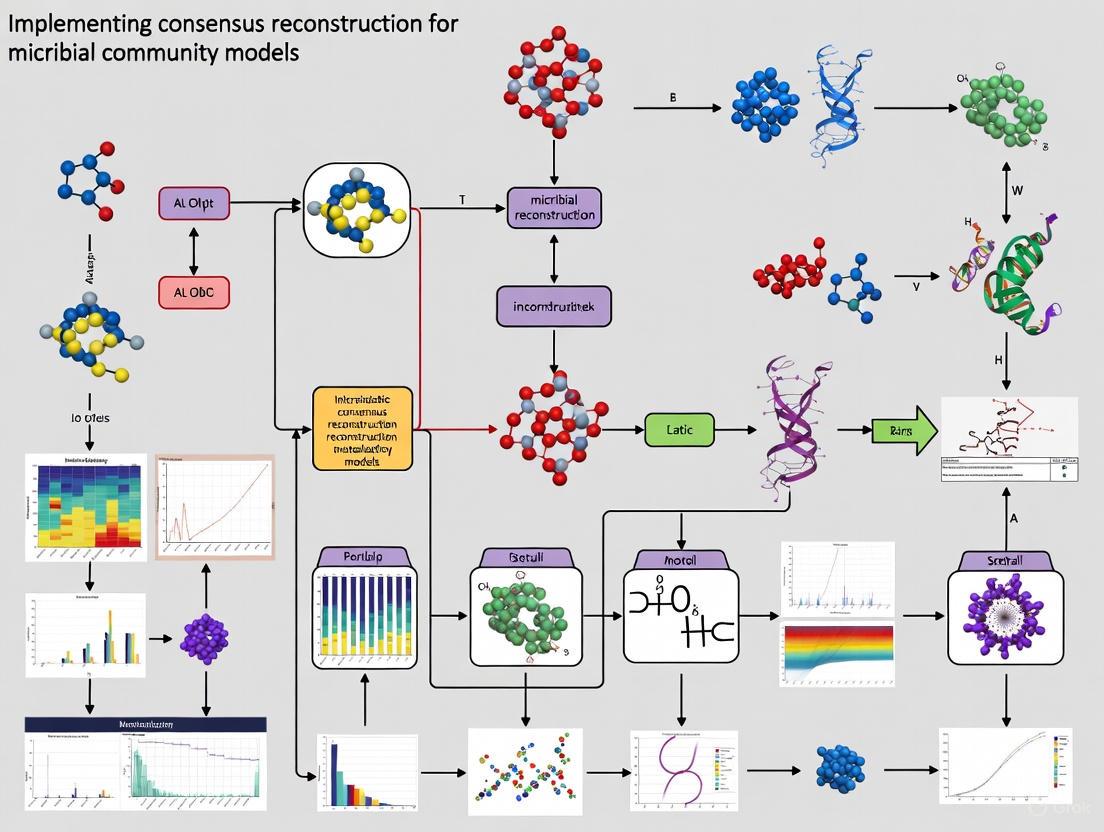
This article provides a comprehensive guide to consensus reconstruction for genome-scale metabolic models (GEMs) of microbial communities, a method that synthesizes outputs from multiple automated tools to create more accurate...
Consensus Reconstruction for Microbial Community Models: A Framework for Enhanced Metabolic Prediction and Clinical Application
Abstract
This article provides a comprehensive guide to consensus reconstruction for genome-scale metabolic models (GEMs) of microbial communities, a method that synthesizes outputs from multiple automated tools to create more accurate and functionally robust models. Aimed at researchers and drug development professionals, we explore the foundational principles demonstrating the limitations of single-tool approaches, detail methodological pipelines like COMMIT for practical application, and address key troubleshooting strategies. The content further validates the consensus approach through comparative analysis, showcasing its superiority in predicting metabolite interactions and reducing network gaps. Finally, we discuss its transformative potential in generating clinically relevant insights for understanding host-microbe interactions and managing complex diseases.
The Case for Consensus: Overcoming the Limitations of Single-Tool Metabolic Reconstructions
Genome-scale metabolic models (GEMs) are pivotal for deciphering the metabolic capabilities of microorganisms and predicting their interactions within communities. The reconstruction of these models from genomic data relies on automated tools, each employing distinct algorithms and biochemical databases. However, this diversity in reconstruction approaches introduces significant variability in the resulting models, potentially impacting the biological insights derived from in silico analyses. This Application Note examines the quantitative differences in GEMs generated by prominent reconstruction tools and outlines a consensus methodology to mitigate such variability, thereby enhancing the reliability of metabolic models for microbial community research.
Quantitative Comparison of Reconstruction Tools
Structural and Functional Disparities in Metabolic Models
A comparative analysis of models reconstructed for 105 marine bacterial metagenome-assembled genomes (MAGs) using CarveMe, gapseq, and KBase revealed substantial differences in model content and functional predictions [1]. The table below summarizes the key structural differences observed in models of coral-associated and seawater bacterial communities.
Table 1: Structural Characteristics of GEMs from Different Reconstruction Tools
| Reconstruction Tool | Approach | Primary Database | Average Number of Genes | Average Number of Reactions | Average Number of Metabolites | Dead-End Metabolites |
|---|---|---|---|---|---|---|
| CarveMe | Top-down | Custom Template | Highest | Intermediate | Intermediate | Fewest |
| gapseq | Bottom-up | ModelSEED | Lowest | Highest | Highest | Most |
| KBase | Bottom-up | ModelSEED | Intermediate | Lowest | Lowest | Intermediate |
| Consensus | Hybrid | Multiple | High | Highest | Highest | Reduced |
The analysis demonstrated that gapseq models contained the highest number of reactions and metabolites, suggesting comprehensive biochemical coverage, but also exhibited the largest number of dead-end metabolites, which can impede metabolic functionality [1]. Conversely, CarveMe models included the highest number of genes but fewer reactions than gapseq models. KBase models generally contained the fewest reactions and metabolites among the three tools [1].
Comparative Similarity Between Reconstruction Approaches
The Jaccard similarity index was calculated to quantify the overlap in reactions, metabolites, and genes between models generated from the same MAGs using different tools. The results revealed remarkably low similarity between approaches despite identical input genomes [1].
Table 2: Jaccard Similarity Between Reconstruction Tools for Coral-Associated Bacteria Models
| Comparison | Reaction Similarity | Metabolite Similarity | Gene Similarity |
|---|---|---|---|
| gapseq vs KBase | 0.23 | 0.37 | 0.42 |
| gapseq vs CarveMe | 0.17 | 0.28 | 0.35 |
| KBase vs CarveMe | 0.19 | 0.31 | 0.45 |
| Consensus vs CarveMe | 0.68 | 0.72 | 0.77 |
The higher similarity between gapseq and KBase models for reactions and metabolites (0.23 and 0.37, respectively) likely stems from their shared use of the ModelSEED database [1]. In contrast, consensus models showed substantially higher similarity to CarveMe models (0.77 for genes), indicating that the consensus approach retains most genes identified by CarveMe while incorporating additional content from other tools [1].
Consensus Reconstruction Approach
Workflow for Building Consensus Community Models
The consensus approach integrates models from multiple reconstruction tools to create a unified metabolic network with enhanced coverage and reduced gaps. The following diagram illustrates the complete workflow for building and analyzing consensus community models:
Impact of Consensus Approach on Model Quality
The consensus approach addresses critical limitations of individual reconstruction tools by combining their strengths. Comparative analyses demonstrate that consensus models encompass a larger number of reactions and metabolites while concurrently reducing the presence of dead-end metabolites [1]. This synergistic effect results from the integration of complementary biochemical knowledge from different databases and reconstruction algorithms.
Consensus models exhibit enhanced functional capability with stronger genomic evidence support for reactions, as they incorporate a greater number of genes from the aggregated reconstructions [1]. This comprehensive representation is particularly valuable for assessing the functional potential of microbial communities, where metabolic complementarity between organisms drives ecosystem functioning.
Detailed Experimental Protocols
Protocol 1: Reconstruction of Genome-Scale Metabolic Models
This protocol outlines the steps for reconstructing GEMs from MAGs using multiple automated tools followed by consensus integration.
Table 3: Reagent Solutions for Metabolic Model Reconstruction
| Reagent/Resource | Function | Example Sources |
|---|---|---|
| Metagenome-Assembled Genomes (MAGs) | Input genomic data for reconstruction | Marine bacterial communities [1] |
| CarveMe Software | Top-down reconstruction from universal template | https://github.com/cdanielmachado/carveme [1] |
| gapseq Software | Bottom-up reconstruction from annotated sequences | https://github.com/jotech/gapseq [1] |
| KBase Platform | Web-based reconstruction pipeline | https://kbase.us [1] |
| AGORA2 Database | Curated metabolic reconstruction resource | https://vmh.life [2] |
| DEMETER Pipeline | Data-driven metabolic network refinement | [2] |
| COMMIT Tool | Community metabolic gap-filling | [1] |
Procedure:
Input Preparation:
- Obtain high-quality MAGs from metagenomic sequencing data with minimum contamination [1].
- Annotate genomes using standard tools like PROKKA or RAST to identify protein-coding genes.
Parallel Model Reconstruction:
CarveMe Reconstruction:
- Install CarveMe according to developer instructions.
- Run basic reconstruction:
carve genome.faa --output model.xml - Use the
--gapfilloption to ensure model functionality [1].
gapseq Reconstruction:
- Install gapseq and required databases.
- Reconstruct metabolic model:
gapseq reconstruct -a genome.faa -b bacteria -o model.sbml[1]. - Use
gapseq findto identify specific metabolic pathways.
KBase Reconstruction:
- Upload genome to KBase platform.
- Use the "Build Metabolic Model" app to generate a draft reconstruction [1].
- Export model in SBML format.
Draft Model Curation:
Quality Assessment:
Protocol 2: Construction and Analysis of Consensus Community Models
This protocol describes the integration of individual models into consensus community models and their subsequent analysis.
Procedure:
Model Integration:
- Merge draft models from different tools using a consensus pipeline that reconciles reaction and metabolite identifiers [1].
- Retain reactions that appear in at least two of the three reconstructions to increase confidence [1].
- Resolve compartmentalization differences between models by standardizing compartment structures.
Community Model Assembly:
- Compile abundance data for all taxa in the community samples.
- Build community models using a framework like MICOM, specifying a relative abundance cutoff (default: 0.0001) for taxon inclusion [3].
- Assess database matching efficiency, aiming for at least 50% of sample abundance matched to the database [3].
Gap-Filling:
Growth Simulation:
The following diagram illustrates the metabolic network differences between individual and consensus reconstruction approaches:
The Scientist's Toolkit
Table 4: Essential Research Reagents and Computational Tools for Metabolic Reconstruction
| Category | Item | Specifications | Application |
|---|---|---|---|
| Reconstruction Software | CarveMe | Top-down approach using universal template | Fast generation of functional models [1] |
| gapseq | Bottom-up approach with comprehensive biochemical data | Detailed pathway reconstruction [1] | |
| KBase | Web-based platform with integrated tools | User-friendly model reconstruction [1] | |
| Reference Databases | AGORA2 | 7,302 strain-resolved reconstructions | Personalized modeling of human microbiomes [2] |
| ModelSEED | Biochemical database | Reaction and metabolite standardization [1] | |
| Virtual Metabolic Human | Metabolic namespace | Standardization of metabolite/reaction identifiers [2] | |
| Analysis Frameworks | MICOM | Community modeling platform | Simulation of microbial community metabolism [3] |
| COMMIT | Community metabolic gap-filling | Gap-filling of community models [1] | |
| DEMETER | Data-driven refinement pipeline | Curation and improvement of draft reconstructions [2] | |
| Validation Resources | NJC19 | Metabolite uptake/secretion data | Validation of model predictions [2] |
| Madin et al. dataset | Species-level metabolite uptake data | Independent validation of metabolic capabilities [2] |
The significant variability in GEMs generated by different reconstruction tools presents both a challenge and opportunity for microbial systems biology. The consensus reconstruction approach detailed in this Application Note provides a robust methodology for integrating diverse reconstructions into unified metabolic networks with enhanced predictive capabilities. By implementing these protocols and utilizing the recommended research toolkit, scientists can develop more accurate metabolic models that better represent the functional potential of microbial communities, ultimately advancing research in drug development, personalized medicine, and microbial ecology.
In the study of complex biological systems, consensus reconstruction refers to a computational approach that integrates multiple individual models or data inputs to generate a unified, more robust, and reliable representation of a system. This methodology is particularly vital in fields like microbial ecology, where the inherent complexity and heterogeneity of communities make it difficult to capture complete system behavior from a single model or dataset. By synthesizing diverse inputs, consensus reconstruction mitigates the limitations and biases inherent in any single approach, leading to more accurate and predictive models. In the context of microbial community models, this technique is instrumental in creating integrated metabolic networks that can elucidate the intricate cross-feeding relationships and community-level functions that emerge from host-microbe and microbe-microbe interactions [4].
The drive towards consensus methods is fueled by the recognition that biological systems are multifaceted. Reductionist approaches, while valuable, are inherently limited in capturing the full complexity of natural ecosystems [4]. Genome-scale metabolic models (GEMs) provide a powerful mathematical framework for simulating metabolic fluxes, but a single model is often insufficient to represent the dynamics of an entire community. Consensus reconstruction addresses this by combining models derived from different genomic data, computational tools, or experimental conditions, resulting in a composite model that is more representative of the true biological state than any of its individual components.
Key Principles and Methodological Framework
Consensus reconstruction operates on the core principle that the integration of multiple, independent inputs enhances the fidelity of the resulting model. The process can be broken down into several key stages, from data collection to the final simulation and validation of the consensus model.
Foundational Workflow for Consensus Reconstruction
The following diagram illustrates the generalized, multi-stage workflow for constructing a consensus metabolic model of a microbial community, from initial data acquisition to final simulation and analysis.
Synthesizing Multiple Inputs
The "consensus" is achieved by synthesizing various inputs during the model integration phase. This synthesis can involve several strategies:
- Algorithmic Integration: Using automated pipelines to merge models from diverse sources. This requires detecting and reconciling differences in reaction networks, metabolite identifiers, and gene-protein-reaction associations [4].
- Constraint-Based Reconciliation: Integrating models by applying shared constraints across the community, such as a unified nutritional medium (diet) and community-level objective functions [4].
- Data-Driven Weighting: Incorporating multiple types of omics data (e.g., metatranscriptomics, metabolomics) to constrain and refine the integrated model, ensuring that the consensus output reflects experimentally observed states [4].
Application Notes: Consensus Reconstruction for Microbial Community GEMs
Protocol: Constructing an Integrated Host-Microbiome Metabolic Model
This protocol details the steps for building a consensus metabolic model that integrates a host organism with its associated microbial community.
Objective: To reconstruct a unified genome-scale metabolic model (GEM) that simulates the metabolic interactions between a host and its gut microbiota.
Background: Individual GEMs are mathematical representations of an organism's metabolism. Integrating separate host and microbial GEMs allows for the simulation of metabolite exchange and cross-feeding, which are fundamental to understanding community-level functions and host health [4].
Step 1: Data Acquisition and Curation
- Host Genomic Data: Collect the annotated genome sequence of the host organism (e.g., human, mouse).
- Microbial Genomic Data: Obtain metagenome-assembled genomes (MAGs) or isolate genomes for key microbial taxa within the community of interest.
- Physiological Data: Gather data on diet composition, nutrient availability, and known host-specific metabolic functions to inform model constraints.
Step 2: Individual Model Reconstruction
- Host Model: Retrieve a pre-existing, high-quality GEM for the host (e.g., Recon3D for humans [4]) or use automated tools like RAVEN [4] or ModelSEED [4] to generate a draft model, followed by extensive manual curation. Eukaryotic host models require special attention to compartmentalization (e.g., mitochondria, peroxisomes) [4].
- Microbial Models: Reconstruct GEMs for each microbial species using curated repositories like AGORA [4] or automated pipelines such as CarveMe [4] and gapseq [4].
Step 3: Model Integration and Consensus Building
- Namespace Standardization: Use resources like MetaNetX [4] to harmonize metabolite and reaction identifiers across all individual models, which may originate from different databases.
- Model Merging: Create a compartmentalized community model. The host model typically forms one compartment, while individual microbes form others. Define exchange reactions that allow metabolites to be transported between these compartments.
- Quality Control: Detect and remove thermodynamically infeasible reaction cycles that may be introduced during the merging process [4].
Step 4: Simulation and Analysis
- Define Constraints: Set the nutritional environment (medium) and apply any known flux constraints.
- Perform Flux Balance Analysis (FBA): Simulate metabolic fluxes under steady-state conditions to optimize a community objective function (e.g., combined biomass production). FBA solves the linear programming problem represented by the stoichiometric matrix (S) of the consensus model, where S•v = 0, with v being the flux vector [4].
- Analyze Results: Identify key cross-feeding metabolites, potential metabolic bottlenecks, and community-level metabolic functions that emerge from the interactions.
Table 1: Key computational tools and databases for consensus reconstruction of microbial community models.
| Tool/Database Name | Type | Primary Function in Consensus Reconstruction |
|---|---|---|
| AGORA [4] | Database | Repository of curated, genome-scale metabolic models for human gut microbes. |
| CarveMe [4] | Software Tool | Automated pipeline for reconstructing metabolic models from genomic data. |
| RAVEN [4] | Software Tool | A toolbox for genome-scale model reconstruction, curation, and simulation. |
| MetaNetX [4] | Database | Platform for integrating and analyzing metabolic networks, providing namespace standardization. |
| BiGG Models [4] | Database | A knowledgebase of curated, genome-scale metabolic models. |
| COBRA Toolbox [4] | Software Tool | A MATLAB suite for performing constraint-based reconstruction and analysis (COBRA) of models. |
Technical Considerations and Comparative Analysis
The implementation of consensus reconstruction is not without challenges. Understanding these limitations is crucial for the appropriate design and interpretation of studies.
- Technical Hurdles: A significant bottleneck is the lack of standardized formats and automated pipelines for integrating models from diverse sources [4]. Merging models often introduces inconsistencies, such as differing protonation states of metabolites or mismatches in polymeric compound representations, which can lead to thermodynamically infeasible energy-generating cycles [4].
- Computational Demands: Simulating multi-species community models, especially those that are dynamic, requires substantial computational resources and sophisticated analysis techniques.
Table 2: Comparison of model reconstruction approaches, highlighting the value of consensus methods.
| Feature | Single Model | Consensus/Integrated Model |
|---|---|---|
| Scope | Metabolism of a single organism. | Metabolism of a host and multiple microbial species. |
| Biological Insight | Isolated metabolic capabilities. | Emergent community functions, metabolic interdependencies, and cross-feeding. |
| Data Integration | Limited to data for a single species. | Can synthesize multi-omic data (metagenomic, metatranscriptomic) across the community. |
| Complexity & Cost | Lower computational cost and complexity. | High computational cost; requires significant curation effort. |
| Predictive Power | Predicts single-species behavior. | Predicts community-level metabolic output and response to perturbations (e.g., diet, antibiotics). |
Visualization of Model Integration and Simulation
The final phase of consensus reconstruction involves simulating the integrated model to gain biological insights. The following diagram details the core computational process of applying constraints and performing flux analysis on the merged model.
Consensus reconstruction represents a paradigm shift in systems biology, moving from isolated models to integrated, community-level representations. By systematically synthesizing multiple inputs—from individual genomic reconstructions to experimental data—this approach generates models that more accurately reflect the complex and dynamic nature of biological systems like host-associated microbial communities. While technical challenges remain, the ability of consensus reconstruction to predict emergent metabolic behaviors and cross-feeding relationships makes it an indispensable tool for researchers and drug development professionals aiming to mechanistically understand and manipulate microbial communities for therapeutic purposes.
Structural and Functional Disparities in Automatically Generated GEMs
Application Notes
The Challenge of Automated Reconstruction Disparities
Automated genome-scale metabolic model (GEM) reconstruction tools have become fundamental for investigating microbial metabolism, yet models built with different tools for the same organism exhibit significant structural and functional variations [5]. These disparities originate from several core methodological differences: the use of distinct biochemical databases (e.g., ModelSEED, BiGG, MetaCyc), the application of different reconstruction approaches (bottom-up vs. top-down), and variations in gene-protein-reaction (GPR) rule inference [5] [6]. For instance, tools like CarveMe employ a top-down approach using a universal model, while gapseq and KBase utilize bottom-up methods, leading to models with different reaction sets and metabolic network connectivity [6]. One comparative analysis revealed that the Jaccard similarity for reaction sets between models of the same organism reconstructed by different tools can be as low as 0.23-0.24, highlighting the profound structural disagreements that exist [6].
Functional Consequences for Microbial Community Research
The structural disparities between automatically generated GEMs translate directly into functional predictive variations, which poses significant challenges for modeling microbial communities [6]. Studies have demonstrated that:
- Predictive performance varies: Models from different tools show divergent capabilities in predicting essential genes and auxotrophy profiles [5].
- Interaction biases arise: The set of metabolites predicted to be exchanged in a community context is more influenced by the reconstruction tool used than by the specific bacterial community being studied [6]. This introduces a potential bias when predicting metabolite interactions between community members.
- Dead-end metabolites differ: The number and identity of dead-end metabolites, which can block metabolic flux, vary considerably between reconstruction approaches [6].
These functional disparities complicate the interpretation of model-based studies and can lead to conflicting biological insights, especially when investigating metabolic interactions within complex microbial systems.
Consensus Reconstruction as a Solution
Consensus reconstruction, which integrates models from multiple automated tools, has emerged as a powerful strategy to mitigate individual tool biases and create more comprehensive and accurate metabolic networks [5] [6]. The core principle involves assembling a "supermodel" that tracks the origin of every metabolic feature (metabolites, reactions, genes) and then generating consensus models based on the level of agreement between the input models [5].
The demonstrated benefits of this approach include:
- Enhanced Predictive Accuracy: Consensus models for Escherichia coli and Lactiplantibacillus plantarum have been shown to outperform manually curated gold-standard models in predictions of auxotrophy and gene essentiality [5].
- Improved Network Coverage and Connectivity: Consensus models retain a larger number of reactions and metabolites from the original models while concurrently reducing the presence of dead-end metabolites, leading to more complete and connected metabolic networks [6].
- Uncertainty Assessment: The consensus framework systematically assesses confidence in the metabolic network, allowing researchers to identify and prioritize uncertain areas of metabolism for experimental validation [5].
Table 1: Structural Characteristics of GEMs from Different Reconstruction Tools (Data from [6])
| Reconstruction Tool | Approach | Primary Database | Relative Number of Genes | Relative Number of Reactions | Dead-End Metabolites |
|---|---|---|---|---|---|
| CarveMe | Top-down | BiGG | Highest | Medium | Medium |
| gapseq | Bottom-up | ModelSEED, MetaCyc | Lowest | Highest | Highest |
| KBase | Bottom-up | ModelSEED | Medium | Medium | Medium |
| Consensus | Hybrid | Multiple | High | Highest | Lowest |
Table 2: Performance Comparison of Standard vs. Consensus Models (Data from [5])
| Model Type | Auxotrophy Prediction Accuracy | Gene Essentiality Prediction Accuracy | Network Certainty | GPR Rule Accuracy |
|---|---|---|---|---|
| Single-Tool GEM | Variable | Variable | Low | Variable |
| Consensus GEM | Superior to Gold-Standard | Superior to Gold-Standard | High | Improved |
Protocols
Protocol 1: Assembling Cross-Tool Consensus Models with GEMsembler
Purpose: To generate a consensus metabolic model from multiple automatically reconstructed GEMs, thereby reducing tool-specific bias and improving model accuracy for microbial community studies.
Background: The GEMsembler Python package provides a systematic workflow for comparing, combining, and analyzing GEMs built with different tools [5]. It enables the assembly of consensus models that harness unique features from each reconstruction approach.
Materials:
- Input Models: Genome-scale metabolic models for the target organism(s) reconstructed by at least two different automated tools (e.g., CarveMe, gapseq, modelSEED) [5] [6].
- Software: GEMsembler Python package (available via https://github.com/).
- Computational Resources: A standard computer workstation capable of running Python and associated scientific libraries (e.g., COBRApy).
- Reference Genome: (Optional) A genome sequence to be used for standardizing gene locus tags in the output model [5].
Procedure:
- Model Conversion: a. Load the input GEMs into the GEMsembler environment. b. Execute the ID conversion function to map all metabolite and reaction identifiers from their native namespaces (e.g., modelSEED, MetaCyc) to a standardized namespace (BiGG is used by GEMsembler) [5]. This step ensures comparability. c. If a reference genome is provided, run the gene ID conversion function, which uses BLAST to map genes from the input models to the locus tags of the reference genome [5].
Supermodel Assembly: a. Use GEMsembler to assemble all converted models into a single "supermodel" object. This supermodel contains the union of all metabolic features (metabolites, reactions, genes) from the input models [5]. b. The supermodel structure, based on COBRApy, is augmented with additional fields that track the original source of every feature [5].
Consensus Model Generation: a. From the supermodel, generate consensus models with different confidence levels. A common approach is to create "coreX" models that contain only features present in at least X number of input models [5]. For example: *
core1: The assembly model, containing all features from any input model. *core2: Contains features present in at least 2 input models. *core3: Contains features present in at least 3 input models. b. GEMsembler automatically resolves reaction attributes (e.g., directionality) and GPR rules based on the principle of agreement among the input models [5].Output and Validation: a. Extract the desired consensus model (e.g.,
core2) in a standard format like SBML for downstream analysis. b. Validate the functional performance of the consensus model by simulating known physiological functions, such as growth on different carbon sources, and compare its predictions against experimental data or the predictions of the individual input models [5].
Protocol 2: Functional Evaluation of Consensus Community Models
Purpose: To assess the functional capacity of a consensus metabolic model in a community context and compare it against single-tool reconstructions.
Background: Evaluating a model's ability to predict community-level metabolic interactions and growth phenotypes is crucial for validating its utility. This protocol uses flux balance analysis (FBA) to test model performance [6].
Materials:
- Metabolic Models: The consensus model and the individual single-tool models from which it was built.
- Software: A constraint-based modeling platform such as the COBRA Toolbox (for MATLAB) or COBRApy (for Python) [5].
- Media Formulation: A defined culture medium composition for the simulation.
- Gene Essentiality Data: (Optional) Experimental data on gene essentiality for the organism under the specified growth condition [5].
- Auxotrophy Data: (Optional) Experimental data on nutrient requirements [5].
Procedure:
- Model Setup: a. Load each model (consensus and single-tool) into the modeling environment. b. Set the exchange reactions in each model to reflect the nutrients available in the defined culture medium. c. Set the objective function to maximize biomass production.
Growth Capability Assessment: a. Perform FBA for each model to predict the growth rate under the defined condition. b. Compare the predicted growth yields and rates across the different models. A reliable consensus model should not exhibit reduced growth capability compared to its constituents unless it has eliminated non-curated reactions.
Auxotrophy Prediction Profiling: a. For each essential nutrient in the medium (e.g., carbon source, nitrogen source, vitamins), simulate the model with the uptake reaction for that nutrient closed. b. A predicted growth rate of zero indicates an auxotrophy for that nutrient. c. Compare the auxotrophy profiles of all models against known experimental data for the organism. Calculate the accuracy, precision, and recall for each model [5].
Gene Essentiality Prediction: a. For each gene in the model, simulate a knockout by constraining the fluxes of all reactions associated with that gene to zero. b. Perform FBA for each knockout and classify the gene as essential if the predicted growth rate falls below a defined threshold (e.g., <5% of wild-type growth). c. Compare the gene essentiality predictions of the consensus model and the single-tool models against experimental gene essentiality data [5].
Community Interaction Potential: a. To assess the model in a community context, use a compartmentalization approach or a costless secretion framework to combine the target model with GEMs of other community members [6]. b. Analyze the spectrum of metabolites that the model is predicted to secrete in the community setting. Compare this "exometabolite profile" across the different reconstruction approaches [6].
Table 3: The Scientist's Toolkit: Essential Reagents and Resources
| Item Name | Function/Application | Example/Note |
|---|---|---|
| CarveMe | Automated top-down GEM reconstruction | Uses BiGG database; fast model generation [6] |
| gapseq | Automated bottom-up GEM reconstruction | Leverages multiple databases (ModelSEED, MetaCyc); comprehensive biochemistry [5] [6] |
| GEMsembler | Consensus model assembly & analysis | Python package for building & analyzing consensus GEMs [5] |
| COBRApy | Constraint-Based Modeling & Simulation | Python environment for running FBA and other simulations [5] |
| MetaNetX | Biochemical namespace reconciliation | Platform for mapping metabolite/reaction IDs across databases [5] |
| COMMIT | Community Model Gap-Filling | Used for gap-filling metabolic models of microbial communities [6] |
The Impact of Biochemical Databases on Reaction Sets and Predicted Metabolic Exchanges
Biochemical databases serve as the foundational knowledgebase for reconstructing genome-scale metabolic models (GEMS), directly influencing the reaction sets and metabolite exchange predictions in microbial community modeling. Consensus reconstruction approaches that integrate multiple databases and tools have demonstrated superior capability in generating more comprehensive metabolic networks with reduced dead-end metabolites compared to single-tool approaches. This protocol outlines the application of consensus metabolic network reconstruction to minimize database-specific biases and improve the accuracy of predicting metabolic interactions in microbial communities.
Genome-scale metabolic models have become indispensable for predicting microbial interactions, yet their reconstruction from biochemical databases introduces significant uncertainties. Different automated reconstruction tools rely on distinct biochemical databases and algorithms, resulting in models with varying metabolic capabilities even when based on identical genomic input. A comparative analysis revealed that reconstruction methodologies can have a greater impact on predicted metabolite exchanges than the actual biological differences between microbial communities [7]. This technical variability poses substantial challenges for reliably predicting cross-feeding interactions and metabolic dependencies.
Consensus metabolic modeling addresses these limitations by integrating multiple independently reconstructed models into a unified representation that captures a broader spectrum of metabolic capabilities. By reconciling inconsistencies between databases and reconstruction tools, consensus approaches produce metabolic networks with enhanced functional coverage and predictive accuracy. This Application Note provides detailed methodologies for implementing consensus reconstruction to investigate database effects on reaction sets and metabolic exchange predictions in microbial communities.
Database-Dependent Variation in Metabolic Reconstruction
Quantitative Comparison of Reconstruction Tools
Automated reconstruction tools employ different biochemical databases and algorithms, generating substantially different metabolic models from the same genomic input. Analysis of models reconstructed from 105 marine bacterial MAGs using three prominent tools revealed marked structural differences (Table 1) [7].
Table 1: Structural characteristics of GEMs reconstructed from identical MAGs using different automated tools
| Reconstruction Tool | Primary Database | Average Reactions per Model | Average Metabolites per Model | Average Genes per Model | Dead-end Metabolites |
|---|---|---|---|---|---|
| CarveMe | BIGG | 1,347 | 1,102 | 598 | 87 |
| gapseq | ModelSEED/KEGG | 1,892 | 1,563 | 512 | 134 |
| KBase | ModelSEED | 1,521 | 1,245 | 542 | 103 |
| Consensus | Multiple | 2,215 | 1,789 | 684 | 62 |
The structural variations directly impact metabolic functionality, with gapseq models containing more reactions and metabolites but also exhibiting higher numbers of dead-end metabolites that may affect pathway completeness. Consensus models integrated the highest number of reactions and metabolites while substantially reducing dead-end metabolites, indicating more complete metabolic networks [7].
Jaccard Similarity Analysis Across Reconstruction Approaches
Quantifying the overlap between models reconstructed using different tools demonstrates the extent of database-induced variation. Analysis of Jaccard similarity indices for reaction sets, metabolite sets, and gene sets revealed low to moderate overlap between tools (Table 2) [7].
Table 2: Jaccard similarity between models reconstructed from identical MAGs using different approaches
| Model Comparison | Reaction Similarity | Metabolite Similarity | Gene Similarity |
|---|---|---|---|
| gapseq vs. KBase | 0.23 | 0.37 | 0.38 |
| gapseq vs. CarveMe | 0.19 | 0.31 | 0.35 |
| KBase vs. CarveMe | 0.21 | 0.33 | 0.44 |
| Consensus vs. CarveMe | 0.42 | 0.51 | 0.76 |
The notably higher similarity between consensus models and CarveMe models suggests CarveMe contributes substantially to the gene content in consensus reconstructions. The low overall similarity across all tools highlights the complementary nature of different reconstruction approaches and the value of their integration [7].
Consensus Metabolic Model Reconstruction Protocol
Workflow for Consensus Model Generation
The following diagram illustrates the complete workflow for generating predictive consensus metabolic network models from multiple individual reconstructions:
Individual Model Reconstruction
Procedure:
- Input Preparation: Compile high-quality metagenome-assembled genomes (MAGs) or isolate genomes in FASTA format.
- Functional Annotation: Annotate all genomes using KOfam for KEGG Orthologs via
anvi-run-kegg-kofamsto ensure consistent functional profiling across datasets [8]. - Multi-tool Reconstruction: Execute parallel reconstructions using at least three automated tools:
- CarveMe: Employ universal template with
carvecommand for top-down reconstruction - gapseq: Implement
gapseqwith ModelSEED/KEGG databases for bottom-up reconstruction - KBase: Utilize Narrative Interface for ModelSEED-based reconstruction
- CarveMe: Employ universal template with
- Quality Assessment: Validate individual models for stoichiometric consistency, energy balance, and network connectivity.
Technical Notes: The top-down approach of CarveMe utilizes a universal metabolic model that is pared down based on genomic evidence, while gapseq and KBase employ bottom-up approaches that build models by aggregating reactions associated with annotated genes [7].
Model Integration and Curation
Procedure:
- Namespace Standardization: Map all metabolites and reactions to common identifiers using MetaNetX namespace or manually defined correspondence tables [9].
- Inconsistency Classification: Systematically identify and categorize discrepancies using COMMGEN:
- Metabolite-level: Identical metabolites with different identifiers; non-identical metabolites with identical network functions
- Reaction-level: Nested/encompassing reactions; alternative cofactor usage; lumped versus detailed pathway representations
- Compartment-level: Differing compartmentalization schemes; transport reaction inconsistencies [9]
- Semi-automated Resolution: Implement rule-based conflict resolution with manual expert curation for complex cases:
- Prioritize reactions with genomic evidence
- Resolve compartmentalization based on experimental evidence
- Standardize cofactor usage across models
- Network Merging: Combine validated components into draft consensus model.
Technical Notes: The COMMGEN tool automatically identifies similarities, dissimilarities, and complementary elements between metabolic networks, providing a systematic framework for resolving database-specific inconsistencies [9].
Community Model Gap-Filling
Procedure:
- Medium Formulation: Define minimal medium composition reflecting environmental conditions.
- Iterative Gap-filling: Implement COMMIT with abundance-weighted iteration:
- Sort MAGs by abundance in descending order
- Initialize with minimal medium
- For each MAG, perform gap-filling to enable biomass production
- Add metabolites secreted by current MAG to medium for subsequent MAGs [7]
- Validation: Assess model functionality for growth simulations and exchange predictions.
Technical Notes: The iterative order during gap-filling shows negligible correlation with the number of added reactions (r = 0-0.3), indicating minimal bias introduced by processing sequence [7].
Metabolic Exchange Prediction Protocol
Predicting Pairwise Metabolic Interactions
Procedure:
- Prerequisite Setup: Ensure all contigs databases contain:
- KEGG Ortholog annotations (
anvi-run-kegg-kofams) - Reaction networks (
anvi-reaction-network) - ModelSEED database setup (
anvi-setup-modelseed-database) [8]
- KEGG Ortholog annotations (
- Exchange Prediction: Execute
anvi-predict-metabolic-exchanges: - Multi-mode Analysis: For community-scale predictions, use external genomes file:
Technical Notes: The algorithm identifies metabolites that can be produced by only one organism but consumed by the other (or both), and vice versa, reporting them as 'potentially-exchanged compounds' [8].
Analysis of Database Effects on Exchange Predictions
Procedure:
- Pathway-specific Analysis: Isolate predictions from specific KEGG Pathway Maps using
--include-pathway-mapsflag to assess database coverage variations. - Compound Equivalence: Account for database-specific metabolite representations using
--use-equivalent-amino-acidsor custom equivalence files. - Method Comparison: Compare predictions from two orthogonal strategies:
- KEGG Pathway Map walking (enabled by default)
- Local reaction network analysis (enable/disable with
--no-pathway-walkor--pathway-walk-only) [8]
- Consensus Integration: Generate exchange predictions from individual and consensus models to quantify database-induced variation.
Technical Notes: The --use-equivalent-amino-acids flag addresses database inconsistencies in chiral specification (e.g., L-Lysine vs. generic Lysine compounds) that can lead to missed exchange predictions [8].
Implementation Guidelines
Research Reagent Solutions
Table 3: Essential computational tools and databases for consensus metabolic reconstruction
| Resource | Type | Primary Function | Access |
|---|---|---|---|
| CarveMe | Software Tool | Top-down model reconstruction from universal template | GitHub |
| gapseq | Software Tool | Bottom-up model reconstruction from genomic annotations | GitHub |
| KBase | Platform | Integrated model reconstruction and analysis | Web-based |
| ModelSEED | Database | Biochemical reaction database and reference models | Web-based |
| KEGG | Database | Pathway maps, reactions, and ortholog assignments | Subscription |
| MetaCyc | Database | Curated metabolic pathways and enzymes | Web-based [10] |
| BioCyc | Database Collection | Organism-specific pathway/genome databases | Subscription [11] |
| COMMGEN | Software Tool | Consensus model generation from multiple reconstructions | Available on request [9] |
| COMMIT | Software Tool | Community model gap-filling | Available on request [7] |
| anvi-predict-metabolic-exchanges | Software Tool | Prediction of metabolite exchanges between genomes | anvi.oorg [8] |
Quality Assessment Metrics
Procedure:
- Structural Validation: Compare reaction/metabolite/gene counts across individual and consensus models.
- Functional Assessment: Validate model predictions against experimental growth data or known auxotrophies.
- Dead-end Metabolite Analysis: Quantify network gaps before and after consensus integration.
- Exchange Prediction Stability: Assess variation in predicted exchanges across database sources.
Technical Notes: Consensus models have been shown to retain the majority of unique reactions and metabolites from individual reconstructions while reducing dead-end metabolites by approximately 30% compared to single-tool approaches [7].
Biochemical databases significantly impact the reaction sets and metabolic exchange predictions in microbial community models. Consensus reconstruction methodologies provide a robust framework for integrating knowledge from multiple databases, mitigating individual database biases, and generating more comprehensive metabolic networks. The protocols outlined herein enable researchers to systematically assess database effects and implement consensus approaches for improved prediction of metabolic interactions in microbial communities.
Building Better Models: A Step-by-Step Pipeline for Consensus Reconstruction and Community Modeling
The reconstruction of genome-scale metabolic models (GEMs) is a fundamental methodology in systems biology, creating mathematical representations of metabolic networks that enable computational prediction of phenotypic behavior from genotypic data [12]. For microbial communities, these models provide mechanistic insight into metabolic interactions, community assembly, and ecosystem functioning. The development of automated reconstruction tools has revolutionized the field by enabling high-throughput generation of GEMs, essential for studying complex microbial systems. This protocol examines three complementary tools—CarveMe, gapseq, and KBase—for constructing microbial GEMs, with particular emphasis on their application in consensus reconstruction approaches for microbial community modeling. Each tool brings distinct strengths: CarveMe employs a top-down parsimony approach, gapseq utilizes informed pathway prediction and gap-filling, and KBase offers an integrated web-based workflow environment. When strategically combined, these tools facilitate the creation of robust, accurate metabolic models that capture the functional potential of individual microorganisms and their interactions within communities.
Comparative Tool Analysis
Table 1: Core Characteristics of Metabolic Reconstruction Tools
| Tool | Primary Approach | Input Requirements | Key Output | Community Modeling Features |
|---|---|---|---|---|
| CarveMe | Top-down reconstruction from universal model; parsimony principle | Genome sequence (FASTA) | Ready-to-use metabolic models (SBML) | Direct generation of community models; ensemble modeling |
| gapseq | Informed pathway prediction; biochemistry database-driven gap-filling | Genome sequence (FASTA) | Curated metabolic models; pathway predictions | Accurate prediction of metabolic interactions |
| KBase | Integrated web-based platform with modular analysis tools | Genome sequence or annotation | Draft reconstructions and simulation-ready models | Ecosystem-scale modeling capabilities |
CarveMe operates on a top-down parsimony principle, beginning with a universal model containing all known metabolic reactions and selectively removing those unsupported by genomic evidence to create a strain-specific model [13]. This approach efficiently produces functional models that are inherently flux-consistent, avoiding energy-generating thermodynamically infeasible reaction cycles [2]. The tool specializes in generating ready-to-use models that immediately support flux balance analysis (FBA), making it particularly valuable for high-throughput applications. A distinctive capability of CarveMe is its direct support for building microbial community models, enabling researchers to assemble multi-species metabolic networks from individual organism reconstructions [13].
gapseq employs a biochemistry database-driven approach with comprehensive pathway prediction capabilities [12]. Unlike purely automated tools, gapseq incorporates extensive manual curation of its reference database, which includes 15,150 reactions and 8,446 metabolites derived from multiple biochemistry databases [12]. The tool features a novel gap-filling algorithm that uses both network topology and sequence homology to reference proteins to identify and resolve metabolic gaps. This methodology allows gapseq to surpass state-of-the-art tools in predicting critical metabolic functions, achieving a 53% true positive rate for enzyme activity predictions compared to 27% for CarveMe and 30% for ModelSEED [12]. Its accurate prediction of carbon source utilization and fermentation products makes it particularly valuable for modeling metabolic interactions in microbial communities.
KBase (KnowledgeBase) provides an integrated, web-based platform for systems biology research, offering a complete workflow from genome annotation to model reconstruction and simulation [13] [2]. This cloud-based environment eliminates local computational requirements while ensuring reproducibility through standardized analysis pipelines. KBase executes proteome comparisons to infer reaction inclusion in new models based on homology to reference organisms [13]. While user-friendly and comprehensive, its implementation is restricted to the KBase interface, limiting customization options compared to command-line tools [13]. The platform supports ecosystem-scale modeling, enabling researchers to build and simulate complex microbial communities.
Performance Characteristics and Validation
Table 2: Performance Benchmarks of Reconstruction Tools
| Performance Metric | CarveMe | gapseq | KBase Draft | AGORA2 (Curated) |
|---|---|---|---|---|
| Flux Consistency | High (by design) | Moderate | Variable | High |
| Enzyme Activity Prediction (True Positive Rate) | 27% | 53% | Not reported | 72-84% |
| Reaction Coverage | Moderate | Comprehensive | Variable | Comprehensive |
| ATP Production Plausibility | Generally high | Generally high | Often excessive | Curated to biological ranges |
| Experimental Data Accuracy | Moderate | High | Variable | High |
Independent benchmarking reveals critical performance differences among reconstruction tools. gapseq demonstrates superior accuracy in predicting enzymatic capabilities, achieving significantly higher true positive rates (53%) compared to CarveMe (27%) based on validation against 10,538 enzyme activities from 3,017 organisms [12]. This enhanced predictive power stems from gapseq's database curation and sophisticated gap-filling approach that incorporates sequence homology and pathway context.
Flux consistency—the absence of stoichiometrically unbalanced reaction sets—varies substantially between tools. CarveMe models exhibit high flux consistency by design, as the tool removes flux-inconsistent reactions during reconstruction [2]. In contrast, gapseq and KBase draft reconstructions typically contain higher proportions of flux-inconsistent reactions, though this reflects their more comprehensive inclusion of biochemically supported reactions rather than functional incapacity [2].
A crucial validation metric is the accurate prediction of experimentally observed phenotypes. When tested against three independently collected experimental datasets, curated resources like AGORA2 demonstrated accuracy ranging from 0.72 to 0.84, surpassing automated reconstruction tools [2]. However, gapseq showed particularly strong performance in predicting carbon source utilization and fermentation products, critical capabilities for modeling metabolic interactions in microbial communities [12].
Integrated Workflow for Consensus Reconstruction
Diagram 1: Integrated workflow for consensus reconstruction of microbial metabolic models. The approach leverages complementary strengths of multiple tools to generate high-quality models for community modeling.
The consensus reconstruction workflow leverages the complementary strengths of CarveMe, gapseq, and KBase to generate metabolic models with enhanced accuracy and coverage. This methodology is particularly valuable for microbial community modeling, where accurate prediction of metabolic interactions depends on the quality of individual organism models.
Stage 1: Parallel Reconstruction
Initiate the process by running all three tools in parallel on the same genomic input:
CarveMe Implementation:
gapseq Implementation:
KBase Implementation: Utilize the "Build Metabolic Model" app in KBase with standard parameters, leveraging the platform's integrated annotation and reconstruction pipeline. Export the resulting model in SBML format for comparative analysis.
Stage 2: Model Comparison and Reaction Union
Compare the outputs from the three tools and create a union reaction set:
- Extract reaction lists from each generated model
- Identify core reactions present in at least two of the three reconstructions
- Resolve conflicts in reaction directionality and compartmentalization
- Create a merged model containing the union of biochemically supported reactions
This approach capitalizes on the complementary strengths of each tool: CarveMe's flux consistency, gapseq's pathway completeness, and KBase's annotation integration.
Stage 3: Manual Curation and Experimental Validation
Refine the merged model through systematic curation:
- Incorporate experimental data from resources like BacDive or NJC19 to validate and expand model capabilities [12] [2]
- Verify pathway completeness for critical metabolic functions, particularly those relevant to the study environment
- Implement compartmentalization where appropriate, particularly for periplasmic reactions in Gram-negative bacteria [2]
- Validate against phenotypic data including carbon source utilization, fermentation products, and gene essentiality
The DEMETER pipeline used in developing AGORA2 provides a robust framework for this curation stage, employing iterative refinement and continuous verification through automated test suites [2].
Stage 4: Community Model Assembly
Integrate individual models into a community metabolic network:
- Establish metabolite exchange through a shared extracellular compartment
- Define community constraints based on environmental conditions
- Implement simulation approaches such as SteadyCom or flux balance analysis with parsimonious enzyme usage
This consensus approach directly addresses limitations in individual tools—balancing CarveMe's tendency toward minimal models with gapseq's comprehensive but sometimes inconsistent networks, while leveraging KBase's annotation quality.
Application Notes for Microbial Community Modeling
Predictive Modeling of Community Dynamics
Integrate metabolic reconstructions with microbial abundance data to predict community dynamics. The graph neural network-based approach described in [14] demonstrates how species-level abundance dynamics can be accurately forecasted using historical relative abundance data. The "mc-prediction" workflow successfully predicted species dynamics up to 10 time points ahead (2-4 months) in wastewater treatment plants, and was also validated on human gut microbiome datasets [14]. This integration of metabolic potential with abundance dynamics enables more accurate prediction of community responses to perturbations.
For temporal prediction:
- Reconstruct metabolic models for dominant community members using the consensus approach
- Calculate cross-feeding potential between community members
- Integrate with abundance time-series data using graph neural networks or other machine learning approaches
- Validate predictions against held-out temporal data
Strain-Resolved Modeling for Personalized Applications
Implement strain-resolved modeling to capture interindividual variation in microbial communities. The AGORA2 resource, containing 7,302 strain-resolved reconstructions, demonstrates the power of this approach for personalized medicine applications [2]. When applied to the gut microbiomes of 616 patients with colorectal cancer, AGORA2 revealed extensive variation in drug conversion potential that correlated with age, sex, body mass index, and disease stages [2].
For strain-resolved community modeling:
- Select reference strains representing phylogenetic diversity within the community
- Apply the consensus workflow to generate high-quality models for each strain
- Account for strain-specific capabilities particularly in drug metabolism, nutrient utilization, and specialized metabolite production
- Scale to population-level analyses by developing strain abundance-weighted community models
Table 3: Key Research Reagents and Computational Resources
| Resource Category | Specific Tool/Database | Function in Reconstruction Workflow | Access Method |
|---|---|---|---|
| Genome Annotation | KBase Annotation Pipeline | Automated gene calling and functional annotation | Web interface |
| Reference Databases | UniProt, TCDB | Protein sequence and transporter reference data | Public download |
| Curated Biochemistry | ModelSEED Biochemistry, gapseq DB | Reaction stoichiometry and metabolite information | Tool-integrated |
| Phenotype Validation | BacDive, NJC19 | Experimental data for model validation | Public access |
| Model Repositories | BiGG, MetaNetX, VMH | Reference models and biochemical nomenclature | Public access |
| Simulation Environments | CobraPy, KBase Apps | Flux balance analysis and constraint-based modeling | Python package/Web |
Experimental Validation Protocols
Model Validation Against Experimental Data
Implement a multi-tier validation protocol to assess reconstruction quality:
Enzyme Activity Validation:
- Retrieve experimental enzyme activity data from BacDive for 30 unique enzymes [12]
- Compare model-predicted enzyme presence with experimental results
- Calculate true positive rates and false negative rates
Carbon Source Utilization Assay:
- Compile experimental growth data on defined media from literature sources [12]
- Simulate growth on each carbon source using flux balance analysis
- Compare predicted vs. experimental growth capabilities
Community Interaction Validation:
- Utilize defined co-culture experiments from literature
- Simulate cross-feeding interactions using the community metabolic model
- Compare predicted metabolite exchanges with experimental measurements
Quantitative Assessment Metrics
Evaluate reconstructions using standardized metrics:
- Flux consistency: Percentage of reactions that can carry flux under physiological constraints [2]
- ATP yield plausibility: Assessment of maximum ATP production to identify energy futile cycles [2]
- Gene essentiality prediction: Comparison of simulated gene essentiality with experimental knockout data
- Biomass yield correlation: Comparison of predicted vs. experimental biomass yields on different substrates
This validation framework ensures that consensus reconstructions not only integrate computational predictions from multiple tools but also align with experimental observations across multiple data types.
The strategic integration of CarveMe, gapseq, and KBase through a consensus reconstruction workflow enables the generation of high-quality metabolic models for microbial community research. By leveraging CarveMe's flux consistency, gapseq's pathway prediction accuracy, and KBase's annotation integration, researchers can overcome limitations inherent in any single approach. The resulting models provide a robust foundation for predicting metabolic interactions, community dynamics, and ecosystem-level functions, with particular relevance for biomedical and environmental applications. As the field advances toward more sophisticated multi-kingdom and personalized modeling, this consensus approach offers a scalable methodology for building accurate, predictive metabolic networks from genomic data.
The Consideration of Metabolite LeIeakage and CommuniTy composition (COMMIT) framework represents a significant advancement in the constraint-based modeling of microbial communities. Traditional approaches to gap-filling metabolic reconstructions have primarily focused on individual microorganisms in isolation, neglecting the critical ecological context in which these organisms naturally exist. COMMIT addresses this fundamental limitation by introducing a novel methodology that incorporates metabolite permeability and community composition directly into the gap-filling process [15] [16]. This innovative approach recognizes that microbial community members are often metabolically interdependent, with the exchange of metabolites significantly influencing their collective functionality.
The framework was developed to overcome challenges in constructing predictive metabolic models for diverse microbial communities, which play crucial roles in fields ranging from human health to agricultural productivity. Previous constraint-based methods for analyzing microbial communities, such as SteadyCom or MICOM, relied on two key assumptions: the availability of high-quality metabolic models for all community members, and the presence of pre-defined transport reactions for metabolite exchange [16] [17]. These approaches fundamentally overlooked how metabolite permeability and community structure determine which metabolites can be exchanged between organisms. COMMIT addresses this gap by systematically considering which metabolites can leak between community members based on their biochemical properties, thereby enabling more accurate reconstruction of metabolic interactions within microbial ecosystems [16].
Theoretical Foundation and Computational Methodology
Core Principles of COMMIT
COMMIT operates on several foundational principles that distinguish it from previous gap-filling approaches. First, it employs consensus metabolic reconstructions generated by integrating results from multiple automated reconstruction tools, including KBase, CarveMe, RAVEN 2.0, and AuReMe/Pathway Tools [16] [17]. This consensus approach leverages the complementary strengths of different reconstruction methodologies, resulting in metabolic models with improved genomic support and reduced gaps. Structural comparisons have revealed substantial differences between draft reconstructions generated by different tools, with an average distance of 0.64 between them (where 1 denotes the largest difference) [17]. By integrating these diverse reconstructions, COMMIT achieves more comprehensive and reliable metabolic models.
Second, COMMIT introduces the novel concept of metabolite leakage based on membrane permeability during the gap-filling process. Rather than relying solely on pre-defined transport reactions, the framework determines which metabolites can be exchanged between community members according to their permeability characteristics [15]. This methodology more accurately reflects biological reality, where many metabolites can passively diffuse across membranes or be transported through non-specific mechanisms. Third, COMMIT performs gap-filling in a community-aware context, where the metabolic capabilities of all community members collectively influence the gap-filling solutions for individual organisms [16]. This approach recognizes that gaps in one organism's metabolic network may be compensated by the metabolic capabilities of other community members through metabolite exchange.
Workflow Implementation
The COMMIT framework implements a sophisticated multi-stage workflow that transforms individual genome sequences into functional community metabolic models. The following diagram illustrates this comprehensive process:
Workflow of the COMMIT Framework for Microbial Community Metabolic Modeling
The process begins with genome sequences for all community members, which are processed through four automated reconstruction tools: KBase, CarveMe, RAVEN 2.0, and AuReMe/Pathway Tools [16] [17]. The resulting draft reconstructions are then integrated into consensus models for each organism. This consensus approach significantly improves quality metrics - comparative analyses show that consensus reconstructions maintain approximately 90% genomic support while reducing gaps in metabolic networks [17]. The consensus generation involves matching metabolite, reaction, and gene identifiers across different namespaces using the MetaNetX database, followed by removal of duplicate metabolites and reactions [17].
The core innovation of COMMIT lies in the subsequent stages, where community composition data and metabolite permeability assessments guide an iterative gap-filling process. Unlike traditional methods that fill gaps in individual models independently, COMMIT performs gap-filling in a community context [15]. The algorithm starts with a minimal medium and progressively adds metabolites available through leakage from other community members. This process continues until all models in the community can produce biomass precursors and cofactors, or until no further improvements can be made [16]. The permeability-based determination of metabolite exchange more accurately reflects biological reality compared to approaches relying solely on annotated transport reactions.
Key Algorithms and Quantitative Assessments
Comparative Performance of Reconstruction Tools
The foundation of COMMIT's consensus approach relies on understanding the strengths and limitations of individual reconstruction tools. The following table summarizes the structural characteristics of metabolic models generated by different automated approaches:
Table 1: Structural Comparison of Metabolic Reconstruction Tools Used in COMMIT
| Reconstruction Tool | Reconstruction Approach | Average Number of Reactions | Average Number of Metabolites | Average Number of Genes | Primary Database |
|---|---|---|---|---|---|
| KBase | Bottom-up | 1,347 | 1,105 | 892 | ModelSEED |
| CarveMe | Top-down | 1,285 | 1,042 | 1,056 | BiGG |
| RAVEN 2.0 | Bottom-up | 1,892 | 1,563 | 945 | KEGG/MetaCyc |
| AuReMe/Pathway Tools | Bottom-up | 987 | 842 | 687 | MetaCyc |
| Consensus | Hybrid | 1,432 | 1,218 | 968 | Multi-database |
The structural comparison reveals substantial differences between draft reconstructions generated by different tools. RAVEN 2.0 typically produces the largest models in terms of reactions and metabolites, while AuReMe/Pathway Tools generates the most compact models [17]. The consensus approach strikes a balance, incorporating elements from all methods while maintaining high genomic support. Importantly, the Jaccard distances between reconstructions generated by different tools show significant variation, with an average distance of 0.64 across all isolates, ranging from 0.54 to 0.72 (where 1 denotes maximal difference) [17]. These structural differences directly impact metabolic capabilities and predicted community interactions, highlighting the importance of the consensus approach.
Efficacy of Community-Aware Gap-Filling
COMMIT's innovative gap-filling methodology demonstrates significant advantages over traditional approaches. The following table quantifies these improvements based on applications to soil communities from the Arabidopsis thaliana culture collection:
Table 2: Performance Comparison of Gap-Filling Approaches
| Gap-Filling Metric | Traditional Individual Gap-Filling | COMMIT Community-Aware Gap-Filling | Improvement |
|---|---|---|---|
| Average Reactions Added per Model | 48.7 | 32.5 | 33.3% reduction |
| Genomic Support | 87.5% | 90.2% | 2.7% increase |
| Dead-End Metabolites | 124 | 89 | 28.2% reduction |
| Identification of Helpers | Limited | 15.7% of community members | Significant enhancement |
| Identification of Beneficiaries | Limited | 23.3% of community members | Significant enhancement |
Applications of COMMIT to two soil communities from the Arabidopsis thaliana culture collection demonstrated a significant reduction in gap-filling solutions compared to filling gaps in individual reconstructions, without affecting genomic support [15] [16]. The framework reduced the number of added reactions by approximately 33% while maintaining 90% genomic support [17]. This improvement stems from COMMIT's ability to leverage metabolic complementarity between community members, where metabolites secreted by one organism can fill gaps in another's metabolic network.
Independent validation studies have confirmed the advantages of consensus models like those generated by COMMIT. Comparative analyses of community models reconstructed from CarveMe, gapseq, and KBase revealed that consensus models encompass larger numbers of reactions and metabolites while concurrently reducing the presence of dead-end metabolites [1]. This enhancement in model quality directly improves predictions of metabolic interactions and community functionality.
Experimental Protocols
Protocol 1: Generating Consensus Metabolic Reconstructions
Purpose: To create high-quality consensus metabolic reconstructions from multiple automated tools for all members of a microbial community.
Materials:
- Genome sequences for all community members (FASTA format)
- KBase, CarveMe, RAVEN 2.0, and AuReMe/Pathway Tools installation
- MetaNetX database (version 4.0 or higher)
- Python environment with COBRApy package
- Sufficient computational resources (minimum 16GB RAM for communities of <50 organisms)
Procedure:
- Generate Draft Reconstructions:
- Process each genome through all four reconstruction tools using default parameters
- For KBase: Use the "Build Metabolic Model" app with default settings
- For CarveMe: Run
carve genome.faa --output model.xml - For RAVEN 2.0: Use the
ravenCobrafunction in MATLAB - For AuReMe: Execute the
auremepipeline with Pathway Tools integration
Standardize Model Format:
- Convert all models to SBML format using tool-specific conversion scripts
- Map all metabolite and reaction identifiers to the MetaNetX namespace using the
mnxrefpackage - Ensure mass and charge balance for all reactions
- Verify gene-protein-reaction associations using standardized gene identifiers
Generate Consensus Models:
- For each organism, identify reactions present in at least two of the four draft reconstructions
- Resolve directionality conflicts using majority voting, with tie-breaking favoring reversibility
- Merge gene sets while preserving all unique gene-reaction associations
- Remove duplicate metabolites based on MetaNetX identity mapping
Validate Consensus Quality:
- Calculate Jaccard similarity between consensus and individual draft reconstructions
- Verify that consensus models retain >85% of metabolic functionality from individual drafts
- Ensure reduction in dead-end metabolites compared to individual reconstructions
Troubleshooting:
- If consensus models show reduced functionality compared to individual drafts, adjust the inclusion threshold to reactions present in at least one reconstruction
- For namespace mapping issues, use the cross-reference tables provided by MetaNetX
- If model size becomes computationally prohibitive, implement reaction pruning based on confidence scores
Protocol 2: Community-Aware Gap-Filling with Metabolite Leakage
Purpose: To perform gap-filling of metabolic reconstructions in the context of microbial community composition and metabolite permeability.
Materials:
- Consensus metabolic reconstructions for all community members
- COMMIT software package (available from Zenodo repository: 10.5281/zenodo.6334079)
- Metabolite permeability database (included with COMMIT)
- Community composition data (relative abundances or absolute counts)
- Linear programming solver (Gurobi, CPLEX, or COIN-OR)
Procedure:
- Initialize Community Model:
- Compile all consensus reconstructions into a community metabolic model
- Assign organism-specific compartments with shared extracellular space
- Set initial medium composition based on experimental conditions or minimal requirements
Assess Metabolite Permeability:
- For each metabolite in the models, calculate permeability score based on:
- Molecular weight (favoring smaller molecules)
- Lipophilicity (logP values)
- Known transport capabilities from literature
- Classify metabolites as highly permeable, moderately permeable, or impermeable
- Add exchange reactions for permeable metabolites between organism compartments and shared extracellular space
- For each metabolite in the models, calculate permeability score based on:
Iterative Community Gap-Filling:
- Sort organisms by abundance in descending order (most abundant first)
- For each organism in sorted order:
- Identify metabolic gaps preventing biomass production
- Formulate linear programming problem to minimize added reactions
- Include currently available metabolites from extracellular space as potential inputs
- Solve gap-filling problem using mixed-integer linear programming
- Add necessary reactions from reference database (MetaCyc or ModelSEED)
- Update extracellular space with newly available metabolites from gap-filled organism
- Proceed to next organism in sorted list with updated extracellular metabolite pool
Validate Community Functionality:
- Verify that all organisms can produce biomass in community context
- Ensure no dead-end metabolites persist in the community model
- Check for stoichiometrically balanced metabolite exchanges
- Validate model against experimental data (if available) for community growth and metabolite consumption/production
Troubleshooting:
- If gap-filling solutions become organism-order dependent, iterate multiple times with different ordering schemes
- For computationally intensive communities, implement sub-sampling of less abundant members
- If unrealistic metabolic loops appear, add thermodynamic constraints to the gap-filling formulation
Table 3: Essential Resources for Implementing the COMMIT Framework
| Resource Category | Specific Tool/Resource | Function in COMMIT Workflow | Access Information |
|---|---|---|---|
| Reconstruction Tools | KBase | Automated draft model generation from genome sequences | https://kbase.us |
| CarveMe | Template-based model reconstruction with gap-filling | https://github.com/cdanielmachado/carveeme | |
| RAVEN Toolbox | MATLAB-based reconstruction from KEGG databases | https://github.com/SysBioChalmers/RAVEN | |
| AuReMe/Pathway Tools | Pathway database-driven reconstruction | https://github.com/AuReMe | |
| Databases | MetaNetX | Namespace reconciliation and metabolite/reaction mapping | https://www.metanetx.org |
| ModelSEED | Biochemical reaction database for gap-filling | https://modelseed.org | |
| MetaCyc | Curated metabolic pathway database | https://metacyc.org | |
| Computational Tools | COBRApy | Constraint-based modeling in Python | https://opencobra.github.io/cobrapy |
| COMMIT Package | Implementation of community-aware gap-filling | https://doi.org/10.5281/zenodo.6334079 | |
| DOT Language/Graphviz | Workflow visualization | https://graphviz.org |
Biological Applications and Validation
The COMMIT framework enables identification of specific ecological roles within microbial communities, particularly "helpers" and "beneficiaries" as conceptualized in the Black Queen hypothesis [16] [17]. Helpers are organisms that perform essential functions, such as producing membrane-permeable metabolites that unavoidably become available to other community members. Beneficiaries are organisms that capitalize on these leaked metabolites without maintaining the corresponding metabolic pathways themselves [17]. Through application to soil communities from the Arabidopsis thaliana culture collection, COMMIT successfully identified both helper and beneficiary organisms, providing mechanistic insights into community organization and stability [16].
Validation studies have demonstrated COMMIT's effectiveness in predicting metabolic interactions that are corroborated by independent computational predictions [17]. The framework has been applied to diverse microbial communities, including soil environments associated with Arabidopsis thaliana and marine bacterial communities [16] [1]. In comparative analyses, COMMIT-generated models showed enhanced functional capability and more comprehensive metabolic network representation compared to models from individual reconstruction tools [1]. Specifically, consensus models retained the majority of unique reactions and metabolites from the original models while reducing the presence of dead-end metabolites and incorporating a greater number of genes, indicating stronger genomic evidence support for reactions [1].
The importance of metabolite leakage and cross-feeding interactions predicted by COMMIT has been experimentally validated in model microbial systems. Research with Pseudomonas stutzeri communities demonstrated that initial community composition controls long-term dynamics and persistence of cross-feeding interactions [18]. In these experimental systems, the initial ratio of specialist-to-generalist organisms determined the long-term dynamics of co-cultures, confirming that community composition fundamentally influences metabolic interactions [18]. These findings provide experimental support for COMMIT's core principle that community context is essential for understanding microbial metabolism.
Advanced Implementation Considerations
Technical Optimization Strategies
Implementation of COMMIT for large microbial communities requires careful consideration of computational resources and optimization strategies. For communities exceeding 100 members, the following approaches can enhance computational efficiency:
- Iterative Sub-sampling: Process community members in batches based on abundance, starting with the most abundant organisms
- Reaction Pruning: Remove metabolically redundant reactions using network reduction algorithms prior to gap-filling
- Parallel Processing: Distribute model reconstruction and gap-filling across multiple computing cores
- Approximation Methods: Use linear programming relaxations for initial gap identification before applying mixed-integer programming
Comparative analyses have shown that the iterative order during gap-filling does not significantly influence the number of added reactions in communities reconstructed using different approaches [1]. The correlation between organism abundance and added reactions was found to be negligible (r = 0-0.3), indicating that COMMIT's performance is robust to processing order [1]. This finding simplifies implementation by reducing concerns about optimal organism sequencing during community-aware gap-filling.
Integration with Complementary Methodologies
COMMIT can be effectively integrated with other constraint-based modeling approaches to enhance its predictive capabilities:
- Dynamic Modeling: Combine with COMETS (Computation of Microbial Ecosystems in Time and Space) to simulate community dynamics
- Metatranscriptomic Integration: Incorporate gene expression data to constrain model simulations
- Taxonomic Profiling: Link with 16S rRNA sequencing data to inform initial community composition
- Experimental Validation: Design cross-feeding experiments based on COMMIT predictions to verify hypothesized interactions
The framework's flexibility allows incorporation of additional constraints based on experimental data, such as metabolite measurements or growth rates. This integration enables more accurate simulation of real-world microbial communities and enhances the predictive power of the resulting metabolic models.
Implementing consensus reconstruction for microbial community models represents a paradigm shift in how researchers approach the complex task of understanding metabolic interactions within microbial ecosystems. Genome-scale metabolic models (GEMs) have emerged as invaluable tools for characterizing the functional capabilities of community members and exploring metabolite exchanges that define microbial interactions [1] [19]. However, the proliferation of automated reconstruction tools—each relying on distinct biochemical databases and algorithmic approaches—has created significant challenges in model consistency and reliability.
The fundamental premise of consensus reconstruction addresses a critical problem in microbial systems biology: different reconstruction tools, while based on the same genomic input, produce models with varying numbers of genes, reactions, and metabolic functionalities [1]. This variability introduces substantial uncertainty in predicting metabolic interactions and can potentially bias scientific conclusions drawn from in silico analyses. The consensus approach mitigates these limitations by combining the strengths of multiple individual reconstructions, thereby creating more robust and comprehensive unified models [1] [20].
This application note establishes a structured framework for implementing consensus reconstruction methodologies, providing detailed protocols for model generation, merging, and validation. By synthesizing recent advances in the field, we present standardized workflows that enable researchers to generate more accurate predictions of metabolic interactions while reducing the presence of dead-end metabolites that often plague individual reconstructions [1].
Background and Significance
The Challenge of Reconstruction Variability
Automated reconstruction tools employ fundamentally different approaches to building metabolic networks. Top-down strategies (exemplified by CarveMe) begin with a well-curated universal template and carve out reactions with annotated sequences, while bottom-up approaches (such as gapseq and KBase) construct draft models through reaction mapping based on annotated genomic sequences [1]. This methodological divergence results in structural and functional differences across models, even when starting from identical genomic input.
Comparative analyses of community models reconstructed from the same metagenomics data reveal striking disparities. Studies demonstrate that tools like CarveMe, gapseq, and KBase produce models with varying numbers of genes, reactions, and metabolic functionalities—differences primarily attributed to their reliance on different biochemical databases [1]. Perhaps more importantly, the set of exchanged metabolites identified appears more influenced by the reconstruction approach than by the specific bacterial community investigated, suggesting a potential bias in predicting metabolite interactions using individual community GEMs [1].
The Consensus Advantage
Consensus reconstruction addresses these challenges through methodological integration. By combining outcomes from multiple reconstruction tools, consensus models encompass larger numbers of reactions and metabolites while concurrently reducing the presence of dead-end metabolites [1]. This synthesis allows researchers to make full and unbiased use of aggregated genes from different reconstructions when assessing the functional potential of microbial communities [1].
The statistical foundation for consensus approaches lies in stability selection and ensemble methods, which help mitigate the limitations of individual inference techniques [20]. By modifying resampling frameworks to use edge selection frequencies directly, methods like OneNet ensure that only reproducible edges are included in the consensus network, substantially improving precision while maintaining network sparsity [20].
Quantitative Comparison of Reconstruction Tools
Table 1: Structural Characteristics of GEMs from Different Reconstruction Approaches
| Reconstruction Tool | Approach Type | Average Number of Genes | Average Number of Reactions | Average Number of Metabolites | Dead-end Metabolites |
|---|---|---|---|---|---|
| CarveMe | Top-down | Highest count | Moderate | Moderate | Moderate |
| gapseq | Bottom-up | Lower count | Highest | Highest | Highest |
| KBase | Bottom-up | Moderate count | Moderate | Moderate | Moderate |
| Consensus | Hybrid | Comprehensive | Highest | Highest | Lowest |
Table 2: Performance Metrics of Consensus Versus Individual Reconstructions
| Model Type | Jaccard Similarity (Reactions) | Jaccard Similarity (Metabolites) | Jaccard Similarity (Genes) | Functional Coverage | Prediction Reliability |
|---|---|---|---|---|---|
| CarveMe | - | - | - | Moderate | Moderate |
| gapseq | 0.23-0.24 | 0.37 | 0.42-0.45 | High | Variable |
| KBase | 0.23-0.24 | 0.37 | 0.42-0.45 | Moderate | Variable |
| Consensus | 0.75-0.77 | N/A | 0.75-0.77 | Highest | Highest |
Consensus Reconstruction Methodologies
Integrated Workflow for Consensus Reconstruction
The following diagram illustrates the comprehensive workflow for generating and validating consensus metabolic models, integrating multiple automated reconstruction tools with gap-filling and validation steps.
Protocol 1: Generation of Draft Models from Metagenome-Assembled Genomes (MAGs)
Purpose: To generate comprehensive draft metabolic models from MAGs using multiple automated reconstruction tools.
Materials:
- High-quality MAGs derived from microbial communities
- High-performance computing infrastructure
- Biochemical databases (e.g., ModelSEED, KEGG, BioCyc)
Procedure:
Input Preparation
- Curate collection of high-quality MAGs derived from microbial communities
- Ensure MAGs meet quality thresholds (completeness >70%, contamination <10%)
- Format genomic data according to tool-specific requirements
Parallel Model Reconstruction
- Execute CarveMe reconstruction using default parameters
- Perform gapseq reconstruction with comprehensive reaction mapping
- Run KBase reconstruction through the KBase narrative interface
- Export models in standardized SBML format for downstream analysis
Quality Assessment
- Verify model functionality through flux balance analysis
- Check for mass and charge balance in key reactions
- Identify blocked reactions and dead-end metabolites
Validation:
- Confirm all models can produce biomass precursors
- Verify ATP maintenance capability
- Ensure transport reactions align with known membrane transporters
Protocol 2: Model Merging and Consensus Generation
Purpose: To integrate multiple draft models into a unified consensus model with enhanced functional coverage.
Procedure:
Model Alignment
- Map reactions and metabolites across models using namespace reconciliation
- Identify common core reactions present in all reconstructions
- Catalog unique reactions specific to individual reconstructions
Consensus Generation
- Implement union approach to combine all reactions from individual models
- Resolve conflicts in reaction directionality and gene-protein-reaction associations
- Apply COMMIT pipeline for community model integration [1]
- Retain reactions with strongest genomic evidence support
Iterative Gap-Filling
- Initialize with minimal medium definition
- Perform gap-filling in order of MAG abundance
- Augment medium with permeable metabolites after each gap-filling step
- Introduce additional uptake reactions for gap-filling database
Validation:
- Verify consensus model encompasses majority of unique reactions from original models
- Confirm reduction in dead-end metabolites compared to individual reconstructions
- Ensure functional capabilities of all original models are preserved
Network Inference and Consensus Integration
The following diagram outlines the process for inferring and validating consensus microbial interaction networks from abundance data, incorporating multiple inference methods.
Protocol 3: Consensus Network Inference with OneNet
Purpose: To implement consensus network inference that combines multiple methods to generate robust microbial interaction networks.
Materials:
- Microbial abundance matrix (OTU/ASV table)
- High-performance R environment
- OneNet R package (https://github.com/metagenopolis/OneNet)
Procedure:
Data Preprocessing
- Load microbial abundance data
- Apply center-log ratio transformation to address compositionality
- Filter low-prevalence taxa (present in <10% of samples)
Bootstrap Resampling
- Generate 100 bootstrap subsamples from original abundance matrix
- Maintain sample size in each subsample through sampling with replacement
Multi-Method Application
- Apply seven inference methods (Magma, SpiecEasi, gCoda, PLNnetwork, EMtree, SPRING, ZiLN) to each bootstrap sample
- Use fixed λ grid for regularization parameter across all methods
- Compute edge selection frequencies for each method
Consensus Generation
- Select different λ for each method to achieve same density across methods
- Summarize edge selection frequencies across all methods
- Apply threshold to selection frequencies (typically >0.8) to compute consensus graph
- Retain only edges that appear reproducibly across methods
Validation:
- Assess network sparsity and connectivity
- Compare precision and recall against synthetic datasets
- Validate identified microbial guilds through functional annotation
Table 3: Research Reagent Solutions for Consensus Reconstruction
| Resource Category | Specific Tool/Resource | Function in Consensus Reconstruction | Key Applications |
|---|---|---|---|
| Automated Reconstruction Tools | CarveMe | Top-down model reconstruction from universal template | Rapid generation of parsimonious metabolic models |
| gapseq | Bottom-up draft model construction with comprehensive reaction mapping | Detailed metabolic network reconstruction with extensive gap-filling | |
| KBase | Web-based integrated reconstruction and analysis platform | User-friendly model building with integrated analysis tools | |
| Consensus Integration Platforms | COMMIT | Community model integration and gap-filling | Merging draft models into unified community models |
| OneNet | Consensus network inference from abundance data | Robust microbial interaction network construction | |
| Biochemical Databases | ModelSEED | Consistent biochemical reaction database | Standardized reaction namespace reconciliation |
| KEGG | Reference pathway and reaction database | Metabolic pathway annotation and validation | |
| BioCyc | Curated organism-specific database | Model validation and functional annotation | |
| Analysis Environments | R Statistical Environment | Network analysis and statistical validation | Implementation of consensus inference methods |
| Python COBRA Tools | Constraint-based modeling and analysis | Flux balance analysis and model validation |
Applications and Validation
Case Study: Marine Bacterial Communities
Consensus reconstruction was applied to two marine bacterial communities (coral-associated and seawater bacteria) using 105 high-quality MAGs [1]. The consensus approach demonstrated significant advantages over individual reconstruction tools:
- Enhanced Functional Coverage: Consensus models encompassed a larger number of reactions and metabolites while concurrently reducing the presence of dead-end metabolites [1].
- Improved Genomic Evidence: Consensus models incorporated a greater number of genes, indicating stronger genomic evidence support for included reactions [1].
- Reduced Tool-Specific Bias: The set of exchanged metabolites in consensus models reflected biological differences between communities rather than reconstruction artifacts [1].
Validation Metrics and Performance Assessment
Quantitative Validation:
- Compare reaction coverage against metabolic databases
- Assess gene essentiality predictions using experimental data
- Validate predicted growth phenotypes with cultivation experiments
Topological Validation:
- Analyze network modularity and cluster composition
- Identify key metabolic hubs and their functional roles
- Compare guild structure with phylogenetic relationships
Functional Validation:
- Correlate predicted metabolite exchanges with measured environmental concentrations
- Validate inferred microbial interactions through co-culture experiments
- Assess consistency of community functional potential with environmental metatranscriptomics
Consensus reconstruction represents a methodological advance in microbial systems biology, addressing the critical challenge of reconstruction variability while enhancing model completeness and reliability. The protocols outlined in this application note provide researchers with standardized workflows for implementing these approaches, from initial model generation through comprehensive validation.
The structured framework for consensus reconstruction enables more accurate prediction of metabolic interactions and facilitates the identification of meaningful biological patterns in complex microbial communities. As the field continues to evolve, further development of automated consensus generation tools and standardized validation frameworks will enhance our ability to reconstruct predictive models that faithfully represent the metabolic potential of microbial ecosystems.
The quest to understand the intricate relationships between microbial communities and their human hosts is a central focus of modern biomedical research. The ability to generate patient-specific microbial community models represents a transformative approach for obtaining clinically relevant insights, moving beyond correlation to causation and mechanistic understanding. These models serve as in silico platforms to simulate community behaviors under different conditions, predict metabolic cross-talk, and identify potential therapeutic interventions [21]. The integration of multi-omics data with sophisticated computational frameworks now enables researchers to construct personalized models that reflect the unique microbial ecosystem of individual patients, offering unprecedented opportunities for precision medicine [22]. This application note details the methodologies and protocols for implementing these approaches, with particular emphasis on consensus reconstruction techniques that enhance model accuracy and biological relevance.
Quantitative Analysis of Model Reconstruction Approaches
Comparison of Automated Reconstruction Tools
The foundation of reliable host-microbe studies lies in the generation of high-quality genome-scale metabolic models (GEMs). Various automated reconstruction tools are available, each with distinct strengths and weaknesses that significantly impact model structure and predictive capability.
Table 1: Structural Characteristics of GEMs from Different Reconstruction Approaches
| Reconstruction Approach | Number of Reactions | Number of Metabolites | Number of Genes | Number of Dead-end Metabolites | Primary Database Source |
|---|---|---|---|---|---|
| gapseq | Highest | Highest | Lower than CarveMe | Highest | ModelSEED |
| CarveMe | Intermediate | Intermediate | Highest | Intermediate | BiGG |
| KBase | Intermediate | Intermediate | Intermediate | Intermediate | ModelSEED |
| Consensus | High (comprehensive) | High (comprehensive) | High (comprehensive) | Lowest (reduced) | Multiple integrated |
A comparative analysis of models reconstructed from the same metagenome-assembled genomes (MAGs) reveals substantial structural differences depending on the tool used. gapseq models typically contain the highest number of reactions and metabolites, while CarveMe models include the highest number of genes. KBase models fall intermediately for these parameters. Importantly, the consensus approach, which integrates models from multiple tools, generates the most comprehensive networks while simultaneously reducing the presence of dead-end metabolites that can limit metabolic functionality [1].
Performance Metrics for Community Models
Evaluating the quality and performance of generated community models is essential for ensuring biological relevance and predictive accuracy.
Table 2: Key Performance Indicators for Patient-Specific Community Models
| Performance Indicator | Description | Measurement Approach | Target Range/Value |
|---|---|---|---|
| Jaccard Similarity (Reactions) | Similarity of reaction sets between different reconstruction tools | Jaccard index calculation between model pairs | Varies (e.g., 0.23-0.24 for gapseq vs KBase) |
| Jaccard Similarity (Metabolites) | Similarity of metabolite sets between different reconstruction tools | Jaccard index calculation between model pairs | Varies (e.g., ~0.37 for gapseq vs KBase) |
| Jaccard Similarity (Genes) | Similarity of gene sets between different reconstruction tools | Jaccard index calculation between model pairs | Varies (e.g., 0.42-0.45 for CarveMe vs KBase) |
| Flux-Transcript Correlation | Concordance between predicted metabolic fluxes and mapped transcript expression | Pearson correlation between flux predictions and transcript abundance | >0.7 (strong biological relevance) |
| Dead-end Metabolite Reduction | Percentage reduction in dead-end metabolites in consensus vs. individual models | [(Individual - Consensus)/Individual] × 100 | Higher percentage indicates better gap-filling |
The Jaccard similarity metrics highlight the considerable variation between models generated by different tools, reinforcing the value of consensus approaches that achieve higher similarity with the most comprehensive individual reconstructions (e.g., 0.75-0.77 similarity between consensus and CarveMe models) [1]. The correlation between predicted metabolic fluxes and experimentally measured transcript abundance serves as a crucial validation metric, with strong correlations (>0.7) indicating biologically relevant models [22].
Experimental Protocols
Workflow for Patient-Specific Community Model Reconstruction
Protocol 1: Multi-Omics Data Processing and MAG Generation
Objective: Process raw sequencing data to generate high-quality metagenome-assembled genomes (MAGs) for model reconstruction.
Materials:
- Patient-derived biological samples (stool, urine, tissue, etc.)
- DNA/RNA extraction kits suitable for microbial content
- Illumina or other NGS platform for sequencing
- High-performance computing infrastructure
Procedure:
Sample Collection and Storage
- Collect patient samples using standardized protocols to minimize technical variation
- Immediately freeze samples at -80°C or preserve in appropriate stabilization buffers
- Record relevant clinical metadata (diet, medications, disease status, time of collection)
Nucleic Acid Extraction and Sequencing
- Extract genomic DNA and total RNA using kits that efficiently lyse diverse microbial taxa
- Perform quality control on nucleic acids (Qubit, Bioanalyzer)
- Prepare sequencing libraries: 16S rRNA gene amplicon for initial profiling, shotgun metagenomics for community characterization, and metatranscriptomics for gene expression
- Sequence using appropriate Illumina kits (e.g., NovaSeq for metagenomics, HiSeq for metatranscriptomics)
Metagenomic Assembly and Binning
- Process raw reads: quality filtering (FastQC), adapter trimming (Trimmomatic), and host sequence removal (Bowtie2)
- Perform co-assembly of quality-filtered reads using metaSPAdes or MEGAHIT
- Bin contigs into MAGs using metaBAT2, MaxBin2, or CONCOCT
- Assess MAG quality (completeness >70%, contamination <10%) using CheckM
- Annotate MAGs with PROKKA or similar pipeline to identify protein-coding genes
Metatranscriptomic Analysis
- Process RNA-seq reads: quality control, rRNA removal, and transcript assembly
- Map reads to reference genomes or MAGs to quantify gene expression
- Normalize expression values (FPKM or TPM) for downstream analysis
Troubleshooting Tips:
- Low MAG quality may require deeper sequencing or alternative assembly parameters
- High host contamination may necessitate additional host depletion steps
- Batch effects can be minimized using randomized processing orders
Protocol 2: Consensus Reconstruction of Community Models
Objective: Generate patient-specific community metabolic models through consensus integration of multiple reconstruction approaches.
Materials:
- High-quality MAGs from Protocol 1
- Metabolic reconstruction tools: CarveMe, gapseq, KBase
- COMMIT software for community integration and gap-filling
- Biochemical databases: ModelSEED, BiGG, KEGG
Procedure:
Individual Model Reconstruction
- Reconstruct draft GEMs for each MAG using three automated tools:
- CarveMe: Use
carvecommand with universal model template - gapseq: Implement
gapseqcomputepipeline with ModelSEED database - KBase: Use "Build Metabolic Model" app on KBase platform
- CarveMe: Use
- Convert all models to standard format (SBML) for compatibility
- Reconstruct draft GEMs for each MAG using three automated tools:
Consensus Model Generation
- For each MAG, merge reactions, metabolites, and genes from all three reconstructions
- Resolve namespace conflicts using metabolite and reaction mapping tables
- Apply the COMMIT pipeline for community-level gap-filling:
- Initialize with minimal medium based on the host environment
- Perform iterative gap-filling based on MAG abundance
- Update medium with secreted metabolites after each iteration
- Validate consensus models by checking for mass and charge balance
Context-Specific Constraining
- Integrate metatranscriptomic data to create patient-specific models:
- Map gene expression values to corresponding metabolic genes in models
- Constrain reaction fluxes based on expression levels (e.g., higher expression allows higher flux bounds)
- Implement transcriptionally-regulated flux balance analysis (trFBA) if appropriate
- Incorporate patient-specific environmental constraints:
- Define nutrient availability based on host site (gut, urine, etc.)
- Include host-derived metabolites and pharmacological agents when relevant
- Integrate metatranscriptomic data to create patient-specific models:
Community Simulation
- Implement appropriate simulation approach based on research question:
- Compartmentalized modeling: For detailed species-species interactions
- Mixed-bag approach: For community-level functional assessment
- Dynamic simulation: For time-course analyses using tools like BacArena
- Set community objective function (e.g., weighted sum of species growth)
- Perform flux balance analysis to predict metabolic behavior
- Implement appropriate simulation approach based on research question:
Validation and Quality Control:
- Compare predicted growth rates with experimentally measured values when available
- Verify production of known microbial metabolites (e.g., short-chain fatty acids in gut)
- Assess flux variability to identify overly flexible or constrained regions
Table 3: Key Research Reagent Solutions for Patient-Specific Community Modeling
| Category | Item/Resource | Specification/Function | Example Tools/Products |
|---|---|---|---|
| Wet Lab Materials | DNA Extraction Kit | Efficient lysis of diverse microbial taxa | DNeasy PowerSoil Pro Kit |
| RNA Stabilization Buffer | Preserves in vivo gene expression profiles | RNAlater Stabilization Solution | |
| Library Prep Kit | Preparation of sequencing libraries | Illumina DNA Prep Kit | |
| Computational Tools | Genome Assembly | Reconstruction of MAGs from sequencing data | metaSPAdes, MEGAHIT |
| Metabolic Reconstruction | Generation of draft GEMs | CarveMe, gapseq, KBase | |
| Community Integration | Gap-filling and integration of community models | COMMIT | |
| Network Analysis | Inference of microbial interactions | OneNet, SpiecEasi | |
| Databases | Metabolic Database | Biochemical reaction databases for model building | ModelSEED, BiGG, KEGG |
| Virulence Factor DB | Annotation of pathogenic mechanisms | VFDB | |
| Metabolome Reference | Composition of host environments | Human Urine Metabolome DB |
Data Integration and Visualization Framework
Clinical Application: Urinary Tract Infection Case Study
The power of patient-specific community modeling is exemplified by its application to urinary tract infections (UTIs). Researchers have successfully integrated metatranscriptomic sequencing with genome-scale metabolic modeling to characterize active metabolic functions of patient-specific urinary microbiomes during acute UTI [22].
Key Findings and Clinical Insights:
Inter-patient Variability: Analysis of 19 female patients with uropathogenic E. coli (UPEC) infections revealed marked inter-patient variability in microbial composition, transcriptional activity, and metabolic behavior, explaining differential clinical presentations and treatment responses.
Virulence Strategy Identification: Transcriptional profiling mapped to the Virulence Factor Database identified distinct virulence strategies across patients, including variable expression of adhesion genes (fimA, fimI) and iron acquisition systems (chuY, chuS, iroN).
Metabolic Cross-feeding: Community modeling revealed extensive metabolic cross-feeding, particularly in patients with mixed communities containing Lactobacillus species alongside UPEC, suggesting potential probiotic interventions.
Context-Specific Constraints: Integration of gene expression data significantly narrowed flux variability and enhanced biological relevance compared to unconstrained models, enabling more accurate prediction of in vivo microbial behavior.
Therapeutic Insights: Model simulations identified condition-specific essential reactions that could serve as targets for narrow-spectrum antimicrobials, minimizing disruption to commensal species.
The implementation of consensus reconstruction approaches for generating patient-specific microbial community models represents a significant advancement in host-microbe studies. By integrating multi-omics data through structured computational frameworks, researchers can now create personalized models that accurately capture the metabolic capabilities and interactions of individual patients' microbiomes. The protocols outlined in this application note provide a roadmap for implementing these powerful approaches, with the consensus method specifically addressing the limitations of individual reconstruction tools by generating more comprehensive metabolic networks with reduced gaps. As these methodologies continue to mature, they hold exceptional promise for unlocking novel clinical insights and accelerating the development of microbiome-based precision medicine applications across a broad spectrum of human diseases.
Refining the Process: Strategies to Overcome Computational and Technical Hurdles
Addressing Dead-End Metabolites and Network Gaps in Community Settings
In genome-scale metabolic models (GEMs), dead-end metabolites (DEMs) are compounds that are either only produced or only consumed by the reactions within the metabolic network, creating terminal points that disrupt metabolic flux [23] [24]. In microbial communities, these gaps become particularly problematic as they not only impair metabolic predictions for individual organisms but also hinder the accurate simulation of cross-feeding interactions and community-level metabolic capabilities [25] [1]. The presence of DEMs often reflects deficits in our knowledge of microbial metabolism or inaccuracies in metabolic reconstructions, representing the "known unknowns" of metabolic networks [24].
Addressing DEMs takes on added complexity in community settings where metabolic interactions between species can resolve individual gaps through cross-feeding. Community gap-filling algorithms have emerged as sophisticated approaches that leverage these multi-species interactions to resolve metabolic gaps while simultaneously predicting metabolic interactions [25]. This protocol outlines how consensus reconstruction approaches—which integrate multiple automated reconstruction tools—can effectively reduce DEMs while providing more accurate predictions of community metabolic behaviors.
Background and Significance
The Nature and Impact of Metabolic Gaps
Dead-end metabolites typically arise from several sources: genome misannotations, unknown enzyme functions, fragmented genome assemblies, and incompletely curated biochemical databases [25] [26]. In individual organism models, DEMs manifest as metabolites that lack either producing or consuming reactions, leading to blocked reactions that cannot carry flux under steady-state conditions [24] [27]. The table below classifies the main types of dead-end metabolites and their characteristics:
Table 1: Classification of Dead-End Metabolite Types
| Metabolite Type | Abbreviation | Definition | Network Consequence |
|---|---|---|---|
| Root-Non-Produced | RNP | Only consumed, never produced | Blocks downstream reactions |
| Root-Non-Consumed | RNC | Only produced, never consumed | Blocks upstream reactions |
| Downstream-Non-Produced | DNP | Becomes non-produced due to upstream RNP | Secondary blocking effect |
| Upstream-Non-Consumed | UNC | Becomes non-consumed due to downstream RNC | Secondary blocking effect |
In community modeling, the traditional single-organism gap-filling paradigm proves insufficient because it fails to account for metabolic complementation between species [25]. Organisms that appear to have metabolic gaps in isolation may actually function within communities through cross-feeding relationships where one species consumes another's waste products. This explains why community gap-filling approaches that consider metabolic interactions can resolve gaps that persist in individual model reconstructions [25] [1].
Consensus Reconstruction Approaches
Consensus reconstruction has emerged as a powerful strategy to mitigate the limitations of individual automated reconstruction tools [1] [19]. Different reconstruction tools (CarveMe, gapseq, KBase) rely on distinct biochemical databases and algorithms, resulting in GEMs with varying numbers of genes, reactions, and metabolic functionalities from the same genome [1]. Consensus models integrate these different reconstructions, capturing a more complete representation of an organism's metabolic potential while reducing database-specific biases [1].
Comparative analyses have demonstrated that consensus models encompass larger numbers of reactions and metabolites while concurrently reducing the presence of DEMs compared to individual reconstruction approaches [1]. This approach proves particularly valuable for community modeling, where accurate prediction of metabolite exchanges depends heavily on the completeness of individual metabolic networks [25] [1].
Community Gap-Filling Methodology
Theoretical Foundation
The community gap-filling algorithm represents an extension of constraint-based modeling approaches that enables simultaneous gap resolution across multiple organisms while accounting for metabolic interactions [25]. The method is formulated as an optimization problem that identifies the minimal number of biochemical reactions from a reference database that need to be added to community member models to restore growth capability.
The algorithm operates on a compartmentalized community model where each species maintains its own metabolic network but can exchange metabolites through a shared extracellular space [25]. Formally, the community gap-filling problem can be represented as:
Objective: Minimize Σ|yᵢ| subject to: N⋅v = 0 vₘᵢₙ ≤ v ≤ vₘₐₓ vⱼ ≥ v₍gᵣₒwₜₕ₎ for all organisms where yᵢ ∈ {0,1} indicates whether reaction i is added from database
This formulation ensures that the added reactions enable each community member to achieve a target growth rate while minimizing the total number of added reactions [25]. The approach effectively distinguishes between gaps resolvable through metabolic interactions and those requiring additional enzymatic capabilities.
The following diagram illustrates the comprehensive workflow for addressing dead-end metabolites through community-aware consensus reconstruction:
Diagram 1: Community Consensus Reconstruction Workflow
Experimental Protocols
Protocol 1: Consensus Model Reconstruction
Purpose: To generate high-quality metabolic models for community members by integrating multiple automated reconstruction tools.
Materials/Software:
- gapseq: For pathway prediction and model reconstruction using comprehensive biochemical databases [12]
- CarveMe: For top-down reconstruction from a universal model template [1]
- KBase: For web-based integrated reconstruction and analysis [1]
- MetaCyc/BiGG Databases: As biochemical references for gap-filling [25] [27]
- COMMIT: For community model integration and gap-filling [1]
Procedure:
- Input Preparation: Obtain genome sequences in FASTA format for all community members. For metagenome-assembled genomes (MAGs), ensure at least medium-quality thresholds (>50% completeness, <10% contamination) [1].
Multi-Tool Reconstruction:
Model Integration:
- Extract reactions, metabolites, and gene-protein-reaction associations from each reconstruction
- Apply consensus algorithm to merge models, retaining reactions present in at least two tools
- Resolve namespace inconsistencies using metabolite and reaction mapping tables
Quality Assessment:
Validation: Compare DEM counts between individual and consensus models. Successful consensus models should reduce DEMs by >15% compared to best individual tool [1].
Protocol 2: Community Gap-Filling Algorithm
Purpose: To resolve persistent metabolic gaps in individual models by leveraging community metabolic interactions.
Materials/Software:
- COMMIT: For community model gap-filling [1]
- COBRA Toolbox: For constraint-based modeling and analysis [25]
- MetaCyc/ModelSEED: As reference reaction databases [25] [12]
Procedure:
- Community Model Assembly:
- Create compartmentalized community model with shared extracellular space
- Define exchange reactions for community-environment metabolite transfers
- Set individual biomass objectives for each community member
Gap Identification:
- Perform DEM analysis on individual models within community context [24]
- Identify blocked reactions using flux balance analysis with community medium
- Classify DEMs as internally resolvable or requiring external inputs
Iterative Gap-Filling:
- Initialize with minimal medium composition
- For each organism (ordered by abundance or phylogenetic diversity):
- Identify DEMs and associated blocked reactions
- Query reference database for candidate reactions connecting DEMs
- Add minimal reaction set enabling DEM resolution
- Update permeable metabolites to community medium
- Repeat until all organisms achieve target growth rates
Solution Refinement:
- Apply parsimony analysis to identify minimal persistent reaction additions
- Validate added reactions against genomic evidence where possible
- Ensure thermodynamic feasibility of added reactions
Validation: Test community model predictions against experimental data on growth rates, metabolite uptake/secretion, and community composition [25].
Protocol 3: DEM Identification and Analysis
Purpose: To systematically identify and classify dead-end metabolites in metabolic models.
Materials/Software:
- Dead-End Metabolite Finder: BioCyc web tool for DEM detection [23]
- Pathway Tools: For DEM identification and pathway analysis [24]
- Custom Scripts: For DEM classification and downstream analysis [27]
Procedure:
- Model Preprocessing:
- Ensure mass and charge balance for all reactions
- Verify reaction directionality assignments
- Check currency metabolite consistency
DEM Detection:
- Run DEM finder algorithm on metabolic network
- Export list of identified DEMs with production/consumption status
- Categorize DEMs as RNP, RNC, DNP, or UNC [27]
Network Propagation Analysis:
- Identify reactions blocked by each DEM
- Trace downstream/upstream effects through network
- Map DEMs to metabolic pathways and subsystems
Community Context Evaluation:
- Assess whether DEMs can be resolved through community exchanges
- Identify potential cross-feeding partners for DEM resolution
- Prioritize DEMs requiring reaction additions vs. those resolvable through interactions
Validation: Manually curate a subset of DEMs to verify algorithmic classification and assess potential resolution strategies [24].
The Scientist's Toolkit
Table 2: Essential Research Reagents and Computational Tools
| Tool/Resource | Type | Function | Application Context |
|---|---|---|---|
| gapseq | Software | Automated metabolic reconstruction | Predicts pathways and reconstructs models from genome sequences [12] |
| CarveMe | Software | Top-down model reconstruction | Creates models from universal template using genome annotation [1] |
| KBase | Web Platform | Integrated reconstruction and analysis | Provides workflow for model building and simulation [1] |
| COMMIT | Software | Community model integration | Performs gap-filling in community context [1] |
| Dead-End Metabolite Finder | Web Tool | DEM identification | Identifies metabolites without balanced production/consumption [23] |
| MetaCyc | Database | Biochemical reaction reference | Curated metabolic pathway and enzyme database [25] |
| ModelSEED | Database | Biochemical data for reconstruction | Comprehensive reaction database for model building [25] [12] |
| COBRA Toolbox | Software | Constraint-based modeling | Simulates metabolic fluxes and identifies gaps [25] |
Expected Results and Interpretation
Quantitative Outcomes
Implementation of the consensus reconstruction and community gap-filling approach typically yields significant improvements in model quality and predictive accuracy:
Table 3: Expected Model Improvement Metrics
| Metric | Individual Tools | Consensus Approach | Improvement |
|---|---|---|---|
| Dead-End Metabolites | 45-85 per model [1] | 30-65 per model [1] | 15-40% reduction |
| Model Reactions | 750-1250 [1] | 900-1400 [1] | 15-25% increase |
| Gene Coverage | 400-700 [1] | 450-750 [1] | 10-15% increase |
| Blocked Reactions | 50-150 [27] | 30-100 [1] | 25-50% reduction |
| Community Exchange Metabolites | Tool-dependent [1] | More diverse set [1] | Increased prediction accuracy |
Case Study Applications
The community gap-filling method has been successfully applied to several model microbial communities:
Synthetic E. coli Community: The algorithm successfully restored growth in a community of two auxotrophic E. coli strains (glucose consumer and acetate consumer) by resolving metabolic gaps through acetate cross-feeding, recapitulating known metabolic interactions [25].
Human Gut Microbiota: Application to Bifidobacterium adolescentis and Faecalibacterium prausnitzii models resolved gaps and predicted butyrate production through metabolic interactions, consistent with experimental observations [25].
Marine Bacterial Communities: Consensus reconstruction of coral-associated and seawater bacterial communities demonstrated that consensus models reduced DEMs while capturing more comprehensive metabolic functionality compared to individual tools [1].
The following diagram illustrates how DEM resolution occurs through community interactions in these case studies:
Diagram 2: Community DEM Resolution Mechanism
Troubleshooting and Optimization
Common Implementation Challenges
Database Inconsistencies: Different tools use varying metabolite namespaces, complicating consensus integration. Solution: Create mapping tables between ModelSEED, BiGG, and MetaCyc identifiers.
Unrealistic Gap-Filling Solutions: Algorithms may add biochemically possible but biologically irrelevant reactions. Solution: Constrain solution space to reactions from phylogenetically related organisms.
Computational Intensity: Community gap-filling with multiple organisms can be computationally demanding. Solution: Implement iterative approaches and use efficient linear programming solvers.
Overestimation of Metabolic Capabilities: Consensus approaches may include reactions without sufficient genomic evidence. Solution: Apply reaction confidence scoring based on genomic evidence and phylogenetic distribution.
Model Quality Assessment
- DEM Reduction Rate: Calculate percentage reduction in DEMs compared to individual reconstructions
- Functional Coherence: Ensure added reactions connect DEMs to biologically relevant pathways
- Genomic Evidence: Verify that added reactions have support in genomic data when possible
- Predictive Accuracy: Test model predictions against experimental growth and secretion data
The integration of consensus reconstruction with community-aware gap-filling provides a powerful framework for addressing the persistent challenge of dead-end metabolites in microbial community modeling. This approach moves beyond single-organism paradigms to leverage ecological interactions, resulting in more accurate and predictive metabolic models that better capture the functional capabilities of microbial communities.
Managing Computational Workload for Large-Scale Community Simulations
The implementation of consensus reconstruction for microbial community models represents a paradigm shift in systems biology, enabling more accurate and comprehensive predictions of community metabolic functions. This approach integrates multiple genome-scale metabolic models (GEMs) of individual organisms, each potentially reconstructed using different automated tools, to form a unified community model [1]. While consensus modeling demonstrably improves functional performance by combining the strengths of individual reconstructions [28], it imposes significant computational burdens that require sophisticated workload management strategies. The computational complexity arises from several factors: the need to run multiple reconstruction tools in parallel, the integration of models with different reaction nomenclature and network structures, and the subsequent simulation of metabolic interactions across the entire community [1] [29].
Managing these workloads effectively is crucial for leveraging the full potential of consensus models. Evidence indicates that consensus models encompass a larger number of reactions and metabolites while concurrently reducing the presence of dead-end metabolites, thus enhancing model functionality and predictive accuracy [1] [28]. However, this comes at a cost—the process of comparing cross-tool GEMs, tracking the origin of model features, and building the final consensus model requires substantial computational resources and careful orchestration of tasks [28]. Furthermore, subsequent simulation techniques like flux balance analysis (FBA) for these large-scale community models generate intensive computational demands, particularly as models expand to include thousands of reactions or dynamic simulations [30]. The shift toward community-level modeling in synthetic ecology [31] and host-microbe interaction studies [32] further underscores the growing importance of efficient computational frameworks for managing these increasingly complex simulations.
Essential Software Tools for Consensus Reconstruction and Simulation
The successful implementation of consensus reconstruction for microbial community models relies on a specialized software ecosystem designed to handle various aspects of model reconstruction, integration, and simulation. The table below summarizes the core tools and their specific functions within the computational workflow.
Table 1: Essential Software Tools for Consensus Microbial Community Modeling
| Tool Name | Primary Function | Key Features | Application in Consensus Workflow |
|---|---|---|---|
| GEMsembler [28] | Consensus model assembly | Compares cross-tool GEMs, tracks feature origins, builds consensus models | Integrates models from multiple reconstruction tools into a unified community model |
| CarveMe [1] | Automated GEM reconstruction | Top-down approach using a universal template, fast model generation | Provides one input model for consensus building |
| gapseq [1] | Automated GEM reconstruction | Bottom-up approach, comprehensive biochemical information using multiple data sources | Provides another input model for consensus building with different database coverage |
| KBase [1] | Automated GEM reconstruction | Bottom-up approach using ModelSEED database | Additional input model source for consensus generation |
| COMMIT [1] | Community metabolic modeling | Gap-filling for community models, predicts metabolic interactions | Refines consensus models and enables community-scale metabolic simulations |
| COBRA Toolbox [32] | Constraint-based modeling | Simulation and analysis of metabolic networks | Performs flux balance analysis on consensus community models |
| SLURM [33] | Workload management | Job scheduling, resource allocation, node management in HPC environments | Manages computational workload across cluster resources |
Computational Resource Requirements
The computational infrastructure for large-scale community simulations must balance performance, scalability, and efficiency. High-performance computing (HPC) workstations with advanced specifications are essential for handling the intensive workloads involved in consensus reconstruction and subsequent simulations [33].
Table 2: Computational Resource Specifications for Community Simulation Workloads
| Resource Component | Recommended Specification | Importance for Consensus Workflows |
|---|---|---|
| CPU | High core count (e.g., 64+ cores) | Enables parallel processing of multiple reconstruction tools and species |
| GPU | Advanced multi-GPU setup (e.g., 4-8 high-end GPUs) | Accelerates flux balance analysis and machine learning components |
| Memory | Large capacity (e.g., 512GB - 1TB+) | Handles large metabolic networks and community-scale data |
| Storage | High-speed NVMe SSDs with substantial capacity | Supports efficient data access for large model databases and simulation outputs |
| Workload Manager | SLURM [33] | Manages job queues, allocates resources efficiently across parallel tasks |
Specialized HPC workstations like the Bizon G9000 (high core count for parallel processing) and ZX9000 (octuple GPU setup for machine learning acceleration) provide the necessary architectural foundation for these demanding computations [33]. The integration of a robust workload manager like SLURM is particularly critical for optimizing resource utilization, as it enables efficient job scheduling, dynamic resource allocation, and system scalability—essential features for managing the multi-stage pipeline of consensus reconstruction and community simulation [33].
Experimental Protocols and Workflows
Protocol 1: Consensus Model Reconstruction Pipeline
The following detailed protocol outlines the complete workflow for constructing consensus metabolic models from individual genome-scale reconstructions, with specific considerations for computational workload management.
Step 1: Multi-Tool Genome-Scale Metabolic Model Reconstruction
- Input Requirements: Annotated genomes or metagenome-assembled genomes (MAGs) for all community members
- Parallel Execution:
- Software Configuration:
- CarveMe: Use
carve --refinewith universal model template - gapseq: Implement
gapseq draftandgapseq gapfillcommands with comprehensive database options - KBase: Utilize the Narrative Interface or SDK for model reconstruction via the ModelSEED framework
- CarveMe: Use
- Expected Output: Multiple GEMs for each organism in standard SBML format
Step 2: Model Integration and Consensus Building
- Input: Collection of GEMs from Step 1 for all community members
- GEMsembler Execution [28]:
- Run
gemsembler compareto analyze structural differences between models - Execute
gemsembler build_consensuswith mediation rules for reaction inclusion - Set parameters for reaction confidence scoring based on tool agreement
- Run
- Computational Considerations:
- Memory-intensive process: allocate 128-256GB RAM for large communities
- Intermediate file management: ensure sufficient temporary storage (>100GB)
- Parallelize by processing different organism sets simultaneously where possible
Step 3: Community Model Assembly and Gap-Filling
- Input: Consensus models for individual community members
- COMMIT Workflow [1]:
- Prepare community composition file with organism abundances
- Run iterative gap-filling process:
commit --gapfill --medium minimal - Specify metabolite exchange constraints based on environmental conditions
- Workload Management:
- Monitor memory usage during gap-filling iterations
- Implement checkpointing for long-running gap-filling processes
- Allocate additional resources for larger communities (>50 species)
Step 4: Model Validation and Functional Testing
- Quality Assessment:
- Test for production of known metabolites
- Verify gene essentiality predictions against experimental data
- Assess biomass production under defined conditions
- Performance Benchmarking:
- Compare consensus model predictions with individual tool reconstructions
- Evaluate computational performance of resulting model
Figure 1: Computational workflow for consensus reconstruction of microbial community models, showing parallel execution paths managed by SLURM.
Protocol 2: Community Metabolic Simulation Workflow
This protocol describes the simulation of metabolic interactions in consensus community models, with optimized computational parameters for handling large-scale simulations.
Step 1: Simulation Setup and Parameter Configuration
- Model Initialization:
- Load consensus community model in COBRA-compatible format [32]
- Define environmental constraints: carbon sources, nutrient limitations
- Set community composition parameters (relative abundances)
- Solver Configuration:
- Select appropriate linear programming solver (e.g., Gurobi, CPLEX)
- Configure solver parameters for optimal performance: optimality tolerance, iteration limits
- Enable presolve options to reduce problem complexity
Step 2: Flux Balance Analysis Implementation
- Static FBA:
- Execute
optimizeCbModelwith biomass maximization objective - Perform parsimonious FBA to obtain unique flux distributions
- Run analysis in parallel for multiple growth conditions using SLURM job arrays
- Execute
- Dynamic FBA [30]:
- Implement time-step iterations with metabolite pool updates
- Use adaptive step sizing for numerical stability
- Allocate substantial memory for storing time-series flux data
Step 3: Metabolic Interaction Analysis
- Cross-Feeding Prediction:
- Identify potential metabolite exchanges through exchange reaction analysis
- Calculate complementarity indices between community members
- Simulate knock-out experiments to identify essential interactions
- Computational Optimization:
- Cache frequently accessed model components
- Use sparse matrix operations for stoichiometric matrices
- Implement checkpointing for long-running simulations
Step 4: Result Analysis and Visualization
- Data Processing:
- Extract key metabolic fluxes and exchange patterns
- Calculate community-level metabolic objectives
- Compare with single-species predictions for validation
- Visualization:
- Generate metabolic interaction networks
- Create flux distribution heatmaps
- Produce time-series plots for dynamic simulations
Figure 2: Metabolic simulation workflow for consensus community models, showing parallel FBA implementation methods managed through HPC resources.
The Scientist's Toolkit: Research Reagent Solutions
The successful implementation of consensus reconstruction for microbial community modeling requires both computational and biological research reagents. The table below details essential materials and their specific functions within the experimental framework.
Table 3: Essential Research Reagents and Materials for Consensus Microbial Community Modeling
| Reagent/Material | Specification | Function in Workflow | Storage/Handling |
|---|---|---|---|
| Metagenomic DNA | High-quality extraction from environmental samples | Source material for metagenome-assembled genomes (MAGs) | -80°C, avoid freeze-thaw cycles |
| Reference Genomes | Curated databases (e.g., NCBI RefSeq, KEGG) | Template for model reconstruction and validation | Digital repository, regular updates |
| Biochemical Databases | ModelSEED, MetaCyc, BiGG, KEGG | Reaction and metabolite annotation for reconstruction tools | Database version control critical |
| Minimal Medium Components | Defined chemical composition | Constraint setting for model simulation and gap-filling | Sterile filtration, 4°C storage |
| Annotation Tools | Prokka, RAST, DRAM | Functional annotation of genomic sequences | High-memory computing environment |
| Validation Metabolites | Analytical standards (GC-MS/LC-MS compatible) | Experimental validation of predicted metabolic capabilities | -20°C, protect from light |
| Culturing Media | Various defined and complex media | Experimental validation of growth predictions | Sterile, 4°C, limited shelf life |
Technical Considerations and Optimization Strategies
Workload Distribution and Parallelization
Effective management of computational workloads for large-scale community simulations requires strategic parallelization across multiple dimensions of the consensus reconstruction pipeline. The heterogeneous nature of these workflows necessitates a tiered approach to resource allocation.
Model Reconstruction Parallelization: The initial reconstruction phase presents significant opportunities for parallel execution. By distributing individual genome reconstructions across multiple computing nodes using SLURM job arrays [33], researchers can dramatically reduce overall processing time. This approach is particularly effective given that reconstruction tools like CarveMe, gapseq, and KBase operate independently on different genomes [1]. For a community of 100 microbial species, simultaneous execution across 100 computing nodes could theoretically reduce reconstruction time from 100 hours to just 1-2 hours, plus overhead.
Algorithm-Specific Resource Allocation: Different stages of the consensus workflow have distinct computational profiles. GEM reconstruction is typically CPU and memory-intensive, while flux balance analysis can benefit significantly from GPU acceleration [33]. The integration phase in GEMsembler requires substantial memory resources to handle multiple models simultaneously [28]. Implementing a resource-aware scheduling system that matches job requirements with appropriate hardware configurations is essential for optimal performance.
Data Management and Integration Challenges
The consensus approach inherently involves managing data from multiple sources and tools, each with potential inconsistencies in nomenclature and structure [1]. These challenges necessitate robust data management strategies.
Namespace Harmonization: Different reconstruction tools employ distinct namespaces for metabolites and reactions, creating integration challenges during consensus building [1]. Implementing automated mapping pipelines using biochemical databases like MetaNetX or BiGG is essential for cross-referencing. Regular updates to these mapping resources are critical as database versions evolve. For large-scale communities, pre-computed mapping tables can significantly reduce computational overhead during model integration.
Quality Control Metrics: Establishing quantitative metrics for model quality at each stage of the pipeline enables automated filtering and prioritization. These metrics should include reaction coverage compared to reference databases, absence of dead-end metabolites, and agreement between tools for core metabolic functions [1] [28]. Implementing these checks early in the workflow prevents propagation of errors to later, more computationally expensive stages.
Emerging Computational Approaches
Recent advances in computational methods offer promising directions for addressing the scaling challenges in community metabolic modeling.
Quantum Computing Applications: Early research demonstrates that quantum algorithms, specifically quantum interior-point methods, can solve flux balance analysis problems [30]. While currently limited to small-scale simulations, this approach suggests a potential pathway for handling the exponentially increasing computational demands of dynamic community simulations as quantum hardware matures.
Hybrid Workload Management: Frameworks like Union demonstrate effective management of hybrid workloads in high-performance computing environments [34]. Adapting these approaches for the mixed workloads of consensus reconstruction (combining traditional HPC simulations with machine learning components) could improve overall efficiency. The integration of specialized workload managers like SLURM with containerization approaches such as Kubernetes may offer flexibility in deploying different components of the pipeline [33].
Machine Learning Acceleration: As consensus modeling generates large datasets of metabolic network structures and their corresponding functional predictions, machine learning approaches can be trained to predict model quality and identify potential integration issues. This can help prioritize computational resources on the most promising model variants and reduce unnecessary computations on flawed integrations.
Evaluating the Impact of Iterative Gap-Filling Order on Model Solutions
Gap-filling is an indispensable step in the reconstruction of genome-scale metabolic models (GSMMs), aimed at resolving metabolic gaps resulting from genome misannotations and unknown enzyme functions. For microbial communities, this process involves complex metabolic interactions among member species. This application note evaluates the impact of the iterative order, in which individual metagenome-assembled genomes (MAGs) are gap-filled, on the final solution of community metabolic models. Based on a comparative analysis of community models reconstructed from automated tools and a consensus approach, we demonstrate that the iterative order, informed by MAG abundance, has a negligible correlation with the number of reactions added during the gap-filling process. The findings provide a validated protocol for implementing consensus reconstruction in microbial community modeling, ensuring robust and unbiased predictions of metabolic interactions.
Genome-scale metabolic models (GSMMs) provide a powerful framework for studying the metabolic capabilities of individual microorganisms and complex microbial communities. A significant challenge in GSMM reconstruction is the presence of metabolic gaps, often caused by genome misannotations and incomplete knowledge of enzyme functions [25]. Gap-filling algorithms are computational methods designed to add biochemical reactions from external databases to metabolic reconstructions to restore model growth [25].
In the context of microbial communities, gap-filling evolves to consider metabolic interactions among coexisting species. Community metabolic models can be reconstructed using various automated tools (e.g., CarveMe, gapseq, KBase), each employing different biochemical databases and algorithms, leading to variations in the predicted metabolic network [1]. A consensus approach, which integrates models from different reconstruction tools, has been proposed to reduce uncertainty and create more comprehensive models [1].
A critical aspect of the community gap-filling process is the iterative order in which individual MAGs are gap-filled within the community context. This order can potentially influence the set of added reactions and the predicted metabolic interactions. This application note synthesizes recent findings on the effect of iterative gap-filling order and provides a detailed protocol for implementing consensus reconstruction in microbial community research.
Key Findings: The Insignificant Impact of Iterative Order
A comparative analysis of community models reconstructed from Coral-associated and seawater bacterial communities revealed that the iterative order of gap-filling, based on MAG abundance, has a minimal effect on the final model solution.
Quantitative Analysis of Iterative Order Effects
The following table summarizes the correlation between MAG abundance (used to define iterative order) and the number of reactions added during the gap-filling process for models generated by different reconstruction approaches:
Table 1: Impact of Iterative Gap-Filling Order on Added Reactions
| Reconstruction Approach | Correlation Coefficient (r) with MAG Abundance | Implication for Model Solution |
|---|---|---|
| CarveMe | 0 - 0.3 (Negligible) | Iterative order has minimal impact [1] |
| gapseq | 0 - 0.3 (Negligible) | Iterative order has minimal impact [1] |
| KBase | 0 - 0.3 (Negligible) | Iterative order has minimal impact [1] |
| Consensus | 0 - 0.3 (Negligible) | Iterative order has minimal impact [1] |
The analysis demonstrated that the number of added reactions and the abundance of MAGs exhibited only a negligible correlation (r = 0–0.3), indicating that the iterative order did not significantly influence the gap-filling solutions [1]. This finding was consistent across the different reconstruction approaches and the two distinct bacterial communities studied, underscoring the robustness of the gap-filling process against variations in the order of MAG processing.
Advantages of the Consensus Reconstruction Approach
While iterative order may have a minimal effect, the choice of reconstruction approach significantly influences model structure and content. The consensus approach offers several key advantages:
Table 2: Comparative Analysis of Consensus vs. Individual Reconstruction Tools
| Model Characteristic | Consensus Model Performance | Implication for Community Modeling |
|---|---|---|
| Reaction & Metabolite Coverage | Encompasses a larger number of reactions and metabolites [1] | Provides a more comprehensive view of community metabolic potential |
| Genomic Evidence | Incorporates a greater number of genes [1] | Indicates stronger genomic evidence support for included reactions |
| Network Gaps | Reduces the presence of dead-end metabolites [1] | Improves network connectivity and functional capability |
| Tool-Based Bias | Mitigates biases inherent in individual reconstruction tools [1] | Leads to more unbiased predictions of metabolic interactions |
The structural characteristics of GEMs vary considerably across reconstruction tools. For instance, gapseq models typically encompass more reactions and metabolites, while CarveMe models include the highest number of genes [1]. The Jaccard similarity between models reconstructed from the same MAG using different tools is relatively low, highlighting the substantial uncertainty in network reconstruction [1]. Consensus models address this by retaining the majority of unique reactions and metabolites from the original models, thereby enhancing functional capability and providing a more reliable foundation for predicting metabolite interactions in communities.
Experimental Protocols
Workflow for Consensus Reconstruction and Gap-Filling
The following diagram illustrates the integrated workflow for building and gap-filling consensus community metabolic models.
Protocol: Iterative Gap-Filling with COMMIT
This protocol details the steps for the iterative gap-filling of consensus community models using the COMMIT algorithm, with a specific focus on evaluating the impact of iterative order.
Objective: To reconstruct a functional community metabolic model using a consensus of automated tools and evaluate the effect of MAG processing order on the gap-filled solution.
Materials and Reagents:
- Input Data: High-quality Metagenome-Assembled Genomes (MAGs) from the microbial community of interest.
- Software Tools:
- CarveMe (v1.5.0 or higher): For top-down model reconstruction [1].
- gapseq (v1.2 or higher): For bottom-up model reconstruction [25] [1].
- KBase (narrative interface): For web-based model reconstruction [1].
- COMMIT algorithm: For community-based iterative gap-filling [1].
- Cobrapy (v0.25.0 or higher): For constraint-based modeling and analysis.
- Computational Environment: Unix-based system (Linux/macOS) with conda for package management, minimum 16 GB RAM.
Procedure:
- Draft Model Reconstruction: a. Reconstruct draft genome-scale metabolic models for each MAG using the three automated tools: CarveMe, gapseq, and KBase. Use default parameters for each tool. b. Convert all generated models to a standardized format (e.g., SBML) and ensure consistent metabolite and reaction namespaces using a mapping table.
Build Draft Consensus Model: a. For each MAG, merge the three draft models (from CarveMe, gapseq, KBase) into a single consensus model. The union of all reactions, metabolites, and genes from the individual models should be taken. b. Combine all individual MAG consensus models into a single compartmentalized community metabolic model.
Define Iterative Gap-Filling Order: a. Obtain the relative abundance data for each MAG within the community from metagenomic sequencing. b. Define two experimental iterative orders for gap-filling: (1) Ascending order (lowest to highest abundance) and (2) Descending order (highest to lowest abundance). This allows for direct comparison of the impact of order.
Perform Iterative Gap-Filling with COMMIT: a. Initiate the gap-filling process with a minimal medium definition. b. For the first MAG in the chosen iterative order, run the COMMIT gap-filling algorithm to add the minimum number of reactions from a reference database (e.g., ModelSEED, MetaCyc) required to restore model growth. c. After gap-filling the MAG, predict the metabolites it can secrete (permeable metabolites) and add these to the medium composition for subsequent MAGs by introducing additional uptake reactions. d. Repeat steps (b) and (c) for each MAG in the predefined iterative order.
Output Analysis and Comparison: a. For each iterative order trial (ascending and descending), record the total number of reactions added to the community model and the specific reactions added per MAG. b. Calculate the correlation coefficient (e.g., Pearson's r) between MAG abundance and the number of reactions added during gap-filling for each run. c. Compare the final flux distributions and predicted metabolic interactions (e.g., cross-feeding) between the models generated from the different iterative orders.
Troubleshooting:
- Issue: Low Jaccard similarity between draft models from different tools.
- Solution: Carefully curate the metabolite and reaction namespace mapping between tools. Manual curation may be required for critical metabolic pathways.
- Issue: High computational demand during community model simulation.
- Solution: Use compartmentalized modeling approaches and consider flux variability analysis on a subset of key exchange reactions to reduce complexity.
The Scientist's Toolkit: Research Reagent Solutions
Table 3: Essential Resources for Consensus Reconstruction of Microbial Communities
| Item Name | Type/Source | Function in Research |
|---|---|---|
| CarveMe | Software Tool | Performs top-down reconstruction of GEMs using a universal template model, enabling fast generation of draft models [1]. |
| gapseq | Software Tool | Conducts bottom-up reconstruction of GEMs by extensively mining genomic and biochemical data, often producing models with high reaction coverage [25] [1]. |
| KBase | Software Platform | Provides an integrated, web-based environment for automated GEM reconstruction and subsequent analysis, leveraging the ModelSEED database [1]. |
| COMMIT | Algorithm | A community-based gap-filling algorithm that resolves metabolic gaps in individual models by considering the metabolic potential of the entire community [1]. |
| ModelSEED | Biochemical Database | A curated database of biochemical reactions, compounds, and pathways used as a reference for reaction addition during gap-filling [25] [1]. |
| MetaCyc | Biochemical Database | A highly curated database of experimentally elucidated metabolic pathways and enzymes, used as a reference for gap-filling [25]. |
This application note provides evidence-based guidance on a specific aspect of consensus model reconstruction for microbial communities: the impact of iterative gap-filling order. The key conclusion is that the order in which MAGs are processed during community gap-filling has a negligible effect on the model solution, as measured by the number of added reactions. This finding allows researchers to proceed with consensus model gap-filling without undue concern for this specific parameter.
The more significant factor influencing model quality and predictions is the choice of reconstruction methodology. The consensus approach is highly recommended as it integrates the strengths of individual tools, mitigates tool-specific biases, and produces more comprehensive and functionally capable models. This leads to more reliable identification of metabolic interactions, which is crucial for applications in drug development and understanding host-microbe interactions in human health and disease [21].
Future work should focus on refining the automated integration of diverse models and improving the curation of community-level biomass objectives and medium conditions to further enhance the predictive power of consensus community metabolic models.
Ensuring Genomic Support and Functional Consistency in the Final Consensus Model
Genome-scale metabolic models (GEMs) are mathematical representations of the metabolic networks of organisms, based on their genome annotations [4]. For microbial communities, GEMs offer valuable insights into the functional capabilities of members and their interactions [6]. However, individual reconstruction tools rely on different biochemical databases and algorithms, leading to variations in model structure and function. Consensus reconstruction addresses this by combining models from multiple automated tools, creating a unified model with enhanced genomic support and functional consistency [6] [16]. This protocol details the application of consensus reconstruction to generate high-quality community models.
Key Concepts and Rationale
The Need for Consensus Reconstruction
Automated reconstruction tools like CarveMe, gapseq, and KBase produce GEMs with different reaction sets, metabolites, and functional capabilities from the same genome [6]. These differences arise from the use of distinct databases (e.g., ModelSEED) and reconstruction philosophies (top-down vs. bottom-up). Consequently, predictions about metabolic interactions can be biased by the choice of a single tool [6]. The consensus approach mitigates this by leveraging the strengths of each method, producing a model that is more representative of the organism's true metabolic potential.
Advantages of Consensus Models
Comparative analyses demonstrate that consensus models encompass a larger number of reactions and metabolites while reducing dead-end metabolites [6]. They also incorporate a greater number of genes, indicating stronger genomic evidence support for reactions, which enhances functional capability and provides a more comprehensive metabolic network for community context [6] [16].
The following diagram illustrates the complete workflow for generating a consensus metabolic model for a microbial community, from individual genome input to a validated, gap-filled community model.
Materials and Reagents
Research Reagent Solutions
Table 1: Essential Materials and Computational Tools for Consensus Reconstruction
| Item | Function/Description | Key Characteristics |
|---|---|---|
| High-Quality Genomes | Input data for metabolic reconstruction. | Metagenome-assembled genomes (MAGs) or isolate genomes [6] [16]. |
| CarveMe Tool | Automated GEM reconstruction using a top-down approach. | Uses a universal template; fast model generation [6]. |
| gapseq Tool | Automated GEM reconstruction using a bottom-up approach. | Incorporates comprehensive biochemical information from various data sources [6]. |
| KBase Platform | Automated GEM reconstruction using a bottom-up approach. | Uses the ModelSEED database for reconstruction [6]. |
| COMMIT Algorithm | Community-level gap-filling considering metabolite permeability and composition. | Uses a permeability-based database to add transport reactions; reduces overall gap-filling solution [16]. |
| MetaNetX | A resource for namespace standardization and model integration. | Resolves nomenclature discrepancies for metabolites, reactions, and genes from different sources [4]. |
Step-by-Step Protocol
Step 1: Generate Draft Reconstructions
Objective: Create initial metabolic models for each community member using multiple automated tools.
- Input Preparation: Obtain high-quality genomes for all microbial members of the community. These can be isolate genomes or metagenome-assembled genomes (MAGs) [6] [16].
- Tool Execution: Run at least three distinct reconstruction tools. The recommended set is CarveMe (top-down), gapseq (bottom-up), and KBase (bottom-up, ModelSEED-based) to ensure methodological diversity [6].
- Output Handling: Save the draft reconstruction for each organism from each tool in a standard format (e.g., SBML).
Step 2: Construct Draft Consensus Model
Objective: Merge the draft models from different tools for each organism into a single, unified consensus model.
- Model Conversion: Convert all draft models to a common format using scripts or tools to resolve differences in metabolite/reaction namespaces. The MetaNetX resource is valuable for this step [4].
- Set Operations: For each organism, create the consensus model by taking the union of reactions, metabolites, and genes from all draft models generated for that organism [16]. This creates the most comprehensive possible network.
- Quality Check: The resulting draft consensus model will have a larger number of reactions, metabolites, and genes than any individual draft model [6] [16].
Step 3: Community-Level Gap-Filling with COMMIT
Objective: Render the draft consensus model functional (able to simulate growth) by adding missing reactions, while considering the ecological context.
The COMMIT algorithm refines the gap-filling process by considering the community composition and the physical property of metabolite permeability, as shown in the following workflow.
Procedure:
- Define Iterative Order: Determine the order for gap-filling individual models. This can be based on taxonomic abundance or a random sequence. Analysis shows the iterative order does not significantly influence the number of added reactions [6].
- Initialize Medium: Begin with a defined minimal medium.
- Iterative Gap-Filling:
- Perform gap-filling on the first organism's model in the sequence using a standard algorithm and the current medium.
- After gap-filling, use a permeability-based database to predict which metabolites (with sufficient permeability) could be secreted by this organism [16].
- Add these permeable metabolites to the medium, making them available for subsequent organisms.
- Repeat this process for the next organism in the sequence using the augmented medium.
- Completion: Once all organism models in the community have been processed, the integrated community model is ready for analysis.
Data Analysis and Validation
Assessing Model Structure and Genomic Support
Objective: Quantify the structural improvements and genomic evidence in the consensus model.
- Calculate Key Metrics: For the final model and the individual draft models, compute:
- Total number of reactions, metabolites, and genes.
- Number of dead-end metabolites.
- Compare Metrics: The consensus model should show a higher count of reactions, metabolites, and genes compared to individual models, indicating improved comprehensiveness [6]. The number of dead-end metabolites should be reduced, indicating improved network connectivity.
Table 2: Structural Comparison of Draft and Consensus Models (Example Data from 105 MAGs)
| Model Reconstruction Approach | Average Number of Reactions | Average Number of Metabolites | Average Number of Genes | Average Number of Dead-End Metabolites |
|---|---|---|---|---|
| CarveMe | Lower | Lower | Highest | Moderate |
| gapseq | Highest | Highest | Lower | Higher |
| KBase | Moderate | Moderate | Moderate | Moderate |
| Consensus Model | Larger than any single approach | Larger than any single approach | Larger than any single approach | Reduced |
Evaluating Functional Consistency
Objective: Ensure the model accurately simulates biological growth and metabolic interactions.
- Flux Balance Analysis (FBA): Simulate growth under defined conditions using FBA. The model should produce biologically plausible growth rates and metabolic fluxes [4].
- Validation of Interactions: Compare the predicted metabolic exchanges (e.g., cross-feeding) against independent experimental or computational data to corroborate the inferred interactions [16].
Troubleshooting
- Low Genomic Support in Consensus Model: Ensure that the original draft reconstructions were generated from the same high-quality genome annotation to maximize overlap and support.
- High Number of Dead-End Metabolites Persists: The community-level gap-filling in COMMIT should alleviate this. If it persists, check the namespace consistency during model merging, as inconsistencies can create artificial gaps.
- Computationally Expensive Process: For very large communities, consider performing the initial draft reconstructions and consensus building on a high-performance computing cluster. The COMMIT approach is designed to be more scalable than some community modeling methods [16].
Proof of Performance: Quantitative Validation and Comparative Advantages of Consensus Models
In the rigorous evaluation of computational methods, particularly in microbial genomics and metabolic modeling, sensitivity and precision serve as foundational metrics for benchmarking against gold standards. These quantitative measures provide a balanced assessment of a method's ability to correctly identify true positives while minimizing false discoveries. Sensitivity (also called recall) measures the proportion of actual positives correctly identified, calculated as TP/(TP+FN), where TP represents True Positives and FN represents False Negatives [35]. In practical terms, it answers: "Of all the true positive results that exist, how many did our method successfully recover?" Precision (positive predictive value) measures the reliability of positive predictions, calculated as TP/(TP+FP), where FP represents False Positives [35]. This metric addresses a different concern: "Of all the positive results our method reported, how many were actually correct?"
The distinction between these metrics becomes critically important when dealing with imbalanced datasets, which are common in microbial genomics where true positive cases (e.g., specific microbial interactions) are often rare compared to true negatives [35]. In such scenarios, relying solely on accuracy can be misleading. A method could achieve high accuracy by correctly identifying only the abundant negative cases while performing poorly on the positive cases of primary interest. Therefore, employing both sensitivity and precision provides a more nuanced evaluation of performance, especially for methods aimed at discovering novel biological relationships where both comprehensive detection (high sensitivity) and reliable predictions (high precision) are valued [36] [35].
Application in Microbial Community and Metabolic Model Research
In microbial community research, sensitivity and precision metrics are increasingly applied to evaluate computational methods that predict host-microbe interactions, virus-host linkages, and metabolic capabilities. The integration of these metrics provides crucial insights into methodological performance that single metrics cannot capture alone.
Recent studies highlight the practical importance of this balanced evaluation. In virus-host linkage inference using Hi-C proximity ligation, researchers demonstrated a critical trade-off: standard analysis achieved 100% sensitivity but only 26% specificity (indicating low precision), meaning nearly three-quarters of the predicted links were incorrect [36]. By applying a Z-score threshold (Z ≥ 0.5), they dramatically improved specificity to 99% (thus high precision) while reducing sensitivity to 62% [36]. This precision-focused approach yielded more reliable virus-host linkages for subsequent experimental validation, though at the cost of missing some true positives.
For metabolic modeling of microbial communities, consensus reconstruction approaches that combine multiple automated tools (CarveMe, gapseq, KBase) have shown promise for improving model quality [1]. The selection of reconstruction tools significantly impacts the resulting metabolic network structure, with different tools exhibiting substantial variation in reactions, metabolites, and genes included [1]. Benchmarking these approaches requires sensitivity and precision assessments to determine which consensus method best captures biologically valid metabolic capabilities while minimizing incorrect pathway predictions.
Differential abundance analysis in microbiome studies presents another application where these metrics guide method selection. Ongoing benchmarking efforts evaluate 22 differential abundance tests using synthetic datasets with known ground truth to determine their sensitivity and specificity characteristics across varying sparsity levels, effect sizes, and sample sizes [37]. Understanding these performance characteristics helps researchers select the most appropriate method for their specific experimental context and research questions.
Table 1: Performance Metrics in Benchmarking Studies
| Study Focus | Sensitivity/Recall | Precision | Key Finding |
|---|---|---|---|
| Hi-C Virus-Host Linkage [36] | 100% (initial), 62% (with Z-score filtering) | ~26% (initial), ~99% (with Z-score filtering) | Z-score filtering dramatically improves precision at the cost of sensitivity |
| Taxonomic Classification [35] | Primary metric for comprehensive identification | Secondary metric for reliability assessment | Critical for imbalanced datasets where true positives are rare |
| Differential Abundance Tests [37] | Varies by method and data characteristics | Varies by method and data characteristics | Performance depends on sparsity, effect size, and sample size |
Context Within Consensus Reconstruction for Microbial Community Models
The implementation of consensus reconstruction for microbial community models represents a methodological advancement aimed at addressing the limitations of individual automated reconstruction tools. In this context, sensitivity and precision metrics provide essential guidance for developing and validating integrated approaches that leverage multiple reconstruction methods.
Individual genome-scale metabolic model (GEM) reconstruction tools exhibit substantial variability in their outputs, with comparative analyses revealing low Jaccard similarity (0.23-0.24 for reactions, 0.37 for metabolites) between models reconstructed from the same metagenome-assembled genomes (MAGs) using different tools [1]. This variability directly impacts the sensitivity and precision of metabolic network predictions. Consensus approaches address this challenge by integrating models from multiple reconstruction tools (CarveMe, gapseq, KBase), creating unified metabolic networks that retain a larger number of reactions and metabolites while reducing dead-end metabolites [1].
When benchmarking consensus reconstruction methods, sensitivity analysis evaluates how well the approach captures metabolic capabilities present in the microbial community, while precision assessment determines the reliability of predicted metabolic functions and interactions. High sensitivity ensures comprehensive coverage of potential metabolic activities, whereas high precision ensures that predicted metabolic exchanges and community interactions are biologically plausible rather than reconstruction artifacts [1]. The optimal consensus approach balances these competing objectives, maximizing both metrics to the greatest extent possible.
The application of sensitivity and precision metrics extends to evaluating predicted metabolic interactions between community members. Different reconstruction tools can predict substantially different sets of exchanged metabolites, influenced more by the reconstruction approach than by the actual bacterial community composition [1]. This highlights the importance of precision-focused benchmarking to identify and mitigate tool-specific biases that could lead to incorrect biological conclusions about microbial interactions.
Experimental Protocols for Benchmarking
Establishing Ground Truth with Synthetic Communities
Purpose: To create a validated reference dataset with known positive and negative interactions for benchmarking computational methods [36].
Materials:
- Microbial strains with known genomic sequences
- Viruses (phages) with documented host interactions
- Growth media and culturing equipment
- DNA cross-linking reagents (formaldehyde)
- DNA extraction and purification kits
- High-throughput sequencing platform
Procedure:
- Design Synthetic Community: Assemble a defined consortium of microbial strains (e.g., 4 marine bacterial strains) and their associated viruses (e.g., 9 phages) with comprehensively characterized interactions [36].
- Sample Preparation: Culture the synthetic community under controlled conditions. For Hi-C proximity ligation, cross-link DNA with formaldehyde to preserve spatial associations between viral and host genomes [36].
- Library Preparation and Sequencing: Extract cross-linked DNA, fragment with restriction enzymes, perform proximity ligation, and prepare sequencing libraries following established protocols [36].
- Bioinformatic Processing: Process raw sequencing data through standard pipelines for metagenomic assembly, binning, and virus-host linkage detection.
- Performance Calculation: Compare computational predictions against known interactions to calculate sensitivity and precision:
- Sensitivity = TP/(TP+FN)
- Precision = TP/(TP+FP) where TP=True Positives, FN=False Negatives, FP=False Positives [35].
Benchmarking Differential Abundance Methods
Purpose: To evaluate the sensitivity and precision of statistical methods for detecting differentially abundant taxa in microbiome datasets [37].
Materials:
- Experimental 16S microbiome sequencing datasets from diverse environments (human gut, soil, marine)
- Simulation tools (metaSPARSim, sparseDOSSA2, MIDASim)
- Computing infrastructure for large-scale benchmarking
- Statistical software environment (R, Python)
Procedure:
- Dataset Selection: Curate 38 experimental 16S microbiome datasets representing diverse environments and experimental conditions to serve as templates [37].
- Parameter Calibration: For each template dataset, calibrate simulation parameters to match key data characteristics (sparsity, diversity, composition) [37].
- Synthetic Data Generation: Use calibrated simulation tools to generate synthetic datasets with known differentially abundant features, incorporating controlled effect sizes [37].
- Method Application: Apply 22 differential abundance tests to each synthetic dataset using standardized parameters [37].
- Performance Evaluation: For each method, calculate:
- Sensitivity = TP/(TP+FN)
- Precision = TP/(TP+FP) across varying sparsity levels, effect sizes, and sample sizes [37].
- Characteristic Analysis: Identify data characteristics most predictive of method performance using multiple regression approaches [37].
Evaluating Consensus Metabolic Reconstruction
Purpose: To assess the performance of consensus approaches for reconstructing genome-scale metabolic models from metagenome-assembled genomes [1].
Materials:
- Metagenome-assembled genomes (MAGs) from target microbial communities
- Metabolic reconstruction tools (CarveMe, gapseq, KBase)
- Model integration and gap-filling pipelines (COMMIT)
- Metabolic network analysis software
- Reference metabolic databases (AGORA, BiGG, ModelSEED)
Procedure:
- Individual Model Reconstruction: Reconstruct metabolic models from the same MAGs using multiple automated tools (CarveMe, gapseq, KBase) [1].
- Consensus Model Generation: Integrate individual models using consensus approaches that combine reactions, metabolites, and genes from all source models [1].
- Structural Comparison: Quantify differences in model structure by comparing the number of reactions, metabolites, dead-end metabolites, and genes across reconstruction approaches [1].
- Functional Assessment: Evaluate metabolic network functionality through flux balance analysis and simulation of defined metabolic objectives [1].
- Performance Benchmarking: Assess sensitivity as the proportion of validated metabolic functions captured by the models, and precision as the proportion of predicted metabolic capabilities that are biologically plausible [1].
Table 2: Experimental Protocols for Different Benchmarking Scenarios
| Protocol | Ground Truth | Primary Applications | Key Output Metrics |
|---|---|---|---|
| Synthetic Communities [36] | Known virus-host interactions | Hi-C linkage methods, network inference | Sensitivity, Precision, Specificity |
| Differential Abundance [37] | Simulated with known differential abundance | 16S microbiome analysis, statistical methods | Sensitivity, Specificity, FDR control |
| Consensus Reconstruction [1] | Model quality indicators | Metabolic modeling, network reconstruction | Reaction coverage, Dead-end metabolites, Functional consistency |
Visualization of Benchmarking Workflows
Benchmarking with Synthetic Communities
Consensus Reconstruction Workflow
Research Reagent Solutions
Table 3: Essential Research Reagents and Materials for Benchmarking Studies
| Reagent/Material | Function | Example Application |
|---|---|---|
| Formaldehyde Cross-linking Reagent | Preserves spatial associations between DNA molecules | Hi-C proximity ligation for virus-host linkage detection [36] |
| Restriction Enzymes | Fragments cross-linked DNA for proximity ligation | Hi-C library preparation [36] |
| DNA Library Prep Kits | Prepares sequencing libraries from cross-linked DNA | High-throughput sequencing of proximity-ligated fragments [36] |
| Synthetic Community Components | Provides ground truth for validation | Controlled mixtures of microbial strains and phages with known interactions [36] |
| Metabolic Reconstruction Tools (CarveMe, gapseq, KBase) | Automated generation of genome-scale metabolic models | Consensus reconstruction of microbial community metabolism [1] |
| Model Integration Pipelines (COMMIT) | Combines and refines metabolic models from different tools | Consensus model generation and gap-filling [1] |
| Simulation Software (metaSPARSim, sparseDOSSA2, MIDASim) | Generates synthetic datasets with known properties | Benchmarking differential abundance methods [37] |
| Metabolic Databases (AGORA, BiGG, ModelSEED) | Provides reference metabolic reactions and pathways | Curating and validating metabolic model components [1] [4] |
Within the field of systems biology, genome-scale metabolic models (GEMs) serve as powerful computational frameworks for predicting cellular metabolism and understanding microbial community interactions. GEMs are reconstructed from genomic annotations and represent the network of metabolic reactions, metabolites, and associated gene-protein-reaction (GPR) rules. A significant challenge in the field is that automated reconstruction tools—such as CarveMe, gapseq, and KBase—generate models with different structural and functional properties for the same organism, leading to varying predictive capabilities [28] [1]. These differences arise because each tool relies on distinct biochemical databases and employs either a top-down (e.g., CarveMe) or bottom-up (e.g., gapseq, KBase) reconstruction approach [1].
Consensus reconstruction has emerged as a robust methodology to integrate models from multiple tools, aiming to synthesize their strengths and mitigate individual weaknesses. This approach assembles a unified model that combines metabolic features from several automatically reconstructed GEMs, thereby increasing the certainty of the metabolic network and enhancing functional performance [28] [16]. Frameworks like GEMsembler and COMMIT have been developed specifically to facilitate the construction and analysis of such consensus models, offering systematic ways to compare, combine, and curate models from different sources [28] [16]. This application note provides a detailed, head-to-head comparison of consensus and single-tool reconstruction approaches, focusing on the quantitative metrics of reactions, metabolites, and genes, and offers a standardized protocol for implementing consensus reconstruction in microbial community research.
Quantitative Comparison: Consensus vs. Single-Tool Models
A comparative analysis of model structures reveals significant differences between individual reconstruction tools and the consensus models built from them. The tables below summarize key structural metrics from studies involving microbial communities and individual species.
Table 1: Structural comparison of GEMs from single-tool and consensus approaches for two bacterial communities (adapted from [1])
| Reconstruction Approach | Community Type | Avg. Number of Reactions | Avg. Number of Metabolites | Avg. Number of Dead-End Metabolites | Avg. Number of Genes |
|---|---|---|---|---|---|
| CarveMe | Coral-associated | 1,152 | 983 | 248 | 698 |
| gapseq | Coral-associated | 1,543 | 1,297 | 397 | 585 |
| KBase | Coral-associated | 1,289 | 1,033 | 271 | 641 |
| Consensus | Coral-associated | 1,791 | 1,450 | 315 | 719 |
| CarveMe | Seawater | 1,138 | 972 | 245 | 681 |
| gapseq | Seawater | 1,521 | 1,278 | 391 | 574 |
| KBase | Seawater | 1,271 | 1,021 | 268 | 626 |
| Consensus | Seawater | 1,763 | 1,430 | 310 | 702 |
Table 2: Performance comparison of curated consensus models against gold-standard models for single species (adapted from [28])
| Model Type | Organism | Auxotrophy Prediction Accuracy (%) | Gene Essentiality Prediction Accuracy (%) |
|---|---|---|---|
| Gold-Standard (Manual) | Lactiplantibacillus plantarum | 89.2 | 84.5 |
| GEMsembler-Curated Consensus | Lactiplantibacillus plantarum | 94.7 | 91.3 |
| Gold-Standard (Manual) | Escherichia coli | 92.1 | 88.7 |
| GEMsembler-Curated Consensus | Escherichia coli | 95.4 | 92.5 |
The data demonstrates that consensus models consistently encompass a larger number of reactions, metabolites, and genes compared to any single-tool model [1]. Furthermore, consensus models achieve a reduction in dead-end metabolites—metabolites that cannot be produced or consumed by the network—indicating a more complete and connected metabolic network [1]. Perhaps most importantly, consensus models, especially after curation, outperform even manually curated gold-standard models in predictive tasks such as auxotrophy and gene essentiality, demonstrating their enhanced functional capability [28].
Experimental Protocol: Consensus Reconstruction with GEMsembler
The following section provides a detailed step-by-step protocol for generating and analyzing consensus models using the GEMsembler framework, based on the methodology described in [28] [5].
Materials and Equipment
- Input Data:
- Genome sequences for the target organism(s) in FASTA format.
- Genome-scale metabolic models (GEMs) for the target organism(s) reconstructed by at least two different automated tools (e.g., CarveMe, gapseq, modelSEED). Models should be in SBML format.
- Software and Computational Environment:
- GEMsembler: A Python package available from the official repository (installation instructions typically provided via pip or conda).
- COBRApy (v0.26.3 or higher): A prerequisite Python package for constraint-based modeling.
- BLAST+ (v2.12.0 or higher): For gene identifier conversion.
- MetaNetX: Required for initial metabolite identifier mapping.
- Computational Resources:
- A computer running Linux or macOS with at least 8 GB RAM. Multi-core processors are recommended for faster BLAST computations.
Step-by-Step Procedure
Step 1: Software and Dependency Installation
Step 2: Data Preparation and Organization
- Create a dedicated project directory.
- Place all input GEMs (in SBML format) for a given organism in a single directory (e.g.,
./input_models/). - Place the reference genome sequence (in FASTA format) to be used for gene locus tag conversion in a separate directory (e.g.,
./genome/).
Step 3: Model Conversion to Common Nomenclature
- The first analytical step is to convert all input models to a common namespace (BiGG) to enable direct comparison and merging.
- Execute the following Python script to initiate the conversion process:
- During this step, GEMsembler maps metabolite IDs to BiGG IDs using MetaNetX and other mapping resources. It then converts reaction equations based on the converted metabolites. Finally, if a reference genome is provided, it converts gene identifiers using BLAST to find sequence matches [5].
Step 4: Supermodel Assembly
- After conversion, the converted models are assembled into a single supermodel object.
- Run the assembly command:
- The supermodel contains the union of all metabolic features (metabolites, reactions, genes) from the input models. It stores information on the origin of each feature and any features that failed conversion [5].
Step 5: Consensus Model Generation
- Generate consensus models with different levels of feature agreement from the supermodel.
- The
coreXconsensus model contains features present in at leastXof the input models.
Step 6: Functional Analysis and Curation (GEMsembler Workflow)
- GEMsembler provides integrated functions for growth assessments, auxotrophy, and gene essentiality predictions to evaluate model quality.
- The package also includes an agreement-based curation workflow. This workflow helps identify reactions and GPR rules with low confidence (low agreement) for targeted manual inspection and refinement [28].
Troubleshooting
- Low Conversion Rate for Metabolites/Reactions: Ensure that the input models use database identifiers that are recognized by the mapping resources (MetaNetX). Pre-converting identifiers to a common namespace like ModelSEED before using GEMsembler may improve results.
- BLAST Gene Mapping Failures: Verify that the provided reference genome is from the same strain as the models. Low sequence similarity will result in failed gene mapping.
- Non-Functional Consensus Model: If the generated consensus model cannot simulate growth, use the built-in gap-filling functions in GEMsembler or external tools like COMMIT [16] to add essential reactions based on ecological context.
Workflow Visualization
The following diagram illustrates the logical workflow for consensus model assembly using GEMsembler, as detailed in the protocol.
The process of model conversion and consensus generation involves several key steps at the feature level, as shown in the diagram below.
Table 3: Key software and databases for consensus metabolic model reconstruction
| Tool/Database | Type | Primary Function in Consensus Workflow | Key Feature |
|---|---|---|---|
| GEMsembler [28] [5] | Software Package | Core framework for comparing, combining, and building consensus GEMs from multiple tools. | Tracks feature origin, provides agreement-based curation, and integrates analysis functions. |
| COMMIT [16] | Software Package | Community model gap-filling that considers metabolite leakage and community composition. | Uses metabolite permeability and iterative gap-filling to create functional community models. |
| CarveMe [1] | Reconstruction Tool | Generates draft GEMs using a top-down approach from a universal template. | Uses BiGG database; fast model generation. |
| gapseq [1] | Reconstruction Tool | Generates draft GEMs using a bottom-up approach by mapping enzymes to reactions. | Uses multiple databases (ModelSEED, MetaCyc); comprehensive biochemistry. |
| MetaNetX [5] [1] | Database Platform | Maps metabolite and reaction identifiers across different biochemical databases. | Essential for converting model nomenclature to a common standard (e.g., BiGG). |
| BiGG Models [5] | Database | A knowledgebase of curated, genome-scale metabolic models. | Serves as a common namespace and source of universal templates for reconstruction. |
| COBRApy [5] | Software Package | A Python library for constraint-based reconstruction and analysis of metabolic models. | Provides the simulation backend for flux balance analysis and model manipulation. |
Consensus reconstruction represents a significant advancement over single-tool approaches for building genome-scale metabolic models. By integrating models from multiple automated tools, consensus methods produce more comprehensive and accurate metabolic networks, as evidenced by their increased reaction and metabolite counts, reduced dead-end metabolites, and superior performance in predicting auxotrophy and gene essentiality [28] [1]. Frameworks like GEMsembler and COMMIT provide standardized, automated workflows for generating these consensus models, making this powerful approach accessible to researchers studying microbial communities. As the field moves toward more complex, community-level modeling, the adoption of consensus techniques will be crucial for generating reliable, biologically meaningful predictions that can guide experimental design and biotechnological applications.
Genome-scale metabolic models (GEMs) serve as powerful computational frameworks for investigating the metabolic capabilities of microbial communities and their interactions within a host environment [32] [4]. The reconstruction of these models is foundational to exploring metabolic fluxes and cross-feeding relationships [32]. However, the automated reconstruction tools available—such as CarveMe, gapseq, and KBase—rely on distinct biochemical databases and algorithms, introducing significant variability and potential bias into the resulting models and their predictive outputs [1]. This application note delineates a consensus reconstruction approach that synthesizes models from multiple tools, demonstrating its superiority in enhancing functional capability and mitigating reconstruction bias, thereby providing a more robust foundation for in-silico studies of microbial communities in drug development and microbial ecology.
Quantitative Superiority of Consensus Models
A comparative analysis of community models reconstructed from marine bacterial metagenome-assembled genomes (MAGs) provides quantitative evidence for the enhanced performance of the consensus approach. The tables below summarize key structural and functional metrics.
Table 1: Structural Characteristics of GEMs from Different Reconstruction Approaches (Coral-Associated Bacteria)
| Reconstruction Approach | Number of Genes | Number of Reactions | Number of Metabolites | Dead-End Metabolites |
|---|---|---|---|---|
| CarveMe | Highest | - | - | - |
| gapseq | - | Highest | Highest | Highest |
| KBase | - | - | - | - |
| Consensus | High (driven by CarveMe) | Higher than individual tools | Higher than individual tools | Lowest |
Table 2: Model Component Similarity (Jaccard Index) Between Reconstruction Approaches
| Compared Approaches | Reaction Similarity | Metabolite Similarity | Gene Similarity |
|---|---|---|---|
| gapseq vs. KBase | 0.23 - 0.24 | 0.37 | - |
| CarveMe vs. KBase | - | - | 0.42 - 0.45 |
| CarveMe vs. Consensus | - | - | 0.75 - 0.77 |
The consensus approach successfully integrates a larger number of reactions and metabolites from the constituent models, leading to more comprehensive metabolic networks [1]. Crucially, it significantly reduces the number of dead-end metabolites, which represent gaps in network connectivity and can limit metabolic functionality [1]. Furthermore, consensus models exhibit higher similarity to CarveMe-derived gene sets, indicating their ability to retain robust genomic evidence while incorporating additional metabolic coverage from other tools [1].
Protocol for Consensus Model Reconstruction and Analysis
This protocol details the process of generating and analyzing a consensus metabolic model for a microbial community, from genomic data to functional simulation.
Materials and Reagent Solutions
Table 3: Essential Research Reagents and Computational Tools
| Item Name | Function/Application in Protocol |
|---|---|
| Metagenome-Assembled Genomes (MAGs) | High-quality genomic data serving as the foundational input for model reconstruction. |
| CarveMe Tool | Automated, template-based reconstruction of draft GEMs using a top-down approach. |
| gapseq Tool | Automated, genomic sequence-based reconstruction of draft GEMs using a bottom-up approach. |
| KBase Platform | Integrated platform for GEM reconstruction and analysis. |
| ModelSEED Database | Biochemical database used by tools like gapseq and KBase for reaction annotation. |
| COMMIT Pipeline | A computational tool for gap-filling community metabolic models. |
| MetaNetX | A resource for namespace reconciliation of metabolites and reactions across models. |
Step-by-Step Methodology
Step 1: Input Data Preparation and Draft Model Reconstruction
- Action: Obtain high-quality MAGs for all target species in the microbial community.
- Action: Independently reconstruct draft GEMs for each MAG using at least three distinct automated tools (e.g., CarveMe, gapseq, KBase). This leverages both top-down and bottom-up reconstruction philosophies [1].
Step 2: Generate Draft Consensus Models
- Action: For each MAG, merge the draft models from the different tools into a single draft consensus model. A published pipeline for this purpose is recommended [1].
- Action: Utilize namespace standardization resources like MetaNetX to resolve inconsistencies in metabolite and reaction identifiers across models derived from different databases [4].
Step 3: Community Model Integration and Gap-Filling
- Action: Combine all single-species draft consensus models into a unified community model using a compartmentalization approach, where each species is assigned a distinct compartment within a shared stoichiometric matrix [1].
- Action: Perform gap-filling on the integrated community model using the COMMIT tool [1].
- Initiate the process with a defined minimal medium.
- Incorporate models into the gap-filling procedure in an order based on their relative abundance in the community (either ascending or descending).
- After each model is gap-filled, its secreted metabolites are added to the communal medium, making them available for subsequent models.
- Note: The number of reactions added during this gap-filling step shows negligible correlation with the order of model integration, ensuring robustness in the final solution [1].
Step 4: Functional Simulation and Analysis
- Action: Employ Constrained-Based Reconstruction and Analysis (COBRA) methods, such as Flux Balance Analysis (FBA), on the gap-filled consensus community model [32] [4].
- Action: Define a suitable objective function (e.g., biomass production) and apply necessary constraints to simulate metabolic fluxes and identify potential cross-feeding interactions and community metabolic functions.
Comparative Advantages of the Consensus Approach
The implementation of the consensus protocol yields significant advantages over reliance on any single reconstruction tool, as visualized below.
- Enhanced Metabolic Coverage: Consensus models aggregate reactions and metabolites from multiple sources, creating a more complete representation of the community's metabolic potential and reducing the omission of critical pathways [1].
- Reduced Network Gaps: The synergistic integration of models from different tools effectively "fills in" gaps present in any single reconstruction, leading to a significant reduction in dead-end metabolites and a more connected, functionally viable metabolic network [1].
- Mitigated Reconstruction Bias: By harmonizing outputs from tools that use different databases (e.g., ModelSEED in gapseq/KBase) and reconstruction logics (top-down vs. bottom-up), the consensus approach minimizes the tool-specific bias that can skew predictions of exchanged metabolites and community functions [1].
- Robust Functional Predictions: The comprehensive and less-gapped nature of consensus models translates into higher-confidence simulations of metabolic interactions, such as cross-feeding and syntrophy, which are crucial for applications in drug development and microbiome engineering [32] [1].
Application in Host-Microbe Interaction Studies
The consensus modeling protocol is particularly valuable in the context of host-microbe interaction research, a key area for therapeutic intervention. Integrated host-microbe GEMs can simulate the metabolic interplay between a eukaryotic host and its associated microbiota [32] [4]. Applying the consensus method to reconstruct the microbial component of these models ensures a more accurate and unbiased representation of the microbiota's metabolic contributions, leading to more reliable predictions of how microbial community perturbations can affect host health and disease states. This provides systems-level insights that support hypothesis generation in drug discovery and personalized medicine [32].
Implementing consensus reconstruction for microbial community models is an emerging paradigm that addresses the uncertainties and biases inherent in single-tool metabolic network predictions. Individual automated reconstruction tools, relying on distinct biochemical databases and algorithms, can generate markedly different models from the same genomic data, complicating the accurate prediction of metabolic interactions [1]. This case study details the application of consensus approaches to build robust metabolic models for two distinct environments: the marine phycosphere and the human urinary tract. By integrating multiple data types and reconstruction tools, we demonstrate how consensus methods enhance the reliability of predicting metabolite exchanges, cross-feeding, and ecological interactions, thereby providing a more faithful representation of community metabolism for researchers and drug development professionals.
Quantitative Comparison of Reconstruction Tools
The foundation of a consensus approach is understanding the strengths and variations between individual genome-scale metabolic model (GEM) reconstruction tools. A comparative analysis of three widely used tools—CarveMe, gapseq, and KBase—revealed significant structural differences in models generated from the same metagenome-assembled genomes (MAGs) [1].
Table 1: Structural Characteristics of GEMs from Different Reconstruction Tools (Adapted from [1])
| Reconstruction Tool | Approach | Primary Database | Avg. Number of Reactions | Avg. Number of Metabolites | Avg. Number of Dead-End Metabolites |
|---|---|---|---|---|---|
| CarveMe | Top-down | BiGG | Intermediate | Intermediate | Low |
| gapseq | Bottom-up | ModelSEED, MetaCyc | Highest | Highest | Highest |
| KBase | Bottom-up | ModelSEED | Intermediate | Intermediate | Intermediate |
This analysis demonstrated that the Jaccard similarity for reaction sets between tools was low (approximately 0.24), confirming that the choice of tool significantly influences the reconstructed network [1]. Consensus models, which amalgamate predictions from multiple tools, address this issue by encompassing a larger number of reactions and metabolites while concurrently reducing the presence of non-functional dead-end metabolites, leading to enhanced functional capability [1].
Protocol: Consensus Metabolic Modeling for Microbial Communities
This protocol describes the process for developing and applying consensus metabolic models to predict interactions in microbial communities, with specific notes for urinary and marine environments.
Sample Processing and Data Generation
- Step 1: Community Profiling. For urinary tract studies, collect urine samples and perform DNA/RNA extraction. Conduct whole-genome metagenomic sequencing to determine taxonomic composition, identifying key taxa such as Escherichia coli, Lactobacillus crispatus, and Gardnerella vaginalis [38] [39]. For marine phycosphere studies, filter water samples to collect microbial biomass around phytoplankton and perform metagenomic sequencing to identify associated bacteria and archaea [40].
- Step 2: Metatranscriptomic Sequencing. (Recommended for Urinary Tract Models) Isolate RNA from a subset of samples. Metatranscriptomic sequencing reveals actively expressed genes, allowing for the construction of context-specific models that reflect the in situ metabolic state of the community [39].
- Step 3: Metabolomic Profiling. (Optional but Recommended) Using Liquid Chromatography-Tandem Mass Spectrometry (LC-MS/MS), perform targeted metabolomic profiling on sample supernatant (e.g., urine or filtered seawater). This quantitatively characterizes the biochemical environment, revealing metabolites like deoxycholic acid (a prognostic indicator for rUTI) and various lipids, which can be used to validate model predictions [38].
Draft Model Reconstruction and Consensus Building
- Step 4: Multi-Tool GEM Reconstruction. For each high-quality genome or MAG identified in Step 1, reconstruct draft GEMs using at least two different automated tools (e.g., CarveMe, gapseq, and KBase) [1]. This leverages the complementary strengths of top-down and bottom-up approaches.
- Step 5: Generate a Consensus Supermodel. Use a dedicated consensus-building platform like GEMsembler to integrate the draft GEMs [5].
- GEMsembler first converts all model features (metabolites, reactions, genes) to a unified nomenclature (e.g., BiGG IDs).
- It then assembles them into a supermodel, which tracks the origin of each feature.
- Finally, it generates consensus models (e.g., "coreX" models containing features present in at least X of the input models) [5].
- Step 6: Community Model Assembly. Combine the consensus models for all constituent organisms into a compartmentalized community metabolic model. Tools like COMMIT can be used for gap-filling the community model in a defined in silico medium [1].
Simulation and Interaction Prediction
- Step 7: Constrain with Context-Specific Data. For the most biologically relevant predictions, constrain the community model with experimental data.
- For urinary tract models, use the Human Urine Metabolome Database to define a virtual urine medium [39]. Further constrain the model with gene expression data from metatranscriptomics to activate only reactions associated with expressed genes [39].
- For marine models, define a seawater medium based on measured nutrient levels.
- Step 8: Simulate Community Metabolism. Use Flux Balance Analysis (FBA) and related techniques to simulate growth and metabolic exchange. Tools like BacArena can simulate dynamic interactions [39]. Analyze the flux through exchange reactions to identify potential metabolic handoffs, such as cross-feeding or competition for resources [41].
The following workflow diagram illustrates the key stages of this protocol.
The Scientist's Toolkit: Key Research Reagents and Solutions
Table 2: Essential Research Reagents and Computational Tools for Consensus Metabolic Modeling
| Item Name | Function/Application | Specific Example/Note |
|---|---|---|
| Biocrates MxP Quant 500 Kit | Targeted metabolomics assay for quantitative profiling of >600 polar and non-polar metabolites in urine or other biofluids. | Used to identify lipid signatures of active rUTI and metabolites like deoxycholic acid [38]. |
| MetaPhlAn 4 | Profiler for taxonomic assignment from metagenomic data. | Provides species-level resolution of community composition for model reconstruction [38]. |
| CarveMe, gapseq, KBase | Automated tools for draft Genome-Scale Metabolic Model (GEM) reconstruction from genomic data. | Each uses different databases/approaches; using multiple is key for consensus [1]. |
| GEMsembler | Python package for comparing GEMs, tracking feature origins, and building consensus models. | Generates "coreX" models containing reactions/metabolites agreed upon by X input models [5]. |
| COMMIT | Tool for gap-filling and refining community metabolic models. | Uses an iterative approach to add necessary reactions for community growth in a defined medium [1]. |
| Human Urine Metabolome Database | Reference for metabolite concentrations in urine. | Used to define a biologically realistic in silico medium for simulating urinary microbiome metabolism [39]. |
| OneNet | R package for constructing consensus microbial association networks from abundance data. | Uses stability selection to combine 7 different inference methods into a single, robust network [20]. |
| Virtual Metabolic Human (VMH) Database | Resource for accessing curated AGORA GEMs of human-associated microbes. | Provides a starting point for modeling known gut/urinary taxa [5]. |
Application Notes
Urinary Tract Microbiome
In a study of recurrent UTI (rUTI), paired metagenomic and metabolomic data were integrated to build a microbe-metabolite association network. This approach revealed distinct metabolic networks for uropathogens versus uroprotective species and identified a specific lipid signature that accurately distinguished active rUTI cases from controls [38]. Furthermore, constraining GEMs with patient-specific metatranscriptomic data revealed significant inter-patient variability in virulence gene expression and metabolic subsystem activity (e.g., arginine and proline metabolism, pentose phosphate pathway) in E. coli, highlighting the power of context-specific modeling for understanding pathogen behavior [39].
Marine Phycosphere Microbiome
The marine phycosphere—the microenvironment surrounding a phytoplankton cell—is a classic system for studying metabolic handoffs. Consensus modeling of coral-associated and seawater bacterial communities showed that the set of exchanged metabolites was highly dependent on the reconstruction approach itself, underscoring the need for consensus methods to mitigate tool-specific bias [1]. An interactionist ontology is particularly fruitful here, where the focus is on the metabolic interactions and interdependence themselves—such as the exchange of vitamins, osmolytes, and public goods—as the primary drivers of community structure and large-scale biogeochemical cycles, rather than the taxonomic identity of the organisms [40] [41].
Anticipated Results and Interpretation
- Identification of Metabolic Handoffs: Simulations will predict the exchange of key metabolites between community members. In the urinary tract, this may involve the consumption of host-derived metabolites by pathogens or cross-feeding between commensals [39] [42]. In the marine phycosphere, interactions often involve the exchange of sulfur compounds, vitamins, and organic carbon between phytoplankton and heterotrophic bacteria [40] [41].
- Validation: Model predictions should be validated against experimental data. For instance, predicted consumption or secretion of metabolites (e.g., putrescine in UTI) can be confirmed against quantitative metabolomic profiles [38] [39]. Predicted essential nutrients for community growth can be tested in vitro.
- Network Analysis: Using consensus network inference tools like OneNet on taxonomic abundance data can complement GEMs by identifying co-occurrence guilds. For example, in liver cirrhosis, a consensus network revealed a guild of bacteria associated with degraded host health [20]. This can help formulate hypotheses about synergistic or competitive relationships to test with metabolic models.
Conclusion
Consensus reconstruction represents a paradigm shift in metabolic modeling of microbial communities, directly addressing the significant biases and inconsistencies inherent in single-tool approaches. By systematically combining reconstructions from tools like CarveMe, gapseq, and KBase, researchers can generate models with greater genomic support, more comprehensive reaction networks, and fewer metabolic gaps. Methodologies like the COMMIT pipeline further enhance these models by realistically accounting for community composition and metabolite leakage. The validated superiority of consensus models in predicting functional potential and metabolite interactions opens new frontiers in biomedical research, from deciphering host-microbe dynamics in diseases like urinary tract infections to guiding the development of targeted microbial therapies. Future work should focus on integrating these models with machine learning and multi-omics data to achieve truly predictive, personalized medicine approaches.
References
- 1. Comparative analysis of metabolic models of microbial ... [https://www.nature.com/articles/s41540-024-00384-y]
- 2. Genome-scale metabolic reconstruction of 7302 human ... [https://www.nature.com/articles/s41587-022-01628-0]
- 3. MICOM workflows - version 0.37.1 [https://micom-dev.github.io/micom/high_level.html]
- 4. Metabolic modeling of host-microbe interactions - PMC [https://pmc.ncbi.nlm.nih.gov/articles/PMC12538087/]
- 5. GEMsembler: consensus model assembly and structural ... [https://pmc.ncbi.nlm.nih.gov/articles/PMC12542698/]
- 6. Comparative analysis of metabolic models of microbial communities... [https://pmc.ncbi.nlm.nih.gov/articles/PMC11116368/]
- 7. Comparative analysis of metabolic models of microbial ... communities [https://www.nature.com/articles/s41540-024-00384-y?error=cookies_not_supported&code=67ebb052-f68c-4982-bd22-2d674eea7bb0]
- 8. anvi-predict-metabolic-exchanges [https://anvio.org/help/main/programs/anvi-predict-metabolic-exchanges/]
- 9. Efficient Reconstruction of Predictive Consensus Metabolic ... [https://journals.plos.org/ploscompbiol/article?id=10.1371/journal.pcbi.1005085]
- 10. MetaCyc: Metabolic Pathways From all Domains of Life [https://metacyc.org/]
- 11. BioCyc Pathway/Genome Database Collection [https://biocyc.org/]
- 12. gapseq: informed prediction of bacterial metabolic pathways ... [https://genomebiology.biomedcentral.com/articles/10.1186/s13059-021-02295-1]
- 13. A workflow for generating multi-strain genome-scale metabolic ... [https://pmc.ncbi.nlm.nih.gov/articles/PMC7017905/]
- 14. Predicting microbial community structure and temporal ... [https://www.nature.com/articles/s41467-025-64175-7]
- 15. COMMIT: Consideration of metabolite leakage and ... [https://pubmed.ncbi.nlm.nih.gov/35320266/]
- 16. COMMIT: Consideration of metabolite leakage and community ... [https://journals.plos.org/ploscompbiol/article?id=10.1371/journal.pcbi.1009906]
- 17. COMMIT: Consideration of metabolite leakage and ... [https://pmc.ncbi.nlm.nih.gov/articles/PMC8942231/]
- 18. Initial community composition determines the long-term ... [https://pmc.ncbi.nlm.nih.gov/articles/PMC9723679/]
- 19. Comparative analysis of metabolic models of microbial ... [https://pubmed.ncbi.nlm.nih.gov/38783065/]
- 20. Consensus network inference from microbiome data [https://journals.plos.org/ploscompbiol/article?id=10.1371/journal.pcbi.1012627]
- 21. From big data and experimental models to clinical trials [https://www.sciencedirect.com/science/article/pii/S0092867425001072]
- 22. Metatranscriptomics-based metabolic modeling of patient ... [https://www.nature.com/articles/s41522-025-00823-6]
- 23. Dead-End Metabolite Finder [https://biocyc.org/dead-end-form.shtml]
- 24. Defining the Known Unknowns of the E. coli Metabolic Network [https://journals.plos.org/plosone/article?id=10.1371/journal.pone.0075210]
- 25. A gap-filling algorithm for prediction of metabolic interactions ... [https://pmc.ncbi.nlm.nih.gov/articles/PMC8584699/]
- 26. A Case Study into Microbial Genome Assembly Gap ... [https://pmc.ncbi.nlm.nih.gov/articles/PMC5513972/]
- 27. Solving gap metabolites and blocked reactions in genome ... [https://pmc.ncbi.nlm.nih.gov/articles/PMC3819652/]
- 28. GEMsembler: consensus model assembly and structural ... [https://pubmed.ncbi.nlm.nih.gov/40919938/]
- 29. Review Disentangling microbial interaction networks [https://www.sciencedirect.com/science/article/pii/S0966842X25000277]
- 30. Quantum Algorithm Targets Metabolic Networks in Step ... [https://thequantuminsider.com/2025/11/25/quantum-algorithm-targets-metabolic-networks-in-step-toward-biological-modeling/]
- 31. Towards synthetic ecology: strategies for the optimization ... [https://www.frontiersin.org/journals/synthetic-biology/articles/10.3389/fsybi.2025.1532846/full]
- 32. Metabolic modeling of host-microbe interactions [https://www.sciencedirect.com/science/article/pii/S2001037025004076]
- 33. SLURM: An HPC Workload | BIZON Manager [https://bizon-tech.com/blog/slurm-kubernetes-hpc-manager]
- 34. Union: A New Era in Hybrid Workload - Simple Science Simulation [https://scisimple.com/en/articles/2025-08-26-union-a-new-era-in-hybrid-workload-simulation--a3lymwe]
- 35. Benchmarking performance with sensitivity, specificity, ... [https://epi2me.nanoporetech.com/benchmarking-performance/]
- 36. This is an uncorrected proof. - Research journals - PLOS [https://journals.plos.org/plosbiology/article?id=10.1371/journal.pbio.3003510]
- 37. Benchmarking Differential Abundance Tests for 16S ... [https://pmc.ncbi.nlm.nih.gov/articles/PMC12088514/]
- 38. Urinary biochemical ecology reveals microbiome ... [https://www.nature.com/articles/s41522-025-00844-1]
- 39. Metatranscriptomics-based metabolic modeling of patient ... [https://pmc.ncbi.nlm.nih.gov/articles/PMC12420794/]
- 40. on the microbiome life-cycle and biogeochemical processes [https://pmc.ncbi.nlm.nih.gov/articles/PMC12361257/]
- 41. An updated view of metabolic handoffs in microbiomes [https://www.sciencedirect.com/science/article/pii/S0966842X25002203]
- 42. The microbiome and host mucosal interactions in urinary ... [https://www.sciencedirect.com/science/article/pii/S1933021922001787]