Engineering Next-Generation Biosensors for High-Throughput Screening of L-Threonine
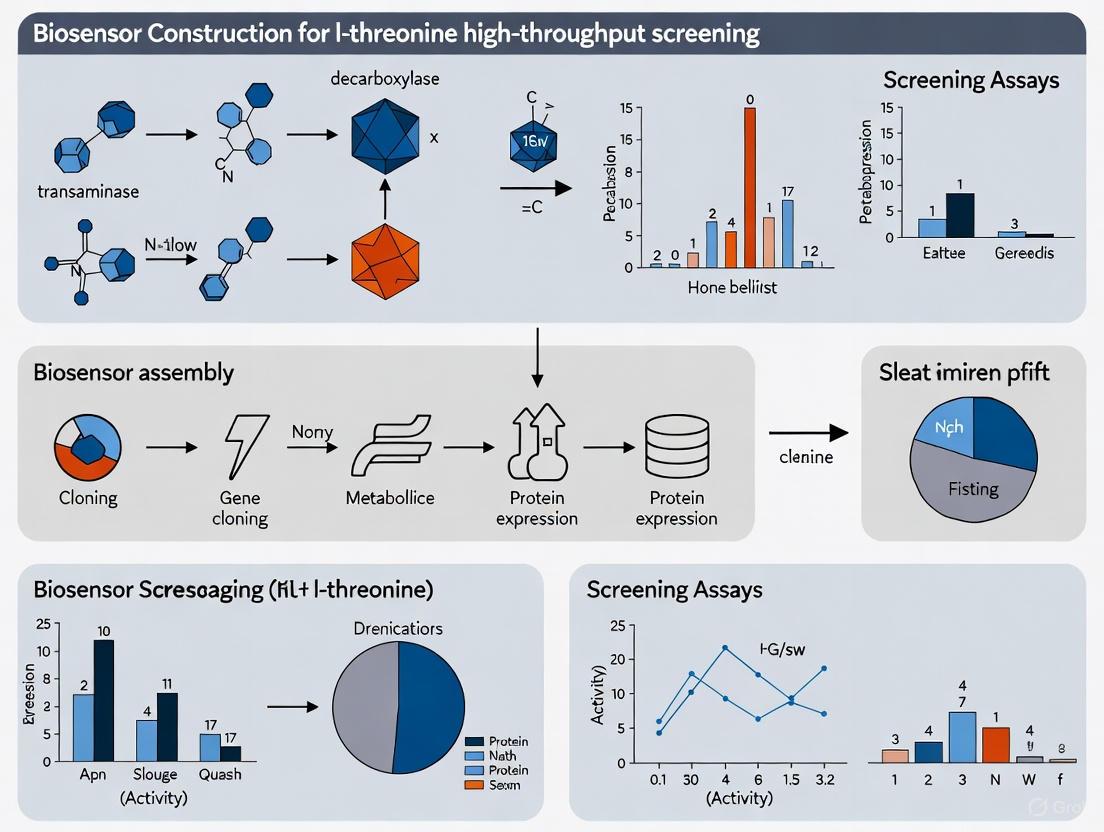
This article provides a comprehensive guide for researchers and scientists on the construction and application of genetically encoded biosensors for the high-throughput screening (HTS) of L-threonine overproducers.
Engineering Next-Generation Biosensors for High-Throughput Screening of L-Threonine
Abstract
This article provides a comprehensive guide for researchers and scientists on the construction and application of genetically encoded biosensors for the high-throughput screening (HTS) of L-threonine overproducers. It explores the foundational principles of biosensor design, including the engineering of transcriptional regulators and riboswitches. The content details practical methodologies for building and implementing these biosensors in HTS campaigns for strain and enzyme evolution. Furthermore, it addresses common optimization challenges and presents validation strategies that compare biosensor performance against traditional analytical techniques. By synthesizing the latest research, this article serves as a strategic resource for accelerating the development of efficient microbial cell factories for L-threonine production.
L-Threonine Biosensor Fundamentals: From Cellular Components to Design Principles
The Critical Need for L-Threonine Biosensors in Metabolic Engineering
The global market for amino acids, valued at $28 billion in 2021, continues to expand with L-threonine representing a particularly significant segment as the third most prominent feed additive [1]. Despite industrial fermentation achieving impressive titers exceeding 120 g/L in engineered Escherichia coli [2] [3], the persistent absence of specific, high-performance biosensors for L-threonine has created a critical bottleneck in strain development pipelines [4] [5]. Conventional analytical methods like chromatography and mass spectrometry are prohibitively time-consuming and labor-intensive for evaluating the millions of mutant variants generated by modern random mutagenesis and directed evolution techniques [4] [6]. This application note details the construction, validation, and implementation of genetically encoded biosensors that directly address this technological gap, enabling dynamic metabolite monitoring and high-throughput screening (HTS) to advance L-threonine overproduction in microbial cell factories.
Biosensor Architectures and Performance Metrics
Recent research has yielded several distinct biosensor architectures for L-threonine, each with unique operational principles and performance characteristics. The table below summarizes the key performance metrics of recently developed L-threonine biosensors.
Table 1: Performance Metrics of Recent L-Threonine Biosensors
| Biosensor Architecture | Sensing Mechanism | Dynamic Range | Key Performance Features | Reference |
|---|---|---|---|---|
| Transcription Factor-Based (CysB T102A) | Evolved CysB mutant with PcysK promoter | 0-4 g/L | 5.6-fold increase in fluorescence response; Used for HTS of producer strains [2] | |
| Dual-Responding Genetic Circuit | L-threonine riboswitch + inducer-like effect + LacI-Ptrc amplification | Not specified | High specificity; Identified mutants with 7-fold increased production [5] | |
| Transport Machinery-Inspired (SerR F104I) | Directed evolution of transcriptional regulator SerR | Not specified | Responds to both L-threonine and L-proline; Used to screen Hom and ProB mutants [1] | |
| Proteomics-Derived Promoter (cysJHp) | Fusion promoter from proteomic analysis | 0-50 g/L | Near-linear response to extracellular L-threonine; FACS-compatible [4] |
Experimental Protocols for Biosensor Implementation
Protocol 1: Construction of an Evolved CysB T102A-Based Biosensor
This protocol details the creation of a highly sensitive biosensor through directed evolution of the native CysB protein [2].
Primary Materials:
- Strain: E. coli DH5α or other appropriate host strains.
- Vector: pTrc99A or similar expression vector.
- Genetic Elements: PcysK promoter, gene for enhanced Green Fluorescent Protein (eGFP), gene encoding CysB transcriptional regulator.
- Equipment: Thermo cycler, fluorescence plate reader, flow cytometer (for validation).
Step-by-Step Procedure:
- Initial Reporter Construction: Clone the PcysK promoter upstream of the egfp gene in the pTrc99A vector to create a transcriptional fusion.
- Sensor Assembly: Co-express the wild-type cysB gene in tandem with the PcysK-egfp reporter construct to create the baseline pSensor.
- Directed Evolution: Perform site-saturation mutagenesis on the cysB gene. The T102 residue is a key target.
- High-Throughput Screening: Transform the mutant library into the host strain and culture in 24-well plates with varying L-threonine concentrations (0-4 g/L).
- Variant Identification: After 8-10 hours of growth, measure eGFP fluorescence. Isolate plasmids from clones showing the highest fluorescence induction ratio (high threonine vs. low threonine).
- Biosensor Validation: The identified mutant, CysB T102A, when reconstituted into the pSensor system, should exhibit a ~5.6-fold increase in fluorescence response across the 0-4 g/L L-threonine range compared to the wild-type sensor [2].
Protocol 2: High-Throughput Screening of Producer Strains Using FACS
This protocol utilizes a validated biosensor for the enrichment of high-producing strains from a mutant library [4] [6].
Primary Materials:
- Biosensor Strain: Producer strain (e.g., E. coli CGMCC 1.366-Thr) harboring the functional L-threonine biosensor.
- Mutagenesis Method: UV, ARTP, or chemical mutagens to create a diverse library.
- Culture Medium: Appropriate fermentation medium (e.g., containing glucose, yeast extract, salts, vitamins).
- Equipment: Fluorescence-Activated Cell Sorter (FACS), fermenter or deep-well plates.
Step-by-Step Procedure:
- Library Generation: Subject the biosensor-equipped producer strain to a chosen mutagenesis method to create a library of genetic variants.
- Cultivation: Grow the mutant library in a suitable fermentation medium under production conditions. Allow sufficient time for L-threonine to accumulate.
- Sample Preparation: Harvest cells during the mid-to-late production phase and resuspend in a buffer compatible with FACS.
- FACS Sorting: Use a flow cytometer to analyze and sort the cell population. Gate the top 0.1%-1% of cells based on fluorescence intensity, corresponding to the highest intracellular L-threonine levels [6].
- Strain Recovery and Validation: Collect sorted cells, plate them on solid medium, and allow colonies to form. Pick individual clones and cultivate them in a controlled fermentation system (e.g., shake flasks or mini-bioreactors).
- Product Quantification: Use high-performance liquid chromatography (HPLC) to accurately measure the L-threonine titer of the screened mutants, confirming the correlation between biosensor signal and production yield.
The Scientist's Toolkit: Essential Research Reagents
Table 2: Key Reagents for L-Threonine Biosensor Development and HTS
| Reagent / Tool | Function / Application | Examples & Notes |
|---|---|---|
| Transcriptional Regulators | Sensory component for biosensor construction | CysB [2], SerR [1]; often require directed evolution for specificity. |
| Reporter Proteins | Quantifiable output signal for biosensor response | eGFP [4] [2], RFP [7], LacZ [4]; enable optical detection. |
| Rare Codon Reporters | FACS-compatible marker for HTS of producer strains | Fluorescent proteins with threonine rare codons (e.g., ATC); fluorescence indicates high intracellular Thr-tRNA levels [6]. |
| HTS-Compatible Vectors | Plasmid backbone for biosensor assembly | pTrc99A [2], pET-30a-trc [5]; typically medium-copy-number, inducible promoters. |
| Host Strains | Chassis for biosensor and producer strain engineering | E. coli MG1655 [4], E. coli DH5α [2], industrial L-threonine producers [4]. |
Visualizing Biosensor Workflows and Mechanisms
L-Threonine Biosensor HTS Workflow
Transcriptional Regulator-Based Biosensor Mechanism
The integration of robust, genetically encoded biosensors into the metabolic engineering workflow represents a paradigm shift for developing L-threonine overproducing strains. The methodologies outlined herein—from the construction of evolved transcriptional regulators to the implementation of FACS-based high-throughput screening—provide a tangible path to overcome the critical screening bottleneck. By translating intracellular metabolite concentrations into quantifiable fluorescent signals, these biosensor platforms enable researchers to efficiently navigate vast genetic landscapes and identify elite producers, thereby accelerating the development of microbial cell factories for the biomanufacturing of L-threonine and other high-value biochemicals.
Genetically encoded biosensors are indispensable tools in synthetic biology and metabolic engineering, serving as sophisticated devices that enable the dynamic regulation of metabolic pathways and high-throughput screening (HTS) of microbial strains for improved chemical production [1]. These biosensors function by converting the intracellular concentration of a target metabolite, such as an amino acid, into a quantifiable signal, typically fluorescence [1] [8]. This capability is crucial for rapidly identifying high-performance producers from vast libraries of microbial variants, a process that would otherwise be prohibitively time-consuming and labor-intensive.
The core functionality of any genetically encoded biosensor hinges on two fundamental molecular components: the biorecognition element and the reporter element. The biorecognition element is responsible for specifically detecting and binding the target molecule, while the reporter element generates a measurable output signal that is correlated with the concentration of the target. This article delineates these core components, provides detailed protocols for their development and implementation, and frames the discussion within the context of constructing biosensors for L-threonine high-throughput screening, a critical amino acid in the feed, food, and pharmaceutical industries [1] [2].
Core Components of Genetically Encoded Biosensors
Biorecognition Elements
Biorecognition elements are sensory proteins that confer specificity to the biosensor by interacting with the target metabolite. The primary types used in microbial biosensors are transcriptional regulators and riboswitches.
- Transcriptional Regulators: These proteins bind to specific DNA sequences (operators) in the absence of an effector, thereby repressing or activating transcription of a downstream gene. Upon binding the target effector molecule (e.g., L-threonine), a conformational change alters their DNA-binding affinity, leading to a change in gene expression [1]. A prominent example is the LysR-type transcriptional regulator (LTTR) family. In Corynebacterium glutamicum, the transcriptional regulator SerR senses intracellular L-serine and activates the expression of its exporter, SerE [1]. Engineering these regulators through directed evolution can alter their effector specificity. For instance, the mutant SerRF104I was engineered to recognize both L-threonine and L-proline as effectors, enabling the development of a novel biosensor for these amino acids [1]. In Escherichia coli, the CysB protein is a transcriptional regulator that controls the cysteine regulon. Its mutant form, CysBT102A, has been successfully deployed as a highly sensitive biorecognition element for L-threonine [2].
- Riboswitches: These are structured RNA elements located in the 5'-untranslated region (5'-UTR) of mRNAs. They regulate gene expression by altering their structure upon direct binding of a small molecule ligand, which affects transcription termination, translation initiation, or mRNA stability [5]. The L-threonine riboswitch has been incorporated into genetic circuits to construct biosensors for identifying L-threonine-overproducing E. coli [5].
Reporter Elements
The reporter element translates the interaction between the biorecognition element and the target metabolite into a detectable and quantifiable signal. The most common reporters are fluorescent proteins.
- Fluorescent Proteins: These proteins allow for real-time, non-destructive monitoring of biosensor activity using techniques like flow cytometry or fluorescence microscopy. The enhanced Yellow Fluorescent Protein (eYFP) was used as a reporter in the SerRF104I-based biosensor for L-threonine and L-proline [1]. Similarly, enhanced Green Fluorescent Protein (eGFP) was employed in the CysBT102A-based L-threonine biosensor, enabling the screening of enzyme mutants and high-producing strains [2]. Red Fluorescent Protein (RFP) is another option used in biosensor construction for visual screening [8]. The choice of fluorescent protein can be tailored to avoid interference with cellular autofluorescence or to enable multiplexing with other sensors.
Table 1: Summary of Key Performance Metrics for L-Threonine Biosensors
| Biorecognition Element | Reporter Element | Dynamic Range | Maximum Fold Induction | Key Application | Citation |
|---|---|---|---|---|---|
| SerRF104I (Engineered LTTR) | eYFP | Not Specified | Not Specified | HTS of Hom and ProB enzyme mutants | [1] |
| CysBT102A (Engineered Transcriptional Regulator) | eGFP | 0 - 4 g/L | 5.6-fold | Iterative strain evolution for L-threonine overproduction | [2] |
| Dual-responding circuit (Riboswitch & Inducer-like effect) | eGFP | Not Specified | Not Specified | Pathway optimization & directed evolution of ThrA | [5] |
| PcysJ, PcysD, PcysJH (Native promoters) | RFP | Not Specified | Not Specified | Dynamic regulation of RhtA transporter expression | [9] |
Experimental Protocols
This section provides a detailed methodology for key experiments in the development and application of transcription factor-based biosensors for L-threonine.
Protocol: Directed Evolution of a Transcriptional Regulator for Altered Effector Specificity
This protocol outlines the process for engineering a transcriptional regulator, such as SerR or CysB, to respond to a new effector like L-threonine [1] [2].
1. Principle: Directed evolution mimics natural selection in the laboratory. By creating a diverse library of mutant genes and applying a high-throughput screening pressure, variants with desired properties—such as the ability to be induced by L-threonine—can be isolated.
2. Reagents and Equipment:
- E. coli or C. glutamicum chassis strain deficient in the native regulator.
- Plasmid vector for expression of the mutant regulator library.
- Phanta Flash Master DNA Polymerase or equivalent high-fidelity PCR enzyme.
- DpnI restriction enzyme.
- Seamless Assembly Mix (e.g., MultiF Seamless Assembly Mix).
- primers for saturation mutagenesis.
- L-Threonine (≥ 99% purity).
- Fluorescence-Activated Cell Sorter (FACS).
- Microplate reader capable of measuring fluorescence and OD.
3. Step-by-Step Procedure: a. Library Construction: i. Target Selection: Based on structural data of the transcriptional regulator (e.g., SerR or CysB), identify amino acid residues in the effector-binding pocket that are critical for ligand specificity [1] [8]. ii. Saturation Mutagenesis: Design primers to randomize the selected codons. Perform PCR using the parental plasmid as a template to generate a comprehensive mutant library. iii. Assembly and Transformation: Digest the PCR product with DpnI to remove the methylated template. Assemble the mutated fragments into a suitable plasmid backbone using a seamless cloning kit and transform into the appropriate microbial chassis.
b. High-Throughput Screening: i. Positive Screening: Culture the mutant library in the presence of a non-inhibitory concentration of L-threonine. Use FACS to isolate the top ~1-5% of cells exhibiting the highest fluorescence from the reporter (e.g., eYFP or eGFP) [10] [8]. ii. Negative Screening: To eliminate mutants with high background (leaky) expression or those that respond to native effectors, subject the enriched population from the positive screen to a second round of FACS in the absence of L-threonine or in the presence of the native effector. Collect cells with the lowest fluorescence [10]. iii. Iteration: Repeat the positive and negative screening cycles 3-4 times to stringently isolate the best-performing mutants.
c. Validation: i. Isolate single clones from the final sorted population. ii. Inoculate clones in 24-deep well plates containing medium with and without L-threonine. iii. After cultivation, measure the optical density (OD600) and fluorescence (e.g., Ex/Em for eGFP: 488/510 nm). Calculate the fold induction (Fluorescence/OD with inducer divided by Fluorescence/OD without inducer). iv. Select mutants exhibiting high fold induction in response to L-threonine and minimal response to non-target molecules for further characterization.
Protocol: Application of a Biosensor for High-Throughput Screening of an Enzyme Library
This protocol describes using an established L-threonine biosensor to screen a library of enzyme mutants (e.g., homoserine dehydrogenase, Hom) for improved L-threonine production [1].
1. Principle: The biosensor strain is co-transformed with a plasmid library of the target enzyme. Intracellular L-threonine produced by beneficial enzyme mutants activates the biosensor, leading to expression of the fluorescent reporter. High-fluorescence cells are isolated, linking genotype to phenotype.
2. Reagents and Equipment:
- Engineered biosensor strain (e.g., containing SerRF104I-eYFP or CysBT102A-eGFP system).
- Plasmid library of the enzyme to be evolved (e.g., l-homoserine dehydrogenase,
hom). - Selective solid and liquid media.
- Flow cytometer or fluorescence-activated cell sorter (FACS).
- Shaking incubator for deep-well plates.
3. Step-by-Step Procedure: a. Preparation: i. Co-transform the biosensor strain with the plasmid library of the target enzyme. Include a control transformation with an empty vector. ii. Plate the transformation mixture on selective solid medium and incubate until colonies appear.
b. Screening: i. Option A: Colony-Based Screening: Pick individual colonies into 96- or 384-well plates containing liquid medium. After incubation, measure fluorescence and OD. Select clones showing fluorescence intensity >10% above the control strain for validation [1]. ii. Option B: FACS-Based Screening: Scrape colonies from the plate and resuspend in liquid medium. Use FACS to directly isolate cells from the culture that display the highest fluorescence intensity (e.g., top 0.1-1%).
c. Validation and Fermentation: i. Inoculate the selected clones in shake flasks or small-scale bioreactors with defined fermentation medium. ii. Culture for a predetermined time (e.g., 24-72 hours), sampling periodically to monitor cell growth (OD600). iii. Quantify L-threonine titer in the fermentation broth using High-Performance Liquid Chromatography (HPLC) to confirm the increased production phenotype of the selected mutants.
Table 2: The Scientist's Toolkit: Essential Research Reagents for L-Threonine Biosensor Development
| Reagent / Material | Function / Role in Biosensor Development | Example from Literature |
|---|---|---|
| MultiF Seamless Assembly Mix | Enzyme mix for seamless, ligation-free assembly of DNA fragments, crucial for plasmid construction. | Used for cloning promoter-reporter fusions and mutant regulator genes [2] [9]. |
| Phanta Flash Master DNA Polymerase | High-fidelity PCR enzyme used for amplification of DNA fragments and library construction by site-directed mutagenesis. | Employed for plasmid reconstruction and amplifying DNA parts for assembly [9]. |
| Fluorescence-Activated Cell Sorter (FACS) | Instrument for high-throughput analysis and sorting of individual cells based on fluorescence, enabling screening of mutant libraries. | Used for dual screening (positive/negative) of LacI and AsnC mutant libraries [10] [8]. |
| L-Threonine Standard (≥99%) | Pure chemical used for calibration curves, determining biosensor dynamic range, and as an inducer in control experiments. | Purchased from suppliers like Sigma-Aldrich or Shanghai Macklin for biosensor characterization [9] [8]. |
| eYFP, eGFP, RFP Genes | Genes encoding fluorescent reporter proteins; the choice depends on the required spectral properties and chassis autofluorescence. | eYFP used with SerRF104I; eGFP used with CysBT102A; RFP used in promoter characterization [1] [2] [9]. |
| pCL1920 or pTrc99A Vectors | Low- or medium-copy number plasmid backbones for stable expression of biosensor components and pathway genes. | pCL1920 used for dynamic regulation studies; pTrc99A used for promoter testing [2] [9]. |
Data Analysis and Interpretation
After performing a screening experiment, the collected data must be rigorously analyzed.
- Dose-Response Curves: To characterize a biosensor, measure the fluorescence output across a range of L-threonine concentrations. Plot the normalized fluorescence (or fold induction) against the log of the L-threonine concentration. This curve reveals the dynamic range, sensitivity, and EC50 (the concentration yielding a half-maximal response) of the biosensor.
- Specificity Testing: Challenge the biosensor with structurally similar amino acids (e.g., L-serine, L-homoserine) to confirm that the fluorescence response is specific to L-threonine. A high-quality biosensor should show minimal activation by non-target molecules.
- Validation with Analytical Methods: Always correlate the biosensor's readout (fluorescence) with the actual L-threonine titer using a gold-standard method like HPLC. This confirms that increased fluorescence reliably predicts increased production and is not an artifact.
Visual Workflows
The following diagrams illustrate the core signaling pathways and experimental workflows described in this article.
Biosensor Mechanism and Application Workflow
L-Threonine Biosynthesis Pathway and Engineering Targets
The construction of genetically encoded biosensors based on transcriptional regulators is a cornerstone of synthetic biology and metabolic engineering. These biosensors are powerful devices for dynamic regulation of metabolic pathways and high-throughput screening (HTS) of desirable phenotypes, enabling rapid identification of high-performance microbial producers for industrial biotechnology [11] [12]. For amino acids in particular, which represent a multi-billion-dollar market, the development of efficient HTS technologies is essential for strain development [13] [1]. This Application Note details the experimental frameworks for utilizing two transcriptional regulators, SerR and CysB, as sensory modules in biosensors for L-threonine and L-proline. Within the broader thesis context of biosensor construction for L-threonine high-throughput screening research, these protocols provide validated methodologies for developing and applying biosensors to identify superior enzyme mutants and production strains.
Biosensor Design Principles and Regulatory Mechanisms
Transcriptional regulator-based biosensors typically consist of a sensory module (the transcriptional regulator), a cognate promoter, and a reporter gene. The regulator binds specific effector molecules, inducing conformational changes that modulate transcription of the reporter [12]. The biosensor output, often fluorescence, provides a quantifiable readout of intracellular metabolite concentration, enabling high-throughput screening.
The following diagram illustrates the core logic and workflow for developing and applying such biosensors, from initial design to high-throughput screening:
Case Study 1: Engineering the SerR Transcriptional Regulator
Background and Rationale
The transcriptional regulator SerR, an LysR-type transcriptional regulator (LTTR) from Corynebacterium glutamicum, naturally regulates the expression of SerE, an exporter for L-serine and L-threonine [11] [1]. A key discovery revealed that SerE also exports L-proline, creating a theoretical basis for hypothesizing that SerR could be engineered to recognize L-threonine and L-proline as effectors [13]. While the wild-type SerR responds specifically to L-serine, directed evolution successfully generated mutant variants with altered effector specificity, enabling the development of a novel dual-specificity biosensor [1].
Key Experimental Results and Performance Data
Directed evolution of SerR yielded the mutant SerRF104I, which showed a robust response to both L-threonine and L-proline. The biosensor was successfully deployed in high-throughput screening campaigns to identify improved variants of key biosynthetic enzymes.
Table 1: Performance Summary of the SerRF104I-based Biosensor in Enzyme Screening
| Target Enzyme | Biosynthetic Pathway | Number of Beneficial Mutants Identified | Production Increase | Key Mutations/Catalytic Similarities |
|---|---|---|---|---|
| L-homoserine dehydrogenase (Hom) | L-threonine | 25 | >10% titer increase | Similarities to most effective reported mutants [13] |
| γ-glutamyl kinase (ProB) | L-proline | 13 | >10% titer increase | Similarities to most effective reported mutants [13] |
Detailed Protocol: Development and Application of the SerRF104IBiosensor
Part I: Directed Evolution of SerR for Altered Effector Specificity
Objective: Engineer SerR to recognize L-threonine and L-proline as effectors. Materials:
- Plasmid Library: SerR mutant library generated via error-prone PCR.
- Host Strain: C. glutamicum ATCC 13032.
- Reporter System: Plasmid with eYFP under control of the SerR-regulated promoter.
- Media: LB and BHIS medium; appropriate antibiotics.
- Inducers: L-serine, L-threonine, L-proline.
Procedure:
- Library Transformation: Transform the SerR mutant library into the C. glutamicum host strain containing the eYFP reporter plasmid.
- Primary Screening: Plate transformed cells on solid media containing L-serine. Screen for clones with low fluorescence, indicating potential disruption of the native L-serine response.
- Secondary Screening: Inoculate low-fluorescence clones into 96-well deep-well plates containing liquid media with either L-threonine (2 g/L) or L-proline (2 g/L). Include controls with L-serine and no inducer.
- Fluorescence Assay: After 24-48 hours of growth, measure optical density (OD600) and eYFP fluorescence (Ex: 513 nm, Em: 527 nm).
- Hit Identification: Calculate fluorescence/OD ratios. Select clones showing high fluorescence in response to L-threonine or L-proline, but not L-serine.
- Validation: Re-test selected hits in triplicate to confirm the response profile. Sequence the serR gene of confirmed hits to identify mutations.
Part II: High-Throughput Screening of Enzyme Mutant Libraries
Objective: Identify superior mutants of Hom and ProB enzymes. Materials:
- Biosensor Strain: C. glutamicum harboring the pSerRF104I biosensor.
- Mutant Libraries: Plasmid-based mutant libraries of hom or proB genes.
- Screening Media: Defined production media with appropriate carbon source.
Procedure:
- Library Transformation: Transform the hom or proB mutant library into the biosensor strain.
- Cultivation and Sorting: Grow the library in 96-well plates for 24 hours. Use fluorescence-activated cell sorting (FACS) to isolate the top 0.1-1% of cells with the highest eYFP fluorescence.
- Validation and Fermentation: Plate sorted cells and pick isolated colonies. Inoculate selected clones into shake-flask fermentation experiments.
- Product Quantification: After fermentation, analyze L-threonine or L-proline titers using HPLC or GC-MS.
- Sequence Analysis: Sequence the hom or proB genes of high-producing clones to identify beneficial mutations.
Case Study 2: Engineering the CysB Transcriptional Regulator
Background and Rationale
CysB is a transcriptional activator that regulates the cysteine regulon in E. coli in response to the availability of sulfur sources [14] [2]. The core hypothesis for its application as an L-threonine biosensor stems from transcriptomic analyses revealing that the promoter PcysK is responsive to exogenous L-threonine. This provided a foundation for using the CysB/PcysK system as a primary biosensor, which was subsequently refined through directed evolution of the CysB protein itself to enhance its sensitivity and dynamic range for L-threonine detection [2].
Key Experimental Results and Performance Data
The engineered CysB biosensor demonstrated a significant improvement in performance, enabling the development of a production strain with industrially relevant titers.
Table 2: Performance Summary of the Engineered CysB-based L-Threonine Biosensor
| Biosensor Component | Configuration | Key Outcome | Overall Impact on Production |
|---|---|---|---|
| Primary Biosensor | PcysK promoter + CysB | Responsive to L-threonine | N/A |
| Evolved Biosensor | PcysK promoter + CysBT102A | 5.6-fold increase in fluorescence responsiveness over 0-4 g/L L-threonine | Enabled high-throughput screening |
| Final Production Strain | THRM13 with optimized metabolic network | L-threonine titer of 163.2 g/L in a 5 L bioreactor; yield of 0.603 g/g glucose | Demonstrated industrial-scale potential |
Detailed Protocol: Development and Application of the CysBT102ABiosensor
Part I: Construction and Evolution of the CysB-based Biosensor
Objective: Develop a highly sensitive L-threonine biosensor from the native CysB/PcysK system. Materials:
- Strains and Plasmids: E. coli DH5α, MG1655; plasmid pTrc99A.
- Reporter: Enhanced Green Fluorescent Protein (eGFP) gene.
- Promoters: Non-coding regions of Cys regulon genes (e.g., cysK, cysJ, cysP).
- Media: LB and M9 minimal medium.
Procedure:
- Primary Reporter Construction: Amplify the non-coding regions of Cys regulon genes and clone them upstream of eGFP in a reporter plasmid.
- Initial Screening: Transform reporter constructs into E. coli DH5α. Grow clones in 24-well plates with L-threonine (0-30 g/L). Measure eGFP fluorescence (Ex: 488 nm, Em: 509 nm) after 8 hours. Select promoters (e.g., PcysK) showing a linear positive response to L-threonine.
- Biosensor Assembly: Construct a biosensor plasmid (pSensor) containing the CysB gene and the PcysK-eGFP reporter.
- Directed Evolution of CysB: Create a library of cysB mutants via site-saturation mutagenesis or error-prone PCR. Clone the mutant library into the pSensor backbone.
- Screening for Enhanced Biosensors: Screen the CysB mutant library as described in Step 2. Isolate clones showing the highest fold-change in fluorescence over the 0-4 g/L L-threonine range.
- Hit Validation: Sequence validated hits (e.g., CysBT102A) and characterize their dose-response curves.
Part II: High-Throughput Screening for L-Threonine Overproducers
Objective: Isolate high-yielding L-threonine E. coli mutants. Materials:
- Biosensor Strain: E. coli production host harboring the pSensorThr (CysBT102A) biosensor.
- Mutagenesis Method: Physical/chemical mutagenesis or a targeted mutant library (e.g., rbs library of key genes).
- Screening Equipment: Flow cytometer or microplate reader.
Procedure:
- Strain Library Preparation: Subject the biosensor strain to mutagenesis to create a diverse library of genetic variants.
- Primary Screening: Use FACS to collect cells from the library population that exhibit the highest eGFP fluorescence. This enriches for high L-threonine producers.
- Secondary Screening: Plate the sorted cells and pick individual colonies into 96-deep well plates for miniaturized fermentation.
- Titer Validation: Measure L-threonine accumulation in the supernatants of micro-fermentations using rapid assay kits or HPLC.
- Systems-Level Optimization: Integrate multi-omics analysis and genome-scale metabolic modeling on the best-performing clones to identify further metabolic engineering targets.
- Bioreactor Validation: Evaluate the performance of the final engineered strain (e.g., THRM13) in controlled bioreactors.
The Scientist's Toolkit: Essential Research Reagent Solutions
Table 3: Key Reagents for Transcriptional Regulator-Based Biosensor Development
| Reagent / Tool | Function / Application | Specific Examples from Case Studies |
|---|---|---|
| Transcriptional Regulators | Sensory module that binds the target metabolite | SerR (from C. glutamicum), CysB (from E. coli) |
| Reporter Proteins | Generates a quantifiable signal output for HTS | Enhanced Yellow Fluorescent Protein (eYFP), Enhanced Green Fluorescent Protein (eGFP) |
| Directed Evolution Techniques | Alters effector specificity and sensitivity of regulators | Error-prone PCR used on serR; Site-saturation mutagenesis of cysB |
| Host Microorganisms | Chassis for biosensor construction and screening | Corynebacterium glutamicum ATCC 13032, Escherichia coli MG1655/DH5α |
| High-Throughput Screening Instruments | Enables sorting and analysis of large mutant libraries | Fluorescence-Activated Cell Sorter (FACS), Microplate Reader for fluorescence/OD |
| Analytical Chemistry Equipment | Validates metabolite production in screened strains | HPLC, GC-MS for quantifying L-threonine and L-proline titers |
Visualizing the CysB Regulatory Pathway and Engineering Workflow
The following diagram details the native CysB regulatory mechanism and the subsequent engineering steps taken to convert it into a functional L-threonine biosensor, highlighting the key genetic modifications.
The case studies of SerR and CysB demonstrate a powerful and generalizable methodology for developing transcriptional regulator-based biosensors. The core strategy involves selecting a native regulator-promoter pair with a foundational response, employing directed evolution to refine specificity and sensitivity, and integrating the resulting biosensor into a high-throughput screening workflow. These protocols provide a roadmap for constructing biosensors not only for L-threonine and L-proline but also for a wide range of other valuable metabolites, accelerating the development of efficient microbial cell factories.
The development of robust high-throughput screening (HTS) systems is crucial for advancing microbial cell factories for L-threonine production. Traditional screening methods are often hindered by the lack of suitable biosensors that can efficiently identify overproducing strains from large mutant libraries. This application note explores two emerging sensing mechanisms—inducer-like effects and synthetic riboswitches—that offer promising alternatives to conventional transcription factor-based biosensors. Within the broader context of biosensor construction for L-threonine research, these mechanisms provide researchers with novel tools for dynamic metabolite detection and regulation, enabling more efficient strain development and metabolic engineering. The compact, protein-independent nature of these systems offers distinct advantages for synthetic biology applications, including reduced metabolic burden and high modularity [5] [15].
Inducer-like Effects of L-Threonine
A groundbreaking discovery in L-threonine sensing revealed that the amino acid itself exhibits an inducer-like effect on cellular genetic circuits. Research demonstrated that L-threonine can directly influence genetic expression without relying on traditional transcription factors. This effect was leveraged in a dual-responding genetic circuit that combined L-threonine's inducer-like properties with a natural L-threonine riboswitch and a lacI-Ptrc signal amplification system. This innovative approach capitalizes on the competition for oxaloacetate (OAA), a crucial TCA cycle intermediate that serves as a precursor for both L-threonine and lycopene biosynthesis. The circuit was specifically designed to screen L-threonine overproducers from random mutant libraries, demonstrating a 7-fold increase in production through directed evolution of the key enzyme thrA [5].
Riboswitch-Based Sensing Mechanisms
Riboswitches are structured non-coding RNA elements located in the 5' or 3' untranslated regions (UTRs) of mRNA that undergo conformational changes upon ligand binding, thereby regulating gene expression. Their modular architecture consists of two primary components: an aptamer domain that specifically binds to the target ligand with high affinity, and an expression platform that transduces the binding event into a genetic regulatory output. This modularity allows for extensive engineering and customization for biosensing applications [16] [17].
Natural riboswitches have been identified for various metabolites including amino acids, enzyme cofactors, nucleotide precursors, and metal ions. However, for targets lacking natural riboswitches, synthetic variants can be developed through computational design and in vitro selection techniques such as SELEX (Systematic Evolution of Ligands by Exponential Enrichment) [16]. Synthetic riboswitches function through several mechanisms including controlling transcription termination, translation initiation, mRNA stability, and splicing. The theophylline-binding aptamer represents a well-characterized synthetic system that has been successfully integrated into functional riboswitch constructs, demonstrating high discriminatory potential against structurally similar purines like caffeine [16].
Table 1: Performance Comparison of L-Threonine Biosensing Mechanisms
| Sensing Mechanism | Dynamic Range | Key Components | Applications Demonstrated | Notable Advantages |
|---|---|---|---|---|
| Inducer-like Effect + Riboswitch | 7-fold production increase | L-threonine riboswitch, lacI-Ptrc amplification | Directed evolution of thrA, pathway optimization | High specificity, cost-effective for large libraries |
| Transcription Factor (CysB) | 5.6-fold fluorescence responsiveness | PcysK promoter, CysB(T102A) mutant | Screening from mutant libraries | 0-4 g/L linear response range |
| Transcriptional Regulator (SerR) | >10% titer increase | SerR(F104I) mutant, eYFP reporter | Evolution of Hom and ProB enzymes | Dual sensing of L-threonine and L-proline |
Riboswitch Design Workflow
The following diagram illustrates the comprehensive workflow for rational riboswitch design, integrating both computational and experimental approaches:
Experimental Protocols
Protocol 1: Construction of a Dual-Responding Genetic Circuit
This protocol details the construction of a dual-responding genetic circuit that capitalizes on both the inducer-like effect of L-threonine and a natural L-threonine riboswitch.
Materials and Reagents
- Plasmid Backbone: pET-30a-trc for eGFP expression
- Assembly Mix: MultiF Seamless Assembly Mix
- Polymerases: Phanta Flash Master DNA polymerase and Green Taq Mix
- Host Strain: E. coli DH5α for initial cloning
- L-Threonine: Purified stock solutions (0-4 g/L for testing)
Procedure
Circuit Design:
- Identify and sequence the natural L-threonine riboswitch from available databases
- Design the dual-responding circuit architecture with the following components:
- L-threonine riboswitch regulatory element
- lacI-Ptrc signal amplification system
- eGFP reporter gene
Genetic Construction:
- Amplify the L-threonine riboswitch using PCR with Phanta Flash Master DNA polymerase
- Digest the pET-30a-trc vector with appropriate restriction enzymes
- Assemble the circuit using MultiF Seamless Assembly Mix according to manufacturer's protocol
- Transform into E. coli DH5α and select on appropriate antibiotic plates
Circuit Validation:
- Inoculate positive clones in LB medium with varying L-threonine concentrations (0, 1, 2, 3, 4 g/L)
- Incubate at 37°C with shaking at 220 rpm for 8 hours
- Measure eGFP fluorescence using flow cytometry or microplate reader
- Confirm dose-dependent response to L-threonine
Library Screening:
- Transform the validated biosensor into the mutant library of interest
- Sort cells using FACS based on fluorescence intensity
- Isolate high-fluorescence populations for further validation [5]
Protocol 2: Development of Transcription Factor-Based Biosensors Through Directed Evolution
This protocol describes the creation of L-threonine biosensors by engineering transcription factors through directed evolution.
Materials and Reagents
- Promoter Elements: PcysK, PcysJ, PcysP, PcysD from E. coli
- Transcription Factor: Wild-type CysB or SerR
- Reporter Genes: eGFP or eYFP
- Mutagenesis Kits: Site-directed mutagenesis reagents
- Selection Medium: LB with appropriate antibiotics
Procedure
Initial Biosensor Construction:
- Amplify the complete non-coding regions of candidate genes (PcysK, PcysJ, PcysP, PcysD) from E. coli genome
- Ligate promoter sequences with eGFP reporter gene into pTrc99A vector
- Transform into E. coli DH5α and culture on LB agar plates
Promoter Response Validation:
- Inoculate transformants in 24-well plates containing LB medium with L-threonine (0, 10, 20, 30 g/L)
- Incubate for 8 hours at 37°C with shaking at 220 rpm
- Measure eGFP fluorescence to identify promoters with linear positive response
Directed Evolution of Transcription Factors:
- Design mutagenic primers to introduce random mutations into the transcription factor genes (CysB or SerR)
- Perform error-prone PCR or site-saturation mutagenesis
- Create mutant libraries and screen for improved responsiveness to L-threonine
Biosensor Characterization:
Protocol 3: Computational Design of Protein-Binding Riboswitches
This protocol utilizes the Riboswitch Calculator algorithm for automated design of riboswitches targeting specific biomarkers.
Materials and Reagents
- Riboswitch Calculator: Algorithm for riboswitch design
- Aptamer Sequences: RNA aptamers for target binding
- Cell-Free Expression System: TX-TL cell-free protein expression system
- Reporter Plasmid: mRFP1 fluorescent protein reporter system
- Ligand Proteins: Purified target proteins (e.g., human mCRP, IL-32γ)
Procedure
Design Specifications:
- Input the sequence of RNA aptamer that binds to the protein of interest
- Specify the secondary structure of the RNA aptamer when bound by the protein
- Input the protein's binding free energy to the RNA aptamer
- Provide the coding sequence of the output reporter protein
Computational Design:
- Run the Riboswitch Calculator to identify synthetic pre-aptamer and post-aptamer sequences
- Utilize genetic algorithm for multi-objective sequence optimization
- Select Pareto-optimal riboswitch sequences maximizing dynamic range (Rmax)
Experimental Characterization:
- Clone designed riboswitch sequences into plasmids regulating mRFP1 expression
- Add varying concentrations of protein ligands via co-expression or direct addition
- Measure mRFP1 fluorescence every 10 minutes using spectrophotometry
- Perform endpoint analysis to quantify changes in reporter expression
Control Experiments:
- Include no-mRFP1 controls to quantify autofluorescence
- Use no-aptamer controls (UTR-136) to measure non-specific changes
- Validate specific riboswitch activation or repression [19]
Signaling Pathways and Molecular Mechanisms
Dual-Response Biosensor Mechanism
The following diagram illustrates the molecular mechanism of dual-responding genetic circuits that combine riboswitches with inducer-like effects:
Research Reagent Solutions
Table 2: Essential Research Reagents for L-Threonine Biosensor Development
| Reagent Category | Specific Examples | Function and Application | Key Characteristics |
|---|---|---|---|
| Aptamer Sources | Natural L-threonine riboswitch, SELEX-derived aptamers | Sensory domain for ligand recognition | High specificity (e.g., theophylline aptamer discriminates against caffeine by 10,000-fold) |
| Transcription Factors | CysB, SerR, evolved mutants (CysB T102A, SerR F104I) | Effector-specific sensing and signal transduction | Broadened effector specificity through directed evolution |
| Reporter Systems | eGFP, eYFP, mRFP1, lacZ | Quantifiable output signal | Enable FACS screening and fluorescence measurements |
| Assembly Systems | MultiF Seamless Assembly Mix, Golden Gate assembly | Genetic circuit construction | Efficient, seamless DNA assembly |
| Host Strains | E. coli DH5α, MG1655, C. glutamicum ATCC 13032 | Biosensor hosting and validation | Genetic tractability, industrial relevance |
| Cell-Free Systems | TX-TL expression system | Riboswitch characterization without cellular barriers | Direct access to expression machinery |
The exploration of alternative sensing mechanisms beyond traditional transcription factors has significantly advanced the field of L-threonine biosensor development. Inducer-like effects and synthetic riboswitches offer complementary advantages for high-throughput screening applications. The inducer-like effect protocol leverages native cellular competition for metabolic precursors, while riboswitch-based approaches provide highly modular, protein-independent sensing platforms. The experimental protocols detailed in this application note provide researchers with comprehensive methodologies for implementing these innovative sensing mechanisms. The combination of these approaches with directed evolution of sensory components and computational design tools creates a powerful toolkit for developing sophisticated biosensors capable of identifying L-threonine overproducers from complex mutant libraries. These advances in biosensor technology promise to accelerate the development of industrial microbial cell factories for L-threonine production and other valuable biochemicals.
The Role of Amino Acid Exporters in Native Regulatory Circuits and Biosensor Inspiration
Amino acid exporters are transmembrane proteins responsible for the controlled efflux of amino acids from the cytoplasm, serving as essential components for maintaining intracellular homeostasis and preventing toxic accumulation of metabolic products. In microbial cell factories, these transporters play a crucial role in the final step of bioproduction, facilitating the secretion of valuable compounds like L-threonine into the extracellular space. Native regulatory circuits have evolved sophisticated mechanisms to coordinate exporter expression with metabolic demand, typically through transcriptional regulators that sense intracellular amino acid concentrations. These natural genetic circuits provide a foundational blueprint for engineering synthetic biology tools, particularly transcription factor (TF)-based biosensors, which are revolutionizing high-throughput screening (HTS) for strain development. Within the context of L-threonine biosensor construction, understanding and exploiting these native systems is paramount for developing efficient screening platforms that can rapidly identify high-performance production strains from vast mutant libraries.
Native Regulatory Circuits Involving Amino Acid Exporters
The SerR-SerE Regulatory System inCorynebacterium glutamicum
In Corynebacterium glutamicum, a well-established workhorse for industrial amino acid production, the transcriptional regulator SerR (Cgl0606) and the exporter SerE (Cgl0605) form a native regulatory circuit responsible for maintaining L-serine homeostasis. SerR is an LysR-type transcriptional regulator (LTTR) that senses intracellular L-serine and activates the expression of SerE, which subsequently exports L-serine from the cell [11]. This system exemplifies the classic bacterial strategy for managing amino acid levels: a TF monitors the intracellular concentration of a specific metabolite and regulates the expression of an exporter gene to prevent potential toxicity from overaccumulation.
Recent research has revealed that the substrate specificity of SerE extends beyond L-serine. Experimental evidence demonstrates that SerE also facilitates the export of L-threonine and, notably, L-proline [13] [11]. This expanded effector profile is significant because it suggests a potential evolutionary and functional link between exporters that handle structurally or biosynthetically related amino acids. The discovery that SerE exports L-proline was particularly unexpected and inspired the hypothesis that its corresponding transcriptional regulator, SerR, might also possess a latent, broadened effector recognition profile that could be unlocked through protein engineering [11].
Table 1: Characterized Amino Acid Exporters and Their Regulatory Systems in C. glutamicum
| Exporter | Transcriptional Regulator | Known Native Effectors (Substrates) | Regulatory Mechanism |
|---|---|---|---|
| SerE | SerR | L-serine, L-threonine, L-proline | Activation of exporter expression by effector-bound SerR |
| ThrE | Not Identified | L-threonine, L-serine, L-proline | Unknown |
| LysE | LysG | L-lysine, L-arginine, L-histidine | Activation of exporter expression by effector-bound LysG |
Regulatory Paradigm and Biosensor Inspiration
The native regulatory circuit of SerR-SerE operates on a simple yet effective genetic logic. Under conditions of low intracellular L-serine, SerR exists in an inactive state that does not significantly activate the promoter upstream of serE. When L-serine accumulates, it binds to SerR as an effector molecule, inducing a conformational change that enables the regulator to activate transcription of serE. The synthesized SerE protein then translocates to the membrane and mediates the efflux of L-serine, thereby reducing the intracellular concentration and completing a homeostatic feedback loop [11].
This natural design provides a direct template for biosensor construction. The core components—a ligand-responsive TF and its cognate promoter—can be isolated and repurposed. In a synthetic biosensor, the output is reconfigured from exporter expression to the production of a easily detectable reporter protein, such as a fluorescent protein (e.g., eYFP, eGFP) [20] [4]. This creates a system where the intracellular concentration of a target metabolite is quantitatively linked to a measurable fluorescent signal, enabling high-throughput screening via fluorescence-activated cell sorting (FACS) [21] [22].
Figure 1: Native SerR-SerE Regulatory Circuit. Intracellular L-serine binds to the transcriptional regulator SerR, which then activates the promoter P_serE, leading to expression of the exporter gene serE and subsequent amino acid export.
Engineering Biosensors Inspired by Native Circuits
Directed Evolution of SerR for L-Threonine and L-Proline Sensing
While the wild-type SerR regulator is specifically responsive to L-serine and does not recognize L-threonine or L-proline as effectors, its structural and functional relationship with the broad-specificity exporter SerE suggested inherent engineering potential. Researchers employed a directed evolution strategy to alter the effector specificity of SerR [13] [11]. A key step in this process involved creating mutant libraries of the serR gene, followed by a screening strategy to identify variants that could activate gene expression in the presence of either L-threonine or L-proline.
This approach successfully yielded the mutant SerRF104I, which contains a single amino acid substitution (phenylalanine to isoleucine at position 104). This variant gained the ability to recognize both L-threonine and L-proline as effectors while retaining its original response to L-serine. When incorporated into a biosensor construct—where the DNA-binding site for SerR was placed upstream of a reporter gene like eyfp—the SerRF104I-based system functioned as a dual-purpose biosensor. It could effectively distinguish microbial strains with varying production levels of L-threonine and L-proline, making it a powerful tool for high-throughput screening [13] [11].
Table 2: Performance of Engineered SerR-Based Biosensor in HTS Applications
| Biosensor Configuration | Effectors Recognized | Application in HTS | Screening Outcome |
|---|---|---|---|
| Wild-Type SerR | L-serine | Not applicable for Thr/Pro | N/A |
| Evolved SerRF104I | L-serine, L-threonine, L-proline | Screening of Hom (L-threonine pathway) and ProB (L-proline pathway) mutant libraries | Identification of 25 Hom and 13 ProB mutants increasing product titer by >10% |
Protocol: Directed Evolution of a Transcriptional Regulator for Altered Effector Specificity
This protocol details the process of engineering a transcriptional regulator, such as SerR, to develop a biosensor for new effector molecules like L-threonine [11] [22].
Materials:
- Plasmid containing the wild-type transcriptional regulator gene (e.g., serR) and its cognate promoter.
- Error-prone PCR kit or site-saturation mutagenesis reagents.
- Host strain (e.g., C. glutamicum or E. coli) with a reporter system (e.g., eYFP) under the control of the TF's target promoter.
- Microtiter plates or FACS for screening.
- Chemicals: Effector molecules (e.g., L-threonine, L-proline), growth media.
Procedure:
Library Generation:
- Random Mutagenesis: Use error-prone PCR to introduce random mutations throughout the coding sequence of the transcriptional regulator gene (serR). Clone the mutated PCR products back into the expression plasmid.
- Site-Saturation Mutagenesis (Semi-Rational): Based on structural data (if available, as with LysG [22]), target specific amino acid residues in the ligand-binding pocket. For each targeted position, use primers to randomize the codon and create a library of mutants.
Transformation: Transform the pooled plasmid library into the appropriate host strain containing the fluorescent reporter construct.
Primary Screening for Gain-of-Function:
- Plate the transformed library on solid media or grow in liquid culture containing the target effector (e.g., L-threonine) at a concentration expected in a producer strain.
- Using an automated plate reader or FACS, screen for clones exhibiting high fluorescence, indicating that the mutant TF activates the reporter in response to the new effector.
Counterscreening for Specificity (Optional but Recommended):
- Isolate the primary hits and re-test them in the presence of the original effector (e.g., L-serine) and other potential cross-reactants.
- The ideal candidate should show a strong response to the new effector(s) and a diminished or altered response to unwanted effectors. This step was crucial in engineering LysG-based sensors with narrowed ligand specificity [22].
Validation and Characterization:
- Re-test the selected mutant candidates in liquid culture with a range of effector concentrations to determine the dynamic range, sensitivity, and specificity of the engineered biosensor.
- Sequence the mutated serR gene to identify the causative mutation(s).
Biosensor Application: Use the validated biosensor plasmid to transform a library of producers (e.g., a mutant library of Hom or ProB enzymes). Use FACS to sort the highly fluorescent cells, which correspond to high producers, for further fermentation validation [11].
Figure 2: Workflow for Engineering a Transcriptional Regulator Biosensor. The process involves creating genetic diversity, functional screening, and validation to develop a tool for high-throughput screening.
Alternative Biosensor Designs for L-Threonine
Beyond TF-based systems, other innovative biosensor strategies for L-threonine have been developed. One approach utilizes artificial promoters discovered via proteomic analysis. In E. coli, the fusion promoter cysJHp, derived from sulfate metabolism genes, was found to be induced in response to extracellular L-threonine. This promoter was used to control the expression of eGFP, creating a biosensor that did not rely on a classical TF but still enabled FACS-based screening of high-producing strains [4].
Another recent strategy leverages codon usage. Genes for fluorescent proteins were engineered to be rich in L-threonine rare codons. In high-yield L-threonine strains, the charged levels of the corresponding rare tRNA are sufficient for efficient translation, leading to high fluorescence. This system directly links the cellular capacity for L-threonine production to the translation of a reporter, providing another unique HTS method [6].
The Scientist's Toolkit: Research Reagent Solutions
Table 3: Essential Research Reagents for Exporter and Biosensor Studies
| Reagent / Tool | Function / Application | Example(s) from Literature |
|---|---|---|
| Transcriptional Regulator (TF) | Sensory component of the biosensor; binds the target metabolite and activates transcription. | SerR (wild-type and F104I mutant) [11], LysG [21] [22] |
| Cognate Promoter | DNA element controlled by the TF; drives expression of the reporter gene in the biosensor circuit. | PserE (for SerR) [11], PlysE (for LysG) [21] |
| Fluorescent Reporter Protein | Provides a measurable output for biosensor activation; enables FACS. | eYFP (enhanced Yellow Fluorescent Protein) [11] [22], eGFP [4] |
| Model Host Organisms | Chassis for biosensor implementation and producer strain development. | Corynebacterium glutamicum [13] [11], Escherichia coli [4] [6], Vibrio natriegens [21] |
| High-Throughput Screening Instrument | Enables rapid sorting of single cells based on biosensor fluorescence. | Fluorescence-Activated Cell Sorter (FACS) [21] [11] [4] |
| Key Enzymes for Pathway Engineering | Metabolic engineering targets to enhance flux towards the target amino acid. | l-homoserine dehydrogenase (Hom) for L-threonine [11], γ-glutamyl kinase (ProB) for L-proline [11] |
| Amino Acid Exporters | Final step in production; can be overexpressed to enhance titers and alleviate feedback inhibition. | SerE, ThrE [23] [11] |
Biosensor Construction and Implementation for Strain and Enzyme Evolution
Step-by-Step Guide to Building a Transcriptional Factor-Based Biosensor
Transcription factor (TF)-based biosensors are sophisticated biological tools that convert the intracellular concentration of a specific small molecule, such as the amino acid L-threonine, into a quantifiable signal, typically fluorescence. These devices are indispensable in synthetic biology and metabolic engineering for applications ranging from high-throughput screening of microbial cell factories to the dynamic regulation of metabolic pathways [24] [25]. Their construction leverages natural biological components: an allosteric transcription factor that undergoes a conformational change upon binding a target ligand (the effector), and a promoter region that controls the expression of a reporter gene based on the TF's DNA-binding status [26].
The fundamental working mechanisms can be categorized as follows:
- Repressor-Based Systems: In the absence of the effector, the TF repressor is bound to its operator site, preventing transcription of the reporter gene. Effector binding causes the repressor to dissociate from the DNA, allowing gene expression to proceed [26].
- Activator-Based Systems: In the absence of the effector, the TF activator cannot bind DNA or recruit RNA polymerase. Effector binding induces a conformational change that enables the TF to bind its operator and activate transcription of the reporter gene [26].
Selecting an appropriate TF is the cornerstone of biosensor development. For novel targets, this process begins with mining literature and specialized databases ( [25]). A powerful alternative is the directed evolution of existing TFs that recognize structurally analogous compounds or related metabolites, a strategy that has successfully generated biosensors for L-threonine and other amino acids [11] [27] [1]. Key performance metrics to optimize during the design phase include specificity (discrimination against non-target molecules), sensitivity (response to minute concentration changes), dynamic range (ratio between fully induced and non-induced signal), and detection range (the span of effector concentrations that elicit a response) [24].
Biosensor Construction Protocol
This protocol details the construction of a plasmid-based, repressor-type TF biosensor in E. coli for the detection of L-threonine, based on the engineering of regulators like SerR or YpItcR [11] [27] [1].
Stage 1: Plasmid Vector Assembly
The biosensor is typically constructed on a plasmid with two key genetic components: the gene encoding the transcription factor and the reporter module it controls.
Step 1.1: Prepare Plasmid Backbone
- Procedure: Digest a suitable medium-copy-number plasmid (e.g., pCDF-Duet or pZnt-eGFP) with restriction enzymes (e.g., NdeI/NotI) following the manufacturer's protocol. Purify the linearized vector using a gel extraction kit [28].
- Objective: Create a ready-to-accept-insert plasmid backbone.
Step 1.2: Clone the Transcription Factor Gene
- Procedure: Amplify the gene encoding your chosen TF (e.g.,
serRorypItcR) from genomic or synthetic DNA using high-fidelity PCR. Incorporate restriction sites compatible with the vector into the primers. Ligate the purified PCR product into the prepared vector backbone using a ligation enzyme mix. Transform the ligation product into competent E. coli DH5α cells and plate on selective media. Verify successful clones by colony PCR and Sanger sequencing [11] [28]. - Objective: Generate the "sensing plasmid" (e.g., pCDF-TtgR) that expresses the TF.
- Procedure: Amplify the gene encoding your chosen TF (e.g.,
Step 1.3: Clone the Reporter Construct
- Procedure: On a second plasmid (or the same plasmid if using a dual-expression system), insert the TF-specific promoter (e.g.,
P_serorP_ccl) upstream of a reporter gene, such aseyfporegfp. Use restriction enzymes (e.g., BglII/XbaI) and ligation, or a one-step cloning method like Gibson assembly. The promoter must contain the specific operator sequence to which the TF binds. Transform and verify the construct as in Step 1.2 [11] [28]. - Objective: Generate the "reporter plasmid" (e.g., pSerR-eYFP) where the TF-regulated promoter controls the expression of a fluorescent protein.
- Procedure: On a second plasmid (or the same plasmid if using a dual-expression system), insert the TF-specific promoter (e.g.,
The following diagram illustrates the genetic circuit and workflow for assembling and testing the biosensor.
Stage 2: Host Transformation and Culture
Step 2.1: Co-transform Host Strain
- Procedure: Co-transform the verified sensing and reporter plasmids into a suitable E. coli host strain (e.g., BL21(DE3)) using a standard heat-shock or electroporation protocol. Plate the transformation mixture on selective media containing the appropriate antibiotics for both plasmids. Incubate overnight at 37°C [28].
- Objective: Create the functional whole-cell biosensor strain.
Step 2.2: Culture Biosensor Cells
- Procedure: Inoculate a single colony into liquid LB medium with antibiotics. Grow the culture overnight at 37°C with shaking (250 rpm). The following day, dilute the overnight culture into fresh medium and grow until the mid-exponential phase (OD600 ≈ 0.3-0.6) [28].
- Objective: Prepare actively growing biosensor cells for induction assays.
Biosensor Characterization and Tuning
Once a functional biosensor is assembled, its performance must be quantitatively characterized and optimized.
Stage 3: Dose-Response Characterization
Step 3.1: Induce with Effector Gradient
- Procedure: Aliquot the mid-exponential phase culture into separate flasks or a multi-well plate. Add a range of L-threonine concentrations (e.g., 0 μM, 10 μM, 100 μM, 1 mM, 10 mM). Include a negative control with no effector. Continue incubation for a fixed period (e.g., 1-3 hours) [11] [27].
- Objective: Measure the biosensor's output across a spectrum of effector concentrations.
Step 3.2: Measure Fluorescence Output
- Procedure: For each sample, measure the optical density at 600 nm (OD600) and the fluorescence (e.g., excitation/emission for eYFP: ~515/530 nm). Ensure measurements fall within the dynamic range of your instrument by diluting samples if necessary [11] [28].
- Objective: Collect raw data on cell growth and reporter signal.
Step 3.3: Calculate and Plot Dose-Response
- Procedure: For each sample, calculate the fluorescence/OD600 ratio to normalize for cell density. Then, calculate the Induction Coefficient or Fold Induction: (Normalized Fluorescence with effector) / (Normalized Fluorescence without effector). Plot the Induction Coefficient against the logarithm of the L-threonine concentration. Fit a sigmoidal curve (e.g., Hill equation) to the data to determine key parameters [28].
- Objective: Quantify the biosensor's performance characteristics.
Table 1: Key Performance Parameters Extractable from Dose-Response Data
| Parameter | Description | Formula/Interpretation |
|---|---|---|
| Dynamic Range | The fold-change between maximal and minimal output signal. | ( \text{Max Induction Coefficient} ) |
| EC₅₀ | The effector concentration that produces a half-maximal response. A measure of sensitivity. | Derived from the Hill fit curve. |
| Detection Range | The span of effector concentrations over which the biosensor responds usefully. | Often taken as EC₁₀ to EC₉₀. |
| Hill Coefficient | Describes the cooperativity of the binding reaction. | From the Hill equation fit; >1 indicates positive cooperativity. |
| Basal Expression | The output signal level in the absence of the effector ("leakiness"). | Normalized fluorescence at 0 mM effector. |
Stage 4: Performance Tuning Strategies
If the initial biosensor performance is suboptimal, employ these tuning strategies:
Strategy 4.1: Engineer the Transcription Factor
- Rational Design: If structural data is available, introduce point mutations into the effector-binding domain to alter affinity or specificity. For example, the SerRF104I mutation enabled recognition of L-threonine and L-proline [11] [1].
- Directed Evolution: Use random mutagenesis (e.g., error-prone PCR) on the TF gene, followed by high-throughput screening of the mutant library to identify variants with improved properties like higher specificity or dynamic range [11] [27].
Strategy 4.2: Engineer the Promoter or RBS
- Promoter Engineering: Modify the TF operator sequence's number, location, or sequence to alter the TF's binding affinity, which affects the detection threshold and dynamic range [24].
- RBS Engineering: Vary the strength of the Ribosome Binding Site (RBS) upstream of the TF and/or reporter gene to optimize their translation rates, fine-tuning the sensor's dynamic range and response curve [24].
Table 2: Tuning Strategies for TF-Based Biosensor Components
| Component | Tuning Method | Primary Performance Metrics Affected |
|---|---|---|
| Transcription Factor (TF) | Directed Evolution; Site-Directed Mutagenesis | Specificity, Sensitivity, Dynamic Range |
| TF Operator Site | Altering sequence, number, or position in promoter | Sensitivity, Detection Range, Dynamic Range, Cooperativity |
| Promoter | Mutating -35/-10 RNA polymerase binding sites | Signal Output Intensity |
| Ribosome Binding Site (RBS) | Varying sequence strength for TF or reporter | Dynamic Range, Response Time |
The following diagram summarizes the characterization and tuning workflow to optimize biosensor performance.
Application in High-Throughput Screening
The primary application within a thesis context on L-threonine production is the high-throughput screening (HTS) of engineered strains or enzyme libraries.
Protocol: Screening an L-Threonine Producer Library
Step 1: Prepare the Mutant Library
Step 2: Cultivation and Sorting
- Procedure: Grow the library in 96-well or 384-well deep-well plates with production medium. Allow L-threonine to accumulate during cultivation. After an appropriate incubation period, either measure the fluorescence directly in the plate reader or use Fluorescence-Activated Cell Sorting (FACS) for single-cell analysis and sorting [11].
- Objective: Link high L-threonine production to high fluorescence intensity in individual clones.
Step 3: Isolation and Validation
- Procedure: Isolate the most fluorescent clones (e.g., the top 1%). Re-culture them in shake flasks under production conditions. Quantify the actual L-threonine titer of these validated hits using analytical methods like HPLC. This step confirms that the biosensor signal correlates with high production [11] [1].
- Objective: Identify and confirm genuine high-producing strains.
The Scientist's Toolkit: Research Reagent Solutions
Table 3: Essential Reagents and Materials for Biosensor Construction
| Reagent/Material | Function/Application | Examples & Notes |
|---|---|---|
| Cloning Vector | Plasmid backbone for gene assembly. | pCDF-Duet, pZnt-eGFP; medium copy number, compatible antibiotic resistance. |
| Restriction Enzymes | Digest DNA for traditional cloning. | NdeI, NotI, BglII, XbaI; high-fidelity enzymes recommended. |
| DNA Polymerase | Amplify gene inserts via PCR. | PrimeSTAR Max (high-fidelity), EmeraldAmp MAX (low-fidelity for error-prone PCR). |
| Competent Cells | Plasmid propagation and biosensor host. | E. coli DH5α (cloning), BL21(DE3) (biosensor expression). |
| Reporter Protein | Generates measurable output signal. | eYFP, eGFP (fluorescence); RFP (red fluorescence); LuxAB (luminescence). |
| Ligase/Assembly Mix | Joins DNA fragments. | T4 DNA Ligase; 2x Hieff Clone Enzyme Premix (for one-step cloning). |
| Selective Antibiotics | Maintain plasmid presence in culture. | Spectinomycin, Ampicillin, Kanamycin; concentration depends on vector. |
| Target Effector | Biosensor analyte and assay standard. | L-Threonine (pure standard); prepare fresh stock solutions in Milli-Q water. |
| Microplate Reader | Quantifies fluorescence/absorbance in HTS. | Must have appropriate filters (e.g., ~515/530 nm for eYFP) and capacity for 96/384-well plates. |
The construction of highly specific and sensitive biosensors is a critical goal in synthetic biology and metabolic engineering. Directed evolution serves as a powerful protein engineering approach to overcome the limitations of natural sensory proteins, which may lack desired specificity, sensitivity, or dynamic range for applied research. This methodology mimics natural evolution in a laboratory setting through iterative rounds of diversification and selection or screening, enabling researchers to guide proteins toward enhanced or entirely novel functionalities [29] [30]. For biosensor construction, directed evolution is particularly valuable for altering the effector specificity of transcriptional regulators, thereby creating novel tools for high-throughput screening (HTS) of valuable compounds such as L-threonine [1] [5].
The fundamental advantage of directed evolution over rational design lies in its ability to navigate the vast sequence space of a protein without requiring comprehensive structural knowledge or complete understanding of sequence-function relationships. During natural protein evolution, spontaneous mutations create variants, with beneficial changes propagating through populations via natural selection. Similarly, directed evolution subjects a protein of interest to iterative mutagenesis, followed by screening or selection for desired properties [29]. This process allows beneficial mutations to accumulate over multiple generations, often resulting in combinations of mutations that would be difficult to predict rationally [29]. For sensory proteins, this approach can yield mutants with inverted specificities, enhanced affinities, or novel recognition capabilities, providing customized components for biosensor design.
Theoretical Framework and Key Concepts
The Directed Evolution Workflow
A bona fide directed evolution experiment consists of multiple iterative cycles, each comprising two fundamental steps: (1) library generation through genetic diversification, and (2) isolation of improved variants via screening or selection [29] [30]. This iterative process distinguishes directed evolution from simple mutagenesis and screening approaches, as it allows the guided exploration of a protein's sequence space, progressively enriching populations with variants exhibiting the desired functional characteristics [29].
The power of directed evolution stems from its ability to evaluate a much greater number of functionally important residues compared to either site-directed or non-iterative mutation and screening methods. While traditional alanine scanning can identify residues necessary for function, directed evolution can identify residues that modulate function in more subtle ways, including those that affect specificity and affinity [29].
Application to Sensory Protein Engineering
Sensory proteins, particularly transcriptional regulators, naturally possess the ability to bind specific effector molecules and subsequently regulate gene expression. This inherent property makes them ideal foundations for biosensor development. However, natural regulators often lack the exact specificity or operational range required for industrial or research applications. Directed evolution addresses this limitation by enabling the molecular optimization of these natural components [1].
For L-threonine biosensor development, the engineering challenge involves creating sensory proteins that can specifically detect this amino acid and transduce its presence into a measurable signal. The directed evolution approach allows researchers to start with a natural transcriptional regulator and systematically evolve its effector-binding pocket to recognize L-threonine, either as a primary effector or alongside its native ligands [1] [5].
Case Study: Evolution of SerR into SerRF104I for L-Threonine and L-Proline Sensing
Background and Rationale
The transcriptional regulator SerR from Corynebacterium glutamicum naturally regulates the expression of SerE, an exporter for L-serine and L-threonine [1]. Although SerR's native effector is L-serine, researchers hypothesized that its specificity could be altered through protein engineering. This hypothesis was supported by the observation that SerE shares overlapping substrate specificity with ThrE, which exports L-serine, L-threonine, and L-proline [1]. This functional overlap between transporters suggested that their corresponding transcriptional regulators might also share latent capacities for recognizing multiple effectors.
The goal of this directed evolution project was to generate SerR variants capable of responding not only to L-serine but also to L-threonine and L-proline, thereby creating a dual-specificity biosensor with applications in metabolic engineering for these valuable amino acids [1]. The successful development of such a biosensor would enable high-throughput screening of microbial strains with enhanced L-threonine and L-proline production capabilities.
Experimental Protocol
Library Generation and Mutagenesis
- Initial Library Construction: Create a mutagenic library of the serR gene. While the specific mutagenesis method used for SerR was not detailed in the search results, common approaches include:
- Error-prone PCR: This method introduces random point mutations throughout the gene by altering PCR conditions to reduce fidelity [30].
- Site-saturation mutagenesis: If specific residues are targeted based on structural knowledge, this method systematically replaces a single position with all possible amino acids [30].
- Library Size Considerations: Aim for library sizes of approximately 10^6-10^9 variants to ensure adequate coverage of sequence space. The maximal library size is often limited by bacterial transformation efficiency [29].
Screening and Selection Strategy
- Biosensor Assembly: Clone the mutant serR library into a plasmid system where the regulator controls the expression of a reporter gene, such as enhanced yellow fluorescent protein (eYFP) [1].
- High-Throughput Screening: Express the biosensor library in a suitable host strain (e.g., E. coli or C. glutamicum). Use fluorescence-activated cell sorting (FACS) to isolate clones that exhibit increased fluorescence in the presence of L-threonine or L-proline [1] [31].
- Specificity Screening: Counter-screen variants against the native effector (L-serine) to identify mutants with altered or broadened specificity.
Iterative Rounds and Characterization
- Progressive Enrichment: Subject enriched populations from initial sorting rounds to additional cycles of mutagenesis and screening to accumulate beneficial mutations [29].
- Variant Isolation and Validation: Isolate individual clones from final populations. Characterize their dose-response relationships with L-threonine, L-proline, and L-serine to quantify changes in effector specificity, sensitivity, and dynamic range [1].
- Sequence Analysis: Sequence validated variants to identify causative mutations. In the case of SerR, the F104I mutation was identified as critical for conferring responsiveness to L-threonine and L-proline [1].
Key Outcomes and Applications
The directed evolution of SerR yielded the mutant SerRF104I, which exhibits a dramatically altered effector profile. Unlike wild-type SerR, which responds specifically to L-serine, the SerRF104I mutant recognizes both L-threonine and L-proline as effectors and can effectively distinguish microbial strains with varying production levels of these amino acids [1].
This engineered biosensor was subsequently deployed in high-throughput screening campaigns to identify improved variants of key biosynthetic enzymes:
- L-homoserine dehydrogenase (Hom): A critical enzyme in L-threonine biosynthesis [1].
- γ-glutamyl kinase (ProB): A key enzyme in L-proline biosynthesis [1].
Using the SerRF104I-based biosensor, researchers successfully identified 25 novel Hom mutants and 13 novel ProB mutants that increased titers of their respective amino acids by over 10%, demonstrating the practical utility of the evolved sensory protein in metabolic engineering applications [1].
Table 1: Key Performance Metrics of Evolved Sensory Proteins
| Sensory Protein | Evolved Property | Screening Throughput | Application Outcome | Reference |
|---|---|---|---|---|
| SerRF104I | Gained response to L-threonine and L-proline | N/A | Identified 25 Hom and 13 ProB mutants increasing product titer >10% | [1] |
| Threonine Biosensor (cysJHp) | Response to intracellular L-threonine | >400 strains from 20 million mutants in 1 week | One mutant produced 17.95% more threonine in 5-L fermenter | [4] |
| Dual-responding Genetic Circuit | L-threonine detection via inducer-like effect & riboswitch | Large-scale RBS library screening | 7-fold increase in L-threonine production through directed evolution of thrA | [5] |
Table 2: Comparison of Directed Evolution Methodologies for Sensory Proteins
| Method | Key Advantage | Limitation | Typical Library Size | Suitable for |
|---|---|---|---|---|
| Error-prone PCR | Easy to perform; no prior structural knowledge needed | Biased mutagenesis spectrum; reduced sequence space sampling | 10^4 - 10^6 variants [30] | Initial diversification; improving stability/activity |
| Site-saturation Mutagenesis | In-depth exploration of chosen positions | Only a few positions mutated; libraries become large quickly | 10^2 - 10^3 variants per position [30] | Fine-tuning specific residues; altering specificity |
| DNA Shuffling | Recombines beneficial mutations from multiple parents | Requires high sequence homology between parents | 10^6 - 10^8 variants [30] | Later evolution rounds; combining beneficial mutations |
| FACS-based Screening | Extremely high throughput (>10^7 cells/hour) | Requires fluorescence signal; specialized equipment needed | 10^7 - 10^8 cells per hour [31] | Sorting large libraries based on reporter fluorescence |
The Scientist's Toolkit: Essential Research Reagents
Table 3: Key Research Reagent Solutions for Directed Evolution of Sensory Proteins
| Reagent / Tool | Function in Workflow | Example from Literature |
|---|---|---|
| Error-Prone PCR Kits | Introduces random mutations throughout target gene for initial library generation | Used for diversification in numerous directed evolution studies [30] |
| Fluorescent Reporter Proteins (eYFP, eGFP) | Provides detectable output for biosensor activity; enables FACS-based screening | eYFP used as reporter in SerRF104I biosensor [1]; eGFP used in threonine biosensor development [4] |
| FACS Instrumentation | Enables high-throughput sorting of cell libraries based on biosensor output | FACS used to screen >20 million mutants for threonine production [4] |
| Dual-Reporting Genetic Circuits | Combines multiple sensing elements to enhance specificity or dynamic range | Circuit using L-threonine riboswitch and inducer-like effect developed for HTS [5] |
| Specialized Host Strains | Provides optimized cellular context for biosensor function and library expression | E. coli and C. glutamicum used as hosts for threonine biosensors [1] [5] |
Experimental Workflow Visualization
Troubleshooting and Optimization Guidelines
Common Experimental Challenges
- Low Library Diversity: If mutagenesis yields insufficient diversity, optimize error-prone PCR conditions or consider alternative mutagenesis methods such as mutator strains [30] or oligonucleotide-based mutagenesis.
- High Background in Screening: Optimize promoter strength and expression levels of the sensory protein to minimize basal expression of the reporter gene. Incorporation of signal amplification systems, such as the lacI-Ptrc system used in dual-responding genetic circuits, can improve signal-to-noise ratios [5].
- Limited Functional Hits: If initial libraries yield few improved variants, increase library size or employ more targeted approaches such as saturation mutagenesis of predicted substrate-binding residues.
Optimization Strategies
- Iterative Evolution: Conduct multiple rounds of evolution with progressively more stringent selection criteria to accumulate beneficial mutations [29].
- Combinatorial Approaches: Combine beneficial mutations identified from different clones to potentially achieve additive or synergistic effects.
- Dynamic Regulation: Consider incorporating evolved biosensors into dynamic regulation systems that not only report metabolite levels but also regulate metabolic flux in real-time [1].
Directed evolution represents a powerful methodology for engineering sensory proteins with tailored effector specificities. The development of the SerRF104I mutant demonstrates how this approach can transform a native transcriptional regulator into a valuable tool for metabolic engineering. The protocols, reagents, and workflows outlined in this application note provide a roadmap for researchers seeking to create custom biosensors for high-throughput screening applications. As directed evolution methodologies continue to advance, with improvements in library generation techniques and screening throughput, the capacity to engineer sophisticated sensory proteins for diverse applications will continue to expand, further enabling the optimization of microbial cell factories for industrial biotechnology.
Designing Dual-Responding and Signal-Amplification Genetic Circuits
The construction of sophisticated genetic circuits that can respond to multiple signals and amplify transcriptional output represents a frontier in metabolic engineering and synthetic biology. These systems are particularly valuable for developing high-throughput screening (HTS) platforms aimed at identifying microbial strains with enhanced production capabilities for target metabolites. Within the context of L-threonine biosensor research, dual-responding circuits enable dynamic detection of this essential amino acid, which finds extensive application in food, animal feed, and pharmaceutical industries [5]. The fundamental challenge in establishing robust HTS systems has been the historical lack of appropriate biosensors capable of precisely identifying desired strains from random mutant libraries [5]. Traditional approaches relying on single-input sensing often lack the specificity and dynamic range necessary for effective screening, creating an imperative for advanced circuit architectures that integrate multiple sensing modalities with signal amplification capabilities.
The core principle behind dual-responding circuits lies in their ability to process complex biological signals through engineered genetic components that function analogously to electronic operational amplifiers [32]. These synthetic biological systems can decompose multidimensional, non-orthogonal signals into distinct components, enabling precise control over gene expression in response to dynamic intracellular conditions [32]. For L-threonine screening, this capability is particularly valuable as it allows researchers to distinguish between high-producing and low-producing strains based on multiple cellular parameters simultaneously, significantly enhancing screening accuracy and efficiency compared to conventional methods.
Core Circuit Design Principles and Components
Fundamental Operating Principles
Dual-responding genetic circuits function through integrated sensing and processing of multiple input signals, which are subsequently translated into amplified transcriptional outputs. These systems typically employ orthogonal regulatory components that minimize crosstalk between signaling pathways while maintaining high specificity for their target inducters [32]. The operational framework can be conceptualized through vector operations and matrix multiplication, where input signals corresponding to different cellular states are decomposed into orthogonal components through carefully tuned linear transformations [32]. This decomposition enables the distinct representation of each biological state, ensuring accurate signal separation and processing.
The mathematical implementation of this signal processing involves applying a coefficient matrix to input signals, corresponding to operations performed by biological operational amplifier (OA) circuits [32]. In an ideal transformation, this process produces a diagonal matrix where only diagonal elements retain expression levels while all off-diagonal elements are zero, effectively isolating each signal component. For L-threonine sensing, this principle allows circuits to respond specifically to the target metabolite while filtering out confounding signals from related metabolic pathways. The effective activator concentration (XE) in such OA circuits can be computed as XE = α · X1 - β · X2, where X1 and X2 represent input transcription signals that regulate the production of activator (A) and repressor (R), respectively, with α and β representing tuning parameters [32].
Critical Circuit Components
The implementation of dual-responding circuits requires several essential genetic components that work in concert to achieve multi-signal responsiveness and signal amplification:
Sensory Modules: These components detect initial biological signals and initiate the circuit response. For L-threonine biosensing, key sensory modules include riboswitches and transcriptional regulators. The L-threonine riboswitch serves as a natural sensor element that undergoes conformational changes upon metabolite binding [5]. Additionally, engineered transcriptional regulators like SerRF104I—a mutant derived from directed evolution of SerR—can recognize both L-threonine and L-proline as effectors [1]. This mutant regulator was created through targeted evolution of the native SerR protein, which naturally responds to L-serine but was engineered to expand its effector specificity.
Signal Processing Modules: These elements manipulate and integrate signals from multiple sensory inputs. Biological operational amplifiers constructed using orthogonal σ/anti-σ pairs or T7 RNA polymerase systems enable linear signal processing operations including subtraction and scaling [32]. These components allow circuits to perform analog-like computations on biological signals, effectively decomposing overlapping expression profiles into distinct components corresponding to different cellular states.
Amplification Modules: These components magnify transcriptional signals to enhance detection sensitivity and dynamic range. Toehold switches represent particularly effective amplification modules that function through programmable RNA-RNA interactions [33]. When introduced downstream of sensory elements, these switches can substantially improve the fold-change of biosensor circuits—from 32.1-fold to 261-fold in documented implementations [33]. The lacI-Ptrc system provides another amplification mechanism, extending the dose-response spectrum of signals through well-characterized regulatory components [5].
Table 1: Essential Genetic Components for Dual-Responding Circuits
| Component Type | Specific Examples | Function | Performance Characteristics |
|---|---|---|---|
| Sensory Modules | L-threonine riboswitch [5] | Metabolite recognition through structural switching | Natural affinity for L-threonine |
| SerRF104I transcriptional regulator [1] | Effector-specific transcriptional activation | Responds to L-threonine and L-proline | |
| Signal Processors | Biological OAs using σ/anti-σ pairs [32] | Linear signal operations (subtraction, scaling) | Enables orthogonal signal decomposition |
| T7 RNAP/T7 lysozyme systems [32] | Transcriptional regulation with linear dynamics | High orthogonality and tunability | |
| Amplification Modules | Toehold switches [33] | Signal amplification via RNA-RNA interactions | Can increase fold-change by 8x (32 to 261) |
| lacI-Ptrc system [5] | Transcriptional amplification | Extends dynamic response range |
Implementation Protocols for L-Threonine Biosensing
Protocol 1: Construction of Dual-Responding L-Threonine Circuit
This protocol details the assembly of a genetic circuit that leverages both the inducer-like effect of L-threonine and riboswitch-based sensing, incorporating the lacI-Ptrc signal amplification system [5].
Step 1: Vector Preparation
- Select an appropriate expression vector (e.g., pET-30a derivative) with a medium-copy origin of replication and compatible selection marker.
- Digest the vector with restriction enzymes that create compatible ends for inserting circuit components while maintaining proper reading frames.
Step 2: Sensory Module Assembly
- Amplify the L-threonine riboswitch element from natural sources (e.g., Escherichia coli genomic DNA) using PCR with primers adding appropriate restriction sites.
- Clone the riboswitch sequence into the prepared vector downstream of a minimal promoter.
- Alternatively, for transcriptional regulator-based sensing, incorporate the SerRF104I coding sequence under control of a constitutive promoter [1].
Step 3: Amplification Module Integration
- Insert the lacI gene under a constitutive promoter to ensure constant repressor production.
- Clone the Ptrc promoter downstream of the sensory module, ensuring proper orientation for transcriptional regulation.
- Incorporate a multiple cloning site downstream of Ptrc for reporter gene insertion.
Step 4: Reporter Gene Integration
- Clone enhanced Green Fluorescent Protein (eGFP) or other suitable reporter genes (e.g., eYFP) downstream of the amplification module.
- Include strong transcriptional terminators after the reporter gene to prevent read-through transcription.
Step 5: Circuit Validation
- Transform the assembled construct into an appropriate E. coli host strain (e.g., BL21 derivatives).
- Verify circuit functionality by measuring reporter expression in response to exogenous L-threonine supplementation across a concentration gradient (0-30 mM).
- Confirm dual-response characteristics by testing circuit activation under different growth conditions.
Protocol 2: Signal Amplification Using Toehold Switches
This protocol describes the implementation of toehold switch-based signal amplification modules to enhance the fold-change of riboswitch circuits, adapted from documented optimization strategies [33].
Step 1: Toehold Switch Selection and Design
- Select appropriate toehold switch sequences (e.g., ACTSTypeIIN1) with demonstrated high fold-change characteristics.
- Design complementary trigger RNA sequences with computational validation of RNA-RNA interaction thermodynamics.
- Incorporate appropriate restriction sites for modular cloning.
Step 2: Circuit Architecture Assembly
- Clone the selected toehold switch upstream of the reporter gene RBS, maintaining the structured RNA element that controls ribosome access.
- Insert the trigger RNA sequence under control of a repressible promoter (e.g., PhlF-responsive promoter).
- Maintain the hybrid input construct consisting of the coenzyme B12 riboswitch and transcriptional repressor as the initial sensing layer.
Step 3: Expression Level Optimization
- Systematically vary promoter strengths controlling trigger RNA expression (e.g., BBaJ23100, BBaJ23101, BBa_J23119).
- Titrate inducer concentrations (IPTG 0-100 μM) to modulate switch RNA expression levels.
- Measure fluorescence output with and without L-threonine (0 μM and 30 μM) to calculate fold-change improvements.
Step 4: Orthogonality Validation
- Test multiple toehold switch-trigger pairs to identify combinations with minimal crosstalk.
- Verify specific activation by cognate trigger RNA while demonstrating non-responsiveness to non-cognate triggers.
- Assess circuit performance in RNase-deficient E. coli strains (e.g., BL21 Star DE3) to enhance RNA component stability.
Step 5: Performance Characterization
- Quantify leaky expression in the absence of L-threonine.
- Measure maximum expression levels at saturating L-threonine concentrations.
- Calculate final fold-change improvements compared to base circuits without toehold switches.
Protocol 3: Dynamic Pathway Optimization Using Biosensor Circuits
This protocol applies the constructed dual-responding circuits to high-throughput screening of L-threonine overproducers, enabling directed evolution of key biosynthetic enzymes.
Step 1: Mutant Library Generation
- Create random mutant libraries of key L-threonine biosynthetic enzymes (e.g., thrA, homoserine dehydrogenase) through error-prone PCR or targeted mutagenesis.
- Clone mutant libraries into expression vectors compatible with the biosensor circuit host strain.
- Alternatively, create ribosomal binding site (RBS) libraries to modulate expression levels of pathway enzymes.
Step 2: High-Throughput Screening Implementation
- Co-transform the biosensor circuit plasmid with the mutant library plasmids into appropriate host strains.
- Plate transformed cells on selective media and incubate until colonies are visible.
- Use fluorescence-activated cell sorting (FACS) to isolate high-fluorescing clones indicating elevated L-threonine production.
- Alternatively, screen using microtiter plates with fluorescence monitoring.
Step 3: Validation of Selected Variants
- Isolate individual clones from sorted populations and cultivate in liquid media.
- Quantify L-threonine production using validated analytical methods (HPLC, LC-MS).
- Correlate fluorescence intensity with actual L-threonine titers to validate screening accuracy.
Step 4: Iterative Strain Improvement
- Subject selected improved variants to additional rounds of mutagenesis and screening.
- Combine beneficial mutations through DNA shuffling or combinatorial assembly.
- Assess production stability over multiple generations.
Table 2: Performance Metrics of Dual-Responding Circuits in HTS Applications
| Circuit Configuration | Fold-Change | Dynamic Range | Application | Reference |
|---|---|---|---|---|
| Base riboswitch circuit | 7.5-fold | Not specified | L-threonine detection | [5] |
| Hybrid input + transcriptional repressor | 32.1-fold | Not specified | Signal inversion & amplification | [5] |
| Toehold switch amplification | 261-887-fold | Varies with promoter/induction | Substantial signal enhancement | [33] |
| Dual-responding circuit (inducer-like effect + riboswitch) | 7-fold production increase | Large-scale mutant screening | Directed evolution of thrA | [5] |
| SerRF104I-based biosensor | >10% titer improvement | Effective mutant discrimination | Homoserine dehydrogenase evolution | [1] |
The Scientist's Toolkit: Essential Research Reagents
Table 3: Key Reagents for Dual-Responding Circuit Construction and Implementation
| Reagent/Component | Function | Example Sources/References |
|---|---|---|
| L-threonine riboswitch | Natural sensory element for metabolite detection | Derived from relevant bacterial species [5] |
| SerRF104I mutant transcriptional regulator | Engineered sensory protein for L-threonine/proline | Created via directed evolution of SerR [1] |
| Toehold switch variants (e.g., ACTSTypeIIN1) | Signal amplification via RNA-RNA interactions | De novo designed riboregulators [33] |
| Orthogonal σ/anti-σ pairs | Signal processing in biological OAs | Engineered from bacterial systems [32] |
| PhlF transcriptional repressor | Signal inversion in hybrid circuits | TetR homolog with strong repressibility [33] |
| Constitutive promoter library | Tunable control of circuit component expression | BioBrick promoters (BBa_J23100, etc.) [33] |
| RNase-deficient E. coli strains | Enhanced stability of RNA circuit components | BL21 Star (DE3) [33] |
| Reporter genes (eGFP, eYFP) | Quantitative circuit output measurement | Standard fluorescent proteins [5] [1] |
Troubleshooting and Optimization Guidelines
Even carefully constructed dual-responding circuits may require optimization to achieve desired performance characteristics. The following guidelines address common challenges in circuit implementation:
Excessive Leaky Expression: High background signal in the absence of the target metabolite represents a frequent implementation challenge. This issue can be addressed by:
- Increasing repressor protein expression through RBS optimization or promoter upgrading
- Incorporating additional transcriptional terminators to minimize read-through
- Implementing multiple layers of repression in circuit architecture
- Screening alternative transcriptional repressors with lower basal expression
Insufficient Fold-Change: When the ratio between induced and uninduced states fails to provide adequate signal discrimination:
- Modulate the expression balance between trigger RNA and toehold switch components [33]
- Systematically test promoter combinations controlling all circuit elements
- Incorporate additional amplification modules in series
- Consider alternative riboswitch variants with improved dynamic range
Growth Defects or Metabolic Burden: Circuit implementation may negatively impact host physiology:
- Utilize low-copy number plasmids to reduce cellular burden
- Incorporate toxin-antitoxin systems for plasmid maintenance without antibiotic selection
- Optimize cultivation conditions to balance circuit function and cell viability
- Consider genome integration of circuit components for enhanced stability
Signal Crosstalk: Unintended interactions between circuit components or with host systems:
- Implement more orthogonal regulatory parts (σ factors, repressors)
- Conduct comprehensive testing of individual components before full assembly
- Utilize computational tools to predict off-target interactions
- Employ chromatin insulation elements in eukaryotic systems
Dual-responding genetic circuits with integrated signal amplification represent a powerful technological platform for metabolic engineering and high-throughput screening applications. The combination of multiple sensory inputs—such as the inducer-like effect of L-threonine with riboswitch-based detection—enables specific and dynamic monitoring of metabolic states that single-input systems cannot achieve [5]. The incorporation of amplification modules, particularly toehold switches and operational amplifier configurations, substantially enhances detection sensitivity and fold-change, facilitating identification of subtle phenotypic improvements within large mutant libraries [32] [33].
These advanced biosensor systems have demonstrated significant practical utility in optimizing L-threonine production, with documented successes including 7-fold production increases through directed evolution of key enzymes [5]. The modular nature of these circuits enables adaptation to diverse metabolic engineering targets beyond L-threonine, with proven applications in proline biosynthesis and other valuable metabolites [1]. As synthetic biology continues to develop more orthogonal regulatory components and predictive design tools, the capabilities of dual-responding circuits will expand accordingly, enabling increasingly sophisticated control over microbial metabolic pathways for bioproduction.
The development of robust biosensors is a cornerstone of synthetic biology and metabolic engineering, enabling the rapid identification of high-performance microbial strains for industrial production. For amino acids like L-threonine, a major animal feed additive with a substantial global market, the absence of specific biosensors has historically been a bottleneck for strain improvement [4]. This application note details the methodology for employing a fluorescence-activated cell sorting (FACS)-based screening platform, utilizing genetically encoded biosensors to screen random mutant libraries for enhanced L-threonine production. The core principle involves the construction of a biosensor that translates intracellular L-threonine concentration into a quantifiable fluorescent signal, allowing for the ultra-high-throughput selection of overproducing variants from populations of millions of cells in a matter of hours [4] [34].
Biosensor Engineering for L-Threonine
The efficacy of FACS screening is entirely dependent on a sensitive and specific biosensor. Two primary strategies for developing L-threonine biosensors are outlined below, based on promoter engineering and transcriptional regulator evolution.
Artificial Promoter-Based Biosensor (cysJHp)
- Discovery and Principle: Proteomic analysis of E. coli challenged with high extracellular L-threonine revealed upregulation of the sulfate metabolism pathway, particularly the cysJ-cysI-cysH operon [4]. The fusion promoter cysJHp was constructed from the native promoters of this operon and was found to respond near-linearly to both extracellular and intracellular L-threonine concentrations, making it an ideal candidate for a production biosensor [4].
- Biosensor Construction: The cysJHp promoter is cloned upstream of a reporter gene, such as egfp (enhanced green fluorescent protein), on a plasmid vector. This construct is then transformed into the host strain carrying the random mutant library. Upon production of L-threonine, the promoter is induced, leading to GFP expression proportional to the intracellular metabolite level [4].
Transcriptional Regulator-Based Biosensor (SerRF104I)
- Discovery and Principle: Inspired by the substrate spectrum of the exporter SerE, which was demonstrated to transport L-proline in addition to L-serine and L-threonine, its corresponding transcriptional regulator, SerR, was investigated [11]. While the wild-type SerR responded only to L-serine, directed evolution was employed to alter its effector specificity.
- Biosensor Construction and Evolution: A mutant SerR, SerRF104I, was identified that could recognize both L-threonine and L-proline as effectors [11]. This mutant regulator was used to construct a whole-cell biosensor where ligand binding activates the transcription of a reporter gene (e.g., eYFP), enabling the detection of L-threonine overproducers.
Table 1: Comparison of L-Threonine Biosensor Strategies
| Feature | Artificial Promoter cysJHp [4] | Evolved Transcriptional Regulator SerRF104I [11] |
|---|---|---|
| Core Sensing Element | Fusion promoter from sulfate metabolism operon | Directed-evolved transcriptional regulator (SerR mutant) |
| Primary Effector/Signal | Intracellular L-threonine concentration | Intracellular L-threonine or L-proline |
| Biosensor Output | Expression of eGFP | Expression of eYFP |
| Key Advantage | Near-linear response to a wide concentration range (0-50 g/L) | High specificity achieved through protein engineering |
| Validated Application | Screening random mutants of an industrial producer | Screening key enzyme (Hom) mutants for L-threonine biosynthesis |
Experimental Protocol: FACS-Based Screening
This protocol details the steps for screening a random mutant library using a biosensor, from library generation to the isolation of improved clones.
Library Generation and Preparation
- Mutagenesis: Create a random mutant library of your L-threonine production strain using a method such as error-prone PCR (epPCR) or chemical mutagenesis (e.g., nitrosoguanidine). The library diversity should target >10⁸ mutants to ensure a sufficient exploration of sequence space [4] [34].
- Biosensor Transformation: Co-transform or sequentially transform the mutant library with the plasmid containing the L-threonine biosensor (e.g., pTZL2 with cysJHp-egfp).
- Cultivation: Inoculate the transformed library into a suitable fermentation medium. Culture with shaking for a defined period (e.g., 24-34 hours) to allow for mutant growth, L-threonine production, and subsequent biosensor activation and fluorescent protein synthesis [4].
FACS Analysis and Sorting
- Sample Preparation: Harvest cells by centrifugation and resuspend in an appropriate buffer (e.g., phosphate-buffered saline) to a density suitable for flow cytometry (typically ~10⁸ cells/mL).
- Instrument Setup: Calibrate the flow cytometer or cell sorter using control strains with known fluorescence (e.g., a non-fluorescent strain and a high-producing strain if available). Set a sorting gate based on fluorescence intensity to isolate the top 0.5-1% of the most fluorescent cells [4] [34].
- High-Throughput Sorting: Perform the sorting process. Modern sorters can analyze and sort up to ~10⁷ events per hour, allowing a library of 20 million mutants to be processed in a few hours [4] [34].
- Recovery and Validation: Collect the sorted cell population in a recovery medium (e.g., rich broth). Plate an aliquot to isolate single colonies and inoculate the rest into a fresh medium for further expansion and validation in shake-flask or microtiter plate fermentations. Confirm improved L-threonine titers using standard analytical methods like HPLC [4].
Research Reagent Solutions
Table 2: Essential Reagents and Materials for FACS-Based Screening
| Item | Function/Description | Example/Reference |
|---|---|---|
| Biosensor Plasmid | Genetic construct for metabolite sensing; contains a threonine-responsive element driving a fluorescent reporter. | pTZL2 (cysJHp-egfp) [4]; pSerRF104I [11] |
| Cell-Free Expression System | For in vitro transcription/translation; used in cell-free compartmentalization screening platforms. | PURExpress or similar E. coli extracts [34] |
| Fluorogenic Substrate | Enzyme substrate that yields a fluorescent product upon conversion; used for activity-based screening. | Fluorescein-di-β-D-cellobioside (FDC) for cellulase screening [34] |
| Flow Cytometer / Cell Sorter | Instrument for analyzing fluorescence of single cells and sorting high-producing variants. | BD FACSymphony or equivalent; note "FACS" is a BD trademark [35] |
| Fermentation Medium | Defined or complex medium supporting high-density growth and product formation. | LB or defined minimal media with optimized carbon source [4] [18] |
| Emulsion Components | For in vitro compartmentalization (IVC); creates microreactors for single gene expression. | Mineral oil, surfactants (ABIL EM 90), supplement solution [34] |
Workflow and Pathway Diagrams
High-Throughput Screening Workflow
Biosensor Signaling Logic
Results and Performance Data
The implementation of FACS-based screening using L-threonine biosensors has led to significant improvements in industrial production strains.
Table 3: Documented Performance of Screening Outcomes
| Screening Method | Starting Strain / Enzyme | Identified Mutant / Variant | Performance Improvement | Citation |
|---|---|---|---|---|
| FACS with cysJHp-egfp | Industrial E. coli producer | One top mutant | 17.95% more threonine in a 5-L fermenter | [4] |
| Biosensor-assisted HTS (CysBT102A) | Engineered E. coli | THRM13 strain | 163.2 g/L L-threonine, yield of 0.603 g/g glucose | [18] |
| InVitroFlow (Cell-free FACS) | Cellulase CelA2-H288F | CelA2-H288F-M1 (N273D/H288F/N468S) | 13.3-fold increased specific activity (220.60 U/mg vs 16.57 U/mg) | [34] |
| FACS with SerRF104I | Key enzyme Hom (l-homoserine dehydrogenase) | 25 novel Hom mutants | Increased L-threonine titer by over 10% | [11] |
Within metabolic engineering, optimizing the flux through a biosynthetic pathway is paramount for achieving high yields of target compounds like L-threonine. A primary strategy for overcoming inherent kinetic limitations and regulatory controls is the directed evolution of key pathway enzymes. This application note details a robust methodology for evolving critical enzymes in the L-threonine pathway—Hom, ProB, and ThrA—by leveraging a genetically encoded biosensor for high-throughput screening (HTS). The integration of biosensor-based HTS with directed evolution creates a powerful DBTL (Design-Build-Test-Learn) cycle, enabling the rapid identification of mutant enzymes that confer enhanced flux and significantly increase L-threonine production in Escherichia coli [5] [36].
Biosensor-Enabled High-Throughput Screening Platform
The cornerstone of this evolutionary approach is a dual-responding genetic circuit that functions as an L-threonine biosensor. This circuit capitalizes on two natural biological components to detect intracellular L-threonine levels: the inherent inducer-like effect of L-threonine and a specific L-threonine riboswitch. To amplify the output signal, the system incorporates the lacI-Ptrc amplification system, which expands the dose-response range, thereby improving the resolution for distinguishing between high- and low-producing strains [5] [37].
The biosensor transduces the intracellular concentration of L-threonine into a quantifiable fluorescent signal. This allows for the rapid screening of vast mutant libraries using flow cytometry and fluorescence-activated cell sorting (FACS). Cells harboring enzyme variants that result in higher L-threonine production exhibit stronger fluorescence and can be efficiently isolated from a pool of millions of variants, overcoming the major throughput bottleneck of traditional chromatographic methods [5] [6].
Key Enzyme Targets and Quantitative Evolution Outcomes
Directed evolution campaigns focused on the key enzymes Hom, ProB, and ThrA have demonstrated significant improvements in L-threonine pathway flux. The summarized outcomes from published studies are presented in the table below.
Table 1: Summary of Enhanced L-Threonine Production via Enzyme and Pathway Engineering
| Engineering Strategy | Target Enzyme/Pathway | Fold Increase in L-Threonine Production | Key Methodology | Citation |
|---|---|---|---|---|
| Directed Evolution | ThrA (Key Enzyme) | 7-fold | Biosensor-based HTS from random mutant library | [5] [37] |
| Pathway Optimization | RBS Library of Pathway Genes | 4-fold | Biosensor-based HTS for ribosomal binding site (RBS) variants | [5] |
| Multi-Enzyme Complex Engineering | ThrB & ThrC | 31.7% increase | Artificial cellulosome-based assembly (CohA-DocA interaction) | [6] |
| Rare Codon Screening | N/A | High-yield strain identification | FACS screening using rare threonine codons in reporter genes | [6] |
These quantitative results underscore the efficacy of biosensor-driven HTS. The 7-fold improvement from ThrA evolution highlights the potential for dramatic gains by optimizing a single, flux-control enzyme [5].
Experimental Protocol for Biosensor-Driven Enzyme Evolution
The following section provides a detailed, step-by-step protocol for the directed evolution of a target enzyme (e.g., ThrA) using the L-threonine biosensor.
Materials and Reagents
- Strain: E. coli chassis engineered with the L-threonine biosensor genetic circuit (e.g., pET-30a-trc plasmid with eGFP reporter) [5].
- Library Construction Reagents: Mutagenic PCR or site-saturation mutagenesis kits (e.g., using Phanta Flash Master DNA Polymerase), seamless assembly mixes (e.g., MultiF Seamless Assembly Mix) [5].
- Culture Media: Luria-Bertani (LB) medium for routine cultivation; defined fermentation medium for L-threonine production assays [6].
- Screening Equipment: Flow cytometer with FACS capability.
Step-by-Step Workflow
Step 1: Design and Construction of Mutant Library
- Design: Identify target residues for mutation in Hom, ProB, or ThrA. This can be based on rational design (e.g., residues near the active site or known regulatory domains) or random mutagenesis approaches [36] [38].
- Build: Generate a library of mutant genes using techniques such as error-prone PCR or site-saturation mutagenesis. For a focused library, randomize 5-6 key residues to create a diversity of up to 10⁶ variants [38]. Clone the resulting mutant library into an appropriate expression vector and transform into the E. coli biosensor strain.
Step 2: High-Throughput Screening with FACS
- Test: Grow the transformed mutant library under conditions that induce protein expression and L-threonine production.
- Harvest cells and resuspend them in a suitable buffer for flow cytometry analysis.
- Use the flow cytometer to analyze the population based on fluorescence intensity, which corresponds to intracellular L-threonine levels.
- Sort: Set a fluorescence threshold to isolate the top 0.1-0.01% of highly fluorescent cells, which are the primary hits with potentially improved enzyme function [6].
Step 3: Validation and Iteration
- Learn: Isolate the sorted cells and culture them individually. Validate L-threonine production using quantitative methods like HPLC [38].
- Sequence the mutant genes from validated high-producers to identify beneficial mutations.
- Initiate a subsequent round of evolution by performing DNA shuffling or combinatorial mutagenesis of the beneficial mutations to accumulate further improvements [38]. Repeat the DBTL cycle for 3-4 rounds or until performance plateaus.
The following diagram illustrates the core workflow of this biosensor-driven directed evolution process.
Pathway Engineering and Multi-Enzyme Assembly
Beyond evolving single enzymes, optimizing the spatial organization of pathway enzymes can significantly enhance flux by mitigating the diffusion of intermediate metabolites. A promising approach is the construction of artificial multi-enzyme complexes.
Table 2: Research Reagent Solutions for Pathway Engineering
| Research Reagent / Method | Function in Enzyme Evolution & Pathway Optimization |
|---|---|
| L-Threonine Riboswitch | Serves as the core biological recognition element in the genetic circuit biosensor, responding specifically to L-threonine concentration [5]. |
| lacI-Ptrc Signal Amplification System | Amplifies the biosensor's output signal, extending the dynamic range and improving the detection of high-producing strains during HTS [5]. |
| Cellulosome Elements (CohA/DocA) | Enables the spatial co-localization of sequential enzymes (e.g., ThrB and ThrC). This creates a substrate channel, reducing intermediate loss and increasing overall pathway efficiency by over 30% [6]. |
| Rare Codon Fluorescent Reporter | A screening marker where fluorescent protein genes are engineered with L-threonine rare codons. Its expression is efficient only in high L-threonine producers, enabling FACS-based selection [6]. |
| MUCICAT Technology | Allows for stable, multi-copy chromosomal integration of optimized gene clusters, eliminating the metabolic burden associated with plasmid-based expression and enhancing genetic stability [6]. |
A protocol for implementing this assembly is as follows:
- Design Fusion Proteins: Fuse the downstream enzyme (e.g., ThrC) with the dockerin module (DocA). Fuse the upstream enzyme (e.g., ThrB) with the cohesin module (CohA) [6].
- Co-express Complexes: Express the CohA and DocA fusion proteins together in the engineered E. coli host. The high-affinity CohA-DocA interaction will facilitate self-assembly of the multi-enzyme complex.
- Integrate into Genome: Use genome integration technologies like MUCICAT to stably incorporate the gene clusters for these fusion proteins into the host chromosome, replacing plasmid-based expression to reduce metabolic load [6].
The relationship between evolved enzymes and this advanced optimization strategy is summarized below.
The integration of genetically encoded biosensors with directed evolution represents a transformative approach for optimizing metabolic pathways. The detailed protocols for evolving Hom, ProB, and ThrA demonstrate that biosensor-based HTS is not just a screening tool but a critical engine for driving the DBTL cycle. By enabling the rapid evaluation of immense genetic diversity, this methodology efficiently navigates the combinatorial search space of enzyme sequences. When combined with advanced pathway engineering strategies like multi-enzyme complex assembly, it provides a comprehensive and powerful framework for breaking yield barriers and developing robust microbial cell factories for the efficient production of L-threonine and other valuable biochemicals.
Optimizing Biosensor Performance and Overcoming Practical Hurdles
Strategies for Enhancing Biosensor Sensitivity and Dynamic Range
In the construction of microbial cell factories, genetically encoded biosensors are indispensable tools for high-throughput screening (HTS), allowing researchers to monitor cellular metabolism and identify high-producing strains. For amino acids like L-threonine, developing biosensors with enhanced sensitivity and dynamic range is particularly valuable for industrial strain development. This application note details practical strategies for optimizing these key biosensor parameters, providing experimental protocols and resources specifically framed within L-threonine biosensor research.
Core Enhancement Strategies and Performance Data
Recent research has demonstrated multiple successful approaches for augmenting biosensor performance. The quantitative improvements achieved through these methods are summarized in Table 1.
Table 1: Performance Enhancement of L-Threonine Biosensors via Different Engineering Strategies
| Engineering Strategy | Sensory Element | Key Modification | Dynamic Range Improvement | Reference |
|---|---|---|---|---|
| Directed Evolution | CysB Transcription Factor | CysB(T102A) point mutation | 5.6-fold increase over 0-4 g/L range | [18] |
| Dual-Responding Circuit | Thr Riboswitch + Inducer Effect | LacI-Ptrc signal amplification | Enabled 7-fold production increase | [5] [37] |
| Cofactor Integration | NADPH/L-Threonine Sensing | Dual-sensing mechanism | Achieved 0.65 g/g yield | [39] |
| Chimeric Promoter | cysJ-cysH Promoter | Native promoter fusion | Linear response 0-50 g/L | [4] |
| Transcription Factor Engineering | SerR Transcriptional Regulator | SerR(F104I) point mutation | Responsive to L-threonine & L-proline | [1] |
Detailed Experimental Protocols
Protocol 1: Directed Evolution of Transcription Factor-Based Biosensors
This protocol describes enhancing the CysB-based L-threonine biosensor through directed evolution, achieving a 5.6-fold increase in fluorescence responsiveness [18].
Materials:
- pSensor plasmid containing PcysK promoter, eGFP reporter, and CysB coding sequence
- Error-prone PCR kit (e.g., commercial kits with optimized MnSO₄ concentration)
- E. coli DH5α or similar cloning strain
- Luria-Bertani (LB) medium and agar plates
- L-threonine stock solutions (0-4 g/L for characterization)
- Fluorescence microplate reader
Procedure:
- Random Mutagenesis: Perform error-prone PCR on the CysB gene using primers flanking the coding sequence. Adjust MnSO₄ and MgCl₂ concentrations (e.g., 100 μM MnSO₄, 500 μM MgCl₂) to achieve moderate mutation frequency [18].
- Library Construction: Clone the mutated PCR products into the pSensor backbone using seamless assembly. Transform into E. coli DH5α and plate on selective media to generate a mutant library of ~10⁴-10⁵ variants.
- Primary Screening: Pick individual colonies into 96-well plates containing LB medium with varying L-threonine concentrations (0 g/L and 2 g/L). Incubate for 8-10 h at 37°C with shaking.
- Fluorescence Assessment: Measure culture density (OD₆₀₀) and eGFP fluorescence (excitation ~488 nm, emission ~510 nm). Calculate fluorescence/OD₆₀₀ ratios for normalization.
- Secondary Screening: Select clones showing significantly higher fluorescence induction at 2 g/L L-threonine versus 0 g/L. Re-test these hits across a full concentration gradient (0, 1, 2, 3, 4 g/L L-threonine).
- Validation: Sequence confirmed improved mutants (e.g., CysB(T102A)) and characterize response curves in biological triplicates.
Troubleshooting:
- Low mutation rate: Increase MnSO₄ concentration or number of PCR cycles
- High basal expression: Screen for mutants with lower fluorescence in 0 g/L L-threonine
- Poor dynamic range: Perform additional evolution rounds combining beneficial mutations
Protocol 2: Implementing a Dual-Responding Genetic Circuit
This protocol utilizes L-threonine's inducer-like effect and riboswitch elements to create a dual-responding biosensor with extended dynamic range [5] [37].
Materials:
- pET-30a-trc or similar medium-copy vector
- L-threonine riboswitch sequence
- lacI-Ptrc amplification system components
- Fluorescent protein gene (eGFP or similar)
- HPLC system for L-threonine quantification validation
Procedure:
- Circuit Assembly: Clone the L-threonine riboswitch upstream of a weak promoter. Incorporate the lacI-Ptrc signal amplification system downstream.
- Reporter Integration: Insert eGFP as the reporter gene under the control of the Ptrc promoter.
- Characterization: Transform the constructed biosensor into appropriate host strains (e.g., L-threonine producing E. coli). Grow cultures in media with L-threonine standard solutions (0-10 g/L).
- Signal Amplification: The system exploits L-threonine's inducer-like effect to activate the riboswitch, while the LacI-Ptrc system provides signal amplification through a positive feedback loop [5].
- Validation: Correlate fluorescence intensity with HPLC-quantified L-threonine concentrations to establish a standard curve.
Troubleshooting:
- High background noise: Optimize riboswitch-promoter spacing or adjust RBS strength
- Signal saturation: Titrate LacI expression using tunable promoters
- Specificity issues: Incorporate additional regulatory elements to minimize cross-talk
Protocol 3: Developing a Redox Imbalance-Driven Dual-Sensing Biosensor
This advanced protocol creates a biosensor that responds to both NADPH and L-threonine, leveraging redox balance to drive metabolite production [39].
Materials:
- Plasmid system for NADPH sensing (e.g., Rex-based biosensor)
- Host strain with engineered NADPH regeneration system
- MAGE (Multiplex Automated Genome Engineering) components for strain evolution
- FACS (Fluorescence-Activated Cell Sorting) equipment
Procedure:
- NADPH Sensing Module: Integrate a NADPH-responsive transcription factor (e.g., Rex) controlling expression of a fluorescent reporter.
- Dual-Sensor Construction: Combine the NADPH sensor with a L-threonine responsive element in a single circuit, ensuring orthogonal operation.
- Host Engineering: Implement "open source and reduce expenditure" strategies to increase NADPH pool [39]:
- Express cofactor-converting enzymes (e.g., NAD kinase)
- Express heterologous NADPH-dependent enzymes
- Enhance NADPH synthesis pathway genes (e.g., zwf, gnd)
- Knock down non-essential NADPH consumption genes
- Strain Evolution: Use MAGE to introduce mutations in redox-imbalanced strains, driving metabolic flux toward L-threonine production.
- Screening: Employ FACS to isolate clones with both high NADPH and high L-threonine correlated signals.
Troubleshooting:
- Growth impairment from redox imbalance: Fine-tune NADPH regeneration pathways
- Signal interpretation complexity: Use two-color fluorescence with distinct reporters for NADPH and L-threonine
- Library size: Use iterative sorting rounds to enrich for desired phenotypes
Visualization of Engineering Strategies
The following diagrams illustrate the key engineering workflows and biosensor architectures for enhancing sensitivity and dynamic range.
Diagram 1: Engineering workflow for enhancing biosensor performance. The process integrates directed evolution, circuit engineering, and dual-sensing approaches.
Diagram 2: Dual-responding genetic circuit architecture. This design combines a L-threonine riboswitch with the LacI-Ptrc amplification system to extend dynamic range [5].
The Scientist's Toolkit: Essential Research Reagents
Table 2: Key Research Reagents for L-Threonine Biosensor Development
| Reagent / Material | Function / Application | Example Sources / Notes |
|---|---|---|
| CysB Protein & PcysK Promoter | Core components of native E. coli L-threonine responsive system | Available from E. coli MG1655 genome; used in [18] |
| L-Threonine Riboswitch | RNA-based sensing element for genetic circuits | Can be synthesized commercially; used in [5] |
| Seamless Assembly Kit | Cloning mutant libraries without restriction sites | e.g., MultiF Seamless Assembly Mix [18] |
| Error-Prone PCR Kit | Generating random mutagenesis libraries | Commercial kits with optimized mutation rates [18] |
| Fluorescent Reporters | Visualizing biosensor response (eGFP, eYFP, RFP) | eGFP used in [18]; eYFP used in [1] |
| FACS Equipment | High-throughput screening of mutant libraries | Essential for sorting large libraries (>10⁶ variants) [39] [6] |
| L-Threonine Standards | Biosensor characterization and calibration | Sigma-Aldrich, Macklin Biochemical; prepare 0-50 g/L gradients [18] [4] |
| NADPH Sensing Modules | Redox state monitoring for dual-sensing | Rex-based systems or other NADPH-responsive TFs [39] |
Enhancing biosensor sensitivity and dynamic range requires a multi-faceted approach combining molecular engineering, genetic circuit design, and innovative screening methodologies. The strategies outlined here—directed evolution of sensory components, implementation of signal amplification circuits, and development of dual-sensing systems—provide a comprehensive toolkit for researchers developing L-threonine biosensors. These approaches have demonstrated significant improvements in biosensor performance, enabling more effective high-throughput screening of L-threonine overproducers for industrial applications. Future directions will likely incorporate machine learning to predict beneficial mutations and more sophisticated multi-input biosensors that respond to additional metabolic states.
In the construction of biosensors for L-threonine high-throughput screening (HTS), achieving high specificity remains a paramount challenge. Cross-reactivity with structurally similar metabolites such as L-serine and L-proline can generate false-positive signals, compromising screening accuracy and efficiency. This application note details proven methodologies and experimental protocols for engineering biosensors with minimal cross-reactivity, enabling researchers to reliably identify superior L-threonine-producing strains.
The fundamental challenge stems from the similar chemical structures and properties of aspartate-derived amino acids. Natural transcriptional regulators and riboswitches often recognize multiple related metabolites, necessitating sophisticated protein and nucleic acid engineering strategies to enhance discrimination capabilities. The protocols below outline systematic approaches to this problem, from initial biosensor design to validation.
Engineering Strategies for Enhanced Specificity
Directed Evolution of Transcriptional Regulators
Background Rationale: Native transcriptional regulators often exhibit broad effector specificity. Directed evolution creates targeted mutations in sensory domains to alter effector binding pockets, potentially narrowing recognition profiles.
Protocol: Directed Evolution of SerR for L-Threonine Specificity [1] [11]
Step 1: Library Generation
- Random Mutagenesis: Use error-prone PCR to introduce mutations into the
serRgene (encoding the transcriptional regulator). Employ a mutation rate of 2-4 mutations/kb. - Site-Saturation Mutagenesis: Alternatively, focus on residues predicted to contact the effector (e.g., F104 in SerR). Design primers with NNK codons to cover all possible amino acid substitutions at target positions.
- Random Mutagenesis: Use error-prone PCR to introduce mutations into the
Step 2: HTS using a Reporter System
- Clone the mutant
serRlibrary into a biosensor plasmid where the regulator controls the expression of a fluorescent reporter (e.g., eYFP or eGFP). - Transform the library into the host production strain (e.g., Corynebacterium glutamicum or E. coli).
- Clone the mutant
Step 3: Screening for Desired Specificity
- Positive Selection: Incubate the mutant library in the presence of the target effector, L-threonine. Isolate the top 0.5-1% of cells showing the highest fluorescence intensity using Fluorescence-Activated Cell Sorting (FACS).
- Negative Selection/Counter-Screening: Take the positive-selected pool and expose it to cross-reactive metabolites (e.g., L-serine or L-proline) at physiological concentrations. Use FACS to collect cells showing low or no fluorescence in this condition. This critical step enriches for mutants that respond to L-threonine but not to interferents.
- Validation: Isulate single clones from the final sorted population. Re-test each clone's response profile by measuring fluorescence in the presence of L-threonine, L-serine, L-proline, and other potential interferents.
Key Outcome: This process yielded the mutant
SerR_F104I, which gained the ability to respond to L-threonine and L-proline while its response to the native effector L-serine was altered [1] [11].
Engineering Chimeric and Mutant Transcription Factors
Background Rationale: Leveraging well-characterized transcription factors from specific metabolic pathways can provide a starting point for developing specific biosensors.
Protocol: Development of a CysB-Based L-Threonine Biosensor [18]
Step 1: Biosensor Construction
- Clone the
cysBgene (encoding the transcriptional regulator of the cysteine regulon) and thePcysKpromoter (native CysB-dependent promoter) upstream of a reporter gene (e.g.,eGFP) on a plasmid vector.
- Clone the
Step 2: Specificity Engineering via Directed Evolution
- Subject the
cysBgene to random mutagenesis. - Screen the mutant library for clones that induce eGFP fluorescence in the presence of L-threonine but not in the presence of O-acetyl-L-serine (the native co-activator of CysB) or other amino acids.
- Isolate the mutant
CysB_T102A, which showed a 5.6-fold increase in fluorescence response specifically to L-threonine over a concentration range of 0–4 g/L [18].
- Subject the
Step 3: Specificity Profiling
- Quantitatively characterize the engineered biosensor by measuring the fluorescence output in response to a range of L-threonine concentrations and a panel of other amino acids to create a specificity profile and confirm reduced cross-reactivity.
Implementing Dual-Response Genetic Circuits
Background Rationale: Combining multiple sensing elements with different specificities in a single genetic circuit can create a logic-gate system that requires the presence of the target metabolite to produce a signal.
Protocol: Constructing a Dual-Response Circuit [5]
Step 1: Circuit Design
- Design a genetic circuit where the expression of a reporter gene (eGFP) is placed under the control of a hybrid promoter.
- Incorporate an L-threonine riboswitch in the 5' untranslated region (5' UTR) of the mRNA. The riboswitch conformation, and thus translation initiation, is modulated by L-threonine binding.
- Combine this with a transcriptional layer based on a promoter that has an "inducer-like" response to L-threonine.
Step 2: Signal Amplification
- Incorporate a signal amplification module, such as the
lacI-Ptrcsystem, to increase the dynamic range of the output. This enhances the sensitivity of the biosensor, allowing it to better distinguish between high and low producers.
- Incorporate a signal amplification module, such as the
Step 3: Characterization
- Test the circuit's response to L-threonine and a panel of other metabolites. A high-output signal should only be generated when L-threonine is present, as it requires both transcriptional and translational activation.
The workflow for designing and validating specific biosensors is summarized in the following diagram:
Quantitative Comparison of Specificity Performance
The following tables summarize the performance characteristics of different engineered biosensors, providing a basis for selecting the most appropriate system for specific research goals.
Table 1: Specificity Profiles of Engineered L-Threonine Biosensors
| Engineering Strategy | Transcription Factor / System | Key Mutations/Components | Response to L-Threonine | Cross-reactivity with L-Serine | Cross-reactivity with L-Proline | Reference |
|---|---|---|---|---|---|---|
| Directed Evolution | SerR (from C. glutamicum) | F104I | Yes | Reduced (compared to wild-type) | Yes (Dual-specificity sensor) | [1] [11] |
| Directed Evolution | CysB (from E. coli) | T102A | Yes (5.6-fold increase in response) | Not specified | Not specified | [18] |
| Dual-Response Circuit | Thr Riboswitch + Inducer-like Promoter | Riboswitch + LacI-Ptrc Amplification | Yes | No significant cross-reactivity reported | No significant cross-reactivity reported | [5] |
Table 2: Performance Metrics of Biosensor-Based HTS for Strain Improvement
| Biosensor Type | Host Organism | Screening Throughput | Fold Improvement in L-Threonine Titer | Final Titer (g/L) | Key Enzymes Targeted for Evolution | Reference |
|---|---|---|---|---|---|---|
| SerR_F104I-based | C. glutamicum | High (Library screening) | >10% (for identified mutants) | Data not specified | l-homoserine dehydrogenase (Hom) | [1] [11] |
| CysB_T102A-based | E. coli | High (Iterative screening) | Significant (from base strain) | 163.2 g/L (in 5 L bioreactor) | Not specified (Whole-pathway optimization) | [18] |
| Dual-Response Circuit | E. coli | High (RBS library screening) | 7-fold (from directed evolution of thrA) | Data not specified | Aspartokinase I/homoserine dehydrogenase I (thrA) | [5] |
The Scientist's Toolkit: Essential Research Reagents
Table 3: Key Reagents for Developing Specific L-Threonine Biosensors
| Reagent / Tool | Function / Role | Example / Source | Application Note |
|---|---|---|---|
| Error-Prone PCR Kit | Introduces random mutations into target genes (e.g., serR, cysB) for library generation. |
Commercial kits from suppliers like NEB or Takara. | Optimize mutation rate to balance diversity and protein functionality. |
| FACS Instrument | Enables high-throughput screening of millions of cells based on fluorescence intensity. | BD FACSAria, Beckman Coulter MoFlo. | Critical for both positive selection (with L-threonine) and negative counter-selection (with cross-reactive metabolites). |
| Fluorescent Reporter Genes | Visual output for biosensor activity. | eYFP, eGFP, mCherry. | eYFP/eGFP are standard for FACS; ensure reporter choice matches your detection equipment. |
| Inducible Promoter Systems | Used in circuit design and for controlled expression of biosensor components. | Ptrc, PLtetO-1. | The lacI-Ptrc system can be used for signal amplification in genetic circuits [5]. |
| L-Threonine & Analogues | Critical for specificity profiling and counter-screening. | Sigma-Aldrich, Thermo Fisher. | Use high-purity (>98%) L-threonine, L-serine, L-proline, and L-homoserine for validation assays. |
| Genomic DNA from Producer Strains | Source of native regulatory parts (promoters, genes). | e.g., from E. coli MG1655 or C. glutamicum ATCC 13032. | Used to clone native elements like the cysJ-cysH or PcysK promoters [18] [4]. |
Minimizing cross-reactivity is not an insurmountable barrier but a manageable engineering challenge in L-threonine biosensor development. The combined strategies of directed evolution with counter-selection, rational design of chimeric transcription factors, and implementation of sophisticated genetic circuits provide a powerful toolkit for creating highly specific screening platforms.
Future directions will likely involve the integration of machine learning models to predict key residues for mutagenesis more efficiently, as demonstrated in the engineering of other transcription factors [40]. Furthermore, the continuous discovery of new regulatory elements and a deeper understanding of metabolite-transporter-regulator relationships will offer new starting points for biosensor design [1] [11]. By applying the detailed protocols and leveraging the reagent toolkit outlined in this document, researchers can construct robust, specific biosensors that significantly accelerate the development of high-yielding L-threonine microbial cell factories.
In the development of robust biosensors for high-throughput screening (HTS), managing host interference presents a fundamental challenge that directly impacts data reliability and screening efficiency. Background noise and matrix effects arise from the complex cellular environment of host production strains, including Escherichia coli extensively used in l-threonine biomanufacturing. These interference factors can significantly compromise biosensor signal integrity, leading to increased false positives/negatives and reduced screening accuracy [41] [2]. For l-threonine HTS campaigns, where identifying high-producing clones from libraries of thousands of variants depends on precise concentration measurements, implementing effective interference management strategies becomes critical for success.
Triple-mode biosensing strategies have recently emerged as powerful solutions to these challenges, integrating multiple detection mechanisms to provide built-in validation and enhanced reliability. By combining colorimetric, fluorescence, and complementary detection techniques such as electrochemical or photothermal methods, these platforms enable cross-verification that effectively discriminates against false signals arising from matrix effects [41]. The integration of nanomaterials further improves signal-to-noise ratios through enhanced specificity and amplification, making these approaches particularly valuable for l-threonine screening in complex cellular lysates [41] [2].
Fundamentals of Interference in Microbial Biosensors
In microbial biosensing systems, interference manifests through multiple mechanisms that can obscure the true signal of target metabolites like l-threonine. Background noise typically originates from non-specific binding, cellular autofluorescence, light scattering by particulate matter, and electronic instrumentation noise. Matrix effects represent more complex interference patterns where host cell components—including proteins, nucleic acids, metabolites, and cell debris—alter biosensor responsiveness through fouling, quenching, or non-specific interactions [41] [42].
For l-threonine biosensing specifically, major interference sources include:
- Cellular autofluorescence from cofactors (NADH, FAD) and aromatic amino acids
- Non-specific binding of cellular proteins to sensor surfaces
- Metabolic cross-talk from structurally similar metabolites (e.g., other amino acids)
- Oxidative/reductive interference from the host metabolic activity
- pH fluctuations in fermentation broth affecting sensor performance [2] [42]
The impact of these interference sources becomes particularly pronounced when scaling from purified standard solutions to complex cell lysates or fermentation samples. Without proper correction, signal distortions can lead to miscalculation of l-threonine production titers by up to 40-60%, severely compromising screening accuracy [2].
Ratiometric Sensing for Interference Compensation
Ratiometric biosensing represents a powerful approach for compensating interference effects through self-referencing capabilities. This methodology utilizes the ratio between two measurable signals rather than absolute intensity values, effectively canceling out fluctuations caused by non-specific matrix effects [43] [44] [42].
Genetically Encoded Fluorescent Biosensors (GEFBs) exemplify this principle, employing Förster Resonance Energy Transfer (FRET) pairs where the conformational change upon analyte binding alters energy transfer efficiency. The resulting ratio of acceptor-to-donor fluorescence provides an internal reference that compensates for variations in biosensor expression levels, sample thickness, and excitation intensity [43] [44]. As demonstrated in the auxin biosensor AuxSen, this approach enables quantitative in vivo visualization of analyte distribution despite the complex cellular environment [44].
Table 1: Ratiometric Biosensor Components and Interference Compensation Mechanisms
| Component | Function | Interference Compensation Mechanism |
|---|---|---|
| FRET Donor (e.g., mCerulean) | Primary excitation recipient | Provides reference signal for normalization |
| FRET Acceptor (e.g., CyPet) | Energy transfer recipient | Reports analyte-dependent conformational change |
| Linker Region | Connects recognition and fluorescence domains | Optimizes spatial orientation for maximum dynamic range |
| Recognition Element (e.g., TrpR) | Binds target analyte | Confers specificity against background metabolites |
| Targeting Sequences | Directs subcellular localization | Reduces interference from irrelevant compartments |
Experimental Protocols for Interference Management
Protocol 1: Implementation of Ratiometric Correction for l-Threonine Biosensing
Principle: This protocol adapts the noise correction factor (NCF) methodology for l-threonine biosensing applications, enabling accurate ratiometric measurements in high-background environments [42].
Materials:
- l-threonine biosensor (e.g., PcysK promoter with CysB/T102A mutant) [2]
- Host cell lysates from l-threonine production strains
- Fluorescence plate reader with dual-emission capability
- Black-walled 96-well or 384-well microplates
- Purified l-threonine standards (0-4 g/L concentration range)
Procedure:
- Sample Preparation:
- Prepare calibration standards by spiking purified l-threonine into host cell lysates at known concentrations (0, 0.5, 1, 2, 3, 4 g/L)
- Include negative controls (lysates without biosensor) for background determination
- Dispense 100 µL of each sample into microplate wells in triplicate
Signal Acquisition:
- For FRET-based biosensors: Excite donor at 433 nm, collect emissions at 475 nm (donor) and 527 nm (acceptor)
- For single-fluorophore biosensors: Measure fluorescence intensity at two different time points or excitation wavelengths
- Acquire multiple readings per well to assess signal stability
NCF Determination:
- Measure fluorescence intensities in cell-free regions adjacent to sample wells to establish background distribution
- Calculate NCF using the formula: NCF = (BackgroundFRET - (SignalDonor × (BackgroundFRET/BackgroundDonor)))
- Alternatively, determine NCF from high signal-to-noise regions within the same sample
Data Processing:
- Apply correction: RatioNCF = (SignalFRET - NCF) / Signal_Donor
- Generate calibration curve from spiked standards using corrected ratios
- Calculate l-threonine concentrations in unknown samples from the calibration curve
Validation: Assess method performance by comparing with HPLC measurements for a subset of samples. The optimized CysBT102A biosensor exhibits a 5.6-fold increase in fluorescence responsiveness across the 0-4 g/L l-threonine range in complex matrices [2].
Protocol 2: Triple-Mode Validation for High-Confidence l-Threonine Detection
Principle: This protocol employs complementary detection mechanisms to cross-validate l-threonine measurements, effectively discriminating analyte-specific signals from matrix interference [41].
Materials:
- Nanomaterial-enhanced biosensor (e.g., graphene-polyaniline-platinum composite)
- Smartphone-based detection platform or portable spectrophotometer
- Photothermal imaging system (optional)
- Multi-well plate platform compatible with all detection modes
Procedure:
- Biosensor Fabrication:
- Immobilize l-threonine recognition elements (e.g., enzymes, aptamers) on nanostructured electrode surfaces
- Characterize sensor surface using SEM and electrochemical impedance spectroscopy
- Validate binding specificity using negative controls (competing amino acids)
Multi-Modal Measurement:
- Colorimetric Mode: Measure absorbance at analyte-specific wavelength (e.g., 450 nm)
- Fluorescence Mode: Activate fluorophore-labeled recognition elements and measure emission
- Electrochemical Mode: Perform differential pulse voltammetry with scanning potential -0.2V to +0.6V
Data Integration:
- Normalize signals from all three modes against internal standards
- Apply weighting factors based on modality-specific performance in complex matrices
- Generate consensus l-threonine concentration from integrated data streams
Interference Assessment:
- Spike recovery tests with structurally similar compounds (e.g., serine, homoserine)
- Evaluate signal consistency across detection modes (discordance suggests interference)
- Apply machine learning algorithms for pattern recognition of interference signatures
Validation Metrics: The triple-mode approach should demonstrate <15% coefficient of variation between modalities and >90% spike recovery for l-threonine in complex lysates [41].
Research Reagent Solutions for Interference Management
Table 2: Essential Reagents for Managing Host Interference in l-Threonine Biosensing
| Reagent/Category | Specific Examples | Function in Interference Management |
|---|---|---|
| Recognition Elements | CysBT102A mutant [2], Engineered TrpR [44] | Enhanced specificity for l-threonine against background metabolites |
| Signal Transduction Components | FRET pairs (mCerulean/CyPet) [42], Nanostructured electrodes [41] | Ratiometric output compensating for non-specific effects |
| Nanomaterial Enhancers | Gold nanostars [45], Graphene-polyaniline composites [41] | Signal amplification and reduced fouling in complex matrices |
| Reference Standards | Isotope-labeled l-threonine (13C), Matrix-matched calibrators | Differentiation from background and compensation of matrix effects |
| Surface Modification Agents | Thiol-modified aptamers [46], Polydopamine coatings [45] | Minimized non-specific binding on sensor surfaces |
Data Presentation and Analysis
Quantitative Performance Metrics
Table 3: Performance Comparison of Interference Management Strategies in l-Threonine Biosensing
| Strategy | Dynamic Range (l-Threonine) | Limit of Detection | Signal-to-Noise Improvement | False Positive Reduction | Implementation Complexity |
|---|---|---|---|---|---|
| Single-Mode (Uncorrected) | 0.5-3 g/L [2] | ~0.2 g/L | Baseline | Baseline | Low |
| Ratiometric (NCF-Corrected) | 0.1-4 g/L [2] [42] | ~0.05 g/L | 3.2-fold [42] | 2.8-fold [42] | Medium |
| Triple-Mode Cross-Validation | 0.05-5 g/L [41] | ~0.02 g/L | 5.6-fold [41] [2] | 4.5-fold [41] | High |
| Auxotrophic Metabolic Sensors | 0.01-2 g/L [47] | ~0.005 g/L | N/A (growth-based) | 3.1-fold [47] | Medium-High |
Workflow Visualization
Interference-Managed l-Threonine Biosensing Workflow
Implementation in l-Threonine High-Throughput Screening
Integrating these interference management strategies into HTS pipelines for l-threonine producer strain development requires systematic validation and optimization. The biosensor developed for l-threonine monitoring—utilizing the PcysK promoter with the CysBT102A mutant—demonstrates how directed evolution of recognition elements can significantly improve performance in complex matrices, achieving a 5.6-fold increase in fluorescence responsiveness [2]. This enhancement directly translates to more reliable identification of high-producing clones during screening campaigns.
For implementation in industrial settings, we recommend a phased approach:
- Primary Screening: Employ ratiometric biosensors with NCF correction for initial clone selection
- Secondary Validation: Utilize triple-mode approaches for confirmation of top-performing clones
- Fermentation Monitoring: Implement real-time biosensing with continuous background correction
Auxotrophic metabolic sensors (AMS) offer an alternative growth-coupled approach for glyoxylate and glycolate detection, with similar principles applicable to l-threonine screening [47]. These systems inherently bypass certain matrix effects by coupling analyte availability to cellular growth, providing orthogonal validation for fluorescence-based methods.
The integration of machine learning algorithms for data analysis further enhances interference management by identifying patterns indicative of matrix effects that may escape conventional correction methods [46]. This comprehensive approach ensures that l-threonine HTS campaigns achieve maximum efficiency and reliability in identifying optimal production strains, ultimately accelerating strain development pipelines for industrial biomanufacturing.
Improving Biosensor Stability and Longevity for Iterative Screening Cycles
Within the framework of developing robust biosensors for high-throughput screening (HTS) of L-threonine overproducers, ensuring the stability and longevity of the biosensor itself is paramount. Iterative screening cycles, essential for directed evolution of strains and pathways, place significant demands on biosensor performance. A degradation in signal output, sensitivity, or dynamic range over time can lead to the erroneous selection of suboptimal mutants, wasting resources and impeding research progress. This Application Note details practical strategies and protocols for enhancing the operational stability of genetically encoded biosensors, with a specific focus on applications in L-threonine screening. The methodologies outlined herein are designed to be integrated into a broader thesis on biosensor construction, providing a reliable foundation for continuous strain improvement.
Stability Challenges in Biosensor Design
Biosensor stability refers to the degree of vulnerability to adverse situations and its ability to maintain performance over time, which is critical for commercial success and reliable application [48]. The mechanisms of biosensor ageing are complex and can be characterized as a decrease in signal over time, stemming from the sum of all changes affecting the biological material (e.g., enzymes, transcriptional regulators) and the signal mediator [49].
For iterative HTS of L-threonine producers, instability can manifest in several ways:
- Reduced Fluorescence Responsiveness: A decline in the dynamic range between low- and high-producer signals.
- Increased Background Noise: Degradation of regulatory components leading to leaky expression and poor signal-to-noise ratios.
- Signal Drift: Changes in output for a given L-threonine concentration across multiple screening cycles.
These factors directly impact the ability to distinguish between high- and low-producing clones from large mutant libraries [5] [18].
Engineering Strategies for Enhanced Stability
Component Selection and Engineering
The choice of sensory elements and their subsequent engineering is the first defense against instability.
- Directed Evolution of Sensory Proteins: The stability and responsiveness of the biosensor can be significantly improved by subjecting its core sensory component to directed evolution. A prime example is the directed evolution of the CysB protein, which led to a mutant (CysB[T102A]) with a 5.6-fold increase in fluorescence responsiveness across the 0–4 g/L L-threonine concentration range [18]. This enhancement implies not only improved sensitivity but also a more robust signal generation mechanism.
- Exploitation of Inducer-like Effects and Riboswitches: A dual-responding genetic circuit that capitalizes on the newly discovered inducer-like effect of L-threonine and incorporates an L-threonine riboswitch can create a more resilient biosensing system [5]. This multi-layered response can compensate for potential degradation in any single pathway.
- Use of Transcriptional Regulators with Broad Specificity: Engineering transcriptional regulators like SerR through directed evolution can generate mutants (e.g., SerR[F104I]) capable of responding to L-threonine [11]. Such evolved regulators can form the basis of stable, specific whole-cell biosensors.
Circuit Design and Signal Amplification
The genetic circuit's architecture plays a crucial role in maintaining a stable, interpretable output.
- Signal Amplification Systems: Incorporating a signal amplification system, such as the lacI-Ptrc system, can extend the dose–response spectrum and improve the discrimination between strains with varying production levels [5]. A stronger, amplified signal is less susceptible to noise and decay over multiple cycles.
- Modular Multi-Enzyme Complexes: To address metabolic imbalance and enhance pathway efficiency, artificial multi-enzyme complexes can be constructed based on systems like cellulosome self-assembly. Co-locating key enzymes (e.g., ThrC-DocA and ThrB-CohA) shortens the substrate transfer path and can stabilize the overall metabolic function of the host cell, indirectly supporting biosensor longevity by maintaining consistent intracellular metabolite levels [6].
Table 1: Key Biosensor Performance Metrics from Recent L-Threonine Studies
| Engineering Strategy | Sensory Element | Key Improvement | Reference |
|---|---|---|---|
| Directed Evolution | CysB[T102A] mutant | 5.6-fold increase in fluorescence responsiveness | [18] |
| Dual-Responding Circuit | L-threonine riboswitch & inducer-like effect | 7-fold increase in L-threonine production via directed evolution | [5] |
| Directed Evolution | SerR[F104I] mutant | Developed a novel biosensor for HTS of L-threonine and L-proline | [11] |
| Multi-Enzyme Assembly | ThrC-DocA & ThrB-CohA | 31.7% increase in L-threonine production | [6] |
Experimental Protocols for Stability Assessment
This section provides a detailed methodology for evaluating biosensor stability during HTS-compatible experiments.
Protocol: Assessing Operational Stability in Microtiter Plates
Objective: To quantify the decay in biosensor response (fluorescence output) over multiple cycles of growth and induction in a high-throughput format.
Materials:
- E. coli strains harboring the L-threonine biosensor (e.g., based on evolved CysB or SerR).
- LB or defined fermentation medium [18] [6].
- Sterile 96-deep well plates.
- Plate reader with fluorescence and optical density (OD600) capabilities.
- L-Threonine standard solutions (e.g., 0 g/L, 2 g/L, 4 g/L).
Procedure:
- Inoculum Preparation: Inoculate 1 mL of medium in a 96-deep well plate with single colonies of biosensor strains. Incubate at 37°C with shaking (220 rpm) for 12 hours.
- Passaging and Induction: a. Dilute the overnight culture 1:100 into fresh medium containing 0, 2, and 4 g/L L-threonine (biological and technical triplicates for each condition). b. Incubate for 8 hours at 37°C with shaking. c. Measure OD600 and fluorescence (e.g., Ex/Em for eGFP: 488/510 nm). d. Use 10 µL of this culture to inoculate the next cycle of fresh, pre-warmed medium. Repeat steps a-d for at least 5-7 cycles to simulate iterative screening.
- Data Analysis: a. Normalize fluorescence to OD600 for each well. b. For each cycle, calculate the fold-change in normalized fluorescence between induced (2 or 4 g/L) and uninduced (0 g/L) conditions. c. Plot the fold-change versus the cycle number. A stable biosensor will show a consistent fold-change across cycles, while an unstable one will exhibit a decreasing trend.
Protocol: Verifying Long-term Storage Stability
Objective: To determine the shelf-life of biosensor strains and the retention of function after storage.
Materials:
- Glycerol stocks of biosensor strains.
- Cryogenic vials.
- -80°C freezer.
Procedure:
- Baseline Measurement: Prepare fresh cultures from glycerol stocks and measure their response to 0 and 4 g/L L-threonine as described in Protocol 4.1, Cycle 1. This establishes the baseline performance.
- Long-term Storage: Create new glycerol stocks from the same baseline cultures and store them at -80°C.
- Periodic Testing: At scheduled intervals (e.g., 1, 3, 6, and 12 months), retrieve a vial of each strain. Avoid repeated freeze-thaw cycles.
- Assessment: Thaw the stocks, inoculate into medium, and immediately measure the biosensor response to 0 and 4 g/L L-threonine. Compare the fold-change in fluorescence to the baseline measurement. A drop of more than 20% is typically considered a significant loss of stability [49] [50].
The Scientist's Toolkit: Research Reagent Solutions
Table 2: Essential Reagents for L-Threonine Biosensor Construction and Stability Testing
| Reagent / Material | Function / Application | Example & Notes |
|---|---|---|
| CysB[T102A] Plasmid | Evolved sensory protein for constructing highly responsive L-threonine biosensors. | Key reagent from [18]; provides a 5.6-fold improvement in response. |
| SerR[F104I] Mutant | Evolved transcriptional regulator for developing biosensors for L-threonine and L-proline. | Enables HTS of key enzymes like homoserine dehydrogenase (Hom) [11]. |
| PcysK Promoter | Native promoter responding to L-threonine, used as the core of primary biosensors. | Often fused with reporter genes like egfp or eyfp [18] [4]. |
| LacI-Ptrc System | Signal amplification module to extend dynamic range and improve signal strength. | Integrated into the genetic circuit to enhance the output and stability of the readout [5]. |
| Coh/Doc Protein Pairs | Scaffolding elements for constructing artificial multi-enzyme complexes. | Co-locate enzymes (e.g., ThrB & ThrC) to optimize metabolic flux and stability [6]. |
| Fluorescent Reporters (eGFP, eYFP) | Quantifiable output for high-throughput detection via flow cytometry or plate readers. | egfp is widely used [5] [18]; eyfp is used in SerR-based biosensors [11]. |
Visualizing Workflows and Stability Mechanisms
The following diagrams, generated using Graphviz DOT language, illustrate the core experimental workflow and a key strategy for enhancing metabolic stability.
Diagram 1: Stability Assessment Workflow
Diagram 2: Multi-Enzyme Complex for Pathway Stability
The stability and longevity of biosensors are not ancillary concerns but foundational to successful iterative HTS campaigns for L-threonine overproducers. By implementing the strategies outlined—employing directed evolution of sensory components like CysB and SerR, incorporating robust circuit designs with signal amplification, and assessing stability through rigorous, HTS-compatible protocols—researchers can construct reliable screening platforms. These stable biosensors will enable more accurate and efficient isolation of high-performing mutants, thereby accelerating the development of robust microbial cell factories for L-threonine and other valuable bioproducts.
In the pursuit of constructing efficient microbial cell factories, achieving high yields of target compounds like L-threonine is often hampered by cellular imbalances. A primary challenge lies in transporter engineering, where the constitutive overexpression of efflux pumps, intended to export products and alleviate feedback inhibition, creates substantial metabolic burden. This burden manifests as hindered growth, reduced respiratory chain complex levels, and ultimately, suboptimal production titers [9].
Dynamic regulation presents a sophisticated solution to this problem. By employing biosensors that respond to intracellular metabolite levels, it is possible to auto-regulate transporter expression precisely when needed. This approach minimizes the constant burden of membrane protein overexpression while ensuring efficient product export during active biosynthesis. This application note details the implementation of such a strategy for L-threonine production, providing a framework that can be adapted for other valuable bio-products [9].
Performance Data: Dynamic vs. Constitutive Regulation
The following data summarizes the quantitative impact of dynamically regulating transporter expression compared to traditional constitutive expression in E. coli.
Table 1: Comparative Performance of Dynamically Regulated vs. Constitutively Expressed Transporters for L-Threonine Production [9]
| Strain / Regulation Type | Transporter(s) Expressed | L-Threonine Titer (g/L) | Yield (g/g Glucose) | Productivity (g/L/h) |
|---|---|---|---|---|
| Constitutive (IPTG-induced) | rhtA | 8.55 | - | - |
| Dynamic (PcysJ promoter) | rhtA | 21.19 | - | - |
| Dynamic (PcysJ promoter) | rhtB | 23.47 | - | - |
| Dynamic (PcysJ promoter) | rhtC | 24.92 | - | - |
| Dynamic (PcysJ promoter) | rhtA, rhtB, rhtC | 26.78 | 0.627 | 0.743 |
Experimental Protocols
Protocol 1: Implementation of a Dynamic Feedback Circuit for Transporter Auto-Regulation
This protocol describes the construction of a feedback circuit where the native L-threonine biosensor promoter PcysJ controls the expression of the RhtA transporter [9].
Materials:
- Strains: E. coli K-12 MG1655 (for sensor characterization); L-threonine-producing E. coli Tm strain (e.g., from Fufeng Group) [9].
- Plasmids: Low-copy-number plasmid with pSC101 replicon (e.g., pCL1920) [9].
- Reagents: L-threonine standard, Isopropyl-β-d-thiogalactoside (IPTG), spectinomycin, Phanta HS Super-Fidelity DNA Polymerase, Gibson Assembly mix [9].
Procedure:
- Amplify Genetic Parts: Amplify the PcysJ promoter sequence from the E. coli K-12 MG1655 genome. Simultaneously, amplify the rhtA gene (or rhtB/rhtC) from the genome and the plasmid backbone from pCL1920.
- Assemble Feedback Plasmid: Use Gibson Assembly to fuse the PcysJ promoter upstream of the rhtA gene. The assembly should follow the structure: PcysJ - B0034 RBS - rhtA - terminator BBa_B1006 [9].
- Transform Producer Strain: Introduce the assembled plasmid (e.g., cl-JAR) into the L-threonine-producing E. coli Tm strain using either the calcium chloride (CaCl₂) transformation method or electroporation.
- Fermentation and Analysis:
- Inoculate transformed strains into L-threonine fermentation medium.
- Conduct shake-flask fermentation under appropriate conditions (e.g., 37°C).
- Measure L-threonine titer using High-Performance Liquid Chromatography (HPLC). Derivatization can be achieved using phenyl isothiocyanate [9].
Protocol 2: High-Throughput Screening of L-Threonine Producers Using a Transcription Factor-Based Biosensor
This protocol utilizes a genetically encoded biosensor for high-throughput screening of mutant libraries to identify high-producing L-threonine strains [1] [6].
Materials:
- Biosensor Strain: Corynebacterium glutamicum or E. coli strain harboring the pSerRF104I biosensor plasmid. This plasmid contains the engineered transcriptional regulator SerRF104I, which responds to L-threonine and controls the expression of an enhanced Yellow Fluorescent Protein (eYFP) [1].
- Mutant Library: A library of strains generated via random mutagenesis (e.g., UV mutagenesis) or directed evolution of key pathway enzymes like homoserine dehydrogenase (Hom) [1].
- Equipment: Flow cytometer with Fluorescence-Activated Cell Sorting (FACS) capability [6].
Procedure:
- Strain Preparation: Subject the biosensor strain to mutagenesis or transform the biosensor into a mutant library. The mutant library for key enzymes can be created via directed evolution of the hom gene for L-threonine or the proB gene for L-proline [1].
- Cultivation: Grow the mutant library in 96-deep well plates with an appropriate medium that supports L-threonine production.
- FACS Analysis and Sorting:
- Dilute the cultured cells and analyze them using a flow cytometer.
- Excite eYFP at 514 nm and measure emission.
- Gate the cell population to select the top 0.01-0.1% of cells exhibiting the highest fluorescence intensity, which correlates with high intracellular L-threonine [6].
- Sort these high-fluorescing cells into a recovery medium.
- Validation: Culture the sorted cells and validate L-threonine production using HPLC or other analytical methods. Strains identified through this method have shown over 10% increase in L-threonine titer [1].
Pathway and Workflow Diagrams
The Scientist's Toolkit: Research Reagent Solutions
Table 2: Key Reagents for Biosensor-Mediated Dynamic Regulation and Screening
| Reagent / Tool | Type/Example | Function and Application | Source/Reference |
|---|---|---|---|
| L-Threonine Biosensor | SerRF104I mutant transcriptional regulator | Sensory component for L-threonine and L-proline; used in HTS and dynamic regulation circuits. | [1] |
| Native Sensor Promoters | PcysJ, PcysD, PcysJH | L-threonine-responsive promoters of varying strengths for fine-tuning dynamic expression systems. | [9] |
| L-Threonine Exporters | RhtA, RhtB, RhtC | Membrane transporters in E. coli that facilitate the export of L-threonine, reducing feedback inhibition. | [9] |
| Fluorescent Reporters | eYFP, StayGold variants | Genetically encoded reporters for quantifying biosensor response and enabling FACS. | [1] [6] |
| Multi-Enzyme Complex System | Cellulosome-inspired assembly (CohA/DocA) | Spatial organization of key enzymes (e.g., ThrB, ThrC) to enhance metabolic flux and increase yield by >30%. | [6] |
| Chromosomal Integration Tool | MUCICAT (CRISPR-associated transposase) | Stable, multi-copy integration of biosensor or pathway genes into the host genome, eliminating plasmid burden. | [6] |
Benchmarking Biosensor Efficacy and Industrial Application Potential
Within the construction of biosensors for high-throughput screening (HTS) of L-threonine, establishing a robust correlation between the biosensor's fluorescent output and the actual product titer is a critical validation step. This protocol details the methodology for validating a genetically encoded L-threonine biosensor by correlating its fluorescence signal with the absolute L-threonine concentration measured via reversed-phase high-performance liquid chromatography (RP-HPLC). This ensures that fluorescence-based sorting reliably enriches for strains with genuinely higher production, a cornerstone for effective metabolic engineering and strain development [5] [4].
Experimental Design and Workflow
A successful validation requires parallel cultivation of a diverse set of strains, followed by concurrent measurement of fluorescence and HPLC-based titer determination to establish a statistically significant correlation.
Conceptual Workflow
The core logic of the validation protocol is a sequential process where samples are split for dual analysis, and the results are combined for final correlation analysis.
Strain Library and Cultivation
- Strain Set: The library should include the parent strain, known high-producing mutants (e.g., THRM13 [18]), and low- or non-producing controls. This diversity ensures a wide range of L-threonine titers and fluorescence signals for correlation.
- Culture Conditions: Inoculate strains in appropriate fermentation medium [6] [4]. Cultivation should be performed in shake flasks or, for more controlled data, in a bioreactor with monitoring and control of parameters like dissolved oxygen (30%) and pH (7.0) [18].
- Sampling Strategy: Harvest samples at multiple time points throughout the fermentation (e.g., during mid-exponential phase, transition phase, and stationary phase) to capture a dynamic range of L-threonine concentrations.
Detailed Experimental Protocols
Protocol A: Fluorescence Signal Measurement
This protocol measures the biosensor's response, typically using flow cytometry or a microplate reader.
- Sample Preparation: For each strain and time point, aseptically withdraw a 1 mL culture aliquot.
- Dilution (Optional): If necessary, dilute the sample with sterile phosphate-buffered saline (PBS) to ensure the fluorescence signal is within the linear detection range of the instrument and to reduce background.
- Fluorescence Measurement:
- Flow Cytometry: Transfer the sample to a FACS-compatible tube. Analyze at least 10,000 events per sample. Use an excitation wavelength of 488 nm and detect eGFP fluorescence with a 530/30 nm bandpass filter [18] [4]. Record the mean or median fluorescence intensity of the population.
- Microplate Reader: Transfer 200 µL of the sample (or dilution) into a black-walled, clear-bottom 96-well plate. Measure fluorescence with excitation at 488 nm and emission at 510-520 nm.
- Data Recording: Record the average fluorescence intensity for each biological replicate.
Protocol B: HPLC-Based L-Threonine Quantification
This protocol uses RP-HPLC with pre-column derivatization for highly accurate and sensitive quantification of L-threonine, adapting validated methods from amino acid analysis [51].
Metabolite Extraction:
- Transfer a 1 mL culture aliquot to a microcentrifuge tube.
- Centrifuge at >13,000 × g for 5 minutes to pellet cells.
- Pass the supernatant through a 0.22 µm syringe filter to remove residual particles. The clarified supernatant is now ready for derivatization.
Pre-column Derivatization with OPA:
- Reagents:
- Derivatization Agent: o-Phthalaldehyde (OPA) reagent.
- Internal Standard (IS): L-theanine or L-norvaline at a defined concentration. The use of an IS is critical for correcting for sample loss and injection volume variability [51].
- Procedure: Combine 10 µL of the filtered supernatant, 20 µL of internal standard solution, and 70 µL of OPA reagent. Allow the reaction to proceed at room temperature for exactly 1-2 minutes before automatic injection into the HPLC system [51].
- Reagents:
HPLC Analysis:
- Column: Reversed-phase C18 column (e.g., 150 mm x 4.6 mm, 3.5 µm).
- Mobile Phase: Binary gradient system.
- Eluent A: Sodium phosphate buffer (e.g., 50 mM, pH 6.5).
- Eluent B: Methanol, Acetonitrile, or a mixture.
- Gradient Program: A linear gradient from 15% B to 60% B over 20-25 minutes.
- Detection: Fluorescence detection with excitation at 230 nm and emission at 450 nm.
- Injection Volume: 5-10 µL.
Calibration and Quantification:
- Prepare a series of L-threonine calibration standards in the same fermentation medium, covering the expected concentration range (e.g., 25 – 600 mg/L or wider as needed) [51].
- Spike each standard with the same concentration of internal standard used for the samples.
- Derivatize and run the standards alongside the samples.
- Calculate the L-threonine concentration in samples based on the calibration curve of the peak area ratio (L-threonine / Internal Standard) versus concentration.
Data Correlation and Biosensor Validation
Key Validation Parameters from HPLC Analysis
The HPLC method must be validated to ensure data quality. The table below summarizes key performance parameters to confirm, based on validation practices for amino acid analysis [51].
Table 1: Key Analytical Performance Parameters for HPLC Method Validation
| Parameter | Target Value / Range | Description |
|---|---|---|
| Linearity | Regression coefficient (R²) > 0.999 | The linear response of the detector across the concentration range [51]. |
| Working Range | e.g., 25 - 600 μmol/kg (or mg/L) | The validated concentration interval for accurate quantification [51]. |
| Limit of Quantification (LOQ) | e.g., 3 - 19 μmol/kg | The lowest concentration that can be reliably quantified [51]. |
| Precision (% RSD) | < 9% for all amino acids | Measure of repeatability and reproducibility, expressed as Relative Standard Deviation [51]. |
| Recovery | 75% - 105% | Accuracy measured by spiking a known amount of analyte and measuring the recovery [51]. |
Correlation Analysis and Model Fitting
- Data Compilation: For each sample (strain + time point), pair the measured fluorescence intensity (from Protocol A) with the corresponding HPLC-measured L-threonine titer (from Protocol B).
- Statistical Correlation: Perform a linear regression analysis to model the relationship:
Fluorescence = a × [L-Threonine] + b. - Goodness-of-fit: Calculate the Pearson correlation coefficient (R) and the coefficient of determination (R²). A strong, positive correlation (e.g., R > 0.9) confirms the biosensor's reliability for HTS [18] [5].
- Visualization: Create a scatter plot with HPLC titer on the x-axis and fluorescence on the y-axis, overlaying the regression line and the R² value.
Defining the HTS Threshold
The correlation model allows for the establishment of a fluorescence threshold for enriching high producers.
- Based on the regression model, determine the fluorescence value that corresponds to the target L-threonine titer for a "high producer."
- This fluorescence value is used to set the gating strategy in FACS. Cells with fluorescence above this threshold are sorted for further fermentation and analysis [18] [4].
The Scientist's Toolkit: Research Reagent Solutions
Table 2: Essential Reagents and Materials for Biosensor Validation
| Item | Function / Application | Examples & Notes |
|---|---|---|
| L-Threonine Biosensor Strain | Genetically engineered producer strain with fluorescent reporter. | Engineered E. coli with biosensor based on evolved CysBT102A or SerRF104I regulators [18] [1]. |
| Fermentation Medium | Supports high-density growth and L-threonine production. | Defined medium with carbon source (e.g., glucose), nitrogen, salts, and vitamins [6] [18]. |
| Internal Standard (IS) | Critical for accurate HPLC quantification. | L-Theanine or L-Norvaline; corrects for sample prep and injection variances [51]. |
| Derivatization Reagent | Enables fluorescence detection of amino acids in HPLC. | o-Phthalaldehyde (OPA); reacts with primary amines at room temperature [51]. |
| HPLC Calibration Standards | For constructing the quantification curve. | Pure L-Threonine standards in matrix-matched solutions over a defined range [51]. |
| Flow Cytometer / FACS | Measures fluorescence of single cells and enables sorting. | Instrument with 488 nm laser and 530/30 nm filter for eGFP; allows high-throughput screening [18] [4]. |
| Reversed-Phase C18 Column | Stationary phase for chromatographic separation of OPA-amino acids. | Standard column for amino acid analysis (e.g., 150 mm length, 4.6 mm internal diameter) [51]. |
The development of microbial cell factories for high-level production of L-threonine represents a significant goal of industrial biotechnology, driven by growing demand in animal feed, pharmaceutical, and food industries. Traditional strain development approaches face limitations in screening efficiency, often failing to identify optimal producers from vast mutant libraries. This application note details a comprehensive strategy that synergizes a genetically encoded biosensor for high-throughput screening with multidimensional metabolic engineering, resulting in an Escherichia coli strain capable of producing 163.2 g/L L-threonine. The documented protocols provide a framework for researchers to implement biosensor-guided strain evolution for metabolic engineering applications.
The integration of biosensor-driven screening with rational metabolic engineering enabled the development of a hyperproducing strain with performance parameters suitable for industrial translation. Key milestones in the strain engineering process and their corresponding production achievements are summarized in Table 1.
Table 1: L-Threonine production performance of engineered E. coli strains
| Strain / Approach | Titer (g/L) | Yield (g/g glucose) | Productivity (g/L/h) | Key Engineering Features | Source |
|---|---|---|---|---|---|
| THRM13 (Final Strain) | 163.2 | 0.603 | 3.40 (over 48h) | Evolved CysB biosensor, multi-omics guided gene targets, genomic integration | [18] |
| THRH16 | 170.3 | Not specified | 3.78 | NADH/ATP synergy, TCA cycle flux redistribution, UspA-mediated stress resistance | [52] |
| THR36-L19 | 120.1 | 0.425 | Not specified | Multi-module engineering, CO₂ fixation enhancement, inducer/antibiotic-free production | [53] |
| Dynamic Transporter Regulation | 26.78 | 0.627 | 0.743 (shake flask) | Biosensor-driven control of RhtA/B/C exporters | [9] |
| Dual-Responding Genetic Circuit | ~7-fold increase | Not specified | Not specified | Inducer-like effect, riboswitch, signal amplification system | [5] |
Biosensor Engineering and Implementation
Biosensor Construction and Directed Evolution
A highly responsive biological sensor was developed to detect intracellular L-threonine and link its concentration to a fluorescent output, enabling rapid screening.
- Primary Biosensor Design: The initial sensor utilized the native E. coli PcysK promoter, which is naturally responsive to the sulfur regulon, and its transcriptional activator CysB [18]. The promoter was fused to a gene encoding an enhanced Green Fluorescent Protein (eGFP).
- Directed Evolution for Enhanced Sensitivity: To improve biosensor performance, the CysB protein was subjected to directed evolution. A key mutant, CysB(T102A), was isolated, which resulted in a 5.6-fold increase in fluorescence responsiveness across the L-threonine concentration range of 0–4 g/L compared to the wild-type sensor [18].
- Alternative Biosensor Systems: Other research has successfully developed distinct biosensor architectures:
- Transporter-Based (SerR): A biosensor was engineered based on the transcriptional regulator SerR, which controls the serine/threonine exporter SerE. A mutant, SerR(F104I), was evolved to recognize both L-threonine and L-proline as effectors [1].
- Dual-Responding Circuit: A synthetic circuit was created that combines the L-threonine riboswitch with a signal amplification system (the LacI-Ptrc system), capitalizing on an observed "inducer-like effect" of L-threonine [5].
- Rare Codon-Based Screening: A non-biosensor, high-throughput screening method was developed by replacing common threonine codons with rare codons (ATC) in a fluorescent protein gene. High-producing strains, with abundant intracellular L-threonine and charged rare tRNAs, express the fluorescent protein more efficiently, allowing for sorting via flow cytometry [6].
High-Throughput Screening Workflow
The following protocol details the use of the evolved CysB(T102A)-PcysK biosensor for high-throughput mutant screening.
Diagram 1: High-throughput screening workflow for identifying L-threonine overproducers.
Protocol: Biosensor-Guided Screening [18]
- Library Transformation: Introduce the biosensor plasmid (e.g., pSensor containing PcysK-eGFP and CysB(T102A)) into the chemically or physically mutagenized library of E. coli cells.
- Microplate Cultivation: Plate transformed clones onto 96-well deep-well plates containing LB or seed medium with appropriate antibiotics. Incubate at 37°C with shaking at 220 rpm for 10-12 hours.
- Fluorescence Measurement: Transfer a portion of each culture to a black, clear-bottom 96-well plate. Measure the eGFP fluorescence (excitation ~488 nm, emission ~525 nm) and the optical density at 600 nm (OD₆₀₀) using a microplate reader.
- Data Normalization: For each clone, calculate the normalized fluorescence value by dividing the fluorescence intensity by the OD₆₀₀. This corrects for differences in cell density.
- Clone Selection: Rank all clones based on their normalized fluorescence and select the top 0.1-0.5% of performers for further validation.
- Validation Fermentation: Inoculate the selected clones into shake flasks containing fermentation medium for a secondary screening to confirm superior L-threonine production using validated methods like HPLC.
Metabolic Engineering of the Production Host
The initial high-producing strain obtained via screening was further optimized through rational metabolic engineering informed by multi-omics analysis and in silico modeling.
Pathway Engineering and Cofactor Balancing
- Elimination of Feedback Inhibition: The native thrA gene (encoding aspartate kinase I-homoserine dehydrogenase I) was replaced with a feedback inhibition-resistant mutant (ThrA⁺) to prevent downregulation by L-threonine [18] [9].
- Precursor Supply Enhancement: To increase the flux towards oxaloacetate, a key precursor, the glyoxylate shunt was activated. This was achieved by dynamically regulating the activity of isocitrate dehydrogenase (ICD) using a quorum-sensing (Esa-QS) system to redirect carbon flux [53].
- Cofactor Engineering: The balance of cofactors was optimized by engineering systems for the synergistic utilization of NADH and NADPH, and enhancing the ATP supply to drive the energetically demanding biosynthetic pathway [52].
- Carbon Fixation and Conservation: To improve the theoretical carbon yield, carbonic anhydrase was overexpressed to enhance CO₂ hydration and bicarbonate supply. The non-oxidative glycolysis (NOG) pathway was also introduced to reduce CO₂ emissions during acetyl-CoA synthesis [53].
Transporter Engineering via Dynamic Regulation
Constitutive overexpression of exporters (RhtA, RhtB, RhtC) can cause metabolic burden. A dynamic feedback circuit was implemented for optimal expression.
Diagram 2: Dynamic regulation of L-threonine exporters using a biosensor.
Protocol: Dynamic Regulation of Transporters [9]
- Clone Biosensor-Transporter Constructs: Fuse the genes for L-threonine exporters (rhtA, rhtB, or rhtC) downstream of a threonine-responsive promoter (e.g., PcysJ, PcysD, or a truncated PcysJH) on a low-copy-number plasmid (e.g., pCL1920).
- Strain Transformation: Introduce the constructed plasmid into an L-threonine-producing E. coli base strain.
- Fermentation Validation: Cultivate the engineered strain in fermentation medium. As L-threonine accumulates intracellularly, it activates the promoter, triggering the expression of the exporter genes. This feedback loop automatically optimizes exporter levels, minimizing metabolic burden while ensuring efficient product secretion.
Genomic Integration and Genetic Stabilization
To move beyond plasmid-dependent expression, which is unstable and imposes a metabolic load, key genetic modules were integrated into the genome.
- Multi-Copy Chromosomal Integration (MUCICAT): The CRISPR-associated transposase system was employed to programmatically integrate multiple copies of the thrC-docA-thrB-cohA gene cluster (an artificial multi-enzyme complex for L-threonine synthesis) at specific sites on the E. coli chromosome. This eliminates plasmid dependency and enhances genetic stability [6].
- Multi-Module Pathway Integration: The entire L-threonine pathway was divided into five modules (precursor supply, central synthesis, cofactor supply, transport, and glucose uptake). Genes within each module were iteratively integrated into the genome with optimized copy numbers to balance metabolic flux [53].
The Scientist's Toolkit: Research Reagent Solutions
Table 2: Essential research reagents and materials for L-threonine strain engineering
| Reagent / Material | Function / Application | Specific Examples / Notes |
|---|---|---|
| Biosensor Plasmids | High-throughput screening of producer strains | pSensor (PcysK-eGFP + CysB/T102A) [18]; pSerR(F104I)-eYFP [1]; Dual-responding circuit (Riboswitch + LacI-Ptrc) [5] |
| Fluorescent Reporters | Quantitative signaling for biosensor output | Enhanced Green Fluorescent Protein (eGFP) [18]; Enhanced Yellow Fluorescent Protein (eYFP) [1] |
| Native & Engineered Exporters | Product secretion, reducing feedback inhibition | RhtA, RhtB, RhtC (dynamically regulated by Pcys promoters) [9] |
| Assembly Kits | Molecular cloning and plasmid construction | Multif Seamless Assembly Mix (ABclonal); Gibson assembly reagents [9] [53] |
| Fermentation Medium | Production-scale evaluation of engineered strains | Contains glucose, yeast extract, peptone, salts (KH₂PO₄, MgSO₄·7H₂O), and metal ions (Fe²⁺, Mn²⁺) [6] [18] |
| Analytical Standards | Quantification of titer and yield via HPLC | L-Threonine standard (Sigma-Aldrich) [9] |
Scale-Up Fermentation Protocol
The final validation of the engineered THRM13 strain was performed in a controlled 5 L bioreactor.
Protocol: Fed-Batch Fermentation in a 5 L Bioreactor [18]
- Seed Culture Preparation: Inoculate a single colony of the engineered strain into a shake flask containing seed medium (e.g., 1.4% peptone, 0.8% yeast extract, 0.5% NaCl, pH 7.2). Incubate at 37°C for 12 hours.
- Bioreactor Inoculation: Transfer the seed culture to a 5 L bioreactor containing a defined fermentation medium (e.g., initial 30-40 g/L glucose, yeast extract, peptone, sodium citrate, KH₂PO₄, MgSO₄·7H₂O, metal ions, and vitamins).
- Fermentation Control Parameters:
- Temperature: Maintain at 37°C.
- pH: Control at 7.0 through the automatic addition of ammonia water, which also serves as a nitrogen source.
- Dissolved Oxygen (DO): Maintain at >30% saturation by cascading agitation speed and aeration rate.
- Fed-Batch Operation: Initiate a glucose feeding strategy when the initial carbon source is depleted to maintain a residual glucose concentration that supports high production while preventing overflow metabolism (e.g., acetate formation).
- Harvest: Terminate the fermentation after approximately 48 hours. The L-threonine titer can be determined by HPLC, typically following derivatization.
The development of high-performance microbial cell factories for the production of amino acids like L-threonine, a feed additive with a multi-billion-dollar market, relies on the ability to screen vast libraries of engineered strains [1] [11]. For decades, high-performance liquid chromatography (HPLC) has been the analytical cornerstone of this field. However, the emergence of genetically encoded biosensors has introduced a powerful alternative for high-throughput screening (HTS) [4] [54]. This application note provides a comparative analysis of these two paradigms, detailing their respective workflows, performance metrics, and implementation protocols to guide researchers in selecting the optimal strategy for L-threonine strain improvement.
Performance Comparison and Data Presentation
The quantitative differences in throughput, speed, and key performance indicators between biosensor-based HTS and traditional chromatographic methods are substantial, as summarized in Table 1.
Table 1: Quantitative Comparison of Screening Methodologies for L-Threonine
| Parameter | Traditional Chromatography (HPLC) | Biosensor-Based HTS |
|---|---|---|
| Theoretical Throughput | Dozens to hundreds of samples per day [4] | >1,000,000 events per day via FACS [6] [4] |
| Screening Cycle Time | Days to weeks | Hours to a single day [4] |
| Key Performance Metrics | Titer, Yield, Purity | Fluorescence Intensity (A.U.) |
| Reported L-Threonine Titer Achievement | ~120 g/L (industrial baseline) [55] | 163.2 g/L (in 5L bioreactor) [56] [2] |
| Critical Enrichment Factor | Not applicable (direct measurement) | Enabled screening of top 0.01% of a library [6] |
| Primary Advantage | Direct, quantitative, and broad-spectrum analysis | Unparalleled speed and scale for phenotype-genotype linkage |
Workflow and Signaling Pathways
The fundamental difference between the two methods lies in their core operational workflows. The traditional method is a sequential, discontinuous process, whereas the biosensor-based method integrates detection and screening into a continuous, automated flow.
Core Workflow of Traditional Chromatography
Core Mechanism and Workflow of a Biosensor
Genetically encoded biosensors are typically constructed from a sensory element (e.g., a transcription factor) and a reporter element (e.g., a fluorescent protein). The mechanism of a transcriptional regulator-based biosensor for L-threonine is illustrated below.
This molecular mechanism enables the highly streamlined screening workflow below, which is compatible with fluorescence-activated cell sorting (FACS).
Experimental Protocols
Protocol 1: Construction and Application of a CysB-Based L-Threonine Biosensor
This protocol details the creation of a highly responsive biosensor through directed evolution [56] [2].
Step 1: Initial Biosensor Construction
- 4.1.1 Clone the
PcysKpromoter and the gene encoding its transcriptional activator,CysB, into a plasmid upstream of a reporter gene (e.g.,eGFPoreYFP) to create the primary sensor [2]. - 4.1.2 Transform the constructed plasmid into the host E. coli strain (e.g., DH5α) for characterization.
- 4.1.1 Clone the
Step 2: Directed Evolution for Enhanced Sensitivity
- 4.2.1 Create a mutant library of the
cysBgene using error-prone PCR. - 4.2.2 Transform the library into an appropriate production host and plate on LB agar. After 12h at 37°C, pick single clones into 24-well plates containing LB medium with a range of L-threonine concentrations (e.g., 0, 10, 20, 30 g/L) [2].
- 4.2.3 Incubate for 8-10h at 37°C with shaking (200-220 rpm).
- 4.2.4 Measure eGFP fluorescence (Ex/Em: ~488/510 nm). Identify clones showing a strong, linear fluorescence increase with L-threonine concentration. The
CysB(T102A)mutant has been reported to yield a 5.6-fold increase in fluorescence responsiveness [56] [2].
- 4.2.1 Create a mutant library of the
Step 3: High-Throughput Screening with FACS
- 4.3.1 Introduce the evolved biosensor (e.g.,
pSensor(Thr)plasmid) into the mutant library of your L-threonine producer strain. - 4.3.2 Culture the library in fermentation medium (e.g., in shake flasks or a bioreactor) to the appropriate growth phase.
- 4.3.3 Dilute or resuspend cells to a concentration suitable for FACS (~10^6 cells/mL).
- 4.3.4 Use a flow cytometer to analyze and sort the top 0.01%-1% of the population based on fluorescence intensity [6]. Gate the population to exclude debris and doublets.
- 4.3.5 Collect sorted cells in recovery medium or directly sort onto agar plates.
- 4.3.1 Introduce the evolved biosensor (e.g.,
Step 4: Validation of High-Producers
- 4.4.1 Ferment the sorted clones in a deep-well plate or shake flask using defined fermentation medium.
- 4.4.2 After cultivation, centrifuge samples and filter the supernatant through a 0.22 µm membrane.
- 4.4.3 Analyze L-threonine titer using HPLC (see Protocol 2) to confirm the increase in production [2].
Protocol 2: HPLC-Based Quantification of L-Threonine
This method serves as the gold standard for validation and precise quantification [4] [55].
Step 1: Sample Preparation
- 4.2.1 Culture strains in fermentation medium. A standard medium may contain glucose, yeast extract, peptone, sodium citrate, potassium phosphate, magnesium sulfate, and trace metals, with pH adjusted to 7.2 [6].
- 4.2.2 Withdraw culture samples at appropriate time points (e.g., 24h, 48h, end of fermentation).
- 4.2.3 Centrifuge at ≥13,000 × g for 10 minutes to pellet cells.
- 4.2.4 Filter the supernatant through a 0.22 µm syringe filter.
Step 2: HPLC Analysis
- 4.2.5 Column: Use a dedicated amino acid analysis column (e.g., C18) or a cation-exchange column.
- 4.2.6 Mobile Phase: Utilize a gradient of buffers, often from sodium acetate buffers to sodium acetate-acetonitrile mixtures, tailored for amino acid separation.
- 4.2.7 Detection: Employ post-column derivatization with ninhydrin or o-phthaldialdehyde (OPA) followed by visible/UV detection (e.g., 440 nm for proline/ninhydrin, 338 nm for OPA derivatives), or use refractive index (RI) detection.
- 4.2.8 Quantification: Generate a standard curve using known concentrations of pure L-threonine (e.g., 0.1 to 10 g/L) to calculate the concentration in unknown samples.
The Scientist's Toolkit: Research Reagent Solutions
Table 2: Essential Reagents and Materials for L-Threonine Biosensor Construction and Screening
| Item | Function/Description | Example/Catalog |
|---|---|---|
| Transcriptional Regulator (Wild-Type) | Sensory component of the biosensor | SerR (from C. glutamicum) [1] [11], CysB (from E. coli) [2] |
| Evolved Mutant Transcription Factor | Provides enhanced sensitivity or specificity for L-threonine | SerR(F104I) [1] [11], CysB(T102A) [56] [2] |
| Inducible Promoter | Biosensor element activated by regulator-effector complex | PcysK, PcysJ, PcysH (from E. coli) [4] [2] |
| Fluorescent Reporter Protein | Generates quantifiable signal for detection & sorting | Enhanced GFP (eGFP), Enhanced YFP (eYFP) [1] [4] |
| FACS Instrument | Enables high-speed, single-cell analysis and sorting of biosensor-equipped libraries | Various commercial flow cytometers |
| Fermentation Medium | Supports high-level production of L-threonine during screening/validation | Defined medium with glucose, salts, vitamins, and nitrogen sources [6] |
The choice between biosensor-HTS and traditional chromatography is not merely a technical preference but a strategic decision. Traditional HPLC remains the unrivaled method for precise, absolute quantification and is essential for final strain validation. However, for the primary screening of massive mutant libraries where relative ranking is sufficient, biosensor-based HTS offers a transformative advantage in speed and scale. The integration of both methods—using biosensors to rapidly enrich the pool of candidates and chromatography to definitively confirm high producers—represents the most powerful and efficient strategy for advancing L-threonine research and industrial production.
Biosensors are powerful analytical tools that integrate a biological recognition element with a transducer to convert a biochemical event into a measurable signal [57]. For researchers in metabolic engineering and synthetic biology, particularly those focused on developing microbial cell factories for amino acid production, biosensors represent indispensable devices for high-throughput screening (HTS) of high-performance producers [1] [6]. The global amino acid market, valued at $28 billion in 2021, continues to expand, creating pressing demands for more efficient screening technologies [1]. While biosensors exist for several amino acids, there has been a notable gap for critical compounds like l-threonine, an essential amino acid with the third-largest market size as a feed additive [1]. This application note evaluates different biosensor architectures within the specific context of l-threonine research, providing performance metrics, detailed protocols, and practical implementation guidelines to inform selection and development strategies.
Biosensor Architectures: Core Principles and Components
At their core, all biosensors consist of two fundamental components: a biorecognition element that provides specificity for the target analyte, and a transducer that converts the recognition event into a quantifiable signal [57]. In the context of l-threonine detection, these components can be engineered in various architectural configurations, each with distinct performance characteristics.
Biorecognition Elements
- Transcriptional Regulators: These are natural cellular proteins that bind specific effector molecules (such as l-threonine) and subsequently activate or repress transcription of reporter genes. The transcriptional regulator SerR, for instance, has been engineered to develop l-threonine biosensors [1].
- Enzymes: These recognize substrates and catalyze reactions, with the reaction product being measured. Key enzymes in l-threonine biosynthesis like l-homoserine dehydrogenase (Hom) can serve as recognition elements [1].
- Riboswitches and RNA-based Elements: These are nucleic acid sequences that undergo conformational changes upon binding target molecules, regulating gene expression [6].
- Whole Cells: Engineered microorganisms can serve as complete recognition systems, incorporating natural sensing mechanisms [57].
Transduction Mechanisms
- Optical Transduction: Utilizes light-based detection including fluorescence (e.g., enhanced Yellow Fluorescent Protein, eYFP), luminescence, absorbance, and FRET (Förster Resonance Energy Transfer) [1] [57]. Fluorescent biosensors enable single-cell resolution and are compatible with flow cytometry, making them ideal for HTS [1] [6].
- Electrochemical Transduction: Measures changes in current (amperometric), potential (potentiometric), or impedance (impedimetric) resulting from biochemical interactions [57].
- Surface Plasmon Resonance (SPR): Detects changes in refractive index at a metal surface, often used for studying binding kinetics [58].
Table 1: Comparison of Biosensor Transduction Mechanisms
| Transduction Method | Measurable Signal | Typical Applications | Advantages | Limitations |
|---|---|---|---|---|
| Fluorescence/Optical | Fluorescence intensity, lifetime, anisotropy | Intracellular metabolite sensing, HTS | High sensitivity, single-cell resolution, real-time monitoring | Photobleaching, autofluorescence interference |
| Electrochemical | Current, potential, impedance | Point-of-care diagnostics, process monitoring | Portability, low cost, high sensitivity | Limited multiplexing capability |
| Surface Plasmon Resonance (SPR) | Resonance angle, wavelength shift | Binding kinetics, biomolecular interactions | Label-free detection, real-time monitoring | Specialized equipment required, surface fouling |
Performance Metrics and Architectural Trade-offs
Evaluating biosensor performance requires assessment across multiple metrics, which often involve trade-offs in architectural design.
Key Performance Metrics
- Sensitivity: The magnitude of signal change per unit change in analyte concentration. In SPR biosensors, sensitivity is measured as the shift in resonance angle per refractive index unit (deg./RIU) [58].
- Dynamic Range: The concentration interval over which the biosensor provides a quantifiable response [59].
- Potency (EC~50~): The concentration of analyte that produces half-maximal biosensor response [59].
- Hill Coefficient (n): Quantifies cooperativity and response steepness; values near 1 indicate a gradual response, while higher values indicate switch-like behavior [59].
- Specificity/Orthogonality: The ability to respond exclusively to the target analyte without cross-reactivity [40].
- Fidelity and Linearity: The degree to which biosensor activity linearly correlates with actual analyte concentration, avoiding signal distortion [59].
Architectural Trade-offs in Biosensor Design
The choice of biosensor architecture involves balancing competing performance attributes:
- Intramolecular vs. Intermolecular Architectures: Single-chain intramolecular FRET biosensors can exhibit zero-order ultrasensitivity, resulting in highly nonlinear response curves with high Hill numbers. In contrast, biosensors favoring intermolecular reactions produce more linear, concentration-independent response curves with superior reporting fidelity [59].
- Transcription Factor-Based vs. Transport-Based Systems: Biosensors based on transcriptional regulators like SerR offer direct intracellular monitoring but may require extensive engineering to achieve desired effector specificity. A study successfully engineered SerR through directed evolution to create the SerRF104I mutant, which gained the ability to respond to l-threonine and l-proline while losing its original specificity for l-serine [1].
- Whole-Cell vs. Cell-Free Systems: Whole-cell biosensors provide amplified signals through cellular machinery but introduce biological variability and longer response times.
Table 2: Performance Comparison of Biosensor Architectures for Metabolite Detection
| Architecture | Sensitivity | Dynamic Range | Linearity (Hill Number) | Temporal Resolution | Implementation Complexity |
|---|---|---|---|---|---|
| Transcriptional Regulator-Based | Moderate to High | 2-3 orders of magnitude | Variable (n = 1-4) | Minutes to Hours | Moderate |
| FRET-Based Intramolecular | High | Limited | Often ultrasensitive (n > 1.5) | Seconds to Minutes | High |
| FRET-Based Intermolecular | Moderate | Wide | Near-linear (n ≈ 1) | Seconds to Minutes | High |
| Enzyme-Based Electrochemical | High | 1-2 orders of magnitude | Linear | Seconds | Low |
| SPR-Based | Very High (e.g., 203°/RIU) | Limited by surface chemistry | Linear | Real-time | Very High |
Application in l-Threonine Biosensing: Case Studies and Experimental Protocols
Protocol 1: Development of a Transcriptional Regulator-Based Biosensor for l-Threonine
This protocol outlines the development of a whole-cell biosensor using engineered transcriptional regulators for l-threonine detection [1].
Research Reagent Solutions
Table 3: Essential Reagents for Transcriptional Regulator-Based Biosensor Development
| Reagent/Solution | Function/Application | Specifications/Alternatives |
|---|---|---|
| SerR Transcriptional Regulator | Sensory protein for effector recognition | Wild-type from Corynebacterium glutamicum; requires engineering for l-threonine response |
| eYFP (enhanced Yellow Fluorescent Protein) | Reporter for signal quantification | Excitation/emission: 513/527 nm; alternatives: GFP, mCherry |
| Expression Vector (e.g., pET22b+) | Genetic carriage for biosensor components | Constitutive or inducible promoters based on application needs |
| l-Threonine Standard Solutions | Calibration and validation | Prepare fresh in appropriate buffer; concentration range: 0-100 mM |
| C. glutamicum or E. coli Host Strains | Chassis for biosensor implementation | E. coli CGMCC 1.366-Thr used for l-threonine production [6] |
| Flow Cytometer | Single-cell resolution screening | Essential for HTS of mutant libraries |
Methodology
Sensor Engineering:
- Identify potential transcriptional regulators associated with amino acid transport. SerR, which natively regulates the SerE exporter, was selected based on its natural affinity for serine and threonine-related compounds [1].
- Perform directed evolution via random mutagenesis on the effector-binding domain of SerR. The study used this approach to identify the key mutation F104I (SerRF104I) that altered effector specificity [1].
- Screen mutant libraries using fluorescence-activated cell sorting (FACS) to identify variants with desired response profiles to l-threonine.
Biosensor Assembly:
- Clone the engineered SerRF104I regulator gene upstream of a promoter sequence it regulates.
- Fuse the eYFP reporter gene downstream of this promoter to create a transcriptional fusion.
- Transform the construct into an appropriate microbial host with minimal background fluorescence.
Calibration and Validation:
- Expose the biosensor strain to a concentration gradient of purified l-threonine (0-100 mM).
- Measure fluorescence intensity using a plate reader or flow cytometer after reaching steady state (typically 4-8 hours).
- Generate a dose-response curve to determine EC~50~, dynamic range, and Hill coefficient.
- Validate specificity by challenging with structurally similar amino acids (e.g., l-serine, l-proline).
Implementation in HTS:
- Apply the biosensor to screen mutant libraries of l-threonine-producing strains (e.g., E. coli or C. glutamicum).
- Use FACS to isolate top producers based on fluorescence intensity.
- The SerRF104I-based biosensor successfully identified 25 novel l-homoserine dehydrogenase (Hom) mutants that increased l-threonine titers by over 10% [1].
The following diagram illustrates the molecular mechanism of the engineered biosensor:
Protocol 2: Rare Codon-Based Fluorescent Reporter for l-Threonine HTS
This protocol employs a codon-usage strategy to screen l-threonine high-producing strains, bypassing the need for traditional transcription-factor based biosensors [6].
Research Reagent Solutions
Table 4: Essential Reagents for Rare Codon-Based Screening
| Reagent/Solution | Function/Application | Specifications/Alternatives |
|---|---|---|
| Rare Threonine Codon (ATC) | Incorporated into reporter genes | Replaces common threonine codons in target sequences |
| Fluorescent Proteins with Rare Codons | Reporter system | DCT1/DCT2/DCT3/GBT1/GBT2/GBT3 variants [6] |
| Flow Cytometer with Cell Sorter | High-throughput screening | Enables sorting of top 0.01% fluorescent population |
| UV Mutagenesis Equipment | Generation of genetic diversity | Creates mutant libraries for screening |
| Fermentation Media | l-Threonine production validation | Contains glucose, yeast extract, salts, vitamins [6] |
| Multi-Enzyme Complex System | Enhanced metabolic pathway efficiency | ThrC-DocA and ThrB-CohA fusion constructs [6] |
Methodology
Reporter Construction:
- Identify genes with high threonine content in their protein sequences.
- Replace all threonine codons with the rare ATC codon using synthetic gene synthesis.
- Fuse these modified sequences to fluorescent proteins (e.g., staygoldr) with identical codon replacement.
- Clone the construct into an appropriate expression vector.
Mutant Library Generation:
- Subject the host strain (e.g., E. coli CGMCC 1.366-Thr) to UV mutagenesis to create genetic diversity.
- Transform the rare-codon reporter construct into the mutant library.
High-Throughput Screening:
- Grow mutant populations in 96-well plates or liquid culture.
- Analyze fluorescence intensity using flow cytometry.
- Set a stringent fluorescence threshold (e.g., top 0.01%) to isolate high producers.
- Sort cells using FACS into recovery media.
Validation and Engineering:
The workflow for this screening method is illustrated below:
Advanced Architectures and Emerging Technologies
Machine Learning-Guided Biosensor Engineering
Recent advances incorporate computational approaches to streamline biosensor development:
- Feature Identification: Machine learning models can predict critical residue regions (CRRs) in transcription factors that determine effector specificity. One study used a Random Forest Algorithm (Model BT) with 88.5% accuracy to narrow mutagenesis focus from 669 to 36 residues [40].
- Rational Design: Molecular dynamics simulations and hydrogen bond count analysis guide site-directed mutagenesis for enhancing orthogonality [40].
- Validation: MicroScale Thermophoresis (MST) provides quantitative binding affinity data to validate engineered biosensors [40].
Multi-Enzyme Complex Engineering for Enhanced Production
Beyond detection, biosensors facilitate strain engineering through screening of pathway enzymes:
- Cellulosome-Inspired Assembly: Creating synthetic multi-enzyme complexes by fusing thrC with docA and thrB with cohA promotes substrate channeling and reduces intermediate diffusion [6].
- Metabolic Flux Optimization: Spatial organization of enzymes shortens substrate transfer path, increasing l-threonine production by 31.7% [6].
- Genomic Integration: Using CRISPR-associated transposase (MUCICAT) technology to integrate biosynthetic pathways into the chromosome eliminates plasmid burden and enhances genetic stability [6].
Selecting appropriate biosensor architecture for l-threonine research requires careful consideration of performance requirements and application context. Transcriptional regulator-based systems like the engineered SerRF104I biosensor offer direct, real-time monitoring of intracellular metabolite levels, while rare codon-based reporters provide an indirect but effective screening method. The choice between these architectures involves trade-offs between sensitivity, specificity, linearity, and implementation complexity. Emerging approaches that combine machine learning-guided design with multi-enzyme pathway engineering represent the next frontier in biosensor development, promising even more powerful tools for metabolic engineering and high-throughput screening of amino acid producers. As these technologies mature, researchers can expect continued improvements in the fidelity, orthogonality, and practical implementation of biosensors for l-threonine and other valuable biochemicals.
The construction of effective biosensors is a cornerstone of modern metabolic engineering, particularly for high-throughput screening (HTS) of microbial strains producing valuable compounds like L-threonine. However, the utility of these biosensors extends far beyond initial strain selection. This application note details how biosensor-based screening strategies can be integrated with live-cell imaging and metabolic flux analysis to create a powerful, multi-dimensional platform for deep phenotyping of industrial production strains. We demonstrate how this integrated approach moves beyond simple yield measurement to provide unprecedented insights into the metabolic and physiological adaptations underlying high-level L-threonine production in Escherichia coli.
Biosensor-Driven High-Throughput Screening
Biosensor Design and Construction for L-Threonine Sensing
The foundation of our integrated platform is a genetically encoded biosensor capable of reliably reporting intracellular L-threonine levels. Based on proteomic analyses of E. coli responding to extracellular threonine challenges, we identified native promoters (cysJ and cysH) that exhibit dose-dependent responsiveness to threonine [55]. These promoters regulate genes within the sulfate metabolism branch of cysteine biosynthesis and show upregulated expression in response to increased threonine concentrations.
Protocol: Construction of Threonine-Responsive Biosensor
- Promoter Selection and Fusion: Amplify the cysJ and cysH promoter regions from E. coli MG1655 genomic DNA and create a fusion promoter (cysJHp) through overlap extension PCR to enhance sensitivity and dynamic range [55].
- Reporter Vector Construction: Clone the cysJHp fusion promoter upstream of a reporter gene in a suitable expression vector. We recommend:
- For quantitative fluorescence measurements: enhanced green fluorescent protein (eGFP)
- For plate reader assays: lacZ for colorimetric quantification
- Vector Transformation: Introduce the constructed biosensor plasmid into your target L-threonine production strain(s) using standard transformation protocols.
- Biosensor Validation: Validate response dynamics by measuring reporter signal (fluorescence or enzyme activity) against known extracellular L-threonine concentrations (0-50 g/L) to establish a standard curve [55].
High-Throughput Screening of Mutant Libraries
The constructed biosensor enables rapid screening of large mutant libraries using fluorescence-activated cell sorting (FACS).
Protocol: FACS-Based Screening of High-Producing Strains
- Library Generation: Create mutant libraries of your production strain using random mutagenesis methods (e.g., UV, ARTP, or chemical mutagens) [55] [6].
- Culture and Expression: Grow mutant libraries in 96-deep well plates with appropriate fermentation medium for 24-48 hours to allow threonine accumulation and biosensor activation.
- FACS Sorting: Dilute cultures and sort using a FACS instrument equipped with appropriate lasers and filters for your fluorescent reporter. We recommend:
- Setting sorting gates to capture the top 0.01-0.1% of fluorescent cells [6]
- Collecting sorted populations into recovery medium
- Validation and Scale-Up: Validate sorted clones for L-threonine production using HPLC or LC-MS, then proceed with further rounds of screening or scale-up fermentation.
Table 1: Biosensor Performance Characteristics
| Parameter | Value/Range | Experimental Conditions |
|---|---|---|
| Response Dynamic Range | ~4.5-fold increase in signal | 0 to 50 g/L extracellular L-threonine [55] |
| Linear Response Range | Up to 50 g/L | LB medium [55] |
| Screening Throughput | >20 million mutants/week | Using standard FACS instrumentation [55] |
| Validation Success Rate | 34/400 isolates showed improved production | From initial FACS screening [55] |
Integration with Live-Cell Imaging for Deep Phenotyping
Multi-Parameter Live-Cell Imaging
The same biosensor strains used for HTS can be subjected to detailed live-cell imaging to characterize morphological and physiological phenotypes associated with high production.
Protocol: Multi-Parameter Fluorescence Imaging
- Strain Preparation: Inoculate validated high- and low-producing strains from biosensor screening in glass-bottom imaging plates with appropriate medium.
- Multi-Channel Image Acquisition: Acquire time-lapse images using a high-content imaging system (e.g., Cytation5) with the following configuration:
- Image Analysis: Use automated image analysis software (e.g., CellProfiler or deep learning-based tools [61]) to extract single-cell data for:
- Biosensor fluorescence intensity (proxy for threonine levels)
- Mitochondrial morphology and membrane potential
- Cell size and division dynamics
Deep Learning-Enhanced Image Analysis
Conventional segmentation methods often require extensive manual curation. We implement deep convolutional neural networks (conv-nets) to automate segmentation of individual cells, significantly reducing analysis time while improving accuracy [61].
Protocol: Deep Learning-Based Cell Segmentation
- Training Set Creation: Manually annotate 50-100 cells across different experimental conditions to create a ground truth dataset.
- Network Training: Train a conv-net using the DeepCell platform or similar framework with the following architecture:
- Input: Raw phase contrast or fluorescence images
- Output: Semantic segmentation masks identifying cell boundaries
- Batch Processing: Apply the trained network to entire experimental datasets to extract single-cell features with minimal manual intervention.
Metabolic Flux Analysis of High-Producing Strains
Seahorse Metabolic Flux Assay
Metabolic flux analysis using the Seahorse Bioanalyzer provides real-time measurements of mitochondrial respiration and glycolytic activity, revealing how metabolic rewiring in high-producing strains affects energy metabolism.
Protocol: Integrated Metabolic Flux with Imaging
- Cell Seeding: Seed 20,000-50,000 cells/well in a XF96 cell culture microplate, optimizing for adherent growth [60].
- Mitochondrial Stress Test: Perform a standard mitochondrial stress test with sequential injection of:
- 1.5 µM oligomycin (ATP synthase inhibitor)
- 1.0 µM FCCP (mitochondrial uncoupler)
- 0.5 µM rotenone/antimycin A (complex I/III inhibitors)
- Post-Assay Imaging: Immediately following flux analysis, inject Hoechst stain (5 µg/mL) through the fourth port and acquire images for cell counting and normalization [60].
- Data Normalization: Normalize oxygen consumption rate (OCR) and extracellular acidification rate (ECAR) data to cell count determined from nuclei imaging rather than seeding density for improved accuracy [60].
Table 2: Key Metabolic Parameters from Flux Analysis
| Parameter | Description | Biological Significance |
|---|---|---|
| Basal Respiration | Oxygen consumption under baseline conditions | General cellular energy requirements |
| ATP-Linked Respiration | Oligomycin-sensitive respiration | Energy dedicated to ATP production |
| Maximal Respiration | FCCP-uncoupled respiration | Mitochondrial respiratory capacity |
| Glycolytic Capacity | Maximum ECAR after oligomycin | Cell's ability to upregulate glycolysis |
| Spare Respiratory Capacity | Difference between maximal and basal respiration | Metabolic flexibility to respond to stress |
Small-Scale Metabolomics for Pathway Analysis
For deeper metabolic insights, we integrate small-scale metabolomics to quantify pathway metabolites and flux distributions.
Protocol: Targeted Metabolite Profiling
- Sample Collection: Rapidly harvest cells (10-60 million) during mid-log phase and immediately quench metabolism in 80% methanol at -40°C.
- Metabolite Extraction: Perform dual-phase extraction with methanol/water/chloroform to recover polar and non-polar metabolites.
- LC-MS Analysis: Analyze extracts using HILIC chromatography coupled to high-resolution mass spectrometry with targeted methods for:
- TCA cycle intermediates
- Amino acids and precursors
- Nucleotides and cofactors
- Data Integration: Correlate metabolite levels with flux data and imaging parameters to build comprehensive metabolic models of high-producing strains.
Research Reagent Solutions
Table 3: Essential Research Reagents and Tools
| Category | Specific Product | Application/Function |
|---|---|---|
| Biosensor Components | cysJHp fusion promoter [55] | Threonine-responsive genetic element |
| eGFP reporter plasmid | Fluorescent output for screening | |
| Live-Cell Imaging | MitoTracker Red CMXRos [60] | Mitochondrial content and morphology |
| TMRE [60] | Mitochondrial membrane potential | |
| Hoechst 33342 [60] | Nuclear staining for cell counting | |
| Metabolic Analysis | Seahorse XF96 FluxPak [60] | Cellular bioenergetics profiling |
| Oligomycin, FCCP, Rotenone/Antimycin A [60] | Mitochondrial stress test modulators | |
| Analytical Tools | DeepCell Platform [61] | Deep learning-based image segmentation |
| CellProfiler Software | Automated image analysis pipeline |
Integrated Workflow Visualization
The integration of biosensor-based high-throughput screening with live-cell imaging and metabolic flux analysis creates a powerful platform for comprehensive strain characterization. This multi-dimensional approach moves beyond traditional screening by revealing the physiological and metabolic adaptations that underlie high-level L-threonine production. The protocols and methodologies described here provide researchers with a detailed roadmap for implementing this integrated strategy, enabling deeper insights into microbial metabolism and accelerating the development of superior production strains for industrial biotechnology.
Conclusion
The development of robust, genetically encoded biosensors marks a transformative advancement for L-threonine production, moving the field beyond reliance on slow, low-throughput analytical methods. By leveraging engineered transcriptional regulators, riboswitches, and sophisticated genetic circuits, researchers can now rapidly isolate high-performing strains and enzyme variants from vast libraries, dramatically accelerating the strain engineering cycle. The successful application of these biosensors, leading to titers exceeding 160 g/L in bioreactors, underscores their immense industrial potential. Future directions will likely focus on integrating biosensors with multiplexed screening, machine learning for predictive design, and real-time dynamic control of fermentation processes. These tools will not only refine L-threonine production but also provide a versatile blueprint for biosensor development across the broader landscape of microbial biotechnology and therapeutic discovery.
References
- 1. Engineering of l-threonine and l-proline biosensors by ... [https://pmc.ncbi.nlm.nih.gov/articles/PMC11743413/]
- 2. Combining biosensor and metabolic network optimization ... [https://biotechnologyforbiofuels.biomedcentral.com/articles/10.1186/s13068-025-02640-7]
- 3. Self-regulated efficient production of L-threonine via an ... [https://www.sciencedirect.com/science/article/pii/S0944501324001216]
- 4. Developing a high-throughput screening method for threonine ... [https://microbialcellfactories.biomedcentral.com/articles/10.1186/s12934-015-0311-8]
- 5. Design of a dual-responding genetic circuit for high- ... [https://www.sciencedirect.com/science/article/abs/pii/S096085242400110X]
- 6. Efficient Production of L-Threonine by E. coli Using High- ... [https://www.mdpi.com/2311-5637/11/11/642]
- 7. Utilizing a high-throughput visualization screening ... [https://www.sciencedirect.com/science/article/pii/S0956566324008121?dgcid=rss_sd_all&]
- 8. Utilizing a high-throughput visualization screening ... [https://www.sciencedirect.com/science/article/abs/pii/S0956566324008121]
- 9. Dynamic Regulation of Transporter Expression to Increase ... [https://www.mdpi.com/2311-5637/8/6/250]
- 10. Design and application of a lactulose biosensor | Scientific Reports [https://www.nature.com/articles/srep45994?error=cookies_not_supported&code=10cfc3b8-472e-4012-b3bc-348f5586e149]
- 11. Engineering of l-threonine and l-proline biosensors by ... [https://bioresourcesbioprocessing.springeropen.com/articles/10.1186/s40643-024-00837-6]
- 12. A Review on Biosensors and Recent Development of ... [https://pmc.ncbi.nlm.nih.gov/articles/PMC7915135/]
- 13. Engineering of L-threonine and L-proline biosensors by ... [https://pubmed.ncbi.nlm.nih.gov/39827424/]
- 14. Sulfur Assimilation Alters Flagellar Function and Modulates ... [https://pmc.ncbi.nlm.nih.gov/articles/PMC6687942/]
- 15. unlocking the full potential of synthetic riboswitches [https://www.nature.com/articles/s41467-025-65808-7]
- 16. Design of Artificial Riboswitches as Biosensors - PMC [https://pmc.ncbi.nlm.nih.gov/articles/PMC5621056/]
- 17. High content design of riboswitch biosensors [https://www.sciencedirect.com/science/article/abs/pii/S0956566322009277]
- 18. Combining biosensor and metabolic network optimization ... [https://pmc.ncbi.nlm.nih.gov/articles/PMC11938683/]
- 19. Automated design of protein-binding riboswitches for ... [https://www.nature.com/articles/s41467-023-38098-0]
- 20. Transcription factor-based biosensors in biotechnology [https://pmc.ncbi.nlm.nih.gov/articles/PMC4700088/]
- 21. Biosensor-based isolation of amino acid-producing Vibrio ... [https://pmc.ncbi.nlm.nih.gov/articles/PMC8605253/]
- 22. Engineering and application of a biosensor with focused ... [https://www.nature.com/articles/s41467-020-18400-0]
- 23. l-Threonine Export: Use of Peptides To Identify a New ... [https://pmc.ncbi.nlm.nih.gov/articles/PMC95414/]
- 24. Applications and Tuning Strategies for Transcription Factor ... [https://pmc.ncbi.nlm.nih.gov/articles/PMC10136082/]
- 25. Transcription factor-based biosensors for screening ... - PMC [https://pmc.ncbi.nlm.nih.gov/articles/PMC9939652/]
- 26. Transcription factor-based biosensors enlightened by the ... [https://www.frontiersin.org/journals/microbiology/articles/10.3389/fmicb.2015.00648/full]
- 27. Development of transcription factor YpItcR for the sensitive ... [https://www.sciencedirect.com/science/article/abs/pii/S0026265X25018399]
- 28. Engineered TtgR-Based Whole-Cell Biosensors for ... [https://www.mdpi.com/2079-6374/15/8/554]
- 29. Directed evolution approaches to the study of proteins - PMC [https://pmc.ncbi.nlm.nih.gov/articles/PMC4255555/]
- 30. A primer to directed evolution: current methodologies and ... [https://pmc.ncbi.nlm.nih.gov/articles/PMC10074555/]
- 31. Robust and flexible platform for directed evolution of yeast ... [https://www.nature.com/articles/s41467-021-22134-y]
- 32. A framework for complex signal processing via synthetic ... [https://www.nature.com/articles/s41467-025-62464-9]
- 33. Signal amplification and optimization of riboswitch-based ... [https://jbioleng.biomedcentral.com/articles/10.1186/s13036-021-00261-w]
- 34. In vitro flow cytometry-based screening platform for ... [https://www.nature.com/articles/srep26128]
- 35. Guidelines for the use of flow cytometry and cell sorting in ... [https://pmc.ncbi.nlm.nih.gov/articles/PMC9165548/]
- 36. Intelligent host engineering for metabolic flux optimisation in ... [https://pmc.ncbi.nlm.nih.gov/articles/PMC8589332/]
- 37. Design of a dual-responding genetic circuit for high- ... [https://pubmed.ncbi.nlm.nih.gov/38295961/]
- 38. Evolution of enzymes with new specificity by high ... [https://www.nature.com/articles/s41598-018-20943-8]
- 39. Developing a Redox Imbalance Forces Drive (RIFD) ... [https://www.sciencedirect.com/science/article/abs/pii/S1096717625001181]
- 40. Design of strictly orthogonal biosensors for maximizing ... [https://www.sciencedirect.com/science/article/pii/S2090123225006988]
- 41. Triple-mode biosensing strategies: A critical review of ... [https://www.sciencedirect.com/science/article/abs/pii/S0026265X25023550]
- 42. Correcting Artifacts in Ratiometric Biosensor Imaging [https://pmc.ncbi.nlm.nih.gov/articles/PMC8418531/]
- 43. Looking through the lens of quantitative biology [https://pmc.ncbi.nlm.nih.gov/articles/PMC10095858/]
- 44. A biosensor for the direct visualization of auxin [https://www.nature.com/articles/s41586-021-03425-2]
- 45. Biosensors, Volume 15, Issue 9 (September 2025) [https://www.mdpi.com/2079-6374/15/9]
- 46. Point-of-care biosensors for infectious disease diagnosis [https://pubs.rsc.org/en/content/articlehtml/2025/ra/d5ra03897a?page=search]
- 47. Computation-aided designs enable developing ... [https://www.nature.com/articles/s41467-025-57407-3]
- 48. An overview of stability and lifetime of electrochemical ... [https://www.sciencedirect.com/science/article/abs/pii/B9780443153341000225]
- 49. Stability in biosensors derived from domain map analysis of ... [https://pmc.ncbi.nlm.nih.gov/articles/PMC11077358/]
- 50. The Example of Blood Glucose Meters [https://www.mdpi.com/2227-9040/13/8/300]
- 51. Validation of a reversed-phase high-performance liquid ... [https://www.sciencedirect.com/science/article/abs/pii/S0308814617311822]
- 52. Engineering Escherichia coli for l-Threonine ... [https://pubmed.ncbi.nlm.nih.gov/39356799/]
- 53. Multi-module engineering to guide the development of an ... [https://www.sciencedirect.com/science/article/abs/pii/S0960852424015062]
- 54. Genetic Biosensor Design for Natural Product Biosynthesis ... [https://www.sciencedirect.com/science/article/pii/S0167779920300883]
- 55. Developing a high-throughput screening method for ... [https://pmc.ncbi.nlm.nih.gov/articles/PMC4546291/]
- 56. Combining biosensor and metabolic network optimization ... [https://pubmed.ncbi.nlm.nih.gov/40134016]
- 57. A Closer Look at Biosensors: A Practical Tutorial for ... [https://www.spectroscopyonline.com/view/a-closer-look-at-biosensors-a-practical-tutorial-for-spectroscopists]
- 58. A comparative study of different types of sandwiched ... [https://www.sciencedirect.com/science/article/abs/pii/S1569441021000912]
- 59. Biosensor Architectures for High-Fidelity Reporting of ... [https://pmc.ncbi.nlm.nih.gov/articles/PMC4129486/]
- 60. High-content fluorescence imaging with the metabolic flux ... [https://www.nature.com/articles/s42003-020-0988-z]
- 61. Deep Learning Automates the Quantitative Analysis of ... [https://journals.plos.org/ploscompbiol/article?id=10.1371/journal.pcbi.1005177]