Flux Balance Analysis: A Beginner's Guide to Metabolic Modeling for Biomedical Research
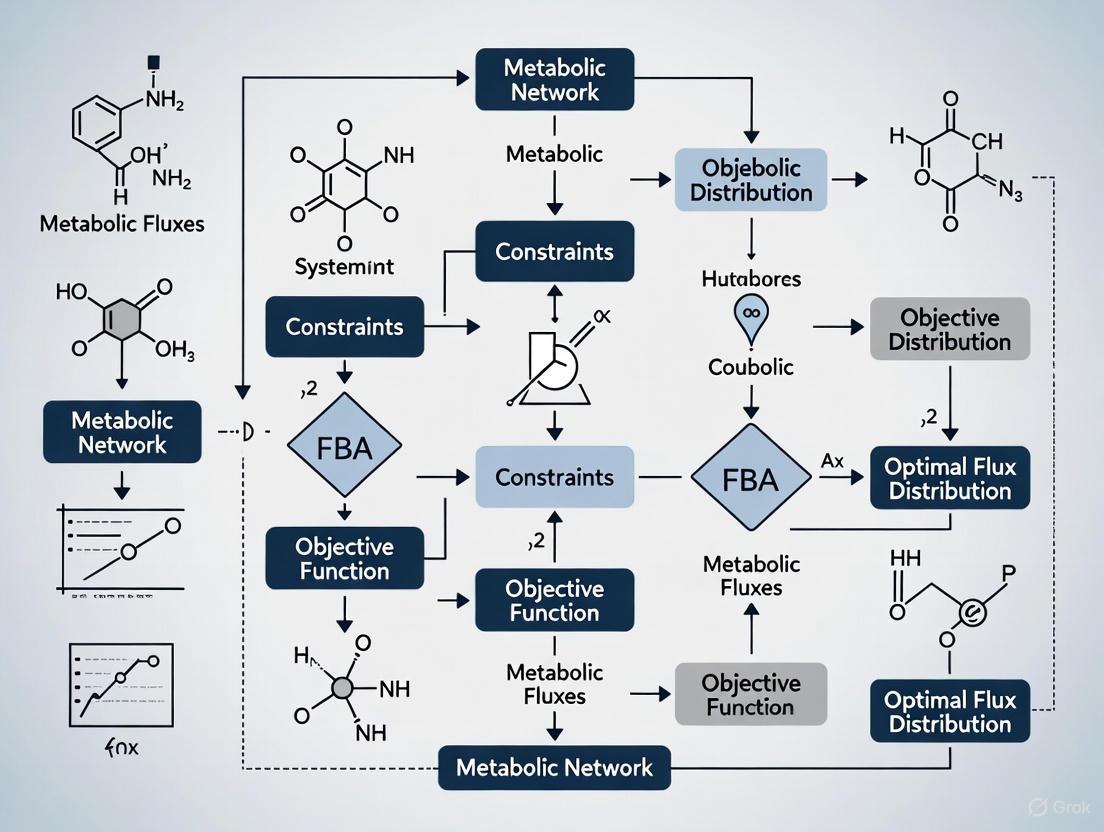
This guide provides a comprehensive introduction to Flux Balance Analysis (FBA), a cornerstone computational method in systems biology and metabolic engineering.
Flux Balance Analysis: A Beginner's Guide to Metabolic Modeling for Biomedical Research
Abstract
This guide provides a comprehensive introduction to Flux Balance Analysis (FBA), a cornerstone computational method in systems biology and metabolic engineering. Tailored for researchers, scientists, and drug development professionals, it covers foundational principles, from the core constraints of mass balance and steady-state to the construction of genome-scale metabolic models. Readers will learn the step-by-step methodology for performing FBA, explore its diverse applications in predicting growth rates and identifying drug targets—with a focus on pathogens like *Mycobacterium tuberculosis*—and gain practical insights for troubleshooting and optimizing their models. The content also addresses the critical process of validating model predictions against experimental data and compares FBA with other modeling approaches, equipping beginners with the essential knowledge to apply FBA in biomedical and biotechnological research.
What is Flux Balance Analysis? Core Principles and Concepts for Beginners
Flux Balance Analysis (FBA) is a mathematical computational method used for simulating the metabolism of cells or entire unicellular organisms. This constraint-based approach analyzes the flow of metabolites through metabolic networks, enabling researchers to predict physiological properties of biological systems without requiring extensive kinetic parameter data. By focusing on the steady-state assumption and employing linear programming optimization, FBA has become an indispensable tool in systems biology, bioprocess engineering, and drug discovery. This technical guide provides a comprehensive overview of FBA's fundamental principles, mathematical foundations, and practical implementations, serving as an essential resource for researchers entering the field of metabolic network analysis.
Flux Balance Analysis represents a cornerstone methodology in systems biology for studying biochemical networks, particularly genome-scale metabolic reconstructions [1]. These network reconstructions encapsulate all known metabolic reactions in an organism and the genes that encode each enzyme. FBA calculates the flow of metabolites through this metabolic network, enabling prediction of an organism's growth rate or the production rate of biotechnologically important metabolites [1]. The method has gained significant traction due to its ability to analyze large-scale networks without requiring difficult-to-measure kinetic parameters [1].
The historical development of FBA dates back to the early 1980s, with Papoutsakis demonstrating the construction of flux balance equations using metabolic maps. Watson subsequently introduced the concept of using linear programming with an objective function to solve for pathway fluxes. The first significant study was published by Fell and Small in 1986, who utilized FBA with elaborate objective functions to study constraints in fat synthesis [2]. Since these early developments, FBA has evolved to become a widely adopted approach for analyzing genome-scale metabolic models, with reconstructions now available for numerous organisms [1].
Compared to traditional modeling approaches based on biophysical equations requiring extensive kinetic parameters, FBA differentiates itself through its constraint-based framework [1]. This fundamental difference allows researchers to simulate metabolic behaviors quickly and efficiently, even for large networks with thousands of reactions. The computational efficiency of FBA enables high-throughput simulations of various genetic and environmental perturbations, making it particularly valuable for exploratory research and hypothesis generation.
Mathematical Foundations
Stoichiometric Matrix Representation
The core mathematical representation in FBA is the stoichiometric matrix (S), which tabulates the stoichiometric coefficients of each metabolic reaction [1]. This m×n matrix, where m represents the number of metabolites and n the number of reactions, systematically encodes the network structure [1]. Each column corresponds to a biochemical reaction, while each row represents a unique metabolite. The entries in each column are the stoichiometric coefficients of the metabolites participating in that reaction, with negative coefficients indicating consumed metabolites and positive coefficients indicating produced metabolites [1].
The mathematical representation of metabolism creates a system of mass balance equations at steady state, expressed as:
Sv = 0
where v is the vector of reaction fluxes (length n), and the steady-state condition (dx/dt = 0) ensures that metabolite concentrations (x) remain constant over time [1] [2]. This equation forms the fundamental constraint in FBA, ensuring that for each metabolite, the total production flux equals the total consumption flux.
Constraints and Solution Space
The stoichiometric balances impose flux constraints on the system, ensuring that the total amount of any compound produced equals the total amount consumed at steady state [1]. In realistic large-scale metabolic models, the number of reactions typically exceeds the number of compounds (n > m), creating an underdetermined system with no unique solution [1]. Additional constraints are represented as inequalities that impose bounds on reaction fluxes:
lowerbound ≤ v ≤ upperbound
These bounds define the maximum and minimum allowable fluxes for each reaction, incorporating physiological limitations [1] [2]. The combination of stoichiometric balances and flux bounds defines the solution space of all possible metabolic flux distributions that satisfy the constraints.
Table 1: Types of Constraints in Flux Balance Analysis
| Constraint Type | Mathematical Representation | Biological Interpretation |
|---|---|---|
| Mass Balance | Sv = 0 | Metabolic intermediates do not accumulate at steady state |
| Capacity Constraints | vmin ≤ v ≤ vmax | Thermodynamic and enzyme capacity limitations |
| Environmental Constraints | vuptake ≤ maximumuptake | Nutrient availability in growth environment |
| Thermodynamic Constraints | vi ≥ 0 or vi ≤ 0 | Directionality of irreversible reactions |
Objective Functions and Linear Programming
To identify a single, meaningful flux distribution from the solution space, FBA introduces an objective function Z = c⁺v, which represents a linear combination of fluxes [1]. The vector c contains weights indicating how much each reaction contributes to the biological objective. In practice, when maximizing a single reaction (such as biomass production), c is typically a vector of zeros with a one at the position of the reaction of interest [1].
The complete FBA problem can be formulated as a linear programming optimization:
maximize c⁺v subject to Sv = 0 and lowerbound ≤ v ≤ upperbound
This optimization identifies the flux distribution that maximizes or minimizes the objective function while satisfying all constraints [1] [2]. For microbial systems, the objective function is often set to maximize biomass production, simulating evolutionary pressure for growth optimization [1]. Other common objectives include maximizing ATP production or minimizing nutrient uptake.
Computational Implementation
Workflow and Algorithm
The implementation of FBA follows a systematic workflow that transforms biological knowledge into quantitative flux predictions. The diagram below illustrates this process:
The FBA process begins with genome annotation to identify metabolic genes, followed by network reconstruction to compile all known metabolic reactions [1]. The reconstruction is converted into a stoichiometric matrix, after which physiological constraints are applied to define the solution space [1]. The critical step of objective function definition determines the biological goal of the optimization, which is then solved using linear programming algorithms [2]. The resulting flux distribution must be validated experimentally to ensure biological relevance.
Essential Tools and Software
Several computational tools are available for implementing FBA. The COBRA (Constraint-Based Reconstruction and Analysis) Toolbox is a freely available MATLAB toolbox that can perform various FBA-based methods [1]. Models for the COBRA Toolbox are typically saved in Systems Biology Markup Language (SBML) format, which has become a standard for model exchange [1]. Additional tools include the RAVEN Toolbox, which requires a linear optimization solver such as Gurobi for operation [3].
Table 2: Research Reagent Solutions for FBA Implementation
| Tool/Resource | Function | Availability |
|---|---|---|
| COBRA Toolbox | MATLAB suite for constraint-based modeling | http://systemsbiology.ucsd.edu/Downloads/Cobra_Toolbox [1] |
| SBML Format | Standard format for encoding metabolic models | http://sbml.org [1] |
| RAVEN Toolbox | MATLAB toolbox for genome-scale model reconstruction and simulation | https://sysbiochalmers.github.io/raven [3] |
| Gurobi Optimizer | Linear programming solver for large-scale optimization | Commercial license required [3] |
| KBase Platform | Web-based platform for FBA model import and analysis | https://www.kbase.us [4] |
Experimental Protocols and Case Studies
Predicting Aerobic and Anaerobic Growth in E. coli
A fundamental application of FBA involves predicting microbial growth under different environmental conditions. The following protocol demonstrates how to simulate E. coli growth in aerobic versus anaerobic conditions:
Model Loading: Import a genome-scale metabolic model of E. coli (e.g., the core E. coli model included in the COBRA Toolbox) using the
readCbModelfunction [1].Constraint Configuration:
- For aerobic growth: Set the maximum glucose uptake rate to a physiologically realistic level (e.g., 18.5 mmol glucose gDW⁻¹ hr⁻¹) using the
changeRxnBoundsfunction, while allowing unlimited oxygen uptake [1]. - For anaerobic growth: Constrain the maximum oxygen uptake rate to zero while maintaining the same glucose uptake constraint [1].
- For aerobic growth: Set the maximum glucose uptake rate to a physiologically realistic level (e.g., 18.5 mmol glucose gDW⁻¹ hr⁻¹) using the
Objective Definition: Set the objective function to maximize flux through the biomass reaction, which simulates growth optimization [1].
Optimization Execution: Perform FBA using the
optimizeCbModelfunction to calculate the optimal growth rate under each condition [1].
This protocol predicts an aerobic growth rate of 1.65 hr⁻¹ and an anaerobic growth rate of 0.47 hr⁻¹ for E. coli, values that align well with experimental measurements [1].
Calculating ATP Yield Per Glucose Consumed
FBA can quantify metabolic efficiency by calculating ATP yield from specific substrates. The following methodology demonstrates this application using Human-GEM, a genome-scale model of human metabolism:
Objective redefinition: Change the model objective from biomass production to maximizing flux through the ATP hydrolysis reaction (MAR03964 in Human-GEM), which represents ATP consumption, using the command:
ihuman = setParam(ihuman, 'obj', 'MAR03964', 1);[3].Media constraints: Prevent import of all metabolites except glucose, for which the maximum import flux is set to 1 (mmol/gDW/h) using exchange bounds:
ihuman = setExchangeBounds(ihuman, 'glucose', -1);[3].Anaerobic calculation: Perform FBA using
solveLP(ihuman)to determine the maximum ATP hydrolyzed (ADP phosphorylated) per glucose consumed without oxygen [3].Aerobic calculation: Allow oxygen uptake by modifying exchange constraints:
ihuman = setExchangeBounds(ihuman, {'glucose', 'O2'}, [-1, -1000]);and re-run FBA [3].
This protocol yields theoretical values of 2 mol ATP/mol glucose under anaerobic conditions and 31.5 mol ATP/mol glucose under aerobic conditions, demonstrating the profound metabolic difference between respiratory and fermentative metabolism [3].
Gene Deletion Studies
FBA enables systematic prediction of essential genes and synthetic lethal interactions through in silico deletion studies:
Single gene deletion: For each gene in the network, evaluate its GPR (Gene-Protein-Reaction) expression as a Boolean statement. If the expression evaluates to false, constrain the associated reaction flux to zero [2].
Double gene deletion: Perform pairwise deletion of all possible gene combinations to identify synthetic lethal interactions where simultaneous deletion of two non-essential genes becomes lethal [2].
Growth assessment: For each deletion strain, calculate the predicted growth rate by maximizing the biomass objective function [2].
Essentiality classification: Classify genes as essential if the predicted growth rate falls below a threshold (e.g., <5% of wild-type growth), and non-essential otherwise [2].
This approach successfully identified 136 double gene knockout combinations that are synthetically lethal in E. coli, demonstrating FBA's utility in identifying potential multi-drug targets [1].
The following diagram illustrates the logical relationships in gene deletion studies:
Advanced Applications and Extensions
Phenotypic Phase Planes (PhPP)
Phenotypic Phase Plane analysis extends FBA by exploring how changes in multiple environmental conditions affect the optimal metabolic phenotype [1]. By repeatedly applying FBA while co-varying nutrient uptake constraints, PhPP generates maps that delineate distinct metabolic phases where different nutrients limit growth or product formation [2]. This approach helps identify optimal culture media compositions for maximizing growth rates or biotechnologically valuable product yields [2].
Metabolic Engineering
FBA provides a computational foundation for rational metabolic engineering through algorithms like OptKnock, which identifies gene knockout strategies that couple cellular growth with production of desirable compounds [1]. By strategically removing metabolic capabilities, these approaches force the metabolic network to redirect carbon flux toward target products while maintaining viability [1] [2]. This methodology has been successfully applied to improve yields of industrially important chemicals such as ethanol and succinic acid [2].
Drug Target Identification
In pharmaceutical applications, FBA enables systematic identification of potential drug targets in pathogens and cancer cells [2]. By simulating single and double gene deletions, researchers can identify metabolic chokepoints that are essential for pathogen survival but absent in human hosts [2]. This approach significantly accelerates the drug discovery process by prioritizing experimental validation toward the most promising targets.
Network Gap Filling
FBA forms the basis for algorithms that identify knowledge gaps in metabolic reconstructions by comparing in silico growth simulations with experimental results [1]. When a model fails to produce biomass precursors known to be essential for growth, these algorithms propose candidate reactions from biochemical databases that, when added to the model, restore growth capability [1]. This application demonstrates how FBA not only utilizes existing knowledge but also contributes to expanding biological knowledge bases.
Limitations and Considerations
Despite its broad utility, FBA has several important limitations that researchers must consider when interpreting results. A significant constraint is FBA's inability to predict metabolite concentrations, as the method focuses exclusively on flux distributions [1]. Additionally, FBA is suitable only for determining fluxes at steady state and cannot directly capture transient metabolic behaviors [1]. Except in some modified implementations, standard FBA does not account for regulatory effects such as enzyme activation by protein kinases or regulation of gene expression, which can lead to discrepancies between predictions and experimental observations [1].
The objective function selection profoundly influences FBA results, and the assumption that metabolism optimizes for a single biological objective represents a simplification of complex evolutionary pressures [1]. Furthermore, FBA predictions depend critically on the completeness and accuracy of the underlying metabolic reconstruction, with missing reactions or incorrect gene-protein-reaction associations potentially leading to erroneous conclusions [1].
Flux Balance Analysis represents a powerful mathematical framework for analyzing metabolic networks that has transformed systems biology and metabolic engineering. By combining stoichiometric constraints with optimization principles, FBA enables quantitative prediction of metabolic behaviors at genome scale. The method's computational efficiency allows high-throughput simulation of genetic and environmental perturbations, making it invaluable for both basic research and biotechnological applications.
As metabolic reconstructions continue to expand and improve, FBA's predictive power and applicability will further increase. Ongoing developments in incorporating regulatory information, kinetic constraints, and multi-scale modeling will address current limitations and extend FBA's utility. For researchers entering the field, mastering FBA provides a foundation for leveraging the growing repository of genome-scale metabolic models to address pressing challenges in biotechnology, medicine, and fundamental biological research.
Flux Balance Analysis (FBA) is a powerful mathematical approach for simulating the flow of metabolites through a metabolic network, enabling researchers to predict cellular behaviors such as growth rates or biochemical production [1]. As a constraint-based method, FBA differentiates itself from kinetic modeling approaches by relying not on difficult-to-measure kinetic parameters but on physicochemical constraints that bound possible network behaviors [1] [2]. This framework allows for the analysis of genome-scale metabolic reconstructions—comprehensive databases of all known metabolic reactions in an organism and the genes that encode each enzyme [1]. The power of FBA lies in its ability to calculate how metabolites flow through these networks by applying two fundamental constraints: the steady-state assumption and mass balance. These core principles form the foundation upon which FBA builds to predict optimal metabolic flux distributions that align with specific cellular objectives, making it invaluable for fields ranging from metabolic engineering to drug discovery [5] [2].
Mathematical Foundations of FBA
The Stoichiometric Matrix and Mass Balance
At the core of FBA lies the stoichiometric matrix (S), a mathematical representation of the metabolic network where rows correspond to metabolites and columns represent biochemical reactions [1] [2]. Each entry in the matrix indicates the stoichiometric coefficient of a metabolite in a particular reaction, with negative values denoting consumption and positive values indicating production [6]. This matrix formally captures the mass balance relationships within the metabolic system.
The mass balance principle ensures that for each internal metabolite, the total amount produced must equal the total amount consumed when the system is at steady state [1]. This constraint is represented mathematically as:
S · v = 0
Where S is the stoichiometric matrix (of size m × n, for m metabolites and n reactions) and v is the flux vector containing the reaction rates [1] [2]. This equation encapsulates the steady-state assumption, meaning that the concentration of internal metabolites remains constant over time because production and consumption rates are balanced [2]. External metabolites (often denoted with an "X" prefix) are not included in this balance, as they can accumulate or be depleted, effectively defining the inputs and outputs of the network [6].
The Steady-State Assumption
The steady-state assumption is a key simplification that makes FBA computationally tractable for large-scale networks [2]. By assuming that internal metabolite concentrations do not change over time, the complex system of differential equations that would normally describe metabolic dynamics reduces to a system of linear equations [2] [7]. This assumption is biologically reasonable when modeling cellular growth under constant conditions, as the timescale of metabolic reactions is typically much faster than that of cellular growth and environmental changes [6].
The combination of these constraints defines the solution space of all possible flux distributions that satisfy the mass balance conditions [1]. In any realistic large-scale metabolic model, there are more reactions than metabolites (n > m), making the system underdetermined with multiple feasible solutions [1]. The set of all flux vectors v that satisfy S · v = 0 is called the null space of S, representing all metabolic flux distributions that maintain the steady state [6].
Linear Programming Formulation
Objective Functions and Optimization
To identify a biologically meaningful flux distribution from the many possible solutions in the null space, FBA incorporates an objective function representing the presumed evolutionary optimization goal of the organism [2]. Common biological objectives include maximizing biomass production (simulating growth), ATP production, or the synthesis of specific metabolites [1] [7].
Mathematically, this objective function is formulated as a linear combination of fluxes:
Z = c^T · v
Where c is a vector of weights indicating how much each reaction contributes to the objective [1]. When optimizing for a single reaction (such as biomass production), c is typically a vector of zeros with a value of 1 at the position of the reaction of interest [1]. The biomass reaction itself is a pseudo-reaction that drains various biomass precursor metabolites (proteins, nucleic acids, lipids) from the system in their appropriate biological ratios [1].
Flux Constraints and Linear Programming
FBA further constrains the solution space by imposing upper and lower bounds on individual reaction fluxes, representing known physiological or environmental limitations [1]. These bounds can incorporate enzyme capacity, substrate availability, or gene knockout constraints [2].
The complete FBA problem is formulated as a linear programming optimization:
Maximize Z = c^T · v Subject to: S · v = 0 LB ≤ v ≤ UB
Where LB and UB represent the lower and upper bounds on reaction fluxes, respectively [2]. Linear programming algorithms efficiently identify the optimal flux distribution that maximizes the objective function while satisfying all constraints [6] [1]. For large metabolic networks, this calculation can be performed in seconds on modern computers, making FBA highly scalable [2].
Table 1: Key Components of the FBA Linear Programming Formulation
| Component | Mathematical Representation | Biological Meaning |
|---|---|---|
| Stoichiometric Matrix | S (m × n matrix) | Network structure of metabolic reactions |
| Flux Vector | v = (v₁, v₂, ..., vₙ) | Reaction rates in the network |
| Mass Balance | S · v = 0 | Steady-state constraint |
| Flux Bounds | LB ≤ v ≤ UB | Physiological constraints on reactions |
| Objective Function | Z = c^T · v | Cellular optimization goal |
Computational Implementation
Workflow and Algorithm
The practical implementation of FBA follows a systematic workflow that transforms a metabolic network reconstruction into quantitative flux predictions. The process begins with constructing the stoichiometric matrix from known biochemical reactions, followed by applying relevant constraints based on the biological scenario being modeled [6] [1]. The linear programming problem is then solved using specialized algorithms such as the simplex method to identify the optimal flux distribution [6].
Advanced FBA Techniques
Several extensions to basic FBA have been developed to address specific research questions or biological complexities. Flux Variability Analysis (FVA) determines the range of possible flux values for each reaction while maintaining optimal objective function value, identifying reactions with flexible flux levels [7]. Parsimonious FBA (pFBA) identifies the most efficient flux distribution among multiple optima by minimizing total flux through the network while maintaining optimal objective function value, reflecting cellular preference for energy efficiency [8] [7].
Recent methodological advances include frameworks like TIObjFind, which integrates Metabolic Pathway Analysis (MPA) with FBA to identify context-specific objective functions by calculating Coefficients of Importance (CoIs) that quantify each reaction's contribution to cellular objectives under different conditions [5]. This approach helps address one of the key challenges in FBA—selecting appropriate objective functions that accurately represent system performance across different environmental conditions [5].
Table 2: Advanced FBA Techniques and Their Applications
| Technique | Methodology | Primary Application |
|---|---|---|
| Flux Variability Analysis (FVA) | Calculates min/max flux for each reaction while maintaining optimal growth | Identify flexible and rigid reactions in network |
| Parsimonious FBA (pFBA) | Minimizes total flux while maintaining optimal objective | Find most energy-efficient flux distributions |
| Dynamic FBA (dFBA) | Extends FBA to dynamic conditions by coupling with external metabolite changes | Model time-dependent metabolic responses |
| TIObjFind | Integrates pathway analysis with FBA using Coefficients of Importance | Identify context-specific objective functions |
| Regulatory FBA (rFBA) | Incorporates gene regulatory constraints into FBA | Model regulatory effects on metabolism |
Experimental Protocols and Methodologies
Core FBA Protocol
Implementing FBA requires specific computational tools and methodologies. The following protocol outlines the key steps for performing basic flux balance analysis:
Model Preparation: Obtain a genome-scale metabolic reconstruction in a standardized format such as Systems Biology Markup Language (SBML) [1]. These reconstructions contain all known metabolic reactions for an organism and the associated genes.
Constraint Definition: Apply mass balance constraints (S · v = 0) and set physiologically relevant flux bounds based on environmental conditions (e.g., nutrient availability) [1]. For growth simulations, glucose uptake might be limited to 18.5 mmol/gDW/h while oxygen uptake is set to a high value for aerobic conditions [1].
Objective Selection: Define an appropriate objective function based on the biological question. For growth prediction, this is typically a biomass reaction that converts metabolic precursors into biomass components at their known biological ratios [1].
Problem Solution: Use linear programming to solve the optimization problem. The COBRA Toolbox provides implementations of FBA algorithms in MATLAB, while COBRApy offers Python-based solutions [1] [8].
Result Validation: Compare predicted fluxes with experimental data such as growth rates or metabolic secretion profiles to validate model predictions [1].
Gene Deletion Studies
A common FBA application involves simulating gene knockouts to identify essential genes and potential drug targets:
Identify Target Reactions: Map genes to reactions using Gene-Protein-Reaction (GPR) associations, which are Boolean expressions defining how genes encode enzyme subunits or isozymes [2].
Constrain Reaction Fluxes: For single gene deletions, set the flux through associated reactions to zero. For multiple gene deletions, evaluate the GPR relationships to determine which reactions become inactive [2].
Solve Modified Problem: Perform FBA on the constrained network and calculate the resulting objective function (e.g., growth rate) [2].
Classify Gene Essentiality: Genes are classified as essential if the predicted growth rate falls below a threshold (e.g., <10% of wild-type growth) [2].
Research Reagents and Computational Tools
Successful implementation of FBA requires both computational tools and well-curated metabolic models. The table below outlines essential resources for conducting flux balance analysis.
Table 3: Essential Research Reagents and Computational Tools for FBA
| Resource Type | Specific Tools/Resources | Function and Application |
|---|---|---|
| Software Toolboxes | COBRA Toolbox (MATLAB) [1], COBRApy (Python) [8], FlexFlux [5] | Implement FBA algorithms and related constraint-based methods |
| Metabolic Databases | KEGG [5], EcoCyc [5] | Provide curated metabolic pathway information for network reconstruction |
| Model Repositories | UCSD Systems Biology (35+ models) [1], BioModels | Access pre-built genome-scale metabolic models |
| Linear Programming Solvers | GLPK [8], MATLAB Optimization Toolbox | Solve the underlying linear programming optimization problems |
| Visualization Tools | pySankey [5], Escher | Create flux maps and visualize metabolic networks |
Applications in Biotechnology and Medicine
The constraint-based framework of FBA has enabled diverse applications across biological research and biotechnology. In metabolic engineering, FBA identifies gene knockout strategies that optimize production of industrially valuable compounds such as ethanol and succinic acid [2]. OptKnock and similar algorithms use FBA to predict genetic modifications that couple desired product formation with cellular growth [1].
In biomedical research, FBA helps identify potential drug targets by determining essential genes in pathogens [5] [2]. Cancer researchers use FBA to understand metabolic reprogramming in tumor cells and identify cancer-specific dependencies [2]. FBA also models host-pathogen interactions and the human microbiota, simulating metabolic interactions in complex microbial communities [2].
More advanced applications include phenotypic phase plane analysis (PhPP), which maps optimal metabolic phenotypes across different nutrient conditions, and culture media optimization, where FBA identifies minimal media components that support microbial growth [2]. These diverse applications demonstrate how the fundamental constraints of steady-state and mass balance provide a powerful framework for understanding and engineering biological systems.
In the realm of systems biology and metabolic engineering, the stoichiometric matrix (S) serves as the fundamental blueprint for quantifying cellular metabolism. This mathematical construct provides a structured representation of all chemical reactions within a metabolic network, enabling researchers to simulate and analyze metabolic capabilities using constraint-based modeling approaches [6]. The matrix encodes the stoichiometry of biochemical transformations, where rows typically represent metabolites and columns represent reactions [9]. The power of this framework lies in its ability to translate biological knowledge into a mathematical format amenable to computational analysis, particularly through Flux Balance Analysis (FBA), which finds an optimal net flow of mass through the metabolic network that follows constraints defined by the user [6].
For researchers and drug development professionals, mastering the stoichiometric matrix is essential for investigating metabolic adaptations in diseases, identifying potential drug targets, and optimizing bioproduction strains [6]. The matrix forms the foundation for in silico models that can predict metabolic behaviors under various genetic and environmental conditions, providing a cost-effective alternative to extensive laboratory experimentation.
Mathematical Foundation and Structural Properties
Fundamental Principles and Notation
The stoichiometric matrix represents a set of reactions involving given components within a metabolic network. By convention, entries in the matrix are stoichiometric coefficients that are negative for reactants (substrates consumed) and positive for products (metabolites formed) [9]. This sign convention ensures proper mass balance throughout the system.
Consider a metabolic network with m metabolites and n reactions. The stoichiometric matrix S has dimensions m × n, where each element S[i,j] represents the stoichiometric coefficient of metabolite i in reaction j. The mathematical representation of the entire network can be expressed as:
S · v = 0
where v is the flux vector containing the reaction rates [6]. This equation represents the steady-state assumption, a core principle in constraint-based modeling, which states that the quantity of metabolites within the system cannot change over time [6].
Practical Illustrations of Stoichiometric Matrices
To illustrate the structure of stoichiometric matrices, consider a simple network involving hydrogen, oxygen, and their derivatives [9]:
Reaction Set:
- 2H₂ + O₂ ⇄ 2H₂O
- H₂ + O₂ ⇄ H₂O₂
Stoichiometric Matrix S:
| Component | Reaction 1 | Reaction 2 |
|---|---|---|
| H₂ | -2 | -1 |
| O₂ | -1 | -1 |
| H₂O | 2 | 0 |
| H₂O₂ | 0 | 1 |
Table 1: Stoichiometric matrix for the hydrogen-oxygen reaction system. Negative coefficients indicate consumption, positive coefficients indicate production.
This example demonstrates how the matrix captures the complete stoichiometric information of the network. The first reaction consumes 2 H₂ and 1 O₂ to produce 2 H₂O, while the second reaction consumes 1 H₂ and 1 O₂ to produce 1 H₂O₂.
Another example involves isomerization and dimerization reactions [9]:
Reaction Set:
- c-C₄H₈ + t-C₄H₈ ⇄ C₈H₁₆
- c-C₄H₈ ⇄ t-C₄H₈
Stoichiometric Matrix:
| Component | Reaction 1 | Reaction 2 |
|---|---|---|
| c-C₄H₈ | -1 | -1 |
| t-C₄H₈ | -1 | 1 |
| C₈H₁₆ | 1 | 0 |
Table 2: Stoichiometric matrix for isomerization and dimerization reactions.
Metabolic Network Visualization
The following diagram illustrates how a metabolic network is translated into a stoichiometric matrix, showing the relationship between metabolites (A, B, C, D) and reactions (v1, v2, v3):
Figure 1: Metabolic network translation to stoichiometric matrix. Yellow nodes represent internal metabolites, green nodes represent external metabolites, and blue circles represent metabolic reactions.
The Stoichiometric Matrix in Flux Balance Analysis
Integration with Constraint-Based Modeling
Flux Balance Analysis (FBA) leverages the stoichiometric matrix as its core mathematical framework. FBA is built on a technique called linear programming (LP), a well-established method for solving optimization problems [6]. In this context, the stoichiometric matrix defines the constraints that govern the mass balance of the metabolic system.
The fundamental equation of FBA is:
S · v = 0
subject to: α ≤ v ≤ β
where v is the flux vector representing reaction rates, and α and β are lower and upper bounds on these fluxes, respectively [6]. The equation represents the steady-state assumption, which prevents metabolites from having unrealistic quantities by requiring that their production and consumption rates balance to zero [6].
Mass Balance and Element Conservation
The stoichiometric matrix enables verification of element conservation across all reactions in the network. This is mathematically expressed as:
S · M = 0
where M is the molecular matrix containing element compositions of each metabolite [9]. Each entry in the product matrix expresses the difference in atom counts of a particular element in a specific reaction. A zero matrix confirms that all elements are properly conserved in all reactions.
For the hydrogen-oxygen example, verifying hydrogen conservation in the first reaction involves calculating: (-2)(2) + (-1)(0) + (2)(2) + (0)(2) = 0, where the first set of parentheses contains stoichiometric coefficients from S and the second set contains hydrogen atom counts from M [9].
Key Components and Balances
Reduced Row Echelon Form (RREF) analysis of the stoichiometric matrix reveals important structural properties. The pivots identify key components, while non-pivot columns reveal balances obeyed by non-key components [9]. For the hydrogen-oxygen system, the RREF of the stoichiometric matrix is:
| Component | Reaction 1 | Reaction 2 |
|---|---|---|
| H₂ | 1 | 0 |
| O₂ | 0 | 1 |
| H₂O | -2 | 2 |
| H₂O₂ | 1 | -2 |
Table 3: RREF of the stoichiometric matrix for the hydrogen-oxygen system.
This indicates that H₂ and O₂ are key components, and the relationships for non-key components are [9]:
ΔnH₂O = -2ΔnH₂ + 2ΔnO₂
ΔnH₂O₂ = ΔnH₂ - 2ΔnO₂
where Δ indicates changes in amounts caused by the reactions.
Advanced Matrix Applications and Analysis
The Augmented Stoichiometric Matrix
Augmenting the stoichiometric matrix with additional information enables more sophisticated analyses. When augmented with a unit matrix, the RREF can reveal dependencies between reactions and identify key and non-key reactions [9].
For a system with three reactions (the original two plus 2H₂O + O₂ ⇄ 2H₂O₂), the augmented stoichiometric matrix and its RREF reveal that:
Number of key components = Number of key reactions [9]
This fundamental equality highlights the relationship between the structural components of the network and the independent biochemical processes.
FBA Optimization Process
The following diagram illustrates the complete Flux Balance Analysis workflow, showing how the stoichiometric matrix serves as the foundation for constraint-based modeling:
Figure 2: Flux Balance Analysis workflow incorporating the stoichiometric matrix.
Experimental Protocols and Methodologies
Protocol: Constructing a Stoichiometric Matrix from Biochemical Data
Objective: Create a stoichiometric matrix from known metabolic pathways of a target organism.
Materials Required:
- Annotated genome data of the target organism
- Biochemical databases (e.g., KEGG, MetaCyc)
- Computational tools (COBRA Toolbox, Python with appropriate libraries)
- Metabolic network reconstruction software
Procedure:
- Identify all metabolic reactions: Compile a complete list of biochemical transformations present in the target organism using genomic annotation and literature data [10].
- List all metabolites: Create a comprehensive inventory of all metabolites participating in these reactions, distinguishing between internal and external metabolites [6].
- Assign stoichiometric coefficients: For each reaction, assign appropriate coefficients to each metabolite (negative for substrates, positive for products).
- Construct the matrix: Create a matrix where rows represent metabolites and columns represent reactions, filling in the stoichiometric coefficients.
- Verify mass balance: Check that
S · M = 0for the molecular matrixMto ensure element conservation [9]. - Validate network connectivity: Ensure all metabolites are properly connected and no dead-ends exist without transport mechanisms.
Troubleshooting Tips:
- If mass balance fails for certain reactions, verify the reaction stoichiometry from multiple databases
- For metabolites that accumulate without consumption, add appropriate transport or exchange reactions
- Ensure reversible reactions are properly annotated with appropriate flux bounds
Protocol: Performing Basic Flux Balance Analysis
Objective: Use the stoichiometric matrix to predict metabolic flux distributions under specific conditions.
Materials Required:
- Stoichiometric matrix for the target organism
- COBRA Toolbox in MATLAB or appropriate Python packages [10]
- Linear programming solver (e.g., GLPK, CPLEX)
- Condition-specific constraint data
Procedure:
- Import the stoichiometric matrix: Load the matrix into your analysis environment.
- Apply flux constraints: Set lower and upper bounds for each reaction based on environmental conditions and enzyme capacities [6].
- Define objective function: Specify the biological objective to optimize (e.g., biomass production, ATP synthesis, or metabolite synthesis) [6].
- Solve the LP problem: Use the simplex method or other LP algorithms to find the flux distribution that optimizes the objective function while satisfying all constraints [6].
- Analyze results: Examine the flux distribution to identify key pathways and potential bottlenecks.
- Validate predictions: Compare with experimental data when available to assess model accuracy.
Research Applications and Implementation Tools
Table 4: Essential tools and resources for stoichiometric matrix-based research
| Tool/Resource | Function | Application Context |
|---|---|---|
| COBRA Toolbox | MATLAB-based suite for constraint-based modeling [10] | Metabolic network analysis, FBA, strain design |
| Python (with cobrapy) | Python implementation of COBRA methods | Custom metabolic modeling, integration with data science workflows |
| Stoichiometric Matrix (S) | Core representation of metabolic network structure [9] | All flux balance analysis applications |
| Linear Programming Solver | Algorithm to solve optimization problems [6] | Finding optimal flux distributions |
| Molecular Matrix (M) | Elemental composition of metabolites [9] | Verifying element conservation in networks |
| RREF Analysis | Matrix decomposition method [9] | Identifying key components and reaction dependencies |
Pharmaceutical and Biomedical Applications
Stoichiometric modeling using FBA has demonstrated significant value in identifying drug targets, particularly in infectious diseases. For example, researchers have used these approaches for rapid countermeasure discovery against pathogens like Francisella tularensis by analyzing essential metabolic functions [10]. Similarly, metabolic network reconstruction and analysis of Yersinia pestis (the causative agent of plague) has identified potential vulnerabilities for antibiotic development [10].
In drug development, these methods enable system-level analysis of bacterial physiology to identify new drug targets that may not be apparent from single-enzyme studies [10]. By simulating gene knockout strategies using approaches like OptKnock, researchers can predict which enzymatic reactions are essential for pathogen survival under specific conditions [10].
The stoichiometric matrix serves as the fundamental blueprint that translates biochemical knowledge into a mathematical framework for metabolic analysis. Its implementation in Flux Balance Analysis enables researchers to predict cellular behaviors, identify critical metabolic pathways, and develop intervention strategies for biomedical and biotechnological applications. As systems biology continues to evolve, the stoichiometric matrix remains a cornerstone technology for understanding complex metabolic networks, with ongoing developments extending its application to microbial communities and multicellular systems [6]. For researchers and drug development professionals, proficiency with this mathematical framework provides a powerful approach for investigating metabolic processes and developing novel therapeutic strategies.
Flux Balance Analysis (FBA) is a powerful mathematical approach for analyzing the flow of metabolites through a metabolic network, enabling researchers to predict cellular phenotypes from genomic information [1]. This constraint-based method calculates the flow of metabolites through metabolic networks, making it possible to predict fundamental biological objectives such as the growth rate of an organism or the rate of production of a biotechnologically important metabolite [1]. FBA has become an indispensable tool in systems biology and metabolic engineering, with established metabolic models available for dozens of organisms [1].
The fundamental principle behind FBA is that it operates on steady-state mass balance constraints, differentiating it from kinetic models that require numerous difficult-to-measure parameters [1]. This approach allows for rapid simulation of metabolic capabilities under various environmental and genetic perturbations, providing researchers with testable hypotheses about organism behavior. FBA has found diverse applications in physiological studies, gap-filling efforts, and genome-scale synthetic biology [1], making it particularly valuable for researchers and drug development professionals seeking to understand and manipulate metabolic systems.
Mathematical Foundation of FBA
Core Mathematical Representation
The first step in FBA is to mathematically represent metabolic reactions using a stoichiometric matrix (S) of size m×n, where m represents the number of unique compounds and n represents the number of reactions in the network [1]. Each column in this matrix represents one reaction, with entries representing the stoichiometric coefficients of the metabolites participating in that reaction. The system of mass balance equations at steady state (dx/dt = 0) is represented by the equation:
Sv = 0
where v is the vector of reaction fluxes and x is the vector of metabolite concentrations [1]. In any realistic large-scale metabolic model, there are more reactions than compounds (n > m), meaning there are more unknown variables than equations, and thus no unique solution to this system.
Constraints and Optimization
FBA incorporates two types of constraints: equality constraints that balance reaction inputs and outputs, and inequality constraints that impose bounds on the system [1]. The matrix of stoichiometries imposes flux balance constraints, ensuring that the total amount of any compound being produced equals the total amount being consumed at steady state. Each reaction can also be assigned upper and lower bounds (vi,max and vi,min), which define the maximum and minimum allowable fluxes.
Table 1: Types of Constraints in Flux Balance Analysis
| Constraint Type | Mathematical Representation | Biological Interpretation |
|---|---|---|
| Mass Balance | Sv = 0 | Total production = total consumption for each metabolite |
| Capacity | vi,min ≤ vi ≤ vi,max | Thermodynamic and enzyme capacity limitations |
| Uptake | vexchange ≤ vexchange,max | Nutrient availability in environment |
FBA identifies optimal points within this constrained solution space by maximizing or minimizing an objective function Z = cTv, which is a linear combination of fluxes [1]. The vector c contains weights indicating how much each reaction contributes to the objective function. Optimization of this system is accomplished using linear programming, with the output being a particular flux distribution (v) that maximizes or minimizes the objective function.
Simulating Growth and Metabolite Production
Defining Biological Objectives
The simulation of growth requires defining a biological objective relevant to the problem being studied. For predicting growth, the objective is typically biomass production, representing the rate at which metabolic compounds are converted into biomass constituents such as nucleic acids, proteins, and lipids [1]. Mathematically, this is represented by a 'biomass reaction' that drains precursor metabolites from the system at their relative stoichiometries to simulate biomass production.
This biomass reaction is scaled so that the flux through it equals the exponential growth rate (μ) of the organism [1]. For metabolite production, the objective function may be modified to maximize the output of a specific biotechnologically or therapeutically relevant compound instead of biomass.
Practical Implementation
The following DOT script illustrates the workflow for implementing FBA to simulate growth and metabolite production:
Workflow for FBA Implementation
Implementation of FBA requires specialized computational tools. The COBRA (Constraints-Based Reconstruction and Analysis) Toolbox is a freely available MATLAB toolbox that can perform a variety of FBA-based methods [1]. Models for the COBRA Toolbox are typically saved in the Systems Biology Markup Language (SBML) format, which enables interoperability between different software platforms [1] [4].
Case Study: Predicting Aerobic and Anaerobic Growth in E. coli
To illustrate growth simulation, consider predicting the growth of E. coli under aerobic and anaerobic conditions. For aerobic growth, the maximum rate of glucose uptake is constrained to a physiologically realistic level (e.g., 18.5 mmol glucose gDW-1 hr-1), while the maximum rate of oxygen uptake is set to a high level so it doesn't constrain growth [1]. Linear programming then determines the flux distribution that maximizes growth rate, typically resulting in a predicted exponential growth rate of 1.65 hr-1.
For anaerobic growth, the maximum uptake of oxygen is constrained to zero, resulting in a significantly lower predicted growth rate of 0.47 hr-1 [1]. These predictions have been experimentally validated, demonstrating FBA's accuracy in simulating growth phenotypes.
Case Study: Calculating ATP Yield per Glucose Consumed
FBA can also simulate metabolite production, such as calculating ATP yield per glucose consumed. This is quantified by the flux through the ATP hydrolysis reaction, with the objective function modified to maximize this flux [3]. When glucose uptake is constrained to 1 mmol/gDW/h and oxygen uptake is prohibited, FBA predicts an ATP yield of 2 mol ATP/mol glucose, consistent with theoretical expectations for anaerobic conditions [3].
When oxygen uptake is allowed, the ATP yield increases dramatically to approximately 31.5 mol ATP/mol glucose, reflecting the much higher energy yield of aerobic respiration [3]. This demonstrates how FBA can capture fundamental metabolic shifts under different environmental conditions.
Table 2: Example FBA Simulations for Biological Objectives
| Simulation Type | Constraints Applied | Objective Function | Typical Result |
|---|---|---|---|
| Aerobic Growth | Glucose uptake ≤ 18.5 mmol/gDW/h; High O2 uptake | Maximize biomass reaction | E. coli growth rate ~1.65 h⁻¹ |
| Anaerobic Growth | Glucose uptake ≤ 18.5 mmol/gDW/h; O2 uptake = 0 | Maximize biomass reaction | E. coli growth rate ~0.47 h⁻¹ |
| Anaerobic ATP Yield | Glucose uptake = 1 mmol/gDW/h; O2 uptake = 0 | Maximize ATP hydrolysis flux | 2 mol ATP/mol glucose |
| Aerobic ATP Yield | Glucose uptake = 1 mmol/gDW/h; High O2 uptake | Maximize ATP hydrolysis flux | ~31.5 mol ATP/mol glucose |
Advanced FBA Applications in Drug Development
Drug Target Identification
FBA has emerged as a valuable tool for drug target identification, particularly for infectious diseases and metabolic disorders. For pathogenic diseases, the approach typically involves identifying enzymes crucial for the survival and growth of the pathogen through FBA-based growth simulation [11]. The following DOT script illustrates the two-stage FBA approach for drug target identification:
Two-Stage FBA for Drug Targets
This two-stage FBA method first finds the steady optimal fluxes of reactions and mass flows of metabolites in the pathologic state, then determines these values in the medication state with minimal side effects [11]. Drug targets are identified by comparing reaction fluxes in both states and examining which reaction fluxes need to be altered to restore health.
Integration with Machine Learning and Multi-Omics
Recent advances have integrated FBA with complementary approaches to enhance its predictive power. Machine learning techniques have emerged as tools for data reduction and variable selection in large datasets, helping to improve the biological interpretation of FBA results [12]. The integration of multi-omics datasets with genome-scale metabolic models provides a platform for modeling context-specific network behavior and improving genotype-to-phenotype predictions [12].
These integrated approaches are particularly valuable for drug development, as they can account for individual metabolic variations and predict patient-specific responses to therapeutic interventions.
Essential Research Reagents and Tools
Successful implementation of FBA requires specific computational tools and resources. The following table details key components of the FBA research toolkit:
Table 3: Research Reagent Solutions for Flux Balance Analysis
| Tool/Resource | Type | Function | Example/Format |
|---|---|---|---|
| COBRA Toolbox | Software | MATLAB toolbox for constraint-based reconstruction and analysis | optimizeCbModel function [1] |
| RAVEN Toolbox | Software | MATLAB toolbox for FBA and metabolic modeling | solveLP function [3] |
| SBML Format | Data Standard | Model exchange between different software platforms | XML-based format [4] |
| Linear Programming Solver | Software | Optimization engine for solving FBA problems | Gurobi, CPLEX [3] |
| Genome-Scale Models | Data Resource | Metabolic network reconstructions | SystemsBiology.ucsd.edu repositories [1] |
| Stoichiometric Matrix | Data Structure | Mathematical representation of metabolic network | S matrix (m×n) [1] |
| Biomass Reaction | Model Component | Simulates biomass production from precursors | Drain reaction for biomass constituents [1] |
Technical Protocols
Basic FBA Protocol for Growth Simulation
Load Metabolic Model: Import a genome-scale metabolic reconstruction in SBML format using the
readCbModelfunction [1].Set Environmental Constraints: Define upper and lower bounds for exchange reactions to simulate specific environmental conditions (e.g., carbon source availability, oxygen presence) [3]. Use the
changeRxnBoundsfunction to modify these constraints.Define Biological Objective: Set the objective function to maximize biomass production for growth simulations [1]. The
setParamfunction can be used to specify the objective reaction and its coefficient.Solve Linear Programming Problem: Use the
optimizeCbModel(COBRA) orsolveLP(RAVEN) function to find the optimal flux distribution [1] [3].Extract and Interpret Results: Analyze the flux distribution to determine growth rate (biomass flux) and key metabolic fluxes.
Protocol for Metabolite Production Optimization
Load and Constrain Model: Follow steps 1-2 from the basic protocol to set up the base model with appropriate environmental constraints.
Modify Objective Function: Set the objective to maximize flux through the reaction producing the target metabolite using the
setParamfunction [3].Apply Additional Constraints: Optionally constrain biomass to a minimum value to ensure cell viability while maximizing product formation.
Solve and Validate: Perform FBA and check feasibility of the solution. Flux variability analysis can identify alternate optimal solutions [1].
Flux Balance Analysis provides a powerful framework for simulating growth and metabolite production by leveraging genome-scale metabolic models and constraint-based optimization. Its mathematical foundation in stoichiometric modeling and linear programming enables quantitative prediction of metabolic phenotypes under various genetic and environmental conditions. The continued development of more comprehensive metabolic models, coupled with integration of multi-omics data and machine learning approaches, promises to further enhance FBA's utility in basic research and drug development applications. For researchers entering this field, mastering the core principles and protocols outlined in this guide provides a solid foundation for leveraging FBA in their investigations of metabolic systems.
Why Use FBA? Advantages Over Kinetic Modeling Approaches
Constraint-based modeling, particularly Flux Balance Analysis (FBA), has emerged as a fundamental tool for analyzing metabolic networks at the genome-scale, enabling researchers to predict organism behavior under various genetic and environmental conditions [13] [14]. This approach stands in contrast to kinetic modeling, which aims to describe the detailed temporal dynamics of metabolic components through differential equations that require extensive mechanistic details and kinetic parameters [13]. While kinetic models provide valuable insights into metabolic dynamics, their application is often limited to small-scale systems due to the scarcity of comprehensive enzyme kinetic data [14].
The fundamental difference between these approaches lies in their core assumptions and data requirements. FBA operates on the principle that metabolic networks reach a steady state, allowing researchers to analyze flux distributions through stoichiometric mass-balance constraints without requiring detailed kinetic information [14]. This methodological distinction creates significant advantages for FBA in applications requiring genome-scale analysis, particularly in drug development and biotechnology where comprehensive cellular modeling is essential [15] [12].
Fundamental Differences Between FBA and Kinetic Modeling
Core Principles and Methodological Frameworks
Flux Balance Analysis employs a constraint-based approach that identifies steady-state flux rates through a metabolic network by satisfying stoichiometric mass-balance constraints and reaction directionality [14]. This methodology focuses on predicting metabolic phenotypes by optimizing an objective function, typically biomass production, within physicochemical constraints [14]. The mathematical foundation of FBA enables the analysis of genome-scale metabolic models comprising thousands of reactions, making it particularly valuable for systems-level investigations [13] [14].
In contrast, kinetic modeling of metabolic networks aims to study the dynamical behavior of metabolic components by describing how these components interact with each other over time [13]. This approach typically employs ordinary differential equations (ODEs) where the state variable is determined by the concentrations of metabolic components, and the system describes the rate of change of these concentrations through functions that incorporate detailed enzymatic mechanisms [13]. The vector of reaction rates in kinetic models is typically highly nonlinear, incorporating mechanisms based on Michaelis-Menten or Hill laws, which significantly contributes to the complexity of system analysis [13].
Table 1: Fundamental Methodological Differences Between FBA and Kinetic Modeling
| Characteristic | Flux Balance Analysis (FBA) | Kinetic Modeling |
|---|---|---|
| Mathematical Foundation | Linear programming; Constraint-based optimization | Nonlinear ordinary differential equations |
| Primary Output | Steady-state flux distributions | Temporal concentration profiles |
| Time Consideration | Steady-state assumption | Explicit time dependence |
| Network Scale | Genome-scale (2000+ reactions) | Small-scale subsystems |
| Parameter Requirements | Stoichiometry, reaction directionality | Enzyme kinetic parameters, mechanistic details |
Data Requirements and Scalability
The data requirements for these approaches differ substantially. Kinetic models demand extensive parameter sets including enzyme kinetic constants, mechanistic details of enzymatic reactions, and regulatory information [13] [14]. This creates a fundamental limitation, as noted in research: "Traditional metabolic modeling techniques involve the reconstruction of kinetic models based on detailed knowledge on enzyme kinetic parameters for all enzymes in a certain system. These models are limited to small-scale systems due to lack of sufficient data on kinetic constants and the highly complex nature of these models" [14].
FBA circumvents these limitations by relying primarily on network stoichiometry and directionality constraints [14]. This fundamental difference in data requirements enables FBA to be applied to genome-scale metabolic models of organisms such as Escherichia coli (comprising more than 2000 reactions) and human metabolism (containing more than 13,000 reactions) [13]. The scalability of FBA makes it particularly suitable for analyzing complex biological systems where comprehensive kinetic data remains unavailable.
Key Advantages of FBA for Practical Applications
Scalability to Genome-Level Networks
The most significant advantage of FBA lies in its ability to model genome-scale metabolic networks, which is particularly valuable for drug development professionals seeking to understand system-wide metabolic responses [13] [12]. Where kinetic modeling approaches struggle beyond several dozen reactions due to parameter identifiability issues and computational complexity, FBA successfully analyzes networks comprising thousands of reactions and metabolites [13]. This scalability enables researchers to model complete metabolic systems of microorganisms and human cells, providing comprehensive insights into metabolic capabilities and potential therapeutic targets [13].
This genome-scale capability is especially relevant for predicting the effects of genetic perturbations in industrial microorganisms or identifying potential drug targets in pathogenic organisms [15] [14]. By simulating gene knockouts or enzyme inhibition scenarios across the entire metabolic network, FBA enables systematic identification of essential reactions and potential vulnerabilities – applications that would be computationally prohibitive with kinetic modeling approaches [14].
Minimal Parameter Requirements
FBA requires significantly fewer parameters than kinetic modeling, needing only reaction stoichiometries and directionality constraints rather than detailed kinetic constants [14]. This parameter efficiency is particularly advantageous when modeling poorly characterized systems or organisms where comprehensive kinetic data is unavailable. The method's robustness to parameter uncertainty makes it invaluable for preliminary investigations and hypothesis generation in early-stage research [14].
Advanced FBA extensions like the MetabOlic Modeling with ENzyme kineTics (MOMENT) method incorporate enzyme kinetic parameters when available, demonstrating how FBA can integrate additional data without sacrificing scalability [14]. This hybrid approach utilizes prior data on enzyme turnover rates and enzyme molecular weights to improve flux predictions while maintaining the computational advantages of constraint-based modeling [14].
Table 2: Comparison of Parameter Requirements and Integration Capabilities
| Parameter Type | FBA Requirements | Kinetic Modeling Requirements | FBA Integration Examples |
|---|---|---|---|
| Stoichiometry | Essential | Essential | Network reconstruction |
| Reaction Directionality | Essential | Essential | Thermodynamic constraints |
| Enzyme Kinetics | Optional | Essential | MOMENT method [14] |
| Nutrient Uptake Rates | Optional (for growth rate prediction) | Essential | Experimentally constrained FBA |
| Gene Expression | Optional | Not typically used | E-flux method [14] |
Integration with Multi-Omics Data and Machine Learning
FBA provides a robust framework for integrating diverse data types, including transcriptomic, proteomic, and metabolomic measurements [12]. This integration capability is enhanced by the method's compatibility with machine learning approaches, which have emerged as powerful tools for data reduction and variable selection in large biological datasets [12]. The combination of FBA with machine learning enables researchers to overcome interpretation challenges associated with large metabolic models and extensive omics datasets [12].
Research highlights that "the integration of flux balance analysis with complementary data analysis and modeling techniques offers the potential to overcome these challenges. In particular machine learning approaches have emerged as the tool of choice for data reduction and selection of most important variables in big data sets" [12]. This synergy allows for more accurate context-specific modeling of metabolic behavior in different tissues, disease states, or environmental conditions – capabilities that are particularly valuable for drug development applications [15] [12].
Experimental Protocols and Methodological Implementation
Standard FBA Protocol for Metabolic Phenotype Prediction
The following protocol outlines the core methodology for implementing Flux Balance Analysis to predict metabolic phenotypes:
Network Reconstruction: Compile a genome-scale metabolic network reconstruction including all known metabolic reactions, their stoichiometries, and directionality constraints based on biochemical literature and genomic annotations [14].
Stoichiometric Matrix Formation: Construct the stoichiometric matrix S where rows represent metabolites and columns represent reactions, with elements indicating the stoichiometric coefficients of each metabolite in each reaction [14].
Constraint Definition: Apply mass-balance constraints at steady state (S·v = 0, where v is the flux vector) and capacity constraints (vmin ≤ v ≤ vmax) based on reaction irreversibility and measured uptake rates when available [14].
Objective Function Specification: Define an appropriate biological objective function, typically biomass production representing cellular growth, though other objectives such as ATP production or metabolite synthesis may be used depending on the biological context [14].
Linear Programming Optimization: Solve the linear programming problem to find the flux distribution that maximizes or minimizes the objective function: maximize c^T·v subject to S·v = 0 and vmin ≤ v ≤ vmax, where c is the vector of objective coefficients [14].
Result Validation and Analysis: Compare predicted flux distributions with experimental measurements such as growth rates, nutrient consumption, or product formation rates, and perform additional analyses like flux variability analysis to assess solution space properties [14].
Advanced FBA Protocol: Integrating Enzyme Kinetics (MOMENT Method)
The MOMENT (MetabOlic Modeling with ENzyme kineTics) method enhances standard FBA by incorporating enzyme kinetic constraints while maintaining scalability [14]:
Kinetic Data Compilation: Collect enzyme turnover numbers (k_cat values) and molecular weights for metabolic enzymes from databases such as BRENDA and SABIO-RK [14].
Enzyme Capacity Constraint Formulation: Implement the constraint that the total enzyme concentration required to support metabolic fluxes cannot exceed the measured or estimated cellular protein capacity: Σ (vi / kcati · MWi) ≤ Etotal, where vi is the flux through reaction i, kcati is the turnover number, MWi is the molecular weight, and Etotal is the total enzyme capacity [14].
Multi-enzyme Complex Handling: Account for isozymes, protein complexes, and multi-functional enzymes by appropriately weighting their contributions to the total enzyme budget [14].
Integrated Optimization: Solve the modified optimization problem that maximizes biomass production subject to both stoichiometric constraints and the enzyme capacity constraint [14].
Growth Rate Prediction: Utilize the method to predict absolute growth rates across different media conditions without requiring experimental measurement of nutrient uptake rates, leveraging the identified design principle that enzymes catalyzing high-flux reactions tend to have higher turnover numbers [14].
Research Reagent Solutions for Metabolic Modeling
Table 3: Essential Research Reagents and Computational Tools for Metabolic Modeling
| Reagent/Tool | Function | Application Context |
|---|---|---|
| Genome-Scale Metabolic Models | Structured representation of metabolic network | Foundation for both FBA and kinetic modeling [14] |
| BRENDA Database | Source of enzyme kinetic parameters (k_cat values) | Enhancing FBA with kinetic constraints (MOMENT method) [14] |
| SABIO-RK Database | Repository for biochemical reaction kinetics | Parameter estimation for kinetic models and advanced FBA [14] |
| Linear Programming Solvers | Optimization algorithms for constraint-based modeling | Core computational engine for FBA [14] |
| ODE Integration Algorithms | Numerical solvers for differential equations | Time-course simulation in kinetic models [13] |
Applications in Drug Development and Biotechnology
FBA provides significant advantages for drug development professionals, particularly through its ability to predict system-level metabolic responses to perturbations [15] [12]. This capability is invaluable for identifying potential drug targets, especially in antimicrobial development where predicting essential genes in pathogenic organisms can guide target selection [14]. The FDA's Generic Drug User Fee Amendments (GDUFA) Science and Research Program has recognized the importance of advanced modeling approaches for generic drug development, particularly for complex products including implants, inhalation, and topical formulations [15].
In biotechnology applications, FBA enables metabolic engineers to predict how genetic modifications will affect product yield and cellular growth [14]. The method's ability to simulate knockouts and overexpression experiments in silico significantly reduces experimental workload by prioritizing the most promising genetic manipulations [14]. Furthermore, FBA's scalability allows for modeling multi-tissue or multi-organism systems, which is particularly valuable for understanding host-pathogen interactions or complex microbiomes [12].
Flux Balance Analysis offers distinct advantages over kinetic modeling approaches, particularly for genome-scale applications in drug development and biotechnology. Its minimal parameter requirements, scalability to complex networks, and compatibility with multi-omics data integration make FBA an indispensable tool for researchers and scientists. While kinetic modeling provides valuable insights into metabolic dynamics for well-characterized subsystems, FBA enables system-level analysis that would be computationally prohibitive with kinetic approaches. The continued development of FBA methodologies, including hybrid approaches that incorporate kinetic constraints while maintaining scalability, promises to further enhance its utility for predicting metabolic behavior and guiding experimental design in biological research and therapeutic development.
How FBA Works: A Step-by-Step Methodology and Real-World Applications in Biomedicine
Genome-scale metabolic models (GEMs) are mathematical representations of the entire metabolic network of an organism, constructed from its genomic information [16]. These models consist of a microbe's entire metabolic map, determined from whole-genome sequencing and annotation of the genomic material encoded in its DNA [16]. By placing genome annotation in the context of how biochemical components combine to consume substrates, produce energy, and facilitate growth, GEMs demonstrate the breadth of our understanding of an organism while highlighting knowledge gaps [16]. The process of creating a metabolic model enables researchers to simulate and manipulate cellular growth in silico using techniques like flux balance analysis (FBA), a constraint-based linear optimization approach for predicting flow of compounds through metabolic networks [16] [3]. GEMs have become powerful frameworks for investigating complex biological systems, including host-microbe interactions, at a systems level [17].
Theoretical Foundation of Metabolic Modeling
Fundamental Principles of Constraint-Based Modeling
Constraint-based modeling approaches, including Flux Balance Analysis (FBA), rely on the fundamental principle of mass conservation within metabolic networks. FBA is a mathematical approach to finding an optimal net flow of mass through a metabolic network that follows a set of instructions defined by the user [18]. This method uses a linear programming technique that employs metabolic models to predict phenotypic responses imposed by environmental elements and factors [16]. The core mathematical formulation represents the metabolic network as a stoichiometric matrix S, where m × n dimensions correspond to m metabolites and n reactions. The system assumes steady-state conditions, represented by the equation S · v = 0, where v is the flux vector through each reaction. Additional constraints are applied through lower and upper bounds (αi ≤ vi ≤ βi) that define reaction reversibility and capacity.
Optimization in Metabolic Networks
The underdetermined nature of metabolic networks (typically with more reactions than metabolites) means multiple flux distributions can satisfy the stoichiometric constraints [16]. FBA resolves this by optimizing for an objective function, typically formulated as Z = c^T · v, where Z represents the objective to be maximized or minimized (e.g., biomass production or ATP yield) [16] [3]. For example, in FBA, "the optimization is typically to maximize the amount of flux through that equation that represents the objective function" [16]. The system of equations representing the cell must produce a solution that results in flux through the objective function equation [16].
Table 1: Key Components of a Constraint-Based Metabolic Model
| Component | Mathematical Representation | Biological Significance |
|---|---|---|
| Stoichiometric Matrix (S) | m × n matrix | Encodes metabolic network connectivity; m metabolites, n reactions |
| Flux Vector (v) | v = (v1, v2, ..., vn)^T | Reaction rates in mmol/gDW/h |
| Mass Balance | S · v = 0 | Steady-state assumption; mass conservation |
| Capacity Constraints | αi ≤ vi ≤ βi | Thermodynamic and enzyme capacity limits |
| Objective Function | Z = c^T · v | Biological objective (e.g., biomass maximization) |
Computational Workflow for GSMM Reconstruction
The process of building a genome-scale metabolic model from genomic data follows a systematic workflow with distinct stages, as illustrated below.
Diagram 1: The GSMM Reconstruction Workflow from DNA to a functional metabolic model capable of running Flux Balance Analysis.
Genome Annotation and Functional Role Identification
The initial step in building a metabolic model involves identifying all genes present in an organism and assigning functional roles to those genes [16]. Multiple tools are available for genome annotation, including RAST (Rapid Annotation using Subsystem Technology), PROKKA, BG7, Blast2GO, and BASys [16]. These tools take unannotated contigs and iterate through steps for accurately identifying protein- and RNA-encoding genes while assigning functional roles. For metabolic modeling purposes, annotations should ideally include Enzyme Commission (EC) numbers, which serve as critical connectors between different repositories [16]. The output from these annotation tools typically includes spreadsheets, GenBank files, or GFF files containing the list of functional roles identified in the genome [16].
Converting Functional Roles to Metabolic Reactions
After identifying protein-encoding genes and assigning functions, the next critical step involves converting these functional roles to the enzyme complexes they form and subsequently to the metabolic reactions they catalyze [16]. This process involves navigating complex many-to-many relationships: "Enzyme complexes can be formed by one or several functional roles, and each functional role can be involved in one or more complexes" [16]. Similarly, "each reaction in a cell can require one or more complexes, while each complex can be involved in one or more reactions" [16]. For example, the functional role "Phosphoenolpyruvate-protein phosphotransferase of PTS system (EC 2.7.3.9)" encoded by the ptsI gene in Escherichia coli participates in multiple complexes, each associated with importing different sugars [16]. Databases like the Model SEED provide structured connections between functions, enzyme complexes, reactions, and compounds, facilitating this complex mapping process [16].
Table 2: Common Tools for GSMM Reconstruction and Analysis
| Tool Name | Primary Function | Key Features | Compatibility |
|---|---|---|---|
| PyFBA | Metabolic model building and FBA | Extensible Python-based platform; uses Model SEED database | Python [16] |
| COBRA Toolbox | Constraint-based reconstruction and analysis | Comprehensive suite of analysis methods; extensive tutorials | MATLAB [19] |
| Model SEED | Automated model reconstruction | Rapid model generation from annotations | Web-based, API [16] |
| RAVEN | Model reconstruction and simulation | Integration with KEGG and MetaCyc; FBA capabilities | MATLAB [3] |
| CarveMe | Automated model reconstruction | Template-based approach; command-line interface | Python |
Network Reconstruction, Gap Filling, and Validation
The converted reactions are assembled into a stoichiometric matrix that forms the mathematical foundation of the model. For example, a Citrobacter model contains "1,399 reactions (columns) and 1,301 compounds (rows)" [16]. This reconstruction process typically reveals gaps in the metabolic network—inability to produce essential biomass components despite annotated genes. Gap filling algorithms address these gaps by adding missing reactions necessary for metabolic functionality, often drawing from universal reaction databases [16]. The final validation phase involves testing whether the model produces biologically realistic predictions under different nutrient conditions, ensuring it can generate appropriate growth yields and byproducts observed in experimental data [16].
Flux Balance Analysis Methodology
Implementing FBA with Genome-Scale Models
Once a functional GSMM is constructed, FBA can be applied to predict phenotypic behaviors. The practical implementation of FBA involves setting specific constraints and objective functions. As demonstrated in Human-GEM, "the model objective (defined by the .c model field) is set to maximize flux through the generic human biomass reaction," and "all exchange reactions are open" by default [3]. However, for meaningful results, additional constraints must be applied, such as defining nutrient availability through exchange reaction bounds [3]. For example, to calculate ATP yield from glucose, the objective function would be set to maximize flux through the ATP hydrolysis reaction while constraining glucose uptake to a specific rate (e.g., 1 mmol/gDW/h) [3]. The FBA solution provides both the optimal objective value (e.g., biomass yield) and the flux distribution through all network reactions.
Advanced FBA Applications and Variants
Basic FBA can be extended with numerous variants that enhance its predictive capabilities and biological relevance. These include:
- Flux Variability Analysis (FVA): Determines the range of possible fluxes through each reaction while maintaining optimal objective value.
- Parsimonious FBA (pFBA): Finds the flux distribution that minimizes total enzyme usage while achieving optimal growth.
- Dynamic FBA: Extends FBA to time-dependent simulations by updating extracellular conditions at each time step.
- Regulatory FBA: Incorporades regulatory constraints based on gene expression data.
- Strain Design Algorithms (e.g., OptKnock): Identify genetic manipulations that optimize for desired phenotypes.
Table 3: Example FBA Applications with Different Objectives and Constraints
| Biological Question | Objective Function | Key Constraints | Expected Outcome |
|---|---|---|---|
| Maximum Growth Rate | Biomass production | Carbon source uptake limited; O2 unlimited | Theoretical max growth yield |
| ATP Yield Calculation | ATP hydrolysis flux | Glucose uptake = 1 mmol/gDW/h; O2 varied | ATP per glucose: 2 (anaerobic) vs. 31.5 (aerobic) [3] |
| Byproduct Secretion | Byproduct formation | Carbon source limited; growth minimized | Maximum theoretical yield |
| Gene Essentiality | Biomass production | Gene deletion (flux = 0) | Prediction of lethal knockouts |
| Nutrient Utilization | Biomass production | Alternate carbon sources | Growth capabilities on different substrates |
Experimental Protocols for GSMM Construction
Protocol: Building a Metabolic Model Using PyFBA
PyFBA provides a systematic methodology for building metabolic models from genome annotations [16]:
Input Preparation: Obtain functional role annotations from RAST or similar annotation pipelines. The preferred format is a spreadsheet listing all protein-encoding genes and their assigned functions.
Installation and Setup: Install PyFBA from GitHub or the Python Package Index repository. Ensure required dependencies (e.g., GLPK or CPLEX solvers) are properly configured.
Reaction Identification: Convert functional roles to reactions using the Model SEED biochemistry database. This step maps each functional role to its corresponding enzyme complexes and associated metabolic reactions.
Stoichiometric Matrix Construction: Compile all identified reactions into a stoichiometric matrix where rows represent metabolites and columns represent reactions.
Gap Filling: Execute the gap-filling algorithm to identify and add missing reactions necessary for metabolic functionality. This step typically requires specifying a biomass objective function and growth media conditions.
Model Validation: Test the model under different nutrient conditions to verify it produces biologically realistic growth predictions and byproduct secretion patterns.
Protocol: Running FBA with the COBRA Toolbox
The COBRA Toolbox offers extensive FBA capabilities through MATLAB [19]:
Model Initialization: Load the GSMM into the MATLAB workspace. For Human-GEM, this would involve loading the
ihumanmodel structure.Solver Configuration: Ensure a linear optimization solver (e.g., Gurobi, GLPK) is installed and accessible by MATLAB.
Objective Setting: Define the objective function using
setParamcommand. For example:ihuman = setParam(ihuman, 'obj', 'MAR03964', 1);sets the objective to maximize ATP hydrolysis.Constraint Application: Define environmental constraints using
setExchangeBounds. For example:ihuman = setExchangeBounds(ihuman, 'glucose', -1);limits glucose uptake to 1 mmol/gDW/h.FBA Execution: Run FBA using
solveLPfunction:sol = solveLP(ihuman);Result Interpretation: Extract key results from the solution structure: optimal flux value (
sol.f) and flux distribution (sol.x).
Table 4: Key Research Reagent Solutions for GSMM Construction and FBA
| Resource Category | Specific Tools/Databases | Function/Purpose | Access Method |
|---|---|---|---|
| Annotation Pipelines | RAST, PROKKA, BG7 | Identify protein-encoding genes and assign functional roles | Web service, command line [16] |
| Biochemistry Databases | Model SEED, KEGG, MetaCyc | Connect functional roles to enzymatic reactions and metabolites | API, downloadable files [16] |
| Modeling Software | PyFBA, COBRA Toolbox, RAVEN | Build metabolic models and run FBA simulations | Python, MATLAB [16] [19] |
| Linear Programming Solvers | GLPK, CPLEX, Gurobi | Solve the linear optimization problem in FBA | Standalone, with modeling software [16] [3] |
| Model Databases | Model SEED, BiGG, AGORA | Access pre-existing, curated metabolic models | Web portals, downloadable |
Visualization of Metabolic Networks and Regulatory Interactions
Effective visualization of metabolic networks and simulation results is crucial for interpretation and communication of findings. Regulatory interactions can be visualized by calculating Regulatory Strength (RS) values, which quantify the strength of up- or down-regulation of reaction steps compared to non-inhibited or non-activated states [20]. The visualization approaches include mapping numerical values to node sizes, colors, or edge widths to represent metabolite concentrations, flux values, or regulatory strengths [20]. For dynamic data, time course plots can be displayed alongside network nodes, or videos with changing data over time can be generated [20]. Specialized tools like Cell Designer, Paint4Net, and SAMMI provide advanced visualization capabilities for metabolic networks [19].
Diagram 2: Visualization of regulatory interactions in a metabolic network, showing substrate/product relationships alongside inhibitory (red) and activating (blue) regulatory interactions with quantitative Regulatory Strength (RS) values.
In flux balance analysis (FBA), the objective function is a mathematical representation of a cell's metabolic goal, serving as the fundamental driver for predicting phenotypic behavior. This quantitative function allows researchers to compute optimal flux distributions through a genome-scale metabolic network by assuming the cell has been evolutionarily optimized for a particular biological objective. The accurate definition of this objective is therefore critical for predicting growth rates, nutrient uptake, byproduct secretion, and gene essentiality. This guide examines the formulation, types, and validation of objective functions for phenotype prediction, providing a structured framework for researchers applying FBA in metabolic engineering and drug development.
Flux Balance Analysis operates on the principle that metabolic networks operate at steady state, where metabolite concentrations remain constant over time. This steady-state assumption reduces the metabolic system to a set of linear equations represented by S∙v = 0, where S is the stoichiometric matrix and v is the vector of metabolic fluxes [2]. Since this system is typically underdetermined (more reactions than metabolites), it admits infinitely many solutions. The objective function resolves this ambiguity by selecting one optimal solution according to a presumed cellular goal [21].
The objective function in FBA is formally expressed as a linear combination of fluxes: Z = cᵀv, where Z represents the objective to be maximized or minimized (e.g., biomass production), and c is a vector of coefficients quantifying each flux's contribution to this objective [2]. For phenotype prediction, the choice of objective function determines the biological relevance of the computed flux distribution, directly impacting predictions of growth capabilities, essential genes, and metabolic engineering strategies.
Types of Metabolic Objective Functions
Different microorganisms and physiological contexts may prioritize different metabolic objectives. The table below summarizes common objective functions used in FBA.
Table 1: Common Objective Functions in Flux Balance Analysis
| Objective Function | Mathematical Form | Primary Application Context | Key References |
|---|---|---|---|
| Biomass Maximization | Maximize v_biomass | Microbial growth prediction (standard condition) | [21] [2] |
| ATP Production Maximization | Maximize v_ATPase | Energy efficiency studies | [21] |
| Product Yield Maximization | Maximize v_product | Metabolic engineering for chemical production | [5] [2] |
| Nutrient Uptake Minimization | Minimize v_uptake | Resource conservation studies | [21] |
| Redox Potential Minimization | Minimize v_NADH | Studies of redox balance | [21] |
The Biomass Objective Function
The most common objective function for predicting growth phenotypes is the Biomass Objective Function (BOF). This function represents a "virtual" reaction that converts various biomass precursors—including amino acids, nucleotides, lipids, and carbohydrates—into a single unit of biomass [21]. The stoichiometric coefficients of this reaction are carefully determined based on experimental measurements of cellular composition.
The formulation of a biomass objective function can be approached at different levels of complexity [21]:
- Basic Level: Defines the macromolecular content of the cell (e.g., weight fractions of protein, RNA, DNA, lipids) and the metabolic precursors required to synthesize them.
- Intermediate Level: Incorporates the energy requirements (e.g., ATP, GTP) for polymerizing macromolecules from their building blocks.
- Advanced Level: Includes additional cofactors, vitamins, and inorganic ions essential for growth, and can be refined into a "core" biomass function representing the minimal essential components based on gene essentiality data [21].
Methodologies for Defining and Validating Objective Functions
Selecting an appropriate objective function is critical for accurate phenotype prediction. The following methodologies provide systematic approaches for this process.
Computational Frameworks for Objective Function Identification
When the true cellular objective is unknown, computational frameworks can infer it from experimental data.
- The ObjFind Algorithm: This optimization-based framework identifies the linear objective function (a weighted sum of fluxes) that, when maximized, yields flux predictions most consistent with experimental fluxomics data (e.g., from isotopomer labeling experiments) [5]. The coefficients of importance (CoIs) assigned to reactions quantify their contribution to the inferred objective.
- The TIObjFind Framework: This advanced framework integrates Metabolic Pathway Analysis (MPA) with FBA to infer objective functions that may change with environmental conditions [5]. It uses a graph-based approach to map fluxes onto a Mass Flow Graph (MFG) and applies a minimum-cut algorithm to identify critical pathways and assign them Coefficients of Importance.
- Flux Cone Learning (FCL): A machine learning strategy that predicts gene deletion phenotypes without a pre-defined objective function [22]. FCL uses Monte Carlo sampling to generate random flux distributions within the metabolic network's possible space (the "flux cone") and trains a supervised learning model (e.g., a random forest classifier) to correlate the shape of this space under gene deletions with experimental fitness data.
Experimental Protocols for Validation
Predictions made using a chosen objective function must be validated against empirical data. The table below outlines key experimental approaches.
Table 2: Experimental Protocols for Validating Objective Functions
| Methodology | Experimental Measurement | Data Used for Validation | Typical Workflow |
|---|---|---|---|
| Gene Essentiality Screening | Growth phenotype of gene knockout strains | Binary classification (essential/non-essential) | 1. Create single-gene knockout library.2. Measure growth in defined media.3. Compare FBA-predicted essentiality with observed growth. |
| Metabolic Flux Analysis (MFA) | Intracellular metabolic fluxes | Quantitative flux values (e.g., mmol/gDW/h) | 1. Grow cells with ¹³C-labeled substrate (e.g., [1-¹³C] glucose).2. Measure labeling patterns in intracellular metabolites.3. Calculate fluxes and compare to FBA predictions. |
| Growth Phenotyping | Microbial growth rate (μ) | Quantitative growth rate (h⁻¹) | 1. Grow cells in defined media with known substrate uptake rates.2. Measure growth rate in bioreactor or microplate reader.3. Compare measured μ with FBA-predicted μ. |
Successful implementation of FBA with an appropriate objective function relies on several key resources and tools.
Table 3: Key Research Reagents and Computational Tools
| Item Name | Function/Application | Example Sources/Formats |
|---|---|---|
| Genome-Scale Metabolic Model (GEM) | A structured database containing all known metabolic reactions, metabolites, and gene-protein-reaction associations for a specific organism. | SBML (Systems Biology Markup Language) file [4]; ModelSEED; BiGG Models. |
| Stoichiometric Matrix (S) | The mathematical core of a GEM, defining the stoichiometric coefficients for all metabolites in all reactions. | TSV (Tab-Separated Values) file with "ModelCompounds" and "ModelReactions" tabs [4]. |
| Linear Programming (LP) Solver | Computational engine that performs the optimization (maximization/minimization) of the objective function. | COBRA Toolbox (MATLAB), Gurobi, CPLEX. |
| Gene-Protein-Reaction (GPR) Rules | Boolean expressions linking genes to the reactions they catalyze, enabling simulation of gene deletions. | Annotations within the GEM (e.g., (gene_A AND gene_B) OR gene_C) [2]. |
| Experimental Flux Data | Measured intracellular flux rates used for validating or inferring objective functions. | ¹³C Metabolic Flux Analysis [5]; Isotopomer profiling. |
Workflow Visualization
The following diagram illustrates the logical workflow for defining and implementing an objective function for phenotype prediction using Flux Balance Analysis.
Diagram 1: Workflow for Objective Function Definition and Validation. This diagram outlines the iterative process of selecting an objective function, running FBA, and validating predictions against experimental data to refine the model.
The process of formulating a biomass objective function involves integrating data from various biochemical assays, as shown below.
Diagram 2: Process for Formulating a Biomass Objective Function. This diagram shows the integration of different types of experimental data to create a stoichiometrically balanced biomass reaction.
Advanced Topics and Future Directions
Context-Specific and Multi-Objective Optimization
While single, fixed objectives like biomass maximization are useful, they may not capture the full complexity of cellular metabolism. Advanced approaches include:
- Context-Specific Objective Functions: Methods like TIObjFind can identify how the effective objective function changes across different environmental conditions or growth phases [5].
- Multi-Objective Optimization: This approach considers multiple, potentially competing objectives simultaneously (e.g., maximizing growth while minimizing redox potential) [21]. Pareto front analysis can then reveal trade-offs between different metabolic goals.
Integration with Machine Learning
The integration of FBA with machine learning is a growing frontier. Flux Cone Learning is a prime example, where the need for a pre-defined objective function is circumvented by training a model (e.g., a random forest classifier) directly on sampled flux distributions to predict gene essentiality or other phenotypes with best-in-class accuracy [22]. This is particularly valuable for complex organisms where the true cellular objective is unknown or context-dependent.
Flux Balance Analysis (FBA) is a powerful mathematical approach for analyzing the flow of metabolites through metabolic networks, particularly genome-scale metabolic reconstructions [1]. Unlike kinetic models that require difficult-to-measure parameters, FBA differentiates itself by relying on constraints to define the space of possible metabolic behaviors [1]. These constraints represent physicochemical, spatial, and regulatory limitations that collectively determine the capabilities of an organism's metabolic system.
Applying physiologically relevant flux constraints represents a critical step in transforming a generic metabolic reconstruction into a condition-specific model capable of generating accurate biological predictions. Constraints lie at the heart of the constraint-based approach, differentiating it from theory-based models and enabling the prediction of metabolic phenotypes without detailed kinetic information [1] [7]. Proper constraint application ensures that the resulting flux distributions are not only mathematically feasible but also biologically meaningful, bridging the gap between in silico modeling and real-world biological systems.
Mathematical Foundation of Flux Constraints
The mathematical framework for FBA begins with representing the metabolic network as a stoichiometric matrix S of size m×n, where m represents the number of metabolites and n the number of reactions [1] [7]. The steady-state assumption, fundamental to FBA, dictates that metabolite concentrations do not change over time, leading to the mass balance equation:
Sv = 0 [1]
This equation states that for each metabolite, the weighted sum of all producing and consuming fluxes must equal zero, ensuring mass conservation. While this mass balance constraint defines the null space of possible flux distributions, additional constraints are required to identify physiologically relevant solutions.
Flux constraints are implemented as bounds on individual reaction fluxes, typically expressed as:
αᵢ ≤ vᵢ ≤ βᵢ
where vᵢ represents the flux through reaction i, αᵢ is the lower bound, and βᵢ is the upper bound [7]. These bounds define the minimum and maximum allowable fluxes for each reaction, incorporating physiological limitations into the model.
Table 1: Types of Flux Constraints in FBA
| Constraint Type | Mathematical Representation | Physiological Basis | Typical Values |
|---|---|---|---|
| Irreversibility | 0 ≤ vᵢ ≤ βᵢ | Thermodynamic favorability | βᵢ = 1000 mmol/gDW/hr |
| Substrate Uptake | -18.5 ≤ vᵢ ≤ 0 | Nutrient availability | Glucose: -10 to -20 mmol/gDW/hr |
| Oxygen Uptake | -20 ≤ vᵢ ≤ 0 | Aerobic vs. anaerobic conditions | Aerobic: -15 to -20 mmol/gDW/hr |
| ATP Maintenance | vᵢ ≥ 1-5 mmol/gDW/hr | Cellular housekeeping requirements | ~7 mmol/gDW/hr |
| Secretion | αᵢ ≤ vᵢ ≤ 0 | Byproduct formation | Variable |
Thermodynamic Constraints
Thermodynamic constraints implement the irreversibility of certain biochemical reactions based on Gibbs free energy considerations. For example, reactions with large negative free energy changes under physiological conditions can be considered irreversible by setting their lower bound to zero [1]. This prevents mathematically possible but thermodynamically infeasible flux directions.
Environmental and Nutritional Constraints
These constraints represent the availability of nutrients in the growth environment. For instance, when modeling E. coli growth on glucose, the glucose uptake rate would be constrained to a physiologically realistic value (e.g., -18.5 mmol/gDW/hr), while oxygen uptake might be limited under anaerobic conditions [1]. These constraints directly link the simulation to specific experimental or environmental conditions.
Capacity and Enzyme Availability Constraints
Enzyme saturation and cellular capacity limitations can be implemented as upper bounds on specific reaction fluxes. For instance, transport reactions may be limited by the number of transporters in the membrane, while enzymatic reactions may be constrained by Vmax values derived from enzyme assays [2].
Regulatory Constraints
Although standard FBA does not explicitly incorporate regulation, regulatory effects can be approximated by constraining reaction fluxes based on known regulatory rules. For example, the flux through catabolic pathways might be reduced when certain metabolites are present, simulating repression mechanisms [1].
Workflow for Implementing Flux Constraints
The following workflow diagram illustrates the systematic process for applying physiologically relevant flux constraints:
Constraint Identification and Quantification
The first step involves identifying which reactions require constraints and determining appropriate numerical values. This process requires integration of multiple data sources:
- Literature mining for measured flux rates and uptake/secretion profiles
- Experimental data from growth assays, metabolite measurements, and enzyme activity assays
- Comparative analysis with similar organisms or conditions
- Theoretical calculations based on physical and chemical limitations
Implementation in Computational Frameworks
Flux constraints are typically implemented using specialized software tools. The following code example demonstrates how to set flux constraints using the COBRA Toolbox in MATLAB:
In Python using cobrapy, similar constraints can be applied:
Experimental Protocols for Constraint Determination
Protocol 1: Determining Maximum Substrate Uptake Rates
Objective: Quantify the maximum uptake rate of carbon sources for constraint setting.
Materials:
- Bacterial strain of interest
- Defined minimal media with varying carbon source concentrations
- Bioreactor or shake flasks with controlled environment
- Spectrophotometer for OD measurements
- HPLC or GC-MS for metabolite quantification
Methodology:
- Inoculate cultures in minimal media with limiting carbon source
- Monitor growth and substrate depletion at regular intervals
- Calculate uptake rates during exponential growth phase using:
Uptake Rate = (Δ[Substrate]/Δt) / (Biomass × Time) - Repeat across multiple initial substrate concentrations
- Determine maximum uptake rate from saturation kinetics
Data Interpretation: The maximum uptake rate observed under non-limiting conditions provides the upper bound for the exchange reaction in the model.
Protocol 2: Establishing ATP Maintenance Requirements
Objective: Determine the ATP maintenance cost (ATPM) for constraint setting.
Materials:
- Wild-type strain and isogenic ATPase-deficient mutant
- Carbon-limited chemostat culture system
- ATP quantification kit
- Biomass composition analysis tools
Methodology:
- Grow cells in carbon-limited chemostat at various dilution rates
- Measure substrate consumption, biomass yield, and metabolic byproducts
- Calculate non-growth associated maintenance from substrate consumption at near-zero growth rates
- Validate using mutant strains with altered ATP utilization
Data Interpretation: The maintenance requirement is implemented as a lower bound on the ATP maintenance reaction in the model.
Protocol 3: Gene Expression-Directed Constraint Setting
Objective: Incorporate transcriptomic data to create condition-specific constraints.
Materials:
- RNA-seq or microarray data for target condition
- Metabolic model with gene-protein-reaction associations
- Threshold determination method (percentile, k-means clustering)
Methodology:
- Map gene expression values to corresponding reactions
- Establish expression thresholds for reaction activation/inhibition
- Constrain fluxes based on expression levels:
- Highly expressed genes: higher upper bounds
- Lowly expressed genes: lower upper bounds
- Absent expression: flux constrained to zero
- Validate predictions with flux measurements
Table 2: Research Reagent Solutions for Constraint Determination
| Reagent/Resource | Function | Example Application |
|---|---|---|
| CobraToolbox [1] | MATLAB package for constraint-based modeling | Implementing flux constraints and performing FBA |
| cobrapy [23] | Python package for constraint-based modeling | Setting flux bounds and running simulations in Python |
| KBase FBA Tools [24] | Web-based FBA platform | Running FBA with predefined media conditions |
| SBML Models [1] | Standard format for metabolic models | Model sharing and constraint implementation |
| Biolog Phenotype Microarrays | High-throughput growth assays | Determining nutrient utilization constraints |
| RNA-seq Data | Genome-wide expression profiling | Creating expression-derived constraints |
| LC-MS/GLC | Metabolite concentration measurement | Determining extracellular flux constraints |
Advanced Constraint Applications and Case Studies
Case Study: Aerobic vs. AnaerobicE. coliGrowth
Applying different oxygen uptake constraints dramatically alters predicted growth phenotypes. Under aerobic conditions with high oxygen uptake (-20 mmol/gDW/hr) and limited glucose availability (-18.5 mmol/gDW/hr), FBA predicts an E. coli growth rate of 1.65 hr⁻¹ [1]. When oxygen uptake is constrained to zero (anaerobic conditions), the predicted growth rate drops to 0.47 hr⁻¹, demonstrating how environmental constraints directly impact metabolic capabilities [1].
Gene Deletion Studies
Flux constraints enable simulation of gene knockout mutants. By constraining reactions associated with deleted genes to zero, FBA can predict the effect on growth or product formation:
This approach can be extended to double gene knockouts to identify synthetic lethal interactions, which is particularly valuable for identifying potential drug targets in pathogens [1] [2].
Flux Variability Analysis (FVA)
After obtaining an optimal solution from FBA, FVA determines the range of possible fluxes for each reaction while maintaining the optimal objective value [23] [7]. This technique identifies reactions with tightly constrained fluxes (potential metabolic bottlenecks) and those with flexibility (redundant pathways).
Validation and Troubleshooting of Constraint Sets
Validation Methods
- Growth Rate Prediction: Compare simulated growth rates with experimentally measured values across multiple conditions
- Substrate Utilization: Verify that the model correctly predicts growth on known carbon sources
- Gene Essentiality: Compare predicted essential genes with experimental essentiality data
- Byproduct Secretion: Check if known metabolic byproducts are correctly predicted
Common Constraint Issues and Solutions
- No Growth Solution: Overly restrictive constraints; systematically relax bounds to identify problematic constraints
- Unrealistically High Fluxes: Missing capacity constraints; review and add enzyme capacity limits
- Incorrect Nutrient Prioritization: Check relative uptake rates and energy yields
- Missing Secretion Products: Verify exchange reaction bounds and network connectivity
Applying physiologically relevant flux constraints transforms generic metabolic reconstructions into condition-specific models capable of predicting realistic metabolic behaviors. The careful implementation of thermodynamic, environmental, capacity, and regulatory constraints ensures that FBA simulations generate biologically meaningful predictions. As constraint-based modeling continues to evolve, improved methods for constraint determination and integration of multi-omics data will further enhance the predictive power and application scope of these approaches in metabolic engineering, drug target identification, and systems biology research.
Flux Balance Analysis (FBA) is a mathematical approach for analyzing the flow of metabolites through a metabolic network, enabling researchers to predict organism growth rates or biochemical production capabilities [1]. The technique calculates the flow of metabolites through a metabolic network, making it possible to predict the growth rate of an organism or the rate of production of a biotechnologically important metabolite [1]. At the heart of FBA lies Linear Programming (LP), a well-established mathematical method for solving optimization problems that provides the computational framework for determining optimal flux distributions [6].
FBA is built on a mathematical technique called linear programming (LP), a well-established method for solving optimisation problems that is applicable to any discipline [6]. The main constituents of LP are functional units called "activities" which represent the behaviors being investigated like units of materials or rates of change [6]. The power of FBA stems from its ability to analyze large-scale metabolic networks without requiring extensive kinetic parameter data, instead relying on constraints that define the possible operational ranges of the metabolic system [1]. This constraint-based approach differentiates FBA from theory-based models that require many difficult-to-measure kinetic parameters [1].
Mathematical Foundation of FBA as a Linear Program
Core LP Formulation for FBA
The standard FBA problem can be formulated as a linear program with three fundamental components: the objective function, stoichiometric constraints, and flux bound constraints [1] [6].
Table 1: Core Components of the FBA Linear Programming Formulation
| Component | Mathematical Representation | Biological Interpretation |
|---|---|---|
| Objective Function | Maximize/Minimize ( Z = c^T v ) | Cellular objective (e.g., biomass production) |
| Stoichiometric Constraints | ( S \cdot v = 0 ) | Mass balance at steady state |
| Flux Bound Constraints | ( \alphai \leq vi \leq \beta_i ) | Thermodynamic and capacity constraints |
The system of mass balance equations at steady state is represented as ( Sv = 0 ), where ( S ) is the stoichiometric matrix of size ( m \times n ) (m metabolites and n reactions), and ( v ) is the flux vector of length n representing reaction rates [1]. Any ( v ) that satisfies this equation is said to be in the null space of ( S ) [1]. In realistic large-scale metabolic models, there are typically more reactions than compounds (( n > m )), meaning there are more unknown variables than equations, so no unique solution exists [1].
The Stoichiometric Matrix and Mass Balance
The stoichiometric matrix ( S ) forms the foundation of the constraint-based model, containing the stoichiometric coefficients for each metabolic reaction [1] [6]. Every row represents one unique compound and every column represents one reaction [1]. The entries in each column are the stoichiometric coefficients of the metabolites participating in a reaction, with negative coefficients for every metabolite consumed and positive coefficients for every metabolite produced [1]. This matrix is typically sparse since most biochemical reactions involve only a few different metabolites [1].
Figure 1: Logical workflow of the FBA linear programming problem, showing how constraints and objective function combine to produce an optimal flux distribution.
Key Components of the FBA Linear Programming Problem
Defining the Biological Objective Function
The objective function ( Z = c^T v ) represents the biological goal that the metabolic network is optimized to achieve, where ( c ) is a vector of weights indicating how much each reaction contributes to the objective function [1]. In practice, when only one reaction is desired for maximization or minimization, ( c ) is a vector of zeros with a one at the position of the reaction of interest [1]. For microbial systems, this is typically biomass production, represented by a "biomass reaction" that drains precursor metabolites from the system at their relative stoichiometries to simulate biomass production [1]. This reaction is scaled so that the flux through it equals the exponential growth rate (μ) of the organism [1].
Types of Constraints in FBA
Constraints are represented in two ways in FBA: as equations that balance reaction inputs and outputs, and as inequalities that impose bounds on the system [1].
Stoichiometric constraints: The matrix of stoichiometries imposes flux (mass) balance constraints on the system, ensuring that the total amount of any compound being produced must equal the total amount being consumed at steady state [1].
Flux bound constraints: Every reaction can be given upper and lower bounds (( \alphai \leq vi \leq \beta_i )), which define the maximum and minimum allowable fluxes [1]. These balances and bounds define the space of allowable flux distributions of a system—the rates at which every metabolite is consumed or produced by each reaction [1].
Environmental constraints: By altering the bounds on exchange reactions, researchers can simulate growth on different media or under different nutrient conditions [1].
Implementing Linear Programming for FBA: A Practical Guide
Computational Tools and Software
Several computational tools are available for implementing FBA using linear programming. The COBRA (Constraint-Based Reconstruction and Analysis) Toolbox is a freely available Matlab toolbox that can perform a variety of COBRA methods, including many FBA-based methods [1]. Models for the COBRA Toolbox are saved in the Systems Biology Markup Language (SBML) format [1]. For Python users, various packages are available for implementing FBA, as demonstrated in protocol examples that provide coding examples using Python3 [6]. KBase (kbases.us) also provides a web-based platform for running FBA through its "Run Flux Balance Analysis" app, which takes a metabolic model and a media formulation as input [24].
Table 2: Experimental Parameters for a Typical FBA Implementation
| Parameter Category | Specific Parameters | Typical Values/Ranges | Implementation Notes |
|---|---|---|---|
| Solver Settings | Optimization direction | Maximize (for biomass) | Minimization for ATP maintenance |
| Solver algorithm | Simplex | Default for most implementations | |
| Tolerance settings | 1e-6 to 1e-9 | Prevents numerical instability | |
| Flux Bounds | Glucose uptake | -10 to -20 mmol/gDW/hr | Negative for uptake |
| Oxygen uptake | ~-20 mmol/gDW/hr | Set to 0 for anaerobic conditions | |
| ATP maintenance | 1-10 mmol/gDW/hr | Represents cellular maintenance costs | |
| Model Properties | Metabolites (m) | Varies by model (dozens to thousands) | Genome-scale models have larger m |
| Reactions (n) | Varies by model (hundreds to thousands) | Typically n > m |
Step-by-Step Protocol for Solving FBA with LP
The following workflow provides a systematic approach for implementing and solving an FBA problem using linear programming:
- Model Input: Load the metabolic model containing all reactions, metabolites, and the stoichiometric matrix S [1] [24].
- Constraint Definition: Set the upper and lower bounds (( \alphai ), ( \betai )) for each reaction flux ( v_i ) based on thermodynamic constraints and environmental conditions [1].
- Objective Specification: Define the objective function vector ( c ) that specifies which reaction(s) to optimize [1] [24].
- LP Problem Formulation: Construct the complete LP problem: Maximize ( c^T v ) subject to ( Sv = 0 ) and ( \alphai \leq vi \leq \beta_i ) [1].
- Solver Execution: Apply an LP solver (e.g., simplex method) to find the optimal flux distribution [6].
- Output Analysis: Extract and interpret the optimal flux values, particularly focusing on the objective function value and key metabolic fluxes [24].
Figure 2: Step-by-step workflow for implementing Flux Balance Analysis using Linear Programming.
The Scientist's Toolkit: Essential Research Reagent Solutions
Table 3: Key Research Reagents and Computational Tools for FBA Implementation
| Tool/Reagent | Function/Purpose | Example Applications |
|---|---|---|
| COBRA Toolbox | MATLAB toolbox for constraint-based modeling | Performing FBA and related methods [1] |
| SBML Format | Systems Biology Markup Language format | Standardized model representation and exchange [1] |
| LP Solvers | Algorithms for solving linear programs (e.g., simplex) | Finding optimal flux distributions [6] |
| Stoichiometric Models | Metabolic network reconstructions | Providing the S matrix for constraint-based analysis [1] |
| Media Formulations | Defined nutrient conditions | Simulating specific environmental conditions [24] |
Advanced Applications and Extensions
Variants and Enhancements of Standard FBA
The basic FBA framework has been extended in several ways to address its limitations and expand its applications:
Dynamic FBA (DFBA): Extends FBA to dynamic conditions by incorporating time-dependent changes in metabolite concentrations [25]. The Linear Kinetics-Dynamic FBA (LK-DFBA) approach adds constraints describing the dynamics and regulation of metabolism that are strictly linear, retaining the computational advantages of LP while capturing dynamic behaviors [25].
Flux Variability Analysis (FVA): Uses FBA to maximize and minimize every reaction in a network to determine the range of possible fluxes for each reaction while maintaining optimal objective function value [1].
Regulatory FBA: Incorporates regulatory information by adding Boolean constraints based on gene expression data [25].
Table 4: Comparison of FBA Variants and Their LP Characteristics
| FBA Variant | LP Structure | Additional Constraints | Typical Applications |
|---|---|---|---|
| Standard FBA | Pure LP | Stoichiometric, flux bounds | Growth prediction, metabolic capabilities [1] |
| Dynamic FBA (SOA) | LP in each time step | Metabolite time derivatives | Batch culture, transient responses [25] |
| LK-DFBA | LP with linear kinetics | Linear approximation of regulation | Dynamic systems with metabolomics data [25] |
| Flux Variability Analysis | Multiple LP solutions | Optimal objective value constraint | Robustness analysis, pathway alternatives [1] |
Applications in Metabolic Engineering and Drug Development
FBA has found diverse uses in physiological studies, gap-filling efforts, and genome-scale synthetic biology [1]. By altering the bounds on certain reactions, growth on different media or with multiple gene knockouts can be simulated [1]. In metabolic engineering, FBA-based algorithms such as OptKnock can predict gene knockouts that allow an organism to produce desirable compounds [1]. For drug development, FBA can identify essential metabolic pathways in pathogens, providing potential drug targets [6].
The LP framework of FBA enables researchers to systematically explore metabolic capabilities, predict the effects of genetic modifications, and identify optimal strategies for strain improvement in biotechnology and pharmaceutical applications [1] [6] [25].
Flux Balance Analysis (FBA) is a powerful mathematical approach for analyzing the flow of metabolites through a metabolic network, enabling the prediction of cellular phenotypes such as bacterial growth and gene essentiality [18] [1]. This constraint-based method relies on genome-scale metabolic models (GEMs) that contain all known metabolic reactions for an organism and the genes encoding each enzyme [1]. FBA has become indispensable in metabolic engineering and drug development because it can predict how genetic perturbations affect growth and metabolite production without requiring difficult-to-measure kinetic parameters [1] [26]. By calculating the optimal flow of metabolites through biochemical networks, FBA allows researchers to identify essential genes whose disruption would prevent microbial growth or target metabolite production [27] [28].
The fundamental principle behind FBA is that metabolic networks operate under constraints, including mass balance and reaction capacity limitations [1]. These constraints define a solution space of all possible metabolic flux distributions. FBA identifies an optimal flux distribution that maximizes or minimizes a specific biological objective, such as biomass production (representing growth) or synthesis of a target metabolite [1] [26]. For researchers investigating novel antibiotics, FBA provides a computational framework to systematically identify metabolic vulnerabilities in pathogenic bacteria, potentially revealing new drug targets that would inhibit bacterial growth while minimizing effects on human hosts [27].
Mathematical and Computational Foundations
Core Mathematical Principles
FBA represents metabolic reactions mathematically using a stoichiometric matrix (S) of size m×n, where m represents the number of metabolites and n the number of reactions in the network [1]. Each column in this matrix represents a biochemical reaction, with entries corresponding to stoichiometric coefficients of metabolites (negative for reactants, positive for products). The system of mass balance equations at steady state (where metabolite concentrations remain constant) is represented as:
Sv = 0
where v is a vector of reaction fluxes [1]. This equation forms the core constraint in FBA, ensuring that for each metabolite, the total production flux equals the total consumption flux.
FBA incorporates additional constraints through upper and lower bounds on reaction fluxes (v), defining maximum and minimum allowable rates for each biochemical reaction [1]. These bounds can implement physiological limitations, such as substrate uptake rates or enzyme capacities. The complete FBA problem involves optimizing an objective function Z = c^T^v, where c is a vector of weights indicating how much each reaction contributes to the biological objective [1]. Linear programming algorithms efficiently solve this optimization problem to find a flux distribution that maximizes or minimizes the objective function while satisfying all constraints.
Computational Implementation
The COBRA (Constraint-Based Reconstruction and Analysis) Toolbox is a widely adopted MATLAB package for performing FBA and related analyses [1] [19]. It provides functions for loading metabolic models, modifying constraints, performing gene knockouts, and analyzing results. For beginners, the toolbox includes extensive tutorials covering FBA basics, gene knockout analysis, flux variability analysis, and other essential techniques [19].
An alternative for users without MATLAB access is Fluxer, a web application that computes, analyzes, and visualizes genome-scale metabolic flux networks [29] [30]. Fluxer automatically performs FBA on models uploaded in Systems Biology Markup Language (SBML) format and provides interactive visualization of resulting flux distributions through spanning trees, dendrograms, and complete graphs [29]. This platform is particularly valuable for visualizing how metabolic fluxes are distributed across pathways and identifying key metabolic routes.
Table 1: Key Software Tools for Flux Balance Analysis
| Tool Name | Platform | Primary Function | Key Features |
|---|---|---|---|
| COBRA Toolbox | MATLAB | Constraint-based modeling | FBA, gene knockouts, flux variability analysis, extensive tutorials [1] [19] |
| Fluxer | Web browser | FBA computation and visualization | Interactive flux visualization, spanning trees, k-shortest paths, reaction knockouts [29] [30] |
| ECMpy | Python | Enzyme-constrained modeling | Adds enzyme constraints to FBA, improves flux predictions [26] |
Predicting Bacterial Growth
Methodology for Growth Prediction
Predicting bacterial growth using FBA requires a well-constructed genome-scale metabolic model, such as the iML1515 model for E. coli K-12 MG1655, which includes 1,515 genes, 2,719 metabolic reactions, and 1,192 metabolites [26]. The key steps involve:
Defining the Biomass Objective Function: The biomass reaction simulates biomass production by draining precursor metabolites (nucleic acids, proteins, lipids) from the system at their appropriate cellular stoichiometries [1]. The flux through this reaction corresponds to the exponential growth rate (μ) of the bacteria.
Setting Medium Conditions: Environmental conditions are implemented by constraining the uptake rates of extracellular metabolites. For example, glucose uptake might be limited to 18.5 mmol/gDW/h while oxygen uptake is set to a high value for aerobic conditions [1].
Applying Optimization: Linear programming identifies the flux distribution that maximizes flux through the biomass reaction, yielding the predicted growth rate [1].
The following workflow diagram illustrates the FBA process for growth prediction:
Advanced Growth Prediction with Enzyme Constraints
Basic FBA can predict unrealistically high fluxes because it doesn't account for enzyme capacity limitations. Enzyme-constrained FBA addresses this by incorporating catalytic constants (Kcat values) and enzyme abundances to impose additional flux constraints [26]. The ECMpy workflow implements this by:
- Splitting reversible reactions into forward and reverse directions with separate Kcat values
- Splitting reactions catalyzed by multiple isoenzymes into independent reactions
- Incorporating protein abundance data from databases like PAXdb
- Using Kcat values from the BRENDA database
- Setting a total protein capacity constraint based on the measured protein fraction of cell mass (e.g., 0.56 for E. coli) [26]
This approach generates more realistic flux predictions and growth rates, particularly when modeling engineered strains with modified enzyme expression levels.
Predicting Essential Genes
Gene Essentiality Analysis Protocol
FBA predicts gene essentiality by simulating single-gene knockouts and determining whether the knockout ablates biomass production [1] [27]. The methodology involves:
In Silico Gene Knockout: A gene is knocked out by constraining the flux through all reactions catalyzed by the encoded enzyme to zero [27].
Growth Assessment: FBA is performed with the knockout constraint to determine if the model can still achieve non-zero growth. If biomass production is impossible, the gene is classified as essential [27].
Validation: Predictions are validated against experimental essentiality data from siRNA screens or gene knockout studies [27].
The Matthews correlation coefficient (MCC) and Fisher's exact test provide statistical measures of prediction accuracy when comparing computational predictions to experimental results [27].
Table 2: Gene Essentiality Prediction Performance in Different Organisms
| Organism/Cell Type | Prediction Accuracy | Key Essential Genes Identified | Validation Method |
|---|---|---|---|
| E. coli (core metabolism) | High agreement with experimental data [1] | Multiple genes in central metabolism | Comparison with experimental knockout collections [1] |
| Clear cell renal cell carcinoma (ccRCC) | Statistically significant (MCC=0.226, p=0.043) [27] | AGPAT6, GALT, GCLC, GSS, RRM2B [27] | siRNA screening in 5 ccRCC cell lines [27] |
| Prostate adenocarcinoma (PC) | Not significant beyond random expectation [27] | Limited prediction accuracy | siRNA screening with caspase activity assay [27] |
Workflow for Genome-Scale Essentiality Screening
The following diagram illustrates the complete workflow for predicting and validating essential genes using FBA:
In cancer metabolism studies, this approach successfully identified five metabolic genes (AGPAT6, GALT, GCLC, GSS, and RRM2B) essential in clear cell renal cell carcinoma but potentially dispensable in normal cells, highlighting their potential as therapeutic targets [27].
Experimental Protocols and Validation
Detailed Protocol for Gene Essentiality Prediction
Objective: Identify genes essential for bacterial growth or metabolite production using FBA.
Materials and Reagents:
- Genome-scale metabolic model (e.g., iML1515 for E. coli [26])
- COBRA Toolbox [1] [19] or Fluxer web application [29]
- Metabolic databases (BRENDA for Kcat values [26], EcoCyc for E. coli biochemistry [26])
- Gene expression data (PAXdb for protein abundances [26])
Methodology:
Model Preparation:
Constraint Definition:
Gene Knockout Simulation:
- Iterate through all genes in the model
- For each gene, constrain associated reaction fluxes to zero
- Perform FBA with biomass maximization using
optimizeCbModel[1]
Essentiality Classification:
- Compare growth rate between wild-type and knockout models
- Classify gene as essential if growth rate decreases below threshold (e.g., <5% of wild-type)
- Perform flux variability analysis to identify alternate optimal solutions [1]
Validation:
- Compare predictions with experimental essentiality data
- Calculate statistical measures (MCC, p-value) to assess accuracy [27]
Scientist's Toolkit: Essential Research Reagents
Table 3: Key Research Reagents and Resources for FBA Studies
| Reagent/Resource | Function | Example Sources/Applications |
|---|---|---|
| Genome-Scale Metabolic Models | Provide biochemical network for simulations | iML1515 (E. coli [26]), AGORA (gut bacteria [31]), Recon3D (human [19]) |
| SBML Files | Standardized format for storing and exchanging models | BiGG Models database [29], ModelSeed [29] |
| Kcat Values | Enzyme catalytic constants for constraint-based modeling | BRENDA database [26], machine learning prediction tools |
| Protein Abundance Data | Constrains total enzyme capacity in models | PAXdb [26], proteomics studies |
| Biochemical Databases | Reference for reaction stoichiometries and gene annotations | EcoCyc [26], KEGG, MetaCyc |
| siRNA Libraries | Experimental validation of essential genes | Custom libraries targeting metabolic genes [27] |
Applications in Drug Development and Metabolic Engineering
FBA-based prediction of essential genes has significant applications in antibiotic discovery and metabolic engineering. In infectious disease research, FBA can identify pathogen-specific essential genes that represent potential drug targets [27] [28]. For metabolic engineering, FBA helps identify gene knockouts that enhance production of valuable compounds while maintaining microbial growth [26] [28].
The OptKnock algorithm, implemented in the COBRA Toolbox, uses FBA to predict gene deletion strategies that couple microbial growth with chemical production [1] [19]. This approach has been successfully applied to engineer strains for producing biofuels, pharmaceuticals, and industrial chemicals [26].
In cancer research, FBA helps identify metabolic dependencies in tumor cells, revealing potential therapeutic targets [27]. For example, the prediction that clear cell renal cell carcinoma depends on AGPAT6, GALT, GCLC, GSS, and RRM2B expression suggests these enzymes as potential targets for selectively inhibiting cancer cell growth [27].
Limitations and Future Directions
While FBA is powerful for predicting gene essentiality, it has limitations. FBA does not naturally account for regulatory effects such as enzyme activation by protein kinases or gene expression regulation [1]. It also cannot predict metabolite concentrations and is primarily suitable for steady-state conditions [1]. Prediction accuracy depends heavily on model quality, with curated models outperforming automatically reconstructed ones [31].
Future developments involve integrating regulatory networks with metabolic models, incorporating kinetic parameters where available, and developing multi-scale models that capture population dynamics [31]. Tools like COMETS extend FBA to simulate spatial and temporal dynamics in microbial communities, enabling more realistic modeling of natural environments [31].
For beginners entering the field, starting with well-curated models like the E. coli core model and following COBRA Toolbox tutorials provides a solid foundation for applying FBA to predict bacterial growth and identify essential genes [1] [19].
Flux Balance Analysis (FBA) is a mathematical computational approach used to analyze the flow of metabolites through a metabolic network. It finds an optimal net flow of mass through this network based on constraints defined by the researcher [18]. In the context of tuberculosis research, FBA has emerged as a powerful systems biology tool for identifying potential drug targets by enabling the study of Mycobacterium tuberculosis (Mtb) metabolism as an integrated system rather than as isolated components [32] [33]. Tuberculosis remains a critical global health challenge, primarily due to the pathogen's ability to persist in hostile host environments and the rising incidence of drug resistance [34]. The unique survival mechanisms of Mtb, including its metabolic adaptability during infection and in response to drugs, make it a formidable pathogen [35].
FBA provides a platform to simulate Mtb's metabolic behavior under various conditions, including those mimicking host-imposed stress and drug exposure. By constructing genome-scale metabolic models that incorporate stoichiometric relationships between metabolites, FBA can predict how the pathogen redistributes metabolic fluxes in response to perturbations such as gene deletions or enzyme inhibitions [36]. This capability is particularly valuable for identifying essential metabolic functions that are critical for bacterial survival and persistence, thereby highlighting promising targets for therapeutic intervention [32]. The application of FBA in TB drug discovery represents a paradigm shift from traditional target identification methods toward a more holistic, systems-based approach that accounts for the inherent robustness and redundancy in microbial metabolic networks.
Key Methodological Protocols in FBA-Based Target Identification
Genome-Scale Metabolic Model Reconstruction and Constraint Definition
The foundation of any FBA study is a high-quality, genome-scale metabolic reconstruction. For Mtb, this involves compiling a comprehensive list of metabolic reactions, their stoichiometries, and their associations with specific genes [36]. The reconstruction process typically utilizes annotated genome sequences from databases like KEGG and EcoCyc, supplemented with organism-specific biochemical literature [37]. For the mycolic acid pathway, researchers have developed a detailed model comprising 197 metabolites participating in 219 reactions catalyzed by 28 proteins [32]. The model is represented mathematically as a stoichiometric matrix S, where each element Sᵢⱼ represents the stoichiometric coefficient of metabolite i in reaction j.
Once the model is reconstructed, constraints are applied to define the solution space. These include:
- Reaction directionality constraints based on thermodynamic feasibility
- Capacity constraints that limit reaction rates through upper and lower bounds
- Environmental constraints that define nutrient availability
- Mass balance constraints that ensure metabolic steady state
The core mathematical formulation of FBA is expressed as: Maximize: Z = cᵀv Subject to: Sv = 0 and vₗ ≤ v ≤ vᵤ Where Z represents the cellular objective (typically biomass production), c is a vector of weights indicating how each reaction contributes to the objective, v is the flux vector, and vₗ and vᵤ are lower and upper bounds on fluxes, respectively [3].
Integrative Computational Pipeline for Target Prioritization
Recent advances have led to the development of sophisticated computational pipelines that integrate FBA with complementary approaches for enhanced target identification. A contemporary protocol involves multiple stages [34]:
Comparative genomics analysis with reductively evolved mycobacteria like Mycobacterium leprae to identify pathway differences in pantothenate biosynthesis (PanB), peptidoglycan synthesis (GlmU), and branched-chain amino acid metabolism (IlvN).
Gene essentiality assessment through in silico gene deletion studies, where reactions catalyzed by essential genes are constrained to zero flux, and the impact on biomass production is evaluated.
Druggability evaluation using structural information and molecular docking studies to assess the potential of identified targets to bind drug-like molecules.
Selectivity analysis to ensure absence of human homologs, maximizing therapeutic selectivity.
Binding validation through molecular dynamics simulations to confirm target engagement and ligand retention.
This integrative approach was validated in a 2025 study that employed molecular dynamics simulations revealing stable conformational behavior and persistent protein-ligand interactions across 300 ns trajectories [34].
Advanced Frameworks: TIObjFind for Condition-Specific Objective Identification
Selecting appropriate objective functions for FBA remains challenging, particularly when modeling Mtb under different environmental conditions or stress responses. The TIObjFind (Topology-Informed Objective Find) framework addresses this limitation by integrating Metabolic Pathway Analysis (MPA) with FBA to systematically infer metabolic objectives from experimental data [37]. The methodology involves:
Reformulating objective function selection as an optimization problem that minimizes the difference between predicted and experimental fluxes while maximizing an inferred metabolic goal.
Mapping FBA solutions onto a Mass Flow Graph (MFG) to enable pathway-based interpretation of metabolic flux distributions.
Applying a minimum-cut algorithm to extract critical pathways and compute Coefficients of Importance (CoIs), which serve as pathway-specific weights in optimization.
This framework enhances the interpretability of complex metabolic networks and provides insights into adaptive cellular responses under different conditions, such as nutrient availability or drug exposure [37].
Experimental Validation and Case Studies
Mycolic Acid Pathway Analysis and Target Identification
The application of FBA to the mycolic acid pathway (MAP) represents a landmark case study in TB drug discovery. Mycolic acids are long-chain α-alkyl-β-hydroxy fatty acids that constitute major components of the mycobacterial cell wall, critical for pathogen survival and virulence [32] [33]. Researchers constructed a comprehensive model of mycolic acid synthesis in Mtb and performed FBA to identify critical control points in the pathway [33].
Table 1: Potential Drug Targets Identified Through FBA of Mycolic Acid Pathway
| Target Protein | Gene | Function in MAP | Essentiality by FBA | Absence of Human Homolog |
|---|---|---|---|---|
| InhA | Rv1484 | Enoyl-ACP reductase | Essential | Yes |
| AccD3 | Rv3282 | Acyl carboxylase | Essential | Yes |
| Fas | Rv2524c | Fatty acid synthase | Essential | Yes |
| FabH | Rv0533c | β-ketoacyl-ACP synthase | Essential | Yes |
| Pks13 | Rv3800c | Polyketide synthase | Essential | Yes |
| DesA1/2 | Rv2846c/Rv2845c | Acyl-ACP desaturase | Essential | Yes |
| DesA3 | Rv3229c | Acyl-ACP desaturase | Essential | Yes |
Systematic in silico gene deletions demonstrated that inhibition of these proteins would disrupt mycolic acid synthesis and impair bacterial viability [32]. The FBA-predicted essentiality showed strong correlation with experimental essentiality determined through transposon site hybridization mutagenesis, validating the computational approach. Sequence analysis confirmed that these targets lack homologs in the human proteome, enhancing their appeal as selective drug targets [33].
Metabolic Adjustment Analysis Under Drug Stress
FBA has been instrumental in understanding metabolic adjustments in Mtb upon exposure to anti-tubercular drugs. A seminal study investigated the effect of isoniazid (INH) inhibition using flux balance analysis of a genome-scale metabolic model of Mtb [36]. The methodology involved:
- Identifying all reactions catalyzed by the INH target gene (Rv1484).
- Generating a wild-type flux profile without constraints.
- Simulating drug inhibition by constraining fluxes through Rv1484-catalyzed reactions to 10-100% of their original values.
- Performing FBA to maximize growth at each inhibition level.
- Analyzing resulting flux distributions for pathway-level changes.
This analysis revealed that INH inhibition causes significant metabolic adjustments beyond the immediate target pathway. Pathways such as folate metabolism, ubiquinone metabolism, and metabolism of certain amino acids showed activation, suggesting compensatory mechanisms employed by the bacterium [36]. Metabolites like NADPH showed drastic reduction, while fatty acids accumulated due to disrupted mycolic acid synthesis. These insights are valuable for designing combination therapies that target both primary and compensatory pathways.
Table 2: Metabolic Changes in Mtb Under Isoniazid Inhibition Predicted by FBA
| Metabolic Parameter | Change Under INH Inhibition | Biological Implications |
|---|---|---|
| NADPH levels | Drastic reduction | Compromised reductive biosynthesis and antioxidant defense |
| Fatty acid accumulation | Significant increase | Disruption of mycolic acid synthesis leading to precursor buildup |
| Folate metabolism | Activation | Possible compensatory mechanism for NADPH regeneration |
| Amino acid metabolism | Selective induction | Variable response depending on specific pathways |
| Overall biomass | Decreasing with increasing inhibition | Impaired bacterial growth and replication |
Differential Producibility Analysis for Drug-Associated Metabolic Responses
A recent innovation combines genome-scale metabolic modeling with differential producibility analysis (DPA) to translate RNA-seq datasets into metabolite signals and identify drug-associated metabolic response profiles [35]. This approach was applied to Mtb exposed to four TB drugs: bedaquiline (BDQ), isoniazid (INH), rifampicin (RIF), and clarithromycin (CLA) at subinhibitory concentrations. The protocol involves:
- Conducting RNA-seq experiments of drug-exposed Mtb.
- Using DPA to map up-regulated and down-regulated metabolites from gene expression data.
- Identifying metabolic pathways flexibly used by Mtb to tolerate drug-induced stress.
- Highlighting key metabolic nodes for therapeutic development.
This analysis revealed that BDQ and INH up-regulated maximum number of central carbon metabolites in glycolysis, pentose phosphate pathway, and TCA cycle, with concomitant down-regulation of lipid and amino acid metabolite classes. Oxaloacetate was significantly up-regulated across all drug treatments, highlighting its importance in Mtb's stress response [35]. The DPA platform thus enables systematic interrogation of Mtb's carbon and nitrogen metabolic adaptations under drug pressure.
Visualization of FBA Workflows in Tuberculosis Drug Discovery
Integrative Computational Pipeline for Target Identification
Figure 1: Integrative computational pipeline for identifying novel drug targets in Mtb using FBA and complementary approaches [34]
Metabolic Adjustment Analysis Under Drug Pressure
Figure 2: Workflow for analyzing metabolic adjustments in Mtb under drug pressure using FBA [36]
Table 3: Key Research Reagent Solutions for FBA in Tuberculosis Drug Discovery
| Reagent/Resource | Type | Function/Application | Example Sources/References |
|---|---|---|---|
| Genome-Scale Metabolic Models | Computational | Provide stoichiometric representation of Mtb metabolism for FBA simulations | Jamshidi & Palsson 2007 model [36] |
| Mycolic Acid Pathway Model | Specialized Model | Focused model for studying mycolic acid synthesis and inhibition | Raman et al. 2005 [32] |
| TIObjFind Framework | Computational Algorithm | Integrates MPA with FBA to infer condition-specific metabolic objectives | TIObjFind [37] |
| LifeChemicals & ChEMBL Libraries | Compound Libraries | Sources for high-affinity ligands identified through virtual screening | LifeChemicals, ChEMBL [34] |
| Molecular Dynamics Simulation Software | Computational Tool | Validates target engagement and ligand retention through dynamics simulations | MD Software [34] |
| Differential Producibility Analysis (DPA) | Analytical Method | Translates RNA-seq data into metabolite signals for drug response profiling | DPA Platform [35] |
| Linear Programming Solvers | Computational Tool | Solves optimization problems in FBA (e.g., Gurobi) | Gurobi, MATLAB [3] |
Flux Balance Analysis has established itself as an indispensable methodology in the quest for novel drug targets against Mycobacterium tuberculosis. The ability to model Mtb metabolism as an integrated system, simulate perturbations, and predict essential metabolic functions has led to the identification of promising targets in pathways critical for bacterial survival and persistence [34] [32]. The continuing evolution of FBA approaches, including integration with comparative genomics, structural biology, and multi-omics data, promises to enhance the predictive power and clinical relevance of these computational methods [34] [35].
Future directions in this field include the development of more sophisticated multi-scale models that incorporate metabolic, regulatory, and signaling networks; the application of machine learning to enhance target prioritization; and the increased use of conditional essentiality analysis to identify targets specific to dormancy and persistence states [34]. As these methodologies mature, FBA-guided drug discovery is poised to make significant contributions to the global fight against tuberculosis, potentially yielding novel therapeutic agents capable of shortening treatment duration, overcoming resistance, and targeting persistent bacilli.
The ultimate goal of cellular metabolism is to facilitate growth, respond to environmental cues, and produce essential biomolecules. Constraint-based modeling (CBM) and its most renowned method, Flux Balance Analysis (FBA), provide powerful mathematical frameworks to predict metabolic flux distributions (net reaction rates) in genome-scale metabolic models (GSMMs) [38] [39]. These approaches predict cellular physiology by leveraging the stoichiometry of metabolic networks and applying constraints based on thermodynamic and enzymatic capacity principles [40]. A key challenge, however, lies in making accurate quantitative predictions of intracellular fluxes. While high-throughput technologies have made transcriptomic and proteomic data increasingly available, integrating this data to improve flux predictions has proven difficult [38].
Historically, methods that integrated expression data did not consistently outperform simpler approaches that ignored such data. A landmark comparison by Machado and Herrgård found that predictions from parsimonious FBA (pFBA)—which maximizes biomass yield while minimizing total flux, without using expression data—were as good as or better than those from various transcriptomics-integration algorithms [38]. This highlighted a significant gap in the field. However, novel methods like Linear Bound Flux Balance Analysis (LBFBA) have recently demonstrated that it is possible to effectively leverage expression data to achieve more accurate quantitative flux predictions than pFBA, marking a significant advancement in the field [38]. This guide provides an in-depth technical exploration of how transcriptomic and proteomic data can be integrated into metabolic models to unlock more accurate and condition-specific insights.
Core Methodologies for Data Integration
Several fundamental strategies exist for incorporating transcriptomic or proteomic data into constraint-based models. These can be broadly categorized into two approaches [38].
- Direct Integration into Flux Bounds: This method uses expression data to directly set the upper and lower bounds for reaction fluxes.
- Åkesson et al. (2004): A simple approach where fluxes of reactions associated with lowly expressed genes are set to zero [38].
- E-Flux: Models the maximum allowable flux for a reaction as a function of its associated gene's measured expression level [38].
- PROM: Utilizes proteomic data to constrain fluxes based on enzyme capacity [38].
- Maximizing Agreement / Minimizing Violation: This approach does not directly set hard bounds. Instead, it uses the optimization objective to encourage consistency between flux distributions and expression data.
- GIMME (Gene Inactivity Moderated by Metabolism and Expression): Minimizes the flux through reactions associated with genes whose expression falls below a user-defined threshold, weighted by the discrepancy from the threshold [38].
- iMAT: Classifies reactions into highly and lowly expressed categories based on gene expression. It then maximizes the number of reactions whose flux states (carrying flux or not) are consistent with their expression category [38].
- tFBA (Transcriptomically controlled FBA): Minimizes the violation of an assumption that significant changes in gene expression from one condition to another should correspond to changes in flux through associated reactions [38].
Table 1: Comparison of Key Omics Integration Methods for FBA
| Method | Integration Approach | Uses Flux Data for Parameterization? | Key Principle |
|---|---|---|---|
| LBFBA | Direct (Soft Bounds) | Yes | Uses linear functions of expression data to set soft, violable flux bounds; parameters are learned from training data [38]. |
| E-Flux | Direct (Hard Bounds) | No | Sets the maximum flux through a reaction as a linear function of gene expression [38]. |
| GIMME | Agreement/Violation | No | Minimizes total flux through reactions associated with lowly expressed genes [38]. |
| iMAT | Agreement/Violation | No | Maximizes the consistency between reaction flux states (on/off) and gene expression categories (high/low) [38]. |
| pFBA | None (Baseline) | No | Maximizes biomass yield and minimizes the sum of absolute fluxes; does not use expression data [38]. |
A Deeper Dive into LBFBA
LBFBA represents a significant step forward because it uses a training dataset to learn reaction-specific relationships between expression and flux, and it implements these as "soft" constraints that can be violated at a cost, preventing model infeasibility [38].
Mathematical Formulation of LBFBA
LBFBA extends the pFBA formulation. The pFBA problem is defined as: [ \min \sum{j \in Reaction} |vj| ] subject to: [ \sum{j \in Reaction} S{ij} \cdot vj = 0 \quad \forall i \in Metabolite ] [ LBj \leq vj \leq UBj \quad \forall j \in Reaction ] [ vj \geq 0 \quad \forall j \in IrreversibleReaction ] [ vj = vj^{ls} \quad \forall j \in ExtracellularReaction ] [ v{biomass} = v{measured_biomass} ] where ( S{ij} ) is the stoichiometric matrix, and ( v_j ) is the flux of reaction ( j ) [38].
LBFBA modifies the objective function and adds constraints: [ \min \sum{j \in Reaction} |vj| + \beta \cdot \sum{j \in R{exp}} \alphaj ] subject to the pFBA constraints, plus: [ v{glucose} \cdot (aj gj + cj) - \alphaj \leq vj \leq v{glucose} \cdot (aj gj + bj) + \alphaj \quad \forall j \in R{exp} ] [ \alphaj \geq 0 \quad \forall j \in R_{exp} ]
Here, ( gj ) is the gene or protein expression level for reaction ( j ), calculated from GPR associations. The parameters ( aj, bj, cj ) are estimated from a training dataset containing paired expression and flux measurements. The slack variable ( \alpha_j ) allows violations of the expression-derived bounds, penalized in the objective function by factor ( \beta ) [38].
Diagram 1: LBFBA parameterization and application workflow. The training phase uses multi-omics data to learn reaction-specific parameters. The application phase uses new expression data and these parameters to predict fluxes.
Data Requirements and Preprocessing Protocols
Successful integration of omics data requires careful preparation and normalization.
Gene-to-Protein-to-Reaction (GPR) Association
A critical first step is mapping gene or protein expression data to metabolic reactions. GPR associations are Boolean rules (e.g., GENE1 AND GENE2 or GENE3 OR GENE4) that define which genes encode the enzymes catalyzing each reaction [38]. To calculate a single expression value ( g_j ) for a reaction ( j ) from its associated genes:
- For isoenzymes (logical OR), sum the expression levels of the associated genes.
- For enzyme complexes (logical AND), take the minimum expression level across all subunit genes.
Establishing a Training Dataset for Parameterized Methods
For methods like LBFBA, a training dataset with paired measurements is essential [38].
- Data Collection: Obtain datasets where transcriptomic/proteomic data and fluxomic data (e.g., from 13C labeling experiments) are measured under the same set of conditions (e.g., 4-5 conditions are often sufficient [38]).
- Reaction Subset Definition: Identify the subset of reactions (( R_{exp} )) for which you have reliable paired data. The original LBFBA study used 37 reactions for E. coli and 33 for S. cerevisiae [38].
- Parameter Estimation: For each reaction in ( R{exp} ), use linear regression on the training data to estimate the parameters ( aj, bj, cj ) that define the linear relationship between expression ( gj ) and flux ( vj ), normalized by glucose uptake rate (( v_{glucose} )).
Practical Workflow and Experimental Protocol
This section outlines a step-by-step protocol for implementing an LBFBA analysis, from data preparation to simulation.
Step 1: Model and Data Preparation
- Obtain a high-quality Genome-Scale Metabolic Model (GEM) in a standard format like SBML or COBRA JSON.
- Compile your transcriptomic (RNA-seq) or proteomic (mass spectrometry) data. Ensure data is normalized and log-transformed as appropriate.
- Map the expression data to model reactions using the model's provided GPR rules.
Step 2: Parameterization (Training Phase)
- If using LBFBA, gather your training dataset of paired expression and flux data.
- For each reaction in your training set, fix the growth rate and extracellular fluxes to their measured values.
- Use a linear regression tool (e.g., in Python or R) with the paired data (expression as independent variable, flux as dependent) to fit the parameters for the bound functions for each reaction.
Step 3: Simulation (Application Phase)
- Load your metabolic model and apply standard constraints (e.g., glucose uptake, oxygen uptake).
- For the new condition, calculate the expression-derived bounds for reactions in ( R{exp} ) using the parameterized functions and the new expression data ( gj ).
- Set the LBFBA objective function: minimize the sum of absolute fluxes plus the penalty on bound violations.
- Solve the linear programming problem using a solver like GLPK or CPLEX.
Step 4: Validation and Analysis
- Compare the predicted fluxes from LBFBA against those from pFBA or other methods.
- If available, validate predictions against experimentally measured intracellular fluxes not used in the training.
- Analyze the differences in flux distributions to generate biological hypotheses about metabolic regulation.
The Scientist's Toolkit
Table 2: Essential Research Reagents and Computational Tools
| Category | Item/Software | Function/Purpose | Reference |
|---|---|---|---|
| Modeling Tools | Escher-FBA | Web-based application for interactive FBA within pathway visualizations; ideal for beginners and exploratory analysis. | [40] |
| COBRA Toolbox | A MATLAB suite for constraint-based modeling, including many algorithms for omics integration. | [40] | |
| COBRApy | A Python version of the COBRA toolbox, supporting SBML and other model formats. | [40] | |
| Data Integration Algorithms | LBFBA | Integrates expression data via soft, linear flux bounds parameterized from training data. | [38] |
| xMWAS | An R-based tool for multi-omics integration using correlation and network analysis. | [41] | |
| WGCNA | R package for weighted correlation network analysis to find clusters (modules) of highly correlated genes/proteins. | [41] | |
| Databases | BiGG Models | A knowledgebase of curated, genome-scale metabolic models. | [40] |
| antiSMASH | A tool for identifying biosynthetic gene clusters (BGCs) in genomic data, useful for secondary metabolism. | [39] |
Applications and Advanced Contexts
Benchmarking Integration Methods
A critical practice in this field is the systematic benchmarking of new methods against established baselines like pFBA. As demonstrated in the development of LBFBA, the key metric for success is the improvement in the accuracy of quantitative intracellular flux predictions against experimental fluxomics data [38]. This principle extends to other omics integration challenges, where evaluating performance against diverse datasets and metrics is crucial [42].
Integrating Multi-Omic Layers for Deeper Insights
While this guide focuses on transcriptomics/proteomics with FBA, true systems biology often requires integrating additional layers. Correlation-based networks and multi-variate methods like PLS can be used to connect transcriptomics, proteomics, and metabolomics data, revealing complex inter-relationships [41]. For instance, pairwise Pearson or Spearman correlation can identify concordant and discordant patterns between mRNA and protein levels, hinting at post-transcriptional regulation [41].
Special Case: Modeling Secondary Metabolism
A significant frontier is the application of FBA to secondary metabolism (e.g., antibiotic production). This presents unique challenges:
- Pathway Reconstruction: Automated reconstruction tools (CarveMe, ModelSEED) often poorly handle secondary metabolic pathways due to incomplete database representation [39]. Manual curation or specialized tools like BiGMeC (for polyketides and nonribosomal peptides) are often required [39].
- Modeling Challenges: Secondary metabolite production is often uncoupled from growth. Standard FBA, which typically maximizes growth, may not predict their production accurately. Advanced techniques, such as dynamic FBA or two-stage optimization, are needed to capture the onset of secondary metabolism [39].
Diagram 2: Spectrum of omics data integration methods, ranging from simple statistical approaches to complex multi-modal integration within metabolic models.
The field of omics integration with metabolic models is rapidly evolving. Key future directions include:
- Automated and Improved Pathway Reconstruction: Enhancing databases and tools to automatically reconstruct secondary metabolic pathways into GSMMs is a critical need [39].
- Handling Multi-Omic Data Complexity: Developing robust methods to manage the high dimensionality, data quality issues, and heterogeneity inherent in integrating multiple omics datasets [41].
- Machine Learning and AI: Leveraging machine learning and artificial intelligence techniques for more powerful, non-linear integration of omics data, moving beyond simple linear correlations [41].
In conclusion, the integration of transcriptomic and proteomic data into flux balance analysis has moved from a promising concept to a practical reality with demonstrable benefits. Methods like LBFBA provide a robust framework for researchers to make more accurate, condition-specific quantitative predictions of metabolic flux. By following the protocols and leveraging the tools outlined in this guide, researchers and drug development professionals can deepen their understanding of cellular physiology, identify novel metabolic engineering targets, and accelerate the discovery of therapeutic interventions.
Beyond the Basics: Troubleshooting Common FBA Pitfalls and Optimization Strategies
Addressing Knowledge Gaps and Incomplete Network Reconstructions
Flux Balance Analysis (FBA) is a mathematical approach to finding an optimal net flow of mass through a metabolic network that follows a set of instructions defined by the user [18]. However, the accuracy of FBA predictions is fundamentally constrained by the completeness of the underlying metabolic network reconstruction. Knowledge gaps and incomplete network reconstructions represent significant challenges, particularly when modeling microbiomes—complex biological systems of heterogeneous communities of microorganisms living in the same habitat or host [43].
Network incompleteness typically manifests as missing annotations, gap metabolites, and incomplete pathways, which can lead to incorrect predictions of organism capabilities and flawed interpretation of experimental data. Addressing these gaps is therefore a critical prerequisite for reliable metabolic modeling, especially in the context of drug development where accurate predictions of microbial behavior or host-pathogen interactions are essential.
Identifying and Classifying Network Gaps
Types of Network Gaps
Network gaps can be systematically categorized and identified through specific diagnostic approaches:
Table: Classification of Common Network Gaps and Diagnostic Methods
| Gap Type | Description | Identification Method |
|---|---|---|
| Dead-End Metabolites | Metabolites that can be produced but not consumed, or vice versa | Flux Variability Analysis (FVA), metabolite connectivity check |
| Blocked Reactions | Reactions that cannot carry flux under any condition | Flux Variability Analysis (FVA) |
| Missing Energy Cofactors | Absence of ATP/ADP, NADH/NAD+ cycling | Sanity checks for physiologically relevant ATP yields [19] |
| Incomplete Transport | Missing exchange reactions for environmental nutrients | Testing growth on different carbon sources [19] |
| Network Leakage | Impossible metabolic conversions without input | Find leakage and siphon modes in a reconstruction [19] |
Gap Detection Workflow
The following workflow provides a systematic approach for identifying gaps in metabolic networks:
Methodologies for Gap Filling and Reconstruction Refinement
Automated Gap-Filling Algorithms
Several computational approaches exist for addressing network gaps, each with distinct advantages and applications:
Table: Comparison of Gap-Filling Approaches
| Method | Principle | Use Case | Software/Tool |
|---|---|---|---|
| FastGapFill | Uses a universal database to add minimal reactions to enable growth [19] | Draft reconstruction completion | COBRA Toolbox [19] |
| DEMETER | Refinement through multi-omics data integration [19] | Context-specific model creation | COBRA Toolbox [19] |
| ModelBorgifier | Integration of multiple models to leverage cross-organism knowledge [19] | Integrating scarce annotation data | COBRA Toolbox [19] |
| rBioNet | Generation and manipulation of reconstructions [19] | Manual curation support | COBRA Toolbox [19] |
Experimental Protocol for Network Validation and Gap Resolution
Protocol 1: Metabolic Network Sanity Checking
Purpose: To identify and validate core metabolic functionality in a reconstructed network.
Materials:
- Metabolic reconstruction in SBML format
- COBRA Toolbox installation in MATLAB/Python
- Compatible linear programming solver (e.g., Gurobi, CPLEX)
- Curated medium composition defining nutrient availability
Procedure:
- Import the model into the COBRA Toolbox using
readCbModel()function. - Set constraints to define the physiological environment using
changeRxnBounds(). - Check mass and charge balance for all reactions using
verifyModel(). - Identify dead-end metabolites using
findDeadEnds()function. - Perform flux variability analysis using
fluxVariability()to identify blocked reactions. - Test ATP production on different carbon sources using
testATPYield()[19]. - Validate growth on defined media using
optimizeCbModel()with biomass objective. - Check for leakage using
findMassLeaks()andfindSiphons()[19].
Expected Results: A comprehensive report of network gaps categorized by type and severity, with specific recommendations for resolution.
Protocol 2: FastGapFill Implementation
Purpose: To automatically fill network gaps using a universal biochemical database.
Materials:
- Gap-identified metabolic model
- Universal reaction database (e.g., MetRxn, KEGG)
- COBRA Toolbox with FastGapFill extension
Procedure:
- Prepare the model and universal database in compatible formats.
- Define metabolic constraints including directionality and cofactor specificity.
- Run FastGapFill algorithm to identify minimal reaction additions.
- Evaluate proposed additions for biochemical consistency.
- Integrate validated reactions into the model.
- Verify network functionality by testing biomass production.
- Manually curate automatically added reactions based on genomic evidence.
Validation: The filled model should produce physiologically realistic yields of ATP and biomass on different substrates [19].
Advanced Reconstruction Techniques for Complex Systems
Multi-Omics Integration for Context-Specific Models
The integration of multi-omics data enables the creation of context-specific models that more accurately reflect biological reality:
Special Considerations for Microbiome Modeling
Microbiome modeling introduces additional complexity due to ecological interactions between community members [43]. Key considerations include:
- Cross-feeding interactions: Positive interactions where organisms produce substrates for each other
- Competition: Negative interactions where organisms compete for the same resource
- Metabolite exchange: Modeling the transfer of metabolites between community members
- Higher-order interactions: Pairwise interactions modulated by third species
The following protocol addresses these unique challenges:
Protocol 3: Community Model Gap Filling
Purpose: To address knowledge gaps in metabolic reconstructions of microbial communities.
Materials:
- Individual metabolic reconstructions of community members
- Metagenomic data defining community composition
- Metatranscriptomic data (if available)
- COBRA Toolbox with community modeling functions
Procedure:
- Create individual gap-filled models for each species using Protocols 1 and 2.
- Define community structure and abundance from metagenomic data.
- Set up community model using
createMultipleSpeciesModel()or similar function. - Define metabolite exchange possibilities between organisms.
- Identify community-level gaps by testing for expected community functions.
- Fill community gaps using ecological reasoning and experimental data.
- Validate community behavior against measured community metabolomics.
Expected Outcome: A functional community model capable of predicting emergent community properties and interactions.
Table: Key Research Reagent Solutions for Network Reconstruction
| Reagent/Resource | Function | Application Notes |
|---|---|---|
| COBRA Toolbox | MATLAB/Python toolbox for constraint-based modeling [19] | Essential platform for all reconstruction and gap-filling workflows |
| DEMETER Pipeline | Refinement of genome-scale reconstructions [19] | Integrates multi-omics data into consistent metabolic models |
| rBioNet | Generation and manipulation of reconstructions [19] | Facilitates manual curation and database management |
| MetaOmics Data | Genes, transcripts, proteins, metabolites from microbiomes [43] | Provides experimental evidence for gap identification and filling |
| AGORA Models | Standardized microbiome models [19] | Reference models for personalized microbiota modeling |
| FastGapFill | Automated gap-filling algorithm [19] | Rapid draft model completion using universal reaction databases |
| ModelBorgifier | Integration of multiple models [19] | Leverages knowledge from related organisms |
| MetaboAnnotator | Efficient metabolite annotation [19] | Standardizes metabolite identification in reconstructions |
Validation and Quality Control for Gap-Filled Networks
Quantitative Assessment Metrics
After addressing network gaps, systematic validation is essential to ensure biological fidelity:
Table: Network Quality Control Metrics
| Validation Test | Target Value | Interpretation |
|---|---|---|
| Growth on Core Substrates | Positive biomass production | Model captures basic viability |
| ATP Yield Validation | Physiologically realistic values [19] | Energy metabolism is functional |
| Gene Essentiality Prediction | >80% agreement with experimental data | Gene-protein-reaction rules are accurate |
| Metabolite Production | Agreement with experimental phenotyping | Output capabilities are captured |
| Double Gene Knockout | Synthetic lethal prediction accuracy | Network redundancy is properly represented |
Continuous Refinement Cycle
Network reconstruction and gap filling should be viewed as an iterative process rather than a one-time task. As new experimental data becomes available and annotation databases improve, reconstructions should be regularly updated and refined. This is particularly important in drug development applications, where model predictions may inform critical decisions about target selection and intervention strategies.
The integration of automated gap-filling with manual curation based on domain knowledge remains the most effective approach for addressing knowledge gaps and incomplete network reconstructions, ultimately enabling more reliable FBA predictions across diverse biological systems.
Refining Biomass Composition for Accurate Growth Predictions
Flux Balance Analysis (FBA) serves as a cornerstone computational method for predicting cellular growth and metabolic behaviors in genome-scale metabolic models (GEMs). The biomass objective function (BOF), a mathematical representation of biomass composition, is a critical component of FBA, acting as the primary optimization target in most simulations. However, a significant challenge persists: the cellular biomass composition is not static but varies considerably across different environmental conditions and genetic backgrounds. This technical guide explores the critical impact of biomass composition refinement on growth prediction accuracy, provides detailed methodologies for experimental compositional analysis, and proposes advanced computational frameworks to account for natural biological variation, thereby enabling more reliable and robust FBA outcomes.
Flux Balance Analysis (FBA) is a constraint-based modeling approach widely used to predict metabolic fluxes in genome-scale metabolic models (GEMs) [44]. By applying mass-balance constraints and assuming steady-state conditions, FBA calculates flow distributions through metabolic networks without requiring detailed kinetic parameters. A fundamental principle of classic FBA is the definition of an objective function, which the model optimizes. The most commonly used objective function is the Biomass Objective Function (BOF), which aims to maximize the efficiency of biomass production, effectively simulating cellular growth [45].
The BOF is mathematically represented by a dedicated biomass reaction. This reaction is an artificial construct that aggregates all essential biomass constituents—such as amino acids, nucleotides, lipids, carbohydrates, and cofactors—into a single equation. Each constituent is assigned a stoichiometric coefficient representing its fractional contribution to the total cellular biomass. Consequently, the accuracy of the biomass composition data used to define this reaction is paramount. As the de facto goal of the model, the BOF directly dictates flux distributions and predicted growth rates. Inaccuracies in its composition can lead to erroneous biological predictions, potentially compromising the utility of the model for metabolic engineering or drug target identification [44] [45].
The Critical Impact of Biomass Composition on FBA Predictions
The presumption that biomass composition remains constant across diverse conditions is a common simplification in many FBA studies. However, substantial experimental evidence contradicts this assumption. Cellular volume and the compositions of macromolecular components like proteins, RNA, and lipids can vary significantly depending on growth conditions, genetic makeup, and cell type [44].
Sensitivity of Flux Predictions to Biomass Composition
Research indicates that flux predictions in FBA are particularly sensitive to variations in certain biomass components. A 2023 systematic investigation revealed that while the building blocks of macromolecules (e.g., individual amino acids and nucleotides) show relatively stable proportions, the overall fractions of macromolecules like proteins and lipids are highly sensitive and can notably influence phenotype predictions [44]. This means that while the "recipe" for making a protein may be fixed, the total amount of protein the cell produces can change, thereby altering the biosynthetic demands placed on the metabolic network.
Conversely, studies on plant metabolism, specifically using Arabidopsis thaliana models, have shown that fluxes through central carbon metabolism pathways (e.g., glycolysis, pentose phosphate pathway) can be relatively robust to changes in biomass composition [45]. This robustness, however, is not universal. A study on oilseed rape highlighted that flux predictions were highly sensitive to the contents of major storage components like oil and protein [45]. These conflicting findings underscore that the impact of biomass composition is model- and organism-dependent, but refining it remains critical for accurate prediction of anabolic fluxes and growth rates.
The Challenge of Condition-Specific Composition
Cells dynamically adjust their composition in response to their environment. For instance, the RNA-to-protein ratio in E. coli correlates strongly with growth phase and culture conditions [44]. Similarly, macromolecular composition changes have been observed in mammalian cell lines and phototrophic organisms under different growth conditions. The perseverative use of a single, statically defined biomass equation fails to capture this biological plasticity, leading to potential inaccuracies when applying GEMs to conditions different from those in which the biomass was originally measured [44].
Methodologies for Experimental Biomass Compositional Analysis
Accurately determining biomass composition requires rigorous, standardized laboratory procedures. The following sections detail established methods for quantifying major biomass components.
Wet Chemical Analysis for Lignocellulosic Biomass
The National Renewable Energy Laboratory (NREL) has developed a series of Laboratory Analytical Procedures (LAPs) for the summative mass closure of biomass feedstocks [46]. While developed for plant feedstocks, the core principles are applicable to other biological samples. The key steps in this workflow are illustrated below:
The corresponding quantitative data for standard reference materials is presented in the table below.
Table 1: Example Compositional Analysis of Biomass Feedstocks (Weight % Dry Basis) [46]
| Biomass Component | Corn Stover | Hardwood | Softwood |
|---|---|---|---|
| Glucan | 35.1 ± 1.2 | 43.2 ± 0.8 | 41.1 ± 1.5 |
| Xylan | 21.1 ± 0.9 | 18.5 ± 0.5 | 6.0 ± 0.3 |
| Arabinan | 2.9 ± 0.2 | 0.6 ± 0.1 | 1.5 ± 0.2 |
| Lignin | 17.5 ± 1.1 | 25.3 ± 0.9 | 28.1 ± 1.3 |
| Ash | 5.2 ± 0.4 | 0.4 ± 0.1 | 0.3 ± 0.1 |
| Extractives | 12.3 ± 0.7 | 3.2 ± 0.3 | 3.5 ± 0.4 |
Near-Infrared Spectroscopy (NIRS) for High-Throughput Analysis
For a faster, non-destructive analysis, Near-Infrared Reflectance Spectroscopy (NIRS) can be employed. This method requires developing calibration models by correlating NIR spectral data with compositional data obtained from primary wet chemical methods [46] [47]. Once validated, NIRS allows for the rapid prediction of lignin, hemicellulose, cellulose, fat, sugar, ash, and nitrogen content from a small sample (as little as 500 mg) [46] [47]. Reported validation metrics for such models can reach an r² of 0.99 for certain components, demonstrating high reliability [47].
Integrated Workflow for Microbial and Mammalian Cells
A generalized protocol for microbial or cell culture biomass analysis involves harvesting cells during mid-exponential growth, followed by sequential analytical steps to quantify macromolecules. The logical flow of this multi-faceted analysis is as follows.
Computational Frameworks for Handling Biomass Variability
To address the inherent uncertainty and dynamic nature of biomass composition, several advanced computational strategies have been developed.
Ensemble Modeling with Multiple Biomass Equations
A prominent approach to mitigate biomass uncertainty is FBA with Ensemble Biomass (FBAwEB) [44]. Instead of relying on a single biomass equation, this method utilizes an ensemble of BOFs, where each equation represents a plausible biomass composition derived from experimental data measured under different conditions or from the natural variation observed in biological replicates. The model is run with each BOF in the ensemble, resulting in a distribution of possible flux solutions rather than a single value. This provides a more comprehensive view of potential metabolic behaviors and identifies fluxes that are robust to changes in biomass composition.
Data-Driven Reconciliation of Gene IDs and GPRs
For FBA models that incorporate Gene-Protein-Reaction (GPR) associations, a critical technical step is ensuring fidelity between the gene identifiers in the model and the referenced genome annotation [4]. Discrepancies, such as the use of different locus tags, will prevent the correct mapping of GPRs, which are necessary for simulating gene knockout experiments. The solution is to either locate the original reference genome used to build the model or to edit the model file (e.g., SBML, TSV) to reconcile the gene IDs with a standard genomic database [4].
The Scientist's Toolkit: Essential Reagents and Materials
Table 2: Key Research Reagent Solutions for Biomass Compositional Analysis [46] [47]
| Reagent / Material | Function / Application |
|---|---|
| Sulfuric Acid (72% & 4% v/v) | Primary catalyst for the two-stage acid hydrolysis of structural carbohydrates. |
| HPLC Columns (e.g., Bio-Rad Aminex HPX-87H) | Separation and quantification of monomeric sugars (glucose, xylose), organic acids, and degradation products (furfural) in hydrolysates. |
| Neutral Detergent Fiber (NDF) / Acid Detergent Fiber (ADF) | Sequential extraction for fiber analysis in feedstocks (note: NREL cautions limited translation for biofuel conversion studies). |
| NIRS Calibration Sets | Pre-characterized sample panels used to develop predictive models for rapid, non-destructive composition analysis. |
| Enzymatic Assay Kits (e.g., for protein, lipids) | Colorimetric or fluorometric quantification of specific macromolecules from cell pellets. |
| De-ashing Cartridges | Used in HPLC sample preparation to remove interfering salts that can cause false signals in refractive index detection. |
Refining biomass composition is not a mere exercise in data curation but a fundamental requirement for enhancing the predictive accuracy of Flux Balance Analysis. The static representation of biomass is a key limitation in the application of GEMs across diverse biological conditions. By adopting rigorous experimental protocols, such as the detailed LAPs from NREL, and implementing advanced computational frameworks like ensemble modeling (FBAwEB), researchers can directly address the dynamic nature of cellular composition. For scientists and drug development professionals, this refined approach ensures that in silico predictions of growth and metabolic flux are more reliable, thereby strengthening the conclusions drawn from FBA and its utility in guiding metabolic engineering and therapeutic discovery.
Choosing the Right Solver and Managing Computational Limits
Flux Balance Analysis (FBA) is a cornerstone mathematical approach in systems biology for analyzing the flow of metabolites through metabolic networks, enabling the prediction of organism growth rates or metabolite production [1]. As a constraint-based method, FBA operates by defining a stoichiometric matrix that represents all known metabolic reactions in an organism, imposing mass balance constraints at steady state (Sv = 0), and applying flux bounds to create a solution space of possible metabolic behaviors [1]. The core computational challenge lies in identifying optimal flux distributions within this space through linear programming, where an objective function Z = c^Tv is maximized or minimized subject to these constraints [1].
Selecting an appropriate solver and understanding its computational limits becomes paramount for researchers, particularly when working with genome-scale models comprising thousands of reactions and metabolites. The solver choice directly impacts solution accuracy, computational efficiency, and the ability to handle complex biological simulations. This technical guide examines solver options, performance characteristics, and practical implementation strategies to help researchers navigate computational challenges in FBA workflows, ensuring robust and reproducible results in metabolic engineering and drug development applications.
Solver Landscape for FBA
Algorithmic Foundations and Common Solvers
FBA computations are typically performed using linear programming (LP) solvers, with potential extensions to mixed-integer linear programming (MILP) for more advanced applications such as modeling gene knockouts or identifying minimal reaction sets [1]. The COBRA Toolbox, a widely adopted MATLAB-based framework for constraint-based reconstruction and analysis, provides a unified interface to various solvers, simplifying implementation for researchers [1].
Different algorithmic approaches power these solvers, each with distinct performance characteristics:
- Simplex-based algorithms: Effective for many standard FBA problems but may face performance challenges with very large-scale models
- Interior-point methods: Often demonstrate superior performance for large-scale, complex models
- Specialized network flow algorithms: Optimized for the specific structure of metabolic networks
For advanced FBA extensions, the Boykov-Kolmogorov algorithm has demonstrated superior computational efficiency for graph-based analyses, delivering near-linear performance across various graph sizes and significantly surpassing conventional algorithms [5] [37]. This becomes particularly valuable in frameworks like TIObjFind that integrate metabolic pathway analysis with traditional FBA [5].
Quantitative Solver Performance Comparison
Table 1: Characteristics of Computational Environments for FBA
| Component | Option A | Option B | Option C |
|---|---|---|---|
| Primary Software | MATLAB | Python | Standalone Executables |
| Key Tools | COBRA Toolbox [1] | COBRApy | Specific Solver APIs |
| Visualization | Python with pySankey [5] | MATLAB built-in | Independent platforms |
| Implementation | Custom code with maxflow package [5] | Package-specific functions | Direct solver calls |
| Use Case | Integrated analysis pipelines [5] | Flexible scripting | High-performance computing |
Table 2: Algorithm Performance for FBA Workflows
| Algorithm Type | Typical Use Case | Performance Scaling | Implementation Complexity |
|---|---|---|---|
| Boykov-Kolmogorov | Minimum cut in graph-based FBA [5] | Near-linear [5] | Moderate |
| Ford-Fulkerson | Basic flow networks | Variable | Low |
| Edmonds-Karp | Small-scale networks | O(ve²) | Low |
| Push-Relabel | Complex networks with max flow | O(v²√e) | High |
| Standard LP Solvers | Traditional FBA [1] | Model-dependent | Low (via COBRA) |
Managing Computational Limits in Practice
Optimization Strategies for Large-Scale Models
As metabolic models expand to genome-scale with thousands of reactions, computational efficiency becomes increasingly critical. Several strategies can enhance performance:
Model Reduction Techniques:
- Network compression: Eliminate trivial reactions and dead-end metabolites
- Pathway aggregation: Group functionally related reactions to reduce dimensionality
- Bound tightening: Apply physiological knowledge to constrain flux ranges
Solver-Specific Optimizations:
- Pre-solve routines: Enable solver-based simplification of LP problems
- Parameter tuning: Adjust optimality tolerances and iteration limits based on precision requirements
- Warm starts: Utilize solutions from similar problems as initial points
Implementation Considerations: The TIObjFind framework exemplifies effective computational strategy implementation, leveraging MATLAB for core analysis while utilizing Python for visualization, thus capitalizing on the strengths of each environment [5]. This hybrid approach distributes computational load and optimizes resource utilization across different stages of the analysis pipeline.
Detailed Methodologies for Benchmarking
Experimental Protocol 1: Solver Performance Evaluation
- Model Selection: Choose benchmark models spanning different organism types and network sizes (e.g., E. coli core model, iJO1366, Recon human metabolic model)
- Solver Configuration: Standardize hardware environment and memory allocation across tested solvers
- Problem Formulation: Implement consistent FBA problems including biomass maximization, nutrient uptake variation, and gene knockout simulations
- Performance Metrics: Measure computation time, memory usage, and solution accuracy across 10 independent runs
- Statistical Analysis: Calculate mean and standard deviation for each metric, employing appropriate statistical tests to determine significant performance differences
Experimental Protocol 2: Computational Limit Testing
- Scale Progression: Systematically increase model complexity from core to genome-scale representations
- Memory Monitoring: Track RAM utilization patterns during solution processes
- Timeout Thresholds: Establish maximum acceptable computation times (e.g., 1 hour for standard FBA)
- Solution Validation: Verify result consistency across solvers for identical problems
- Documentation: Record all hardware specifications, software versions, and parameter settings for reproducibility
Visualizing FBA Computational Workflows
Solver Selection Decision Pathway
FBA Computational Architecture
Essential Research Reagent Solutions
Table 3: Computational Tools for FBA Implementation
| Tool Name | Type | Primary Function | Implementation Context |
|---|---|---|---|
| COBRA Toolbox [1] | MATLAB Package | FBA implementation and analysis | Core FBA simulation [1] |
| MATLAB maxflow | Algorithm Package | Minimum cut calculations | TIObjFind framework [5] |
| Boykov-Kolmogorov | Graph Algorithm | Efficient path finding in MPA | Metabolic Pathway Analysis [5] |
| pySankey | Visualization Package | Flux distribution plotting | Result visualization in Python [5] |
| Stoichiometric Matrix (S) | Data Structure | Metabolic network representation | All FBA implementations [1] |
Selecting appropriate computational solvers and effectively managing their limits represents a fundamental aspect of successful Flux Balance Analysis. As metabolic models continue to increase in complexity and scope, understanding the performance characteristics of different algorithms—from traditional LP solvers for basic FBA to specialized graph algorithms like Boykov-Kolmogorov for pathway analysis—becomes essential for researchers [5] [1]. The integration of multiple tools, such as implementing core algorithms in MATLAB while leveraging Python for visualization, demonstrates effective strategies for optimizing computational workflows [5].
Future advancements in FBA computation will likely involve increased utilization of hybrid approaches that combine stoichiometric modeling with machine learning techniques, as seen in emerging frameworks like NEXT-FBA [48]. Additionally, as single-cell modeling and multi-scale integration become more prevalent, computational efficiency will remain a active area of development. By applying the principles outlined in this guide—thoughtful solver selection, strategic model reduction, and systematic performance benchmarking—researchers can navigate current computational limitations while contributing to the evolving landscape of constraint-based metabolic modeling.
Optimization with Flux Variability Analysis (FVA) and Parsimonious FBA (pFBA)
Flux Balance Analysis (FBA) has established itself as a cornerstone computational method in systems biology for predicting metabolic behavior in various organisms. As a constraint-based modeling approach, FBA applies linear programming to optimize the distribution of metabolic fluxes while satisfying stoichiometric, thermodynamic, and capacity constraints [49] [50]. The fundamental premise is that stoichiometric constraints limit the vector of flux values for biochemical reactions to a feasible region within the flux space [49]. FBA typically identifies a single optimal flux vector that maximizes a biologically relevant objective function, most commonly the biomass growth rate [50] [44].
However, a significant limitation of conventional FBA is that it provides only a single flux distribution from what is often a vast space of possible alternative solutions that achieve the same optimal objective value [49] [31]. This "optimal solution space" can contain an infinite number of flux vectors, each representing a different metabolic state that satisfies all constraints while achieving the same optimal growth rate [49]. This degeneracy problem necessitates methods that can characterize the full range of metabolic capabilities within this solution space.
Flux Variability Analysis (FVA) and Parsimonious FBA (pFBA) have emerged as powerful complementary approaches that address this limitation. While FBA identifies what is possible for the metabolism, FVA reveals what is possible within the optimal space, and pFBA identifies what is parsimonious according to evolutionary principles [50] [31]. These methods provide critical insights for metabolic engineering, drug discovery, and fundamental biological research by offering a more comprehensive understanding of metabolic flexibility and robustness [51] [52].
Theoretical Foundations of FVA and pFBA
Mathematical Framework of Flux Variability Analysis (FVA)
Flux Variability Analysis systematically quantifies the range of possible fluxes for each reaction while maintaining optimality of a specified objective function. After first solving a standard FBA problem to find the maximal objective value (e.g., growth rate, Z*), FVA performs a series of additional optimization steps for each reaction of interest [49] [31].
For each reaction i with flux vᵢ, FVA solves two linear programming problems:
Minimize vᵢ subject to:
- S ⋅ v = 0 (Steady-state mass balance)
- vₗₐ₆ ≤ v ≤ vᵤₚ (Flux constraints)
- Z = Z* (Optimal objective constraint)
Maximize vᵢ subject to the same constraints.
The solutions to these problems provide the minimum and maximum possible flux for each reaction vᵢᵐⁱⁿ and vᵢᵐᵃˣ while maintaining optimal metabolic function [31]. This defines the range of flux variability for each reaction within the optimal solution space.
A significant challenge with FVA in high-dimensional spaces is that the solution space polytope often occupies a negligible fraction of the FVA-defined bounding box, making the FVA box relatively uninformative about the actual correlations between fluxes [49]. This limitation has motivated the development of complementary approaches like the Solution Space Kernel (SSK) that provide more geometrically meaningful characterizations of the feasible flux space [49].
Principles of Parsimonious FBA (pFBA)
Parsimonious FBA builds upon standard FBA by adding a second optimization criterion based on the principle of metabolic parsimony. This approach operates on the hypothesis that cells have evolved to minimize protein allocation and metabolic costs while achieving optimal growth [50] [31].
The pFBA implementation involves a two-step optimization process:
- First, perform standard FBA to determine the maximum biomass production rate (Z*).
- Then, with the growth rate constrained to Z*, minimize the sum of absolute values of all metabolic fluxes: min ∑|vᵢ|.
This second optimization step identifies the flux distribution that achieves the same optimal growth rate while minimizing the total metabolic flux, effectively representing the most efficient use of the metabolic network with minimal enzyme investment [50] [31]. However, this assumption of cellular parsimony represents a simplification, as real cells operate under complex regulatory mechanisms that may not always favor absolute minimal flux [50].
Table 1: Comparison of Standard FBA, FVA, and pFBA
| Feature | Standard FBA | Flux Variability Analysis (FVA) | Parsimonious FBA (pFBA) |
|---|---|---|---|
| Primary Objective | Find a single flux distribution that maximizes biomass | Determine flux ranges for all reactions at optimal growth | Find the flux distribution with minimal total enzyme usage at optimal growth |
| Output | Single flux vector | Minimum and maximum flux for each reaction | Single flux vector minimizing total flux |
| Solution Space | Single point (typically a vertex) | Bounding box around optimal solution space | Single point (often more central in solution space) |
| Computational Load | Single LP optimization | Two LP optimizations per reaction | Two sequential LP optimizations |
| Biological Interpretation | Maximum possible growth | Metabolic flexibility and robustness | Metabolic efficiency and economy |
Practical Implementation and Protocols
Computational Tools and Platforms
Several software platforms implement FVA and pFBA for microbial and mammalian systems. The COBRA (Constraint-Based Reconstruction and Analysis) Toolbox for MATLAB provides core functions for both methods, while the Python implementation COBRApy offers similar capabilities with additional scripting flexibility [31]. For community modeling, MICOM implements FVA for microbial consortia, incorporating abundance data to constrain individual species contributions [31].
Specialized tools like the SSKernel package offer advanced solution space analysis, characterizing the bounded kernel of the FBA solution space to overcome limitations of the FVA bounding box [49]. This approach focuses on the geometrically meaningful, bounded regions of the solution space while separately handling unbounded directions through ray vectors [49].
Table 2: Computational Tools for FVA and pFBA Implementation
| Tool Name | Primary Function | Key Features | Application Context |
|---|---|---|---|
| COBRA Toolbox | FBA, FVA, pFBA | MATLAB-based, comprehensive metabolic modeling suite | General purpose, single organisms |
| COBRApy | FBA, FVA, pFBA | Python implementation, scriptable, extensible | General purpose, integration with ML pipelines |
| MICOM | Community FVA | Incorporates species abundance data, cooperative trade-off | Microbial communities, gut microbiome |
| COMETS | Dynamic FVA | Spatial and temporal dynamics, metabolite diffusion | Microbial ecology, colony formation |
| SSKernel | Solution space analysis | Kernel construction, bounded flux ranges | Solution space characterization, bioengineering |
| Microbiome Modeling Toolbox | Pairwise interaction FVA | Host-microbe and microbe-microbe interactions | Metabolic interaction networks |
Step-by-Step Protocol for FVA and pFBA
A. Model Preparation and Validation
- Load a genome-scale metabolic model (GEM) in SBML format.
- Verify mass and charge balance for all reactions using MEMOTE or similar quality assessment tools [31].
- Set medium constraints to reflect experimental conditions (e.g., carbon source availability, oxygen levels).
- Define the objective function, typically biomass production.
B. Flux Variability Analysis Protocol
- Perform standard FBA to determine the maximum objective value (Z*).
- Add a constraint fixing the objective function to Z* (or within a small tolerance, e.g., 99-100% of optimal).
- For each reaction i in the model:
- Set the objective to minimize flux vᵢ and solve the LP problem.
- Set the objective to maximize flux vᵢ and solve the LP problem.
- Record the minimum and maximum fluxes.
- For large models, computational time can be reduced by:
- Focusing on a subset of reactions of biological interest.
- Utilizing parallel computing to distribute reactions across multiple processors.
C. Parsimonious FBA Protocol
- Perform standard FBA to determine maximum biomass production (Z*).
- Add a constraint fixing biomass production to Z*.
- Change the objective function to minimize the sum of absolute fluxes: min ∑|vᵢ|.
- Solve this modified LP problem to obtain the parsimonious flux distribution.
- (Optional) To improve numerical stability, implement this as a quadratic programming problem minimizing ∑vᵢ² or use linear approximations for absolute values.
D. Result Interpretation and Validation
- Compare FVA ranges to identify highly flexible (high variability) and constrained (low variability) reactions.
- Contrast pFBA predictions with standard FBA results to identify reactions potentially subject to parsimony selection.
- Validate predictions against experimental data such as gene essentiality, fluxomics measurements, or substrate uptake rates where available [50].
Applications in Metabolic Research and Drug Development
Prediction of Gene Knockout Effects
Both FVA and pFBA provide critical insights for predicting metabolic responses to genetic perturbations. FVA can identify reactions whose flux variability changes significantly after gene knockouts, revealing metabolic adaptations and compensatory pathways [49] [50]. In the MINN framework, pFBA serves as a biological regularizer when integrated with neural networks, improving prediction of metabolic fluxes in E. coli under different growth rates and gene knockout conditions [50].
The SSKernel approach specifically enables bioengineers to predict how interventions like gene knockouts modify the solution space and affect target fluxes representing desired metabolic outputs [49]. This application is particularly valuable for metabolic engineering strategies aimed at optimizing production of target compounds.
Microbial Community Modeling
FVA-based methods have been extended to microbial communities to predict ecological interactions. Tools including COMETS, MICOM, and the Microbiome Modeling Toolbox implement FVA variants to simulate growth in mono- and co-culture conditions [31]. By comparing predicted growth rates and metabolic exchanges, researchers can infer interaction types (e.g., competition, cross-feeding) directly from genomic information [31].
However, a systematic evaluation revealed limitations in prediction accuracy when using semi-curated GEMs from databases like AGORA, highlighting the importance of model quality for reliable interaction prediction [31]. Curated models significantly outperform automatically reconstructed models for these applications.
Biomass Composition Optimization
Uncertainty in biomass composition represents a significant challenge in FBA predictions. Research has demonstrated that flux predictions are particularly sensitive to macromolecular compositions (proteins and lipids), while being less affected by variations in monomer compositions [44]. FVA can assess how variations in biomass equations affect flux ranges, while pFBA provides a method to obtain unique solutions despite biomass composition uncertainties.
To address this, ensemble representations of biomass equations have been proposed, allowing flexibility in biosynthetic demands across different environmental conditions [44]. This approach mitigates inaccuracies that arise from using a single biomass equation under multiple growth conditions.
Understanding Metabolic Trade-offs
FVA naturally reveals fundamental trade-offs in metabolic networks by identifying anti-correlated flux pairs—when one flux increases, the other must decrease to maintain optimality [52]. The FluTO framework formalizes this concept by mathematically describing trade-offs among metabolic reactions, identifying invariant reaction fluxes under specific resource constraints [52].
These trade-off analyses provide insights into how cells allocate limited resources between competing objectives such as growth versus survival, or rapid proliferation versus stress resistance [52]. In cancer metabolism, FVA can help elucidate the trade-offs between proliferation and invasion capabilities observed in different tumor microenvironments.
Research Reagent Solutions
Table 3: Essential Computational and Experimental Reagents for FVA/pFBA Studies
| Reagent/Resource | Type | Function/Application | Example Sources |
|---|---|---|---|
| Genome-Scale Metabolic Models | Computational | Base network structure for simulations | BiGG Model Database, AGORA, MetaNetX |
| SBML Format | Data standard | Model exchange and interoperability | SBML.org, COBRA Toolbox |
| Curated GEMs (e.g., iAF1260) | Computational | Higher accuracy predictions for specific organisms | ModelSEED, BiGG Database |
| Fluxomic Data (¹³C-labeling) | Experimental data | Validation of flux predictions | MFA experiments, published datasets |
| Gene Essentiality Data | Experimental data | Validation of model predictions | Published knockout libraries |
| Multi-omics Datasets | Experimental data | Context-specific constraint definition | GEO, PaxDB, SRA |
| COBRA Toolbox | Software | Core FVA/pFBA implementation | Open source, MATLAB |
| MEMOTE | Software | Model quality assessment | Open source, Python |
Future Perspectives and Integration with Emerging Technologies
The field of constraint-based modeling is rapidly evolving with several promising directions for FVA and pFBA methodologies. Integration with machine learning approaches represents a particularly active research frontier. Hybrid architectures like Metabolic-Informed Neural Networks (MINNs) combine GEM structures and FBA constraints within neural networks to predict metabolic states from multi-omics data [50]. These approaches can leverage the pattern recognition capabilities of ML while maintaining biochemical feasibility through FBA constraints.
Another significant advancement is the development of more sophisticated solution space analysis techniques. The Solution Space Kernel approach addresses fundamental limitations of FVA by characterizing the bounded, low-dimensional kernel of the flux space, providing a more geometrically meaningful representation of feasible flux states [49]. This methodology facilitates the exploration of representative flux states and enables more reliable prediction of bioengineering interventions.
Future applications in personalized medicine are particularly promising. As noted in recent reviews, incorporating cellular objectives beyond biomass maximization—such as those relevant to different cell types in multicellular organisms—could enhance drug discovery and therapeutic targeting [52]. For cancer research, understanding metabolic trade-offs between proliferation, survival, and invasion through FVA could identify novel metabolic vulnerabilities in different tumor microenvironments.
The increasing availability of high-quality, manually curated metabolic models will further enhance the predictive accuracy of FVA and pFBA [31]. Concurrently, methods to address inherent uncertainties in model components, such as ensemble representations of biomass equations, will improve robustness of predictions across diverse environmental and genetic conditions [44]. These advancements position FVA and pFBA as increasingly powerful tools for both basic biological discovery and applied biotechnology.
Interpreting Non-Unique Solutions and Alternate Optimal Phenotypes
Flux Balance Analysis (FBA) is a cornerstone mathematical approach for analyzing the flow of metabolites through biochemical networks. It operates on genome-scale metabolic reconstructions that contain all known metabolic reactions for an organism and the genes encoding each enzyme [1]. FBA calculates the flow of metabolites through this network, enabling predictions of organism growth rates or production rates of biotechnologically important metabolites. The mathematical foundation of FBA lies in constructing a stoichiometric matrix (S) where every row represents a metabolite and every column represents a reaction. The system of mass balance equations at steady state (dx/dt = 0) is represented as Sv = 0, where v is the flux vector containing the flux through all network reactions [1].
A fundamental challenge arises because realistic large-scale metabolic models contain more reactions than metabolites (n > m), resulting in an underdetermined system with no unique solution [1]. The space of all possible solutions that satisfy the mass balance constraints is known as the solution space. Within this space, FBA identifies optimal points by maximizing or minimizing a biologically relevant objective function (Z = cTv), typically using linear programming. Common objectives include maximizing biomass production (simulating growth) or maximizing the production of a specific metabolite [1] [26]. When multiple distinct flux distributions yield the identical optimal value for the objective function, these are termed alternate optimal solutions or non-unique solutions [1]. This phenomenon reflects the inherent redundancy and robustness of metabolic networks, where organisms can achieve the same phenotypic outcome through different biochemical routes.
The Nature and Significance of Alternate Optimal Phenotypes
Biological Basis for Alternate Optima
Alternate optimal solutions arise from the network topology of metabolism. Metabolic networks have evolved with redundant pathways and parallel reaction sequences that fulfill equivalent functions. For example, an organism may possess two different enzymatic pathways that both synthesize the same essential amino acid, or it may use different combinations of isozymes to achieve the same metabolic output. This redundancy provides biological robustness, allowing organisms to maintain functionality despite environmental perturbations or genetic mutations [1].
From a mathematical perspective, alternate optima occur when the linear programming problem defined by FBA has multiple flux vectors (v) that yield the same optimal value for the objective function Z. This typically happens when the objective function is parallel to a face (or edge) of the solution space polyhedron rather than intersecting at a single vertex [1]. In such cases, all points along that face yield the identical objective value, creating a continuum of equivalent solutions.
Implications for Metabolic Capabilities
The existence of alternate optimal phenotypes has significant implications for interpreting FBA results:
- Metabolic Flexibility: Non-unique solutions indicate that an organism can achieve its objective (e.g., maximal growth) using different metabolic strategies. This flexibility may be exploited in varying environmental conditions [1].
- Prediction Uncertainty: When alternate optima exist, the single flux distribution returned by a basic FBA simulation represents just one of many possible physiological states. Relying solely on this single solution can be misleading for metabolic engineering decisions [1].
- Robustness Analysis: Identifying reactions that maintain constant fluxes across all alternate optima reveals critical choke points in the network, while variable fluxes indicate metabolically flexible steps [1].
Table 1: Characteristics of Alternate Optimal Solutions
| Characteristic | Mathematical Description | Biological Interpretation |
|---|---|---|
| Objective Value | Identical Z = cTv for all solutions | Same phenotypic performance (e.g., growth rate) |
| Flux Distribution | Different v vectors | Different patterns of metabolic flux |
| Network Topology | Parallel or redundant pathways | Metabolic flexibility and robustness |
| Solution Space | Multiple points or continua on polyhedron face | Multiple physiological states achieving same outcome |
Methodologies for Identifying and Analyzing Non-Unique Solutions
Flux Variability Analysis (FVA)
Flux Variability Analysis is the primary method for characterizing alternate optimal solutions. FVA systematically determines the minimum and maximum possible flux for each reaction while maintaining the optimal objective value [1]. The methodology proceeds as follows:
- First, perform standard FBA to determine the optimal value of the objective function (Zopt).
- For each reaction in the network, solve two separate linear programming problems:
- Maximize the reaction flux (vi) subject to Sv = 0 and Z = Zopt
- Minimize the reaction flux (vi) subject to Sv = 0 and Z = Zopt
- The range between the minimum and maximum flux defines the allowable variability for each reaction while maintaining optimality.
Reactions with small flux variability are tightly constrained and essential for achieving the objective, while reactions with large variability can assume different flux levels across alternate optima [1]. The COBRA Toolbox includes built-in functions for performing FVA, making it accessible to researchers [1].
Mixed-Integer Linear Programming (MILP)
For identifying distinct alternate optimal solutions, mixed-integer linear programming approaches can be employed [1]. These methods formulate the problem to find flux distributions that are substantially different from previously identified solutions. One common implementation involves:
- Finding an initial optimal flux distribution (v0)
- Adding constraints that require subsequent solutions to differ from v0 by a minimum threshold in a specified number of reactions
- Iteratively generating multiple distinct solutions that all satisfy the optimal objective value
This approach is particularly valuable for mapping the diversity of possible metabolic states compatible with an observed phenotype.
Tools and Implementation
Several software tools facilitate the analysis of non-unique solutions:
- COBRA Toolbox: A MATLAB-based toolbox that includes functions for FVA and related analyses [1].
- COBRApy: A Python version of the COBRA toolbox that enables similar functionality [26].
- Escher-FBA: A web application for interactive FBA that allows users to explore flux changes visually, though it primarily focuses on single solutions [40].
Table 2: Computational Tools for Analyzing Alternate Optima
| Tool | Primary Function | Alternate Optima Analysis | Access Method |
|---|---|---|---|
| COBRA Toolbox | Constraint-based modeling | Flux Variability Analysis (FVA) | MATLAB package [1] |
| COBRApy | Constraint-based modeling | FVA and MILP methods | Python package [26] |
| Escher-FBA | Interactive FBA visualization | Limited to single solutions | Web application [40] |
| TIObjFind | Objective function identification | Identifies reaction contributions | Framework with optimization [37] |
Workflow for Characterizing Alternate Optimal Phenotypes
The following diagram illustrates the comprehensive workflow for identifying and interpreting non-unique solutions in FBA:
Experimental Protocol for Flux Variability Analysis
A detailed protocol for implementing FVA using the COBRA Toolbox involves these critical steps:
- Model Preparation: Load the metabolic model in SBML format using
readCbModel. Ensure the model includes proper reaction bounds and a biomass objective function [1]. - Standard FBA: Perform FBA using
optimizeCbModelto determine the optimal growth rate or other objective value. - FVA Configuration: Set the objective function value constraint to 95-100% of the optimal value to define the solution space for variability analysis.
- FVA Execution: Use the
fluxVariabilityfunction with parameters including:- The constrained model
- OptPercentage parameter (e.g., 95-100%)
- List of reactions to analyze (or all reactions)
- Result Analysis: Examine the minimum and maximum flux values for each reaction. Calculate the flux range as (vmax - vmin).
- Reaction Classification: Categorize reactions based on their flux variability:
- Fixed/Constrained: Flux range < tolerance (e.g., 0.001 mmol/gDW/hr)
- Variable/Flexible: Significant flux range exists
- Blocked/Inactive: Both min and max fluxes are zero
Advanced Analysis: Phenotypic Phase Planes
For more sophisticated investigation of optimal phenotypes under varying environmental conditions, phenotypic phase plane analysis can be employed [1]. This method involves:
- Systematically varying two extracellular uptake rates (e.g., carbon and oxygen sources)
- Performing FVA at each combination of uptake rates
- Mapping the regions of the phase plane where different metabolic pathways become active or inactive
- Identifying phase boundaries where optimal pathway usage shifts
This approach reveals how alternate optimal solutions emerge and disappear as environmental conditions change, providing deeper insight into metabolic network regulation.
Table 3: Key Research Reagents and Computational Tools for FBA Studies
| Resource | Type | Function/Purpose | Example Sources |
|---|---|---|---|
| Genome-Scale Model | Data Structure | Mathematical representation of metabolism | BiGG Models [40], MetaNetX |
| Stoichiometric Matrix | Mathematical Construct | Defines mass balance constraints | Derived from biochemical databases |
| SBML Format | Data Standard | Enables model exchange and interoperability | Systems Biology Markup Language [1] |
| COBRA Toolbox | Software Package | Implementation of FBA and related methods | MATLAB-based [1] |
| Linear Programming Solver | Computational Engine | Solves the optimization problem | GLPK, CPLEX, Gurobi [40] |
| Experimental Flux Data | Validation Data | Confirms model predictions | Isotope tracing, fluxomics [53] |
| Enzyme Kinetics Data | Constraint Parameters | Improves model accuracy with kcat values | BRENDA database [26] |
Applications and Case Studies
Gene Knockout Analysis
A compelling application of alternate optimal solution analysis appears in double gene knockout studies. Researchers have used FBA to explore the effects of deleting every pairwise combination of 136 E. coli genes to identify synthetic lethal pairs—combinations where cell survival is compromised despite individual knockouts being viable [1]. In such analyses, the presence of alternate optimal solutions in the wild-type strain reveals redundant pathways that can compensate for single gene losses. When both genes in a synthetic lethal pair are knocked out, all alternate optima may disappear, resulting in zero biomass production and predicted cell death.
Metabolic Engineering with OptKnock
The OptKnock algorithm leverages knowledge of alternate optimal solutions to identify gene knockouts that couple biomass production with the synthesis of desirable compounds [1]. By eliminating solutions where high product flux and high growth flux are decoupled, OptKnock forces the metabolic network to produce the target compound as a prerequisite for growth. Understanding alternate optima is crucial for this approach, as it ensures that the engineered strain cannot bypass the production pathway while maintaining growth.
Integrating Omics Data
Recent advances, such as the enhanced Flux Potential Analysis (eFPA) algorithm, integrate proteomic or transcriptomic data with FBA to improve flux predictions [53]. These approaches help resolve alternate optimal solutions by incorporating experimental measurements of enzyme expression levels. eFPA demonstrates that flux changes correlate better with pathway-level enzyme expression changes than with individual enzyme fluctuations, providing a principled method for selecting the most biologically relevant solution from multiple optima [53].
Ensuring Accuracy: How to Validate FBA Models and Compare Modeling Approaches
Flux Balance Analysis (FBA) is a cornerstone computational method in constraint-based metabolic modeling that predicts intracellular metabolic fluxes by combining genome-scale metabolic models (GEMs) with an optimality principle [22]. FBA operates on the assumption that the metabolic network is in a steady state, meaning the production and consumption rates for all intracellular metabolites are balanced [54]. The method uses linear optimization to identify flux distributions that maximize or minimize a specified biological objective function, most commonly biomass growth rate or product formation [54]. However, the biological relevance and accuracy of these predictions depend critically on the model constraints, the chosen objective function, and the quality of the metabolic network reconstruction [54] [31].
Benchmarking FBA predictions against experimental data is not merely a final verification step but a fundamental practice that validates the model's ability to represent real biological systems. This process is essential for basic biological discovery, biomedical applications such as identifying antimicrobial drug targets, and biotechnological applications like engineering high-yield microbial strains [22]. Without rigorous validation, FBA predictions risk remaining theoretical exercises with limited practical utility. This guide examines the current methodologies, performance benchmarks, and protocols for comparing FBA results with experimental data, providing researchers with a framework for assessing the predictive power of their metabolic models.
Methodologies for Validating FBA Predictions
Direct Comparison with 13C-Metabolic Flux Analysis
One of the most robust methods for validating intracellular flux predictions from FBA involves comparison with fluxes estimated through 13C-Metabolic Flux Analysis (13C-MFA) [54]. 13C-MFA utilizes isotopic labeling patterns from 13C-labeled substrates combined with computational optimization to determine in vivo metabolic flux distributions [54]. Unlike FBA, which predicts fluxes based on hypothesized optimality principles, 13C-MFA infers fluxes from experimental measurements of isotope enrichment in metabolic products. This methodology provides an empirical reference point against which FBA predictions can be benchmarked, particularly for central carbon metabolism where isotopic tracing is most informative.
The validation process involves calculating statistical measures of agreement between the FBA-predicted fluxes and the 13C-MFA-derived fluxes. Key comparison metrics include correlation coefficients, mean squared error, and statistical tests for significant deviations. When discrepancies are identified, researchers can investigate potential causes, which may include incorrect gene-protein-reaction associations in the GEM, inappropriate objective functions, or missing regulatory constraints [54]. This iterative process of comparison and model refinement enhances the biological fidelity of FBA models and strengthens confidence in their predictive capabilities for uncharacterized conditions or genetic modifications.
Gene Essentiality Predictions
A widely used benchmark for FBA models is their ability to predict gene essentiality—identifying which gene deletions result in lethal phenotypes [22]. This validation approach compares computational predictions with experimental data from genome-wide knockout screens. When a gene is essential, its deletion should result in a predicted growth rate of zero or below a viability threshold in the specific simulated condition.
The performance of FBA in gene essentiality prediction varies considerably across organisms. For well-characterized microorganisms like Escherichia coli, FBA achieves high prediction accuracy (up to 93.5% correctly predicted genes) when models are carefully curated and appropriate objective functions are selected [22]. However, predictive performance declines for higher organisms where optimality objectives are less clearly defined or for less curated models [22] [31]. Quantitative metrics for this validation approach include accuracy, precision, recall, and F1-score, which provide a comprehensive view of model performance across both essential and non-essential genes.
Table 1: Performance Comparison of FBA and Advanced Methods in Predicting Gene Essentiality in E. coli
| Method | Average Accuracy | Precision | Recall | Key Features |
|---|---|---|---|---|
| Traditional FBA | 93.5% | Not specified | Not specified | Uses biomass optimization objective |
| Flux Cone Learning (FCL) | 95% | Improved | Improved | Machine learning approach using flux cone geometry |
| NEXT-FBA | Improved over traditional FBA | Not specified | Not specified | Hybrid approach using exometabolomic data |
Growth Rate Predictions in Different Conditions
Benchmarking FBA predictions against experimental growth rates across various environmental conditions provides insights into the model's ability to capture metabolic adaptations to different nutrient availabilities [31]. This validation method involves simulating growth in multiple defined media conditions and comparing the predicted growth rates with empirically measured values. The correlation between predicted and measured growth rates across conditions indicates how well the model captures the organism's metabolic capabilities and regulatory adaptations.
For microbial communities, additional validation approaches include comparing predicted and measured growth rates in mono- and co-culture conditions to assess the model's ability to capture ecological interactions [31]. Tools such as COMETS, Microbiome Modeling Toolbox, and MICOM implement various community modeling approaches that can be benchmarked against experimental interaction data [31]. The validation of community models presents additional challenges, particularly in defining appropriate community-level objective functions and allocating resources among community members.
Advanced Hybrid and Machine Learning Approaches
NEXT-FBA: A Hybrid Stoichiometric/Data-Driven Approach
The recently developed NEXT-FBA (Neural-net EXtracellular Trained Flux Balance Analysis) represents a significant advancement in improving the biological relevance of intracellular flux predictions [55] [48]. This hybrid methodology addresses the limitations of traditional FBA by using exometabolomic data to derive biologically relevant constraints for intracellular fluxes in GEMs [55]. The approach trains artificial neural networks with exometabolomic data and correlates these patterns with 13C-labeled intracellular fluxomic data, capturing underlying relationships between extracellular substrate consumption/product formation and intracellular metabolic states [55].
In validation experiments, NEXT-FBA has demonstrated superior performance in predicting intracellular flux distributions that align closely with experimental observations compared to existing methods [55]. A key advantage is its minimal input data requirements for pre-trained models, making it particularly valuable for bioprocess optimization where limited measurements are available. Case studies demonstrate how NEXT-FBA can identify key metabolic shifts and refine flux predictions to yield actionable process and metabolic engineering targets [55].
Flux Cone Learning: A Machine Learning Framework
Flux Cone Learning (FCL) represents a novel machine learning strategy for predicting deletion phenotypes from the shape of the metabolic space [22]. This approach uses Monte Carlo sampling to capture the geometry of the metabolic flux space (flux cone) for both wild-type and gene deletion strains. A supervised learning model is then trained on these flux samples alongside experimental fitness labels, learning the correlations between changes in flux cone geometry and phenotypic outcomes [22].
Table 2: Machine Learning Approaches for Enhancing FBA Predictions
| Method | Key Methodology | Data Requirements | Best Applications | Advantages over Traditional FBA |
|---|---|---|---|---|
| Flux Cone Learning (FCL) | Monte Carlo sampling + supervised learning | Gene deletion fitness data | Gene essentiality prediction, phenotype prediction | No optimality assumption required; higher accuracy |
| NEXT-FBA | Neural networks + exometabolomic data | Extracellular metabolome data | Bioprocess optimization, intracellular flux prediction | Uses extracellular data to constrain intracellular fluxes |
| Omics-based ML | Supervised ML with transcriptomics/proteomics | Omics data across multiple conditions | Condition-specific flux predictions | Integrates regulatory information; smaller prediction errors |
FCL delivers best-in-class accuracy for predicting metabolic gene essentiality, outperforming gold standard FBA predictions across multiple organisms [22]. In E. coli, FCL achieved approximately 95% accuracy in essentiality prediction, representing a significant improvement over FBA's 93.5% accuracy [22]. This approach is particularly valuable for predicting phenotypes in higher organisms where optimality principles are unknown, as it does not require specifying an objective function. The versatility of FCL extends beyond essentiality prediction to other phenotypes, such as predicting small molecule production potential from deletion screen data [22].
Omics Integration Approaches
Machine learning models that integrate transcriptomic and/or proteomic data offer another promising approach for improving the accuracy of condition-specific flux predictions [56]. These supervised learning models use omics data as input features to predict both internal and external metabolic fluxes, demonstrating smaller prediction errors compared to parsimonious FBA (pFBA) in case studies of E. coli [56]. This approach circumvents the need for specifying objective functions and instead learns the mapping between omics measurements and metabolic states from experimental data.
The workflow for omics integration involves training machine learning models on paired datasets of omics measurements and flux distributions, the latter typically derived from 13C-MFA or similar experimental flux determination methods. Once trained, these models can predict metabolic fluxes directly from new omics data, potentially capturing regulatory effects that are not represented in standard FBA models. However, this approach requires substantial training data across multiple conditions and may have limited extrapolation capability beyond the training data distribution.
Experimental Protocols for Benchmarking
Workflow for Validating FBA Predictions
The following diagram illustrates the comprehensive workflow for validating FBA predictions against experimental data:
Protocol for Gene Essentiality Validation
Objective: To validate FBA predictions of gene essentiality against experimental knockout screens.
Materials and Reagents:
- Genome-Scale Metabolic Model: Curated model for the target organism (e.g., iML1515 for E. coli)
- Gene Deletion Library: Experimentally characterized knockout strains
- Growth Media: Chemically defined media with specified carbon sources
- Measurement Platform: Microplate reader or bioreactor for growth quantification
- Computational Tools: FBA software (e.g., COBRA, RAVEN), statistical analysis package
Procedure:
- In silico Gene Deletion:
- For each gene in the validation set, modify the GEM to reflect the gene knockout using the gene-protein-reaction (GPR) associations
- Set the flux bounds of reactions dependent on the deleted gene to zero
- Run FBA with appropriate objective function (typically biomass maximization)
- Record the predicted growth rate
Experimental Growth Assessment:
- Cultivate wild-type and knockout strains in biological replicates
- Measure growth curves over sufficient time to reach stationary phase
- Calculate maximum growth rate or final biomass yield for each strain
Classification and Comparison:
- Classify genes as essential or non-essential based on experimental growth thresholds (typically <10% of wild-type growth)
- Compare with FBA predictions using classification metrics (accuracy, precision, recall)
- Identify false positives and false negatives for model refinement
Troubleshooting Tips:
- If essentiality predictions show systematic errors, check GPR associations for completeness
- If growth rates are consistently overestimated, verify nutrient uptake constraints
- For condition-specific discrepancies, validate medium composition in the model
Protocol for 13C-MFA Flux Validation
Objective: To validate FBA-predicted intracellular flux distributions against 13C-MFA measurements.
Materials and Reagents:
- 13C-Labeled Substrates: Specifically labeled carbon sources (e.g., [1-13C]glucose)
- Analytical Instrumentation: LC-MS or GC-MS for mass isotopomer distribution measurements
- Metabolic Modeling Software: 13C-MFA package (e.g., INCA, OpenFLUX)
- Cultivation System: Controlled bioreactor or chemostat for steady-state cultivation
Procedure:
- Experimental Flux Determination:
- Cultivate cells under metabolic steady-state conditions with 13C-labeled substrate
- Extract intracellular metabolites and measure mass isotopomer distributions
- Use 13C-MFA software to estimate metabolic fluxes that best fit the labeling data
- Determine confidence intervals for estimated fluxes
FBA Flux Prediction:
- Constrain the FBA model with the same substrate uptake and secretion rates as the experimental condition
- Run FBA with appropriate objective function
- Extract predicted fluxes for reactions corresponding to the 13C-MFA flux map
Statistical Comparison:
- Calculate correlation coefficients between predicted and measured fluxes
- Perform linear regression and assess significance
- Identify reactions with statistically significant differences between prediction and measurement
- Investigate metabolic pathways showing systematic discrepancies
Analysis Considerations:
- Focus validation on central carbon metabolism where 13C-MFA provides most accurate flux estimates
- Account for measurement uncertainty in both FBA constraints and 13C-MFA fluxes
- Consider using statistical tests such as χ2-test of goodness-of-fit to assess overall agreement [54]
The Scientist's Toolkit: Research Reagent Solutions
Table 3: Essential Research Reagents and Computational Tools for FBA Validation
| Item | Function | Examples/Specifications |
|---|---|---|
| Genome-Scale Metabolic Models | Foundation for FBA simulations | AGORA (gut bacteria), iML1515 (E. coli), Yeast8 (S. cerevisiae) |
| 13C-Labeled Substrates | Experimental flux determination via 13C-MFA | [1-13C]glucose, [U-13C]glutamine, positionally labeled compounds |
| Gene Knockout Collections | Experimental validation of gene essentiality | Keio collection (E. coli), yeast knockout library |
| Mass Spectrometry Platforms | Measurement of mass isotopomer distributions | LC-MS, GC-MS systems with appropriate sensitivity |
| FBA Software Platforms | Performing flux balance analysis | COBRA Toolbox, RAVEN Toolbox, CellNetAnalyzer |
| 13C-MFA Software | Estimating fluxes from labeling data | INCA, OpenFLUX, IsoSim |
| Community Modeling Tools | Predicting multi-species interactions | COMETS, MICOM, Microbiome Modeling Toolbox |
Benchmarking FBA predictions against experimental data remains an essential practice for advancing metabolic modeling and expanding its applications in biotechnology and medicine. While traditional FBA provides a solid foundation for metabolic predictions, emerging hybrid approaches like NEXT-FBA and machine learning methods like Flux Cone Learning demonstrate significant improvements in prediction accuracy. The continued development and rigorous validation of these methods will enhance confidence in constraint-based modeling as a whole and ultimately facilitate more widespread use of FBA in both basic and applied biological research.
As the field progresses, key challenges remain in improving the quality of metabolic reconstructions, developing better methods for integrating multi-omics data, and creating more sophisticated validation frameworks that account for the inherent uncertainties in both predictions and measurements. By adopting the robust validation and model selection procedures outlined in this guide, researchers can enhance the biological relevance of their FBA predictions and contribute to the ongoing development of more predictive metabolic models.
Genome-scale metabolic models (GSMMs) are powerful computational tools that enable researchers to predict the metabolic behavior of an organism under specific conditions. For antibiotic-producing bacteria like Streptomyces coelicolor, these models are indispensable for guiding metabolic engineering strategies to enhance the production of valuable secondary metabolites [57]. Flux Balance Analysis (FBA) serves as the mathematical foundation for these predictions, providing a computational method to find an optimal flow of metabolites through a metabolic network that satisfies constraints defined by the user [18]. This case study examines the development and validation of iAA1259, an updated GSMM of S. coelicolor, and frames the process within the broader context of creating and validating a metabolic model for beginners in FBA research.
Background and Model Evolution
Streptomyces coelicolor is a soil-dwelling bacterium renowned for its ability to produce a diverse array of secondary metabolites, including numerous antibiotics. In fact, over two-thirds of clinically used antibiotics are derived from natural products discovered in Streptomyces and related species [57]. The complex metabolism of this organism has made it a model system for studying antibiotic production in actinobacteria.
The reconstruction of metabolic models for S. coelicolor has progressed through several generations, each improving in scope and predictive accuracy. The table below chronicles this evolutionary pathway.
Table 1: Evolution of S. coelicolor Genome-Scale Metabolic Models
| Model Name | Publication Year | Key Features and Improvements |
|---|---|---|
| iIB711 | 2005 | First-generation model; 819 reactions, 152 transport reactions, 711 genes [58]. |
| iMA789 | 2010 | Introduced more detailed antibiotic metabolic pathways; used to interpret time-course gene expression data [57]. |
| iMK1208 | 2014 | Expanded reactions & genes; updated biomass equation; used for actinorhodin overproduction [59]. |
| iAA1259 | 2018 | Focus on multi-omics integration; updated pathways & biomass; better metabolite annotation [57]. |
| iKS1317 | 2019 | 1,317 genes, 2,119 reactions; 87.1% accuracy in gene knockout predictions in minimal media [60]. |
The iterative refinement of these models has been driven by advances in our genetic and biochemical understanding of Streptomyces metabolism, as well as improvements in the technical concepts of computational model building [57]. The iAA1259 model, the focus of this case study, represents one of the most comprehensive efforts to create a high-quality, validated model for this organism.
Model Development: iAA1259 Reconstruction
The construction of iAA1259 was based on a systematic update of all three previously published models (iIB711, iMA789, and iMK1208), incorporating new genetic and biochemical knowledge [57]. The reconstruction process involved several key enhancements to the metabolic network:
- Expansion of Metabolic Pathways: Several new pathways were added, including those for polysaccharide degradation (xylan, cellulose), the secondary metabolite yellow Coelicolor Polyketide (yCPK), and signaling molecules (gamma-butyrolactones SCB1, 2, and 3) [57].
- Curation of Existing Pathways: The futalosine pathway (an alternative menaquinone biosynthesis pathway) and oxidative phosphorylation reactions were manually curated to reflect recent research findings [57].
- Biomass Reaction Update: The biomass reaction was updated to incorporate more detailed knowledge of cellular composition, including the presence of 2-demethylmenaquinol and organic polyphosphate storage [57].
- Enhanced Metabolite and Gene Annotation: To facilitate integration with experimental data, all metabolites were annotated with standard identifiers (PubChem, ChEBI) and structural information (InChi, SMILES strings). Similarly, gene annotation was expanded to include identifiers for Gene Ontology, Ensembl, and RefSeq, while protein annotations were linked to UniProt, Pfam, and Panther databases [57].
These improvements resulted in a model that is fully compliant with contemporary standards for high-quality GSMMs, making it a robust platform for predictive biology and data integration [57].
Experimental Validation and Protocols
A critical phase in the development of any metabolic model is its experimental validation. For iAA1259, this involved comparing model predictions against empirical data to assess its predictive power. Two primary validation methodologies were employed: chemostat growth validation and dynamic growth prediction.
Chemostat Growth Validation
Objective: To validate the model's accuracy in predicting biomass yield under steady-state conditions. Protocol:
- Data Acquisition: Experimental data from Melzoch et al. (cited in [57]) for S. coelicolor grown in glucose-limited minimal defined media was used.
- Model Constraints: The known glucose and oxygen uptake rates, along with the production rates of CO₂ and γ-actinorhodin, were applied as constraints to the model.
- Flux Balance Analysis: Biomass production was set as the objective function to be maximized, and the predicted growth rate was calculated using FBA.
- Comparison: The in silico predicted growth rate was compared against the experimentally observed dilution rate (which equals the growth rate at steady state) from the chemostat data [57].
Dynamic Growth Prediction
Objective: To assess the model's ability to predict growth in a dynamic, non-steady-state system. Protocol:
- Data Acquisition: Published experimental growth data from a fermenter system was used [57].
- Application of Dynamic Constraints: Time-course data from the fermenter (likely substrate consumption and/or product formation rates) were applied as changing constraints to the model over the simulated time period.
- Growth Prediction: The model was used to predict biomass accumulation over time under these dynamic constraints.
- Quantitative Analysis: The predicted growth curve was compared quantitatively to the experimental data by calculating the average absolute error between prediction and observation [57].
Results and Performance Analysis
The validation experiments demonstrated a consistent improvement in the predictive performance of the iAA1259 model compared to its predecessors.
The chemostat validation showed that iAA1259 achieved a slight improvement in growth rate predictions, reducing the average error to 7.0% compared to 8.2% for the previous model (iMK1208) [57]. This confirms that the core metabolic predictions of the updated model are at least as accurate as previous generations.
A more substantial improvement was observed in the dynamic growth predictions. The iAA1259 model dramatically reduced the average absolute error in predicting dynamic cell growth to 5.3%, compared to 37.6% with the iMK1208 model [57]. This significant enhancement suggests that the updates in iAA1259 better capture the organism's metabolic behavior under changing environmental conditions.
Table 2: Summary of iAA1259 Model Performance Metrics
| Validation Type | Key Performance Metric | Result for iAA1259 | Comparison with Predecessor (iMK1208) |
|---|---|---|---|
| Chemostat Growth | Average error in growth rate prediction | 7.0% | 8.2% error |
| Dynamic Growth | Average absolute error in biomass prediction | 5.3% | 37.6% error |
| Gene Knockout | Prediction accuracy in minimal media (from iKS1317) | Not Reported | 87.1% accuracy [60] |
The following diagram illustrates the workflow for the validation process of a metabolic model like iAA1259, connecting the reconstruction, simulation, and validation phases.
Workflow for Metabolic Model Validation
Multi-Omics Integration and Applications
A key design objective for the iAA1259 model was to facilitate integrative analysis of multi-omics data. The extensive annotation of metabolites and genes enables researchers to directly map experimental data onto the metabolic network.
- Metabolomics Integration: The model's metabolite annotations allow for automatic mapping of metabolites from untargeted metabolomics datasets (e.g., annotated with mzMatch) onto the metabolic network. This enables direct comparison between predicted metabolic fluxes and experimentally observed metabolite levels [57].
- Transcriptomics and Proteomics Integration: The expanded gene and protein annotations enable the model to incorporate transcriptomics and proteomics data. This can be used to create context-specific models or to validate gene-protein-reaction associations under different experimental conditions [57].
These capabilities make iAA1259 particularly valuable for systems biology studies aimed at understanding the complex regulation of secondary metabolism in Streptomyces. The model provides a computational framework to test hypotheses about metabolic bottlenecks, identify targets for genetic manipulation, and guide the overproduction of clinically important antibiotics.
The following table details key reagents, databases, and computational tools essential for working with Streptomyces metabolic models, as featured in the cited research.
Table 3: Essential Research Reagent Solutions for Metabolic Modeling
| Item Name | Type/Category | Function in Research |
|---|---|---|
| SBML (Systems Biology Markup Language) | Data Format | Standardized format for representing and exchanging metabolic models [4]. |
| COBRA Toolbox | Software Toolbox | MATLAB toolbox for constraint-based reconstruction and analysis of metabolic models [61]. |
| PubChem & ChEBI | Metabolite Database | Provide standardized chemical identifiers for unambiguous metabolite annotation [57]. |
| Gene Ontology (GO) | Gene Function Database | Provides controlled vocabulary for gene product functional annotations [57]. |
| UniProt | Protein Database | Central resource for protein sequence and functional information [57]. |
| ModelSEED | Model Reconstruction Platform | Used for automated reconstruction of draft genome-scale metabolic models [61]. |
| OptForce Algorithm | Computational Algorithm | Identifies key genetic interventions for overproducing target compounds [61]. |
The iAA1259 model represents a significant advancement in the computational modeling of Streptomyces coelicolor metabolism. Through systematic updates to metabolic pathways, biomass composition, and comprehensive annotation, it provides enhanced predictive capabilities, particularly for dynamic growth simulations. Its design for multi-omics integration makes it a valuable tool for the analysis of complex biological data and for guiding metabolic engineering efforts.
For researchers beginning their work with FBA, this case study illustrates the iterative and evidence-driven process of model development and validation. The continuous refinement of models like iAA1259 is crucial for advancing our ability to harness microbial factories for antibiotic production, especially in an era of growing antimicrobial resistance. Future work will likely focus on further integrating regulatory networks with metabolic models and expanding the application of these models to non-model Streptomyces strains for the discovery and production of novel natural products.
Flux Balance Analysis (FBA) is a cornerstone mathematical approach for analyzing the flow of metabolites through metabolic networks. It enables researchers to predict cellular phenotypes, including growth rates and metabolic secretion, by leveraging stoichiometric models of metabolism and applying constraints-based optimization [1]. FBA operates on the principle of mass balance, using a stoichiometric matrix (S) to represent all metabolic reactions within an organism. The fundamental equation, Sv = 0, describes the system at steady state, where v is the vector of metabolic fluxes [1]. This constraint-based approach eliminates the need for difficult-to-measure kinetic parameters, instead relying on the network structure and physiological constraints to define a space of possible metabolic behaviors.
Differential Producibility Analysis (DPA) extends these core principles specifically for drug discovery and development. DPA represents a specialized application of FBA that compares the metabolic capabilities of diseased versus normal cells, or drug-sensitive versus resistant cell populations, to identify critical metabolic vulnerabilities. By analyzing differential flux states and their impact on biomass production or target metabolite secretion, DPA can predict how cancer cells, for instance, rewire their metabolism to support rapid proliferation and how targeted interventions might disrupt these pathways most effectively. This case study explores the technical framework of DPA through a specific research implementation that identified hexokinase as a promising therapeutic target in colorectal cancer by exploiting its metabolic dependencies within the tumor microenvironment [62].
Theoretical Foundations of FBA and DPA
Mathematical Framework of FBA
The computational foundation of FBA rests on constructing and solving a constrained optimization problem based on the stoichiometry of the metabolic network. The key components are:
- Stoichiometric Matrix (S): An m×n matrix where m represents metabolites and n represents reactions. Each element Sij is the stoichiometric coefficient of metabolite i in reaction j [1].
- Flux Vector (v): An n-dimensional vector containing the flux values (reaction rates) for all reactions in the network.
- Mass Balance Constraint: At steady state, the system is described by Sv = 0, ensuring that metabolite production and consumption are balanced [1].
- Flux Constraints: Additional physiological limitations are imposed as inequality constraints: vmin ≤ v ≤ vmax, where bounds can represent enzyme capacities, substrate uptake rates, or other limitations.
- Objective Function: A linear combination of fluxes Z = c^T v is defined to represent a biological objective, such as biomass production, which is then maximized or minimized using linear programming [1].
Extending FBA to DPA
DPA builds upon this framework by introducing comparative analysis between distinct physiological states. Where standard FBA identifies a single optimal flux distribution, DPA systematically compares flux distributions under different conditions—such as before and after drug treatment, or between mutant and wild-type cells—to identify statistically significant differences in metabolic capabilities. This involves:
- Context-Specific Model Generation: Creating condition-specific metabolic models incorporating transcriptomic, proteomic, or metabolomic data.
- Perturbation Simulation: Implementing in silico gene knockouts or enzyme inhibitions to simulate drug effects.
- Differential Flux Calculation: Computing the differences in predicted flux distributions for key metabolic reactions between conditions.
- Target Prioritization: Ranking potential drug targets based on the magnitude of their effect on the desired phenotype (e.g., inhibited cancer cell growth with minimal impact on healthy cells).
Table 1: Core Components of the FBA/DPA Mathematical Framework
| Component | Mathematical Representation | Biological Interpretation |
|---|---|---|
| Stoichiometric Matrix | S (m × n matrix) | Network structure of all metabolic reactions |
| Flux Vector | v = (v₁, v₂, ..., vₙ)ᵀ | Rate of each metabolic reaction |
| Mass Balance | Sv = 0 | Metabolic steady-state assumption |
| Flux Bounds | vₘᵢₙ ≤ v ≤ vₘₐₓ | Physiological/enzymatic capacity limits |
| Objective Function | Z = cᵀv | Biological goal (e.g., biomass production) |
Computational Methodology for DPA
Implementing DPA follows a structured computational workflow that integrates metabolic modeling, perturbation analysis, and machine learning-driven pattern recognition. The process begins with constructing or selecting a genome-scale metabolic model (GEM) appropriate for the biological system under investigation. For human cancer studies, this often involves generic human metabolic models like Recon3D, which can subsequently be tailored to specific tissues or cell types using omics data [19]. The DPA workflow can be conceptually summarized in the following diagram:
Metabolic Network Sampling and Perturbation Analysis
Following model contextualization, the next critical step involves comprehensive sampling of the metabolic flux space. Unlike traditional FBA which identifies a single optimal flux distribution, DPA employs Monte Carlo sampling techniques to generate a large ensemble of possible flux states that satisfy the stoichiometric and thermodynamic constraints [63]. This approach captures the inherent flexibility and redundancy of metabolic networks. For the colorectal cancer case study, researchers utilized unsteady-state parsimonious flux balance analysis to determine flux distributions for different genetic backgrounds (KRAS mutant vs. wildtype) and microenvironmental conditions (standard media vs. cancer-associated fibroblast-conditioned media) [62].
The perturbation analysis phase involves systematically inhibiting each enzyme in the network—simulating potential drug targets—and observing the network-wide consequences. This is performed at varying levels of inhibition (e.g., 20%, 40%, 60%, 80%, 100%) to model different drug efficacies [62]. The output is a high-dimensional dataset where each point represents the complete flux distribution resulting from a specific perturbation.
Data Analysis and Target Prioritization
The complex, high-dimensional data generated from perturbation simulations requires advanced analytical approaches for interpretation. Researchers in the colorectal cancer study employed representation learning, a machine learning technique for dimensionality reduction, to project the network-wide flux distributions into a two-dimensional space [62]. This transformation enables visualization and identification of perturbations that cause substantially different effects compared to others.
Enzyme perturbations whose flux distributions cluster together typically represent redundant effects on the network, while outliers indicate unique metabolic disruptions. These unique disruptors are prioritized as potential therapeutic targets. In the referenced study, this approach identified hexokinase (HK)—the first enzyme in the glycolytic pathway—as producing a distinct perturbation pattern, particularly in KRAS mutant cells grown in CAF-conditioned media, suggesting it as a promising target for subsequent experimental validation [62].
Table 2: Key Computational Tools for Implementing DPA
| Tool/Resource | Primary Function | Application in DPA |
|---|---|---|
| COBRA Toolbox [1] [19] | MATLAB-based suite for constraint-based modeling | Perform FBA, flux variability analysis, and knockout simulations |
| Monte Carlo Samplers [63] | Generate random flux distributions within solution space | Characterize the range of metabolic behaviors under constraints |
| Machine Learning Libraries (e.g., scikit-learn, TensorFlow) | Dimensionality reduction and pattern recognition | Identify unique perturbation signatures from high-dimensional flux data |
| Systems Biology Markup Language (SBML) [1] | Standard format for encoding metabolic models | Ensure model interoperability between different software tools |
Experimental Validation of DPA Predictions
Preclinical Models for Validation
Computational predictions from DPA require rigorous experimental validation in biologically relevant systems. The colorectal cancer case study utilized patient-derived tumor organoids (PDTOs), which are three-dimensional cell cultures that recapitulate the genetic and phenotypic properties of the original tumor [62]. These organoids were cultured in both standard media and cancer-associated fibroblast-conditioned media (CAF-CM) to mimic the tumor microenvironment, enabling researchers to test whether the predicted target (hexokinase) showed heightened importance in the context of stromal interactions.
Functional Assessment Techniques
Validation of DPA predictions typically involves multiple complementary experimental approaches:
- Cell Viability Assays: Standard measures of cell proliferation and death following target inhibition confirm whether predicted essential genes are indeed required for survival. In the colorectal cancer study, PDTOs cultured in CAF-CM showed increased sensitivity to hexokinase inhibition, validating the computational prediction [62].
- Metabolic Imaging: Advanced techniques like fluorescence lifetime imaging microscopy (FLIM) enable direct measurement of metabolic changes in response to target inhibition. FLIM can detect alterations in the cellular redox state by monitoring the autofluorescence of NAD(P)H, providing functional confirmation that the targeted pathway has been effectively disrupted [62].
- Metabolite Profiling: Mass spectrometry-based metabolomics can verify predicted changes in metabolite levels following enzyme inhibition, providing additional confirmation that the metabolic network has been perturbed as anticipated.
The successful experimental validation of hexokinase inhibition in colorectal cancer organoids demonstrates how DPA can bridge computational prediction and biological application, ultimately identifying clinically relevant therapeutic targets.
Research Reagent Solutions
Implementing DPA and its experimental validation requires specialized reagents and computational resources. The following toolkit outlines essential components:
Table 3: Essential Research Reagents and Resources for DPA Implementation
| Category | Specific Reagents/Resources | Function in DPA Workflow |
|---|---|---|
| Computational Tools | COBRA Toolbox [19], Monte Carlo Samplers [63] | Perform flux balance analysis and sample metabolic flux spaces |
| Metabolic Models | Recon3D, AGORA, organism-specific GEMs | Provide stoichiometric framework for constraint-based modeling |
| Cell Culture Models | Patient-derived tumor organoids (PDTOs) [62] | Provide physiologically relevant systems for experimental validation |
| Microenvironment Models | Cancer-associated fibroblast-conditioned media (CAF-CM) [62] | Recapitulate tumor stromal interactions in vitro |
| Metabolic Imaging | Fluorescence Lifetime Imaging Microscopy (FLIM) [62] | Measure metabolic functional changes in response to perturbations |
| Target Inhibitors | Small molecule inhibitors (e.g., hexokinase inhibitors) | Experimentally test predictions of metabolic essentiality |
Discussion and Future Perspectives
DPA represents a powerful extension of FBA that directly addresses the challenges of drug discovery in complex biological systems. By systematically comparing metabolic capabilities across conditions and employing machine learning to identify critical disruption points, DPA moves beyond single-state predictions to capture the dynamic flexibility of metabolic networks. The case study validation in colorectal cancer demonstrates that this approach can successfully identify targets whose importance is heightened in specific microenvironmental contexts—precisely the type of target that might be missed by conventional essentiality screening.
Future developments in DPA methodology are likely to focus on several key areas. Integration of multi-omics data will enhance the contextualization of models, particularly incorporating regulatory information beyond metabolism. Machine learning advancements, such as the Flux Cone Learning approach which has demonstrated best-in-class accuracy for predicting metabolic gene essentiality, will further improve target prioritization [63]. Additionally, temporal resolution in DPA could capture metabolic adaptation dynamics following treatment, potentially identifying secondary targets to prevent resistance. As these methodologies mature, DPA is poised to become an increasingly integral component of targeted therapeutic development, particularly for complex diseases like cancer where metabolic reprogramming plays a central role.
Understanding the intricate workings of cellular metabolism is fundamental to advancements in biotechnology, biomedical research, and therapeutic development. Two predominant computational frameworks have emerged for modeling metabolic networks: Flux Balance Analysis (FBA), a constraint-based method, and Kinetic Modeling, a dynamic mechanistic approach. These techniques offer complementary perspectives on metabolic function, each with distinct theoretical foundations and practical applications. For researchers and drug development professionals entering this field, grasping the core principles, capabilities, and limitations of each method is crucial for selecting the appropriate tool for specific biological questions. This guide provides a comprehensive technical comparison of FBA and kinetic modeling, detailing their mathematical underpinnings, respective strengths and weaknesses, and emerging strategies for their integration.
The fundamental distinction between these approaches lies in their treatment of time and cellular components. FBA analyzes metabolic networks at steady-state, predicting flux distributions through a system of linear equations constrained by stoichiometry and uptake rates. In contrast, kinetic modeling employs ordinary differential equations (ODEs) to simulate the temporal evolution of metabolite concentrations, explicitly incorporating enzyme kinetics and regulatory mechanisms [13] [64]. This core difference dictates their information requirements, computational complexity, and applicability to different research scenarios in metabolic engineering and drug discovery.
Core Principles and Methodologies
Flux Balance Analysis (FBA)
Flux Balance Analysis is a constraint-based optimization method that predicts steady-state metabolic fluxes in large-scale networks. The core assumption is that the system operates at a quasi-steady state, meaning metabolite concentrations remain constant over the modeled period, thus eliminating the need for kinetic parameters. The mathematical foundation of FBA is described by the mass balance equation:
N ∙ v = 0
where N is the stoichiometric matrix (representing the metabolic network structure), and v is the flux vector of all reaction rates [65]. This underdetermined system is solved by imposing constraints on reaction fluxes (e.g., substrate uptake rates) and optimizing a cellular objective, most commonly biomass maximization to simulate evolutionary selection for rapid growth [65] [66].
The FBA framework is computationally efficient and readily scalable, making it particularly suitable for analyzing genome-scale metabolic models (GSMMs) containing thousands of reactions. For instance, the E. coli model iJR904 comprises over 1,000 reactions, while human metabolic reconstructions exceed 17,000 components [13] [65]. FBA solutions identify optimal flux distributions and can predict essential genes and synthetic lethality, providing valuable insights for drug target identification in pathogenic organisms or cancer metabolism [66].
Kinetic Modeling
Kinetic models simulate metabolic dynamics by explicitly describing reaction rates as functions of metabolite concentrations, enzyme levels, and kinetic parameters. This approach employs a system of ordinary differential equations (ODEs):
dC(t)/dt = N ∙ v(C(t), p)
where C is the metabolite concentration vector, t denotes time, N is the stoichiometric matrix, and v(C(t), p) represents the nonlinear reaction rate laws parameterized by p (kinetic constants such as Michaelis-Menten constants and inhibitor dissociation constants) [64]. Unlike FBA, kinetic models capture transient metabolic behaviors, regulatory mechanisms (allosteric regulation, post-translational modifications), and metabolite concentration dynamics in response to perturbations [13] [64].
The development of kinetic models requires extensive biological data, including enzyme mechanisms, kinetic parameters, and metabolite concentrations. Parameter estimation remains a significant challenge, often requiring in vivo time-course data from stimulus-response experiments and sophisticated computational fitting procedures [64]. Recent advances, such as the RENAISSANCE framework, utilize generative machine learning to efficiently parameterize large-scale kinetic models, substantially reducing parameter uncertainty and improving prediction accuracy [67].
Comparative Analysis: Strengths and Weaknesses
Table 1: Comparison of Key Characteristics Between FBA and Kinetic Modeling
| Feature | Flux Balance Analysis (FBA) | Kinetic Modeling |
|---|---|---|
| Mathematical Foundation | Linear programming; Steady-state assumption | Nonlinear ordinary differential equations (ODEs) |
| Time Resolution | Steady-state (no dynamics) | Explicit time dependence |
| Network Scale | Genome-scale (1,000+ reactions) | Small to medium-scale (typically <100 reactions) |
| Key Input Requirements | Stoichiometry, Constraints, Objective function | Kinetic parameters, Enzyme concentrations, Initial metabolite levels |
| Parameter Availability | Less demanding (stoichiometry only) | Highly demanding (kinetic constants needed) |
| Regulatory Integration | Limited (via constraints) | Direct (allosteric, transcriptional, post-translational) |
| Computational Load | Low (linear optimization) | High (numerical integration of ODEs) |
| Primary Applications | Pathway analysis, Strain design, Gene essentiality | Dynamic response, Metabolic control, Drug effects |
| Key Limitations | Cannot predict metabolite concentrations or dynamics | Parameter uncertainty, Poor scalability |
Advantages and Disadvantages of FBA
The principal strength of FBA lies in its scalability to genome-sized networks without requiring extensive kinetic parameters [13]. This enables researchers to model entire metabolic systems using only stoichiometric information and measured exchange fluxes, making it particularly valuable for initial metabolic assessments and systems-level analyses. FBA efficiently predicts phenotypic capabilities, optimal growth rates, and essential genes, facilitating its application in metabolic engineering for identifying gene knockout targets and optimizing bioproduction [65] [66].
However, FBA exhibits several important limitations. The steady-state assumption prevents capturing dynamic metabolic transitions or transient behaviors, which are crucial for understanding cellular responses to perturbations [13]. FBA predictions rely heavily on the chosen objective function, typically biomass maximization, which may not always reflect cellular priorities in non-growth conditions or secondary metabolism [68] [66]. Additionally, FBA cannot directly predict metabolite concentrations and may incorporate unrealistic flux distributions due to the lack of kinetic considerations [69].
Advantages and Disadvantages of Kinetic Modeling
Kinetic modeling provides a mechanistically detailed representation of metabolic processes, enabling prediction of dynamic responses to genetic or environmental perturbations [64]. By explicitly incorporating enzyme kinetics and regulatory mechanisms, these models can capture complex cellular behaviors such as metabolic oscillations, homeostatic control, and transient pathway activation [13]. Kinetic models directly simulate metabolite concentration time-courses, enabling quantitative comparisons with experimental metabolomics data [67].
The primary challenge in kinetic modeling is the parameterization problem. The development of accurate models requires numerous kinetic parameters (Km, Kcat, Ki values) that are often unavailable, difficult to measure in vivo, and may vary across physiological conditions [67] [64]. This parameter uncertainty, combined with the high computational cost of solving large ODE systems, severely limits the scale of kinetic models, with most comprising fewer than 100 reactions compared to thousands in genome-scale FBA models [64].
Integration Strategies and Future Directions
Hybrid Approaches
Recognizing the complementary nature of FBA and kinetic modeling, researchers have developed hybrid frameworks that leverage the strengths of both approaches:
Dynamic FBA (dFBA): This technique combines FBA with external dynamic models of cell growth and substrate uptake. The simulation time is divided into discrete intervals, with FBA calculating instantaneous flux distributions at each step, while metabolite concentrations and constraints are updated based on the predicted fluxes [68]. dFBA has been successfully applied to model Shewanella oneidensis metabolism, capturing the sequential utilization of lactate, pyruvate, and acetate during batch culture [68].
Thermodynamic Constraints: Incorporating thermodynamic realizability constraints into FBA ensures that predicted flux directions are consistent with metabolite concentration ranges and Gibbs free energy changes [69]. This approach improves prediction reliability by eliminating thermodynamically infeasible flux distributions.
Machine Learning Integration: Recent advances employ generative machine learning frameworks like RENAISSANCE to efficiently parameterize kinetic models using multi-omics data, substantially reducing parameter uncertainty and computational time [67] [12]. These approaches facilitate the development of large-scale kinetic models that were previously computationally prohibitive.
Table 2: Essential Research Reagents and Computational Tools for Metabolic Modeling
| Tool/Reagent | Type/Function | Application Context |
|---|---|---|
| Stoichiometric Matrix (N) | Mathematical representation of metabolic network | Core component for both FBA and kinetic models |
| Constraint Bounds | Physiological limits on reaction fluxes | Essential input for FBA simulations |
| Objective Function | Cellular optimization goal (e.g., biomass) | Required for FBA solution selection |
| Kinetic Parameters (Km, Kcat, Ki) | Enzyme kinetic constants | Critical for kinetic model parameterization |
| Time-Course Metabolite Data | Experimental concentration measurements | Validation and parameterization of kinetic models |
| Enzyme Assay Reagents | In vitro kinetic characterization | Determination of kinetic parameters |
| Isotope Labeled Substrates | ¹³C-tracers for flux determination | Experimental validation of flux predictions |
| Software Platforms (COPASI, RAVEN, CarveMe) | Modeling and simulation environments | Implementation and analysis of metabolic models |
Experimental Protocols for Model Validation
Dynamic FBA Protocol for Batch Culture
Experimental Setup: Grow microorganisms in batch culture with defined initial substrate concentrations. For Shewanella oneidensis, use 30 mM lactate medium with 0.1% inoculation [68].
Time-Course Sampling: Collect samples at regular intervals (e.g., hourly) to measure biomass density (OD600) and extracellular metabolite concentrations (lactate, pyruvate, acetate) via HPLC or GC-MS.
Monod Model Parameterization: Fit the experimental data to a Monod kinetic model to estimate specific growth rates (μmax), substrate saturation constants (Ks), and biomass yield coefficients (YX/S) [68].
dFBA Implementation: Divide the cultivation period into discrete time intervals (e.g., 5-minute steps). At each interval:
- Use the Monod model to calculate substrate uptake and secretion rates
- Apply these rates as constraints to a genome-scale FBA model
- Solve the FBA problem using a dual-objective function combining biomass maximization and flux minimization
- Update extracellular metabolite concentrations based on predicted fluxes
Model Validation: Compare predicted biomass growth and metabolite profiles against experimental measurements, adjusting objective function weights as needed to improve accuracy [68].
Kinetic Model Parameterization Using Machine Learning
Data Integration: Collect steady-state metabolite concentrations, metabolic fluxes, and enzyme levels through multi-omics measurements (fluxomics, metabolomics, proteomics) [67].
Network Compression: Reduce model complexity by eliminating conserved metabolites and combining reversible reactions while preserving network functionality.
Generator Training: Implement the RENAISSANCE framework using feed-forward neural networks as generators:
- Initialize a population of generators with random weights
- Each generator produces kinetic parameter sets from Gaussian noise input
- Parameterize the kinetic model and evaluate dynamic properties
- Assign rewards based on consistency with experimental observations (e.g., doubling time)
- Evolve generators using natural evolution strategies (NES) to maximize reward [67]
Model Selection: Identify parameter sets that produce biologically relevant dynamics, particularly those matching experimentally observed timescales (e.g., 24-minute dominant time constant for E. coli with 134-minute doubling time) [67].
Robustness Testing: Validate model stability by perturbing metabolite concentrations (±50%) and verifying return to steady-state within biologically plausible timeframes.
Flux Balance Analysis and kinetic modeling represent complementary paradigms for metabolic network analysis, each with distinctive strengths and limitations. FBA provides a computationally efficient framework for genome-scale predictions of steady-state flux distributions but lacks temporal resolution and requires careful selection of objective functions and constraints. Kinetic modeling offers mechanistic insight into dynamic metabolic behaviors and regulatory mechanisms but faces challenges in parameter identification and scalability.
The future of metabolic modeling lies in the continued development of hybrid approaches that integrate the scalability of FBA with the mechanistic detail of kinetic models. Machine learning-enabled parameterization, constraint-based methods incorporating thermodynamic and kinetic considerations, and dynamic frameworks that adapt to changing cellular environments represent promising directions for the field. For researchers and drug development professionals, the selection between FBA and kinetic modeling should be guided by the specific biological question, available data, and desired predictive outcomes, with the recognition that these approaches are increasingly converging toward unified modeling frameworks.
Metabolic fluxes, defined as the in vivo conversion rates of metabolites through enzymatic reactions and transport processes, represent an integrated functional phenotype of a living system [54] [70]. They emerge from multiple layers of biological organization and regulation, including the genome, transcriptome, and proteome [54]. The quantitative analysis of these fluxes provides unparalleled insights into cellular physiology, pathway activities, and metabolic regulation, making it indispensable for systems biology, metabolic engineering, and biomedical research [70] [71] [72]. In metabolic engineering specifically, detailed flux maps enable researchers to identify bottlenecks in metabolic networks, quantify metabolic control, and design strategies to improve the production of valuable biochemicals [71].
However, in vivo metabolic fluxes cannot be measured directly, necessitating computational approaches for their estimation or prediction [54]. Among the most powerful and widely used techniques are Flux Balance Analysis (FBA) and 13C Metabolic Flux Analysis (13C-MFA). While both methods analyze metabolic networks operating at steady state, they differ fundamentally in their approaches, data requirements, and applications [54] [71]. This review provides a comprehensive technical comparison of these complementary techniques, offering detailed methodologies and implementation guidelines for researchers and drug development professionals.
Fundamental Principles: A Tale of Two Approaches
Flux Balance Analysis (FBA): Constraint-Based Prediction
FBA is a mathematical approach for predicting metabolic fluxes based on the optimization of an objective function subject to stoichiometric and capacity constraints [18]. The core principle involves defining a metabolic network mathematically through its stoichiometric matrix (S), which tabulates the stoichiometric coefficients for all metabolic reactions and transport processes [71]. The method assumes the system is at metabolic steady state, meaning the concentrations of metabolic intermediates and reaction rates remain constant [54]. This steady-state assumption is formalized as:
S · v = 0
where v represents the vector of metabolic fluxes [71].
The underdetermined nature of this system (more fluxes than metabolites) requires the introduction of an objective function that the cell is presumed to optimize, such as biomass maximization or ATP production [54] [71]. Linear programming is then used to identify flux maps that optimize this objective function while satisfying additional constraints, such as substrate uptake rates or thermodynamic boundaries [54]. FBA is computationally tractable for genome-scale models and requires relatively little experimental data, making it suitable for large-scale simulations and predictions [54].
13C Metabolic Flux Analysis (13C-MFA): Data-Driven Estimation
In contrast to FBA's prediction approach, 13C-MFA estimates fluxes by integrating experimental data from isotopic labeling experiments [70] [71]. The method involves feeding cells with 13C-labeled substrates (e.g., [1,2-13C]glucose) and measuring the resulting labeling patterns in intracellular metabolites using mass spectrometry or NMR techniques [70] [72]. These labeling patterns depend on the specific pathways active in metabolism, as enzymatic reactions rearrange carbon atoms in characteristic ways [72].
The flux estimation in 13C-MFA is formulated as a least-squares optimization problem:
argmin Σ(x - x~M~)^2
where x represents the simulated labeling patterns and x~M~ represents the experimentally measured labeling data [70]. The optimization varies the flux values (v) to minimize the difference between simulated and measured labeling patterns, subject to stoichiometric constraints (S·v=0) [70]. This approach provides accurate determination of fluxes through metabolic cycles, parallel pathways, and reversible reactions without assuming cellular optimality [73] [71].
Table 1: Core Methodological Differences Between FBA and 13C-MFA
| Feature | Flux Balance Analysis (FBA) | 13C Metabolic Flux Analysis (13C-MFA) |
|---|---|---|
| Fundamental Approach | Prediction based on optimization principles | Estimation based on experimental data |
| Key Data Inputs | Stoichiometric model, constraints, objective function | Isotopic labeling data, external fluxes |
| Mathematical Framework | Linear programming | Nonlinear least-squares regression |
| Steady-State Assumption | Metabolic steady state | Metabolic and isotopic steady state (for SS-MFA) |
| Network Scale | Genome-scale models common | Typically central carbon metabolism |
| Optimality Assumption | Required (objective function) | Not required |
Technical Implementation: Methodologies and Workflows
FBA Workflow and Implementation
The standard workflow for implementing FBA involves several key steps:
- Network Reconstruction: Compile a stoichiometric model encompassing all known metabolic reactions based on genomic annotation and biochemical literature [54].
- Constraint Definition: Apply constraints based on physiological knowledge, such as substrate uptake rates, thermodynamic boundaries, or enzyme capacity limitations [54] [71].
- Objective Selection: Choose an appropriate objective function representing cellular optimization goals, such as biomass maximization for growing cells [54] [71].
- Flux Solution: Solve the linear programming problem to obtain a flux distribution that optimizes the objective while satisfying all constraints [54].
- Validation: Compare predictions with experimental data, such as growth rates or substrate consumption patterns [54] [74].
For researchers implementing FBA, software tools like the COBRA Toolbox provide comprehensive implementations of FBA and related algorithms [19]. The COBRA Toolbox includes tutorials for Flux Balance Analysis, Flux Variability Analysis, and related methods, making it accessible for beginners [19].
Figure 1: FBA Implementation Workflow
13C-MFA Experimental Protocol and Computational Analysis
Implementing 13C-MFA requires careful experimental design and computational analysis:
- Tracer Selection: Choose appropriate 13C-labeled substrates based on the metabolic pathways of interest. Common choices include [1,2-13C]glucose, [U-13C]glucose, or mixtures thereof [70] [72].
- Labeling Experiment: Cultivate cells with the labeled substrate until isotopic steady state is reached (typically 2-3 generations for microbial systems) [72].
Measurement of External Rates: Quantify substrate uptake, product secretion, and growth rates during the experiment [72]. For exponentially growing cells, external rates (r~i~) can be calculated as:
r~i~ = 1000 · (μ · V · ΔC~i~) / ΔN~x~
where μ is the growth rate, V is culture volume, ΔC~i~ is metabolite concentration change, and ΔN~x~ is the change in cell number [72].
- Isotopic Labeling Measurement: Extract intracellular metabolites and measure mass isotopomer distributions using GC-MS or LC-MS [70] [73].
- Flux Estimation: Use specialized software (e.g., INCA, Metran) to estimate fluxes by fitting the metabolic model to the labeling data [70] [72].
- Statistical Evaluation: Assess goodness-of-fit using χ²-tests and determine confidence intervals for estimated fluxes [54] [73].
Figure 2: 13C-MFA Implementation Workflow
Comparative Analysis: Strengths, Limitations, and Applications
Capabilities and Limitations
Table 2: Comparative Analysis of FBA and 13C-MFA Capabilities
| Aspect | FBA | 13C-MFA |
|---|---|---|
| Flux Quantification | Predictive | Descriptive/Estimative |
| Network Coverage | Genome-scale | Central metabolism (typically 50-150 reactions) |
| Data Requirements | Minimal (primially stoichiometry) | Extensive (isotopic labeling, external fluxes) |
| Time Requirements | Minutes to hours | Days to weeks |
| Optimality Assumption | Required | Not required |
| Pathway Resolution | Limited for parallel pathways | Excellent for parallel pathways & cycles |
| Flux Uncertainty | Solution space analysis | Confidence intervals |
| Dynamic Applications | Possible with dFBA | Limited to steady-state or INST-MFA |
FBA's primary strength lies in its ability to analyze genome-scale networks with minimal experimental data requirements [54] [71]. This makes it particularly valuable for hypothesis generation, network exploration, and applications where comprehensive network coverage is essential. However, FBA relies heavily on the assumption of cellular optimality and the correct choice of objective function, which may not always reflect biological reality [54] [74]. Additionally, FBA often fails to accurately resolve fluxes through parallel pathways or cyclic structures without additional constraints [73].
13C-MFA provides superior accuracy for quantifying fluxes in central carbon metabolism, with the ability to resolve parallel pathways, reversible reactions, and metabolic cycles without optimality assumptions [73] [71]. The method also provides statistical measures of flux confidence, allowing researchers to evaluate the reliability of their estimates [54] [73]. The main limitations of 13C-MFA include its restriction to central metabolic pathways and the substantial experimental effort required for isotopic tracing and analytical measurements [70] [71].
Complementary Applications in Metabolic Engineering and Biomedical Research
The complementary nature of FBA and 13C-MFA makes them valuable for different stages of research projects:
FBA excels in:
- Strain Design: Predicting gene knockout targets for metabolic engineering [71]
- Network Exploration: Analyzing metabolic capabilities across conditions [54]
- Large-Scale Modeling: Integrating multi-omic data in genome-scale models [54] [71]
- Community Modeling: Simulating metabolic interactions in microbial communities [75]
13C-MFA is indispensable for:
- Pathway Validation: Precisely quantifying fluxes through engineered pathways [71]
- Bottleneck Identification: Pinpointing rate-limiting steps in metabolic networks [71] [72]
- Mammalian Cell Analysis: Characterizing metabolic alterations in cancer cells [72]
- Model Validation: Testing and refining genome-scale models with experimental data [54] [74]
In cancer research, 13C-MFA has revealed critical metabolic adaptations, including aerobic glycolysis (the Warburg effect), reductive glutamine metabolism, and altered serine/glycine pathways [72]. These insights provide potential therapeutic targets for disrupting cancer metabolic dependencies.
Advanced Techniques and Future Directions
Extensions and Hybrid Approaches
Both techniques have evolved beyond their standard formulations to address methodological limitations:
FBA Extensions:
- Flux Variability Analysis (FVA): Characterizes the range of possible fluxes in alternative optimal solutions [54]
- Minimization of Metabolic Adjustment (MOMA): Predicts flux distributions in mutant strains [54]
- Dynamic FBA: Incorporates dynamic changes in substrate concentrations and growth [71]
13C-MFA Variants:
- Isotopically Nonstationary MFA (INST-MFA): Estimates fluxes from transient labeling data, enabling shorter experiments [70]
- Metabolically Nonstationary MFA: Handles systems where metabolites and fluxes change over time [70]
- Parallel Labeling Experiments: Uses multiple tracers simultaneously to improve flux precision [54] [71]
Emerging hybrid approaches leverage the strengths of both techniques. For example, FBA predictions can be validated and refined using 13C-MFA flux estimates, increasing confidence in genome-scale models [54] [74]. Additionally, 13C-MFA data can be used to identify appropriate objective functions for FBA by determining which optimization principles best match experimental flux measurements [54].
The Scientist's Toolkit: Essential Research Reagents and Software
Table 3: Essential Research Resources for Metabolic Flux Studies
| Resource Category | Specific Examples | Application Notes |
|---|---|---|
| 13C-Labeled Substrates | [1,2-13C]glucose, [U-13C]glutamine, [1-13C]pyruvate | Selection depends on pathways of interest; >99% isotopic purity recommended |
| Analytical Instruments | GC-MS, LC-MS, NMR | GC-MS common for amino acids; LC-MS for central metabolites |
| FBA Software | COBRA Toolbox, cobrapy | Open-source platforms with FBA, FVA, and strain design capabilities |
| 13C-MFA Software | INCA, Metran | User-friendly tools implementing EMU framework |
| Model Databases | BiGG, ModelSeed | Curated metabolic models for various organisms |
| Cell Culture Supplies | Defined media, serum alternatives | Essential for precise extracellular flux measurements |
Flux Balance Analysis and 13C Metabolic Flux Analysis represent complementary pillars of constraint-based metabolic modeling. While FBA provides powerful predictive capabilities for genome-scale networks with minimal data requirements, 13C-MFA delivers high-precision descriptive flux maps for central metabolism grounded in experimental data. The strategic integration of both approaches - using FBA for initial hypothesis generation and large-scale modeling, followed by 13C-MFA for detailed validation and refinement - represents a powerful paradigm for metabolic engineering and systems biology. As both methodologies continue to advance, with improvements in model validation, uncertainty quantification, and dynamic applications, they will undoubtedly remain essential tools for unraveling the complexity of cellular metabolism in basic research and applied biotechnology.
Flux Balance Analysis (FBA) represents a cornerstone mathematical approach for analyzing metabolic networks, enabling researchers to predict organism behavior by finding an optimal net flow of mass through these systems [18]. The framework operates on constraint-based modeling, utilizing genome-scale metabolic models (GEMs) that contain all known metabolic reactions for an organism. As the field has progressed, successive model generations have evolved from basic FBA implementations to more sophisticated approaches that integrate enzyme constraints and machine learning, each offering distinct advantages and limitations for predictive accuracy in biological discovery and biotechnology applications [22] [26]. This evolution is particularly crucial for applications in biomedicine and drug development, where accurate prediction of gene essentiality can inform novel antimicrobial treatments and cancer therapies. This technical guide examines the methodological progression across model generations, providing a comparative analysis of their predictive capabilities and implementation frameworks.
Generations of Constraint-Based Models
The development of constraint-based metabolic modeling has progressed through three distinct generations, each building upon the previous to address specific limitations. The first generation established the core FBA framework, while subsequent generations introduced additional biological constraints and computational approaches to enhance predictive accuracy.
First Generation: Standard Flux Balance Analysis
Standard FBA operates on a stoichiometric matrix S of dimensions m × n (where m represents metabolites and n represents reactions) to define the solution space of all possible metabolic flux distributions [26]. The model is governed by the mass balance equation:
Sv = 0
where v is the flux vector. This is subject to thermodynamic and capacity constraints:
Vimin ≤ vi ≤ Vimax
The system assumes steady-state metabolism and utilizes linear programming to identify an optimal flux distribution that maximizes a specified cellular objective, typically biomass production or synthesis of a target compound [18] [26]. For gene essentiality prediction, gene deletions are implemented through a gene-protein-reaction (GPR) map that zeros out flux bounds for reactions catalyzed by the deleted gene.
Second Generation: Enzyme-Constrained Models
Second-generation models address a critical limitation of standard FBA: the prediction of unrealistically high fluxes by incorporating enzyme capacity constraints [26]. Approaches like ECMpy, GECKO, and MOMENT integrate catalytic constants (kcat) and enzyme mass balances into the modeling framework. The ECMpy workflow, for instance, introduces an overall total enzyme constraint without altering the fundamental GEM structure, unlike GECKO and MOMENT which add pseudo-reactions and metabolites, thereby increasing model complexity [26].
Key implementation steps include:
- Splitting reversible reactions into forward and reverse directions to assign distinct kcat values
- Separating reactions catalyzed by multiple isoenzymes into independent reactions
- Incorporating enzyme molecular weights and cellular protein fraction constraints
- Integrating mutant enzyme kinetic parameters to reflect genetic engineering modifications
Third Generation: Hybrid Machine Learning Approaches
The most recent generation, exemplified by Flux Cone Learning (FCL), combines mechanistic modeling with data-driven supervised learning [22]. FCL utilizes Monte Carlo sampling to generate a large corpus of flux distributions from a GEM, capturing the geometric shape of the metabolic "flux cone" after genetic perturbations. These sampled fluxes serve as high-dimensional features for training machine learning models on experimental fitness data from deletion screens.
The FCL framework comprises four components [22]:
- A genome-scale metabolic model defining the stoichiometric constraints
- A Monte Carlo sampler for feature generation from deletion cones
- A supervised learning algorithm (e.g., random forest classifier) trained on fitness labels
- An aggregation step that uses majority voting to generate deletion-wise predictions
Table 1: Comparative Analysis of Model Generations for Metabolic Prediction
| Feature | Standard FBA | Enzyme-Constrained FBA | Flux Cone Learning (FCL) |
|---|---|---|---|
| Core Methodology | Linear programming optimization | FBA with enzyme kinetic constraints | Monte Carlo sampling + machine learning |
| Key Constraints | Stoichiometry, reaction bounds | Stoichiometry, reaction bounds, enzyme capacity | Stoichiometry, reaction bounds, experimental data |
| Optimality Assumption | Required (e.g., biomass maximization) | Required | Not required |
| Data Requirements | GEM only | GEM, kcat values, enzyme abundances | GEM, experimental fitness data |
| Gene Essentiality Accuracy (E. coli) | 93.5% [22] | Varies with constraint quality | 95% [22] |
| Applicability to Complex Organisms | Limited when optimality objective is unknown [22] | Limited when optimality objective is unknown | High (organism-agnostic) |
| Implementation Complexity | Low | Medium to High | High |
Experimental Protocols and Methodologies
Protocol for Standard FBA Implementation
Objective: Predict growth phenotype or metabolite production after genetic perturbation.
Materials:
- Genome-scale metabolic model (e.g., iML1515 for E. coli)
- Constraint-based modeling software (e.g., COBRApy)
- Medium composition data
Methodology:
- Model Preparation: Import GEM and validate stoichiometric consistency.
- Gene Deletion Simulation: Implement gene knockouts using the GPR map to set bounds of associated reactions to zero.
- Medium Configuration: Define nutrient availability by setting upper bounds for exchange reactions (e.g., EXglcDe) based on experimental conditions.
- Objective Specification: Set the optimization objective function (e.g., biomass reaction or target metabolite production).
- Optimization: Solve the linear programming problem to obtain optimal flux distribution.
- Validation: Compare predicted growth rates or flux distributions with experimental data.
Protocol for Enzyme-Constrained Model Implementation
Objective: Improve flux prediction accuracy by incorporating enzyme capacity constraints.
Materials:
- Base GEM (e.g., iML1515)
- Enzyme kinetic database (e.g., BRENDA)
- Protein abundance data (e.g., PAXdb)
- ECMpy software package
Methodology:
- Model Modification: Split reversible reactions and isoenzyme complexes into separate reactions.
- Parameter Incorporation: Assign kcat values and molecular weights to all enzymatic reactions.
- Constraint Addition: Implement total enzyme mass constraint based on cellular protein fraction.
- Parameter Adjustment for Engineered Strains: Modify kcat values and gene abundance levels to reflect mutations (e.g., removal of feedback inhibition).
- Gap Filling: Add missing reactions critical for target pathways (e.g., thiosulfate assimilation for L-cysteine production).
- Flux Prediction: Perform FBA with enzyme constraints to predict physiologically realistic fluxes.
Protocol for Flux Cone Learning Implementation
Objective: Predict gene deletion phenotypes without optimality assumptions.
Materials:
- Curated GEM
- Monte Carlo sampling software (e.g., optGpSampler)
- Experimental fitness data from deletion screens
- Machine learning libraries (e.g., scikit-learn for random forests)
Methodology:
- Flux Sampling: For each gene deletion, generate multiple flux samples (typically 100-5,000) from the corresponding metabolic solution space.
- Feature-Label Pairing: Assign experimental fitness scores as labels to all flux samples from the same deletion cone.
- Model Training: Train a supervised learning model (e.g., random forest classifier) on the flux sample dataset to identify correlations between flux cone geometry and phenotypic outcomes.
- Model Validation: Evaluate predictive accuracy on held-out genes using metrics like precision, recall, and overall accuracy.
- Prediction Aggregation: Apply majority voting across all flux samples from a deletion cone to generate final phenotype predictions.
Diagram 1: FCL workflow for phenotype prediction.
Comparative Performance Analysis
Predictive Accuracy Across Organisms
The evolution from standard FBA to advanced hybrid models has demonstrated significant improvements in predictive accuracy, particularly for gene essentiality predictions. In E. coli growing aerobically on glucose, FCL achieves approximately 95% accuracy for essential gene prediction, outperforming standard FBA's 93.5% accuracy [22]. This improvement is particularly pronounced for non-essential and essential gene classification, where FCL demonstrates 1% and 6% improvement, respectively, over FBA.
Table 2: Performance Comparison Across Model Generations and Organisms
| Organism | Standard FBA Accuracy | Enzyme-Constrained FBA Accuracy | FCL Accuracy | Notes |
|---|---|---|---|---|
| E. coli | 93.5% [22] | Not explicitly quantified | 95% [22] | Best-curated model; maximal FBA performance |
| S. cerevisiae | Lower than E. coli [22] | Not reported | Best-in-class [22] | FBA performance drops in higher organisms |
| Chinese Hamster Ovary (CHO) Cells | Limited [22] | Not reported | Best-in-class [22] | Optimality principle unknown for FBA |
| Metabolically Diverse Pathogens | Varies | Not reported | High [22] | FCL captures species-specific flux cone geometry |
Robustness to Model Completeness and Sampling Density
FCL maintains strong predictive performance even with less complete GEMs, with only the smallest model (iJR904) showing statistically significant performance degradation [22]. The approach remains effective with sparse sampling, as models trained with as few as 10 samples per flux cone already match state-of-the-art FBA accuracy. This robustness demonstrates the method's practical utility for organisms with less thoroughly curated metabolic models.
Successful implementation of advanced metabolic modeling requires specific computational tools and data resources. The following table details essential components for contemporary flux analysis research.
Table 3: Essential Research Reagents and Computational Tools for Metabolic Modeling
| Resource Category | Specific Tools/Databases | Function and Application |
|---|---|---|
| Genome-Scale Models | iML1515 (E. coli) [26] | Base metabolic network containing reactions, metabolites, and GPR rules |
| Software Packages | COBRApy [26] | Python package for constraint-based reconstruction and analysis |
| ECMpy [26] | Workflow for adding enzyme constraints to GEMs | |
| Kinetic Databases | BRENDA [26] | Comprehensive enzyme kinetic parameter database |
| Protein Abundance Data | PAXdb [26] | Protein abundance information for enzyme concentration constraints |
| Metabolic Databases | EcoCyc [26] | Encyclopedia of E. coli genes and metabolism for model validation |
| Sampling Tools | optGpSampler | Monte Carlo sampling of flux solution spaces for FCL |
| Machine Learning Libraries | scikit-learn | Implementation of random forests and other supervised learning algorithms |
The evolution from standard FBA to enzyme-constrained models and finally to hybrid machine learning approaches like Flux Cone Learning represents a paradigm shift in metabolic modeling. Each generation addresses specific limitations of its predecessors: enzyme-constrained models rectify unrealistic flux predictions by incorporating kinetic parameters, while FCL eliminates the need for optimality assumptions that limit FBA's application to higher organisms. The demonstrated improvement in predictive accuracy across diverse organisms, from E. coli to Chinese Hamster Ovary cells, highlights the transformative potential of these advanced frameworks. For researchers in drug development and biotechnology, this progression enables more reliable prediction of gene essentiality for antimicrobial discovery and more accurate modeling of engineered production strains. As the field continues to evolve, the integration of mechanistic models with data-driven machine learning approaches promises to further expand the predictive capabilities and application scope of metabolic modeling in biological discovery and biomedical applications.
Conclusion
Flux Balance Analysis stands as a powerful and accessible framework for predicting cellular behavior by leveraging the fundamental constraints of metabolism. For biomedical researchers, mastering FBA's core principles, methodological workflow, and validation techniques opens the door to systematically probing metabolic networks, from identifying vulnerabilities in pathogenic bacteria to engineering microbes for therapeutic production. The future of FBA in clinical and biomedical research is deeply intertwined with the increasing availability of high-quality, multi-omics data. Enhanced by machine learning and integrated with regulatory information, next-generation FBA promises to deliver more accurate, dynamic, and clinically relevant models. This will accelerate the identification of novel antimicrobial targets, the understanding of drug mechanism-of-action, and the development of personalized treatment strategies based on an organism's or even a patient's unique metabolic landscape.
References
- 1. What is flux balance analysis? - PMC [https://pmc.ncbi.nlm.nih.gov/articles/PMC3108565/]
- 2. Flux balance analysis [https://en.wikipedia.org/wiki/Flux_balance_analysis]
- 3. Flux balance analysis - Human-GEM Guide - GitHub Pages [https://sysbiochalmers.github.io/Human-GEM-guide/flux_balance_analysis/]
- 4. Flux Balance Analysis (FBA) Model [https://docs.kbase.us/data/upload-download-guide/fba-model]
- 5. Optimization-based framework with flux balance analysis (FBA ... [https://journals.plos.org/ploscompbiol/article?id=10.1371/journal.pcbi.1013635]
- 6. Introduction to flux balance analysis (FBA) [https://www.protocols.io/view/introduction-to-flux-balance-analysis-fba-daz22f8e.html]
- 7. 11.2 Constraint-based modeling and flux balance analysis [https://fiveable.me/systems-biology/unit-11/constraint-based-modeling-flux-balance-analysis/study-guide/Oo6YYJECiE8REn7w]
- 8. Flux balance analysis [https://bio-protocol.org/exchange/minidetail?id=9218247&type=30]
- 9. Stoichiometric Matrix - an overview [https://www.sciencedirect.com/topics/mathematics/stoichiometric-matrix]
- 10. A Beginner's Guide to the COBRA Toolbox [https://pubmed.ncbi.nlm.nih.gov/34719002/]
- 11. Two-stage flux balance analysis of metabolic networks for ... [https://bmcsystbiol.biomedcentral.com/articles/10.1186/1752-0509-5-S1-S11]
- 12. Advances in flux balance analysis by integrating machine ... [https://www.sciencedirect.com/science/article/pii/S2001037021003354]
- 13. Combining Kinetic and Constraint-Based Modelling to ... [https://www.mdpi.com/2227-9717/9/10/1701]
- 14. Prediction of Microbial Growth Rate versus Biomass Yield by a ... [https://pmc.ncbi.nlm.nih.gov/articles/PMC3390398/]
- 15. Advancing Generic Drug Development ... [https://www.fda.gov/drugs/news-events-human-drugs/advancing-generic-drug-development-translating-science-approval-2025-10072025]
- 16. From DNA to FBA: How to Build Your Own Genome-Scale ... [https://pmc.ncbi.nlm.nih.gov/articles/PMC4911401/]
- 17. Metabolic modeling of host-microbe interactions [https://www.sciencedirect.com/science/article/pii/S2001037025004076]
- 18. Introduction to flux balance analysis (FBA) [https://www.protocols.io/view/introduction-to-flux-balance-analysis-fba-daz22f8e]
- 19. Tutorials — The COBRA Toolbox - openCOBRA [https://opencobra.github.io/cobratoolbox/stable/tutorials/]
- 20. Visualizing regulatory interactions in metabolic networks [https://bmcbiol.biomedcentral.com/articles/10.1186/1741-7007-5-46]
- 21. The Biomass Objective Function - PMC - PubMed Central [https://pmc.ncbi.nlm.nih.gov/articles/PMC2912156/]
- 22. Accurate prediction of gene deletion phenotypes with Flux ... [https://www.nature.com/articles/s41467-025-63436-9]
- 23. 代谢网络建模原创- cobrapy-CSDN博客 [https://blog.csdn.net/m0_64163073/article/details/132766899]
- 24. Run Flux Balance Analysis | KBase App [https://kbase.us/applist/apps/fba_tools/run_flux_balance_analysis/release]
- 25. LK-DFBA: a linear programming-based modeling strategy for ... [https://bmcbioinformatics.biomedcentral.com/articles/10.1186/s12859-020-3422-0]
- 26. Flux Balance Analysis | Virginia - iGEM 2025 [https://2025.igem.wiki/virginia/fba]
- 27. Flux balance analysis predicts essential genes in clear cell ... [https://www.nature.com/articles/srep10738]
- 28. Metabolites production improvement by identifying minimal ... [https://pubmed.ncbi.nlm.nih.gov/26489144/]
- 29. Fluxer: a web application to compute, analyze and ... [https://pmc.ncbi.nlm.nih.gov/articles/PMC7319574/]
- 30. Tutorial [https://fluxer.umbc.edu/tutorial]
- 31. Predicting microbial interactions with approaches based on ... [https://bmcbioinformatics.biomedcentral.com/articles/10.1186/s12859-024-05651-7]
- 32. Flux balance analysis of mycolic acid pathway: targets for ... [https://pubmed.ncbi.nlm.nih.gov/16261191/]
- 33. Flux Balance Analysis of Mycolic Acid Pathway [https://journals.plos.org/ploscompbiol/article?id=10.1371/journal.pcbi.0010046]
- 34. Identifying dormancy-associated enzymes in ... [https://pubmed.ncbi.nlm.nih.gov/40730708/]
- 35. Differential producibility analysis reveals drug-associated ... [https://www.sciencedirect.com/science/article/pii/S002192582500136X]
- 36. Modeling metabolic adjustment in Mycobacterium tuberculosis ... [https://pmc.ncbi.nlm.nih.gov/articles/PMC3065594/]
- 37. Optimization-based framework with flux balance analysis (FBA ... [https://pmc.ncbi.nlm.nih.gov/articles/PMC12578352/]
- 38. Integrating proteomic or transcriptomic data into metabolic ... [https://pmc.ncbi.nlm.nih.gov/articles/PMC6223374/]
- 39. Flux balance analysis-based metabolic modeling of microbial ... [https://pmc.ncbi.nlm.nih.gov/articles/PMC10449171/]
- 40. Escher-FBA: a web application for interactive flux balance ... [https://bmcsystbiol.biomedcentral.com/articles/10.1186/s12918-018-0607-5]
- 41. Algorithms and tools for data-driven omics integration to ... [https://translational-medicine.biomedcentral.com/articles/10.1186/s12967-025-06446-x]
- 42. Benchmarking of multimodal single-cell omics data ... [https://www.nature.com/articles/s41588-025-02437-2]
- 43. Microbiome modeling: a beginner's guide [https://www.frontiersin.org/journals/microbiology/articles/10.3389/fmicb.2024.1368377/full]
- 44. Mitigating biomass composition uncertainties in flux balance ... [https://pmc.ncbi.nlm.nih.gov/articles/PMC10400880/]
- 45. Flux Balance Analysis of Plant Metabolism: The Effect ... [https://www.frontiersin.org/journals/plant-science/articles/10.3389/fpls.2016.00537/full]
- 46. Biomass Compositional Analysis Laboratory Procedures [https://www.nrel.gov/bioenergy/biomass-compositional-analysis]
- 47. Biomass composition analysis [https://bio-protocol.org/exchange/minidetail?id=418690&type=30]
- 48. NEXT-FBA: A hybrid stoichiometric/data-driven approach to ... [https://www.sciencedirect.com/science/article/pii/S1096717625000461]
- 49. The FBA solution space kernel: introduction and illustrative ... [https://bmcbioinformatics.biomedcentral.com/articles/10.1186/s12859-025-06216-y]
- 50. MINN: A metabolic-informed neural network for integrating ... [https://pmc.ncbi.nlm.nih.gov/articles/PMC12359237/]
- 51. Applications of genome-scale metabolic models to the ... [https://www.sciencedirect.com/science/article/pii/S0169260724003900]
- 52. Metabolic Objectives and Trade-Offs: Inference and Applications [https://pmc.ncbi.nlm.nih.gov/articles/PMC11857637/]
- 53. Enhanced flux potential analysis links changes in enzyme ... [https://pmc.ncbi.nlm.nih.gov/articles/PMC11965317/]
- 54. Model Validation and Selection in Metabolic Flux Analysis and ... [https://pmc.ncbi.nlm.nih.gov/articles/PMC10922127/]
- 55. NEXT-FBA: A hybrid stoichiometric/data-driven approach to ... [https://pubmed.ncbi.nlm.nih.gov/40118205/]
- 56. Predicting metabolic fluxes from omics data via machine ... [https://www.sciencedirect.com/science/article/pii/S2001037023003586]
- 57. Development and validation of an updated computational ... [https://bmcgenomics.biomedcentral.com/articles/10.1186/s12864-018-4905-5]
- 58. Genome-scale analysis of Streptomyces coelicolor A3(2) ... [https://pubmed.ncbi.nlm.nih.gov/15930493/]
- 59. Kim2014 - Streptomyces coelicolor (iMK1208) | BioModels [https://www.ebi.ac.uk/biomodels/MODEL2408040001]
- 60. A Genome-Scale Metabolic Model of Streptomyces coelicolor [https://pubmed.ncbi.nlm.nih.gov/30525286/]
- 61. Construction and application of the genome-scale ... [https://www.frontiersin.org/journals/bioengineering-and-biotechnology/articles/10.3389/fbioe.2023.1108412/full]
- 62. Merging metabolic modeling and imaging for screening ... [https://www.nature.com/articles/s41540-025-00494-1]
- 63. Accurate prediction of gene deletion phenotypes with Flux ... [https://pmc.ncbi.nlm.nih.gov/articles/PMC12475001/]
- 64. Kinetic modeling of cell metabolism for microbial production [https://www.sciencedirect.com/science/article/abs/pii/S0168165615302248]
- 65. Understanding FBA Solutions under Multiple Nutrient Limitations [https://pmc.ncbi.nlm.nih.gov/articles/PMC8143296/]
- 66. Flux balance analysis-based metabolic modeling of microbial ... [https://journals.plos.org/ploscompbiol/article?id=10.1371/journal.pcbi.1011391]
- 67. Generative machine learning produces kinetic models that ... [https://www.nature.com/articles/s41929-024-01220-6]
- 68. Integrating Flux Balance Analysis into Kinetic Models to ... [https://pmc.ncbi.nlm.nih.gov/articles/PMC3271021/]
- 69. Including metabolite concentrations into flux balance analysis [https://pubmed.ncbi.nlm.nih.gov/17543097/]
- 70. 13C metabolic flux analysis - PubMed Central - NIH [https://pmc.ncbi.nlm.nih.gov/articles/PMC9493264/]
- 71. A guide to metabolic flux analysis in metabolic engineering [https://www.sciencedirect.com/science/article/abs/pii/S1096717620301683]
- 72. A guide to 13C metabolic flux analysis for the cancer biologist [https://www.nature.com/articles/s12276-018-0060-y]
- 73. Publishing 13C metabolic flux analysis studies: A review and ... [https://pmc.ncbi.nlm.nih.gov/articles/PMC5866723/]
- 74. Model Validation and Selection in Metabolic Flux Analysis and ... [https://pmc.ncbi.nlm.nih.gov/articles/PMC10055486/]
- 75. A Peptide-Based Method for 13 C Metabolic Flux Analysis in ... [https://journals.plos.org/ploscompbiol/article?id=10.1371/journal.pcbi.1003827]