High-Throughput FACS Screening of Betaxanthin-Producing S. cerevisiae: A Biosensor Platform for Strain and Drug Development
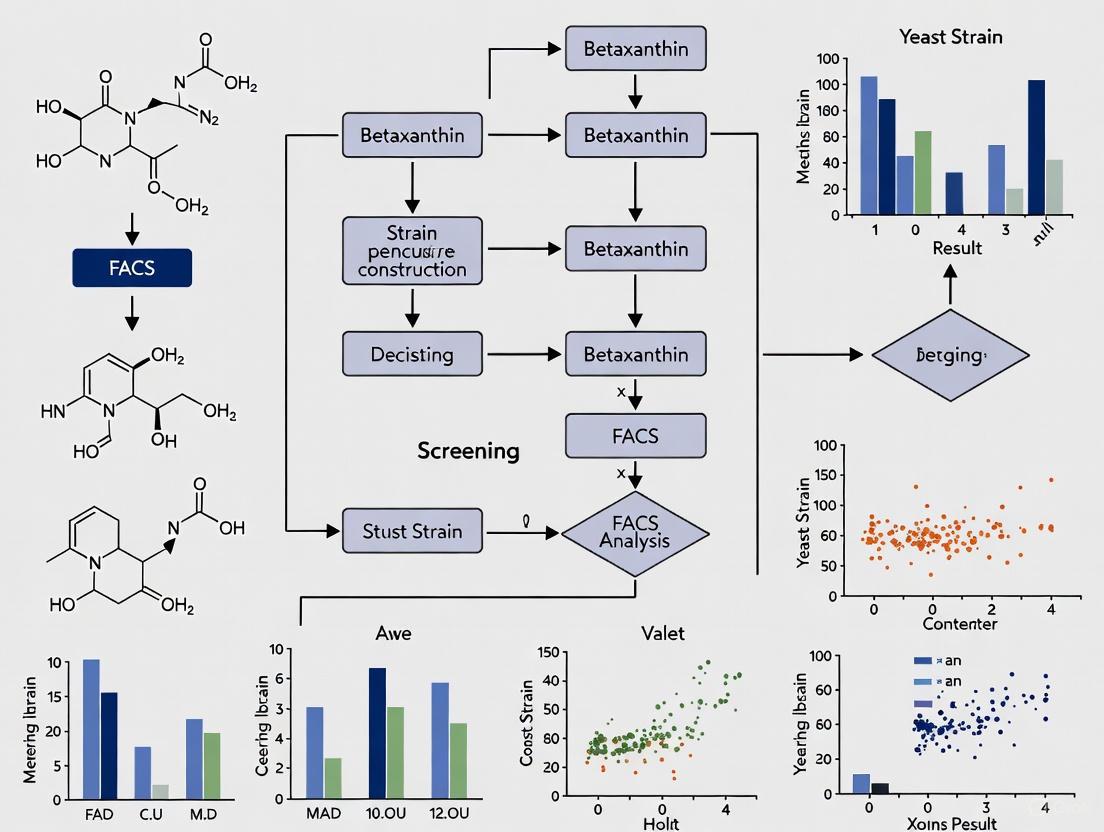
This article details the establishment of Fluorescence-Activated Cell Sorting (FACS) as a high-throughput screening platform for engineering Saccharomyces cerevisiae, using betaxanthin fluorescence as a biosensor for metabolic flux.
High-Throughput FACS Screening of Betaxanthin-Producing S. cerevisiae: A Biosensor Platform for Strain and Drug Development
Abstract
This article details the establishment of Fluorescence-Activated Cell Sorting (FACS) as a high-throughput screening platform for engineering Saccharomyces cerevisiae, using betaxanthin fluorescence as a biosensor for metabolic flux. It covers the foundational role of betaxanthins as real-time reporters for tyrosine and L-DOPA biosynthesis, explores methodological workflows that couple FACS with CRISPRi/a libraries for target identification, and addresses critical troubleshooting for screen optimization, such as preventing betaxanthin export. Furthermore, it validates the approach by demonstrating successful strain improvement for pharmaceutically relevant molecules like p-coumaric acid and L-DOPA, offering a powerful framework for researchers and drug development professionals to accelerate microbial host engineering.
Betaxanthins as Versatile Biosensors: Linking Fluorescence to Metabolic Pathway Engineering
Within metabolic engineering, the development of efficient biosensors is crucial for high-throughput screening of high-producing microbial strains. The betaxanthin biosynthetic pathway represents a powerful dual-mode reporter system, conferring both a visible yellow-orange color and distinct green fluorescence upon excitation. This application note details the molecular machinery and experimental protocols for implementing this pathway in Saccharomyces cerevisiae, specifically framed within a research context utilizing Fluorescence-Activated Cell Sorting (FACS) to isolate strains with enhanced L-tyrosine or L-DOPA production. The spontaneous nature of the final catalytic step [1] [2] and the intrinsic fluorescence of the betaxanthin molecules [3] make this system uniquely suited for screening vast mutant libraries.
The Biochemical Pathway: A Two-Enzyme System
The biosynthesis of betaxanthins from L-tyrosine is a remarkably streamlined process requiring only two core enzymatic reactions, followed by a spontaneous condensation.
Pathway Enzymology
- Hydroxylation: The pathway initiates with the conversion of L-tyrosine to L-3,4-dihydroxyphenylalanine (L-DOPA). This reaction is catalyzed by a cytochrome P450 monooxygenase, functionally referred to as tyrosine hydroxylase (TyH or CYP76AD) [4] [5].
- Oxidative Cleavage: L-DOPA is subsequently converted into the central intermediate, betalamic acid. This step involves the opening of the aromatic ring between carbons 4 and 5 and is catalyzed by a 4,5-dopa-extradiol-dioxygenase (DOD) [4] [5].
- Spontaneous Condensation: The final, decisive step is the spontaneous and non-enzymatic condensation of betalamic acid with a variety of amino acids or amines to form the respective betaxanthins [1] [2]. This reaction forms the characteristic 1,7-diazaheptamethin conjugated system, which is responsible for both the pigment's color and its fluorescence [5].
The following diagram illustrates this pathway and its integration into the FACS-based screening workflow:
Quantitative Performance of Engineered Strains
Combinatorial engineering of enzyme variants has led to significant improvements in betaxanthin and betanin production in S. cerevisiae. The table below summarizes key performance metrics from recent studies.
Table 1: Production of Betalains in Engineered Yeast Strains
| Product | Host Strain | Key Enzymatic Combination | Titer Achieved | Reference |
|---|---|---|---|---|
| Betaxanthins | S. cerevisiae CEN.PK | DOD from Bougainvillea glabra + TyH from Abronia nealleyi, Acleisanthes obtusa, or Cleretum bellidiforme | >6-fold increase over previous reports | [4] [5] |
| Betanin | S. cerevisiae | BvCYP76AD1W13L + MjDOD + BvUGT73A36 | 30.8 ± 0.14 mg/L in 48 h | [4] [5] |
| Betanin | S. cerevisiae | Pathway optimization and fermentation | 28.7 mg/L in 72 h | [6] |
| Betanin | S. cerevisiae BY4741 | MjDOD + BvCYP76AD1W13L + MjcDOPA5GT + ScARO4K229L | 17 mg/L | [5] |
Experimental Protocol: Implementation for FACS Screening
This protocol describes the process of constructing a betaxanthin-producing yeast strain and utilizing it for FACS-based screening to isolate mutants with elevated flux from L-tyrosine to L-DOPA.
Strain Construction for Biosensor Implementation
Objective: Integrate the core betaxanthin pathway into the S. cerevisiae genome at the CAN1 locus.
Materials:
- Parent Strain: S. cerevisiae CEN.PK113-5D or similar, expressing Cas9 [4] [5].
- gRNA Plasmid: Targeting the CAN1 locus (e.g., pCfB2310) [4] [5].
- Transformation Elements: A pool of linear DNA fragments for in vivo assembly, including:
- Upstream and downstream homology arms for CAN1.
- A library of 12 DOD gene variants (e.g., from Mirabilis jalapa, Bougainvillea glabra, Beta vulgaris), each under the control of the TEF1 promoter and CYC1 terminator.
- A library of 11 TyH gene variants (e.g., from Abronia nealleyi, Acleisanthes obtusa, Cleretum bellidiforme), each under the control of the TDH3 promoter and ADH1 terminator.
- An auxotrophic marker (e.g., KlURA3 from Kluyveromyces lactis) [4] [5].
Method:
- Co-transform the parent strain with the gRNA plasmid and the pool of five DNA elements.
- Plate the transformation mixture onto appropriate selective media (e.g., lacking uracil) and incubate for 2-3 days.
- Screen resulting colonies for yellow-orange pigmentation and/or fluorescence to identify successful transformants [5] [7].
FACS Screening for High-Producing Strains
Objective: Enrich a population of cells with high intracellular L-DOPA production, indicated by high betaxanthin fluorescence.
Materials:
- Library of mutagenized yeast strains expressing the betaxanthin biosensor.
- Fluorescence-Activated Cell Sorter (FACS).
- Standard YPD or selective liquid media.
- Microtiter plates containing solid growth media.
Method:
- Grow the mutant library in liquid media to mid-exponential phase.
- Dilute and resuspend cells in a suitable buffer for FACS analysis.
- FACS Analysis and Sorting:
- Use a blue laser (e.g., 488 nm) for excitation.
- Detect fluorescence emission using a standard FITC/GFP filter (e.g., 530/30 nm bandpass filter).
- Establish a sorting gate based on the fluorescence intensity of a control strain with known low production. Sort the top 0.5-1% of highly fluorescent events [8].
- Collect the sorted cell population and plate onto solid media to obtain single colonies.
- Visually re-screen the resulting colonies for intense coloration [8] [7].
- Validate the production tier of selected hits by culturing in liquid media and quantifying L-tyrosine, L-DOPA, or betaxanthin via HPLC or other analytical methods.
Critical Consideration for Screening: The native export of betaxanthins from yeast cells can lead to cross-feeding and false positives on solid media. To mitigate this, implement the biosensor in a strain background with a deletion of QDR2, a multidrug resistance transporter that exports betaxanthins. Deletion of QDR2 significantly improves intracellular retention of the pigment, enhancing the correlation between cellular fluorescence and production capability and drastically improving the quality of the FACS screen [8]. The following workflow integrates this critical step:
The Scientist's Toolkit: Essential Research Reagents
The following table catalogs the key genetic components and strains required to establish this betaxanthin-based screening system.
Table 2: Key Research Reagents for Betaxanthin Biosensor Implementation
| Reagent / Genetic Element | Function / Role in the System | Example Sources / Notes |
|---|---|---|
| TyH (CYP76AD) Variants | Catalyzes the conversion of L-tyrosine to L-DOPA. | Abronia nealleyi, Acleisanthes obtusa, Cleretum bellidiforme, Beta vulgaris (including mutated W13L variant for higher activity) [4] [5]. |
| DOD Variants | Catalyzes the conversion of L-DOPA to betalamic acid. | Bougainvillea glabra, Mirabilis jalapa, Beta vulgaris [4] [5]. Optimal strains may contain two copies of BgDOD [4]. |
| Glucosyltransferase (UGT) | Glucosylates betanidin to produce the more stable betanin (for betacyanin production). | BvUGT73A36 from Beta vulgaris identified as highly effective [4] [5]. |
| S. cerevisiae Δqdr2 Strain | Host strain with deleted QDR2 gene, a multidrug transporter that exports betaxanthins. Crucial for improving intracellular signal retention and FACS screen quality [8]. | Can be engineered in CEN.PK or S288C background strains. |
| gRNA Plasmid (pCfB2310) | Targets the CAN1 locus for CRISPR-Cas9 mediated integration of the biosensor pathway [4] [5]. | Provides a specific genomic locus for consistent pathway expression. |
For metabolic engineers optimizing microbial cell factories, a significant challenge is the lack of high-throughput screening assays for most industrially interesting molecules [9]. This application note details the core principles and methodologies for using betaxanthins, a class of yellow-orange fluorescent pigments, as a proxy for monitoring the intracellular supply of aromatic amino acids (AAAs), particularly L-tyrosine, in Saccharomyces cerevisiae.
This approach enables researchers to leverage Fluorescence-Activated Cell Sorting (FACS) to screen vast genetic libraries for strains with enhanced AAA biosynthesis. This is crucial for engineering yeast to produce valuable AAA-derived compounds, such as the pharmaceuticals L-DOPA and p-coumaric acid, whose direct screening is often low-throughput and analytically demanding [9] [8].
Core Principle: The Betaxanthin Biosensor Mechanism
The betaxanthin-based screening system functions as an enzyme-coupled biosensor that converts the concentration of L-tyrosine into a fluorescent signal.
Biochemical Pathway
The biosensor consists of two key enzymatic steps that are introduced into the yeast host:
- Tyrosine Hydroxylation: The enzyme tyrosine hydroxylase (TyH), a cytochrome P450 (CYP76AD), converts L-tyrosine to L-DOPA (L-3,4-dihydroxyphenylalanine) [5] [8].
- Spontaneous Condensation: An extradiol dioxygenase (DOD, or DOPA dioxygenase) opens the cyclic ring of L-DOPA to form betalamic acid. This compound then spontaneously undergoes a Schiff-base condensation with endogenous amino acids or amines to form a variety of betaxanthins [9] [8] [10].
The resulting betaxanthins are fluorescent (excitation ~463 nm, emission ~512 nm) and yellow-pigmented, providing both a colorimetric and a fluorometric readout that is proportional to the precursor L-tyrosine pool [9] [5].
Diagram 1: The betaxanthin biosensor pathway. Fluorescent betaxanthins are formed from L-tyrosine via a two-enzyme cascade followed by a spontaneous reaction.
Quantitative Validation of the Proxy Relationship
The correlation between betaxanthin fluorescence and the production of target AAA-derived molecules has been quantitatively demonstrated in multiple studies, validating its use as a reliable proxy.
Table 1: Validation of Betaxanthin Fluorescence as a Proxy for AAA-Derived Product Synthesis
| Target Product | Engineering Strategy | Betaxanthin Fluorescence Fold-Change | Validated Product Titer Increase | Citation Context |
|---|---|---|---|---|
| p-Coumaric Acid (p-CA) | Screening a 4k gRNA library deregulating 1000 metabolic genes | Up to 5.7-fold increase in intracellular betaxanthin | 6 targets increased secreted p-CA titer by up to 15% | [9] |
| L-DOPA | Testing 30 gene targets identified via betaxanthin screening | Not Specified | 10 targets increased secreted L-DOPA titer by up to 89% | [9] |
| Betaxanthin | Global transcriptional engineering of transcription factors (Spt15, Gcn4) | Visual screening of yellow coloration | 208 mg/L betaxanthin in yeast cells by flask fermentation | [11] |
| Betanin | Combinatorial engineering of TyH and DOD enzyme variants | 6-fold higher betaxanthin fluorescence than previously reported | 30.8 mg/L betanin achieved in the best strain | [5] |
Experimental Protocol for FACS-Based Screening
The following protocol provides a detailed methodology for implementing a betaxanthin-based screen to isolate S. cerevisiae strains with an enhanced aromatic amino acid supply.
The entire screening and validation process, from library construction to final strain verification, is illustrated below.
Diagram 2: Core workflow for FACS-based screening of betaxanthin-producing S. cerevisiae strains. HTP = High-Throughput; LTP = Low-Throughput.
Step-by-Step Protocol
Step 1: Biosensor Strain Construction
- Objective: Genetically integrate the betaxanthin pathway into a chosen S. cerevisiae background strain (e.g., CEN.PK or S288C derivative) to ensure uniform expression [9] [8].
- Procedure:
- Integrate genes for a feedback-insensitive AAA pathway (e.g.,
ARO4^(K229L),ARO7^(G141S)) to relieve allosteric inhibition and increase baseline L-tyrosine supply [9] [11]. - Integrate the betaxanthin biosensor cassette, typically consisting of:
- To reduce false positives in FACS caused by betaxanthin export, consider deleting the multidrug transporter gene
QDR2, which significantly improves intracellular pigment retention [8].
- Integrate genes for a feedback-insensitive AAA pathway (e.g.,
Step 2: Library Transformation and Culture
- Objective: Introduce genetic diversity (e.g., CRISPRi/a gRNA libraries, transposon disruption libraries) into the biosensor strain.
- Procedure:
- Transform the constructed biosensor strain (e.g., ST9633 from [9]) with your chosen library (e.g., a gRNA library targeting 1000 metabolic genes) [9].
- Plate transformants on appropriate selective solid media and incubate for 2-3 days to form colonies.
- Pool all colonies and inoculate into a suitable liquid minimal medium (e.g., with 20 g/L glucose). Cultivate for 48 hours to allow library expression [9].
Step 3: FACS Enrichment
- Objective: Isolate the most fluorescent cells from the pooled library.
- Procedure:
- Dilute the cultured cells to a density suitable for FACS (e.g., ~10^6 cells/mL).
- Use a FACS sorter with a 488 nm laser for excitation and a 530/30 nm bandpass filter (or similar) for detection of betaxanthin fluorescence [9].
- Set a sorting gate to collect the top 1-3% of the population with the highest fluorescence intensity [9]. Sort between 8,000-10,000 events into a collection tube containing growth medium.
Step 4: Post-Sort Processing and Hit Identification
- Objective: Recover sorted cells and identify individual high-performing strains.
- Procedure:
- Allow sorted cells to recover in liquid medium overnight.
- Plate the recovered cells on solid agar plates to obtain single colonies. Incubate for 3-4 days [9].
- Visually screen hundreds of single colonies, picking ~350 of the most intensely yellow-pigmented candidates for further analysis [9].
- Cultivate these hits in 96-deep-well plates for 48 hours and quantify fluorescence using a plate reader to confirm high betaxanthin production. Select the top performers (e.g., those with fluorescence fold-change >3.5) [9].
- Isolate and sequence the plasmids (or genomic DNA) from these top strains to identify the genetic modifications (gRNA targets, transposon insertion sites) responsible for the improved phenotype.
Step 5: Validation in Target Production Strain
- Objective: Confirm that the identified genetic targets improve the synthesis of the ultimate molecule of interest (e.g., p-CA, L-DOPA).
- Procedure:
- Introduce the identified genetic modifications into a dedicated production strain that makes the target molecule but lacks the betaxanthin pathway.
- Cultivate the engineered validation strains and analyze product titer using low-throughput but precise analytical methods like HPLC or LC-MS [9].
- This critical step validates that the betaxanthin proxy screen successfully identified targets that genuinely enhance flux towards the desired AAA-derived product.
The Scientist's Toolkit: Key Reagents and Materials
Table 2: Essential Research Reagents for Betaxanthin-Based Screening
| Reagent / Material | Function / Role in the Experiment | Examples & Notes |
|---|---|---|
| Biosensor Enzymes | Catalyze the conversion of L-tyrosine to fluorescent betaxanthins. | TyH: CYP76AD from A. nealleyi, B. vulgaris W13L variant [5]. DOD: From B. glabra, M. jalapa [5]. |
| Genetic Libraries | Introduce genetic diversity to perturb host metabolism and identify beneficial mutations. | CRISPR-dCas9 VP64/Mxi1 libraries [9]; Barcoded transposon-disruption libraries [8]. |
| S. cerevisiae Strains | Chassis organism for metabolic engineering. | CEN.PK113-5D, S288C-derived strains (e.g., BY4741) [5] [8]. |
| FACS Sorter | Enables high-throughput, single-cell isolation based on fluorescence. | Must be equipped with a 488 nm laser and appropriate emission filters (~510-520 nm) [9]. |
| Analytical Standards | For accurate quantification of target molecules during validation. | L-DOPA, p-Coumaric Acid, Betanin for HPLC/LC-MS calibration [10]. |
Critical Technical Considerations
- Minimizing False Positives: The natural export of betaxanthins can lead to cross-feeding between cells on agar plates, causing false positives. Deletion of the transporter gene
QDR2is a proven strategy to enhance intracellular betaxanthin retention and significantly improve screening fidelity [8]. - Biosensor Compartmentalization: The initial screen may identify targets that primarily improve biosensor function (e.g., compartmentalization) rather than AAA supply. Iterative screening rounds in a
QDR2-deficient background can help shift focus toward genuine flux enhancements [8]. - Orthogonal Validation: Always confirm that hits from the betaxanthin screen improve the titer of your final product of interest using precise, targeted analytical methods. The proxy is a powerful filter, but not a substitute for final product quantification [9].
Betaxanthins are yellow- to orange-colored, water-soluble pigments that belong to the broader family of betalains [12]. Their unique biosynthesis pathway and fluorescent properties have made them invaluable as natural biosensors in metabolic engineering, particularly for reporting on the activity of P450 enzymes and the availability of aromatic amino acid precursors in microbial cell factories like Saccharomyces cerevisiae [8] [9] [13].
This application note details the underlying principles, quantitative data, and standardized protocols for employing betaxanthins as a high-throughput screening tool. The content is framed within thesis research focused on using FACS to isolate high-producing S. cerevisiae strains, providing a practical guide for researchers and scientists in drug development and metabolic engineering.
The Betaxanthin Biosensor Principle and Pathway
The core of the biosensor is a short, two-step metabolic pathway that can be introduced into yeast. The system is fundamentally based on the native plant biosynthesis pathway for betalains [14] [12].
- P450-Catalyzed Hydroxylation: A cytochrome P450 enzyme (CYP76AD1 or a functional homolog) performs the initial, rate-limiting step: the hydroxylation of the aromatic amino acid L-tyrosine to form L-3,4-dihydroxyphenylalanine (L-DOPA) [8] [13]. The activity of this P450 enzyme is directly coupled to the biosensor's output.
- Ring Cleavage and Spontaneous Condensation: The enzyme 4,5-DOPA dioxygenase (DOD) cleaves the aromatic ring of L-DOPA to form betalamic acid [14] [5]. Betalamic acid then spontaneously condenses with various endogenous amino acids or amines present in the cell to form a spectrum of yellow, fluorescent betaxanthins [9].
The fluorescence intensity of the resulting betaxanthins serves as a direct, real-time readout for the flux through the pathway, reporting on both the functional expression and activity of the P450 enzyme and the intracellular availability of its substrate, L-tyrosine [9] [13].
The diagram below visualizes this signaling pathway and its application as a biosensor.
Quantitative Performance Data
The effectiveness of metabolic engineering and screening efforts is quantified by betaxanthin production and the resulting fluorescence. The table below summarizes reported performance metrics from key studies.
Table 1: Quantitative Betaxanthin Production Metrics in Engineered S. cerevisiae
| Engineering/Screening Strategy | Key Genetic Modifications / Targets | Reported Betaxanthin Production | Fold Increase vs. Control | Primary Citation |
|---|---|---|---|---|
| Combinatorial Enzyme Screening | Expression of optimal TyH (A. nealleyi, A. obtusa, C. bellidiforme) and DOD (B. glabra) variants. | >6x higher than previous reports | >6.0 | [5] |
| Global Transcriptional Engineering | Mutation of global transcription factors SPT15 (R238K) and GCN4 (S22Y, T51N, L71N). | Up to 51.2 mg/L (in flask) | 2.17 | [15] |
| CRISPRi/a Library Screening | Deregulation of 30 unique metabolic gene targets (e.g., PYC1, NTH2). | Intracellular fluorescence increased 3.5–5.7 fold | 3.5 – 5.7 | [9] |
| Arabidopsis cDNA Library Screening | Overexpression of plant genes AtMSBP1, AtGRP7, and AtCOL4 to enhance P450 function. | Betaxanthin fluorescence increased 2.36-fold | 2.36 | [13] |
Experimental Protocols
Protocol: FACS-Based Screening for High-Betaxanthin Producers
This protocol is designed for the enrichment of S. cerevisiae strains with high P450 activity and precursor supply from a mutant or variant library [8] [9].
Workflow Overview:
Materials:
- Yeast mutant library (e.g., knockout, CRISPRi/a, or cDNA overexpression library)
- Betaxanthin Biosensor Strain (e.g., yJS1256 genotype) [13]
- FACS instrument (e.g., BD FACSAria)
- SCD-URA medium (0.17% YNB, 0.5% ammonium sulfate, 2% glucose, CSM-URA)
Procedure:
- Library Transformation: Introduce the betaxanthin biosensor plasmid (containing CYP76AD1 and DODA genes) into your yeast mutant library to generate a uniform biosensor background across all variants [9] [13].
- Cultivation: Plate transformed libraries on SCD-URA agar plates and incubate at 30°C for 48-72 hours. For liquid pre-culture, inoculate colonies in SCD-URA medium and grow to mid-log phase (OD600 ~0.5-0.8) [13].
- Sample Preparation: Harvest cells by centrifugation (3,000 x g, 5 min). Wash and resuspend in ice-cold phosphate-buffered saline (PBS) or ddH2O to a final density of ~10^7 cells/mL. Keep samples on ice and protected from light [8].
- FACS Enrichment:
- Use a strain without the biosensor as a negative control to set the baseline fluorescence.
- Create a gate around the top 0.5% to 3% of the cell population based on fluorescence intensity (Ex/Em: ~463/512 nm) [8] [9].
- Sort the gated population into sterile collection tubes containing rich medium (e.g., YPD).
- Recovery and Validation:
- Plate the sorted cells on SCD-URA agar plates and incubate at 30°C until colonies form (2-4 days) [9].
- Visually screen for intensely yellow colonies [15].
- Inoculate selected colonies into 96-deep-well plates containing SCD-URA medium and culture for 48 hours. Measure fluorescence (Ex/Em: ~463/512 nm) and normalize to cell density (OD600) to quantify betaxanthin production [9] [13].
Critical Notes:
- False Positives Mitigation: To minimize false positives from betaxanthin secretion and cross-feeding, perform screenings in a strain background with deleted multidrug transporter QDR2, which improves intracellular betaxanthin retention [8].
- Iterative Screening: For complex traits, perform multiple rounds of screening. A barcoded transposon library can be integrated into new, improved background strains from each round to iteratively identify additive mutations [8].
Protocol: Quantifying Betaxanthin Fluorescence in Liquid Culture
This method is used for validating hits from FACS sorting or for comparing betaxanthin production across a small number of strains [9] [13].
Procedure:
- Culture Inoculation: Inoculate candidate strains and appropriate controls in SCD-URA medium.
- Growth and Harvest: Grow cultures at 30°C with shaking (250 rpm) to mid-log phase (OD600 ~0.5-0.8). Transfer 150-200 µL of culture to a black-walled, clear-bottom 96-well plate.
- Fluorescence Measurement: Using a microplate reader, measure the fluorescence with an excitation of 463 nm and an emission of 512 nm [9].
- Data Normalization: Normalize the raw fluorescence readings (Relative Fluorescence Units, RFU) to the cell density (OD600) of the sample to obtain the specific fluorescence:
RFU/OD600.
The Scientist's Toolkit: Key Research Reagents
The table below lists essential genetic components and strains used in establishing and applying the betaxanthin biosensor.
Table 2: Essential Research Reagents for Betaxanthin Biosensor Applications
| Reagent / Genetic Component | Function / Role in Biosensor System | Example Sources / Notes |
|---|---|---|
| Tyrosine Hydroxylase (TyH/CYP76AD1) | Rate-limiting P450 enzyme; converts L-tyrosine to L-DOPA. Activity is the primary reporting target. | Beta vulgaris (with W13L mutation for improved activity), A. nealleyi, A. obtusa [5] |
| DOPA Dioxygenase (DOD/DODA) | Converts L-DOPA to betalamic acid, the core chromophore for all betalains. | Mirabilis jalapa (MjDOD), Bougainvillea glabra (BgDOD) [14] [5] |
| Biosensor Strain (Base Strain) | Engineered S. cerevisiae host expressing the core betaxanthin pathway. | yJS1256 (from Dueber lab) [13]; strains with deleted QDR2 show improved intracellular signal retention [8] |
| Upstream Pathway Engineering | Genetic modifications to enhance supply of L-tyrosine precursor. | Feedback-insensitive ARO4K229L and ARO7G141S; overexpression of ARO1, ARO2 [9] [15] |
| Transcription Factor Mutants | Global regulators that enhance overall pathway flux when mutated. | Spt15p (R238K) and Gcn4p (S22Y, T51N, L71N) [15] |
| P450 Helper Genes | Plant-derived genes that improve functional expression of P450s in yeast. | AtMSBP1, AtGRP7, AtCOL4 from Arabidopsis thaliana cDNA libraries [13] |
This application note details the superior properties of betaxanthins as reporter molecules for Fluorescence-Activated Cell Sorting (FACS)-based screening in Saccharomyces cerevisiae strain development. Within metabolic engineering, the ability to conduct high-throughput (HTP), non-destructive screening is a critical bottleneck. Betaxanthins, derived from the betalain biosynthesis pathway, provide a powerful solution through their intrinsic fluorescence and color, enabling direct HTP screening and sorting of live yeast cells for enhanced production of valuable compounds like L-DOPA and p-coumaric acid.
Optimizing microbial hosts for the production of valuable metabolites often requires multiple genomic modifications, necessitating the screening of vast mutant libraries [8]. However, a significant challenge is that most industrially interesting molecules cannot be screened at sufficient throughput, as they lack properties enabling easy detection [9]. While artificial biosensors can be developed, their creation is difficult and time-consuming [9]. Consequently, analysis often relies on low-throughput (LTP) methods, severely limiting the pace of strain development.
Betaxanthins offer an effective solution to this problem. They are a group of yellow-orange, fluorescent pigments naturally produced in plants and some fungi [5]. When engineered into yeast, the betaxanthin pathway converts L-tyrosine into betalamic acid, which spontaneously condenses with endogenous amino acids to form fluorescent betaxanthins [9]. This creates a visible and fluorescent readout directly correlated with the intracellular pool of a key precursor, enabling researchers to use betaxanthin fluorescence as a proxy for strain performance in HTP campaigns.
Key Advantages of Betaxanthin as a Reporter
Betaxanthins provide a unique combination of benefits not commonly found in other reporter systems.
- Dual-Modal Detection (Color and Fluorescence): Betaxanthins provide both a visual colorimetric readout (yellow-orange) and a specific fluorescent signal (excitation/emission ~463/512 nm) [9]. This allows for preliminary visual screening of colonies on plates followed by precise, quantitative FACS analysis.
- Non-Destructive and HTP-Compatible: The fluorescence signal is generated within live cells, making the screening process non-destructive. This permits the sorting of viable, high-producing cells that can be regrown for further rounds of screening or fermentation, which is essential for iterative strain improvement [8] [9].
- Direct Correlation with Pathway Activity: Betaxanthin biosynthesis is directly linked to the central metabolite L-tyrosine. Its fluorescence intensity therefore serves as a reliable real-time indicator of the flux through the shikimate and L-tyrosine biosynthesis pathways, which are precursors for a wide range of valuable compounds [9].
The following table summarizes how these advantages position betaxanthins favorably against other common analytical methods.
Table 1: Comparison of Betaxanthin-Based Screening with Other Common Analytical Methods
| Method | Throughput | Destructive? | Key Limitation |
|---|---|---|---|
| Betaxanthin FACS | High | No | Requires pathway engineering; can be influenced by cellular export [8] |
| Liquid Chromatography (e.g., HPLC) | Low | Yes | Requires sample preparation and cell lysis; slow |
| Enzyme-Linked Immunosorbent Assay (ELISA) | Medium | Usually | Requires specific antibodies and sample processing |
| Traditional Microbiology (e.g., agar diffusion) | Low to Medium | Yes | Often indirect and semi-quantitative |
Quantitative Data from Screening Campaigns
The practical application of betaxanthin-based screening has yielded significant quantitative improvements in multiple metabolic engineering studies.
Table 2: Documented Performance of Betaxanthin-Based FACS Screening
| Study Goal | Screening Library | Key Finding | Outcome in Validation |
|---|---|---|---|
| Improve L-DOPA production [8] | Yeast deletion collection (~4,785 ORFs) | Identified deletion of PDR8 and QDR2 (multidrug transporters) increased intracellular betaxanthin retention. | Deletion of HMX1 (heme oxygenase) in a final screen round increased L-DOPA production. |
| Improve p-coumaric acid (p-CA) and L-DOPA production [9] | CRISPRi/a gRNA library (~1,000 metabolic genes) | Isolated 30 gene targets that increased intracellular betaxanthin content by 3.5–5.7 fold. | 10 targets increased secreted L-DOPA titer by up to 89%; 6 targets increased p-CA titer by up to 15%. |
| Optimize betalain pathway [5] | Combinatorial library of 12 DOD and 11 TyH enzyme variants | Engineered strains produced over six-fold higher betaxanthins than previously reported. | Identified optimal enzyme combinations (e.g., DOD from B. glabra with TyH from A. nealleyi). |
Detailed Experimental Protocols
Protocol: FACS Screening of a CRISPRi/a Library for Betaxanthin Production
This protocol is adapted from the HTP screening workflow used to identify metabolic engineering targets for improving L-DOPA and p-CA production [9].
I. Principle A gRNA library targeting metabolic genes for CRISPR interference/activation (CRISPRi/a) is transformed into a betaxanthin-producing S. cerevisiae strain. Cells exhibiting high fluorescence due to increased L-tyrosine precursor supply are isolated using FACS and the enriched genetic targets are identified and validated.
II. Research Reagent Solutions & Essential Materials
Table 3: Key Reagents and Materials for FACS Screening
| Item | Function / Description | Example / Note |
|---|---|---|
| Betaxanthin Screening Strain | Engineered S. cerevisiae with integrated betaxanthin biosensor genes (e.g., TEF1 promoter-driven DOD and TyH). | Strain ST9633 [9] expresses feedback-insensitive ARO4K229L and ARO7G141S. |
| CRISPRi/a gRNA Library | Plasmid library for transcriptional regulation. Targets ~1000 metabolic genes with dCas9-VPR (activation) and dCas9-Mxi1 (repression) [9]. | |
| SYTOX Green / SYBR Green | Nucleic acid stains for cell cycle analysis during process optimization [16]. | Used for monitoring culture health, not for the primary betaxanthin signal. |
| Flow Cytometer with Cell Sorter | Instrument for detecting fluorescence and sorting cells. | Must be equipped with a 488 nm laser and a 530/30 nm bandpass filter for betaxanthin detection (Em ~512 nm). |
| Minimal Media | Selective medium for culture growth and maintenance. | e.g., Synthetic Defined (SD) media with appropriate amino acid drop-out. |
III. Procedure
- Library Transformation: Transform the CRISPRi/a gRNA plasmid library into the competent betaxanthin screening strain using a high-efficiency lithium acetate transformation protocol. Ensure transformation yield is sufficient to cover the library diversity by at least 3-5-fold.
- Outgrowth and Expansion: Pool all transformants and allow outgrowth in a non-selective rich medium (e.g., YPD) for 4-6 hours. Subsequently, transfer the culture to a selective minimal medium to maintain plasmid pressure and grow for 16-24 hours.
- Sample Preparation for FACS: Dilute the culture to an optimal density of ~1-5 x 10⁶ cells/mL in phosphate-buffered saline (PBS) or a suitable sorting buffer. Keep samples on ice and protected from light until sorting.
- FACS Gating and Sorting:
- Use a forward scatter (FSC-A) vs. side scatter (SSC-A) plot to gate on the primary population of single, healthy yeast cells.
- Create a histogram of fluorescence (e.g., FL1-A channel for betaxanthin) and set a sorting gate to capture the top 1-3% of the most fluorescent events [9].
- Sort the gated population into a collection tube containing rich recovery medium.
- Recovery and Analysis:
- Allow the sorted cells to recover in rich medium overnight.
- Plate on selective agar plates to obtain single colonies.
- Visually screen several hundred colonies for intense yellow pigmentation and pick them into 96-deep-well plates for cultivation.
- Quantify fluorescence in a plate reader to confirm high betaxanthin production.
- Isolate plasmid DNA from confirmed high-producers and sequence the gRNA cassette to identify the enriched genetic targets.
- Validation: Re-introduce the identified gRNAs individually into the betaxanthin strain and the target production strain (e.g., L-DOPA or p-CA producer) to validate the phenotype using LTP analytical methods like HPLC.
Protocol: Optimizing Betaxanthin Compartmentalization to Reduce False Positives
A challenge with the betaxanthin biosensor is the export of the fluorescent pigment from cells, which can lead to cross-contamination and false positives during screening on solid media [8]. The following protocol describes a genetic modification to mitigate this issue.
I. Principle Deletion of specific multidrug resistance transporter genes, such as QDR2, reduces the active export of betaxanthins from yeast cells. This increases intracellular betaxanthin retention, improves the correlation between intracellular fluorescence and production capacity, and minimizes false positives by reducing pigment sharing between adjacent colonies.
II. Procedure
- Strain Engineering: In your betaxanthin-producing background strain (e.g., yJS1051), construct a markerless knockout of the QDR2 gene (YIL121W) using a CRISPR-Cas9 or homologous recombination method [8].
- Validation of Compartmentalization:
- Grow the wild-type (parent) and Δqdr2 strains in liquid minimal medium.
- After 48 hours of growth, separate the cells from the culture medium by centrifugation.
- Measure the fluorescence of the cell pellet (resuspended in PBS) and the culture supernatant separately using a plate reader.
- Compare the ratio of intracellular to extracellular fluorescence between the two strains. The Δqdr2 strain should show a significantly higher percentage of retained intracellular fluorescence [8].
- Implementation: Use the Δqdr2 betaxanthin strain as the new background for all subsequent FACS screening campaigns to improve screening fidelity.
Visualizing the Workflow and Pathway
The following diagrams illustrate the logical workflow for a screening campaign and the core betalain biosynthesis pathway.
Diagram 1: FACS Screening Workflow. This diagram outlines the key steps in a high-throughput screening campaign using betaxanthin fluorescence and FACS [9].
Diagram 2: Core Betaxanthin Biosynthesis Pathway. The pathway shows the two key enzymatic steps converting L-tyrosine to fluorescent betaxanthins [5]. Key enzymes are highlighted in green, and the final fluorescent product in red.
Building the Screening Pipeline: From Library Construction to FACS Enrichment
This application note details a robust workflow for identifying non-obvious metabolic engineering targets in Saccharomyces cerevisiae for the production of valuable compounds like betaxanthins and p-coumaric acid. The central challenge in strain development for many industrially relevant molecules is the lack of high-throughput (HTP) screening assays for the products themselves. This protocol overcomes this bottleneck by coupling HTP screening of a proxy molecule with subsequent low-throughput, targeted validation of the molecule of interest [17]. The methodology is presented within the context of optimizing betaxanthin-producing yeast strains, leveraging the native fluorescence of betaxanthins for Fluorescence-Activated Cell Sorting (FACS) [8] [4].
The coupled screening strategy is an iterative process that transitions from a broad, HTP search for beneficial genetic perturbations to a focused validation and combination of the most promising hits. This approach is particularly powerful for identifying non-intuitive targets that would be difficult to predict through rational design alone [17]. The entire workflow, from library creation to validation, is visualized in the following diagram:
Experimental Protocols
Protocol: Initial High-Throughput FACS Screening with a Betaxanthin Biosensor
This protocol describes the initial screening of a gRNA library to identify gene perturbations that enhance betaxanthin production, which serves as a proxy for the L-tyrosine pathway flux [17] [8].
3.1.1 Key Research Reagent Solutions
- Betaxanthin Biosensor Strain: S. cerevisiae strain expressing a tyrosine hydroxylase (e.g., CYP76AD variant) and 4,5-dopa-extradiol-dioxygenase (DOD) from a plasmid or genomic integration. The DOD enzyme converts L-DOPA to betalamic acid, which condenses with amino acids to form fluorescent betaxanthins [8] [4].
- gRNA Library: A plasmid-based library designed to deregulate approximately 1000 metabolic genes in S. cerevisiae using a dCas9 system [17].
- FACS Buffer: Phosphate-buffered saline (PBS), pH 7.4, sterile-filtered.
3.1.2 Step-by-Step Procedure
- Library Transformation: Transform the gRNA library plasmids into the betaxanthin biosensor strain of S. cerevisiae using a high-efficiency lithium acetate protocol. Ensure a high transformation efficiency to maintain library diversity [17].
- Culture Growth: Inoculate the transformed library into appropriate selective liquid medium and incubate at 30°C with shaking for 48 hours to allow for gene expression and betaxanthin accumulation.
- Sample Preparation for FACS: Harvest cells by centrifugation and resuspend in chilled FACS buffer to a density of ~1 × 10^7 cells/mL. Keep samples on ice and protected from light until sorting.
- FACS Enrichment: Use a FACS sorter equipped with a 488-nm laser and a 530/30 nm bandpass filter for betaxanthin detection. Gate the population to collect the top 0.5-1% of fluorescent events [8].
- Hit Recovery: Sort the selected cells directly onto solid selective medium plates. Incubate the plates at 30°C for 2-3 days until colonies form [8].
- Hit Identification: Pick individual colonies, culture them, and isolate plasmid DNA. Sequence the gRNA region to identify the genetic target responsible for the high-flux phenotype.
Protocol: Targeted Validation of Hits in Product-Producing Strains
This protocol validates the hits from the initial screen in strains engineered to produce the final compounds of interest, such as p-coumaric acid or L-DOPA [17].
3.2.1 Key Research Reagent Solutions
- High-Producing Strains: Engineered S. cerevisiae strains with optimized pathways for p-coumaric acid or L-DOPA production.
- Validated gRNA Plasmids: Individual plasmids encoding the gRNAs for the top hits identified in section 3.1.
3.2.2 Step-by-Step Procedure
- Strain Engineering: Individually transform the validated gRNA plasmids into the high-producing p-CA and L-DOPA strains.
- Small-Scale Production: Inoculate biological triplicates of each strain into 5 mL of selective production medium in a deep-well plate. Incubate at 30°C with shaking for 72-96 hours.
- Sample Analysis:
- Data Analysis: Compare the product titers of the engineered strains to the control strain (containing a non-targeting gRNA). Select targets that confer a statistically significant increase in titer for further study.
Protocol: Combinatorial Multiplexing of High-Confidence Targets
This protocol tests for additive or synergistic effects by combining multiple beneficial genetic perturbations in a single strain [17].
3.3.1 Key Research Reagent Solutions
- gRNA Multiplexing Library: A library of plasmids expressing multiple gRNAs, designed to simultaneously regulate several of the high-confidence targets identified in section 3.2.
3.3.2 Step-by-Step Procedure
- Library Design and Construction: Design and build a library of plasmids that combine the gRNAs for the 6-10 top-performing targets from the validation round. The library should contain all possible pairwise combinations and/or higher-order multiplexes [17].
- Combinatorial Screening: Transform the multiplexing library into the betaxanthin biosensor strain and subject it to the FACS screening protocol outlined in section 3.1.
- Validation: Isplicate the top-performing multiplexed strains from the FACS screen and test them in the high-producing p-CA and L-DOPA strains as described in section 3.2.
- Strain Characterization: Ferment the best-performing combinatorial strain(s) in bioreactors to fully characterize the growth and production kinetics.
Data Presentation and Analysis
The following tables summarize typical results obtained from applying the coupled workflow, demonstrating its effectiveness in identifying impactful metabolic engineering targets.
Table 1: Identification and Validation of Non-Obvious Metabolic Engineering Targets [17]
| Target Gene | Function | Fold Increase in Betaxanthin (Initial Screen) | % Increase in p-CA Titer (Validation) | % Increase in L-DOPA Titer (Validation) |
|---|---|---|---|---|
| PYC1 | Pyruvate carboxylase | ~4.5 | Up to 15% | Not specified |
| NTH2 | Neutral trehalase | ~3.5 | Up to 15% | Not specified |
| HMX1 | Heme oxygenase | Not specified | Not specified | Up to 89% [8] |
| PDR8 | Transcriptional regulator of ABC transporters | ~5.7 | Not specified | Not specified |
| QDR2 | Multidrug resistance transporter | ~5.7 | Not specified | Not specified |
Table 2: Performance of Combinatorial Strain [17]
| Strain Description | Genetic Modifications | Betaxanthin Content (Fold Increase) | p-CA Titer Improvement |
|---|---|---|---|
| Combinatorial Strain | Simultaneous regulation of PYC1 and NTH2 |
3.0 | Additive trend observed |
The Scientist's Toolkit: Essential Research Reagents
Table 3: Key Research Reagent Solutions for the Coupled Screening Workflow
| Reagent / Material | Function / Application in the Workflow | Examples / Notes |
|---|---|---|
| dCas9/gRNA System | Enables targeted deregulation (CRISPRi) of metabolic genes without knockout. | Essential for creating the initial library of genetic perturbations [17]. |
| Betaxanthin Biosensor | Provides a HTP-compatible fluorescent readout for L-tyrosine/L-DOPA pathway activity. | Comprises DOPA dioxygenase (DOD); fluorescence enables FACS [8] [4]. |
| FACS Instrument | Allows for the isolation of high-producing cells from a large, diverse library based on fluorescence. | Gates set for top 0.5-1% of fluorescent events [8]. |
| Specialized S. cerevisiae Strains | Host organisms engineered for different stages of the workflow. | Includes biosensor strain, high-producing p-CA strain, and high-producing L-DOPA strain [17]. |
| HPLC System | Provides accurate, low-throughput quantification of the final product of interest (e.g., p-CA, L-DOPA). | Used for targeted validation and final titer confirmation [17] [8]. |
The coupled high-throughput and targeted validation strategy provides a powerful and generalizable framework for metabolic engineering. By using the betaxanthin biosensor as a proxy, this workflow successfully identified non-obvious targets like PYC1, NTH2, and HMX1 that significantly improved the production of p-coumaric acid and L-DOPA, with the latter showing an 89% increase in titer [17] [8]. Furthermore, the combinatorial multiplexing step demonstrated that additive improvements could be achieved, as seen with the simultaneous regulation of PYC1 and NTH2. This integrated approach is highly useful for strain development programs where direct HTP screening assays for the desired products are not available.
Implementing CRISPRi/a gRNA Libraries for Genome-Wide Metabolic Gene Perturbation
Within metabolic engineering, the ability to precisely control gene expression on a genome-wide scale provides a powerful approach for optimizing microbial cell factories. This application note details the implementation of combined CRISPR interference and activation (CRISPRi/a) technologies to perform genome-wide metabolic gene perturbations in Saccharomyces cerevisiae strains engineered for betaxanthin production. The protocols herein are designed for researchers aiming to identify gene targets that enhance the production of high-value compounds, using fluorescence-activated cell sorting (FACS) to screen for strains with elevated betaxanthin yield based on the native fluorescence of these pigments.
Research Reagent Solutions
The following table catalogues essential reagents and resources required for implementing the genome-wide CRISPRi/a screening workflow.
Table 1: Key Research Reagents and Resources for CRISPRi/a Screening
| Item Name | Function/Description | Source/Example |
|---|---|---|
| CRISPRa Pooled Library | Library of gRNAs for transcriptional activation of target genes. | Weissman Lab Human CRISPR Activation Library (Addgene #60956) [18] |
| CRISPRi Pooled Library | Library of gRNAs for transcriptional repression of target genes. | Human Genome-Wide CRISPRi sgRNA Library (Cellecta #KIHGW-106-P) [19] |
| dCas9-VP64 Fusion Protein | Effector for CRISPRa; dCas9 fused to transcriptional activator. | pHRdSV40-dCas9-10xGCN4_v4-P2A-BFP (Addgene #60903) [18] |
| dCas9-KRAB Fusion Protein | Effector for CRISPRi; dCas9 fused to transcriptional repressor. | KRAB repressor complexed with dCas9 [19] |
| Guide RNA (gRNA) Design Tool | Software for designing gRNAs with high on-target and low off-target activity. | CRISPRware [20] |
| Betaxanthin Producer Strain | Engineered S. cerevisiae host strain for betalain pathway expression. | ST8251 (CEN.PK113-5D expressing cas9) [5] |
A Workflow for Genome-Wide CRISPRi/a Screening in Yeast
The diagram below outlines the core workflow for performing a genome-wide CRISPRi/a screen to identify gene perturbations that enhance betaxanthin production in yeast.
Experimental Protocols and Methodologies
Library Selection and gRNA Design
Selecting an appropriate gRNA library is critical for screen success. Two primary types are available:
- CRISPR Activation (CRISPRa) Libraries: Designed to overexpress genes by recruiting transcriptional activators like VP64 to gene promoters [18]. The Weissman lab library, for example, targets 15,977 human genes with 198,810 gRNAs [18].
- CRISPR Interference (CRISPRi) Libraries: Designed to repress genes by recruiting repressive domains like KRAB to gene promoters [19]. A standard human CRISPRi library includes five sgRNAs per gene and 3,700 non-targeting controls [19].
For custom library design, use the CRISPRware software package. This tool uses next-generation sequencing data and advanced algorithms to design gRNAs with high on-target and low off-target activity [20]. The software incorporates modern on-target scoring methods like Ruleset 3 and uses GuideScan2 for comprehensive off-target analysis, ensuring high-quality library design [20].
Library Amplification and Lentiviral Production
Materials:
- Pooled library plasmid (e.g., Addgene #60956)
- High-efficiency electrocompetent E. coli (e.g., NEB DH5α, Lucigen Endura)
- LB medium with appropriate antibiotic
- Plasmid purification kit
Protocol:
- Transformation: Transform the entire library plasmid pool into high-efficiency electrocompetent cells to maintain library diversity. It is recommended to achieve a transformation efficiency that provides at least 30x coverage of the library complexity [18].
- Plasmid Recovery: Grow transformed bacteria in liquid culture for 12-16 hours under antibiotic selection.
- Plasmid Purification: Isolate the pooled plasmid library using a maxi-prep kit. Determine the DNA concentration and purity via spectrophotometry.
- Lentiviral Production: Co-transfect the purified gRNA library plasmid with lentiviral packaging plasmids (e.g., psPAX2, pMD2.G) into HEK293T cells using a standard transfection protocol.
- Virus Harvesting: Collect lentiviral supernatants at 48 and 72 hours post-transfection, concentrate if necessary, and titer the viral particles.
Yeast Transformation and Screening
Materials:
- Betaxanthin-producing yeast strain (e.g., ST8251) [5]
- Lentiviral particles containing gRNA library
- YPD medium
- Appropriate antibiotics for selection
- Phosphate-buffered saline (PBS)
- FACS sorter
Protocol:
- Strain Preparation: Grow the betaxanthin-producing S. cerevisiae strain ST8251 to mid-log phase in YPD medium [5].
- Transduction: Transduce the yeast culture with the lentiviral gRNA library at a low multiplicity of infection (MOI ~0.3) to ensure most cells receive a single gRNA. Include a selection marker (e.g., puromycin) 24 hours post-transduction.
- Expression Induction: Induce the expression of the CRISPRi/a system and the betalain biosynthetic pathway as required by your specific strain design.
- FACS Screening: After 48-72 hours of induction, harvest cells and resuspend in PBS. Use FACS to isolate the top 1-5% of cells exhibiting the highest fluorescence intensity in the betaxanthin channel, leveraging the native fluorescence of these pigments for screening [5]. A minimum of 50 million cells should be screened to ensure adequate library representation.
- Cell Recovery and Expansion: Sort the high-fluorescing population into recovery media, allow the cells to grow, and repeat the FACS process for 2-3 additional rounds to enrich for consistently high producers.
Hit Identification and Validation
Materials:
- Genomic DNA extraction kit
- PCR reagents
- NGS platform
- Cloning reagents
Protocol:
- gRNA Recovery: Extract genomic DNA from the final sorted population and the unsorted control population. Amplify the integrated gRNA sequences via PCR.
- Next-Generation Sequencing: Sequence the PCR amplicons using an NGS platform to quantify the enrichment of specific gRNAs in the high-producing population compared to the control.
- Hit Confirmation: Select the top 10-20 enriched gRNAs for individual validation. Clone each gRNA into your expression vector and transform them individually into the betaxanthin producer strain.
- Phenotype Validation: Measure the betaxanthin production of each individual clone using fluorescence measurements and HPLC analysis to confirm the hit.
The CRISPRi/a Molecular Mechanism
The following diagram illustrates the molecular mechanism by which CRISPRi and CRISPRa systems regulate gene expression at the transcriptional level.
Data Presentation and Analysis
The quantitative details of the core libraries discussed are summarized in the table below for easy comparison.
Table 2: Comparison of Genome-Wide CRISPRi/a Libraries
| Library Parameter | CRISPRa Library (Weissman) | CRISPRi Library (Cellecta) |
|---|---|---|
| Species | Human | Human |
| Genes Targeted | 15,977 | All protein-coding |
| Total gRNAs | 198,810 | 5 per gene + 3,700 controls |
| Controls | 5,968 | 3,700 |
| gRNAs per Gene | ~12 | 5 |
| Vector Backbone | Lentiviral | Lentiviral |
| Selection | Puromycin | Varies |
| Reference | [18] | [19] |
Within metabolic engineering, the development of microbial cell factories for the production of valuable compounds like betalain pigments relies on high-throughput screening methods to identify high-producing strains. This application note details the construction of a robust Saccharomyces cerevisiae screening strain engineered for the overproduction of betaxanthins, the yellow-orange pigments of the betalain family. The core of this strain is a genetically encoded biosensor that links intracellular L-DOPA concentration to the production of fluorescent betaxanthins, enabling rapid screening via fluorescence-activated cell sorting (FACS) [8]. The protocols herein are designed for researchers and scientists engaged in the metabolic engineering of yeast for the production of aromatic amino acid derivatives.
The Betaxanthin Biosensor Principle and Key Genetic Components
The biosensor operates on a simple two-enzyme pathway that converts the precursor L-tyrosine into fluorescent betaxanthins. The fluorescence intensity of individual cells serves as a quantifiable proxy for the flux through the betalain biosynthesis pathway [8].
Diagram 1: The core betaxanthin biosensor pathway. Abbreviations: TyH, Tyrosine Hydroxylase; DOD, DOPA dioxygenase.
Key Enzymes for the Biosensor Pathway
- Tyrosine Hydroxylase (TyH/CYP76AD): Catalyzes the initial and rate-limiting hydroxylation of L-tyrosine to L-3,4-dihydroxyphenylalanine (L-DOPA). This cytochrome P450 enzyme requires careful engineering for functional expression in yeast [5] [21].
- DOPA-4,5-extradiol Dioxygenase (DOD): Cleaves the aromatic ring of L-DOPA to form betalamic acid, the universal chromophore of all betalains [5]. Betalamic acid spontaneously condenses with amino acids or amines to form the fluorescent yellow betaxanthins [8] [22].
Protocol: Strain Construction and Engineering
This section provides a detailed methodology for constructing a high-performance betaxanthin screening strain.
Combinatorial Assembly of the Betaxanthin Pathway
Objective: To identify and integrate optimal combinations of TyH and DOD gene orthologs into the yeast genome for high betaxanthin flux [5].
Materials:
- Parent Strain: S. cerevisiae CEN.PK113-5D expressing Cas9 (e.g., ST8251) [5].
- gRNA Plasmid: Targeting the CAN1 locus (e.g., pCfB2310) for genomic integration [5].
- Expression Cassettes (for in vivo assembly):
- Upstream homology arm for CAN1 locus.
- A library of 12 different DOD variants (e.g., from Mirabilis jalapa, Bougainvillea glabra) under the control of the TEF1 promoter (Ptef1) and CYC1 terminator (Tcyc1).
- A library of 11 different TyH variants (e.g., from Beta vulgaris W13L, Abronia nealleyi, Acleisanthes obtusa) under the control of the TDH3 promoter (Ptdh3) and ADH1 terminator (Tadh1) [5] [23].
- An auxotrophic marker (e.g., KlURA3 from Kluyveromyces lactis).
- Downstream homology arm for CAN1 locus.
Procedure:
- Co-transform the parent strain with the gRNA plasmid and the pool of five expression cassette elements.
- Plate the transformation mixture onto appropriate selective medium (e.g., lacking uracil) and incubate at 30°C for 2-3 days.
- Screen resulting colonies for yellow coloration and fluorescence to identify top performers. The best-engineered strains have been reported to produce over six-fold higher betaxanthins than previous benchmarks [5].
Engineering for Enhanced Precursor Supply
Objective: To modulate global transcription and metabolic pathways to increase the intracellular pool of L-tyrosine, the precursor for L-DOPA and betaxanthins [11] [15].
Materials:
- Engineered Chassis Strains: Strains with upstream aromatic amino acid pathway enhancements (e.g., overexpression of feedback-insensitive ARO4^K229L^ and ARO7^G141S^, and genes TKL1, RKI1, ARO2) [11] [15].
- Transcription Factor Libraries: Mutant libraries of global transcription factors SPT15 and GCN4 generated via error-prone PCR.
Procedure:
- Integrate the betaxanthin biosensor pathway (from section 3.1) into the engineered chassis strains to create a base screening strain (e.g., LYTY-B).
- Transform the base strain with the mutant SPT15 and/or GCN4 libraries.
- Screen the library by visually judging the depth of yellow colony coloration or by measuring fluorescence.
- Validate high-producing isolates (e.g., strain CBS-19 with SPT15^R238K^ mutation). This combined approach has achieved betaxanthin titers of 208 mg/L in flask fermentation [11] [15].
Optimizing Biosensor Compartmentalization for FACS
Objective: To minimize extracellular secretion of betaxanthins, which can lead to cross-feeding and false positives during FACS screening [8].
Materials:
- Yeast Strains: Containing the integrated betaxanthin biosensor.
Procedure:
- Delete the QDR2 gene in your biosensor strain using CRISPR-Cas9 or homologous recombination. QDR2 encodes a drug:H+ antiporter that exports betaxanthins from the cell [8].
- Confirm the phenotype by comparing the ratio of intracellular to extracellular fluorescence in the Δqdr2 mutant versus the wild-type strain. Deletion of QDR2 significantly increases intracellular betaxanthin retention, sharpening the fluorescence signal for FACS [8].
Protocol: FACS Screening and Validation
This protocol describes how to use the engineered strain to screen for mutants with enhanced L-DOPA/betaxanthin production.
Diagram 2: Workflow for FACS-based screening of a betaxanthin-producing yeast library.
Materials:
- Library: A mutant library (e.g., transposon disruption library) built in the robust betaxanthin screening strain from Section 3.
- Equipment: Fluorescence-Activated Cell Sorter (FACS).
- Growth Medium: Appropriate selective liquid and solid media.
- Buffers: Phosphate-buffered saline (PBS) or other suitable suspension buffer.
Procedure:
- Grow the mutant library to mid-exponential phase in deep-well plates.
- Harvest and wash the cells, resuspending them in ice-cold PBS to maintain viability and prevent further metabolite production.
- Sort cells using FACS. Excite at ~488 nm and detect emission at ~508-608 nm (characteristic of betaxanthins) [22]. Set a gate to collect the top 0.5-1% of the most fluorescent cells [8].
- Plate the sorted cells directly onto solid medium and incubate until colonies form.
- Isolate individual colonies and re-test their fluorescence and betaxanthin production in small-scale liquid cultures.
- Validate top hits by quantifying betaxanthin or L-DOPA titers using HPLC. For betaxanthins, measure absorbance at ~480 nm [22]. For L-DOPA, use other appropriate analytical methods.
Research Reagent Solutions
Table 1: Essential reagents and genetic elements for constructing a betaxanthin screening strain.
| Item | Function / Role in Experiment | Specific Examples / Notes |
|---|---|---|
| TyH (CYP76AD) Orthologs | Catalyzes the rate-limiting step from L-tyrosine to L-DOPA. | Abronia nealleyi, Acleisanthes obtusa, Cleretum bellidiforme, and Beta vulgaris W13L mutant [5] [23]. |
| DOD Orthologs | Converts L-DOPA to betalamic acid, leading to betaxanthin formation. | Mirabilis jalapa (MjDOD), Bougainvillea glabra (BgDOD) [5] [21]. |
| Global Transcription Factor Mutants | Enhance global metabolic flux, particularly the aromatic amino acid pathway. | SPT15 (e.g., R238K mutant), GCN4 (e.g., S22Y, T51N, L71N mutants) [11] [15]. |
| Metabolic Engineering Targets | Increase precursor (L-tyrosine) supply by relieving feedback inhibition and enhancing pathway flux. | ARO4^K229L^, ARO7^G141S^, ARO1, ARO2, TKL1 [11] [15]. |
| Transporter Deletion Target (QDR2) | Knocking out this gene improves intracellular retention of betaxanthins, sharpening FACS signal [8]. | A drug:H+ antiporter of the Major Facilitator Superfamily. |
Expected Outcomes and Data Analysis
Successful implementation of these protocols will yield a strain with high, detectable betaxanthin production. The table below summarizes performance metrics from key studies.
Table 2: Quantitative data from betalain pathway engineering in yeast.
| Engineered Feature / Strain | Product | Reported Titer (mg/L) | Key Genetic Modifications |
|---|---|---|---|
| Combinatorial Enzyme Screening [5] | Betanin | 30.8 ± 0.14 | Optimal TyH & DOD variants with UGT73A36 glucosyltransferase. |
| Global Transcriptional Engineering [11] [15] | Betaxanthin | 208.0 | SPT15^R238K^ mutant in a metabolically optimized chassis. |
| Metabolic & Transport Engineering [8] | Betaxanthin (Intracellular) | N/A | Deletion of QDR2 transporter to increase intracellular fluorescence. |
| Reference Strain [5] | Betaxanthin | >6x improvement over prior reports | Combinatorial expression of TyH and DOD variant libraries. |
Fluorescence-Activated Cell Sorting (FACS) is a powerful methodology for identifying and isolating high-producing microbial strains in metabolic engineering applications. Within the context of engineering S. cerevisiae for betaxanthin production, FACS enables the screening of vast genetic libraries by exploiting the innate fluorescent properties of these pigments. Betaxanthins, which are yellow-orange fluorescent derivatives of the betalain pathway, exhibit excitation and emission maxima of approximately 463 nm and 512 nm, respectively [9]. This technical note provides a detailed protocol for gating strategies and sorting populations of S. cerevisiae exhibiting high fluorescence due to betaxanthin accumulation, thereby facilitating the isolation of strains with enhanced production capabilities.
Key Research Reagent Solutions
The table below catalogues essential reagents and materials critical for the successful execution of FACS-based screening for betaxanthin-producing yeast strains.
Table 1: Essential Research Reagents and Materials for FACS Screening of Betaxanthin-Producing Yeast
| Item | Function/Description | Example/Application in Betaxanthin Screening |
|---|---|---|
| Viability Dye (e.g., Propidium Iodide (PI), 7-AAD) | Distinguishes live cells from dead cells based on membrane integrity. Dead cells take up the dye and fluoresce [24]. | Excluding non-viable cells that may exhibit non-specific fluorescence or could skew productivity measurements. |
| Compensation Beads | Ultraviolet-inactivated beads used to set up compensation for spectral overlap in multicolor experiments [24]. | Critical for accurate fluorescence measurement when using multiple fluorophores, such as in conjunction with a fluorescent viability dye. |
| Fluorescence Minus One (FMO) Controls | Control samples containing all fluorophore-conjugated antibodies except one. Used to set positive/negative gates accurately [24]. | While betaxanthin is intrinsic, FMO principles are vital if staining for surface markers (e.g., for pre-enrichment) or when using a fluorescent viability dye. |
| Quantitative Calibration Beads (e.g., Quantum MESF Beads) | Beads with predefined fluorescence intensities used to convert fluorescence intensity into standardized units [25]. | Enables quantitative comparison of betaxanthin fluorescence across different experiments, instruments, and days. |
| Betaxanthin Biosensor Pathway | Heterologous expression of tyrosine hydroxylase (CYP76AD1) and DOPA dioxygenase (DOD) to convert endogenous tyrosine into betalamic acid, which condenses to form fluorescent betaxanthins [9] [8]. | Creates the measurable fluorescent signal that serves as a proxy for L-tyrosine and L-DOPA pathway flux. |
| CRISPRi/a gRNA Library | Library of guide RNAs for dCas9-based transcriptional regulation (interference/activation) of metabolic genes [9]. | Used to generate a diverse population of yeast strains with varying betaxanthin production levels for sorting. |
Workflow for FACS-Based Strain Screening
The following diagram illustrates the comprehensive workflow for screening a combinatorial library of S. cerevisiae to isolate strains with high betaxanthin production.
Critical Gating Strategy for Betaxanthin-Producing Yeast
A rigorous, sequential gating strategy is paramount to accurately identify and sort single, viable, and high-fluorescing yeast cells. The following diagram and protocol detail this process.
Step-by-Step Gating Protocol
Exclude Debris and Noise
- Plot: Create a Forward Scatter-Area (FSC-A) vs. Side Scatter-Area (SSC-A) dot plot.
- Action: The main population of yeast cells will appear as a distinct cloud. Draw a gate (e.g., R1) around this population. Adjust the FSC threshold to remove most of the debris, air bubbles, and laser noise, which typically have low FSC signals [24].
Exclude Doublets and Multiplets
- Plot: Create a Forward Scatter-Height (FSC-H) vs. Forward Scatter-Area (FSC-A) plot. Apply the R1 gate to this plot.
- Action: Single cells will form a diagonal line where FSC-H and FSC-A are proportional. Multiplets will have a higher FSC-A for a similar FSC-H. Draw a gate (e.g., R2) around the single-cell population [26] [24].
Exclude Non-Viable Cells
- Plot: Create a Viability Dye (e.g., PI) vs. SSC-A plot. Apply the R2 (Singlets) gate to this plot.
- Action: Viable cells will exclude the dye and appear as a negative population. Dead cells will be positive. Draw a gate (e.g., R3) around the viability dye-negative population to select for live cells [24].
Identify and Sort High Betaxanthin Producers
- Plot: Create a histogram or dot plot for the fluorescence channel corresponding to betaxanthin (e.g., FITC/GFP filter set, ~512 nm emission). Apply all previous gates (R1, R2, R3) to this plot.
- Action: The negative control (a strain not producing betaxanthin) will show a peak of events at low fluorescence intensity. A betaxanthin-producing population will show a clear shift to higher fluorescence intensity [26]. Set a sorting gate (e.g., R4) on the top 1-3% of the fluorescent population [9]. Sort at least 8,000-10,000 events from this gated population to ensure sufficient library coverage.
Quantitative Data and Experimental Parameters
Table 2: Quantitative Metrics from FACS Screening for Betaxanthin Production
| Parameter | Value / Specification | Context & Experimental Details |
|---|---|---|
| Betaxanthin Fluorescence | Excitation: ~463 nmEmission: ~512 nm [9] | Used to trigger the flow cytometer's laser and detector settings for sorting. |
| Typical Sort Yield | 8,000 - 10,000 events [9] | The number of cells sorted from the highest fluorescing population to ensure adequate library representation for downstream validation. |
| Sorting Gate Stringency | Top 1% - 3% of library [9] | The gate is set based on the fluorescence intensity of the library population relative to a negative control. |
| Fold Improvement (Screening) | 3.5 to 5.7-fold increase in intracellular betaxanthin content [9] | Achieved by screening a CRISPRi/a library; measured as normalized fluorescence fold-change in isolated hits versus the parent strain. |
| Key Genetic Modification | Deletion of QDR2 transporter gene [8] | This mutation increases intracellular retention of betaxanthin by reducing export, thereby improving the FACS signal-to-noise ratio and reducing false positives. |
| Validation Metric (L-DOPA) | Up to 89% increased secreted titer [9] | The ultimate validation of hits from the betaxanthin screen was confirmed by measuring production of the target molecule, L-DOPA, using low-throughput methods like HPLC. |
Concluding Remarks
The application of a disciplined FACS gating strategy, as outlined in this protocol, is critical for the successful isolation of high-performing S. cerevisiae strains from complex libraries. The use of betaxanthin as a fluorescent proxy for pathway flux enables high-throughput screening, which, when coupled with low-throughput validation of the final product, creates a powerful integrated workflow [9]. Attention to detail in eliminating debris, doublets, and dead cells, along with leveraging genetic modifications like QDR2 deletion to improve signal compartmentalization [8], significantly enhances the quality and success rate of the screen. This approach provides a robust framework for accelerating metabolic engineering efforts aimed at producing valuable compounds derived from aromatic amino acids.
Within metabolic engineering, a significant challenge is the identification of novel genetic targets that enhance the production of valuable compounds, particularly when direct high-throughput screening for the molecule of interest is not feasible. This case study details an innovative screening workflow developed to overcome this hurdle for the production of p-coumaric acid (p-CA) and L-DOPA in Saccharomyces cerevisiae. The core strategy hinges on a method termed "screening by proxy," which leverages the biosynthesis of betaxanthins—fluorescent, tyrosine-derived pigments—as a detectable surrogate for the enhancement of the underlying tyrosine pathway. The entire workflow is designed around the use of Fluorescence-Activated Cell Sorting (FACS) to isolate high-producing strains, a process central to the broader thesis of optimizing betaxanthin-producing S. cerevisiae [27] [8]. By coupling high-throughput genetic screening of a precursor with low-throughput validation of the target molecules, this approach successfully pinpointed non-obvious gene targets and synergistic gene combinations, leading to substantial increases in final product titers.
Methodologies and Workflows
Key Experimental Protocols
Library Construction and Strain Engineering
The foundation of the screening process was the creation of a large-scale genetic library to systematically perturb the yeast metabolome.
- gRNA Library Design: Two distinct 4k gRNA libraries were constructed, each designed to deregulate the expression of approximately 1,000 metabolic genes in S. cerevisiae using a dCas9 system [27] [17]. This approach allows for fine-tuning gene expression without complete knockout.
- Strain Transformation: The gRNA library plasmids were transformed into a parental S. cerevisiae strain that was already engineered for betaxanthin production or high p-CA synthesis [27] [28].
- Multiplexing Library: To investigate synergistic effects, a separate gRNA multiplexing library was created. This library contained gRNAs targeting the final candidate genes, enabling the selection of strains with multiple genetic perturbations simultaneously [27].
Betaxanthin Biosensor-Based FACS Screening
The high-throughput screening phase utilized the intrinsic fluorescence of betaxanthins.
- Cultivation and Staining: The transformed library was cultured in 96-deepwell plates. Betaxanthins are naturally fluorescent and do not require additional staining, simplifying the protocol [27] [4].
- FACS Enrichment: Cells were analyzed and sorted using a FACS instrument. The sorting gate was set to isolate the top 0.5-1% of the population with the highest fluorescence intensity, enriching for strains with elevated tyrosine and betaxanthin production [27] [8].
- Iterative Sorting and Recovery: Sorted cells were collected, allowed to recover in rich media, and often subjected to multiple rounds of sorting to increase the enrichment of high-producers. Individual colonies were subsequently isolated from the sorted pool for further analysis [8].
Targeted Validation of p-CA and L-DOPA Production
Hits identified from the FACS screen were rigorously validated for the production of the actual target molecules.
- Shake-Flask Fermentation: The selected mutant strains were cultured in shake flasks with a defined production medium [27].
- Analytical Quantification:
Core Experimental Workflow
The following diagram outlines the sequential, integrated process that defines the "screening by proxy" approach.
Key Findings and Data Synthesis
Identified Gene Targets and Their Effects
The screening workflow successfully identified numerous non-obvious gene targets that significantly improved the production of pathway intermediates and final products. The table below summarizes the key quantitative results from the study.
Table 1: Summary of Screening Outcomes and Production Improvements
| Screening Stage / Target | Number of Hits Identified | Measured Outcome | Improvement Over Control |
|---|---|---|---|
| Initial Betaxanthin FACS Screen | 30 targets | Intracellular betaxanthin content | 3.5 - 5.7 fold increase [27] |
| Validation in p-CA Strain | 6 targets | Secreted p-CA titer | Up to 15% increase [27] |
| Multiplexed Target (PYC1 + NTH2) | 1 combination | Intracellular betaxanthin content | ~3 fold increase [27] |
| Validation in L-DOPA Strain | 10 targets | Secreted L-DOPA titer | Up to 89% increase [27] [17] |
The Betaxanthin Biosensor Pathway
The success of the high-throughput screen relies on the intrinsic fluorescent properties of betaxanthins. The following diagram illustrates the biosynthetic pathway that links tyrosine metabolism to the detectable betaxanthin signal.
The Scientist's Toolkit: Research Reagent Solutions
The successful implementation of this screening platform depends on a suite of key reagents and genetic tools. The following table details these essential components and their functions.
Table 2: Key Research Reagents and Materials
| Reagent/Material | Function in the Protocol | Specific Examples / Notes |
|---|---|---|
| dCas9-gRNA System | Enables targeted deregulation of gene expression without knockout. | System provides graded modulation of metabolic gene expression [27]. |
| gRNA Library | Introduces vast genetic diversity for screening; targets 1000+ metabolic genes. | Two 4k gRNA libraries; a separate multiplexing library for combining hits [27] [28]. |
| Betaxanthin Biosensor | Serves as a fluorescent, high-throughput proxy for tyrosine pathway flux. | Comprises tyrosine hydroxylase and DOD enzyme; no external staining needed [27] [4]. |
| Engineered S. cerevisiae Strains | Chassis organisms for production of betaxanthin, p-CA, and L-DOPA. | Includes high-producing p-CA and L-DOPA base strains for validation [27] [8]. |
| FACS Instrument | The core tool for high-throughput, quantitative screening of fluorescent cells. | Used to isolate top 0.5% of fluorescent cells for betaxanthin enrichment [27] [8]. |
This case study demonstrates a powerful and generalizable framework for metabolic engineering. The "screening by proxy" approach effectively bridges the gap between the vast diversity created by modern genetic tools and the analytical limitations of many target molecules. By using the betaxanthin biosensor and FACS, researchers can rapidly sift through complex libraries to find strains with enhanced precursor flux.
The identification of non-obvious targets like PYC1 (pyruvate carboxylase) and NTH2 (a neutral trehalase) underscores the value of unbiased screening over purely rational design. Furthermore, the ability to combine these targets in a multiplexed library and observe additive effects—a threefold improvement in betaxanthin and a corresponding trend in p-CA—highlights the potential of this workflow to discover synergistic gene interactions for maximal titer improvement [27]. The final validation of targets in an L-DOPA producer, resulting in up to an 89% increase in titer, powerfully confirms that modifications boosting tyrosine and betaxanthin production can successfully translate to significant enhancements in the synthesis of more complex, tyrosine-derived molecules [27] [17]. This end-to-end pipeline, from high-throughput genetic screening to multi-strain validation, provides a robust blueprint for accelerating strain development for a wide array of valuable natural products.
Resolving Screen Limitations: Strategies to Enhance Specificity and Signal
In high-throughput screening campaigns for metabolic engineering, particularly those utilizing fluorescence-activated cell sorting (FACS) to identify high-producing Saccharomyces cerevisiae strains, betaxanthin biosensors have emerged as valuable tools. These yellow-orange pigments, derived from the condensation of betalamic acid with amino acids or amines, provide a fluorescent readout that correlates with the production of valuable compounds like L-DOPA [8] [29]. However, a significant technical challenge complicates their application: the extracellular secretion and subsequent cell-to-cell sharing of betaxanthins [8]. This phenomenon leads to fluorescence signal diffusion between microbial cells within a population, resulting in false positives during FACS enrichment and ultimately compromising screening efficiency.
This Application Note addresses the critical need for effective compartmentalization strategies to confine betaxanthins within producing cells. We present validated methodologies—encompassing both genetic engineering and physical encapsulation approaches—that prevent metabolite sharing, thereby enhancing signal-to-noise ratios and ensuring the identification of truly high-producing clones. The protocols are framed within the context of a broader thesis on FACS screening for betaxanthin-producing S. cerevisiae strains, providing researchers with practical solutions to a pervasive problem in metabolic engineering screening programs.
Background
The Betaxanthin Sharing Problem in FACS Screens
Betaxanthins, the yellow-orange fluorescent derivatives of betalain pigments, are hydrophilic and can traverse cellular membranes through mechanisms that are not fully characterized [8] [29]. In a pooled microbial culture, this results in the diffusion of fluorescent molecules from high-producing cells to neighboring low-producing or non-producing cells. During FACS analysis, this metabolite sharing causes a misattribution of fluorescence signals, whereby non-productive cells appear fluorescent and are consequently incorrectly sorted as false positives [8]. This fundamental issue undermines the screening efficiency, requiring additional validation steps and reducing the overall success rate of identifying genetically superior producers.
The QDR2 Transporter as a Genetic Solution
A key insight from functional genomics screening revealed that deletion of the QDR2 gene (YIL121W), which encodes a multidrug resistance transporter protein of the major facilitator superfamily, considerably increases the retention of betaxanthins inside S. cerevisiae cells [8]. The resulting intracellular compartmentalization of the fluorescent signal directly improves the quality of FACS-based screens by reducing the coefficient of variation in the betaxanthin signal and minimizing the frequency of false positives [8]. Subsequent research has confirmed the role of QDR2 in betalain transport, reinforcing its value as a genetic target for improving screening fidelity [4].
Experimental Protocols
Protocol 1: Generation of a QDR2 Deletion Strain for Improved Betaxanthin Retention
This protocol describes the creation of a S. cerevisiae strain with a markerless deletion of the QDR2 gene, resulting in enhanced intracellular retention of betaxanthins for improved FACS screening.
- Key Reagents: Primers QDR2KOFwd and QDR2KORev (see Table 1), high-fidelity PCR system, QDR2 deletion cassette (e.g., from the yeast deletion collection), S. cerevisiae host strain (e.g., yJS1051 or CEN.PK113-5D), betaxanthin biosensor plasmid (e.g., expressing DOPA dioxygenase from Mirabilis jalapa), standard yeast culture media (YPD, SC).
- Procedure:
- Amplify Deletion Cassette: Using PCR, amplify the QDR2 deletion cassette from the genomic DNA of the corresponding strain in the yeast deletion collection. The primers should contain 50-bp homology arms flanking the QDR2 open reading frame.
- Transform Yeast: Transform the purified PCR product into the chosen S. cerevisiae host strain using a standard lithium acetate transformation protocol.
- Select Transformants: Plate the transformation mixture onto appropriate selective media and incubate at 30°C for 2-3 days until colonies form.
- Verify Deletion: Screen colonies for correct gene deletion using colony PCR with verification primers that bind outside the integrated cassette and inside the deleted ORF.
- Introduce Biosensor: Transform the validated qdr2Δ strain with a plasmid containing the betaxanthin biosensor genes (e.g., DOPA dioxygenase, DOD).
- Validate Phenotype: Confirm the increased intracellular betaxanthin retention by comparing the ratio of intra- to extracellular fluorescence between the qdr2Δ strain and the wild-type control, as detailed in the Validation section below.
Protocol 2: Hydrogel Encapsulation for Physical Compartmentalization
This protocol outlines a method for encapsulating single yeast cells within a F127-bisurethane methacrylate (F127-BUM) hydrogel matrix. This physical barrier prevents betaxanthin sharing while allowing nutrient and oxygen diffusion, enabling reusable, long-term production and screening.
- Key Reagents: F127-BUM polymer (30 wt%), photo-initiator (e.g., Irgacure 2959), betaxanthin-producing S. cerevisiae strain, UV light source (365 nm, 5-10 mW/cm²), sterile phosphate-buffered saline (PBS), culture media.
- Procedure:
- Prepare Cell Suspension: Grow the betaxanthin-producing yeast strain to mid-log phase (OD₆₀₀ ~ 0.8-1.0). Harvest cells by gentle centrifugation and resuspend in a small volume of sterile PBS or media to create a concentrated cell suspension.
- Formulate Hydrogel Precursor: Mix the F127-BUM polymer with the photo-initiator to achieve a final concentration of 30 wt% polymer and 0.5% (w/v) initiator. Gently warm the mixture to ~4°C to liquefy it.
- Incorporate Cells: Mix the concentrated cell suspension with the liquefied hydrogel precursor at a 1:9 (v/v) ratio. Ensure homogeneous distribution of cells by gentle pipetting, avoiding bubble formation.
- Cast and Photocure: Transfer the cell-laden hydrogel to a mold or directly into a bioreactor chamber. Expose to UV light (365 nm) for 2-5 minutes to initiate cross-linking and form a stable, solid hydrogel.
- Equilibrate and Culture: Immerse the polymerized hydrogel construct in an appropriate culture medium and incubate at 30°C with shaking to initiate production.
- Screen and Reuse: After a production period, the hydrogel can be directly analyzed via FACS or microscopy. For repeated use, wash the hydrogel with fresh medium to remove residual extracellular metabolites before initiating a new production cycle. The constructs can also be preserved via lyophilization and rehydrated for on-demand use [30].
Validation Methods
Quantifying Compartmentalization Efficiency
To validate the success of the described strategies, perform the following analytical measurements:
Intra- vs. Extracellular Fluorescence Assay:
- Culture control and engineered strains (or hydrogel constructs) under betaxanthin-producing conditions.
- Collect samples and separate cells from medium by centrifugation.
- Measure the fluorescence of the cell pellet (washed with PBS) and the cell-free supernatant. Use excitation/emission wavelengths of 480-485 nm and 510-540 nm, respectively, specific for betaxanthins [4] [22].
- Calculate the intracellular retention ratio as the fluorescence of the cell pellet divided by the total fluorescence (pellet + supernatant). A successful compartmentalization strategy will show a significantly higher ratio in the engineered system compared to the control.
FACS Profile Analysis:
- Analyze a mixed population of high- and low-producing cells using FACS, gating for betaxanthin fluorescence.
- A successful compartmentalization strategy will yield two distinct cell populations with clear separation, as opposed to a broad, unimodal distribution caused by metabolite sharing.
The Scientist's Toolkit
Table 1: Key Research Reagent Solutions for Betaxanthin Compartmentalization Studies
| Item | Function/Description | Example Source/Reference |
|---|---|---|
| QDR2 Deletion Strain | Engineered S. cerevisiae strain with deleted QDR2 gene to enhance intracellular betaxanthin retention. | [8] |
| F127-BUM Hydrogel | A temperature-responsive, shear-thinning polymer used for physical encapsulation of microbial cells. | [30] |
| Betaxanthin Biosensor Plasmid | Plasmid expressing DOPA dioxygenase (DOD), which converts L-DOPA to fluorescent betaxanthins. | [8] [4] |
| DOPA Dioxygenase (DOD) | Key enzyme in the betaxanthin biosensor pathway; catalyzes the conversion of L-DOPA to betalamic acid. | Mirabilis jalapa, Bougainvillea glabra [4] |
| L-DOPA Substrate | Precursor molecule for betaxanthin biosynthesis; feeding can be used to induce biosensor fluorescence. | Commercial reagent |
| Spectrofluorometer | Instrument for quantifying betaxanthin fluorescence (Ex/Em: ~480-485/~510-540 nm). | Standard lab equipment |
Workflow and Pathway Diagrams
Strategic Workflow for Addressing Betaxanthin Compartmentalization
The following diagram illustrates the logical decision-making process and experimental workflow for selecting and implementing the appropriate compartmentalization strategy in a FACS screening project.
Molecular Basis of the QDR2 Deletion Strategy
This diagram depicts the cellular mechanism by which deletion of the QDR2 transporter gene leads to improved intracellular retention of betaxanthins, thereby enhancing the FACS signal.
Data Presentation
Table 2: Quantitative Comparison of Compartmentalization Strategies
| Strategy | Key Parameter | Control (Wild-Type) | Engineered System | Measurement Method | Reference |
|---|---|---|---|---|---|
| QDR2 Deletion | Intracellular Betaxanthin Retention | Low (High export) | Significantly Increased (Export blocked) | Intra-/Extracellular Fluorescence Ratio | [8] |
| QDR2 Deletion | Coefficient of Variation (CV) in FACS | High (Broad signal distribution) | Reduced (Sharper population peak) | Flow Cytometry Analysis | [8] |
| Hydrogel Encapsulation (F127-BUM) | Metabolite Sharing Between Cells | Prevalent | Effectively Prevented | Microscopy / Spatial Fluorescence | [30] |
| Hydrogel Encapsulation (F127-BUM) | Reusability & Longevity | Single-use liquid culture | >1 Year with Repeated Batches (Post-lyophilization) | Metabolite Titer over Time | [30] |
| Hydrogel Encapsulation (F127-BUM) | Post-Preservation Activity (L-DOPA production) | N/A (Loses viability) | >150 mg/L (No significant loss post-lyophilization) | HPLC / Spectrophotometry | [30] |
Within metabolic engineering, optimizing the microbial production of valuable compounds often extends beyond pathway engineering to include the critical role of transporter proteins. Efficient intracellular retention of products is a common challenge, particularly when using fluorescence-activated cell sorting (FACS) for high-throughput screening. This Application Note details a targeted methodology for engineering Saccharomyces cerevisiae by deleting the QDR2 gene, a multidrug resistance transporter, to significantly increase the intracellular retention of betaxanthins. This strategy was developed in the context of a broader thesis research project focusing on FACS-based screening for betaxanthin-producing yeast strains. The protocol enables researchers to improve biosensor performance and screening efficiency by minimizing the extracellular secretion of fluorescent compounds, thereby reducing false positives and enhancing the correlation between cellular fluorescence and actual production titer [8].
Scientific Background and Rationale
The Betaxanthin Biosensor and the Challenge of Secretion
The betaxanthin biosensor is a powerful tool for engineering microbial cell factories. It functions by coupling the intracellular concentration of a target molecule, L-DOPA, to the production of fluorescent betaxanthins. This is achieved through the expression of the enzyme DOPA dioxygenase (DOD) from Mirabilis jalapa, which converts L-DOPA into betalamic acid. Betalamic acid then spontaneously condenses with endogenous amino acids to form betaxanthins, which are fluorescent and can be detected via FACS [8].
A significant limitation of this system is the natural tendency of S. cerevisiae to export betaxanthins out of the cell. This secretion leads to the sharing of the fluorescent signal between high- and low-producing cells in a pooled culture, compromising the effectiveness of FACS-based screens. The fluorescence measured from a single cell may not accurately represent its production capability if a substantial portion of the betaxanthin it produces is exported, or if it receives betaxanthins exported by neighboring cells [8].
QDR2 as a Drug:H+ Antiporter for Betaxanthin Export
QDR2 (YIL121W) is a multidrug resistance transporter protein belonging to the major facilitator superfamily (MFS) and specifically to the drug:H+ antiporter (DHA1) family [8]. It functions as an exporter of various cationic compounds. A genome-wide screen of the yeast deletion collection for increased betaxanthin fluorescence identified deletions of PDR8—a transcriptional regulator of drug resistance genes—and its regulatory target, QDR2 [8]. Follow-up experiments confirmed that the deletion of QDR2 alone was sufficient to dramatically increase the intracellular retention of betaxanthins, accounting for the effect observed from the PDR8 deletion. This identifies Qdr2p as a key exporter of betaxanthins in yeast.
Table 1: Key Transporter Genes Affecting Betalain Production and Localization in S. cerevisiae
| Gene | Gene Function | Effect on Betalain/Betaxanthin | Experimental Validation |
|---|---|---|---|
| QDR2 | Drug:H+ antiporter (DHA1 family) of the Major Facilitator Superfamily | Deletion increases intracellular retention of betaxanthins [8]; implicated in betanin transport [4] [5] | Markerless knockout confirmed increased intracellular fluorescence and reduced export [8] |
| APL1 | Putative transporter of the APC superfamily | Implicated in betanin transport [4] [5] | Identified in combinatorial engineering study of betanin biosynthesis [4] [5] |
| PDR8 | Transcriptional activator of ABC transporters and drug resistance genes | Deletion increases intracellular betaxanthin, effect mediated through QDR2 [8] | Phenotype of deletion mirrored QDR2 deletion; regulator of QDR2 expression [8] |
The following diagram illustrates the rationale for deleting QDR2 to enhance FACS screening.
Diagram 1: The role of QDR2 in betaxanthin export and its impact on FACS signal. Deleting QDR2 blocks export, increasing intracellular concentration for a stronger, more accurate fluorescence signal.
Materials and Reagents
Research Reagent Solutions
Table 2: Essential Research Reagents for QDR2 Deletion and Betaxanthin Assay
| Reagent / Material | Function / Application | Specifications / Notes |
|---|---|---|
| S. cerevisiae Strain | Host organism for genetic engineering and screening. | Common lab strains: S288C (e.g., BY4741) or CEN.PK [4] [8]. |
| Betaxanthin Biosensor Cassette | Enables fluorescence-based detection of L-DOPA. | Contains DOPA dioxygenase (DOD) gene from Mirabilis jalapa [8]. |
| QDR2 Deletion Construct | For targeted gene knockout. | Contains a selectable marker (e.g., KlURA3) flanked by homology arms for the QDR2 locus. |
| Fluorescence-Activated Cell Sorter (FACS) | High-throughput screening and analysis of cellular fluorescence. | Enriches for cells with high intracellular betaxanthin retention [8]. |
| Microplate Reader | Quantification of fluorescence in culture supernatants and cell lysates. | Used for validation of intracellular vs. extracellular betaxanthin distribution. |
Experimental Protocol
The complete experimental workflow, from strain construction to validation, is outlined below.
Diagram 2: Overall workflow for constructing and validating a QDR2 deletion strain for improved intracellular fluorescence retention.
Detailed Methodological Steps
Construction of the QDR2 Deletion Strain
This protocol assumes the starting strain already harbors the betaxanthin biosensor (DOD expression cassette).
- Design the Deletion Construct: The construct should contain a selectable marker (e.g.,
KlURA3for uracil prototrophy) flanked by ~500 bp homology arms upstream and downstream of the QDR2 (YIL121W) open reading frame. - Prepare Yeast Cells: Grow the parent biosensor strain in appropriate medium to mid-exponential phase.
- Transformation: Transform the yeast with the purified deletion construct using a standard lithium acetate/polyethylene glycol (LiAc/PEG) transformation protocol.
- Selection and Isolation: Plate the transformation mixture onto solid synthetic medium lacking uracil. Incubate at 30°C for 2-3 days until colonies appear.
- Colony PCR Verification: Screen individual colonies by colony PCR using primers that bind outside the homology region and within the marker gene to confirm correct integration and replacement of the QDR2 ORF.
Cultivation and Sample Preparation for Fluorescence Analysis
- Inoculation: Inoculate single colonies of both the verified
qdr2Δmutant and the isogenic parent control strain into liquid medium. - Cultivation: Grow cultures for a period sufficient for betaxanthin production (e.g., 48-72 hours), with shaking at 30°C.
- Harvesting and Separation:
- Transfer 1 mL of culture to a microcentrifuge tube.
- Centrifuge at maximum speed for 2 minutes to separate cells from the supernatant.
- Carefully transfer the supernatant to a new tube. This is the extracellular fraction.
- Resuspend the cell pellet in 1 mL of phosphate-buffered saline (PBS) or distilled water. This is the whole cell fraction.
FACS Screening and Fluorescence Measurement
FACS Analysis:
- Dilute the whole cell fraction to an appropriate density for flow cytometry (e.g., ~10^6 cells/mL).
- Analyze samples using a FACS instrument, exciting with a 488-nm laser and detecting fluorescence through a 530/30 nm bandpass filter (or equivalent for FITC/GFP).
- Gate the population based on forward and side scatter, then analyze the fluorescence distribution of at least 10,000 events.
Quantitative Fluorescence Validation:
- Transfer 100-200 µL of both the whole cell fraction and the extracellular fraction to a black-walled, clear-bottom 96-well microplate.
- Measure the fluorescence using a plate reader (Excitation: ~485 nm, Emission: ~535 nm).
- Normalize the fluorescence readings to the optical density (OD600) of the culture.
Expected Results and Data Interpretation
Quantitative Outcomes
Successful deletion of QDR2 should yield a distinct and quantifiable phenotype characterized by enhanced intracellular fluorescence retention.
Table 3: Expected Fluorescence Distribution in Control vs. QDR2Δ Strain
| Strain | Intracellular Fluorescence (Normalized) | Extracellular Fluorescence (Normalized) | Key Phenotypic Observation |
|---|---|---|---|
| Parent Control Strain | Low | High | High coefficient of variation (CV) in FACS histograms, indicating signal spread and potential for cross-talk [8]. |
| QDR2Δ Mutant Strain | High (Significantly Increased) | Low (Significantly Decreased) | Lower CV in FACS histograms, leading to a more reliable and robust screen [8]. |
The primary expected result is a dramatic shift in the localization of betaxanthin fluorescence from the extracellular medium to the intracellular compartment. Data from a validation experiment showed that deleting QDR2 "considerably increased retention of betaxanthin inside the cell" compared to the control strain [8]. This will be evident in the FACS data as a rightward shift of the fluorescence histogram for the qdr2Δ mutant and confirmed by plate reader data showing higher fluorescence in the whole cell fraction and lower fluorescence in the supernatant.
Impact on FACS Screening Quality
The improved compartmentalization of the fluorescent signal directly translates to a more effective screening platform. The reduction in extracellular betaxanthin minimizes the "sharing" of signal between microbial neighbors on an agar plate or in a liquid culture, which is a known source of false positives [8]. Consequently, the fluorescence intensity of a cell measured by FACS becomes a more accurate proxy for its intrinsic L-DOPA production capability, increasing the probability of successfully isolating high-producing clones.
The deletion of QDR2 is a validated and effective strategy to enhance intracellular betaxanthin retention in S. cerevisiae. This protocol provides a direct method to improve the signal-to-noise ratio of the betaxanthin biosensor, thereby increasing the fidelity and success rate of FACS-based screens for L-DOPA overproduction. The principle may also be applicable to other biosensor systems where product secretion confounds single-cell analysis.
This transporter engineering approach fits into the broader thesis context by providing a refined tool—a more compartmentalized biosensor strain. This tool allows for subsequent, more effective genome-wide screens to identify further mutations that genuinely enhance pathway flux and L-DOPA production, rather than merely affecting transporter activity. The method is reproducible and can be implemented in any laboratory with standard molecular biology and flow cytometry capabilities.
Fluorescence-Activated Cell Sorting (FACS) is a powerful tool for screening Saccharomyces cerevisiae strain libraries for enhanced production of valuable compounds like betaxanthins. However, the efficiency of this method is often compromised by two major challenges: high false positive rates and inadequate library coverage. False positives, often caused by the extracellular sharing of fluorescent betaxanthins between cells, can lead to the enrichment of non-productive strains, while poor library coverage risks missing potential high-performing candidates. This application note details targeted strategies to overcome these challenges, with a specific focus on screening for betaxanthin-producing yeast strains. We provide a quantitative summary of key genetic modifications, detailed protocols for library construction and screening, and visual workflows to guide researchers in optimizing their FACS-based metabolic engineering pipelines.
The following tables consolidate key quantitative findings from recent studies, providing a reference for evaluating genetic modifications and screening outcomes.
Table 1: Impact of Genetic Modifications on Betaxanthin Fluorescence and Retention [8]
| Gene Deletion | Effect on Fluorescence / Production | Proposed Mechanism |
|---|---|---|
| PDR8 | Enriched in initial screen (17 of 30 sequenced colonies) | Transcriptional activator of ABC transporters; deletion indirectly improves intracellular betaxanthin retention. |
| QDR2 | Significantly increased intracellular betaxanthin retention | Deletion of this multidrug resistance transporter prevents betaxanthin export, reducing extracellular sharing and false positives. |
| HMX1 | Increased L-DOPA production (used as a proxy for betaxanthin precursor) | Deletion of heme oxygenase increases cellular heme concentration, potentially improving P450 enzyme function in the pathway. |
Table 2: Screening Outcomes from Combinatorial and CRISPRi/a Libraries [9] [4]
| Screening Strategy | Library Size / Targets | Key Outcome | Fold-Improvement |
|---|---|---|---|
| Combinatorial Enzyme Engineering | 12 TyH and 11 DOD variants | Identification of optimal enzyme combinations for betaxanthin production. | >6-fold increase in betaxanthin production vs. previous reports |
| CRISPRi/a gRNA Library Screening | 969 metabolic genes | 30 unique gene targets significantly improved betaxanthin content. | 3.5 to 5.7-fold increase in intracellular fluorescence |
| Multiplexed gRNA Library | Combinations of top hits (e.g., PYC1, NTH2) | Additive effect of combinatorial gene regulation. | 3-fold improvement in betaxanthin content |
Key Methodologies and Experimental Protocols
Protocol 1: Constructing a Barcoded Transposon-Mediated Disruption Library for Iterative Screening
This protocol enables the creation of a single, sequence-characterized disruption library that can be efficiently integrated into new background strains for multiple rounds of screening without rebuilding the library [8].
Materials:
- Parental S. cerevisiae Strain: Engineered with a betaxanthin biosensor (e.g., expressing DOPA dioxygenase (DOD) from Mirabilis jalapa).
- In Vitro Transposon Disruption Library: Prepared from yeast genomic DNA, containing random barcoded transposon insertions.
- Mapping Reagents: For Randomly Barcoded Transposon Sequencing (RB-TNSEQ) to associate each barcode with its genomic insertion site.
Procedure:
- Library Generation and Mapping: Generate a barcoded transposon-mediated gene disruption library in vitro using purified genomic DNA from your base yeast strain. Perform RB-TNSEQ to uniquely map each barcode to its specific genomic integration site. This step is performed once.
- Library Integration into New Background: For each round of screening, integrate the pre-mapped disruption library into your new background strain (e.g., a strain already containing beneficial mutations like qdr2Δ) via homologous recombination.
- Pooled Screening and Sorting: Culture the pooled transformants and induce betaxanthin production. Use FACS to sort the population, gating for the top 0.5-1% of fluorescent events.
- Hit Identification via BarSEQ: Isistate genomic DNA from the sorted population and the pre-sorted library. Amplify and sequence the transposon barcodes (BarSEQ). Compare barcode frequencies between the sorted and unsorted pools to identify enriched gene disruptions.
- Iteration: Use the identified hits to construct an improved background strain for the next round of screening. Return to Step 2 with the same pre-characterized disruption library.
Protocol 2: FACS-Based Screening with Optimized Resolution
This protocol outlines the steps for conducting a FACS screen with measures to minimize false positives arising from betaxanthin sharing [8] [31].
Materials:
- Screening Strain Library: e.g., the disruption library integrated into a qdr2Δ background strain.
- Staining Buffer: Phosphate-buffered saline (PBS) with bovine serum albumin (BSA).
- Fixable Viability Stain (FVS): To exclude dead cells from the analysis.
- BD Horizon Brilliant Stain Buffer: For optimal staining with fluorescent dyes.
Procedure:
- Strain Preparation and Induction: Inoculate the pooled library in appropriate selective media and grow to mid-log phase. Induce the expression of the betalain pathway genes as required.
- Sample Preparation: Harvest cells and resuspend in a protein-containing buffer (e.g., PBS with 1% BSA) to reduce cell clumping and non-specific staining.
- Viability Staining (Optional but Recommended): Stain cells with a Fixable Viability Stain in a protein-free buffer before fixation, then wash with a protein-containing buffer to eliminate unbound dye and reduce background. This excludes dead cells that can cause staining artifacts.
- FACS Analysis and Sorting:
- Gating Strategy:
- First, gate for single cells using forward scatter-height (FSC-H) vs. forward scatter-area (FSC-A) to exclude doublets and aggregates.
- Within the single cell gate, apply a viability stain gate to exclude dead cells.
- Finally, gate for the top 0.5-1% of fluorescent events in the betaxanthin channel (e.g., FITC, ~512 nm emission).
- Sorting: Sort the gated population of highly fluorescent cells directly into recovery media or onto agar plates.
- Gating Strategy:
- Post-Sort Validation: Pick individual sorted colonies and re-grow in liquid culture for bulk fluorescence measurement and product quantification (e.g., via HPLC for L-DOPA) to confirm true positives.
The Scientist's Toolkit: Essential Research Reagents
Table 3: Key Reagents for FACS-Based Betaxanthin Screening in S. cerevisiae [8] [31] [4]
| Reagent / Material | Function in the Workflow |
|---|---|
| DOPA Dioxygenase (DOD) | Key biosensor enzyme; converts L-DOPA to betalamic acid, which condenses to form fluorescent betaxanthins. |
| Barcoded Transposon Library | Enables genome-wide mutagenesis; barcodes allow for easy tracking and enrichment analysis of insertions. |
| Fixable Viability Stain (FVS) | Critical for distinguishing live from dead cells during FACS, preventing false positives from non-viable, sticky cells. |
| BD Horizon Brilliant Stain Buffer | Reduces dye-dye interactions in polychromatic panels, ensuring optimal fluorescence signal and resolution. |
| CRISPRi/a gRNA Library | Allows for targeted transcriptional up- or down-regulation of metabolic genes to identify beneficial modifications. |
| Tyrosine Hydroxylase (CYP76AD variants) | Catalyzes the initial and rate-limiting conversion of tyrosine to L-DOPA, the precursor for betaxanthins. |
| qdr2Δ Knockout Strain | Modified background strain that retains betaxanthins intracellularly, drastically improving FACS resolution. |
Workflow and Pathway Visualization
Diagram 1: Iterative FACS screening workflow for betaxanthin-producing yeast.
Diagram 2: Core betaxanthin biosynthesis pathway in engineered yeast.
Combinatorial Engineering: Multiplexing Beneficial Targets for Additive Effects
A fundamental challenge in metabolic engineering is moving beyond the identification of single beneficial gene modifications to effectively combining multiple targets for additive or synergistic improvements in microbial cell factories. This is particularly critical in the context of optimizing complex biosynthetic pathways, such as those producing l-DOPA and betaxanthins in the yeast S. cerevisiae. While high-throughput screening methods, including Fluorescence-Activated Cell Sorting (FACS), enable the discovery of single targets, the interplay between these targets often remains unpredictable. Empirical combinations can result in antagonistic effects, where the combined phenotype is worse than the individual modifications [32]. This application note details a structured methodology, framed within betaxanthin-based FACS screening, for systematically identifying and multiplexing beneficial genetic targets to achieve additive gains in production titers. The protocols herein provide a roadmap for leveraging combinatorial engineering to overcome cellular regulatory complexity and maximize pathway performance.
Research Reagent Solutions
The following table catalogues essential reagents and genetic tools for implementing the combinatorial screening and validation workflow.
Table 1: Key Research Reagents and Materials
| Item | Function/Description | Application in Protocol |
|---|---|---|
| Betaxanthin Biosensor | Enzyme-coupled system expressing DOPA dioxygenase (DOD); converts L-DOPA to fluorescent betaxanthins [8]. | Serves as the primary HTP readout for L-DOPA/tyrosine levels during FACS screening. |
| CRISPRi/a gRNA Libraries | Pooled libraries for dCas9-mediated transcriptional inhibition (CRISPRi, e.g., dCas9-Mxi1) or activation (CRISPRa, e.g., dCas9-VPR) of ~1000 metabolic genes [9]. | Generation of genomic diversity for initial target identification (Steps 3.1-3.3). |
| Barcoded Transposon Library | A pre-mapped, barcoded in vitro transposon-mediated disruption library for iterative strain engineering [8]. | An alternative to CRISPRi/a for creating genomic deletions across multiple screening rounds. |
| FACS Instrument | Fluorescence-Activated Cell Sorter. | High-throughput isolation of high-fluorescence, high-producing yeast cells from pooled libraries (Step 3.2). |
| S. cerevisiae Strain yJS1051 | A base strain engineered for L-DOPA production and/or betaxanthin screening [8]. | The host organism for library construction and phenotypic screening. |
Experimental Protocols
Protocol: Initial High-Throughput Target Identification using FACS
This protocol outlines the initial screening of a CRISPRi/a library to identify gene targets that enhance betaxanthin fluorescence, serving as a proxy for L-DOPA/tyrosine production.
Materials:
- Betaxanthin screening strain (e.g., ST9633 [9])
- CRISPRi (dCas9-Mxi1) and CRISPRa (dCas9-VPR) gRNA plasmid libraries [9]
- Standard yeast transformation reagents (e.g., LiAc/SS Carrier DNA/PEG method)
- FACS equipment
- Fluorescence-compatible microtiter plates (96-deep-well)
Procedure:
- Library Transformation: Transform the pooled CRISPRi and CRISPRa gRNA plasmid libraries separately into the betaxanthin screening strain. Aim for a transformation efficiency that ensures adequate library coverage (e.g., >10^6 transformants).
- Pooled Cultivation: Pool the transformants and cultivate them in appropriate selective liquid medium.
- FACS Enrichment: Use FACS to sort the yeast population based on betaxanthin fluorescence. Gate and collect the top 1-3% most fluorescent cells [9].
- Recovery & Single-Colony Isolation: Recover the sorted cells in fresh medium overnight. Plate the cells on solid agar medium to obtain single colonies.
- Secondary Screening: Visually pick several hundred of the most yellow-pigmented colonies (e.g., ~350). Inoculate them into 96-deep-well plates containing liquid medium and culture for 48 hours.
- Hit Identification: Measure the fluorescence of each culture (Ex/Em: ~463/512 nm). Normalize the fluorescence to the parent strain. Select clones that show a significant fold-increase (e.g., >3.5x) for further analysis [9].
- Target Sequencing: Isolate the sgRNA plasmids from the selected hits and sequence them to identify the genomic targets responsible for the enhanced phenotype.
Protocol: Validation and Additive Combination of Targets
This protocol describes the validation of primary hits in a production strain and a subsequent strategy for testing pairwise combinations.
Materials:
- Validated single-target strains
- L-DOPA or p-coumaric acid (pCA) high-producing strain
- Low-throughput analytical methods (e.g., HPLC)
Procedure:
- Primary Validation: Clone and individually test the top ~30 identified gene targets (e.g., via CRISPRi/a or knockout) in a high-producing L-DOPA or pCA strain that may lack the betaxanthin biosensor.
- Low-Throughput Analysis: Cultivate the engineered validation strains and quantify the final product titer using HPLC or other relevant analytical methods. This step confirms which targets improve production of the molecule of interest, not just the biosensor signal.
- Dual-Target Library Construction: To test for additive effects, create a multiplexing library where the top 6-10 validated targets are combined pairwise. This can be achieved by assembling gRNA arrays on a single plasmid or by performing iterative genetic crosses.
- Screening for Additivity: Subject the dual-target library to the betaxanthin FACS screening protocol (Protocol 3.1). The goal is to identify strain combinations that show fluorescence levels exceeding those of any single target.
- Final Strain Validation: Isolate the best-performing dual-target strains and validate their superior production titers in the L-DOPA production strain using controlled fermentations and analytical methods.
Data Presentation and Analysis
The following tables summarize quantitative data from exemplar studies, providing a benchmark for expected outcomes.
Table 2: Summary of Identified Gene Deletions from a Transposon Screen Enhancing Betaxanthin Fluorescence [8]
| Identified Gene Deletion | Frequency in Selected Pool | Proposed Mechanism for Fluorescence Increase |
|---|---|---|
| PDR8 | 17 out of 30 sequenced colonies | Transcriptional regulator of ABC transporters; deletion improves intracellular betaxanthin retention. |
| QDR2 | 2 out of 30 sequenced colonies | Multidrug resistance transporter; deletion increases betaxanthin compartmentalization. |
| IMA5 | 1 out of 30 sequenced colonies | α-glucosidase; mechanism for fluorescence enrichment unclear. |
Table 3: Titration of Gene Expression via CRISPRi/a and Resulting Impact on Metabolite Production [9]
| Target Gene | Regulation Type (CRISPRi/a) | Effect on Betaxanthin Fluorescence (Fold-Change) | Effect on p-CA Secreted Titer | Effect on L-DOPA Secreted Titer |
|---|---|---|---|---|
| PYC1 | a (VPR) | >3.5x | Increased by up to 15% | Data available for 10 targets, with up to 89% increase in secreted titer. |
| NTH2 | i (Mxi1) | >3.5x | Increased by up to 15% | - |
| PYC1 + NTH2 | a + i | 3.0x (additive trend) | Additive improvement observed | - |
Workflow and Pathway Visualizations
The following diagrams, generated using Graphviz and adhering to the specified color and contrast guidelines, illustrate the core experimental workflow and the metabolic pathway involved.
Diagram 1: Iterative Combinatorial Engineering Workflow.
Diagram 2: L-DOPA and Betaxanthin Biosynthetic Pathway.
The functional expression of cytochrome P450 enzymes (P450s) in microbial chassis such as Saccharomyces cerevisiae is frequently hampered by low expression levels and insufficient catalytic activities, presenting a major bottleneck for the microbial production of high-value natural products [33]. This Application Note details a robust protocol for identifying host factors that enhance P450 functional expression through functional screening of a cDNA library from Arabidopsis thaliana in a biosensor-equipped S. cerevisiae strain. The methodology leverages a betaxanthin-producing yeast strain, which serves as a colorimetric and fluorescent biosensor for high-throughput screening of cDNA library clones that improve the activity of a model P450, CYP76AD1 [33] [5]. We provide comprehensive step-by-step protocols for library construction, high-throughput screening via fluorescence-activated cell sorting (FACS), and validation of candidate genes. Furthermore, we present quantitative data demonstrating that the identified host factors—AtGRP7, AtMSBP1, and AtCOL4—can act synergistically, enhancing betaxanthin production by 2.36-fold and the conversion rate of α-santalene to Z-α-santalol by 2.97-fold [33]. This framework is invaluable for researchers and scientists engaged in drug development and metabolic engineering aiming to construct optimized microbial platforms for complex natural product biosynthesis.
Cytochrome P450 enzymes are heme-thiolate proteins indispensable in the oxidative metabolism of diverse compounds and the biosynthesis of numerous plant-derived natural products with pharmaceutical relevance, including opioids, artemisinic acid, and glycyrrhetinic acid [33]. Saccharomyces cerevisiae is a preferred heterologous host for P450 expression due to its eukaryotic internal membrane system, which supports the functional anchoring of P450s and their cognate cytochrome P450 reductases (CPRs) [33]. Nonetheless, the low functional expression of P450s in yeast remains a significant constraint for industrial applications [33] [34] [35].
Traditional approaches to ameliorate P450 performance, such as N-terminal engineering, protein modification, and CPR co-expression, yield inconsistent results that are often P450-specific [33]. An alternative strategy involves harnessing the innate regulatory networks of plants, which have evolved sophisticated mechanisms for the efficient expression and folding of a vast array of P450s [33]. This protocol describes the screening of an A. thaliana cDNA overexpression library in a betaxanthin-biosensor yeast strain to identify host factors that generally enhance P450 functional expression. The identified genes can be utilized to engineer platform yeast strains, thereby accelerating the production of valuable compounds such as betalain pigments and terpenoids [33] [5] [36].
Experimental Design and Workflow
The overall experimental workflow, depicted in Figure 1, encompasses the construction of the cDNA library in yeast, high-throughput screening based on betaxanthin fluorescence, and validation of candidate genes in other P450-dependent pathways.
Figure 1. Schematic overview of the functional screening workflow for identifying P450-enhancing host factors from an A. thaliana cDNA library.
Materials and Reagents
Strains and Plasmids
Table 1: Key Strains and Plasmids
| Name | Type | Description | Source/Reference |
|---|---|---|---|
| yJS1256 | S. cerevisiae strain | Betaxanthin-producing biosensor strain; MATa his∆1 leu2∆0 met15∆0 ura3∆0 | [33] |
| pGADT7-AD | Plasmid | Contains A. thaliana cDNA library under ADH1 promoter and terminator | [33] |
| pRS416-TEF1p | Plasmid | Helper plasmid with TEF1 promoter and homology arms for in vivo assembly | [33] |
| BY4741-derived strain | S. cerevisiae strain | Engineered for Z-α-santalol production; expresses CYP736A167 and CPR2 | [33] |
Media and Buffers
- Luria-Broth (LB) Medium: 10 g/L Tryptone, 5 g/L Yeast Extract, 10 g/L NaCl. For solid medium, add 15 g/L Agar. For plasmid propagation in E. coli, add ampicillin to 100 µg/mL.
- YPD Medium: 20 g/L Glucose, 20 g/L Peptone, 10 g/L Yeast Extract.
- Synthetic Complete Drop-out Medium lacking Uracil (SCD-URA): 0.17% Yeast Nitrogen Base (YNB, without amino acids), 0.5% Ammonium Sulfate, 2% Glucose, supplemented with appropriate CSM-URA drop-out mix. For solid medium, add 20 g/L Agar.
The Scientist's Toolkit: Essential Research Reagents
Table 2: Key Research Reagent Solutions
| Reagent / Kit | Function / Application | Brief Description |
|---|---|---|
| Arabidopsis thaliana cDNA Library | Source of host factors | Genome-scale cDNA library from A. thaliana in pGADT7-AD, providing a diverse pool of plant genes to screen [33]. |
| ZymoPrep Yeast Plasmid Miniprep Kit | Plasmid isolation from yeast | Used to isolate the specific cDNA plasmid from positive yeast clones for subsequent sequence identification and re-validation [33]. |
| Betaxanthin Fluorescence Biosensor | High-throughput screening | The engineered yeast strain yJS1256 produces betaxanthins, whose fluorescence serves as a direct readout for CYP76AD1 activity, enabling FACS or microplate-based screening [33] [5]. |
| CRISPR-Cas9 Genome Editing System | Strain engineering for validation | Used to construct the validation strain for Z-α-santalol production by integrating CYP736A167, CPR2, and other pathway genes [33]. |
| LiAc/SS Carrier DNA/PEG Method | Yeast transformation | Standard method for introducing DNA constructs into S. cerevisiae competent cells [37]. |
Step-by-Step Protocols
Protocol 1: Construction of cDNA Overexpression Library inS. cerevisiae
Objective: To construct a high-diversity A. thaliana cDNA library in the betaxanthin-biosensor yeast strain yJS1256.
Procedure:
- Linearize vector backbone: Digest the pRS416-TEF1p helper plasmid with EcoRI and BamHI restriction enzymes. Purify the linearized vector.
- Amplify cDNA library: Perform PCR amplification of the A. thaliana cDNA library fragments from the pGADT7-AD plasmid using primers that add homology arms complementary to the linearized pRS416-TEF1p vector.
- Co-transformation: Co-transform approximately 100-200 ng of the linearized pRS416-TEF1p vector and 500 ng of the PCR-amplified cDNA library fragments into competent yJS1256 yeast cells using the high-efficiency LiAc/SS carrier DNA/PEG method [37].
- In vivo assembly: The yeast's homologous recombination machinery will assemble the complete expression plasmid in vivo.
- Selection and library quality control: Plate the transformation mixture on SCD-URA agar plates and incubate at 30°C for 2-3 days. Ensure that at least 1 x 10^6 independent colonies are obtained to guarantee sufficient coverage of the cDNA library [33].
Protocol 2: High-Throughput Screening for Enhanced P450 Function
Objective: To isolate yeast clones exhibiting enhanced betaxanthin accumulation due to improved CYP76AD1 activity. The biosensor strain produces betaxanthins, where the fluorescence intensity directly correlates with the activity of the expressed P450, CYP76AD1 [33] [5].
Diagram 2: Betaxanthin Biosensor Screening Principle
Figure 2. The betaxanthin biosensor principle. Host factors that improve the functional expression or activity of CYP76AD1 lead to increased flux through the pathway, resulting in higher betaxanthin accumulation and fluorescence.
Procedure - FACS Screening:
- Library preparation: Harvest the yeast library from the SCD-URA plates by scraping. Suspend cells in sterile SCD-URA liquid medium.
- Cell sorting: Dilute the cell suspension to an OD600 of ~0.1 in sterile phosphate-buffered saline (PBS). Subject the cells to analysis and sorting using a FACS instrument equipped with a 488-nm laser for excitation. Collect fluorescence emission using a 530/30 nm bandpass filter.
- Gating strategy:
- First, gate the population based on forward scatter (FSC) and side scatter (SSC) to exclude debris and cell clumps.
- From the singlet gate, select the top 0.5-1% of cells exhibiting the highest fluorescence intensity in the FITC/GF channel (corresponding to betaxanthin fluorescence).
- Collection and recovery: Sort the selected high-fluorescence population directly into sterile SCD-URA liquid medium. Incubate the sorted cells at 30°C with shaking for 1-2 days to allow for recovery.
Procedure - Manual Screening (Alternative):
- Clone selection: Manually pick 76 of the most intensely yellow-colored colonies from the SCD-URA agar plates [33].
- Liquid culture and assay: Inoculate each picked clone into 1 mL of SCD-URA medium in a 96-deep-well plate. Grow for 2 days at 30°C.
- Fluorescence measurement: Sub-culture the pre-cultures into fresh medium to an OD600 of 0.1. Grow to mid-log phase. Dilute the cells two-fold in ddH2O and transfer to a black-walled, clear-bottom 96-well microplate.
- Quantification: Measure fluorescence (Ex/Em: ~498/533 nm) using a microplate reader. Normalize the fluorescence readings (Relative Fluorescence Units, RFU) to the cell density (OD600) of each well.
Protocol 3: Validation of Candidate Genes
Objective: To confirm the universal effect of identified host factors on other P450 enzymes and quantify the improvement.
Procedure:
- Plasmid recovery and identification: Isolate plasmids from the validated positive yeast clones using the ZymoPrep Yeast Plasmid Miniprep Kit. Transform the isolated plasmids into E. coli DH5α for amplification. Sequence the plasmids to identify the cDNA inserts.
- Strain reconstruction: Re-transform the identified candidate genes (e.g., AtGRP7, AtMSBP1, AtCOL4) individually and in combination into the fresh yJS1256 strain to confirm the phenotype.
- Cross-validation in a second P450 system:
- Strain: Use an engineered Z-α-santalol producing S. cerevisiae strain (e.g., BY4741 background with integrated CYP736A167 and CPR2).
- Transformation: Introduce the candidate genes into this validation strain.
- Fermentation and analysis: Grow the engineered strains in 50 mL of SCD-URA medium in 250 mL flasks for 5 days at 30°C and 250 rpm [33].
- Metabolite extraction: Harvest 2 mL of culture, centrifuge, and resuspend the cell pellet in 700 µL of ethyl acetate. Disrupt cells by bead beating. Centrifuge and collect the supernatant for analysis.
- GC-MS quantification: Analyze the extracts using GC-MS (e.g., DB-5MS column). Use the following temperature gradient: hold at 40°C for 3 min, ramp to 130°C at 10°C/min, then to 180°C at 2°C/min, and finally to 300°C at 50°C/min, holding for 10 min [33].
- Calculation: Quantify α-santalene and Z-α-santalol using standard curves. Calculate the conversion rate as [Z-α-santalol] / ([α-santalene] + [Z-α-santalol]).
Expected Results and Data Interpretation
Identification and Synergistic Effects of Host Factors
Screening the A. thaliana cDNA library is expected to yield several clones with significantly enhanced fluorescence. Three genes identified previously—AtGRP7 (Glycine-Rich RNA Binding Protein 7), AtMSBP1 (Membrane Steroid Binding Protein 1), and AtCOL4 (Constans-like 4)—demonstrate the potential of this approach [33].
Table 3: Quantitative Enhancement of P450 Activity by Identified Host Factors
| Gene Overexpressed | Fold-Increase in Betaxanthin Accumulation | Effect on α-Santalene to Z-α-Santalol Conversion |
|---|---|---|
| AtGRP7 | 1.32-fold | Not Reported Individually |
| AtMSBP1 | 1.86-fold | Not Reported Individually |
| AtCOL4 | 1.10-fold | Not Reported Individually |
| Combination (AtGRP7 + AtMSBP1 + AtCOL4) | 2.36-fold | >2.97-fold increase in conversion rate [33] |
The data show that while individual genes can improve P450 function, their combined expression results in a synergistic or additive effect, leading to a substantially greater improvement [33]. This underscores the advantage of screening for multiple host factors that can act on different limiting cellular processes.
Mechanistic Insights
The specific mechanisms by which these host factors enhance P450 expression are an area of active research. However, their known or hypothesized functions provide clues:
- AtGRP7: As an RNA-binding protein, it may regulate the stability or translation of mRNAs involved in heme biosynthesis, P450 folding, or the secretory pathway [33].
- AtMSBP1: A membrane-associated protein that could facilitate the proper localization and stabilization of membrane-bound P450 enzymes or modulate sterol homeostasis, which impacts membrane integrity [33].
- AtCOL4: A transcription factor that may upregulate the expression of endogenous yeast genes supporting P450 function, such as chaperones or components of the endoplasmic reticulum stress response.
Further investigation using transcriptomic analysis of engineered strains is recommended to elucidate the global transcriptional changes and pinpoint the precise mechanisms [33].
Troubleshooting
Table 4: Common Issues and Recommended Solutions
| Problem | Potential Cause | Solution |
|---|---|---|
| Low library diversity after transformation | Inefficient homologous recombination or transformation | Optimize the ratio of insert to vector DNA during co-transformation. Use fresh, high-efficiency competent yeast cells. |
| High background fluorescence in parent strain | Leaky expression or non-specific signal | Include the parent strain (yJS1256 with empty vector) as a negative control in every screening experiment to set appropriate gating thresholds in FACS. |
| Identified candidates fail validation in secondary system | P450-specific effects or context-dependent activity | Screen multiple P450s during initial validation if possible. Consider that some host factors may be specific to certain P450 classes or families. |
| Low betaxanthin yields even after candidate gene expression | Limited precursor (L-tyrosine) availability | Engineer the host strain to enhance the flux of the shikimate pathway towards L-tyrosine to ensure precursor supply is not the limiting factor [37] [36]. |
This Application Note provides a detailed methodology for employing host factor screening via an A. thaliana cDNA library to overcome the pervasive challenge of low functional expression of P450s in S. cerevisiae. The protocol, from library construction to validation, enables the discovery of novel plant-derived genes that can significantly boost the performance of diverse P450 enzymes. The synergistic effect of the identified factors AtGRP7, AtMSBP1, and AtCOL4 highlights the power of this approach for constructing robust platform yeast strains. By implementing these protocols, researchers in drug development and metabolic engineering can accelerate the creation of microbial cell factories for the sustainable production of high-value natural products and pharmaceuticals.
Beyond the Screen: Validating Hits and Benchmarking Against Industry Standards
In the metabolic engineering of Saccharomyces cerevisiae for the production of valuable compounds, high-throughput screening using betaxanthin fluorescence provides a powerful tool for initial strain selection. Betaxanthins, which are yellow-orange fluorescent pigments formed from the condensation of betalamic acid with various amines, serve as excellent visual and fluorescent proxies for strain performance due to their direct link to the L-tyrosine metabolic pathway [5] [9]. However, the ultimate assessment of engineered strains requires rigorous downstream validation to correlate betaxanthin fluorescence with the actual titer of the target product, whether it be betalains like betanin or other tyrosine-derived compounds such as L-DOPA and p-coumaric acid [28] [9]. This Application Note provides detailed protocols for this critical transition from fluorescent-based screening to precise product quantification, framed within the context of FACS-based screening for betaxanthin-producing yeast strains.
Background and Rationale
Betaxanthins as Screening Proxies
Betaxanthins belong to the betalain family of pigments and are characterized by their fluorescent properties (excitation maximum: ~463-485 nm, emission maximum: ~508-512 nm) [9] [38] [22]. Their biosynthesis in engineered yeast directly connects to the central L-tyrosine pool, making them ideal indicators of flux through this key metabolic node. The intensity of betaxanthin fluorescence generally correlates with the availability of L-tyrosine and the efficiency of its conversion through the heterologous pathway [9]. However, multiple factors can decouple this correlation, including:
- Differential regulation of pathway enzymes beyond the betaxanthin branch point
- Variation in transport mechanisms for different pathway intermediates
- Product inhibition or feedback regulation at pathway branch points
- Differences in storage or sequestration of final products
Therefore, while FACS screening efficiently enriches for strains with high betaxanthin production, downstream validation is essential to identify strains that also excel in producing the ultimate target compounds.
Key Considerations for Downstream Validation
Successful downstream validation requires addressing several methodological challenges:
- Compartmentalization effects: Intracellular vs. extracellular distribution of products affects both fluorescence readings and actual titers [8]
- Stability of compounds: Betalains are sensitive to pH, light, oxygen, and temperature [22]
- Analytical specificity: Distinguishing between pathway intermediates and final products
- Throughput vs. precision balance: Transitioning from high-throughput fluorescence to precise chromatographic methods
The following sections provide comprehensive protocols to address these challenges systematically.
Experimental Protocols
Protocol 1: FACS-Based Screening of Betaxanthin-Producing Strains
Principle
Utilize the native fluorescence of betaxanthins for high-throughput enrichment of strains with high L-tyrosine flux using Fluorescence-Activated Cell Sorting (FACS). This protocol is adapted from established methodologies [8] [9].
Materials
- Engineered S. cerevisiae strain library with betaxanthin pathway integrated
- Synthetic complete medium with appropriate amino acid drop-out mix
- Glucose (20 g/L) as carbon source
- 96-deep-well plates for cultivation
- FACS instrument (e.g., BD FACSAria, Beckman Coulter MoFlo)
- Sterile phosphate-buffered saline (PBS) for sample dilution
Procedure
- Strain cultivation: Inoculate library strains in 500 μL synthetic medium in 96-deep-well plates
- Incubation: Grow at 30°C with shaking at 300 rpm for 48 hours
- Sample preparation: Dilute cultures 1:100 in sterile PBS to achieve optimal cell density for FACS (approximately 10^6 cells/mL)
- FACS configuration:
- Excitation laser: 488 nm
- Emission filter: 530/30 nm bandpass for betaxanthin detection
- Sort gate: Set to collect top 1-3% most fluorescent cells
- Sorting: Collect 8,000-10,000 events in recovery medium
- Recovery: Plate sorted cells on solid medium and incubate at 30°C for 4 days
- Selection: Visually select the most intensely yellow-pigmented colonies (typically 300-500 colonies) for downstream validation
Critical Notes
- Include control strains with known betaxanthin production levels for instrument calibration
- For libraries with high clonal variation, consider pre-enrichment in liquid culture before FACS
- To minimize betaxanthin sharing between cells, which can cause false positives, use strains with deleted multidrug transporter QDR2 to improve intracellular retention [8]
Protocol 2: Quantitative Betalain Analysis
Principle
Quantify both betaxanthin and betacyanin content in engineered strains using spectrophotometric methods, with the option to transition to more specific HPLC-based analysis for definitive product identification [38].
Materials
- UV-Vis spectrophotometer with 1 cm pathlength cuvettes
- Centrifuge and microcentrifuge tubes
- Methanol (HPLC grade) or deionized water for extraction
- Acidified water (pH 5.0) for betalain stabilization
Spectrophotometric Procedure
- Sample preparation: Harvest cells by centrifugation (5,000 × g, 10 min)
- Extraction: Resuspend cell pellet in 500 μL extraction solvent (methanol or acidified water)
- Cell disruption: Use bead beating or repeated freeze-thaw cycles for complete pigment extraction
- Clarification: Centrifuge at 12,000 × g for 15 min to remove cell debris
Measurement: Transfer supernatant to cuvette and measure absorbance at:
- 485 nm for betaxanthins
- 536 nm for betacyanins
- 600 nm as reference for nonspecific absorption
Calculation: Use the following formulas for quantification [38]:
Table 1: Formulas for betalain quantification
| Compound | Formula |
|---|---|
| Betaxanthin | (A₄₈₅ × DF × MW) / (ε × L) |
| Betacyanin | (A₅₃₆ × DF × MW) / (ε × L) |
Where:
- A = Absorbance at specified wavelength
- DF = Dilution factor
- MW = Molecular weight (339 g/mol for betaxanthins, 550 g/mol for betacyanins)
- ε = Molar extinction coefficient (48,000 L/mol·cm for betaxanthins, 60,000 L/mol·cm for betacyanins)
- L = Path length (1 cm)
HPLC Validation for Betanin
For specific quantification of betanin in engineered strains:
- Column: C18 reverse-phase column (250 × 4.6 mm, 5 μm)
- Mobile phase:
- A: Water with 0.1% formic acid
- B: Acetonitrile with 0.1% formic acid
- Gradient: 5-30% B over 20 min
- Flow rate: 1.0 mL/min
- Detection: 536 nm for betanin identification
- Quantification: Use betanin standard curve (0.1-100 mg/L)
Protocol 3: L-DOPA and p-Coumaric Acid Quantification
Principle
Validate production of non-pigmented target compounds that share the tyrosine precursor pathway with betaxanthins using HPLC-based methods [28] [9].
Materials
- HPLC system with UV/Vis detector or LC-MS system
- L-DOPA standard (Sigma-Aldrich)
- p-Coumaric acid standard (Sigma-Aldrich)
- Acetonitrile and methanol (HPLC grade)
- Formic acid or trifluoroacetic acid for mobile phase modification
Sample Preparation
- Culture supernatant: Centrifuge culture at 5,000 × g for 10 min, filter supernatant through 0.2 μm membrane
- Intracellular metabolites: Extract with 80% methanol/water, vortex, centrifuge, collect supernatant
- Combined analysis: For total production, acidify culture to pH 2.0 and extract with equal volume ethyl acetate
HPLC Analysis for L-DOPA
- Column: C18 column (150 × 4.6 mm, 3.5 μm)
- Mobile phase: 50 mM potassium phosphate buffer (pH 2.5):methanol (95:5)
- Flow rate: 1.0 mL/min
- Detection: 280 nm
- Retention time: ~4.5 min
- Quantification: External standard curve (0.1-50 mg/L)
HPLC Analysis for p-Coumaric Acid
- Column: C18 column (150 × 4.6 mm, 3.5 μm)
- Mobile phase:
- A: Water with 0.1% formic acid
- B: Acetonitrile with 0.1% formic acid
- Gradient: 10-60% B over 15 min
- Flow rate: 1.0 mL/min
- Detection: 308 nm
- Retention time: ~8.5 min
- Quantification: External standard curve (0.1-50 mg/L)
Data Analysis and Interpretation
Correlation Assessment
Establish correlation between betaxanthin fluorescence and target product titer using statistical methods:
- Calculate correlation coefficients (Pearson r) for fluorescence vs. product titer
- Perform regression analysis to establish predictive models
- Identify outliers where fluorescence and titer diverge, indicating potential metabolic bottlenecks
Table 2: Example correlation data from combinatorial engineering study [5]
| Strain ID | Betaxanthin (RFU) | Betanin (mg/L) | L-DOPA (mg/L) | Correlation (Betaxanthin:Betanin) |
|---|---|---|---|---|
| ST10319 | 100 ± 8 | 5.2 ± 0.3 | - | 0.91 |
| ST10325 | 642 ± 45 | 30.8 ± 0.14 | - | 0.94 |
| yJS1051 | 150 ± 12 | - | 45 ± 3 | - |
| ΔQDR2 | 180 ± 15 | - | 52 ± 4 | - |
Identification of Metabolic Bottlenecks
When betaxanthin fluorescence does not correlate with target product titer, consider these potential causes:
- Insufficient glucosyltransferase activity for betanin production [5]
- Competing pathways draining L-DOPA pool
- Transport limitations affecting product secretion [8]
- Post-translational regulation of pathway enzymes
Validation of Screening Hits
Systematically validate FACS-selected strains for actual product formation:
Table 3: Validation workflow for betaxanthin-high producers [28] [9]
| Step | Method | Target | Success Criteria |
|---|---|---|---|
| Primary screening | FACS | Betaxanthin fluorescence | Top 1-3% population |
| Secondary screening | Colony pigmentation | Visual betaxanthin | Intense yellow color |
| Tertiary validation | Spectrophotometry | Betaxanthin/betacyanin | >3.5-fold increase vs. control |
| Quaternary validation | HPLC | Specific products (betanin, L-DOPA) | Significant titer improvement |
| Mechanistic validation | qPCR, Western blot | Pathway enzyme expression | Correlation with productivity |
The Scientist's Toolkit
Table 4: Essential research reagents and solutions
| Item | Function | Example Application |
|---|---|---|
| TYR1/ TyH (CYP76AD) variants | Tyrosine hydroxylase converting tyrosine to L-DOPA | Abronia nealleyi, Acleisanthes obtusa, Cleretum bellidiforme enzymes showed high activity [5] |
| DOD variants | 4,5-DOPA-extradiol-dioxygenase converting L-DOPA to betalamic acid | Bougainvillea glabra DOD showed high performance in engineered strains [5] |
| UGT73A36 glucosyltransferase | Glucosylation of betanidin to betanin | Critical for betanin production in yeast [5] |
| QDR2 deletion strain | Reduces betaxanthin export, improving FACS accuracy | Enhanced screening by increasing intracellular fluorescence [8] |
| Betalamic acid standard | HPLC quantification reference | Essential for validating betalain pathway function |
| L-DOPA standard | Analytical standard for quantification | Reference for dopamine and BIA pathway precursors |
| CRISPRi/a gRNA libraries | Titrating expression of metabolic genes | Identification of non-obvious targets for betalain production [9] |
Workflow and Pathway Visualization
Betalain Biosynthesis Pathway
Downstream Validation Workflow
The transition from betaxanthin fluorescence to validated product titers represents a critical juncture in the development of high-performing microbial cell factories. The protocols outlined herein enable researchers to systematically validate FACS-selected strains, identify metabolic bottlenecks, and iteratively improve strain performance. Through careful application of these downstream validation methods, metabolic engineers can reliably advance from promising fluorescent signals to strains with industrially relevant production capabilities for betalains, L-DOPA, and other valuable tyrosine-derived compounds.
Within metabolic engineering, a significant challenge is the lack of high-throughput (HTP) screening assays for the majority of industrially interesting molecules. This application note details a proven solution: a coupled workflow that uses the fluorescent precursor, betaxanthin, in a HTP fluorescence-activated cell sorting (FACS) screen to identify non-obvious genetic targets in Saccharomyces cerevisiae that improve the secretion of the target molecules, p-coumaric acid (p-CA) and L-DOPA [9] [39]. This methodology bridges the gap between rapid genetic library screening and low-throughput analytical validation, efficiently quantifying performance improvements in strain development programs.
Performance Metrics and Quantitative Outcomes
The following tables summarize the quantitative improvements in precursor and target molecule production achieved through the described screening workflow.
Table 1: Key Performance Metrics from the Coupled Screening Workflow
| Metabolite | Strain/Context | Performance Metric | Improvement | Key Identified Targets |
|---|---|---|---|---|
| Betaxanthins (Precursor Proxy) | Initial gRNA Library Screen | Intracellular Fluorescence (Fold Change) | 3.5 - 5.7 fold [9] | 30 unique gene targets [9] |
| Betaxanthins (Precursor Proxy) | gRNA Multiplexing Library | Intracellular Fluorescence (Fold Change) | 3 fold [9] | Combined regulation of PYC1 & NTH2 [9] |
| p-Coumaric Acid (p-CA) | Validation in High-Producing Strain | Secreted Titer | Up to 15% [9] | 6 out of the initial 30 targets [9] |
| L-DOPA | Validation in Production Strain | Secreted Titer | Up to 89% [9] | 10 out of the initial 30 targets [9] |
Table 2: Essential Research Reagent Solutions
| Research Reagent | Function in the Workflow | Key Examples / Notes |
|---|---|---|
| CRISPRi/a gRNA Libraries | Enables targeted up-/down-regulation of metabolic genes to generate diversity. | Libraries targeting ~1000 metabolic genes with dCas9-VPR (activator) and dCas9-Mxi1 (repressor) [9]. |
| Betaxanthin Biosensor | Provides a HTP-amenable fluorescent proxy for L-tyrosine and L-DOPA supply. | Comprises tyrosine ammonia-lyase (TAL) or hydroxylase, and DOPA dioxygenase (DOD) [9] [8]. |
| FACS | Allows for high-throughput sorting of top-producing yeast clones from large libraries. | Gate set on top 1-3% fluorescent population from a library of thousands of transformants [9]. |
| LC-MS/MS | Enables accurate, low-throughput quantification of target molecules for validation. | Used for precise measurement of L-DOPA and p-CA titers in validation strains [9] [40]. |
| Transport Engineering Strains | Used to investigate and improve metabolite secretion. | Strains with deletions in transporters like QDR2 increase intracellular betaxanthin retention, improving screen quality [8] [41]. |
Experimental Protocols
Protocol: High-Throughput FACS Screening for Betaxanthin-Producing Strains
This protocol is designed to identify S. cerevisiae strains with enhanced L-tyrosine precursor supply, which is linked to the production of p-CA and L-DOPA [9].
- Strain Preparation:
- Start with a betaxanthin biosensor strain (e.g., ST9633) that has been engineered to constitutively produce betaxanthins from L-tyrosine. This base strain should ideally include feedback-insensitive alleles of ARO4 and ARO7 to prevent allosteric inhibition of the aromatic amino acid pathway [9].
- Transform the biosensor strain with the CRISPRi or CRISPRa gRNA library plasmids targeting metabolic genes. A single transformation can generate sufficient diversity (10²–10⁶ transformants) for screening [9].
- Library Cultivation and Preparation for FACS:
- Plate the transformed library on solid mineral media and incubate for several days to obtain single colonies.
- Pick approximately 350 of the most yellow-pigmented colonies and cultivate them in 96-deep-well plates containing mineral media (e.g., with 20 g/L glucose) for about 48 hours [9].
- FACS Sorting and Analysis:
- Dilute the cultured cells to an appropriate concentration for sorting.
- Use a FACS sorter with a 488 nm laser for excitation and a 530/30 nm bandpass filter for emission detection [9].
- Set a sorting gate to collect the top 1-3% of the population with the highest fluorescence.
- Recover the sorted cells in fresh media overnight. Plate the cells on solid media to obtain single colonies for the next validation step.
- Primary Hit Validation:
- Inoculate the sorted colonies in 96-deep-well plates and grow for 48 hours.
- Measure the fluorescence of the cultures (Ex/Em: ~463/512 nm) and benchmark against the parent strain.
- Isplicate plasmids from clones showing a significant fluorescence fold-change (e.g., >3.5 fold) and sequence the gRNA cassettes to identify the genetic targets responsible for the improved phenotype [9].
Protocol: Targeted Validation of p-CA and L-DOPA Secretion
This low-throughput protocol validates the hits from the FACS screen by directly measuring the titer of the target molecules [9].
- Strain Construction for Validation:
- Clone the identified gRNA targets (individual or multiplexed combinations) into a clean background strain engineered for high-level production of p-CA or L-DOPA.
- For p-CA, this typically involves expressing a tyrosine ammonia-lyase (TAL). For L-DOPA, this requires a tyrosine hydroxylase (such as CYP76AD1) [9] [8].
- Cultivation and Sample Preparation:
- Inoculate the validation strains in triplicate in appropriate liquid media (e.g., minimal media with defined carbon source).
- Cultivate the strains for a defined period (e.g., 72-96 hours) to reach stationary phase.
- Collect culture samples and centrifuge (e.g., at 13,000 rpm for 3-5 minutes) to separate the cell pellet from the supernatant, which contains the secreted product.
- Quantitative Analysis via LC-MS/MS:
- Chromatography: Use a reversed-phase C18 column (e.g., Poroshell 120 PFP, 3.0 x 150 mm). The mobile phase consists of 0.1% formic acid in water (Solvent A) and 0.1% formic acid in methanol (Solvent B). A gradient from 3% to 98% Solvent B over 5-10 minutes at a flow rate of 0.2-0.3 mL/min effectively separates the analytes [40].
- Mass Spectrometry: Operate the mass spectrometer in negative ion mode for p-CA and positive ion mode for L-DOPA. Use Multiple Reaction Monitoring (MRM) for high sensitivity and specificity.
- For L-DOPA, monitor the transition m/z 198 → 152 [40].
- Quantification: Use a calibration curve of pure analytical standards. For highest accuracy, employ a stable isotope-labeled internal standard, such as [²H₃]-L-DOPA (m/z 201 → 154), if available [40].
Pathway and Workflow Visualization
In the metabolic engineering of Saccharomyces cerevisiae for the production of aromatic amino acid derivatives, two primary strategies emerge: rational pathway engineering and high-throughput (HTP) screening of genetic targets. Rational engineering employs pre-determined, intuitive modifications to optimize known pathway enzymes and regulators. In contrast, HTP screening leverages combinatorial libraries and biosensors to identify non-intuitive beneficial mutations that would be difficult to predict a priori [9]. This application note provides a detailed comparative framework and associated protocols for evaluating targets identified through FACS-based screening of betaxanthin-producing yeast against classically rational engineered strains. The workflow is essential for validating novel genetic discoveries and translating proxy screening results (e.g., betaxanthin fluorescence) into improved production of target compounds like p-coumaric acid (p-CA) and L-DOPA [9] [8].
Workflow for Comparative Analysis
The following diagram illustrates the integrated workflow for screening and comparative analysis, combining HTP discovery with low-throughput validation.
Key Experimental Protocols
Protocol 1: FACS-Based Screening of Betaxanthin-Producing Libraries
Purpose: To identify high-betaxanthin-producing yeast clones from a CRISPRi/a library for subsequent gene target identification [9] [8].
Materials:
- Screening Strain: S. cerevisiae strain with integrated betaxanthin pathway (e.g., expressing tyrosine ammonia-lyase, DOPA dioxygenase (DOD), and feedback-insensitive ARO4K229L and ARO7G141S alleles) [9] [11].
- Library: CRISPRi (dCas9-Mxi1) and/or CRISPRa (dCas9-VPR) gRNA libraries targeting metabolic genes [9].
- Growth Media: Defined mineral media with 20 g/L glucose [9].
- Equipment: Fluorescence-activated cell sorter (FACS).
Procedure:
- Transform Library: Introduce the gRNA library plasmids into the betaxanthin screening strain using a high-efficiency yeast transformation protocol.
- Culture & Grow: Plate transformants on solid mineral media agar and incubate for 4 days at 30°C to obtain single colonies [9].
- Prepare for FACS: Resuspend colonies in liquid mineral media. Keep samples on ice and protected from light to prevent betaxanthin degradation.
- FACS Sorting: Analyze cell suspension using a FACS system with excitation at 463 nm and emission detection at 512 nm. Gate and collect the top 1-3% most fluorescent events [9] [8].
- Recovery & Expansion: Sort selected cells directly into recovery media (e.g., YPD). Incubate overnight with shaking, then plate on solid media to obtain single colonies for further analysis [9].
Protocol 2: Low-Throughput Validation of Candidate Targets
Purpose: To validate the effect of candidate genetic targets on the production of the molecule of interest (e.g., p-CA or L-DOPA) using precise analytical methods [9].
Materials:
- Strains: High-producing p-CA or L-DOPA strains transformed with individual candidate gRNAs or control vectors.
- Controls: Rationally engineered reference strains (e.g., overexpressing ARO4K229L, ARO7G141S, TKL1) [11].
- Analytical Equipment: HPLC or HPLC-MS/MS system.
Procedure:
- Strain Cultivation: Inoculate candidate and control strains in 2 mL of appropriate selective mineral medium in 96-deep-well plates. Culture for 48-72 hours at 30°C with shaking [9].
- Sample Preparation: Centrifuge cultures at 3,000 × g for 10 min to separate cells from supernatant. Filter the supernatant through a 0.22 µm membrane.
- HPLC-MS/MS Analysis:
- Column: C18 reversed-phase column (e.g., 150 mm × 2.1 mm, 1.8 µm).
- Mobile Phase: A: 0.1% formic acid in water; B: 0.1% formic acid in acetonitrile.
- Gradient: 5% B to 95% B over 15 min, hold 2 min.
- Flow Rate: 0.3 mL/min.
- Detection: MS/MS in multiple reaction monitoring (MRM) mode for betalains, p-CA, or L-DOPA [42].
- Data Analysis: Quantify product concentration using external standard curves. Compare titers of candidate strains against rationally engineered controls.
Biosensor Mechanism and Transport Engineering
The betaxanthin biosensor is central to the HTP screening workflow. The diagram below details its genetic architecture and mechanism, highlighting key transport engineering targets.
Key Transport Engineering Targets:
- Qdr2p Deletion: Significantly increases intracellular retention of betaxanthins by impairing efflux, thereby improving the correlation between intracellular fluorescence and production capacity for FACS screening [8] [41].
- Pdr8p Deletion: This transcriptional regulator of drug resistance genes, including QDR2, indirectly affects betaxanthin compartmentalization. Its deletion phenocopies the QDR2 deletion effect by reducing transporter expression [8].
Quantitative Comparison of Engineering Strategies
Table 1: Performance Comparison of Rationally Engineered Strains vs. HTP-Screened Targets for Aromatic Compound Production
| Strain / Target | Engineering Strategy | Target Product | Titer / Fold-Change | Key Genetic Features |
|---|---|---|---|---|
| LYTY5 + SPT15-mutant [11] | Rational + Global TF | Betaxanthin | 36.21 mg/L | ARO4K229L, ARO7G141S, TKL1, RKI1, ARO2, SPT15R238K |
| ST9633 + PYC1/NTH2 [9] | HTP Screening (CRISPRi/a) | Betaxanthin | 3-fold increase vs. control | Derepression of PYC1 and NTH2 via CRISPRa |
| L-DOPA Strain + Target [9] | HTP Screening (CRISPRi/a) | L-DOPA | 89% increase vs. parent | 10 unique targets from library |
| p-CA Strain + Target [9] | HTP Screening (CRISPRi/a) | p-Coumaric Acid | 15% increase vs. parent | 6 unique targets from library |
| Reference Strain [9] [11] | Rational | Betaxanthin | 23.5 - 34.44 mg/L | ARO4K229L, ARO7G141S |
Table 2: Research Reagent Solutions for Strain Engineering and Screening
| Reagent / Tool | Function / Application | Example Source / Identifier |
|---|---|---|
| dCas9-VPR / dCas9-Mxi1 [9] | Transcriptional activation/repression for CRISPRa/i screening | Bowman et al. (PMID: 25948787) |
| gRNA Library [9] | Targeting 969 metabolic genes for systematic deregulation | Array-synthesized gRNA library |
| Betaxanthin Biosensor [8] [5] | HTP fluorescent proxy for L-tyrosine/L-DOPA supply | Mirabilis jalapa DOD + spontaneous condensation |
| Betalain Micro-HPLC-MS/MS [42] | Sensitive quantification of betalains and related metabolites | C18 column, MRM mode, 0.1% formic acid/acetonitrile gradient |
| FACS Setup [9] [8] | Isolation of high-betaxanthin producers | Excitation: 463 nm, Emission: 512 nm |
The comparative analysis of HTP-screened targets against rational engineering strategies reveals their complementary strengths. Rational engineering, such as overexpressing feedback-insensitive ARO4 and ARO7 alleles, provides a solid, predictable foundation for high production [11]. In contrast, HTP screening uncovers non-intuitive targets like PYC1 (pyruvate carboxylase) and NTH2 (a regulator of carbon metabolism), which are not directly linked to the aromatic amino acid pathway but can provide substantial additive improvements when combined with the rational base [9]. This suggests that PYC1 activation may enhance precursor supply from central carbon metabolism.
A critical factor for successful screening is engineering the cellular context itself. Deleting transporters like QDR2 enhances screening fidelity by compartmentalizing the fluorescent betaxanthin signal within the cell, drastically reducing false positives caused by metabolite cross-feeding between colonies on agar plates [8] [41]. The highest-performing strains will likely be hybrids, created by superimposing the best HTP-discovered targets onto a robust, rationally engineered chassis. The presented protocols provide a roadmap for this iterative, combinatorial strain optimization process, enabling the efficient development of microbial cell factories for valuable aromatic amino acid derivatives.
The initial development of a high-throughput FACS-based screening platform for betaxanthin-producing Saccharomyces cerevisiae strains has established a powerful workflow for metabolic engineering [9]. This methodology leverages the fluorescent properties of betaxanthins as a proxy for tyrosine pathway activity, enabling rapid screening of genetic libraries for strains with enhanced production of target compounds [8]. The true value of this platform, however, lies in its generalizability to other valuable metabolites beyond the betalain pathway.
This application note demonstrates how the core principles of the betaxanthin screening workflow can be systematically adapted and applied to diverse classes of metabolites. We provide detailed protocols and data-driven insights for researchers seeking to extend this platform to high-value compounds in pharmaceutical, nutraceutical, and specialty chemical applications. The strategies outlined herein focus on addressing the primary challenge in generalizing the workflow: establishing functional linkages between target metabolites and detectable signals for high-throughput screening.
Core Workflow and Adaptation Framework
Foundational Betaxanthin Screening Workflow
The original workflow for betaxanthin-producing S. cerevisiae employs a coordinated process that integrates genetic library construction, biosensor-enabled screening, and multi-stage validation [9]. The process begins with the implementation of CRISPRi/a gRNA libraries targeting metabolic genes, followed by FACS sorting based on betaxanthin fluorescence, and culminates in targeted validation of hits for the molecule of interest using analytical methods [9]. This structured approach enabled the identification of non-obvious beneficial metabolic engineering targets, such as the simultaneous regulation of PYC1 and NTH2, which resulted in a threefold improvement in betaxanthin content [9].
The following diagram illustrates the core workflow that serves as the template for adaptation to other metabolites:
Strategic Framework for Workflow Adaptation
Adapting the core workflow to new metabolites requires addressing three critical considerations: (1) establishing a detectable signal linked to target metabolite production, (2) validating the correlation between the screening signal and actual product titers, and (3) ensuring the generalizability of genetic targets across related pathways. The following table summarizes the key adaptation parameters for different metabolite classes:
Table 1: Workflow Adaptation Parameters for Different Metabolite Classes
| Metabolite Class | Screening Signal | Correlation Validation | Library Approach | Example Targets |
|---|---|---|---|---|
| Tyrosine-Derived | Betaxanthin fluorescence [9] | p-Coumaric acid, L-DOPA titers [9] | CRISPRi/a (1000 genes) [9] | PYC1, NTH2 [9] |
| P450-Dependent | Enzyme-coupled biosensors [8] | Extracellular L-DOPA measurement [8] | Transposon disruption [8] | HMX1, QDR2 [8] |
| Glucosylated | Colorimetric screening [43] | Betanin quantification [43] | UGT variant library [43] | CqGT2, BgGT2 [43] |
| Complex Plant Metabolites | Untargeted metabolomics [44] | Bioactivity assays [44] | Natural variant screening [44] | Alkaloids, terpenoids [44] |
Application to Specific Metabolite Classes
L-DOPA and Catecholamine Derivatives
The betaxanthin screening platform has been successfully adapted for L-DOPA production, demonstrating direct generalizability within the tyrosine-derived metabolite pathway. In this application, the same betalamic acid-based biosensor system produces fluorescent betaxanthins in response to L-DOPA accumulation [8]. Implementation of an iterative screening methodology with a barcoded transposon-mediated disruption library identified HMX1 deletion as a key modification that increases total heme concentration and enhances L-DOPA production by up to 89% [9] [8].
Protocol: L-DOPA Screening Workflow
- Strain Engineering: Transform L-DOPA production host with betaxanthin biosensor cassette (DOPA dioxygenase from Mirabilis jalapa)
- Library Construction: Integrate barcoded transposon disruption library via homologous recombination (once characterized, reusable across iterations) [8]
- FACS Enrichment: Sort population using gates set for top 0.5-1% fluorescence intensity [8]
- Hit Validation: Cultivate individual isolates and quantify L-DOPA production using HPLC or LC-MS [8]
- Iterative Screening: Use confirmed hits as background strains for subsequent library screening rounds [8]
Critical Considerations: Deletion of QDR2 significantly improves intracellular betaxanthin retention, reducing false positives in FACS screening by minimizing metabolite sharing between cells [8].
Betanin and Betalain Pigments
For betanin production, the workflow utilizes colorimetric screening alongside fluorescence-based methods. Combinatorial engineering of the betalain biosynthesis pathway in yeast identified optimal combinations of tyrosine hydroxylase and DOD variants, resulting in strains producing over six-fold higher betaxanthins than previously reported [5]. The highest betanin titers (30.8 ± 0.14 mg/L) were achieved with UGT73A36 glucosyltransferase from Beta vulgaris [5].
Protocol: Betanin Production Screening
- Combinatorial Assembly: Integrate library of 12 DOD variants and 11 TyH variants using gRNA plasmid targeting CAN1 locus [5]
- Colorimetric Primary Screen: Visually select colonies with intense yellow-orange pigmentation [5]
- Fluorescence Secondary Screen: Quantify betaxanthin fluorescence in 96-deep-well plates [5]
- Glucosyltransferase Screening: Express variant UGTs in top production strains [43]
- Transport Engineering: Evaluate role of QDR2 and APL1 in betanin transport [5]
The pathway engineering strategy for betalain production involves coordinated optimization of multiple enzymatic steps:
Complex Plant Metabolites
For metabolites without direct biosensor options, the workflow can be adapted using untargeted metabolomics as a screening endpoint. In the study of Catharanthus roseus, HPLC-ESI-HRMS/MS-based metabolite profiling identified 34 metabolites, including 23 indole alkaloids, enabling correlation of metabolic profiles with bioactivity [44]. This approach provides a generalizable method for screening strain libraries producing diverse plant secondary metabolites.
Protocol: Metabolomics-Guided Screening
- Sample Preparation: Extract metabolites from microbial cultures using cold methanol quenching [45]
- LC-MS Analysis: Perform UHPLC-HRMS with reverse-phase or HILIC chromatography [45]
- Data Processing: Use GNPS molecular networking and MS-DIAL for metabolite annotation [44]
- Bioactivity Correlation: Link metabolic features to bioactivity through statistical analysis [44]
Advanced Screening and Analytical Technologies
High-Throughput Metabolite Profiling
Recent advances in mass spectrometry enable higher-throughput screening compatible with the general workflow. Infrared matrix-assisted laser desorption electrospray ionization (IR-MALDESI) allows direct sampling of cell lysates at speeds of one sample per second with high mass resolution [46]. This technology facilitates phenotypic screening of microbial libraries based on intracellular metabolite fingerprints.
Dynamic Single-Cell Metabolomics
The integration of stable isotope tracing with single-cell analysis provides a powerful method for screening metabolic activity rather than just metabolite concentration. This approach, termed dynamic single-cell metabolomics, reveals heterogeneous metabolic activities within cell populations and enables tracking of metabolic fluxes at single-cell resolution [47]. When combined with the FACS-based screening workflow, this technology can identify strains with enhanced pathway activity rather than just end-product accumulation.
Research Reagent Solutions
Table 2: Essential Research Reagents and Their Applications
| Reagent/Technology | Function | Application Examples |
|---|---|---|
| CRISPRi/a gRNA Libraries | Titrated expression of metabolic genes [9] | Identification of PYC1, NTH2 for p-coumaric acid [9] |
| Barcoded Transposon Libraries | Genome-wide gene disruption [8] | Identification of HMX1 for L-DOPA production [8] |
| Betaxanthin Biosensor | Enzyme-coupled fluorescence detection [8] | Screening tyrosine-derived metabolites [9] [8] |
| UGT Variant Library | Screening glycosylation activity [43] | Identification of CqGT2, BgGT2 for betanin production [43] |
| HILIC/UHPLC-HRMS | Polar metabolite separation and detection [45] | Comprehensive metabolome coverage [45] |
| IR-MALDESI | High-throughput metabolite fingerprinting [46] | Phenotypic screening of microbial libraries [46] |
The FACS-based screening platform originally developed for betaxanthin-producing S. cerevisiae demonstrates remarkable generalizability across diverse metabolite classes. Through strategic adaptation of biosensor systems, analytical endpoints, and genetic library approaches, researchers can extend this workflow to virtually any valuable metabolite. The protocols and data presented herein provide a framework for implementing this platform across pharmaceutical, nutraceutical, and specialty chemical applications, accelerating the development of microbial cell factories for nature-identical compound production.
This application note details a streamlined workflow that couples high-throughput fluorescence-activated cell sorting (FACS) of a betaxanthin-based biosensor with low-throughput validation to identify non-obvious metabolic engineering targets in Saccharomyces cerevisiae. Implementing this approach, we isolated 30 unique gene targets that significantly enhanced precursor supply, 10 of which subsequently increased secreted L-DOPA titers by up to 89% in validation studies [9]. The protocols and data herein provide a robust framework for engineering microbial cell factories for products lacking direct high-throughput screening assays.
A significant obstacle in metabolic engineering is the lack of high-throughput (HTP) screening assays for the vast majority of industrially interesting molecules, which rely on slow, low-throughput (LTP) analytical methods [9]. To address this, we developed a "screening by proxy" strategy using a biosensor for common precursors.
Betaxanthins as a Biosensor: Betaxanthins are yellow-orange, fluorescent pigments formed by the spontaneous condensation of betalamic acid with various amino acids or amines [9] [1]. The biosynthesis of these compounds, and the target molecule L-DOPA, shares a common precursor, L-tyrosine. The fluorescent properties of betaxanthins (excitation: ~463 nm, emission: ~512 nm) make them an ideal, HTP-compatible proxy for monitoring the cellular supply of L-tyrosine and its derivative, L-DOPA [9] [8]. This allows for the rapid screening of genetic libraries using FACS, bypassing the need for a direct HTP assay for L-DOPA itself.
Key Experimental Findings & Quantitative Data
The following table summarizes the key genetic targets identified through the initial betaxanthin screen and their subsequent validation in L-DOPA and p-coumaric acid (p-CA) production strains [9].
Table 1: Metabolic Engineering Targets and Their Efficacy
| Identified Gene Target | Regulatory Approach | Effect on Betaxanthin Production (Fold Change) | Effect on p-CA Secreted Titer | Effect on L-DOPA Secreted Titer |
|---|---|---|---|---|
| PYC1 & NTH2 | Simultaneous regulation via gRNA multiplexing | 3.0-fold increase | Additive improvement trend observed | Not Tested |
| Unnamed Targets (6) | Individual regulation (from initial 30) | 3.5 – 5.7-fold increase | Up to 15% increase | Not Tested |
| Unnamed Targets (10) | Individual regulation (from initial 30) | 3.5 – 5.7-fold increase | Not Tested | Up to 89% increase |
Transporter Engineering for Improved Screening and Production
Engineering metabolite transport can enhance both screening fidelity and production titers. The following table lists key transporters identified as affecting betaxanthin and L-DOPA production [8] [41].
Table 2: Key Transporters in Betaxanthin and L-DOPA Biosynthesis
| Transporter Gene | Family/Function | Effect on System |
|---|---|---|
| QDR2 | Drug:H+ Antiporter (DHA) family [8] | Deletion increases intracellular betaxanthin retention, reducing cross-feeding and improving FACS screen quality [8]. |
| APL1 | Not Specified | Involved in betaxanthin transport; engineering can influence product secretion [41]. |
| PDR8 | Transcriptional regulator of ABC transporters | Deletion increases betaxanthin fluorescence, primarily through its downstream effect on QDR2 [8]. |
Experimental Protocols
Protocol: High-Throughput FACS Screening for Enhanced Betaxanthin Production
This protocol is designed to identify genetic variants that improve L-tyrosine precursor supply, using betaxanthin fluorescence as a proxy.
I. Research Reagent Solutions
- Betaxanthin Screening Strain (e.g., ST9633): A S. cerevisiae strain engineered to constitutively express the betaxanthin pathway and feedback-insensitive alleles of
ARO4andARO7[9]. - CRISPRi/a gRNA Libraries: Plasmid libraries for dCas9-mediated transcriptional regulation (e.g., dCas9-VPR for activation, dCas9-Mxi1 for repression) targeting hundreds of metabolic genes [9].
- FACS Buffer: Sterile phosphate-buffered saline (PBS) or equivalent isotonic buffer.
- Growth Media: Appropriate minimal media with 20 g/L glucose, lacking specific nutrients for plasmid selection [9].
II. Procedure
- Library Transformation: Transform the betaxanthin screening strain with the CRISPRi/a gRNA library plasmids to generate a diverse pool of engineered variants [9].
- Outgrowth and Expansion: Incubate the transformed library in liquid growth media for sufficient time to allow for gene expression and betaxanthin accumulation.
- Sample Preparation for FACS:
- Harvest cells by gentle centrifugation.
- Resuspend the cell pellet in an appropriate volume of ice-cold FACS Buffer to achieve a single-cell suspension.
- Filter the suspension through a cell strainer (e.g., 35-40 µm nylon mesh) to remove aggregates and ensure single-cell passage through the flow cytometer.
- FACS Enrichment:
- Using a flow cytometer equipped with a 488-nm laser and a 530/30 nm bandpass filter (or equivalent for FITC detection), analyze the cell population.
- Set a sorting gate to collect the top 1-3% of the population with the highest fluorescence intensity [9].
- Sort approximately 8,000–10,000 cells into a tube containing recovery media.
- Recovery and Analysis:
- Allow the sorted cells to recover in liquid media overnight.
- Plate the cells on solid agar media and incubate for 3-4 days to form single colonies [9].
- Visually screen colonies for intense yellow pigmentation and pick the top ~350 candidates for further characterization in deep-well plates [9].
- Isroduce plasmid DNA from the best performers and sequence the gRNA cassettes to identify the enriched genetic targets [9].
Protocol: Validation of Hits in an L-DOPA Production Strain
This LTP protocol validates the targets identified in the HTP screen for their direct impact on L-DOPA production.
I. Research Reagent Solutions
- L-DOPA Production Strain: A S. cerevisiae strain engineered for heterologous L-DOPA production, typically expressing a tyrosine hydroxylase (e.g., CYP76AD1) [8].
- Validated gRNA Plasmids: Individual plasmids containing the gRNA sequences identified in Section 3.1.
- Analytical Standard: Pure L-DOPA for HPLC calibration.
II. Procedure
- Strain Construction: Introduce each validated gRNA plasmid (and corresponding dCas9 regulator) into the L-DOPA production strain. Include a control strain with a non-targeting gRNA.
- Cultivation: Inoculate biological replicates of each strain in appropriate media and cultivate in deep-well plates or small shake flasks for a standard duration (e.g., 48-72 hours) [9].
- Sample Preparation:
- Collect culture broth and separate cells from supernatant by centrifugation.
- Filter the supernatant through a 0.2 µm filter prior to HPLC analysis.
- L-DOPA Quantification:
- Analyze the filtered supernatant using HPLC with UV/Vis or electrochemical detection.
- Separate compounds using a reversed-phase C18 column. A mobile phase of methanol/buffer is typical.
- Quantify L-DOPA by comparing peak areas to a standard curve.
- Compare the L-DOPA titer from each engineered strain to the control strain to calculate percent improvement [9].
The Scientist's Toolkit: Essential Research Reagents
Table 3: Key Reagents for FACS-based Screening of Betaxanthin-Producing Yeast
| Reagent / Tool | Function in the Workflow | Key Details |
|---|---|---|
| Betaxanthin Biosensor | HTP-proxy for L-tyrosine/L-DOPA supply | Converts L-tyrosine to fluorescent betaxanthins via betalamic acid [9] [1]. |
| CRISPR-dCas9 Regulator Libraries | Genome-wide perturbation of gene expression | Enables titration of gene expression (activation/repression) to uncover non-obvious targets [9]. |
| Fluorescence-Activated Cell Sorter (FACS) | High-throughput isolation of high-producing variants | Enriches for top 1-3% fluorescent cells from libraries of millions [9] [8]. |
| Tyrosine Hydroxylase (CYP76AD1) | Key enzyme for L-DOPA production | Catalyzes the conversion of L-tyrosine to L-DOPA in the validated production strain [8]. |
| QDR2 Deletion Strain | Background for improved screening | Knocking out this transporter increases intracellular betaxanthin retention, reducing false positives in FACS screens [8]. |
Visual Workflows and Pathways
Betaxanthin and L-DOPA Biosynthetic Pathway
Coupled HTP/LTP Screening Workflow
Conclusion
The integration of betaxanthin-based biosensors with FACS screening presents a robust and generalizable platform for the high-throughput engineering of S. cerevisiae. This methodology successfully bridges the gap for molecules lacking direct HTP assays, moving beyond traditional rational design to uncover non-intuitive genetic targets. The key takeaways demonstrate that this approach can significantly improve the production of pharmaceutically relevant compounds like L-DOPA and p-coumaric acid. Future directions should focus on expanding the library of betaxanthin-coupled biosensors for a wider range of metabolites, further optimizing host chassis by integrating beneficial targets, and applying this powerful screening tool to the discovery of novel drug precursors and complex natural products, thereby accelerating the pipeline from strain construction to clinical application.
References
- 1. The Decisive Step in Betaxanthin Biosynthesis Is a ... [https://pmc.ncbi.nlm.nih.gov/articles/PMC32006/]
- 2. MetaCyc betaxanthin biosynthesis [http://vm-trypanocyc.toulouse.inra.fr/META/NEW-IMAGE?type=PATHWAY&object=PWY-5426]
- 3. A betaxanthin-based visible and fluorescent reporter for ... [https://www.sciencedirect.com/science/article/pii/S2214514122002525]
- 4. Combinatorial engineering of betalain biosynthesis ... [https://pmc.ncbi.nlm.nih.gov/articles/PMC10436450/]
- 5. Combinatorial engineering of betalain biosynthesis pathway ... [https://biotechnologyforbiofuels.biomedcentral.com/articles/10.1186/s13068-023-02374-4]
- 6. Improvement of betanin biosynthesis in Saccharomyces ... [https://www.sciencedirect.com/science/article/pii/S2405805X22001077]
- 7. A high-throughput method for screening of L-tyrosine ... [https://www.jstage.jst.go.jp/article/jgam/64/4/64_2017.12.001/_article]
- 8. Iterative screening methodology enables isolation of ... [https://www.nature.com/articles/s41598-019-41759-0]
- 9. Coupling High-Throughput and Targeted Screening for ... [https://pmc.ncbi.nlm.nih.gov/articles/PMC10804409/]
- 10. Betaxanthin Profiling in Relation to the Biological Activities ... [https://pmc.ncbi.nlm.nih.gov/articles/PMC10056917/]
- 11. Coordinated synthesis of aromatic amino acid derived ... [https://pmc.ncbi.nlm.nih.gov/articles/PMC12312307/]
- 12. Biological Properties and Applications of Betalains [https://www.mdpi.com/1420-3049/26/9/2520]
- 13. Improved Functional Expression of Cytochrome P450s in ... [https://www.frontiersin.org/journals/bioengineering-and-biotechnology/articles/10.3389/fbioe.2021.764851/full]
- 14. Biotechnological production and emerging applications of ... [https://www.sciencedirect.com/science/article/pii/S073497502500062X]
- 15. Coordinated synthesis of aromatic amino acid derived ... [https://microbialcellfactories.biomedcentral.com/articles/10.1186/s12934-025-02799-6]
- 16. A cytofluorimetric analysis of a Saccharomyces cerevisiae ... [https://pmc.ncbi.nlm.nih.gov/articles/PMC8191950/]
- 17. - Coupling and High Screening for Identification... Throughput Targeted [https://orbit.dtu.dk/en/publications/coupling-high-throughput-and-targeted-screening-for-identificatio]
- 18. Addgene: Weissman Lab - Human CRISPR Activation Pooled Library - CRISPRa [https://www.addgene.org/pooled-library/weissman-crispra/]
- 19. Human Genome-Wide CRISPRi sgRNA Library | Cellecta, Inc - Cellecta [https://cellecta.com/products/human-genome-wide-crispri-sgrna-library]
- 20. CRISPRware: a software package for contextual gRNA library design | BMC Genomics | Full Text [https://bmcgenomics.biomedcentral.com/articles/10.1186/s12864-025-11775-8]
- 21. Screening of Plant UDP-Glycosyltransferases for Betanin ... [https://link.springer.com/article/10.1007/s12010-024-05100-4]
- 22. Betalain Pigments: Isolation and Application as Reagents ... [https://pmc.ncbi.nlm.nih.gov/articles/PMC12190680/]
- 23. US20240309412A1 - Methods for producing betalains in ... [https://patents.google.com/patent/US20240309412A1/zh]
- 24. Considerations for Flow Cytometry Gating | FACS Analysis [https://www.stemcell.com/considerations-for-facs-gating.html]
- 25. Quantitative Flow Cytometry: Applications & Benefits [https://kcasbio.com/blogs/understanding-quantitative-flow-cytometry/]
- 26. Data analysis in flow cytometry [https://www.abcam.com/en-us/technical-resources/guides/flow-cytometry-guide/data-analysis-in-flow-cytometry]
- 27. Coupling High-Throughput and Targeted Screening for ... [https://pubmed.ncbi.nlm.nih.gov/38141039/]
- 28. Coupling High-Throughput and Targeted Screening for ... [https://www.sciencedirect.com/org/science/article/pii/S2161506324001281]
- 29. Betaxanthin - an overview [https://www.sciencedirect.com/topics/medicine-and-dentistry/betaxanthin]
- 30. Compartmentalized microbes and co-cultures in hydrogels for ... [https://pmc.ncbi.nlm.nih.gov/articles/PMC7000784/]
- 31. 7 Tips for Optimizing Your Flow Cytometry Experiments [https://www.bdbiosciences.com/en-us/learn/science-thought-leadership/blogs/optimizing-tips-flow-cytometry-experiments]
- 32. A rational multi-target combination strategy for synergistic ... [https://pmc.ncbi.nlm.nih.gov/articles/PMC11847002/]
- 33. Improved Functional Expression of Cytochrome P450s in ... [https://pmc.ncbi.nlm.nih.gov/articles/PMC8696027/]
- 34. Recent Advances in P450 Enzyme Engineering for the ... [https://pubmed.ncbi.nlm.nih.gov/40931706/]
- 35. Recent Advances in the Engineering of Cytochrome P450 ... [https://www.mdpi.com/2073-4344/15/4/374]
- 36. Enzyme and Pathway Engineering for Improved Betanin ... [https://pubmed.ncbi.nlm.nih.gov/38861476/]
- 37. Improvement of betanin biosynthesis in Saccharomyces ... [https://pmc.ncbi.nlm.nih.gov/articles/PMC9672881/]
- 38. Betalain content [https://bio-protocol.org/exchange/minidetail?id=847311&type=30]
- 39. Coupling High-Throughput and Targeted Screening for ... [https://www.osti.gov/pages/biblio/2471105]
- 40. The simple and rapid quantification method for L-3,4- ... [https://pmc.ncbi.nlm.nih.gov/articles/PMC9300427/]
- 41. Transportome-wide engineering of Saccharomyces ... [https://www.sciencedirect.com/science/article/pii/S109671762100015X]
- 42. Using the SPE and Micro-HPLC-MS/MS Method for ... [https://www.mdpi.com/1420-3049/22/12/2137]
- 43. Screening of Plant UDP-Glycosyltransferases for Betanin ... [https://pmc.ncbi.nlm.nih.gov/articles/PMC11985647/]
- 44. HPLC-ESI-HRMS/MS-Based Metabolite Profiling and ... [https://www.mdpi.com/2223-7747/14/15/2395]
- 45. From Complexity to Clarity: Expanding Metabolome Coverage ... [https://pmc.ncbi.nlm.nih.gov/articles/PMC11836935/]
- 46. Metabolite fingerprinting by infrared matrix-assisted laser ... [https://www.sciencedirect.com/science/article/pii/S2472630325000305]
- 47. Dynamic single-cell metabolomics reveals ... [https://www.nature.com/articles/s41467-025-59878-w]