High-Throughput Plant Lipid Engineering: A Protoplast Transformation and FACS Screening Platform
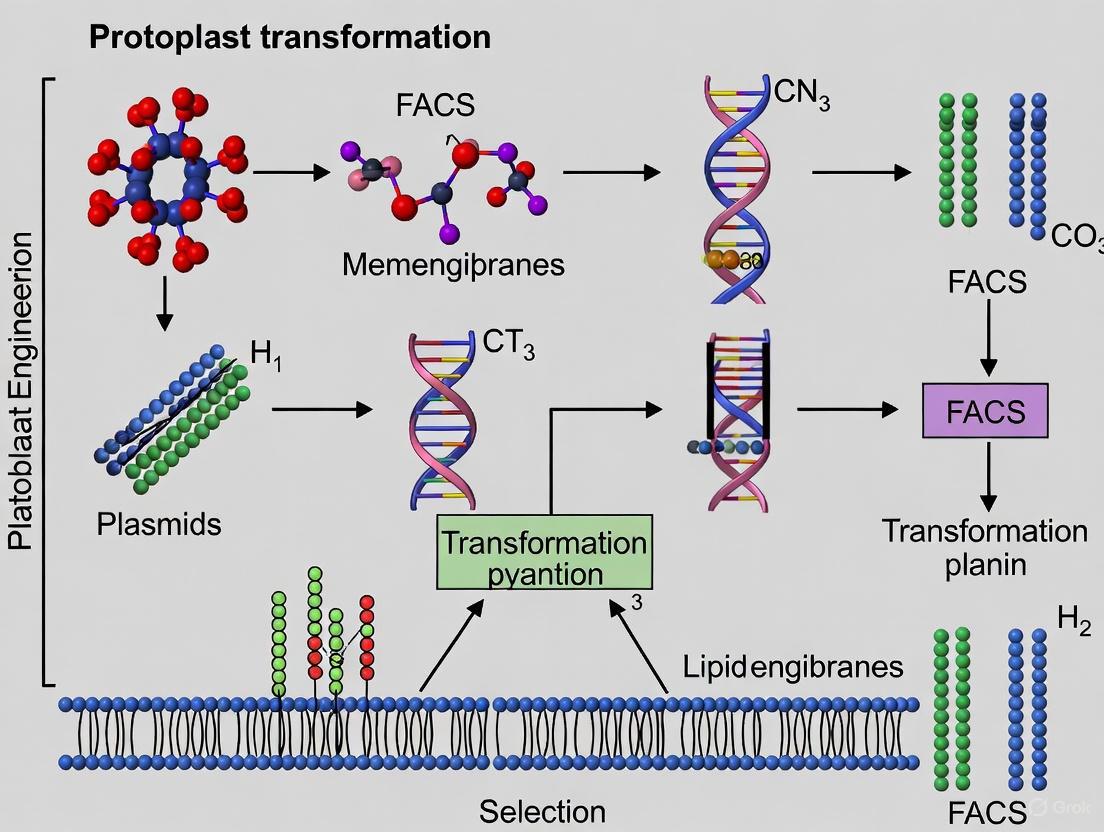
This article details a transformative high-throughput screening platform that integrates plant protoplast transformation with Fluorescence-Activated Cell Sorting (FACS) to accelerate metabolic engineering for lipid production.
High-Throughput Plant Lipid Engineering: A Protoplast Transformation and FACS Screening Platform
Abstract
This article details a transformative high-throughput screening platform that integrates plant protoplast transformation with Fluorescence-Activated Cell Sorting (FACS) to accelerate metabolic engineering for lipid production. It provides a comprehensive resource for researchers and scientists, covering the foundational principles of protoplast biology, step-by-step methodological protocols for transient transformation and sorting, and crucial troubleshooting guides for optimizing viability and efficiency. The content further validates the platform's efficacy through case studies in crops like tobacco and maize, compares it to conventional methods like Agrobacterium-mediated transformation, and discusses its profound implications for developing sustainable bio-based fuels and oleochemicals, with potential cross-over applications in biomedical research.
The Protoplast and FACS Foundation: Principles of Single-Cell Plant Analysis
What Are Plant Protoplasts? Defining a Versatile Experimental System
Protoplasts are living plant cells that have been stripped of their rigid cell walls, resulting in a spherical structure bounded by the plasma membrane and containing all other cellular components [1]. These unique biological entities serve as a fundamental experimental system in plant biotechnology, providing researchers with a versatile tool for investigating gene function, facilitating genetic exchange, and studying cellular processes. The term "protoplast" was first introduced by Hanstein in 1880, with the first isolation achieved by Klercker in 1892 using mechanical methods [1]. However, serious progress in protoplast culture began in the 1960s when Cocking pioneered enzymatic isolation techniques, opening new possibilities for plant cell manipulation [1].
For researchers focused on plant lipid engineering, protoplasts offer an invaluable experimental platform. Their lack of cell walls allows for direct access to the plasma membrane, enabling efficient delivery of genome-editing reagents, transient gene expression studies, and the application of fluorescence-activated cell sorting (FACS) for metabolomic analysis of specific cell types [2]. This combination of accessibility and regenerative capability makes protoplasts particularly suitable for high-throughput screening of engineered lipid pathways and metabolic profiling.
Protoplast Isolation and Culture: Fundamental Methodologies
Isolation Techniques and Optimization
Protoplast isolation primarily employs enzymatic methods, which have largely replaced earlier mechanical approaches due to higher yields and improved cell viability [1]. The enzymatic process typically uses a mixture of cell wall-degrading enzymes, including cellulase, hemicellulase, and pectinase (often commercially available as macerozyme or pectolyase), which work synergistically to digest the complex polysaccharide matrix of the plant cell wall [3] [1].
Two principal enzymatic approaches exist:
- Sequential Method: This two-step process first uses pectinase to separate cells by degrading the middle lamella, followed by cellulase treatment to liberate protoplasts from the remaining cell wall structures.
- Simultaneous Method: This more efficient approach employs a combination of macerozyme and cellulase simultaneously to achieve complete protoplast isolation in a single step [1].
Critical factors influencing isolation success include:
- Source tissue selection: Mesophyll tissues from expanded leaves are generally preferred, though embryos, roots, and callus cultures can also serve as effective sources [1].
- Age of donor material: Tissue ontogeny significantly impacts protoplast yield and viability [4] [5].
- Enzyme solution composition: Optimal concentrations must be determined empirically for each plant species and tissue type [4] [5].
- Duration of enzymolysis: Incubation time must balance complete cell wall digestion against potential damage to protoplast viability [4] [5].
Recent research on Cannabis sativa L. demonstrates the importance of optimizing these parameters, with the highest protoplast yields (2.2 × 10⁶ protoplasts/1 g fresh weight) and viability (78.8%) achieved using specific enzyme combinations and carefully controlled digestion periods [4] [5].
Purification and Viability Assessment
Following isolation, protoplasts undergo purification to remove undigested tissue, cell debris, and damaged protoplasts. This typically involves filtration through mesh sieves (often 40-100 μm) followed by centrifugation using sucrose or Percoll gradients to concentrate intact protoplasts [1].
Viability assessment is crucial before proceeding with experiments. Common methods include:
- Fluorescein diacetate (FDA) staining: Viable cells accumulate fluorescent products through esterase activity.
- Phenosafranine staining: This dye selectively stains non-viable protoplasts.
- Calcofluor white (CFW) staining: Detects cell wall regeneration in cultured protoplasts.
- Oxygen uptake measurement: Assesses metabolic activity.
- Photosynthetic activity measurement: Relevant for chloroplast-containing protoplasts [1].
Table 1: Quantitative Assessment of Protoplast Isolation Efficiency in Recent Studies
| Plant Species | Yield (protoplasts/g FW) | Viability (%) | Cell Wall Re-synthesis (%) | Plating Efficiency (%) | Transfection Efficiency (%) |
|---|---|---|---|---|---|
| Cannabis sativa | 2.2 × 10⁶ | 78.8 | 56.1 | 15.8 | 28 (PEG-mediated) |
| Undaria pinnatifida (seaweed) | 2-4 × 10⁷ | Not specified | Not specified | Higher than previous reports | Not specified |
Culture Media and Regeneration
Protoplast culture requires specialized media formulations that support cell wall regeneration, initial cell divisions, and subsequent callus formation. While MS (Murashige and Skoog) medium is commonly used, modifications are often necessary for optimal growth [1].
Key considerations for protoplast culture media include:
- Reduced ammonium and adjusted micronutrient concentrations
- Elevated calcium levels (2-4 times normal) for membrane stability
- Glucose as carbon source, sometimes combined with sucrose
- Appropriate plant growth regulator balance: High auxin/cytokinin ratios typically induce cell division, while reversed ratios promote organogenesis [1].
- Osmoticum regulation: Maintenance of proper osmotic pressure is critical initially, with gradual reduction during culture.
Protoplasts can be cultured using several methods:
- Agar culture: Bergmann's cell plating technique immobilizes protoplasts in soft agar, facilitating observation of individual cells.
- Liquid culture: The most common approach allows easy manipulation of density and osmotic pressure.
- Feed layer technique: Uses X-irradiated feeder cells to support low-density protoplast cultures.
- Co-culture: Enables culture of morphologically distinct protoplasts from different species.
- Micro-drop culture: Ideal for low-density cultures in specialized dishes [1].
The regeneration pathway typically involves cell wall formation within 24-48 hours, followed by first cell division within 2-7 days, continued divisions forming microcalli, and eventual plant regeneration through organogenesis or somatic embryogenesis [1].
Diagram 1: Protoplast isolation and regeneration workflow. The process begins with tissue selection and proceeds through critical stages including enzymatic isolation, culture, and eventual plant regeneration.
Advanced Applications in Plant Lipid Engineering
Protoplast Transformation and Genome Editing
Protoplasts serve as efficient recipients for genetic transformation through various methods:
Protoplast-mediated transformation enables direct DNA uptake by naked plant cells, primarily for transient expression studies that allow rapid assessment of gene function without genomic integration [6]. The two main delivery approaches are:
- Polyethylene glycol (PEG)-mediated transfection: PEG facilitates membrane permeabilization and DNA uptake, with recent studies achieving 28% transfection efficiency in cannabis protoplasts [4] [5]. Research in the FAST-PB pipeline demonstrated that PEG2050 increased transfection efficiency by over 45% [7] [8].
- Electroporation: Application of electrical pulses creates temporary pores in the plasma membrane for DNA entry [6].
For lipid engineering research, protoplast transformation offers distinct advantages:
- High-throughput screening of lipid-regulating transcription factors and enzymes
- Rapid assessment of CRISPR/Cas9 construct efficiency before stable transformation
- Metabolic engineering of lipid biosynthesis pathways through transient expression
CRISPR/Cas9 applications increasingly leverage protoplast systems for efficient genome editing. The direct delivery of ribonucleoprotein (RNP) complexes to protoplasts enables DNA-free editing, eliminating concerns about transgene integration [4] [5]. This approach is particularly valuable for manipulating lipid biosynthetic pathways, as demonstrated in studies where CRISPR activation of lipid-controlling genes enhanced diverse lipid production by up to 6-fold [7] [8].
Fluorescence-Activated Cell Sorting (FACS) of Protoplasts
The combination of protoplast technology with FACS has revolutionized cell type-specific metabolic analysis in plants. This approach enables researchers to isolate distinct cell populations from complex tissues for subsequent lipid profiling and metabolic engineering [2].
The FACS workflow for protoplasts includes:
- Protoplast isolation from tissues of interest using optimized enzymatic combinations
- Sorting based on fluorescent markers (either endogenous or introduced via transformation)
- Metabolite extraction from sorted populations
- Mass spectrometry analysis (GC-TOF-MS or LC-MS/MS) for lipid profiling [2]
This methodology has been successfully applied to Arabidopsis roots, where specific cell types were isolated using GFP-marked lines followed by GC-TOF-MS analysis, revealing significant differences in metabolite concentrations between cell types [2]. For lipid engineering, this enables precise manipulation of metabolic pathways in specific cell types and assessment of resulting changes to lipid profiles at cellular resolution.
High-Throughput Screening and Automated Platforms
Recent advances have integrated protoplast systems into automated high-throughput pipelines for accelerated plant bioengineering. The FAST-PB (Fast, Automated, Scalable, High-Throughput Pipeline for Plant Bioengineering) platform exemplifies this approach, combining automated biofoundry engineering of protoplasts with single-cell mass spectrometry for enhanced lipid production [7] [8].
Key features of automated protoplast platforms include:
- Parallel processing of 96 vectors simultaneously via Golden Gate cloning
- Automated transformation and regeneration systems
- Integration with MALDI-MS for high-throughput single-cell lipid profiling
- Robotic handling of protoplast cultures reducing variability and increasing reproducibility [7] [8]
These automated systems significantly increase the throughput of synthetic biology, genome editing, and metabolic engineering applications, making comprehensive screening of lipid engineering approaches feasible.
Protoplast Fusion for Somatic Hybridization
Protoplast fusion enables the creation of novel genetic combinations through somatic hybridization, bypassing sexual compatibility barriers. This technique has particular relevance for transferring complex metabolic traits, including lipid biosynthesis pathways, between species [9] [3].
Conventional fusion methods include:
- PEG-induced fusion: Widely used but often characterized by low efficiency and cytotoxicity
- Electrofusion: Provides better control but requires specialized instrumentation and can cause membrane damage [9]
Recent innovations have focused on enhancing fusion efficiency through membrane modification. Studies with Tat peptide-conjugated PEG-lipids demonstrated significantly improved fusion efficiency (9.1%) in rice protoplasts compared to conventional methods [9]. The alkyl chain length of these synthetic modifiers proved critical for optimal membrane insertion and fusion activity, with C12 chains identified as most effective [9].
Table 2: Advanced Protoplast Applications in Biotechnology
| Application | Methodology | Key Outcome | Relevance to Lipid Engineering |
|---|---|---|---|
| Transient Transformation | PEG-mediated or electroporation | 28-45% transfection efficiency | Rapid screening of lipid gene constructs |
| CRISPR Editing | RNP complex delivery | DNA-free mutagenesis | Precise manipulation of lipid pathways |
| FACS Analysis | Cell sorting + GC-TOF-MS | Cell-type specific metabolite profiles | Understanding lipid metabolism at cellular level |
| Automated Screening (FAST-PB) | Biofoundry + MALDI-MS | 6-fold lipid enhancement | High-throughput metabolic engineering |
| Enhanced Protoplast Fusion | Tat-PEG-lipid membrane modification | 9.1% fusion efficiency | Combining lipid traits from different species |
Diagram 2: Protoplast applications in lipid engineering research. The versatile protoplast system enables diverse genetic manipulation and analytical approaches that converge to advance lipid engineering outcomes.
Essential Research Reagents and Solutions
Successful protoplast isolation, culture, and transformation requires carefully formulated reagents and solutions. The following table summarizes key components and their functions based on current protocols:
Table 3: Essential Research Reagents for Protoplast Experiments
| Reagent Category | Specific Examples | Function | Application Notes |
|---|---|---|---|
| Enzyme Solutions | Cellulase Onozuka R-10, Pectolyase Y-23, Macerozyme R-10 | Digest cell wall components | Concentration optimization critical; 0.5-2% typical range [4] [5] |
| Osmotic Stabilizers | Mannitol (0.4-0.6 M), Sucrose, Sorbitol | Maintain osmotic balance, prevent bursting | Essential throughout isolation and early culture stages [4] [5] |
| Membrane Permeabilizers | PEG 4000-6000, PEG2050 | Facilitate DNA uptake during transformation | PEG2050 increased transfection efficiency >45% [7] [8] |
| Culture Media | Modified MS, B5 media | Provide nutrients for cell wall regeneration and division | Reduced ammonium, elevated calcium (2-4×) beneficial [1] |
| Growth Regulators | Auxins (2,4-D, NAA), Cytokinins (BAP, TDZ) | Direct cell division and regeneration pathways | High auxin:cytokinin promotes division; reversed ratio favors organogenesis [4] [5] |
| Viability Stains | Fluorescein diacetate (FDA), Calcofluor white (CFW) | Assess protoplast integrity and viability | FDA labels live cells; CFW detects cell wall regeneration [1] [6] |
| Membrane Modifiers | Tat-PEG-lipids (C12 alkyl chains) | Enhance protoplast fusion efficiency | Improved fusion efficiency to 9.1% in rice protoplasts [9] |
Plant protoplasts represent a versatile and powerful experimental system that continues to evolve through methodological innovations. The integration of advanced techniques such as CRISPR genome editing, FACS-based cell sorting, and automated high-throughput screening has significantly expanded their utility in plant lipid engineering research. Recent developments in protoplast isolation efficiency, transformation protocols, and fusion technologies provide researchers with robust tools for manipulating lipid biosynthetic pathways, analyzing metabolic outcomes at cellular resolution, and accelerating the development of improved plant varieties with enhanced lipid profiles. As these technologies continue to mature, protoplast-based systems will undoubtedly play an increasingly central role in advancing our understanding and manipulation of plant lipid metabolism.
Protoplast totipotency refers to the inherent capacity of a single plant cell, devoid of its cell wall, to regenerate an entire new plant through dedifferentiation, proliferation, and redifferentiation. This principle provides a foundational platform for modern plant bioengineering [10] [11]. In the context of plant lipid engineering research, protoplast systems enable precise manipulation of metabolic pathways in single cells, which can subsequently be regenerated into whole plants with enhanced traits. The isolation of protoplasts creates a unique system for the delivery of biomolecules and genome editing tools, bypassing the species- and genotype-specific limitations often encountered with Agrobacterium-mediated transformation methods, especially in woody plants [12]. When combined with Fluorescence-Activated Cell Sorting (FACS), protoplasts become a powerful tool for isolating specific cell types based on lipid-associated fluorescent markers or for selecting genetically engineered cells from a heterogeneous population, thereby accelerating the development of improved bioenergy crops [13] [2].
The developmental journey from an isolated protoplast to a regenerated plant involves a complex series of molecular reprogramming events. Isolated protoplasts rapidly dedifferentiate, a process accompanied by large-scale chromatin remodeling and major transcriptional changes that reinitiate the cell cycle and activate totipotency [11]. Successful establishment of totipotency requires precise in vitro culture conditions, including optimized plant growth regulators, osmotic stabilizers, and medium formulations, to guide the protoplasts through cell wall regeneration, cell division, callus formation, and ultimately, organogenesis [14].
Key Experimental Workflows
The general workflow for exploiting protoplast totipotency in research, from isolation to the application of regenerated plants, involves several critical stages. The following diagram outlines this overarching process, highlighting how it integrates with analytical techniques like FACS for cell selection.
Molecular Basis of Totipotency Establishment
The re-entry of a differentiated protoplast into the cell cycle and the establishment of totipotency are governed by a precise molecular reprogramming network. This network integrates hormonal signaling, major shifts in metabolism, and epigenetic modifications, as revealed by transcriptome and proteome studies [11].
Application Notes and Protocols
Protocol 1: Protoplast Isolation, Transfection, and Regeneration for Temperate Japonica Rice
This protocol, adapted from a 2025 study, enables efficient protoplast-based regeneration and CRISPR/Cas9 genome editing in temperate japonica rice, a valuable system for introducing traits like drought tolerance [15].
Starting Material:
- Use embryogenic callus induced from mature seeds of cultivars 'Ónix' or 'Platino' on 2N6 medium supplemented with 2,4-D.
- Select friable, pale yellow calli with high cellular density (approx. 500 mg) propagated for two months under long-day conditions (16h light/8h dark) with bi-weekly subcultures [15].
Protoplast Isolation:
- Enzymatic Digestion: Incubate calli in an enzyme solution containing 1.5% (w/v) Cellulase Onozuka R-10 and 0.75% (w/v) Macerozyme R-10 dissolved in 0.6 M mannitol (AA medium).
- Conditions: Digest for 18-20 hours in the dark at 28°C with gentle shaking at 40 rpm. A milky appearance indicates successful digestion.
- Purification: Filter the protoplast suspension through a mesh to remove debris and wash via centrifugation in a suitable buffer (e.g., W5 solution). Protoplast viability should range between 70-99% [15].
Transfection (for Genome Editing):
- Use PEG-mediated transfection. For CRISPR/Cas9, a plasmid encoding the editing machinery or a pre-assembled ribonucleoprotein (RNP) complex targeting a gene of interest (e.g., OsDST for drought tolerance) can be delivered [15].
Regeneration:
- Encapsulation: Embed transfected protoplasts in alginate beads.
- Coculture: Culture the beads in 2N6 medium supplemented with feeder extracts to support embryogenic callus formation, which typically occurs within 35 days.
- Shoot Regeneration: Transfer developed calli to N6R and N6F media to induce shoot formation.
- Acclimatization: Root regenerated seedlings and acclimatize them to greenhouse conditions within three months [15].
Protocol 2: High-Efficiency Protoplast Regeneration forBrassica carinata
This 2025 protocol outlines a highly efficient, five-stage regeneration system for the oilseed crop Brassica carinata, making it ideal for lipid engineering applications [14].
Starting Material:
- Use fully expanded leaves from 3- to 4-week-old sterile seedlings of genotypes like 'Derash' (G3) [14].
Protoplast Isolation:
- Plasmolysis: Slice leaves and incubate in plasmolysis solution (0.4 M mannitol) for 30 minutes.
- Enzymatic Digestion: Incubate leaf pieces in an enzyme solution containing 1.5% (w/v) cellulase Onozuka R-10, 0.6% (w/v) macerozyme R-10, 0.4 M mannitol, 10 mM MES, and 1 mM CaCl₂ (pH 5.7) for 14-16 hours in the dark at room temperature with gentle shaking.
- Purification: Filter, wash, and purify protoplasts using W5 solution and centrifugation [14].
Regeneration (Five-Stage Process):
- MI Medium (Cell Wall Formation): Use a medium with high concentrations of auxins (NAA and 2,4-D).
- MII Medium (Active Cell Division): Use a medium with a lower auxin-to-cytokinin ratio.
- MIII Medium (Callus Growth & Shoot Induction): Use a medium with a high cytokinin-to-auxin ratio.
- MIV Medium (Shoot Regeneration): Use a medium with an even higher cytokinin-to-auxin ratio.
- MV Medium (Shoot Elongation): Use a medium with low levels of BAP and GA₃.
- Maintain appropriate osmotic pressure in the early stages and adhere to specific culture durations on each medium. This protocol can achieve an average regeneration frequency of up to 64% [14].
Protocol 3: FACS for Cell-Type-Specific Metabolite Profiling inArabidopsis
This protocol details the use of FACS to isolate specific protoplast populations for downstream metabolomic analysis, such as profiling lipid compounds in different cell types [2].
Protoplast Isolation from Roots:
- Use the apical third of roots from 10-day-old seedlings of a GFP-expressing line (e.g., J0571 for cortex/endodermis).
- Digest roots in an enzyme solution containing 45 units/mL cellulysin and 0.3 units/mL pectolyase in buffer (600 mM mannitol, 2 mM MgCl₂, 0.1% BSA, 2 mM CaCl₂, 2 mM MES, 10 mM KCl, pH 5.7) for 1.5 hours in the dark at room temperature with gentle shaking [2].
Fluorescence-Activated Cell Sorting (FACS):
- Instrument Setup: Use a FACS sorter (e.g., BD FACSAria). Replace standard sheath fluid with 0.7% NaCl solution to avoid contamination in subsequent mass spectrometry analysis.
- Gating Strategy: Identify GFP-positive (GFP+) and GFP-negative (GFP−) protoplast populations based on forward scatter (FSC), side scatter (SSC), and fluorescence intensity.
- Sorting: Set nozzle aperture to 100 µm and sort protoplasts into collection tubes. A typical yield from line J0571 is approximately 1 million GFP+ and 4-5 million GFP− protoplasts.
- Post-Sort Processing: Centrifuge sorted protoplasts, snap-freeze the pellet in liquid nitrogen, and store at -80°C until metabolite extraction [2].
Metabolite Analysis:
- Perform metabolite extraction using a methanol:chloroform:water mixture and analyze using GC-TOF-MS for untargeted profiling or LC-MS/MS for targeted analysis of lipids and other metabolites [2].
Table 1: Protoplast Isolation and Regeneration Efficiency Across Species
| Plant Species | Starting Tissue | Key Enzymes | Protoplant Viability | Regeneration Efficiency | Key Factors for Success | Primary Application |
|---|---|---|---|---|---|---|
| Temperate Japonica Rice [15] | Embryogenic callus | 1.5% Cellulase R-10, 0.75% Macerozyme R-10 | 70-99% | Not specified | Alginate beads, feeder extract, specific media (2N6, N6R, N6F) | CRISPR/Cas9 genome editing |
| Brassica carinata [14] | Leaf mesophyll | 1.5% Cellulase R-10, 0.6% Macerozyme R-10 | Not specified | Up to 64% | Five-stage media regime, osmotic control, genotype | High-throughput genome editing |
| Banana (Cavendish) [16] | Embryogenic Cell Suspensions (ECS) | Cellulase, Macerozyme, Driselase, Pectinase | Assessed by cytoplasmic streaming | Plant regeneration achieved | Antioxidant mixture (AOM), BSA, conditioned medium | Transient transfection, regeneration |
| Multi-Genotype Poplar [12] | Leaf (in vitro) | 1.5% Cellulase R-10, 0.5% Macerozyme R-10 | 11.28% - 93.87% (Genotype-dependent) | Not specified | Universal enzyme solution, W5 purification, genotype selection | Transient transformation, gene function studies |
| Arabidopsis thaliana [11] | Whole seedlings (aerial parts) | Low concentration cellulase | >90% | ~50% plating efficiency | Liquid PIM medium with 2,4-D and Thidiazuron | Study of totipotency mechanisms |
Table 2: Transfection and Analytical Applications of Protoplast Systems
| Application | Method / Technique | Reported Efficiency / Outcome | Key Reagents / Tools | Reference |
|---|---|---|---|---|
| Transient Transfection | PEG-mediated DNA delivery | ~0.75% (Banana), 40% (B. carinata) with GFP | PEG, GFP reporter plasmid | [16] [14] |
| Genome Editing Validation | PEG-mediated RNP/DNA delivery | Confirmed editing of OsDST gene | CRISPR-Cas9 construct, PEG | [15] |
| Cell-Type Specific Analysis | FACS + GC-TOF-MS | Distinct metabolite profiles in root cell types | GFP marker lines, 0.7% NaCl sheath fluid | [2] |
| High-Throughput Phenotyping | Automated Microscopy + Tracking | Quantified cell expansion and proliferation rates | Multi-well plates, image analysis pipeline | [10] |
| Robotic Automation | Biofoundry (FAST-PB) | Engineered plant cells with higher lipid production | Robotics, single-cell metabolomics | [13] |
The Scientist's Toolkit: Essential Research Reagents and Materials
Table 3: Key Research Reagent Solutions for Protoplast Research
| Reagent / Material | Function / Application | Example Usage & Notes |
|---|---|---|
| Cellulase "Onozuka" R-10 | Degrades cellulose in the plant cell wall. | Standard component of enzymatic mixes across species (e.g., 1.5% for rice, banana, poplar) [15] [16] [12]. |
| Macerozyme R-10 | Degrades pectins and hemicelluloses in the middle lamella. | Used in combination with cellulase (e.g., 0.75% for rice, 0.5-0.6% for B. carinata and poplar) [15] [14] [12]. |
| Mannitol (0.4-0.6 M) | Osmoticum to stabilize protoplasts and prevent bursting. | Maintains osmotic balance in isolation and wash buffers [15] [14]. |
| Polyethylene Glycol (PEG) | Induces membrane fusion and facilitates transfection. | Standard method for transient expression of DNA or RNP complexes [15] [14]. |
| Alginate / Agarose | For immobilizing protoplasts in beads or layers. | Supports structured growth and microcallus development (e.g., rice alginate beads) [15] [10]. |
| W5 Solution | Protoplast wash and purification solution. | Provides ions for membrane stability; used in purification and short-term storage on ice [14] [12]. |
| 2,4-Dichlorophenoxyacetic acid (2,4-D) | Synthetic auxin for inducing and maintaining dedifferentiation. | Critical for initiating cell division in protoplast culture media (e.g., Arabidopsis PIM medium) [11] [14]. |
| Thidiazuron (TZ) | Cytokinin for promoting cell division. | Used in combination with 2,4-D in Arabidopsis liquid protoplast culture [11]. |
| Feeder Layers / Conditioned Medium | Provides unknown growth factors and signaling molecules. | Supports protoplast growth via coculture (rice) or via secretome (banana) [15] [16]. |
| Antioxidant Mixtures (AOM) | Reduces oxidative browning and improves protoplast viability. | Can enhance yield (e.g., threefold increase in banana protoplast yield with AOM and BSA) [16]. |
Fluorescence-Activated Cell Sorting (FACS) represents a powerful technological advancement for plant cell analysis, enabling high-resolution, cell type-specific investigation of gene expression and metabolic processes. This technology is particularly transformative in the context of plant lipid engineering research, where it facilitates the rapid screening of genetic constructs and the isolation of specific protoplast populations based on metabolic traits such as lipid accumulation [17]. Traditional functional genetic studies in crops are time-consuming and cannot be readily scaled, often requiring months to over a year to generate transgenic plants. The integration of protoplast transformation with FACS overcomes this significant bottleneck, creating a versatile high-throughput screening platform that can be applied to almost any crop species [17]. This primer details the practical application of FACS within plant sciences, providing researchers with comprehensive protocols and analytical frameworks to accelerate metabolic engineering pipelines.
Key Principles and Applications in Plant Lipid Engineering
Plant protoplasts, isolated through enzymatic digestion of cell walls, serve as ideal starting material for FACS-based analyses. As single cells, they allow for precise studies that are often challenging in multicellular systems [17]. The application of FACS in plant lipid engineering is multifaceted. It enables the quantitative analysis of lipid accumulation in individual protoplasts transformed with genes involved in lipid biosynthesis [17]. Furthermore, it allows for the physical sorting and collection of protoplast populations based on desired traits, such as high lipid content, for downstream molecular analyses (e.g., RNA sequencing) or for regeneration studies [17] [18].
A significant advantage is the platform's capability for high-throughput screening. Complex genetic libraries can be screened in a single experiment over a matter of days, as opposed to the years required by conventional breeding or stable transformation methods [17]. This is achieved by transiently transforming protoplasts with expression libraries and using fluorescence-based indicators of lipid content to sort millions of cellular variants rapidly [17].
Essential Reagents and Materials
Successful FACS-based plant protoplast analysis requires a suite of specialized reagents. The table below catalogues the essential materials and their functions.
Table 1: Research Reagent Solutions for Plant Protoplast Isolation and FACS
| Reagent/Material | Function/Application |
|---|---|
| Cellulase & Macerozyme | Enzymatic digestion of cellulose and pectin in plant cell walls to release protoplasts [18]. |
| Osmoticum (e.g., D-mannitol) | Maintains osmotic pressure to prevent protoplast rupture during and after isolation [18]. |
| Buffer Components (MES, KCl, CaCl₂) | Stabilizes pH and provides essential ions for protoplast membrane integrity and health [18]. |
| Polyethylene Glycol (PEG) | Mediates transfection of DNA constructs into protoplasts for transient expression studies [19]. |
| Fluorescent Reporter Plasmids | Serve as visual markers for transformation efficiency (e.g., DsRED [19]) or as biosensors for metabolic traits. |
| RNA Extraction Buffer (in collection tubes) | Preserves RNA integrity immediately after sorting for subsequent transcriptomic analysis [18]. |
Detailed Experimental Protocols
Protoplast Isolation from Plant Seedlings
This protocol is adapted from established methods for Arabidopsis thaliana roots [18] and can be modified for other tissues and species.
- Plant Material Preparation: Grow thousands of seedlings hydroponically or on agar plates to obtain sufficient root material. The use of a nylon filter mesh aids in efficient harvesting [18].
- Preparation of Protoplasting Solution:
- Dissolve 1.25% (w/v) Cellulase, 0.3% (w/v) Macerozyme, 0.4 M D-mannitol, 20 mM MES, and 20 mM KCl in demineralized water.
- Adjust pH to 5.7 with 1 M Tris/HCl.
- Heat the solution to 55°C for 10 minutes, then cool to room temperature.
- Add 0.1% (w/v) BSA, 10 mM CaCl₂, and 5 mM β-mercaptoethanol [18].
- Harvesting and Digestion:
- Harvest roots by scraping them from the mesh and transfer to the protoplasting solution (∼10 ml per 1,500 seedlings).
- Incubate with gentle shaking (75 rpm) at room temperature for 1 hour [18].
- Protoplast Purification:
- Filter the protoplast suspension through a 40 μm cell strainer to remove undigested debris.
- Centrifuge filtrate at 500 G for 10 minutes in a swing-bucket centrifuge.
- Remove supernatant and resuspend the protoplast pellet in an appropriate incubation solution (e.g., W5 buffer or protoplasting solution without enzymes) [18].
- Use a hemacytometer to determine protoplast density and adjust as necessary for FACS.
Protoplast Transformation for Lipid Engineering
For lipid engineering applications, protoplasts are transformed with genetic constructs prior to sorting. The following is an efficient PEG-mediated method, as demonstrated in oil palm [19].
- Transformation Setup: Isolate mesophyll protoplasts and purify as described above.
- DNA Incubation: Incubate protoplasts with 50 µg of plasmid DNA for 10 minutes.
- PEG Treatment: Add 35% PEG solution to the protoplast-DNA mixture and incubate for 5 minutes.
- Heat Shock: Subject the protoplasts to a heat-shock treatment at 42°C for 90 seconds.
- Recovery: Wash the protoplasts to remove PEG and allow for transgene expression for up to 72 hours before FACS analysis [19].
FACS of Plant Protoplasts
The following protocol details the instrument setup and sorting process for collecting specific protoplast populations.
- Instrument Setup:
- Use a 100 μm nozzle and a sheath pressure of 20 psi.
- Enable sample agitation to prevent protoplast sedimentation.
- Configure the machine to measure Forward Scatter (FSC), Side Scatter (SSC), and fluorescence emissions (e.g., 530/30 nm for GFP, 610/20 nm for red autofluorescence) using a 488 nm laser [18].
- Gating Strategy:
- Create a dot plot of FSC vs. SSC. Set a forward scatter cutoff to exclude small debris [18].
- Create a dot plot of green fluorescence vs. red fluorescence. Use a wild-type (non-fluorescent) protoplast sample to establish the baseline diagonal population.
- Adjust voltage and compensation settings to clearly resolve the fluorescent-positive population. For example, one study used the following voltages: FSC 60V, SSC 250V, GFP 350V, and Red Spectrum Autofluorescence 335V, with a compensation of -17.91% of GFP into the RSA channel [18].
- Define a gate around the fluorescent-positive protoplast population (e.g., high lipid content indicated by a fluorescent dye) [17].
- Cell Sorting:
- Set the FACS precision mode for optimal yield or purity, depending on the experimental goal and the abundance of the target cell type.
- Sort protoplasts directly into collection tubes containing RNA extraction buffer (for transcriptomics) or culture medium. As few as 500 sorted events have been used successfully for microarray analysis [18].
Data Analysis and Interpretation
Flow cytometry data is typically presented in histogram or scatter plot formats, each providing distinct information [20].
- Histograms are used for single-parameter data, such as fluorescence intensity. A shift in the peak to the right indicates higher fluorescence, correlating with greater expression of a fluorescent protein or higher accumulation of a metabolite like lipid [20].
- Scatter Plots are essential for multiparameter analysis. The FSC vs. SSC plot is used to gate on intact protoplasts and exclude debris. Fluorescence vs. FSC or SSC plots are then used to identify and quantify the target population [20] [18].
Table 2: Key FACS Parameters and Their Significance in Plant Protoplast Analysis
| Parameter | What It Measures | Interpretation in Plant Protoplasts |
|---|---|---|
| Forward Scatter (FSC) | Cell size | Used to distinguish intact protoplasts from smaller debris [18]. |
| Side Scatter (SSC) | Cell granularity/internal complexity | Can indicate the presence of organelles; chloroplasts contribute significantly to SSC in mesophyll protoplasts. |
| Green Fluorescence (e.g., 530/30 nm) | GFP or FITC signal | Indicates expression of a GFP-tagged transgene or successful transformation [18]. |
| Red Autofluorescence (e.g., 610/20 nm) | Chlorophyll fluorescence | A natural property of photosynthetic protoplasts; used for compensation and to distinguish cell types [18]. |
Workflow and Pathway Visualization
Experimental Workflow for FACS-Based Screening
The following diagram illustrates the complete workflow from plant material to sorted protoplasts for lipid engineering applications.
Regulatory Pathway for Lipid Accumulation
Understanding the genetic regulators of lipid biosynthesis is central to engineering strategies. The diagram below summarizes key transcription factors.
Troubleshooting and Best Practices
- Low Transformation Efficiency: Ensure PEG concentration and incubation times are optimized for your specific protoplast system. A recent study on oil palm achieved 56% efficiency using 35% PEG for 5 minutes [19].
- Poor Protoplast Yield or Viability: Optimize enzyme concentrations and digestion time. Avoid over-digestion, which can damage protoplasts and affect gene expression profiles [18].
- Clogging During FACS: Dilute the protoplast suspension, re-filter through a 40 μm strainer, or perform a sample-line backflush on the sorter [18].
- High Background Fluorescence: Always include a negative control (wild-type or empty vector transformed protoplasts) to accurately set fluorescence gates and compensation [20] [18].
- RNA Degradation in Sorted Samples: Sort protoplasts directly into RNA stabilization buffer and store samples immediately at -80°C [18].
Application in Crop Engineering
The integration of protoplast transformation and FACS provides a robust platform for accelerating crop improvement. This system is highly valuable for functional gene validation, allowing researchers to quickly test the effect of genes involved in lipid biosynthesis before committing to lengthy stable transformation processes [17]. It enables promoter characterization, as demonstrated in oil palm, where the CaMV35S promoter was identified as the most efficient for transgene expression in mesophyll protoplasts [19]. Furthermore, the platform's scalability supports complex genetic screens, making it possible to identify novel genetic components that enhance valuable traits like lipid accumulation from large expression libraries in a matter of days [17]. This high-throughput capability is a significant step toward developing new crop varieties tailored for sustainable bio-based economies.
Why Protoplasts and FACS? Overcoming Bottlenecks in Traditional Plant Breeding
Traditional plant breeding methods, which rely on controlled pollination and cross-breeding, are often restrictive due to the inability to transfer traits between sexually incompatible plants and the challenge of improving polygenic traits [3]. Modern breeding technologies, spearheaded by genome editing, have revolutionized the field. However, the delivery of gene-editing tools to the host genome and the subsequent recovery of successfully edited plants form significant bottlenecks in their application [21]. Moreover, conventional methods to test gene functions in crops are time-consuming, often requiring several months to over a year to generate desired mutants or transgenic plants, creating a significant hurdle for complex metabolic engineering [17].
Protoplasts (plant cells with their walls removed) and Fluorescence-Activated Cell Sorting (FACS) present a powerful combined technology platform to overcome these obstacles. This approach enables rapid, high-throughput screening and allows for DNA-free genome editing, thereby accelerating both basic research and crop improvement [17] [22].
The Strategic Advantages of the Protoplast-FACS Platform
Key Benefits of Protoplasts in New Plant Breeding Technologies (NPBTs)
Protoplasts serve as an ideal single-cell system for biotechnology applications due to several unique advantages [21] [3]:
- DNA-free Genome Editing: Transient transformation of protoplasts using CRISPR/Cas9 ribonucleoprotein (RNP) complexes enables precise genetic modifications without integrating foreign DNA into the host genome. This circumvents transgenesis and associated regulatory hurdles [21] [22].
- Bypassing Species Barriers: In many plant species, particularly monocots, susceptibility to Agrobacterium transformation is a major limitation. Protoplast transformation via polyethylene glycol (PEG) or electroporation provides a universal and host-pathogen-independent delivery method [21].
- Elimination of Chimerism: Plants regenerated from protoplasts are derived from a single cell. This avoids the issue of chimerism, where only parts of a regenerated plant are edited, a common problem in conventional tissue culture where de novo shoots can form from a group of cells [21].
- High-Throughput Potential: A single protoplast preparation can yield millions of cells, enabling the testing of numerous genetic constructs or the screening of vast cellular populations in one experiment [17].
The Power of Fluorescence-Activated Cell Sorting (FACS)
Flow cytometers can analyze a vast range of cell parameters at high speed. When coupled with protoplasts, this technology unlocks powerful applications [23] [17]:
- High-Throughput Phenotypic Screening: FACS can be used to screen millions of protoplasts in a matter of hours based on fluorescent markers linked to desired traits, such as lipid accumulation [17]. This allows for the direct screening of complex genetic libraries in a single experiment.
- Multiparameter Analysis: Modern spectral flow cytometers, like the BD FACSDiscover A8, can track 20 or more fluorescent markers simultaneously. This exponentially increases the amount of data that can be collected from a single experiment, allowing researchers to study complex metabolic pathways and cell states [24].
- Isolation of Specific Cell Types: FACS enables the sorting of specific protoplast populations based on size, complexity, or fluorescence for downstream culture, 'omics' analysis, or regeneration of uniformly edited plants [17].
Table 1: Quantitative Performance of Protoplast Systems in Various Crops
| Crop Species | Protoplast Yield (per gram FW) | Viability (%) | Transfection Efficiency (%) | Regeneration Frequency (%) | Key Application | Citation |
|---|---|---|---|---|---|---|
| Brassica carinata | 400,000-600,000 cells/ml | N/R | 40 (GFP) | Up to 64 | CRISPR genome editing | [14] |
| Cannabis sativa L. | 2.2 x 10⁶ | 78.8 | 28 | Microcalli formation | Transfection & culture | [4] |
| Cichorium spp. (Chicory) | N/R | N/R | High (PEG) | High efficiency | DNA-free genome editing | [22] |
| Rapeseed (B. napus) | N/R | N/R | N/R | Up to 45 (shoot) | Editing of GTR genes | [25] |
Application Notes for Plant Lipid Engineering
The combination of protoplasts and FACS is particularly transformative for plant lipid engineering. The "Leaf Oil" platform technology, which aims to engineer vegetative tissues to accumulate high levels of triacylglycerol, was rapidly developed using transient expression systems [17].
In a landmark study, tobacco protoplasts were transiently transformed with genes involved in lipid biosynthesis and subsequently sorted based on their lipid content using FACS. This established protoplasts as a predictive tool for plant lipid engineering. The platform was used to demonstrate the major role of the transcription factor ABI3 in plant lipid accumulation [17]. This workflow enables the screening of complex genetic libraries for enhanced lipid traits in a matter of days, as opposed to the years required by conventional breeding or stable transformation.
Experimental Protocols
Detailed Protocol: Protoplast Isolation, Transfection, and Regeneration
The following protocol synthesizes optimized methods from recent studies on Brassica carinata [14] and rapeseed [25], which are directly applicable to oilseed engineering.
Plant Material and Protoplast Isolation
- Seed Germination: Surface-sterilize seeds and germinate them on half-strength Murashige and Skoog (MS) medium supplemented with 10 g L⁻¹ sucrose and 7 g L⁻¹ Bacto agar. Maintain cultures at 25°C/18°C (day/night) with a 16-hour photoperiod [14] [25].
- Source Tissue: Harvest fully expanded young leaves from 3- to 4-week-old seedlings. The age and health of the donor plant are critical for high yield and viability [4] [25].
- Plasmolysis: Finely slice leaves on a damp surface and incubate in plasmolysis solution (0.4 M mannitol, pH 5.7) for 30 minutes in the dark at room temperature (RT) [25].
- Enzymatic Digestion: Transfer leaf pieces to an enzyme solution. A typical optimized solution contains 1.5% (w/v) cellulase Onozuka R-10, 0.6% (w/v) macerozyme R-10, 0.4 M mannitol, 10 mM MES, 0.1% (w/v) BSA, 1 mM CaCl₂, and 1 mM β-mercaptoethanol (pH 5.7). Incubate for 14-16 hours at RT in the dark with gentle shaking [14] [25].
- Purification: Filter the digested mixture through a 40-100 μm nylon mesh. Centrifuge the filtrate at 100 g for 10 minutes. Wash the pellet by resuspending in W5 solution (154 mM NaCl, 125 mM CaCl₂, 5 mM KCl, 5 mM glucose, pH 5.7) and centrifuging. Resuspend the final pellet in W5 solution and keep on ice for 30 minutes [14] [4] [25].
Transfection via PEG-Mediated Transformation
- Density Adjustment: Count protoplasts using a hemocytometer and adjust the density to 400,000-600,000 cells per mL using a 0.5 M mannitol solution [25].
- Transfection Mixture: Incubate protoplasts with the desired genetic material (e.g., plasmid DNA, mRNA, or RNP complexes for CRISPR editing). Add an equal volume of 40% PEG solution (PEG 4000, 0.2 M mannitol, 0.1 M CaCl₂) to the protoplast mixture and mix gently. Incubate for 15-30 minutes at RT [22] [25].
- Washing: Dilute the mixture stepwise with W5 solution and collect the transfected protoplasts by centrifugation at 100 g for 5 minutes [25].
Protoplast Regeneration – A Multi-Stage Process
Successful regeneration requires a carefully orchestrated sequence of media with specific plant growth regulators (PGRs). The following five-stage protocol for Brassica carinata has achieved up to 64% regeneration frequency [14]:
Table 2: Multi-Stage Media Formulation for Protoplast Regeneration
| Stage | Medium Name | Objective | Critical PGR Composition | Culture Duration |
|---|---|---|---|---|
| Stage 1 | MI | Cell wall formation | High auxins: 0.5 mg L⁻¹ NAA, 0.5 mg L⁻¹ 2,4-D | 7-10 days |
| Stage 2 | MII | Active cell division | Lower auxin-to-cytokinin ratio | 10-14 days |
| Stage 3 | MIII | Callus growth & shoot induction | High cytokinin-to-auxin ratio | 14-21 days |
| Stage 4 | MIV | Shoot regeneration | Very high cytokinin-to-auxin ratio (e.g., 2.2 mg L⁻¹ TDZ + 0.5 mg L⁻¹ NAA) | Until shoot formation |
| Stage 5 | MV | Shoot elongation | Low levels of BAP and GA₃ | Until shoots are >2 cm |
Protocol: High-Throughput Screening via FACS
- Staining (for Lipid Screening): Transfected protoplasts can be stained with fluorescent dyes that bind to neutral lipids, such as Nile Red or BODIPY, to enable sorting based on lipid content [17].
- Instrument Setup: Calibrate the flow cytometer using control (untransfected and unstained) protoplasts. Set parameters for forward scatter (FSC, cell size), side scatter (SSC, internal complexity), and relevant fluorescence channels.
- Sorting: Define a sorting gate based on the fluorescence intensity of the desired trait. Sort the protoplast population with the highest fluorescence (e.g., top 1-5%) into a collection tube containing culture medium.
- Culture and Regeneration: Plate the sorted, high-performing protoplasts using the alginate disk embedding method [25] and initiate the multi-stage regeneration protocol to recover whole plants.
The Scientist's Toolkit: Essential Research Reagents
Table 3: Key Research Reagent Solutions for Protoplast and FACS Workflows
| Reagent / Material | Function / Application | Example Specifications / Notes |
|---|---|---|
| Cellulase "Onozuka" R-10 | Enzymatic cell wall digestion | Critical for high-yield protoplast isolation; often used at 1.5% (w/v) [14] [25] |
| Macerozyme R-10 / Pectolyase Y-23 | Pectin degradation | Breaks down the middle lamella; concentration optimization is key [4] [25] |
| Polyethylene Glycol (PEG) | Facilitates transfection | Promotes membrane fusion and uptake of DNA/RNP; typically PEG 4000 at 40% [22] [25] |
| Fluorescent Lipophilic Dyes (e.g., Nile Red) | Staining neutral lipids | Enables FACS-based screening for lipid accumulation phenotypes [17] |
| Sodium Alginate | Protoplast embedding | Used for alginate disk culture, providing structural support to fragile protoplasts [25] |
| Plant Growth Regulators (PGRs) | Directing regeneration | Specific combinations of auxins (e.g., 2,4-D, NAA) and cytokinins (e.g., BAP, TDZ) are crucial for each regeneration stage [14] |
| Ribonucleoprotein (RNP) Complexes | DNA-free genome editing | Preassembled complexes of Cas9 protein and guide RNA for transient CRISPR editing [21] [22] |
Workflow and Signaling Pathway Diagrams
Integrated Protoplast-to-Plant Workflow
Signaling Pathway for Lipid Accumulation in Engineered Protoplasts
Plant protoplasts, isolated cells devoid of cell walls, serve as a versatile experimental system for plant cell engineering. Their unique accessibility for transfection, transformation, and membrane manipulation makes them an indispensable tool for dissecting complex cellular processes. Within the broader context of a thesis on protoplast transformation and Fluorescence-Activated Cell Sorting (FACS), this document details standardized application notes and protocols. These methods are specifically designed for researchers and scientists to investigate lipid metabolism, stress responses, and protein signaling at a single-cell resolution, thereby accelerating drug development and plant lipid engineering research.
Application Note 1: Investigating Lipid Metabolism and Signaling
Background and Objective
Lipids function as essential structural components of membranes, energy reserves, and signaling molecules in plant cells. The objective of this application is to utilize protoplasts for studying the dynamics of lipid metabolism and lipid-mediated signaling pathways, which are crucial for plant development and environmental adaptation.
Key Experimental Findings
Protoplast-based systems have been instrumental in identifying key genes and proteins involved in lipid biosynthesis and function during critical developmental processes such as pollen germination and pollen tube elongation.
- Table: Key Lipid-Related Genes and Functions in Plant Reproduction
Gene / Protein Gene Family Function in Lipid Metabolism Organism Reference OeFAD2-3 / OeFAD3B Fatty acid desaturase Increase in linoleic and alpha-linolenic acids Olive [26] AtDGAT1 Diacylglycerol acyltransferase Promotes Triacylglycerol (TAG) accumulation Arabidopsis [26] AtKCS4 3-ketoacyl-CoA synthase Production of very-long-chain FAs; disruption impairs pollen tube elongation Arabidopsis [26] ZmMs25 Fatty acyl reductase Defective anther cuticles and pollen exine formation; male sterility Maize [26] AtACBP3 Acyl-CoA-binding protein Maintenance of acyl-lipid homeostasis Arabidopsis [26]
Recent research using stable isotope labeling with 18O-water in oilseeds like camelina and rapeseed has revealed that fatty acid catabolism (β-oxidation) occurs concurrently with biosynthesis during active oil synthesis, a finding that upends traditional models [27]. This simultaneous anabolism and catabolism must be considered when engineering high-oil plants.
Detailed Protocol: Transient Transformation for Lipid Pathway Analysis
Workflow: Protoplast Isolation → Transient Transformation → Metabolite/Lipidomic Analysis → FACS.
Protoplast Isolation:
- Source Material: Use 1–2-week-old leaves from in vitro-grown plants or etiolated hypocotyls for optimal yield and viability [28].
- Enzymatic Digestion: Incise tissue and immerse in an enzyme solution (e.g., 1.5% cellulase R10, 0.4% macerozyme R10, 0.4 M mannitol, 10 mM CaCl₂, 20 mM MES, pH 5.8).
- Incubation: Digest in darkness for 3-4 hours with gentle agitation.
- Purification: Filter the mixture through a 40-75 μm nylon mesh. Pellet protoplasts by centrifugation at 100 × g for 6 minutes and resuspend in an appropriate culture medium (e.g., 0.32% B-5 medium, 0.25 M mannitol, 4 mM MES, pH 5.8) [29].
Transient Transformation:
- DNA/Construct Preparation: Prepare plasmid DNA carrying genes of interest (e.g., lipid biosynthetic enzymes, fluorescent reporters).
- Transfection: Use Polyethylene Glycol (PEG)-mediated transformation or electroporation to introduce DNA. For example, a transformation efficiency of up to 75.4% has been reported in cannabis protoplasts using GFP-tagged constructs [28].
- Incubation: Incubate transformed protoplasts for 12-48 hours to allow for transient gene expression.
Lipidomic and Metabolite Analysis:
- Lipid Extraction: Use multi-dimensional liquid chromatography-mass spectrometry (LC-MS) for high-throughput lipid analysis [26].
- Spatial Imaging: Apply matrix-assisted laser desorption/ionization mass spectrometry imaging (MALDI-MSI) to locate different lipids at the tissue or single-cell level [26].
FACS Analysis:
- Staining: Use fluorescent dyes (e.g., Nile Red for neutral lipids) or rely on expressed fluorescent protein tags (e.g., GFP fused to a lipid-binding domain).
- Sorting and Analysis: Employ FACS to isolate protoplasts based on fluorescence intensity, enabling the analysis of distinct cellular populations with altered lipid profiles.
Reagent Solutions
- Cellulase R10 & Macerozyme R10: Essential enzymes for cell wall digestion.
- Mannitol: Provides osmotic support to maintain protoplast integrity.
- PEG 4000: A fusogen and transformation agent for introducing DNA.
- Nile Red: A lipophilic dye for staining intracellular lipid droplets.
Application Note 2: Quantifying Stress Responses via Microfluidic Flow Cytometry
Background and Objective
Abiotic and biotic stresses trigger rapid physiological changes in plants, including the accumulation of Reactive Oxygen Species (ROS). This application note describes a protocol using microfluidic flow cytometry for the quantitative, single-cell analysis of stress responses in protoplasts.
Key Experimental Findings
Microfluidic flow cytometry allows for high-throughput, quantitative assessment of intracellular ROS dynamics in response to various stressors.
- Table: Stressor-Induced ROS Accumulation in Arabidopsis Protoplasts
Stressor Treatment Observation in Protoplasts Key Finding H₂O₂ Quantitative increase in ROS accumulation Validates system sensitivity to oxidative stress [29] Cadmium Ions Induced oxidative burst Models heavy metal toxicity [29] UV Light Induced oxidative burst; stronger in white vs. purple Petunia Demonstrates photoprotective role of anthocyanins [29] Temperature Shock Altered ROS homeostasis Assesses response to thermal stress [29]
Detailed Protocol: Single-Cell ROS Dynamics Analysis
Workflow: Protoplast Isolation → Stress Application → Fluorescent Staining → Microfluidic Flow Cytometry.
Protoplast Isolation: Follow the protocol in Section 2.3.
Stress Application:
- Aliquot protoplasts and treat with stressors: H₂O₂ (0.1-1 mM), Cadmium Chloride (10-100 µM), or UV-A/UV-B irradiation for a defined duration.
- Include an untreated control for baseline measurement.
Fluorescent Staining for ROS:
- Dye Loading: Incubate protoplasts with 10 µM dichlorodihydrofluorescein diacetate (DCFH-DA) in the dark for 20-30 minutes. DCFH-DA is cell-permeable and is oxidized by ROS to the fluorescent DCF.
- Washing: Centrifuge and resuspend protoplasts in fresh culture medium to remove excess dye.
Microfluidic Flow Cytometry:
- Device: Use a Poly(dimethyl-siloxane) (PDMS) microfluidic device fabricated via soft lithography, with a channel height of 60 µm and width of 40 µm [29].
- Optical Setup: Set up on an inverted microscope with 488-nm laser excitation for DCF fluorescence. Collect emission light using a photomultiplier tube (PMT).
- Data Acquisition: Measure the real-time fluorescence output of single protoplasts as they pass through the detection zone. Data is recorded as Relative Fluorescence Units (RFU).
The following workflow diagram illustrates the key steps of this protocol for analyzing stress responses in protoplasts.
Reagent Solutions
- DCFH-DA: A ROS-sensitive fluorescent biosensor.
- H₂O₂, Cadmium Chloride: Standard stressors for inducing oxidative stress.
- PDMS (Poly(dimethyl-siloxane)): The material used to fabricate the microfluidic chip.
- Mb01 Buffer / W5 Solution: Used for nuclei isolation and protoplast purification.
Application Note 3: Analyzing Protein Signaling and Phosphorylation
Background and Objective
Protein phosphorylation is a central mechanism in cellular signaling. Phospho-specific flow cytometry (phospho flow) enables multiplexed analysis of kinase signaling pathways in single cells. This protocol adapts phospho flow for use in plant protoplast systems to study signaling dynamics.
Key Experimental Findings
Phospho flow allows for the simultaneous measurement of multiple phosphorylation events in heterogeneous cell populations, providing a systems-level view of signaling network activation.
Detailed Protocol: Phospho-Specific Flow Cytometry
Workflow: Stimulation → Fixation → Permeabilization → Staining → FACS Acquisition → Analysis.
Stimulation: Treat protoplasts with signaling agonists (e.g., hormones, pathogens, or light) for a defined time (e.g., 5-15 minutes) to activate specific pathways.
Fixation: Rapidly add formaldehyde (final concentration ~1.5%) directly to the culture to cross-link proteins and "freeze" phosphorylation states instantly. Incubate at room temperature for 10 minutes [30].
Permeabilization:
- Pellet cells by centrifugation (500 × g, 5 min).
- Resuspend the pellet in residual medium by vortexing.
- Add ice-cold 100% methanol drop-wise while vortexing to a final concentration of 90% methanol. This step permeabilizes the cells and allows intracellular antibody access. Incubate on ice for at least 15 minutes [30].
Staining:
- Wash cells with staining medium (PBS with 0.5% BSA).
- Resuspend the cell pellet in staining medium containing titrated, fluorophore-conjugated phospho-specific antibodies (e.g., anti-pStat, anti-pMAPK) and surface marker antibodies if needed. Incubate for 30-60 minutes in the dark [30].
FACS Acquisition and Analysis:
- Acquire cells on a flow cytometer equipped with appropriate lasers.
- Analyze data by gating on the protoplast population and comparing the median fluorescence intensity (MFI) of phospho-antibody staining between stimulated and unstimulated controls. Calculate fold-change to quantify pathway activation [30].
The following diagram outlines the core steps of the phospho-flow cytometry protocol, highlighting the critical stages that preserve phosphorylation states for accurate analysis.
Reagent Solutions
- Formaldehyde (16%): Cross-linking fixative for preserving intracellular phosphorylation.
- Methanol (100%): Denaturing permeabilization reagent, essential for staining transcription factors like STATs.
- Phospho-Specific Antibodies: Antibodies that bind only to the phosphorylated form of the target protein (e.g., pStat1, pStat3, pStat6).
- Staining Medium (PBS/0.5% BSA): Provides an isotonic environment for antibody staining.
The Scientist's Toolkit: Essential Research Reagents
The following table compiles key reagents and their functions for the experiments described in these application notes.
- Table: Essential Research Reagents for Protoplast-Based Studies
Reagent Name Function / Application Example Use Case Cellulase R10 / Macerozyme R10 Enzymatic digestion of plant cell walls Protoplast isolation from leaf tissue [28] [29] DCFH-DA Fluorescent probe for detecting intracellular ROS Quantifying oxidative stress responses [29] Tat-PEG-Lipid (C12) Synthetic fusogen for enhancing membrane fusion Promoting protoplast fusion for somatic hybridization [31] [9] Formaldehyde Cross-linking fixative Preserving protein phosphorylation states in phospho-flow [30] Methanol Denaturing permeabilization agent Enabling intracellular antibody access for phospho-flow [30] Mannitol / Sorbitol Osmoticum Maintaining osmotic balance in protoplast culture media [28] [29] PEG 4000 Polymer for inducing protoplast fusion or DNA transfection Transient transformation of protoplasts [28] Propidium Iodide (PI) DNA intercalating dye / viability stain Assessing protoplast viability and genome size estimation [32] Fluorophore-Conjugated Phospho-Specific Antibodies Detection of phosphorylated signaling proteins Multiplexed analysis of kinase pathways via phospho-flow [30]
The integrated use of protoplast isolation, transient transformation, and advanced cytometry techniques provides a powerful platform for plant lipid engineering. The protocols detailed herein for studying lipid metabolism, stress responses, and protein signaling enable precise, high-throughput analysis at the single-cell level. This approach facilitates a deeper understanding of plant cellular physiology and accelerates the development of engineered plants with enhanced traits for food security, sustainable energy, and pharmaceutical applications.
Building the Pipeline: Protocols for Protoplast Transformation and High-Throughput Screening
Protoplasts, plant cells devoid of cell walls, serve as a versatile tool in plant biotechnology, enabling critical applications from transient gene expression and genome editing to somatic hybridization. Within the specific context of plant lipid engineering research, protoplast systems offer a unique single-cell platform for the rapid validation of genetic constructs designed to manipulate lipid pathways. Their compatibility with Flow-Activated Cell Sorting (FACS) allows for the high-throughput selection of engineered cells based on fluorescent markers or intrinsic lipid profiles, significantly accelerating the screening process. This protocol details efficient, standardized methods for protoplast isolation from two common source tissues—leaves and callus—providing a foundational technique for researchers aiming to leverage protoplasts in metabolic engineering.
Materials and Reagent Solutions
Research Reagent Solutions
The following table catalogues the essential solutions and reagents required for successful protoplast isolation, purification, and culture.
Table 1: Key Research Reagent Solutions for Protoplast Isolation and Culture
| Reagent/Solution Name | Key Components | Primary Function in Protocol |
|---|---|---|
| Plasmolysis Solution (e.g., PSII) | 0.5 M Mannitol [5] [4] | Pre-treatment to contract the protoplast away from the cell wall, reducing rupture during enzymatic digestion. |
| Enzyme Solutions | Cellulase Onozuka R-10 (0.5%-2.5%), Pectolyase Y-23 (0.05%-0.1%) or Macerozyme R-10, Osmoticum (e.g., 0.4-0.55 M Mannitol), MES buffer, Calcium/Magnesium salts [5] [4] [14] | Enzymatic degradation of cellulose (cellulase) and pectin (pectolyase/macerozyme) in the plant cell wall to release protoplasts. |
| Wash Solution (e.g., W5) | 154 mM NaCl, 125 mM CaCl₂, 5 mM KCl, 2 mM MES [14] [33] | Washing and purifying isolated protoplasts; the calcium helps stabilize the fragile protoplast membranes. |
| Protoplast Culture Medium | Basal salts and vitamins (e.g., MS), Plant Growth Regulators (e.g., Auxins, Cytokinins), Osmoticum (e.g., 0.4 M Mannitol), Sucrose [5] [4] [14] | Supports protoplast viability, cell wall re-synthesis, and subsequent cell division in a sustained osmotic environment. |
| Embedding Matrix (e.g., Alginate) | 2.8% Sodium Alginate, 0.4 M Mannitol [14] | Immobilizes protoplasts in a semi-solid matrix, which can improve plating efficiency and microcallus formation. |
| Transfection/PEG Solution | Polyethylene Glycol (PEG, e.g., PEG 4000 or PEG 2050), MgCl₂ [34] [33] | Mediates the transient transfection of DNA or RNPs into protoplasts for functional genomics or genome editing. |
Methodologies
Workflow for Protoplast Isolation and Culture
The following diagram illustrates the comprehensive workflow from plant material preparation to the generation of stably engineered plants, highlighting the key steps for lipid engineering applications.
Detailed Protocol for Protoplast Isolation
Plant Material Preparation
- Seeds Sterilization: Surface-sterilize seeds using a sequence of treatments. A typical protocol involves a distilled water bath at 40°C for 30 minutes, followed by immersion in a 0.2% (v/v) fungicide solution on a shaker for 30 minutes, and then treatment with a 20% (w/v) chloramin T solution for 30 minutes. Rinse with 70% ethanol for 30 seconds between each step and perform three final washes with sterile distilled water [5] [4].
- In Vitro Germination and Growth: Place sterilized seeds on solid germination medium (e.g., MS30: MS salts and vitamins, 30 g L⁻¹ sucrose, 0.6% plant agar, pH 5.8). Maintain cultures at 24 ± 2°C with an 18/6 h (light/dark) photoperiod [5] [4]. The age of the donor plant is critical; for cannabis, 15-day-old leaves are optimal [5] [4], while for Brassica carinata, 3-4 week-old leaves are used [14].
Source Tissue Selection and Preparation
- Leaf Tissue: Harvest fully expanded young leaves. Use a scalpel to remove the mid-rib and slice the leaf tissue into fine strips (0.5 - 1 mm) to maximize surface area for enzyme contact [33] [28].
- Callus Tissue: Use friable, embryogenic callus tissue. Gently break up the callus clusters before digestion to expose more cells to the enzyme solution [28].
Plasmolysis and Enzymatic Digestion
- Plasmolysis: Transfer the finely cut tissue into a plasmolysis solution (e.g., 0.5 M mannitol) and incubate in the dark for 30-60 minutes [5] [14]. This step is crucial for pre-conditioning the cells and enhancing protoplast yield and viability.
- Enzyme Solution Preparation: Prepare the enzyme solution fresh or aliquot from a frozen stock. Filter-sterilize (0.22 µm membrane) before use. The composition must be optimized for the species and tissue.
- Digestion: Replace the plasmolysis solution with the appropriate enzyme solution. Incubate in the dark with gentle shaking (e.g., 35-40 rpm) for a determined period (e.g., 5-16 hours). The duration and enzyme concentration are key variables [5] [4] [33].
Table 2: Optimized Enzyme Solutions for Different Plant Species
| Plant Species | Tissue | Enzyme Solution Composition | Incubation Time | Reported Yield & Viability |
|---|---|---|---|---|
| Cannabis sativa [5] [4] | Leaf & Petiole | ½ ESIV: 0.5% Cellulase R-10, 0.05% Pectolyase Y-23, 0.5 M Mannitol | 16 h (long) | 2.2 × 10⁶ protoplasts/g FW; 78.8% viability |
| Brassica carinata [14] | Leaf | 1.5% Cellulase R-10, 0.6% Macerozyme R-10, 0.4 M Mannitol | 14-16 h | Regeneration frequency up to 64% |
| Pisum sativum [33] | Leaf | 2.0% Cellulase R-10, 0.4% Macerozyme R-10, 0.5 M Mannitol | 16 h | Transfection efficiency 59 ± 2.64% |
Protoplast Purification and Viability Assessment
- Filtration and Washing: After digestion, gently swirl the mixture and filter the protoplast suspension through a 40-100 µm nylon mesh to remove undigested tissue and debris [5] [14]. Transfer the filtrate to a centrifuge tube.
- Centrifugation and Collection: Centrifuge the filtrate at a low speed (e.g., 100 × g for 5-10 minutes) to pellet the protoplasts. Carefully remove the supernatant.
- Sucrose Floatation (Optional): Resuspend the pellet in a sucrose/MES solution (e.g., 0.6 M sucrose). Slowly overlay this with a W5 or similar solution to create a density gradient. Centrifuge again (e.g., 145 × g for 10 min). Viable, intact protoplasts will float to the interface and can be collected with a pipette [5] [4].
- Wash and Resuspension: Wash the collected protoplasts by resuspending them in W5 solution and centrifuging. Finally, resuspend the purified protoplasts in an appropriate culture or transfection medium at the desired density [14] [33].
- Viability Assessment: Mix a small aliquot of protoplasts with an equal volume of Fluorescein Diacetate (FDA) stain. Viable protoplasts will fluoresce green under a fluorescence microscope. Calculate viability as a percentage of fluorescing cells from the total cell count using a hemocytometer [28].
Protoplast Transfection and Application in Lipid Engineering
The isolated and purified protoplasts can be directly utilized for downstream applications, with transfection being a critical step for engineering goals.
PEG-Mediated Transfection:
- Adjust protoplast density to 0.5-2 × 10⁶ cells/mL in an appropriate transfection medium (e.g., MMg solution: 0.4 M mannitol, 15 mM MgCl₂) [33].
- For each transfection, aliquot 100 µL of protoplast suspension into a tube.
- Add the transfection material (e.g., 10-20 µg of plasmid DNA or pre-assembled CRISPR/Cas9 Ribonucleoprotein (RNP) complexes) and mix gently [14] [33].
- Add an equal volume of PEG solution (e.g., 40% PEG 4000) dropwise, with gentle mixing. Incubate the mixture for 15-20 minutes at room temperature [33].
- Carefully dilute the mixture with 4-5 volumes of W5 solution and mix gently. Pellet the protoplasts by centrifugation at 100 × g for 5 minutes. Remove the supernatant and resuspend the transfected protoplasts in culture medium.
Application in Lipid Engineering and FACS:
- Rapid Assay: Protoplasts transfected with constructs targeting lipid biosynthesis genes (e.g., using CRISPR activation [34]) can be cultured for 24-48 hours and then analyzed.
- Lipid Phenotyping: Single-cell matrix-assisted laser desorption/ionization mass spectrometry (MALDI-MS) can be integrated to profile lipids and identify engineered cells with enhanced lipid production [34].
- FACS Sorting: Protoplasts can be sorted based on co-transfected fluorescent reporters (e.g., GFP) [35] [14] or, potentially, using lipophilic dyes that bind to accumulated neutral lipids. This allows for the high-throughput enrichment of protoplasts with desired metabolic traits before proceeding to regeneration.
Troubleshooting and Best Practices
- Low Yield: Optimize enzyme concentration and combination, and ensure tissue is finely sliced. The age of the donor plant is critical; younger tissues generally yield more protoplasts [5] [28].
- Low Viability: Avoid excessive force during pipetting. Ensure all solutions have the correct osmolarity and contain essential cations like calcium to stabilize membranes. Reduce digestion time if necessary [5] [33].
- Poor Cell Wall Regeneration/Division: Use an embedding method like alginate to provide a supportive matrix [14]. Optimize the culture medium with the correct balance of plant growth regulators, typically a high auxin-to-cytokinin ratio for initial divisions [14]. Maintain appropriate plating density (>2 × 10⁵ cells/mL) [28].
- Low Transfection Efficiency: Ensure PEG concentration and quality are optimal. Test different incubation times with PEG. Use high-quality, supercoiled plasmid DNA and ensure protoplasts are healthy and viable before transfection [33].
In plant lipid engineering, the efficient delivery of genetic material into protoplasts is a cornerstone for advancing research in metabolic engineering and trait development. Among the most prominent techniques are polyethylene glycol (PEG)-mediated transformation, lipofection, and electroporation. These methods facilitate the transient expression of genes, including those for CRISPR/Cas9 genome editing, enabling high-throughput screening and manipulation of metabolic pathways without the need for stable transformation. When combined with Fluorescence-Activated Cell Sorting (FACS), they provide a powerful pipeline for isolating rare engineered cells with enhanced lipid profiles. This document details the application notes and standardized protocols for these key transformation techniques, contextualized within a protoplast-based lipid engineering workflow.
Comparative Analysis of Transformation Techniques
The following table summarizes the key performance metrics and optimal parameters for PEG-mediated transformation, lipofection, and electroporation as reported in recent plant biotechnology studies.
Table 1: Comparative overview of plant protoplast transformation techniques
| Technique | Reported Efficiency | Optimal Parameters | Key Advantages | Common Challenges | Primary Applications in Lipid Engineering |
|---|---|---|---|---|---|
| PEG-Mediated | 28% - 40.4% [36] [4] [5] | • PEG4000 concentration: 45% [36]• Incubation: 35 min in dark [36] | • High efficiency• Low cost• Applicable to many species [36] | • Cytotoxicity at high PEG [9]• Optimization required | • Delivery of CRISPR/Cas9 constructs [14] [4]• Transient gene expression assays |
| Lipofection | Up to 9.1% fusion efficiency [9] | • Tat-PEG-lipid with C12 alkyl chain [9] | • Promotes membrane fusion [9]• Reduced stress on cells [9] | • Requires specialized reagents [9]• Lower efficiency than PEG | • Membrane engineering• Protoplast fusion for somatic hybridization |
| Electroporation | Up to 83% protein delivery [37] | • Requires optimization of field strength & pulse duration [37] | • Fast and inexpensive [37]• Suitable for proteins & RNPs [37] | • Can cause significant cell damage [37]• Genotype-dependent [37] | • Delivery of Ribonucleoproteins (RNPs) for DNA-free editing [37] |
Detailed Experimental Protocols
PEG-Mediated Transformation
This protocol, optimized for blueberry and cannabis protoplasts, is highly effective for plasmid DNA delivery [36] [4] [5].
Protoplast Isolation and Purification:
- Source Material: Use 15- to 30-day-old callus or leaf tissue from in vitro-grown plants [36] [4].
- Enzymatic Digestion: Incubate finely sliced tissue in an enzyme solution. A typical solution contains 1.2% (w/v) Cellulase R-10, 0.8% (w/v) Macerozyme R-10, and 0.5 M d-mannitol in the dark for 5-16 hours [36] [4] [5].
- Purification: Filter the digestate through a 40-100 μm mesh. Purify protoplasts by centrifugation in a sucrose/MES solution overlayered with W5 solution [14] [4].
- Viability Assessment: Determine protoplast density using a hemocytometer and assess viability via cytoplasmic streaming or fluorescence microscopy, aiming for >78% viability [4] [5] [16].
Transformation Procedure:
- DNA Preparation: Use 35-40 μg of plasmid DNA per 100 μL of protoplast suspension [36].
- PEG Solution: Prepare a solution containing 45% (w/v) PEG4000 and a high concentration of Ca²⁺ [36].
- Incubation: Gently mix the DNA and protoplasts with an equal volume of the PEG solution. Incubate the mixture in the dark for 35 minutes [36].
- Washing and Culture: Carefully wash the protoplasts with W5 solution to remove PEG and resuspend in an appropriate culture medium. For cannabis, embedding protoplasts in agarose beads with conditioned medium is critical for subsequent cell division [4] [5].
Lipofection-Mediated Fusion
This novel protocol uses functionalized lipids to promote protoplast fusion, which is useful for creating somatic hybrids or transferring organelles [9].
Protoplast Preparation:
- Isolate protoplasts from desired species (e.g., rice) using standard enzymatic methods [9].
Membrane Decoration with Tat-PEG-Lipids:
- Reagent Preparation: Synthesize or acquire Tat peptide-conjugated PEG-lipids. The C12 alkyl chain variant (Tat-PEG-lipid (C12)) has been identified as optimal [9].
- Surface Modification: Incubate protoplasts with Tat-PEG-lipid (C12) to allow for spontaneous insertion of the lipid moiety into the protoplast membrane. This decoration shifts the surface zeta potential towards neutral or slightly positive, enhancing fusion propensity [9].
Fusion Induction:
- Aggregation: Bring the decorated protoplasts into close contact.
- Fusion: The Tat peptides on the surface of one protoplast interact with the membranes of adjacent protoplasts, facilitating fusion. This method achieved a 9.1% fusion efficiency in rice protoplasts and can be combined with electrofusion for further enhancement [9].
Electroporation
Electroporation is a physical method suitable for delivering DNA, RNA, and proteins into protoplasts [37].
Protoplast Preparation:
- Resuspend freshly isolated and purified protoplasts in an electroporation buffer containing osmoticum (e.g., 0.4 M mannitol).
Electroporation Procedure:
- Parameter Optimization: This is a critical step. Key parameters to optimize include:
- Field strength: Typically varies by species and cell type.
- Pulse duration: Requires empirical determination.
- Cargo concentration [37].
- Delivery: Mix the protoplast suspension with the macromolecule to be delivered (e.g., plasmid DNA or RNPs). Transfer the mixture to an electroporation cuvette and apply the predetermined electrical pulse [37].
- Post-Treatment: Immediately after pulsing, dilute the protoplasts in a recovery buffer and incubate them in the dark to allow membrane resealing and gene expression.
- Parameter Optimization: This is a critical step. Key parameters to optimize include:
Research Reagent Solutions
The following table lists essential reagents and their functions for establishing protoplast transformation workflows.
Table 2: Key reagents for protoplast transformation and their applications
| Reagent / Solution | Function / Purpose | Example Usage |
|---|---|---|
| Cellulase Onozuka R-10 | Degrades cellulose in plant cell walls [36] [14] [4] | Component of enzyme solution for protoplast isolation. |
| Macerozyme R-10 | Degrades pectins in the middle lamella [36] [14] | Component of enzyme solution for protoplast isolation. |
| Pectolyase Y-23 | Alternative pectin-degrading enzyme [4] [5] | Used in cannabis protoplast isolation [4] [5]. |
| Mannitol (0.4-0.5 M) | Osmoticum to stabilize protoplasts [36] [4] | Core component of enzyme, washing, and culture solutions. |
| PEG4000 | Induces membrane crowding and DNA uptake [36] | Used at 45% concentration for efficient transformation [36]. |
| Tat-PEG-Lipid (C12) | Synthetic lipid for membrane decoration & fusion [9] | Promotes protoplast fusion in lipofection protocols [9]. |
| W5 Solution | Washing and protoplast resuspension solution [14] [4] | Used to wash protoplasts free of enzymes and PEG. |
Workflow Integration for Lipid Engineering
The transformation techniques detailed above are integral components of a larger high-throughput pipeline for plant lipid engineering. The following diagram illustrates how these methods are combined with FACS and metabolomics to screen for improved lipid traits.
Figure 1: Integrated high-throughput workflow for plant lipid engineering.
This integrated approach, dubbed FAST-PB (Fast, Automated, Scalable, High-Throughput Pipeline for Plant Bioengineering), has been successfully applied in maize and Nicotiana benthamiana. It combines automated protoplast transformation with single-cell metabolomics, enabling the identification of engineered cells with up to 6-fold enhanced lipid production [7].
PEG-mediated transformation, lipofection, and electroporation each offer distinct advantages for introducing genetic cargo into plant protoplasts. The choice of technique depends on the specific application, desired efficiency, and target molecule (DNA, protein, or RNP). Integrating these transformation methods with FACS and high-throughput phenotyping platforms creates a powerful synergistic workflow. This pipeline significantly accelerates the cycle of genome editing and metabolic engineering for plant lipid research, from initial construct design to the isolation of high-performing cell lines.
Clustered Regularly Interspaced Short Palindromic Repeats (CRISPR) and CRISPR-associated protein 9 (Cas9) ribonucleoprotein (RNP)-mediated genetic engineering represents a transformative approach in plant genome editing. This technology involves the direct delivery of preassembled complexes of Cas9 protein and guide RNA (gRNA) into plant cells, enabling precise genetic modifications without the need for foreign DNA [38]. Unlike traditional methods that rely on plasmid DNA delivery via Agrobacterium-mediated transformation or particle bombardment, RNP-based editing eliminates the integration of exogenous recombinant DNA into the plant genome, resulting in transgene-free edited plants [38] [39]. The application of this technology within plant lipid engineering research offers unprecedented opportunities to manipulate metabolic pathways and enhance lipid production in various plant species, from model organisms to crop plants.
The fundamental advantage of CRISPR/Cas9 RNP systems lies in their transient activity within plant cells. Once introduced, the preassembled Cas9-gRNA complexes immediately become active and can directly target genomic loci specified by the gRNA sequence. Following double-strand break induction and subsequent repair via non-homologous end joining (NHEJ), the RNPs are rapidly degraded by cellular proteases and nucleases, leaving no persistent editing machinery [40] [41]. This transient nature minimizes off-target effects and reduces potential cellular toxicity associated with constitutive Cas9 expression [38]. For lipid engineering applications, where precise modulation of metabolic pathway genes is often required, RNP-mediated editing provides a rapid, efficient, and clean system for generating targeted mutations without the complications of transgenic DNA integration.
Advantages of RNP-Mediated Editing for Plant Lipid Engineering
The adoption of RNP-based CRISPR/Cas9 systems for plant lipid engineering offers several distinct advantages over DNA-based delivery methods, particularly when integrated with protoplast transformation and Fluorescence-Activated Cell Sorting (FACS) pipelines.
DNA-Free Editing and Regulatory Compliance
RNP-mediated editing eliminates the introduction of foreign DNA into plant cells, addressing significant regulatory concerns associated with genetically modified organisms (GMOs) [39]. The absence of recombinant DNA integration simplifies the regulatory pathway for commercial application of edited oil-producing plants, as the resulting plants are often considered non-transgenic [41]. This technical advantage is particularly valuable for crop species where public acceptance of GMOs remains challenging.
Enhanced Specificity and Reduced Off-Target Effects
The transient nature of RNP complexes in plant cells contributes to significantly reduced off-target effects compared to stable expression systems [38]. Because the editing activity is limited by the rapid degradation of RNPs in the cellular environment, the window for potential off-target cleavage is minimized. Furthermore, researchers can titrate RNP concentrations to achieve optimal editing efficiency while maintaining high specificity [38]. This precision is crucial when engineering lipid biosynthetic pathways, where unintended mutations in parallel metabolic routes could compromise plant viability or yield.
Rapid Protoplast-Based Screening Applications
CRISPR/Cas9 RNPs are ideally suited for high-throughput screening in protoplast systems, enabling rapid functional validation of genetic targets prior to undertaking lengthy stable transformation and regeneration processes [17] [33]. Protoplasts transfected with RNPs can be quickly screened for editing efficiency, and successful gRNA candidates can be advanced to whole-plant regeneration protocols. This approach significantly accelerates the design-build-test cycle for identifying optimal gene targets for lipid enhancement, potentially reducing development timelines from years to months [7].
Compatibility with Advanced Phenotyping Technologies
The combination of RNP-mediated protoplast editing with high-throughput phenotyping technologies like FACS and mass spectrometry creates a powerful pipeline for lipid engineering [7] [17]. Edited protoplasts can be screened for lipid content using fluorescent dyes such as BODIPY 505/515, and high-lipid variants can be isolated via FACS for further regeneration or analysis [17] [42]. This integrated approach enables direct selection of cells with enhanced lipid traits at the single-cell level, bypassing the need for cumbersome selection markers and accelerating the development of improved oil-producing plant lines.
Experimental Protocols
Protoplast Isolation and Transfection
This protocol outlines the optimized procedure for isolating and transfecting plant protoplasts with CRISPR/Cas9 RNPs, with specific examples from soybean [39], pea [33], and wheat [41].
Plant Material and Growth Conditions
- Soybean: Sow seeds in soil composed of peat, vermiculite, organic waste, and limestone. Grow for 10 days in a growth chamber at 25°C, 60% humidity, with a 10/14-hour light/dark cycle and photosynthetic flux of 625 µmol/m²/s [39].
- Pea: Surface sterilize seeds using Tween-20, rinse thoroughly with Milli-Q water, and sow in pots containing Soilrite mix. Maintain plants in a controlled growth chamber at 24°C with a 16/8-hour light/dark cycle and 60-65% relative humidity for 2-4 weeks [33].
- Wheat: Grow partially etiolated seedlings for protoplast isolation from mesophyll tissue [41].
Protoplast Isolation
Tissue Preparation: Harvest fully expanded unifoliate leaves (soybean) or young leaves (pea). Remove midribs and cut into 0.5-1.0 mm thin strips using a sterile scalpel blade [33] [39].
Enzyme Solution Preparation: Prepare enzyme solution containing:
- 20 mM MES (pH 5.7)
- 20 mM KCl
- 10 mM CaCl₂
- 0.1% BSA
- Mannitol (0.3-0.6 M for pea; concentration varies by species)
- Cellulase R-10 (1-2.5%)
- Macerozyme R-10 (0-0.6%) [33]
Digestion Process:
- Transfer tissue strips to enzyme solution (10 mL per gram of tissue).
- Incubate in the dark for 6-16 hours with gentle shaking (30-40 rpm).
- For pea protoplasts, optimal yields are achieved with 2.0% cellulase, 0.4% macerozyme, 0.5 M mannitol, and 6 hours of enzymolysis [33].
Protoplast Purification:
- Stop digestion by adding an equal volume of W5 solution (2 mM MES, 154 mM NaCl, 125 mM CaCl₂, 5 mM KCl).
- Filter the enzymolysate through a 40 µm cell strainer to remove undigested debris.
- Centrifuge filtrate at 100 × g for 5 minutes to pellet protoplasts.
- Resuspend protoplasts in W5 solution or appropriate transfection buffer.
- Assess protoplast viability using Evans blue staining or fluorescein diacetate (FDA) staining [33] [41].
CRISPR/Cas9 RNP Complex Assembly
gRNA Design and Synthesis:
- Design gRNAs targeting genes of interest using prediction software (e.g., CRISPOR).
- Select target sequences with high specificity and efficiency scores.
- For lipid engineering, potential targets include transcription factors (WRI1, ABI3, LEC2) or enzymes in fatty acid synthesis [17] [39].
- Synthesize gRNAs commercially or in vitro using T7 RNA polymerase.
RNP Complex Formation:
PEG-Mediated Transfection
Protoplast Preparation:
- Adjust protoplast density to 1-2 × 10⁶ cells/mL in transfection buffer (e.g., MMg solution: 15 mM MgCl₂, 0.5 M mannitol, 4 mM MES, pH 5.7).
Transfection Mixture:
- Combine 100 µL protoplast suspension with assembled RNP complexes.
- Add an equal volume of PEG solution (40% PEG4000, 0.2 M mannitol, 0.1 M CaCl₂).
- For pea protoplasts, optimal transfection efficiency (59 ± 2.64%) is achieved using 20% PEG, with 20 µg plasmid DNA, and 15 minutes of incubation [33].
- Mix gently and incubate at room temperature for 5-30 minutes.
Washing and Recovery:
- Gradually dilute the transfection mixture with W5 solution (e.g., 1 mL, 2 mL, 4 mL at 5-minute intervals).
- Centrifuge at 100 × g for 5 minutes to pellet transfected protoplasts.
- Resuspend in culture medium appropriate for the plant species.
- Incubate in the dark at 25-30°C for 24-48 hours before analysis [39] [41].
Lipid Staining and FACS for High-Throughput Screening
This protocol describes the integration of lipid staining and FACS to screen for protoplasts with enhanced lipid content following RNP-mediated editing.
Lipid Staining with Fluorescent Dyes
BODIPY 505/515 Staining:
- Prepare a 10 mM stock solution of BODIPY 505/515 in anhydrous DMSO, store in amber bottle protected from light.
- Add 2 µL stock solution to 10 mL protoplast suspension to achieve a final concentration of 2 µM.
- Incubate for 10 minutes at room temperature protected from light [42].
Nile Red Staining (Alternative):
Flow Cytometry Analysis and Cell Sorting
Instrument Setup:
- Use a flow cytometer equipped with a 488 nm argon laser.
- For BODIPY 505/515: Measure fluorescence in FL1 channel (530 ± 15 nm).
- For Nile Red: Measure fluorescence in FL2 channel (560-640 nm).
- Adjust photomultiplier voltage settings based on cell size and fluorescence characteristics [42].
- Typical settings: FSC = E00, SSC = 250, FL1 = 220, FL2 = 300 [42].
Gating and Analysis:
- Establish gates to exclude non-fluorescent particles, bacteria, and detritus.
- Analyze approximately 3,000-10,000 cells per sample.
- Use side scatter (SSC) as an indicator of cell size [42].
- Record fluorescence signals using logarithmic amplification.
Cell Sorting:
- Set sorting gates based on fluorescence intensity to isolate high-lipid protoplasts.
- Sort into collection tubes containing appropriate culture medium.
- For regeneration, sort directly onto regeneration media.
- For molecular analysis, sort into lysis buffer for DNA extraction [17].
Validation of Lipid Content
- SPV Colorimetric Method:
- Use the sulpho-phospho-vanillin (SPV) method to validate lipid content measurements.
- Prepare standard curve using commercially available soybean oil.
- Establish conversion relationship: lipid (mg) = 0.069 × OD₅₃₀ - 0.001 (R² = 0.993) [43].
- The SPV method shows linear correlation with BODIPY 505/515 fluorescence, enabling quantification of actual lipid content [42].
Plant Regeneration from Edited Protoplasts
The following table outlines key considerations for regenerating plants from RNP-edited protoplasts:
Table 1: Plant Regeneration from RNP-Edited Protoplasts
| Species | Regeneration Status | Key Challenges | Potential Solutions |
|---|---|---|---|
| Soybean | Established protocols | Low transformation and regeneration efficiency | Optimize culture conditions, hormone combinations |
| Pea | Under development | Species-specific recalcitrance | Adjust enzymatic combinations, tissue sources |
| Wheat | Established via immature embryos | Protoplast regeneration not feasible | Use biolistic RNP delivery to immature embryos [41] |
| Conifers (P. taeda, A. fraseri) | Not yet achieved | No protoplast regeneration system | Develop de novo regeneration protocols [44] |
Quantitative Data and Optimization Parameters
Editing Efficiency Across Plant Species
The following table summarizes CRISPR/Cas9 RNP editing efficiencies achieved in various plant species:
Table 2: Editing Efficiencies of CRISPR/Cas9 RNP Systems in Plants
| Plant Species | Target Gene | Editing Efficiency | Delivery Method | Reference |
|---|---|---|---|---|
| Soybean | GmCPR5 | 4.2-18.1% | PEG-mediated protoplast transfection | [39] |
| Pea | PsPDS | Up to 97% | PEG-mediated protoplast transfection | [33] |
| Wheat | Pi21, Tsn1, Snn5 | 2.5-62% (protoplasts) | PEG-mediated protoplast transfection | [41] |
| Pinus taeda | PAL | 2.1% | PEG-mediated protoplast transfection | [44] |
| Abies fraseri | PDS | 0.3% | PEG-mediated protoplast transfection | [44] |
| Tobacco | Various | Up to 45% with PEG2050 | PEG-mediated protoplast transfection | [7] |
Optimization Parameters for Enhanced Editing
Several critical parameters significantly influence editing efficiency in RNP-based systems:
Table 3: Key Optimization Parameters for RNP-Mediated Editing
| Parameter | Optimal Condition | Effect on Efficiency | Recommendation |
|---|---|---|---|
| Temperature | 30°C | Increases editing efficiency by ~1.2-1.5× compared to 25°C | Incubate transfected protoplasts at 30°C when possible [41] |
| PEG Concentration | 20-40% | Critical for membrane fusion; 20% optimal for pea protoplasts | Titrate PEG concentration for specific species [33] |
| RNP Concentration | 10 µg Cas9 + 4 µg gRNA (per 100 µL protoplasts) | Higher concentrations increase efficiency but may cause toxicity | Optimize for each gRNA target [39] |
| Incubation Time | 15-30 minutes (PEG exposure) | Sufficient for membrane permeabilization without excessive toxicity | 15 minutes optimal for pea protoplasts [33] |
| Protoplat Viability | >80% pre-transfection | Critical for post-transfection survival and editing | Use healthy, exponentially growing source material [33] |
The Scientist's Toolkit: Essential Research Reagents
Table 4: Essential Reagents for RNP-Mediated Plant Genome Editing
| Reagent/Category | Specific Examples | Function | Application Notes |
|---|---|---|---|
| Nucleases | Cas9 protein (commercially purified) | Target DNA cleavage | Ensure nuclear localization signals; optimize concentration |
| gRNA Synthesis | T7 RNA polymerase, synthetic gRNAs | Target recognition | Design multiple gRNAs per target; verify efficiency in vitro |
| Protoplast Isolation | Cellulase R-10, Macerozyme R-10 | Cell wall digestion | Optimize enzyme combinations for each species/tissue [33] |
| Osmotic Stabilizers | Mannitol (0.3-0.6 M) | Maintain protoplast integrity | Adjust concentration based on species requirements |
| Transfection Agents | PEG4000 (20-40%) | Membrane permeabilization | Critical for RNP delivery; optimize concentration [33] [39] |
| Viability Stains | Evans Blue, Fluorescein Diacetate (FDA) | Assess protoplast health | >80% viability recommended pre-transfection |
| Lipid Stains | BODIPY 505/515, Nile Red | Lipid visualization and quantification | BODIPY preferred over Nile Red for minimal chlorophyll interference [42] |
| Culture Media | Species-specific regeneration media | Protoplast culture and plant regeneration | Must be optimized for each species and genotype |
Workflow and Pathway Diagrams
DNA-Free Genome Editing Workflow
Lipid Engineering Screening Pipeline
Applications in Plant Lipid Engineering
The integration of CRISPR/Cas9 RNP technology with protoplast transformation and FACS screening presents powerful applications for plant lipid engineering research:
Targeted Manipulation of Lipid Biosynthesis Pathways
RNP-mediated editing enables precise knockout of key genes regulating lipid biosynthesis and accumulation. Prominent targets include:
- Transcription factors: WRI1, ABI3, FUS3, LEC1, LEC2, which regulate oil accumulation in seeds and vegetative tissues [17].
- Lipid droplet proteins: SEIPIN proteins that modulate triacylglycerol accumulation and lipid droplet proliferation [7].
- Enzymes in fatty acid synthesis: Direct manipulation of the fatty acid biosynthetic pathway to alter lipid composition and content.
Studies have demonstrated that CRISPR activation of lipid controlling genes can enhance diverse lipids up to 6-fold in plant cells [7]. The DNA-free nature of RNP editing allows for rapid iteration of different gene targets without the regulatory burden of transgenic approaches.
High-Throughput Metabolic Engineering
The combination of RNP editing with automated high-throughput platforms (e.g., FAST-PB) enables massive scaling of metabolic engineering experiments [7]. This approach allows researchers to:
- Test multiple gene targets simultaneously in a single experimental run.
- Rapidly assess the impact of combinatorial gene edits on lipid profiles.
- Identify optimal gene editing strategies for enhancing lipid production.
- Perform design-build-test-learn cycles in significantly reduced timeframes.
Automated platforms integrating protoplast transformation, genome editing, and single-cell mass spectrometry (MALDI-MS) can process thousands of variants, accelerating the development of improved oil-producing plant lines [7].
Engineering Climate-Resilient Oil Crops
CRISPR RNP technology facilitates the development of oil crops with enhanced resilience to environmental stresses, including temperature variations. Research has demonstrated that:
- Laboratory evolution at mild cold temperatures (15°C) can enhance cell yield in microalgae, though sometimes with a trade-off in lipid content per cell [43].
- Selection lines evolved at benign temperatures (25°C) can show increases in both cell and lipid yields [43].
- Genome editing of forest trees like Pinus taeda can modify wood composition, reducing lignin content and improving pulping efficiency [44].
These applications highlight the potential of DNA-free editing to create next-generation oil crops with improved productivity and sustainability profiles.
The engineering of plant lipids for enhanced accumulation and tailored composition is a cornerstone of sustainable bioresource development. Central to this engineering effort is the ability to accurately monitor lipid dynamics in live cells. This Application Note details the integration of fluorescent biosensors and reporters within a high-throughput screening platform that combines protoplast transformation and Fluorescence-Activated Cell Sorting (FACS). This methodology enables researchers to rapidly screen complex genetic libraries for traits related to lipid metabolism, bypassing the bottleneck of generating stable transgenic plants, which can take months to years [45]. We provide validated protocols and reagent solutions to accelerate your plant lipid engineering research.
The Scientist's Toolkit: Research Reagent Solutions
The table below catalogues essential reagents for implementing fluorescent reporter-based assays in plant protoplasts.
Table 1: Key Research Reagents for Lipid Biosensor Experiments
| Reagent Name | Function/Application | Key Characteristics |
|---|---|---|
| Erg6-mKate2 [46] | Genetically encoded biosensor for tracking oil accumulation. | Localizes to Lipid Droplet (LD) membrane; red fluorescence (mKate2) correlates with oil content; enables in vivo monitoring. |
| LDM Pro-Probe [47] | Small molecule probe for selective LD membrane imaging. | Activated by HClO/ClO- microenvironment around LDs; shifts fluorescence from green (LDM) to red (LDM-OH) upon activation. |
| Nile Red [48] | Lipophilic fluorescent dye for staining neutral lipids. | Emits fluorescence in hydrophobic environments; stains LD core; compatible with live-cell imaging. |
| BODIPY 493/503 [46] | Neutral lipid-specific fluorescent dye. | High specificity for neutral lipids under quenching conditions; used in LD index assays. |
| ABI3 Transcription Factor [45] | Master regulator of lipid accumulation. | Transient overexpression in protoplasts induces lipid biosynthesis; used for screening setup validation. |
| Tat-PEG-lipid (C12) [31] | Cell-penetrating peptide-lipid conjugate. | Promotes protoplast fusion; enhances fusion efficiency up to 9.1% in rice protoplasts. |
Fluorescent Reporter Systems for Lipid Accumulation
Genetically Encoded Biosensors
Genetically encoded biosensors are engineered proteins that produce a fluorescent signal in response to a specific cellular event, such as lipid accumulation.
- The Erg6-mKate2 Reporter: This biosensor consists of the Ustilago maydis delta(24)-sterol C-methyltransferase (Erg6) protein, which naturally localizes to the LD membrane, fused to the red fluorescent protein mKate2 [46]. When expressed in cells, the fusion protein integrates into the LD monolayer, and the resulting fluorescence intensity serves as a proxy for LD abundance. This system shows a strong correlation between fluorescence and oil accumulation, starting from the onset of nitrogen limitation [46].
- Key Advantages: It allows for non-destructive, in vivo monitoring of oil formation over time in cultures from microbioreactors to shake flasks, eliminating the need for expensive dyes like BODIPY and offline methodologies [46]. Its design, based on an evolutionarily conserved LD-associated protein, facilitates transfer to other oleaginous yeast systems [46].
Small Molecule Fluorescent Probes
Small molecule probes are synthetic dyes that accumulate in specific lipid compartments based on their physicochemical properties.
- The LDM Pro-Probe: This probe employs a sophisticated three-pronged design strategy for selective LD membrane labeling [47]:
- Lipophilicity-based targeting: The probe's inherent lipophilicity directs it to less polar regions of the cell, primarily LDs.
- Microenvironment activation: The probe is activated by the elevated levels of hypochlorous acid/ hypochlorite (HClO/ClO⁻) found in the immediate vicinity of LDs.
- Electrostatic anchoring: Upon activation, the probe (LDM-OH) binds to LD membrane proteins via electrostatic interactions, enabling clear visualization of the ring-like LD membrane structure [47].
- Nile Red and BODIPY: These are classic dyes for staining the neutral lipid core of LDs. Nile Red exhibits vibrant fluorescence in a neutral lipid environment [48], while BODIPY 493/503 is highly specific for neutral lipids under quenching conditions and is used in quantitative LD index assays [46].
Table 2: Comparison of Fluorescent Reporters for Lipid Droplet Analysis
| Feature | Erg6-mKate2 Biosensor [46] | LDM Pro-Probe [47] | Nile Red / BODIPY [46] [48] |
|---|---|---|---|
| Type | Genetically Encoded | Synthetic Small Molecule | Synthetic Small Molecule |
| Target | LD Membrane | LD Membrane & Microenvironment | Neutral Lipid Core |
| Activation/Mode | Constitutive expression & LD integration | Activated by LD HClO/ClO⁻ | Polarity-sensitive fluorescence |
| Primary Application | In vivo, long-term tracking of oil accumulation | Live-cell imaging of LD membrane dynamics | End-point staining and quantification |
| Key Benefit | No dye cost, suitable for scale-up | Specificity for LD membrane structure | Well-established, wide applicability |
Experimental Protocols
Protocol 1: Protoplast Transformation for Biosensor Expression
This protocol describes the transient transformation of plant protoplasts with genetic constructs, such as the Erg6-mKate2 biosensor, to enable monitoring of lipid accumulation.
- Step 1 – Protoplast Isolation:
- Harvest fresh leaf tissue (e.g., from tobacco) and slice it into thin strips.
- Incubate the tissue in an enzyme solution (e.g., 1.5% cellulase, 0.4% macerozyme, 0.4 M mannitol, pH 5.7) for 4-16 hours with gentle shaking (30-50 rpm) in the dark.
- Filter the resulting mixture through a 50-100 μm mesh to remove undigested debris.
- Pellet the protoplasts by centrifugation at 100 x g for 5 minutes and wash twice with W5 solution (154 mM NaCl, 125 mM CaCl₂, 5 mM KCl, 2 mM MES, pH 5.7).
- Step 2 – Transformation:
- Resuspend the purified protoplast pellet (e.g., 2 x 10⁵ cells) in MMg solution (0.4 M mannitol, 15 mM MgCl₂, 4 mM MES, pH 5.7).
- Add plasmid DNA (10-20 μg) encoding the biosensor (e.g., Erg6-mKate2) to the protoplast suspension.
- Add an equal volume of PEG solution (40% PEG-4000, 0.2 M mannitol, 0.1 M CaCl₂) and mix gently.
- Incubate at room temperature for 15-20 minutes.
- Stop the reaction by diluting with W5 solution and pellet the protoplasts via centrifugation.
- Step 3 – Induction of Lipid Accumulation:
- Resuspend the transformed protoplasts in an appropriate culture medium that induces lipid accumulation. This can be achieved by:
- Incubate the cultures for 24-72 hours under standard growth conditions before analysis.
Protocol 2: FACS-Based Screening for High-Lipid Protoplasts
This protocol leverages FACS to isolate protoplasts with high lipid content based on biosensor fluorescence or dye staining.
- Step 1 – Sample Preparation:
- For biosensor-expressing protoplasts: Analyze directly after the induction period.
- For dye-based staining: Incubate protoplasts with a fluorescent dye such as Nile Red (e.g., 1 μg/mL final concentration) or BODIPY 493/503 for 15-30 minutes. Protect from light.
- Step 2 – FACS Instrument Setup:
- Use a flow cytometer equipped with lasers and filters appropriate for your fluorophore (e.g., 561 nm laser and 600/20 nm filter for mKate2; 488 nm laser and 530/30 nm filter for BODIPY/Nile Red).
- Establish triggering parameters on a forward scatter (FSC) or side scatter (SSC) threshold to detect protoplasts.
- Run a negative control (untransformed/unstained protoplasts) to set a baseline for autofluorescence and establish sorting gates.
- Step 3 – Gating and Sorting:
- Create a gate around the protoplast population on an FSC vs. SSC dot plot to exclude debris and aggregates.
- Analyze the fluorescence intensity of the gated population. Create a gate (e.g., P1) to select the top 1-5% of protoplasts with the highest fluorescence signal.
- Sort the high-fluorescence population into a collection tube containing culture medium or a lysis buffer for downstream analysis (e.g., lipidomics, RNA-seq).
- Step 4 – Post-Sort Analysis:
- Confirm the lipid-rich phenotype of the sorted population using independent methods, such as fluorescence microscopy or lipid extraction followed by gravimetric analysis.
Workflow for high-throughput screening of lipid-accumulating protoplasts.
Biosensor Mechanism and Signaling Pathways
Understanding the molecular mechanism of biosensors is key to their effective application.
- Erg6-mKate2 Mechanism: This is a localization-based sensor. The Erg6 protein is naturally targeted to the LD membrane due to its specific lipid-binding properties. The fusion to mKate2 means that as LDs are synthesized and grow in number and size, more Erg6-mKate2 molecules are recruited to these structures, leading to an increase in localized red fluorescence that can be quantified [46].
- LDM Pro-Probe Activation Pathway: The LDM pro-probe is activated through a specific biochemical pathway in the unique microenvironment surrounding LDs.
LDM pro-probe activation pathway for LD membrane imaging.
Data Analysis and Interpretation
- Quantitative Fluorescence Measurement: Reporters like Erg6-mKate2 provide a relative measure of LD abundance. Fluorescence intensity from cell populations, measured via microplate readers or flow cytometers, should be normalized to cell density (e.g., OD600) for accurate comparison [46].
- Validation: Always correlate fluorescence data from biosensors with a direct method of lipid quantification. The LD index assay using BODIPY under quenching conditions is one such validated offline method that provides an accurate measure of neutral lipid content and can be used to confirm biosensor readouts [46].
Protoplasts, plant cells devoid of cell walls, serve as a versatile and powerful single-cell system for plant research. Within the context of plant lipid engineering, they provide an invaluable platform for rapid functional screening of genetic constructs and genome editing tools prior to undertaking lengthy stable plant transformation. When combined with Fluorescence-Activated Cell Sorting (FACS), protoplast-based assays enable high-throughput phenotyping and the isolation of rare cells with enhanced traits, such as elevated lipid accumulation. This application note details a comprehensive workflow, from protoplast isolation and transfection to FACS-based analysis, providing a standardized protocol for researchers in metabolic engineering and plant biotechnology.
The integrated pathway from protoplast to phenotyped cells follows a logical sequence of optimized steps, visualized below.
Detailed Protocols and Methodologies
Protoplast Isolation and Purification
The initial stage is critical for obtaining a high yield of viable protoplasts capable of subsequent transfection and culture.
Plant Material and Plasmolysis: Use young, fully expanded leaves from 15- to 22-day-old in vitro grown plants [5] [4]. Excise leaves and finely slice them into approximately 0.5 mm strips using a sterile scalpel. Initiate the process by incubating the tissue in a plasmolysis solution (e.g., 0.5 M mannitol, pH 5.6) for one hour in the dark at 26°C [5] [4]. This step contracts the protoplast away from the cell wall, reducing damage during isolation.
Enzymatic Digestion: Replace the plasmolysis solution with an appropriate enzyme solution. A proven formulation for cannabis, for example, is the ½ ESIV solution, containing 0.5% (w/v) cellulase Onozuka R-10, 0.05% (w/v) pectolyase Y-23, 20 mM MES, 5 mM MgCl₂, and 0.5 M mannitol (pH 5.6) [5] [4]. Incubate for 16 hours in the dark at 26°C, with gentle shaking (35 rpm) during the final hour of digestion.
Purification and Viability Assessment: Following digestion, filter the protoplast suspension through a 100 μm nylon sieve to remove undigested debris. Pellet the protoplasts by centrifugation at 100 × g for 5 minutes. Purify the protoplasts using a sucrose gradient: resuspend the pellet in a sucrose/MES solution, gently overlay with a W5 solution (2 mM MES, 154 mM NaCl, 125 mM CaCl₂, 5 mM KCl), and centrifuge at 145 × g for 10 minutes [5] [4]. Intact protoplasts will collect at the interface. Collect and wash them in W5 solution. Determine yield using a hemocytometer and assess viability (commonly >78%) via fluorescent diacetate (FDA) staining or by observing cytoplasmic streaming [5] [16].
Protoplast Transfection
Polyethylene glycol (PEG)-mediated transfection is a highly effective method for delivering DNA into protoplasts.
Protoplast Preparation: Adjust the density of freshly isolated and purified protoplasts to 8 × 10⁵ protoplasts per milliliter in an appropriate transfection medium, often based on mannitol or MgCl₂ to maintain osmotic balance [5] [33].
PEG-Mediated Transfection: For each transfection, combine up to 20 µg of plasmid DNA with 100-200 µL of the protoplast suspension. Add an equal volume of a 40% PEG solution (e.g., PEG 4000 in 0.2 M mannitol and 0.1 M CaCl₂) and mix gently by inversion. Incubate the mixture at room temperature for 15-30 minutes [33]. The PEG concentration is critical; a study in pea protoplasts showed maximal efficiency (59%) with 20% PEG [33].
Washing and Culture: Dilute the transfection mixture progressively with W5 solution (e.g., 2x, 4x, and 8x volumes) to gradually reduce PEG concentration without causing osmotic shock. Centrifuge the protoplasts at 100 × g for 5 minutes, remove the supernatant, and resuspend the pellet in a rich culture medium. For sustained culture and division, embed the transfected protoplasts in alginate or agarose beads and culture them in medium supplemented with plant growth regulators and conditioned medium, if available [5] [16].
FACS-Based Phenotyping and Sorting
This stage allows for the quantitative analysis and isolation of protoplasts based on desired traits, such as lipid content.
Sample Preparation for FACS: For lipid phenotyping, stain the protoplasts with a fluorescent dye that binds neutral lipids, such as Nile Red or BODIPY, by incubating according to the manufacturer's protocol. To ensure sample quality, pass the stained protoplast suspension through a 30-40 µm cell strainer to remove aggregates that could clog the flow cytometer [45] [49].
Flow Cytometric Analysis and Sorting: Use a FACS instrument equipped with appropriate lasers and filters for your chosen fluorophore. Analyze the protoplasts based on forward scatter (FSC, indicating size) and side scatter (SSC, indicating granularity/complexity) to gate on the intact, healthy protoplast population [50] [49]. Subsequently, analyze the fluorescence intensity of the gated population to identify cells with high lipid content. The sorting mechanism employs an electrostatic charging system to deflect droplets containing single, high-fluorescing protoplasts into collection tubes [49]. Always include unstained and non-transfected controls to establish baseline autofluorescence and define sorting gates accurately.
Table 1: Key Parameters and Efficiencies in Protoplast Workflows
| Process Step | Key Optimized Parameter | Reported Efficiency / Yield | Reference Model System |
|---|---|---|---|
| Isolation | 16h enzymolysis with 0.5% Cellulase R-10, 0.05% Pectolyase Y-23 | 2.2 × 10⁶ protoplasts/g FW; 78.8% viability | Cannabis sativa [5] |
| Transfection | 20% PEG, 20 µg DNA, 15 min incubation | 59 ± 2.64% Transfection Efficiency | Pea [33] |
| Transfection | PEG-mediated transformation | 28% Transfection Efficiency | Cannabis sativa [4] |
| Culture | Embedding in agarose beads with conditioned medium | 15.8% Plating Efficiency | Cannabis sativa [5] |
The Scientist's Toolkit: Essential Research Reagents
A successful protoplast-to-FACS pipeline relies on a suite of specialized reagents and materials. The following table details the essential components.
Table 2: Key Research Reagent Solutions for Protoplast and FACS Workflows
| Reagent / Material | Function / Application | Example Formulation / Notes |
|---|---|---|
| Cellulase "Onozuka" R-10 | Enzymatic degradation of cellulose in plant cell walls. | Used at 0.5% - 2.5% (w/v) in enzyme solutions [5] [33]. |
| Macerozyme R-10 / Pectolyase Y-23 | Degradation of pectins and middle lamella for tissue maceration. | Pectolyase Y-23 is often used at lower concentrations (0.05-0.1%) [5] [4]. |
| Mannitol | Osmoticum to stabilize protoplasts and prevent lysis. | Commonly used at 0.4-0.6 M in isolation and wash buffers [5] [33]. |
| Polyethylene Glycol (PEG) | Facilitates plasmid DNA uptake into protoplasts during transfection. | PEG 4000 at 20-40% concentration is standard for high-efficiency transfection [33]. |
| Fluorescent Lipophilic Dyes | Staining neutral lipids for FACS-based phenotyping and sorting. | Nile Red and BODIPY are common choices for tracking lipid accumulation [45]. |
| W5 Solution | Protoplast wash and resuspension solution, provides ionic balance. | 2 mM MES, 154 mM NaCl, 125 mM CaCl₂, 5 mM KCl; used for post-transfection washes [4] [33]. |
| Propidium Iodide (PI) | Viability dye; labels dead cells with compromised membranes. | Used in FACS to exclude non-viable protoplasts from analysis and sorting [49] [51]. |
Critical Data Analysis and Interpretation
The final phase involves translating raw FACS data into biologically meaningful insights, guided by appropriate controls and gating strategies.
Data Analysis Workflow
Following the workflow above, analysts must first exclude debris and aggregate cells based on light scatter properties [50] [49]. The resulting population of single, live protoplasts is then analyzed for fluorescence intensity, which serves as a proxy for the trait of interest, such as lipid content. Comparing the fluorescence distribution of transfected protoplasts to non-transfected controls allows for the assessment of the genetic construct's effect. This method has been successfully used to demonstrate, for instance, the major role of the transcription factor ABI3 in plant lipid accumulation [45] [17]. The sorted, high-performing subpopulations can subsequently be used for downstream applications like omics analysis (proteomics [50]) or regeneration attempts to produce whole plants with improved traits [5] [16].
Plant lipid engineering represents a pivotal frontier in sustainable biotechnology, enabling the production of high-value oils for biofuel, nutraceutical, and industrial applications. This case study examines metabolic engineering strategies applied in tobacco (Nicotiana tabacum) and maize (Zea mays) to enhance and re-route lipid biosynthesis pathways. We focus specifically on the integration of protoplast transformation and fluorescence-activated cell sorting (FACS) as critical enabling technologies for accelerating research and development cycles. Tobacco serves as an ideal model system due to its well-characterized genetics and high biomass yield, while maize offers significant potential for kernel oil enhancement. The protocols and data presented herein provide researchers with a framework for implementing these approaches in plant lipid engineering pipelines.
Lipid Engineering Strategies in Tobacco and Maize
Metabolic Engineering Approaches
Engineering lipid biosynthesis in plants requires a multi-pronged strategy targeting various metabolic checkpoints. Successful approaches typically combine "Push-Pull-Protect" paradigms to maximize triacylglycerol (TAG) accumulation:
- Push Strategies: Enhance carbon flux toward fatty acid synthesis by overexpressing key transcription factors like WRINKLED1 (WRI1) which upregulates glycolysis and fatty acid biosynthesis [52] [53].
- Pull Strategies: Increase TAG assembly by overexpressing enzymes such as diacylglycerol acyltransferase (DGAT) and phospholipid:diacylglycerol acyltransferase (PDAT) that catalyze the final acylation steps in TAG biosynthesis [52] [53].
- Protect Strategies: Stabilize lipid droplets through expression of oleosin proteins that coat oil bodies and prevent lipolysis [52].
In tobacco leaves, these combined approaches have achieved remarkable success, with engineered lines accumulating over 30% triacylglycerol (TAG) of dry weight without drastic consequences on plant growth [54]. Isotopically nonstationary metabolic flux analysis (INST-MFA) of these high-lipid lines revealed a significant tradeoff between starch and lipid accumulation, with decreased foliar starch concurrent with increased lipid content [54]. Flux modeling indicated a substantial contribution of NADP-malic enzyme to plastidic pyruvate production for lipid synthesis [54].
In maize, research has focused on enhancing kernel oil content, with commercial hybrids averaging ∼8% oil compared to developed high-oil lines reaching up to 20% [55]. Systems metabolic engineering approaches are now being employed to further increase embryo oil content without sacrificing yield, with emerging efforts to produce specialized lipids such as EPA- and DHA-rich maize for biofortification purposes [55].
Acyl Flux Reorganization in Engineered Lines
Detailed analysis of acyl flux in engineered tobacco leaves reveals significant reorganization of the lipid metabolic network. In high-oil accumulating leaves, acyl flux through the eukaryotic pathway of glycerolipid assembly is enhanced at the expense of the prokaryotic pathway [52]. Notably, the phosphatidylcholine acyl editing cycle represents the largest acyl flux reaction in both wild-type and engineered tobacco leaves [52]. This suggests that engineering approaches must account for endogenous metabolic network plasticity.
Table 1: Key Lipogenic Factors for Plant Lipid Engineering
| Factor | Source | Function | Effect in Engineered Plants |
|---|---|---|---|
| WRI1 | Arabidopsis thaliana | Transcription factor regulating glycolysis and FA synthesis [52] [53] | Increases fatty acid synthesis ("Push") |
| DGAT1 | Arabidopsis thaliana | Acyl-CoA:diacylglycerol acyltransferase [52] [53] | Enhances TAG assembly ("Pull") |
| OLEOSIN | Sesamum indicum | Lipid droplet coating protein [52] | Stabilizes oil bodies ("Protect") |
| LEC2 | Arabidopsis thaliana | Master regulator of oilseed maturation [54] | Induces embryogenesis and oil accumulation |
| PDAT | Various species | Phospholipid:diacylglycerol acyltransferase [53] | Provides acyl-CoA-independent TAG synthesis |
Protoplast Transformation for Lipid Engineering
Protoplast Workflow for Rapid Gene Evaluation
Protoplast transformation serves as a powerful tool for rapid assessment of genetic constructs prior to stable transformation. The isolation, transfection, and regeneration protocol enables high-throughput screening of lipid engineering strategies.
Optimized Protoplast Isolation and Transfection
Protoplast isolation requires careful optimization of multiple parameters to ensure high yield and viability:
Donor Tissue Selection: Young, expanding leaves from 15-22 day old in vitro plants provide optimal material [4]. Tobacco (Nicotiana tabacum) and poplar (Populus tremula × Populus alba) mesophyll tissues have been successfully utilized [56].
Enzyme Composition: Efficient cell wall digestion typically requires 1.5-2% (w/v) cellulase Onozuka R-10 combined with 0.05-0.3% pectolyase Y-23 or macerozyme R-10 [57] [4]. The exact composition must be optimized for specific species and tissue types.
Osmotic Stabilization: Mannitol (0.4-0.6 M) in the enzyme solution and subsequent washing steps maintains osmotic balance and prevents protoplast rupture [57].
Transfection Method: Polyethylene glycol (PEG)-mediated transfection achieves 20-28% efficiency with both plasmid DNA and ribonucleoprotein (RNP) complexes [57] [4]. RNP delivery enables DNA-free genome editing, eliminating transgene integration concerns.
Table 2: Protoplast Isolation and Transfection Parameters Across Species
| Parameter | Tobacco | Maize | Poplar | Cannabis |
|---|---|---|---|---|
| Optimal Tissue Age | 15-22 days [4] | Not specified in results | 1-2 months [56] | 15 days [4] |
| Cellulase Concentration | 1.5-2% [57] | Not specified in results | 0.5% [56] | 1.25% [4] |
| Pectinase Type | Macerozyme R-10 [56] | Not specified in results | Macerozyme R-10 [56] | Pectolyase Y-23 [4] |
| Typical Yield (protoplasts/g FW) | ~2.2×10^6 [4] | Not specified in results | ~7×10^6 [56] | 2.2×10^6 [4] |
| Viability | ~79% [4] | Not specified in results | Not specified in results | 78.8% [4] |
| Transfection Efficiency | 28% [4] | Not specified in results | Not specified in results | 28% [4] |
FACS Integration for High-Throughput Screening
Fluorescence-activated cell sorting (FACS) enables isolation of protoplasts with desired lipid accumulation characteristics using lipid-specific fluorescent dyes such as Nile Red or BODIPY. This approach allows for:
- High-throughput screening of protoplast populations expressing lipid-enhancing transgenes
- Selection of rare cells with exceptional lipid accumulation profiles
- Enrichment of successfully edited cells prior to regeneration
- Multi-parameter analysis of lipid content and composition
When combined with protoplast transformation, FACS provides a powerful platform for accelerating lipid engineering pipelines, reducing the time from gene candidate identification to regenerated plant analysis.
Experimental Protocols
Protocol: Protoplast Isolation from Tobacco Leaves
This protocol is adapted from established methods for tobacco and cannabis protoplast isolation [56] [4], optimized for lipid engineering applications.
Materials:
- Young leaves from 15-22 day old in vitro tobacco plants
- Enzyme solution: 1.25% cellulase Onozuka R-10, 0.15% pectolyase Y-23, 0.4 M mannitol, 20 mM KCl, 20 mM MES pH 5.7, 10 mM CaCl₂
- W5 solution: 154 mM NaCl, 125 mM CaCl₂, 5 mM KCl, 5 mM glucose, 2 mM MES pH 5.7
- MMg solution: 0.4 M mannitol, 15 mM MgCl₂, 4 mM MES pH 5.7
- 40% PEG solution: 40% PEG 4000, 0.3 M mannitol, 0.1 M CaCl₂
Procedure:
- Tissue Preparation: Harvest fully expanded young leaves and slice into 0.5-1 mm strips with a sharp blade.
- Plasmolysis: Incubate tissue strips in CPW salt solution with 9% mannitol for 1 hour.
- Enzymatic Digestion: Replace solution with enzyme mixture and incubate for 5-16 hours in the dark at 26°C with gentle shaking (35 rpm).
- Protoplast Release: Gently agitate the digested mixture to release protoplasts.
- Filtration and Purification: Filter through 40-100 μm mesh to remove undigested debris.
- Centrifugation: Centrifuge at 100 × g for 5 minutes and collect floating protoplasts.
- Washing: Resuspend protoplasts in W5 solution and repeat centrifugation.
- Viability Assessment: Mix protoplasts with 0.1% fluorescein diacetate and count viable (fluorescent) cells using a hemocytometer.
Protocol: PEG-Mediated Protoplast Transfection
This protocol describes transfection of isolated protoplasts with CRISPR/Cas9 RNP complexes for lipid engineering applications [57].
Materials:
- Purified protoplasts (1×10^5 cells in 100 μL MMg solution)
- CRISPR/Cas9 RNP complex (pre-assembled Cas9 protein and sgRNA)
- 40% PEG solution
- Plasmid DNA (1 μg/μL in ddH₂O) - if using plasmid-based system
Procedure:
- Protoplast Preparation: Resuspend purified protoplasts in MMg solution at 1×10^3 cells/μL.
- DNA/RNP Addition: Add 20 μg plasmid DNA or 5-10 μg RNP complex to 100 μL protoplast suspension.
- PEG Transfection: Add 120 μL of 40% PEG solution, mix gently by tapping, and incubate for 15-20 minutes at room temperature.
- Washing: Gradually dilute with W5 solution (0.5 mL, then 1 mL, then 2 mL) at 5-minute intervals.
- Recovery: Centrifuge at 100 × g for 3 minutes, remove supernatant, and resuspend in culture medium.
- Culture: Transfer to multi-well plates at 1-2×10^5 protoplasts/mL and culture in the dark at 26°C.
Protocol: Lipid Flux Analysis Using Isotopic Labeling
This protocol describes metabolic flux analysis of lipid biosynthesis in engineered tobacco lines using 13CO₂ labeling [54].
Materials:
- 4-6 week old engineered tobacco plants
- 13CO₂ labeling chamber
- Liquid nitrogen for sample freezing
- GC-MS system for analysis
Procedure:
- Plant Preparation: Acclimate plants to growth chamber conditions (16/8 hour light/dark, 150 μmol/m²/s light intensity).
- Isotopic Labeling: Expose plants to 13CO₂ for defined time intervals (minutes to hours).
- Sample Collection: Harvest leaves at multiple time points and immediately freeze in liquid nitrogen.
- Lipid Extraction: Extract lipids using methyl tert-butyl ether (MTBE) method to ensure recovery of all lipid classes including polar sphingolipids.
- Acyl-ACP Analysis: Analyze acyl-acyl carrier proteins using extended quantification methods accommodating isotopic labeling.
- Flux Modeling: Perform isotopically nonstationary metabolic flux analysis (INST-MFA) to map carbon partitioning.
The Scientist's Toolkit: Research Reagent Solutions
Table 3: Essential Reagents for Plant Lipid Engineering Research
| Reagent/Category | Specific Examples | Function in Lipid Engineering |
|---|---|---|
| Cell Wall Digestion Enzymes | Cellulase Onozuka R-10, Macerozyme R-10, Pectolyase Y-23 [56] [57] [4] | Digest plant cell walls for protoplast isolation |
| Osmotic Stabilizers | Mannitol, Sorbitol [57] | Maintain osmotic balance to prevent protoplast rupture |
| Transfection Reagents | Polyethylene glycol (PEG) 4000 [56] [57] | Facilitate delivery of genetic material into protoplasts |
| Lipid Staining Dyes | Nile Red, BODIPY | Fluorescent staining of neutral lipids for FACS analysis |
| CRISPR Components | Cas9 protein, sgRNA, RNP complexes [57] | DNA-free genome editing for metabolic engineering |
| Plant Growth Regulators | 6-benzylaminopurine (BAP), thidiazuron (TDZ) [4] | Stimulate protoplast division and plant regeneration |
| Lipid Analysis Standards | Deuterated lipid internal standards | Quantitative analysis of lipid species via GC-MS/LC-MS |
The integration of protoplast transformation, FACS, and metabolic engineering strategies provides a powerful platform for enhancing lipid biosynthesis in tobacco and maize. Tobacco serves as an excellent model system with proven capacity for high-level lipid accumulation in vegetative tissues, while maize offers significant potential for seed oil enhancement. The protocols and data presented here establish a foundation for implementing these approaches in plant lipid engineering pipelines. Continued refinement of genome editing tools, coupled with advanced screening methodologies, will further accelerate the development of optimized oil-producing plants for sustainable bioenergy and bioproduct applications.
Maximizing Success: Troubleshooting Protoplast Viability and Screening Efficiency
In the field of plant metabolic engineering, particularly for ambitious goals such as reprogramming plant lipid biosynthesis, the ability to rapidly test genetic constructs is paramount. Protoplasts, plant cells devoid of cell walls, have emerged as a powerful single-cell screening platform that integrates seamlessly with Fluorescence Activated Cell Sorting (FACS) for high-throughput analysis [17]. This combination allows researchers to screen complex genetic libraries in a matter of days, bypassing the bottleneck of generating stable transgenic plants, which can take months to years [17]. The efficacy of this entire workflow, however, hinges on the initial isolation of a high yield of viable, healthy protoplasts. The quality of the isolated protoplasts directly impacts the success of downstream applications, including transient transfection and the accurate phenotyping of metabolic traits such as lipid accumulation. This protocol details the optimization of the two most critical factors for high-yield protoplast isolation: the selection of the source tissue and the composition of the enzyme solution.
Optimizing Key Factors for Protoplast Isolation
The yield and viability of isolated protoplasts are influenced by a complex interplay of factors. The following tables summarize optimized conditions from recent studies across various plant species, providing a reference for researchers to adapt to their specific systems.
Table 1: Optimized Source Tissue Conditions for High-Yield Protoplast Isolation
| Plant Species | Optimal Source Tissue | Age of Donor Material | Reported Yield | Reported Viability |
|---|---|---|---|---|
| Cannabis sativa [4] | Leaves and petioles | 15-day-old in vitro plants | 2.2 x 10⁶ /g FW | 78.8% |
| Soybean (Glycine max) [58] | Hypocotyls | 2-week-old seedlings | >3.0 x 10⁶ /g FW | High |
| Cotton (Gossypium hirsutum) [59] | Taproots | 72-hour hydroponic growth | 3.55 x 10⁵ /g FW | 93.3% |
| Pea (Pisum sativum) [33] | Fully expanded leaves | 2-4 week-old plants | - | - |
Table 2: Enzyme Solution Compositions for Different Plant Species and Tissues
| Plant Species / Tissue | Cellulase Concentration | Macerozyme/Pectolyase Concentration | Osmoticum | Optimal Digestion Time |
|---|---|---|---|---|
| Soybean Hypocotyl [58] | 1.5% Cellulase | 0.4% Macerozyme R-10 | 0.4 M Mannitol | 8 hours |
| Cannabis Leaf [4] | 1.25% Cellulase Onozuka R-10 | 0.15% Pectolyase Y-23 | - | 16 hours (overnight) |
| Cotton Root [59] | 1.5% Cellulase R10 | 0.75% Macerozyme R10 | 0.4 M Mannitol | 3 hours |
| General Leaf Material [60] | 1-2% Cellulase | 0.1-0.5% Macerozyme | 0.4-0.6 M Mannitol/Sorbitol | 4-16 hours |
Detailed Experimental Protocol
This section provides a step-by-step methodology for the isolation and purification of protoplasts from leaf tissue, synthesizing best practices from the cited research.
Protoplast Isolation and Purification
Materials:
- Plant Material: 15- to 22-day-old leaves from in vitro grown plants [4].
- Enzyme Solution: Prepare fresh according to Table 2. Filter-sterilize through a 0.45 μm or 0.2 μm membrane [59].
- W5 Solution: 154 mM NaCl, 125 mM CaCl₂, 5 mM KCl, 2 mM MES, pH 5.7 [59].
- Sucrose/MES Solution: 0.6 M sucrose, 20 mM MES, pH 5.7 [4].
- Tools: Sterile scalpels, 100 μm and 40 μm nylon meshes or cell strainers, centrifuge with swinging-bucket rotor, hemocytometer.
Procedure:
- Preparation of Tissue: Harvest young, fully expanded leaves. Remove the midrib and slice the tissue into fine, 0.5–1.0 mm strips using a sharp blade to maximize surface area for enzyme contact [33] [59].
- Plasmolysis: Place the cut tissue into a small volume of osmoticum (e.g., PSII solution or CPW salt solution) and incubate for 30-60 minutes. This step causes the protoplasts to shrink away from the cell wall, reducing the risk of rupture during isolation [4].
- Enzymatic Digestion: Replace the plasmolysis solution with the pre-warmed, filter-sterilized enzyme solution. Use approximately 10 ml of enzyme solution per 1 g of fresh weight tissue [58]. Incubate in the dark with gentle shaking (40-55 rpm) at 25-26°C for the optimized duration (see Table 2).
- Release and Filtration: After digestion, add an equal volume of W5 solution to stop the enzymatic reaction. Gently agitate the mixture to release the protoplasts. Filter the resulting slurry sequentially through 100 μm and 40 μm nylon meshes to remove undigested tissue and cell clumps [33] [59].
- Purification: Transfer the filtrate to a round-bottom centrifuge tube and centrifuge at 100 x g for 5-10 minutes to pellet the protoplasts. Carefully remove the supernatant. For further purification, resuspend the pellet in sucrose/MES solution and slowly overlay with W5 solution. Centrifuge at 145 x g for 10 minutes. Intact, viable protoplasts will form a band at the interface between the sucrose and W5 solutions [4]. Collect this band, resuspend in W5 or culture medium, and count using a hemocytometer.
Viability Assessment
- FDA Staining: Prepare a 0.01% (w/v) Fluorescein diacetate (FDA) stock solution in acetone. Mix 10-20 μL of protoplast suspension with an equal volume of the FDA stock. Incubate for 5-10 minutes at room temperature and observe under a fluorescence microscope. Viable protoplasts will fluoresce green [58] [60].
- Calculation: Viability (%) = (Number of fluorescent protoplasts / Total number of protoplasts) x 100.
The Scientist's Toolkit: Research Reagent Solutions
Table 3: Essential Reagents for Protoplast Isolation and Analysis
| Reagent / Instrument | Function / Application | Specific Examples |
|---|---|---|
| Cellulase R-10 [4] [59] | Degrades cellulose in the primary cell wall. | Critical for liberating protoplasts from plant tissue. |
| Macerozyme R-10 / Pectolyase Y-23 [4] [58] | Degrades pectin in the middle lamella, separating cells. | Pectolyase Y-23 is often more potent than Macerozyme. |
| Mannitol / Sorbitol [58] [59] | Osmoticum to maintain osmotic pressure and prevent protoplast rupture. | Typically used at 0.4-0.6 M concentration. |
| MES Buffer [59] | Maintains stable pH during the enzymatic digestion process. | Used in enzyme and wash solutions at pH 5.7. |
| Fluorescein Diacetate (FDA) [58] [60] | Fluorescent viability stain for protoplasts. | A quick and reliable method to assess isolation success. |
| BioSorter / COPAS Platforms [61] | Large-particle flow cytometers for gentle, high-throughput analysis and sorting of protoplasts. | Enables sorting based on lipid content (using fluorescent dyes like Nile Red) or other traits [17]. |
Workflow Integration for Lipid Engineering
The ultimate value of high-quality protoplast isolation is realized when integrated into a functional screening pipeline. For lipid engineering, the workflow begins with careful tissue selection and isolation of viable protoplasts, which are then transiently transformed with genetic constructs (e.g., transcription factors like WRI1 or ABI3) [17]. The transformed protoplasts can be analyzed and sorted via FACS based on a detectable trait, such as lipid content stained with a fluorescent dye. This allows for the rapid enrichment of protoplasts with desired metabolic phenotypes, dramatically accelerating the design-built-test-learn cycle.
Optimizing Osmotic Balance and Culture Density for Cell Division
Within the broader scope of a thesis on protoplast transformation and Fluorescence-Activated Cell Sorting (FACS) for plant lipid engineering, the optimization of fundamental culture parameters is critical. The successful application of high-throughput screening platforms, which rely on viable, dividing protoplasts, is fundamentally dependent on recreating a stable cellular environment [17]. This application note details proven protocols for establishing the optimal osmotic balance and culture density required to support cell wall re-synthesis and subsequent mitotic divisions in plant protoplasts. These parameters are foundational for downstream applications, including transient gene expression to manipulate lipid biosynthesis pathways and the regeneration of engineered plants [57] [4].
Core Principles and Key Parameters
Protoplasts, as plant cells devoid of cell walls, require precise external conditions to maintain structural integrity and initiate the developmental processes leading to division and regeneration. The two most critical parameters for achieving this are osmotic balance and initial culture density.
- Osmotic Balance: The protoplast's plasma membrane is directly exposed to the external medium. An optimal osmotic pressure, maintained by non-ionic osmoticums like mannitol or sucrose, prevents water from rushing in and causing lysis or from leaving and causing plasmolysis. This stability is essential for sustaining viability during the initial isolation, transfection, and early culture stages.
- Culture Density: Protoplasts are social cells; they require communication and a critical mass to initiate division. A culture density that is too low leads to poor plating efficiency and failure to divide, while excessively high densities can cause nutrient depletion and accumulation of toxic waste products, similarly inhibiting growth.
The following workflow outlines the logical progression from protoplast isolation to the optimization of culture conditions for cell division, which is a prerequisite for successful lipid engineering screens.
Research Reagent Solutions
The following table catalogues essential reagents and their specific functions in establishing and maintaining osmotic balance and supporting cell division in protoplast cultures.
Table 1: Key Research Reagents for Protoplast Culture
| Reagent | Function in Protocol | Specific Example |
|---|---|---|
| Mannitol | Provides osmotic support to stabilize protoplasts and prevent lysis [57]. | 0.6 M in Vaccinium membranaceum [62]; 0.8 M in Uncaria rhynchophylla [63]. |
| Cellulase R-10 | Digests cellulose in the plant cell wall to release protoplasts [57]. | 1.25-2.0% (w/v) concentration used in multiple protocols [62] [63]. |
| Macerozyme R-10 | Digests pectin in the middle lamella, aiding in cell separation [57]. | 0.6-1.0% (w/v) concentration [62] [63]. |
| Polyvinylpyrrolidone (PVP-40) | Suppresses phenolic oxidation, protecting protoplast viability [62]. | 1% (w/v) included in enzyme solution for black huckleberry [62]. |
| Calcium Chloride (CaCl₂) | Stabilizes the plasma membrane and facilitates protoplast fusion [57]. | Component of enzyme and washing solutions. |
| PEG-4000 | Mediates transient transfection by facilitating plasmid DNA or RNP uptake [62] [63]. | 40% concentration optimal for transformation in multiple species [62] [63]. |
Established Protocols and Quantitative Data
The optimization of osmotic balance and culture density is species-specific, but data from recent studies provide a robust starting point for protocol development. The following table summarizes optimized parameters from successful protoplast culture systems.
Table 2: Optimized Parameters for Protoplast Isolation and Culture
| Plant Species | Optimal Osmoticum (Mannitol) | Optimal Enzyme Digestion | Protoplast Yield & Viability | Key Findings for Culture |
|---|---|---|---|---|
| Black Huckleberry (Vaccinium membranaceum) [62] | 0.6 M | 2% Cellulase R-10, 1% Hemicellulase, 1% Macerozyme R-10, 1.5% Pectinase; 14 h | 7.20 × 10⁶ protoplasts g⁻¹ FW; 95.1% viability | Inclusion of 1% PVP-40 was critical for suppressing phenolic oxidation and enhancing viability. |
| Cannabis (Cannabis sativa L.) [4] | Not Specified | 0.5-2.5% Cellulase Onozuka R-10, 0.05-0.3% Pectolyase Y-23; 16 h | 2.2 × 10⁶ protoplasts g⁻¹ FW; 78.8% viability | Embedding protoplasts and using rich medium with PGRs led to 56.1% cell wall re-synthesis and 15.8% plating efficiency. |
| Uncaria rhynchophylla [63] | 0.8 M | 1.25% Cellulase R-10, 0.6% Macerozyme R-10; 5 h | 1.5 × 10⁷ protoplasts g⁻¹ FW; >90% viability | 0.8 M D-mannitol concentration was identified as a critical inflection point for high yield and viability. |
| Solanum Genus (Tomato, Potato) [57] | 0.4-0.6 M (Mannitol or Sorbitol) | 1.5-2% Cellulase, with Hemicellulase and Pectinase; time varies | Varies by species and tissue | Osmotic substances must be maintained in all washing, transfection, and regeneration steps until callus formation. |
Detailed Protocol: Isolation and Culture Setup
This protocol synthesizes common steps from the cited research for establishing protoplast cultures conducive to cell division [62] [57] [4].
Step 1: Protoplast Isolation and Osmotic Stabilization
- Source Material: Use young, fully expanded leaves from 3-4 week-old, in vitro-grown plantlets. This ensures thin cell walls and high metabolic activity.
- Enzyme Solution Preparation: Freshly prepare an enzyme solution containing cellulase (1.25-2%), macerozyme (0.6-1%), and hemicellulase or pectinase as needed. Dissolve enzymes in a digestion buffer containing 0.6-0.8 M mannitol and 1-10 mM CaCl₂. Adjust the pH to 5.5-5.8. For species high in phenolics, include 1% PVP-40. Sterilize by filtration.
- Tissue Digestion: Slice leaf tissue finely and submerge in the enzyme solution. Apply a mild vacuum infiltration (e.g., -0.08 MPa for 30 min) to enhance enzyme penetration. Incubate in the dark at 25-26°C with gentle shaking (40-55 rpm) for the empirically determined duration (5-16 h).
Step 2: Purification and Viability Assessment
- Purification: Filter the digested mixture through a 100 μm nylon sieve to remove undigested tissue. Centrifuge the filtrate at 100 × g for 5 min. Gently resuspend the protoplast pellet in a washing solution (e.g., W5 solution containing mannitol).
- Viability Count: Determine yield and viability using a hemocytometer. Mix a protoplast sample with an equal volume of Fluorescein Diacetate (FDA) solution. Viable protoplasts with active esterases will fluoresce green under blue light. Calculate viability as (fluorescing protoplasts / total protoplasts) × 100%.
Step 3: Setting up Cultures for Division
- Density Adjustment: Adjust the density of viable protoplasts using an appropriate culture medium. The optimal density for promoting division is often between 5.0 × 10⁴ to 2.0 × 10⁵ protoplasts per mL [4]. For cannabis, a density of 8 × 10⁵ per mL was used successfully.
- Culture Technique: Use embedding techniques (e.g., in alginate beads or soft agar) to provide physical support and a stable microenvironment. Culture the protoplasts in the dark at 24-26°C.
- Monitoring: Monitor cultures daily for the first signs of cell wall regeneration (transition from spherical to oval shape) and subsequent mitotic divisions, which can begin within 48-96 hours.
Application in Lipid Engineering
The optimized culture of protoplasts is a cornerstone for functional genomics in plant lipid engineering. Transient transformation of protoplasts provides a rapid, high-throughput system to screen genetic constructs.
- High-Throughput Screening: Protoplasts can be transfected with genes encoding transcription factors like WRI1 or ABI3, which are master regulators of lipid biosynthesis [17]. Successfully transfected protoplasts, identified via a co-transfected fluorescent marker, can be sorted by FACS based on induced lipid accumulation using dyes like Nile Red. This allows for the screening of complex genetic libraries in a matter of days [17].
- DNA-Free Genome Editing: Optimized protoplasts are ideal for delivering CRISPR/Cas9 ribonucleoprotein (RNP) complexes. This DNA-free approach avoids transgene integration, minimizes off-target effects, and can be used to precisely edit genes in metabolic pathways to enhance lipid production [57]. The regenerative capacity of the protoplasts is then crucial for generating whole plants with these engineered traits.
Common Challenges:
- Low Viability: Ensure the use of young tissue, correct osmotic pressure, and include antioxidants like PVP-40. Avoid prolonged enzyme digestion.
- Failure to Divide: Re-optimize the initial culture density. Verify the composition of the culture medium, ensuring it contains the necessary plant growth regulators (e.g., auxins and cytokinins) and is refreshed periodically to support sustained growth.
In conclusion, meticulous optimization of osmotic balance and culture density is not merely a preparatory step but a fundamental determinant of success in protoplast-based research. The protocols and data summarized here provide a validated roadmap for establishing robust protoplast systems that support cell division, thereby enabling advanced applications in transient gene expression, FACS-based screening, and genome editing for plant lipid engineering.
Protoplast transformation is a critical technique for plant genetic engineering, allowing researchers to introduce foreign genes into isolated plant cells for functional studies and trait improvement. Within the context of plant lipid engineering research, efficient DNA delivery into protoplasts enables high-throughput screening using Fluorescence-Activated Cell Sorting (FACS) to identify genotypes that enhance lipid accumulation [17]. The choice of transformation method significantly impacts efficiency and cell viability. This Application Note provides a detailed comparison between two principal transfection methods: polyethylene glycol (PEG)-mediated transformation and cationic lipid-based delivery, offering structured protocols and data to guide researchers in selecting the optimal approach for their plant lipid engineering projects.
Comparative Performance Data
The following tables summarize key quantitative data from recent studies comparing PEG and cationic lipid transfection methods.
Table 1: Direct Comparison of PEG and Cationic Lipid Methods in Citrus Protoplasts [64]
| Transfection Method | Transfection Efficiency | Cell Viability | Key Components |
|---|---|---|---|
| PEG-only (MW 6000) | ~2% | Not specified | PEG, plasmid DNA |
| Cationic Lipid (Lipofectamine LTX) | ~30% | 45% | Lipofectamine LTX with PLUS Reagent, plasmid DNA |
| Cationic Lipid + PEG | ~51% | Not specified | Lipofectamine LTX with PLUS Reagent, PEG, plasmid DNA |
Table 2: Performance of PEG-Mediated Transformation Across Plant Species
| Plant Species | Source Material | Optimal PEG Conditions | Transformation Efficiency | Reference |
|---|---|---|---|---|
| Areca Palm (Areca catechu L.) | Juvenile leaves | 40% PEG-4000, 400 mM CaCl₂, 30 µg DNA, 30 min incubation | 11.85% | [65] |
| Blueberry (Vaccinium corymbosum) | 30-day-old callus | 45% (w/v) PEG, 35-40 µg DNA, 35 min incubation | 40.4% | [66] |
Detailed Experimental Protocols
PEG-Mediated Transformation of Areca Palm Protoplasts
This protocol is adapted from a study that established a successful transformation and CRISPR/Cas9 editing system for areca palm [65].
Protoplast Isolation:
- Source Material: Use fresh, unexpanded juvenile leaves (0-5 cm from the growth point) from 12-30 month-old areca palm trees. Alternatively, use a 30-day culture of callus from leaf discs [66].
- Enzyme Solution: Digest tissues for 5 hours in the dark in an enzyme solution containing 1.2% (w/v) Cellulase R-10, 0.8% (w/v) Macerozyme R-10, and 0.5 M d-mannitol to maintain osmotic pressure [65] [66].
- Purification: Filter the digested mixture through a 100 µM nylon mesh and collect protoplasts by centrifugation on a sucrose-mannitol gradient. This should yield a high number of protoplasts (e.g., ~9.08 x 10⁶ cells/g FW) with viability exceeding 90% [65] [64].
Transformation Procedure:
- DNA Preparation: Use approximately 30-40 µg of plasmid DNA for every 100 µL of protoplast suspension [65] [66].
- PEG Mixture: Gently mix the protoplasts and DNA with a transformation solution containing 40% PEG-4000 and 400 mM CaCl₂ [65].
- Incubation: Incubate the mixture for 30-35 minutes in the dark [65] [66].
- Washing: After incubation, carefully wash the protoplasts with a W5 solution (154 mM NaCl, 125 mM CaCl₂, 5 mM KCl, 2 mM MES, pH 5.7) to stop the reaction and remove the PEG.
- Culture: Re-suspend the transformed protoplasts in an appropriate culture medium and incubate under suitable conditions for gene expression or regeneration.
Cationic Lipid-Mediated Transformation of Citrus Protoplasts
This protocol, based on work in citrus, demonstrates how cationic lipids can achieve high transfection efficiency with low cytotoxicity [64].
Protoplast Isolation from Cell Culture:
- Source Material: Use embryogenic calli or suspension cultures of the target species (e.g., sweet orange 'N7-3').
- Enzyme Solution: Digest cells for 15 hours at 25 ± 1 °C in a medium containing 0.6 M mannitol, 10 mM CaCl₂, 10 mM MES (pH 5.6), 0.75% (w/v) Cellulase Onozuka RS, and 0.75% (w/v) Macerozyme R-10.
- Purification: Filter and collect protoplasts via centrifugation on a sucrose-mannitol gradient. Count and dilute to a concentration of 1.5 x 10⁶ cells per mL for transfection [64].
Lipofection Procedure:
- Complex Formation: Pre-incubate the plasmid DNA with Lipofectamine LTX Reagent and PLUS Reagent according to the manufacturer's instructions to form stable lipid-DNA complexes.
- Transfection: Add the complexes directly to the protoplast suspension and mix gently.
- Synergistic Boost (Optional): For maximum efficiency, the protocol can include a subsequent treatment with PEG, boosting efficiency to 51% [64].
- Incubation and Washing: Incubate the protoplasts for a suitable period (e.g., 15-30 minutes), then wash with an osmoticum solution to remove the transfection reagents.
- Culture and Regeneration: Culture the transfected protoplasts in a regeneration medium like BH3 to develop stable, genome-edited plants, as demonstrated with CRISPR/Cas9-edited citrus plants [64].
The Scientist's Toolkit: Essential Research Reagents
Table 3: Key Reagents for Protoplast Transformation and Their Functions
| Reagent / Solution | Function / Role in Transformation |
|---|---|
| Cellulase R-10 / Macerozyme R-10 | Enzymatic degradation of the plant cell wall to release protoplasts. |
| Mannitol / Sucrose | Osmoticum to maintain osmotic pressure and stabilize fragile protoplasts. |
| PEG (Polyethylene Glycol) | Induces membrane fusion and pore formation, allowing DNA uptake. |
| CaCl₂ (Calcium Chloride) | Positively charged ions that help neutralize the negative charges on the DNA and protoplast membrane, facilitating PEG-mediated uptake. |
| Cationic Lipids (e.g., Lipofectamine) | Form positively charged lipid nanoparticles that encapsulate nucleic acids and fuse with the protoplast membrane. |
| MES Buffer | Maintains optimal pH during enzymatic digestion and transformation. |
| W5 Solution | Washing solution used to terminate PEG transformation and maintain protoplast health. |
Workflow Integration for Plant Lipid Engineering
The application of these transformation techniques within a plant lipid engineering workflow, which integrates FACS screening, is crucial for high-throughput trait development [17]. The following diagram illustrates the logical pathway from protoplast transformation to the identification of high-lipid genotypes.
Pathway to High-Lipid Genotypes
The choice between PEG and cationic lipid transfection methods depends on the specific requirements of the plant lipid engineering project. PEG-mediated transformation is a well-established, cost-effective method that can yield good results in amenable systems like areca palm and blueberry [65] [66]. In contrast, cationic lipid-based protocols, particularly those utilizing reagents like Lipofectamine, offer significantly higher transformation efficiency and better cell viability in challenging species like citrus, and can be further enhanced when used synergistically with PEG [64]. For high-throughput screening platforms that rely on FACS to identify protoplasts with enhanced lipid accumulation, maximizing transformation efficiency is paramount to creating diverse and representative mutant libraries [17]. The protocols and data provided herein serve as a foundation for researchers to implement and further optimize these critical techniques.
Minimizing Cytotoxicity and Oxidative Stress During Transfection
In the field of plant metabolic engineering, protoplast transformation combined with Fluorescence-Activated Cell Sorting (FACS) has emerged as a powerful platform for high-throughput screening, particularly in plant lipid engineering research [17]. This approach enables rapid testing of genetic components and screening of millions of cell variants in a matter of days, dramatically accelerating the design-built-test-learn cycle compared to conventional plant transformation methods [17]. However, a critical challenge in this workflow lies in the inherent susceptibility of protoplasts to transfection-induced cytotoxicity and oxidative stress, which can compromise cell viability, data integrity, and experimental outcomes.
Protoplasts, as plant cells devoid of cell walls, are particularly vulnerable to cellular stress during transfection procedures [67]. The removal of the cell wall exposes the plasma membrane directly to environmental and experimental stresses, while the transfection process itself can trigger reactive oxygen species (ROS) production, leading to oxidative damage [68] [67]. This is especially problematic in lipid engineering studies, where oxidative stress can directly impact lipid profiles and metabolic pathways [68]. Therefore, implementing strategies to minimize these adverse effects is paramount for obtaining reliable, reproducible results in protoplast-based screening platforms.
Fundamental Vulnerabilities of Protoplasts
The very nature of protoplasts as wall-less cells creates inherent vulnerabilities. The plasma membrane, now the primary interface with the external environment, becomes directly exposed to mechanical, osmotic, and chemical stresses during transfection [67]. This exposure can trigger immediate stress responses, including rapid ion fluxes, changes in membrane potential, and activation of NADPH oxidases that produce ROS [67]. These early signaling events can compromise experimental results, particularly in studies focused on lipid metabolism where membrane integrity is crucial.
The enzymatic digestion process required for cell wall removal further exacerbates these vulnerabilities by activating defense responses and generating ROS as signaling molecules [67]. Protoplasts subsequently exist in a heightened state of sensitivity, making them particularly susceptible to additional stresses introduced during transfection procedures.
Transfection-Specific Stress Inducers
Common transfection methods introduce multiple stressors that can impact cell viability and function:
Electroporation applies high-voltage electrical pulses to create temporary pores in the cell membrane for nucleic acid delivery. While effective across various cell types, this method often results in significant cell death due to membrane disruption and osmotic imbalance [69]. The electrical pulses can also generate localized heat and free radicals, further contributing to oxidative stress.
Chemical transfection using cationic lipids or polymers, while generally gentler than electroporation, introduces its own challenges. The positively charged carriers can interact with anionic cellular components, disrupting membrane asymmetry and potentially triggering apoptosis [70] [69]. The trade-off between high transfection efficiency and low cytotoxicity remains a significant restraint in the transfection market [70].
Polyethylene glycol (PEG)-mediated transformation, commonly used for protoplasts, can induce significant osmotic stress and membrane disruption [14]. The rapid dehydration and subsequent rehydration during PEG treatment and removal creates substantial mechanical stress on the plasma membrane.
Table 1: Common Transfection Methods and Their Associated Stress Profiles
| Method | Key Stressors | Primary Impact on Protoplasts | Typical Efficiency/Viability Trade-off |
|---|---|---|---|
| Electroporation | Electrical field, membrane poration, free radical generation | Membrane disruption, osmotic imbalance, oxidative stress | High efficiency but often low viability [69] |
| Chemical (Cationic Lipids/Polymers) | Carrier-membrane interactions, endosomal entrapment | Membrane asymmetry disruption, inflammation-like responses | Moderate efficiency with variable toxicity [70] |
| PEG-Mediated | Osmotic shock, dehydration-rehydration cycles | Membrane fluidity alterations, mechanical stress | High efficiency possible with optimized protocols [14] |
Practical Strategies for Stress Minimization
Protocol Optimization for Enhanced Viability
Successful protoplast transfection requires careful optimization of both isolation and transformation protocols to maintain cell health while achieving satisfactory transformation efficiency. Research on Brassica carinata protoplasts has demonstrated that maintaining appropriate osmotic pressure at early culture stages is crucial for successful regeneration [14]. This can be achieved through the use of osmotic stabilizers such as mannitol (0.4-0.5 M) in enzyme solutions, washing buffers, and culture media.
The duration of enzymatic digestion for protoplast isolation must be carefully calibrated – typically 14-16 hours for leaf tissue – as prolonged exposure to digestive enzymes increases oxidative stress and reduces viability [14]. Implementing a stepwise culture system with specific media formulations for different developmental stages (cell wall formation, cell division, callus growth, shoot induction, and shoot elongation) can significantly improve regeneration frequency up to 64%, as demonstrated in Brassica carinata [14].
Temperature control during and after transfection is another critical factor. Protocols should specify maintaining protoplasts on ice or at controlled room temperature during processing, followed by incubation at appropriate growth temperatures (typically 25°C for most species) to support recovery while minimizing metabolic stress.
Antioxidant and Cytoprotective Supplementation
The strategic use of antioxidants and cytoprotective compounds represents one of the most effective approaches to countering transfection-induced oxidative stress. Several compounds have demonstrated efficacy in protecting protoplasts during transformation procedures:
Exogenous antioxidants such as N-acetyl-L-cysteine (NAC, 5 mM) and tert-butylhydroquinone (tBHQ, 10 μM) can be added to culture media to directly scavenge ROS and bolster cellular defense systems [71]. These compounds have shown protective effects in epithelial cell models exposed to cigarette smoke extract, reducing ROS accumulation and maintaining redox homeostasis.
Natural polyphenolic compounds including resveratrol (20 μM) demonstrate potent antioxidant and anti-inflammatory properties by enhancing the activation of the Nrf2 signaling pathway, which upregulates downstream antioxidant enzymes like HO-1 and NQO1 [71]. Although evidence in plant protoplast systems is still emerging, these compounds have shown significant cytoprotective effects in mammalian cell models.
Enzyme-based protectants such as bovine serum albumin (BSA, 0.1% w/v) are commonly included in protoplast isolation and transformation buffers to stabilize membranes and reduce mechanical stress [14]. Additionally, compounds like 2,6-Di-tert-butyl-4-methylphenol (BHT) can be added to lipid extraction buffers at 0.1% to prevent lipid peroxidation during subsequent analyses [68].
Table 2: Antioxidant Reagents for Mitigating Transfection-Associated Oxidative Stress
| Reagent | Working Concentration | Mechanism of Action | Application Timing |
|---|---|---|---|
| N-Acetyl-L-Cysteine (NAC) | 5 mM [71] | Direct ROS scavenging, glutathione precursor | Pre-treatment (1 hour) and during recovery |
| tert-Butylhydroquinone (tBHQ) | 10 μM [71] | Nrf2 pathway activation, antioxidant response element induction | Pre-treatment (1 hour) |
| Resveratrol | 20 μM [71] | Nrf2/Keap1 pathway modulation, miR-200a upregulation | Pre-treatment (1 hour) and during culture |
| Mannitol | 0.4-0.5 M [14] | Osmotic stabilization, hydroxyl radical scavenging | Throughout isolation and transformation |
| BSA | 0.1% (w/v) [14] | Membrane stabilization, adsorption of toxic compounds | Enzyme solution and washing buffers |
Integrated Workflow for Stress-Reduced Protoplast Transfection
The following diagram illustrates a comprehensive experimental workflow that incorporates stress-minimization strategies throughout the protoplast transformation and FACS process:
The Scientist's Toolkit: Essential Research Reagents
Table 3: Key Research Reagent Solutions for Protoplast Transfection and Stress Management
| Reagent/Category | Specific Examples | Function & Importance in Stress Reduction |
|---|---|---|
| Osmotic Stabilizers | Mannitol (0.4-0.5 M), Sorbitol | Maintain osmotic balance, prevent bursting or collapse of wall-less protoplasts [14] |
| Membrane Protectants | BSA (0.1%), Ficoll | Stabilize fragile plasma membranes, absorb harmful compounds during isolation [14] |
| Enzyme Mixtures | Cellulase Onozuka R10 (1.5%), Macerozyme R10 (0.6%) | Efficient cell wall digestion reducing extended enzyme exposure and associated stress [14] |
| Antioxidant Supplements | NAC (5 mM), Resveratrol (20 μM), β-mercaptoethanol (1 mM) | Scavenge ROS, activate cellular defense pathways (Nrf2), reduce oxidative damage [14] [71] |
| Transfection Reagents | PEG solution, Cationic lipids | Efficient nucleic acid delivery with minimal membrane disruption [14] [69] |
| Viability Indicators | Fluorescein diacetate (FDA), DCFH-DA, Propidium iodide | Assess membrane integrity, intracellular esterase activity, and ROS production [72] [71] |
| Culture Media Supplements | Specific PGR combinations (NAA, 2,4-D, BAP), GA3 | Support protoplast development through defined developmental stages [14] |
Monitoring and Assessment Techniques
Viability and Oxidative Stress Assessment
Regular assessment of protoplast viability and oxidative stress levels is essential for protocol optimization and data validation. Several well-established techniques enable this monitoring:
Fluorescent probes provide real-time information about cellular health and ROS production. Dihydrochlorofluorescein diacetate (DCFH-DA) is widely used to detect intracellular ROS, particularly hydroxyl radicals, peroxynitrite, and peroxyl radicals [72] [71]. Once inside cells, DCFH-DA is deacetylated by cellular esterases to non-fluorescent DCFH, which is then oxidized to highly fluorescent DCF by ROS. This fluorescence intensity can be quantified using flow cytometry or spectrofluorophotometry [71].
Viability stains including fluorescein diacetate (FDA) and propidium iodide enable rapid assessment of membrane integrity and metabolic activity. FDA passes through intact membranes and is converted to fluorescent fluorescein by active esterases in living cells, while propidium iodide only enters cells with compromised membranes, making it useful for identifying dead or dying cells [73].
Biochemical assays for oxidative stress markers offer complementary quantitative data. Measurements of malondialdehyde (MDA) levels via thiobarbituric acid reactive substances (TBARS) assays provide information about lipid peroxidation extent, while glutathione (GSH/GSSG) ratios and superoxide dismutase (SOD) activity assessments give insight into cellular antioxidant capacity [71].
FACS Optimization for Stressed Protoplasts
When implementing FACS for protoplast screening, several parameters require optimization to account for potential stress effects:
Gating strategies should include viability markers to exclude dead or dying cells from analysis and sorting. Forward and side scatter parameters may shift in stressed protoplasts due to changes in size and granularity, requiring adjustment of sorting gates [73].
Fluorescent reporter systems, particularly GFP-fusion proteins, enable rapid selection of expressible heterologous genes and purification of transformants with high expression levels [73]. This approach bypasses both laborious spore separation and transformant screening, significantly accelerating the build and test process.
Sorting parameters including nozzle size, sheath pressure, and sort mode should be optimized for fragile protoplasts. Larger nozzle sizes (100-150 μm) and reduced pressure help maintain viability during sorting. The collection medium should contain osmotic stabilizers and antioxidants to support cell recovery post-sorting [73].
Minimizing cytotoxicity and oxidative stress during protoplast transfection is not merely a technical concern but a fundamental requirement for generating biologically meaningful data, especially in lipid engineering research where oxidative stress directly impacts the metabolic pathways under investigation. The strategies outlined here – including optimized protocols, antioxidant supplementation, and careful monitoring – collectively address the key vulnerabilities of protoplast systems.
By implementing these approaches, researchers can significantly enhance the reliability and throughput of protoplast-based screening platforms, enabling more rapid advancement in plant metabolic engineering. The integration of stress-reduction strategies throughout the transformation and sorting workflow ensures that selected variants truly represent superior metabolic characteristics rather than merely superior stress tolerance, ultimately accelerating the development of improved plant varieties for bioindustrial applications.
Within the broader context of protoplast-based screening for plant lipid engineering, the regeneration of whole plants from transfected protoplasts represents the critical, final step. While high-throughput platforms combining protoplast transformation and Fluorescence Activated Cell Sorting (FACS) enable the rapid isolation of high-lipid cells in a matter of days, the subsequent journey from a sorted microcallus to a viable plantlet often remains a significant bottleneck [17] [45]. This application note provides detailed methodologies to overcome this hurdle, framing the process within the workflow of a lipid engineering research pipeline. The protocols herein are designed to help researchers translate a FACS-sorted phenotype into a stable, genetically engineered plant line.
The following tables summarize key quantitative metrics from recent protoplast and regeneration studies, providing benchmarks for experimental planning.
Table 1: Protoplast Isolation and Transfection Efficiency Across Species
| Plant Species | Source Tissue | Isolation Yield (protoplasts/g FW) | Viability (%) | Transfection Efficiency (%) | Key Reagent | Reference |
|---|---|---|---|---|---|---|
| Cannabis sativa 'Finola' | 15-day-old leaves & petioles | 2.2 x 10⁶ | 78.8% | 28% (PEG-mediated) | ½ ESIV Enzyme Solution [4] | [4] |
| Sweet Orange (C. sinensis) | Embryogenic Suspension Cells | Not Specified | 45% (post-transfection) | 51% | Lipofectamine LTX with PLUS [64] | [64] |
| Sweet Orange (C. sinensis) | Embryogenic Suspension Cells | Not Specified | Not Specified | 2% | PEG (MW 6000) [64] | [64] |
Table 2: Protoplast Culture and Early Regeneration Metrics
| Parameter | Cannabis sativa Protocol [4] | Sweet Orange Protocol [64] |
|---|---|---|
| Cell Wall Re-synthesis | 56.1% (of viable cells) | Not Specified |
| Plating Efficiency | 15.8% (17% for transfected cells) | Not Specified |
| Microcallus Formation | Achieved within 3 weeks | Achieved; 9 stable edited lines regenerated |
| Key Culture Media | BH3 medium for dilution; MS-based media for callus proliferation [4] | Modified H + H medium for suspension; BH3 media for protoplasts [64] |
| Critical PGRs | 6-Benzylaminopurine (BAP), Thidiazuron (TDZ) for greening [4] | Not Specified |
Experimental Protocols
Protocol 1: Isolation, Transfection, and Culture of Cannabis Protoplasts
This robust protocol ensures high yield, viability, and culture progression to microcallus [4].
1. Donor Material Preparation:
- Use 15-day-old leaves and petioles from in vitro-grown plants (e.g., cultivars 'Finola' or 'Futura 75').
- Sterilize seeds and germinate on solid MS30 medium (MS salts, 30 g/L sucrose, 8 g/L plant agar, pH 5.8).
2. Protoplast Isolation:
- Enzyme Solution: Use a ½ ESIV solution (1.25% Cellulase Onozuka R-10, 0.125% Pectolyase Y-23, 0.5 M Mannitol, 20 mM KCl, 20 mM MES, pH 5.7).
- Procedure: a. Harvest 300 mg of tissue, cut into 0.5 mm pieces in PSII solution (10.9 g/L sucrose, 3 mM MES, pH 5.7), and incubate for 1 hour in the dark at 26°C. b. Replace PSII with 3 ml of enzyme solution. c. Perform "long enzymolysis" for 16 hours in the dark at 26°C, with gentle shaking (35 rpm) for the final hour.
3. Protoplast Purification: a. Filter the digest through a 100 μm nylon sieve. b. Centrifuge at 100 g for 5 min. c. Resuspend the pellet in a sucrose/MES solution (0.5 M sucrose, 3 mM MES, pH 5.7) and carefully overlay with W5 solution (154 mM NaCl, 125 mM CaCl₂, 5 mM KCl, 5 mM glucose, pH 5.7). d. Centrifuge at 145 g for 10 min. The viable protoplasts will form a band at the interface. e. Collect the protoplasts, suspend in W5 solution, and centrifuge again at 100 g for 5 min.
4. Transfection (PEG-mediated): a. Adjust protoplast density to 8 x 10⁵ protoplasts/mL in an appropriate culture medium. b. Transfer 1-2 mL of protoplast suspension to a tube. c. Add plasmid DNA (e.g., CRISPR/Cas9 constructs for lipid engineering) to a final concentration of 10-20 μg per 10⁶ protoplasts. d. Add an equal volume of 40% PEG solution (PEG 4000, 0.2 M Mannitol, 0.1 M CaCl₂) dropwise, with gentle mixing. e. Incubate for 15-30 minutes. f. Dilute stepwise with W5 solution and wash by centrifugation to remove PEG.
5. Culture and Microcallus Formation: a. Embed the transfected protoplasts in a thin layer of culture medium supplemented with plant growth regulators (e.g., BAP and TDZ). b. Culture in the dark at 24 ± 2°C. c. Cell wall re-synthesis and first divisions should occur within 7-10 days. d. Upon microcallus formation (2-3 weeks), transfer to solid proliferation media for further growth.
Protocol 2: Cationic Lipid-Mediated Transfection for Citrus Protoplasts
This protocol uses Lipofectamine to achieve high transfection efficiency with low cytotoxicity, ideal for delicate systems [64].
1. Protoplast Source:
- Use protoplasts isolated from embryogenic suspension cultures of sweet orange (Citrus sinensis 'N7-3').
2. Transfection with Lipofectamine: a. Resuspend protoplasts at a high density (1.5 x 10⁶ cells per mL) in a 1:1 (v:v) mixture of 0.6 M BH3 and 0.6 M EME sucrose. b. For each transfection, prepare the DNA-lipid complex in a separate tube: * Dilute 5-10 μg of plasmid DNA (e.g., pCAMBIA2300-EGFP-Cas9) in a serum-free medium. * Add PLUS Reagent and mix. * Add Lipofectamine LTX Reagent and incubate for 15-30 minutes at room temperature. c. Add the DNA-lipid complex dropwise to the protoplast suspension with gentle agitation. d. Incubate the transfection mixture for 4-24 hours under normal culture conditions.
3. Regeneration: a. After transfection, wash the protoplasts to remove the lipid complex. b. Culture the protoplasts in appropriate regeneration media to initiate cell division and callus formation. c. Nine stable genome-edited citrus plants were regenerated using this method, confirming the protocol's effectiveness for producing whole plants [64].
Visualization of Workflows and Pathways
The following diagrams illustrate the core experimental workflow and a key transcriptional pathway regulating lipid accumulation, relevant for engineering designs.
Diagram 1: High-Throughput Screening & Regeneration Workflow
Title: Protoplast to Plantlet Workflow
Diagram 2: Transcriptional Regulation of Lipid Accumulation
Title: Key Lipid Regulation Pathway for Engineering
The Scientist's Toolkit: Essential Research Reagent Solutions
Table 3: Key Reagents for Protoplast Isolation, Transfection, and Regeneration
| Reagent / Solution | Function | Example & Notes |
|---|---|---|
| Cellulase 'Onozuka' R-10/RS | Digests cellulose in the plant cell wall. | A core component of enzyme mixtures; concentration must be optimized for species/tissue [64] [4]. |
| Pectolyase Y-23 / Macerozyme R-10 | Breaks down pectin in the middle lamella. | Pectolyase Y-23 is potent; used at low concentrations (e.g., 0.125%) [4]. |
| Lipofectamine LTX with PLUS | Cationic lipid transfection reagent. | Forms lipoplexes with DNA, enhancing delivery and nuclear translocation while reducing cytotoxicity compared to PEG in citrus [64]. |
| Polyethylene Glycol (PEG) | Promotes membrane fusion and DNA uptake. | A widely used, cost-effective transfection method (e.g., PEG 4000); can be cytotoxic [64] [4]. |
| Mannitol / Sucrose Solutions | Acts as an osmotic stabilizer. | Prevents protoplast lysis by maintaining osmotic balance in enzyme, washing, and culture solutions [64] [4]. |
| BH3 / MS Media | Culture medium for protoplasts and calli. | BH3 is used for protoplast culture; MS-based media are standard for subsequent callus growth and regeneration [4]. |
| Plant Growth Regulators (PGRs) | Directs cell fate and organogenesis. | Cytokinins (BAP, TDZ) are crucial for initiating division in microcalli and promoting shoot organogenesis [4]. |
The integration of Fluorescence-Activated Cell Sorting (FACS) with single-cell metabolomics using Matrix-Assisted Laser Desorption/Ionization Mass Spectrometry (MALDI-MS) represents a transformative approach for plant lipid engineering research. This powerful combination enables researchers to isolate specific protoplast populations based on fluorescent markers and directly analyze their metabolic phenotypes, particularly lipids, at single-cell resolution. The methodology is especially valuable for probing the heterogeneous metabolic responses in plant systems following genetic manipulation, providing unprecedented insights into the functional outcomes of metabolic engineering strategies [34] [74].
Within the context of plant lipid engineering, this integrated approach addresses a critical technological gap. While FACS enables high-throughput separation of transfected protoplasts based on reporter genes, and single-cell MALDI-MS provides comprehensive lipid profiling, their combination creates a seamless pipeline from cell sorting to metabolic phenotyping. Recent advancements in automated plant bioengineering pipelines, such as the FAST-PB (Fast, Automated, Scalable, High-Throughput Pipeline for Plant Bioengineering), have demonstrated the practical implementation of this integration, significantly accelerating the development of improved bioenergy crops [34] [74].
Technical Foundations and Principles
Fluorescence-Activated Cell Sorting (FACS) Fundamentals
FACS operates on the principle of hydrodynamic focusing, where cells in suspension are forced into a single-file stream using sheath fluid, allowing each cell to be interrogated independently by laser beams at rates of tens of thousands of cells per second [75]. As cells pass through the laser, they scatter light and emit fluorescence from labeled probes or intrinsic fluorophores. Key optical parameters include forward scatter (FSC), which correlates with cell size, and side scatter (SSC), which indicates cellular granularity and complexity [75].
The quantitative nature of modern flow cytometry is essential for reproducible FACS-MALDI integration. Embracing quantitative flow cytometry with proper calibration using standardized beads and reference fluorophores traceable to the National Institute of Standards and Technology (NIST) ensures that fluorescence intensity measurements are comparable across instruments and over time [76]. This standardization is particularly crucial when sorting cells for downstream metabolomic analysis, as slight variations in sorting parameters can significantly affect metabolic measurements.
For plant protoplast applications, FACS enables the isolation of specific cell populations based on fluorescent markers indicating successful transfection or the expression of key metabolic enzymes. This sorting capability is fundamental for selecting engineered cells from complex protoplast mixtures before subsequent metabolic profiling [34].
Single-Cell MALDI-MS Fundamentals
MALDI-MS has emerged as a powerful tool for spatially resolved metabolic analysis at the single-cell level. The technique involves co-crystallizing the sample with a matrix compound that absorbs laser energy, facilitating the desorption and ionization of analytes [77] [78]. For single-cell applications, technological advancements have pushed spatial resolution to pixel sizes of 1×1 µm² using transmission-mode MALDI with laser post-ionization (t-MALDI-2-MSI), enabling the visualization of intracellular lipid distributions and metabolic heterogeneity within seemingly homogeneous cell populations [78].
The integration of microscopy modalities with MALDI-MS has been particularly valuable for contextualizing metabolic data. Recent implementations combine in-source brightfield and fluorescence microscopy with MALDI-MSI, sharing essential components of the optical beam path and stage movement. This design inherently co-registers both modalities by utilizing the same coordinate system, overcoming previous challenges with precise alignment between fluorescence markers and mass spectrometry data [78].
For plant metabolomics, MALDI-MS can detect diverse lipid classes including glycerophospholipids, phosphatidylcholines, phosphatidylinositols, and other key metabolites involved in lipid biosynthesis pathways. When applied at single-cell resolution, this technique reveals metabolic heterogeneity that would be masked in bulk tissue analyses [77] [34].
Integrated Experimental Workflow
Protoplast Isolation and Transformation
The integrated FACS-MALDI workflow begins with the isolation of viable protoplasts from plant tissues. The following protocol has been optimized for plant lipid engineering applications:
- Tissue Selection and Preparation: Select young, healthy leaves from 4-6 week old plants. Surface sterilize with 70% ethanol for 30 seconds followed by 1% sodium hypochlorite for 5 minutes, then rinse thoroughly with sterile distilled water [34] [79].
- Cell Wall Digestion: Cut leaves into thin strips (0.5-1 mm) and incubate in enzyme solution containing 1.5% cellulase, 0.4% macerozyme, 0.4 M mannitol, 20 mM KCl, 20 mM MES (pH 5.7), and 10 mM CaCl₂. Incubate for 4-16 hours in the dark with gentle shaking (40 rpm) [34] [74].
- Protoplast Purification: Filter the digestion mixture through 100 μm and 70 μm mesh sequentially. Centrifuge filtrate at 100 × g for 5 minutes. Resuspend pellet in W5 solution (154 mM NaCl, 125 mM CaCl₂, 5 mM KCl, 2 mM MES, pH 5.7) and purify using sucrose gradient centrifugation [34].
- Transformation: For CRISPR editing or gene expression, incubate 2×10⁵ protoplasts with 20-40 μg plasmid DNA and 40% PEG2050 for 15-30 minutes. PEG2050 increases transfection efficiency by over 45% according to recent implementations [34]. Wash with W5 solution and culture in appropriate medium for 24-72 hours to allow transgene expression.
Table 1: Protoplast Isolation Reagents and Formulations
| Component | Concentration | Function | Notes |
|---|---|---|---|
| Cellulase | 1.5% (w/v) | Digest cellulose cell walls | Activity varies by source; test each lot |
| Macerozyme | 0.4% (w/v) | Digest pectin in middle lamella | Critical for protoplast release |
| Mannitol | 0.4 M | Osmotic stabilizer | Maintains protoplast integrity |
| MES Buffer | 20 mM, pH 5.7 | Maintain optimal pH | Essential for enzyme activity |
| CaCl₂ | 10 mM | Membrane stability | Enhances protoplast viability |
FACS Sorting of Protoplasts
Following transformation and expression, protoplasts are prepared for sorting using standardized FACS protocols:
- Staining and Labeling: For sorting transfected protoplasts, include a fluorescent reporter (e.g., GFP, YFP) in the transformation construct. For specific cell types, use fluorescent antibodies or vital stains compatible with downstream MALDI-MS. Avoid stains that interfere with metabolic profiles or MALDI ionization [78].
- Instrument Calibration: Perform quantitative calibration using multi-intensity beads with assigned Equivalent Reference Fluorophore (ERF) values. Establish sorting gates based on forward scatter (size exclusion), side scatter (complexity), and fluorescence intensity [76].
- Sorting Parameters: Use a 100 μm nozzle with low system pressure (10-20 psi) to minimize shear stress on fragile protoplasts. Sort into collection tubes containing 100-200 μL of appropriate recovery medium. Maintain samples at 4°C throughout the sorting process to preserve metabolic states [75].
- Quality Control: Assess sort efficiency and viability using post-sort analysis. Typical yields range from 50,000 to 500,000 cells per sample, depending on transformation efficiency and sort stringency. Expect viability >80% for successful downstream metabolomics [34].
Sample Preparation for MALDI-MS
Preparation of sorted protoplasts for MALDI-MS analysis requires careful optimization to preserve spatial information and metabolic integrity:
- Substrate Selection: Use conductive indium-tin-oxide (ITO) coated glass slides for t-MALDI applications. Pre-clean slides with ethanol and allow to dry completely before sample application [77] [78].
- Cell Deposition: Centrifuge sorted protoplasts at 100 × g for 5 minutes and resuspend in a minimal volume of isotonic solution. Spot 1-2 μL aliquots (containing approximately 50-200 cells) onto pre-chilled ITO slides. Allow to settle for 1-2 minutes before careful removal of excess liquid [78].
- Washing and Fixation: Briefly rinse with 10 mM ammonium formate (5 seconds) to remove interfering salts. For fresh frozen preparations, flash freeze in liquid nitrogen-cooled isopentane. For fixed samples, use optimized formalin fixation protocols that preserve metabolite detectability [77].
- Matrix Application: Apply matrix using an automated sprayer or sublimation apparatus. For lipidomics, 1,5-diaminonaphthalene (DAN) or 2,5-dihydroxybenzoic acid (DHB) are recommended. For sublimation, use 60-80 mg matrix in a sublimation apparatus at 120-150°C and 0.1 mbar for 10-15 minutes [78].
- Quality Assessment: Examine prepared slides using brightfield microscopy to ensure cell integrity and homogeneous matrix crystallization. Optimal crystal size should be smaller than the laser spot size (typically <5 μm) [78].
MALDI-MS Data Acquisition
Acquisition parameters must be optimized for single-cell sensitivity and spatial resolution:
- Spatial Resolution: Set pixel size to 1×1 μm² to 5×5 μm² depending on cell size and research question. For subcellular localization, 1×1 μm² is essential, while for cellular phenotyping, 5×5 μm² may suffice [78].
- Ionization Mode: Implement MALDI-2 (laser post-ionization) to enhance sensitivity for lipids, particularly for low-abundance species. Set laser energy 10-20% above the ionization threshold [78].
- Mass Range and Resolution: For comprehensive lipidomics, acquire data from m/z 150-2000 with a mass resolution of >30,000. Use trapped ion mobility separation (TIMS) when available to enhance peak capacity and separate isobaric species [77].
- Calibration: Perform mass calibration using red phosphorus or commercial standard mixtures spotted adjacent to samples. For high mass accuracy applications, use internal standards applied with the matrix [77].
Table 2: MALDI-MS Acquisition Parameters for Single-Cell Lipidomics
| Parameter | Recommended Setting | Impact on Data Quality |
|---|---|---|
| Pixel Size | 1×1 μm² to 5×5 μm² | Determines spatial resolution and cellular detail |
| Laser Energy | 10-20% above threshold | Balances sensitivity and fragmentation |
| Laser Repetition Rate | 1-10 kHz | Affects acquisition speed and spatial fidelity |
| Mass Range | m/z 150-2000 | Covers most lipid classes and metabolites |
| Mass Resolution | >30,000 (FTMS preferred) | Enables confident compound identification |
| Spectral Rate | 0.5-2 pixels/second | Balances throughput and signal quality |
Data Integration and Analysis
The integration of FACS and MALDI-MS data requires specialized computational approaches:
- Image Co-registration: Align FACS-derived fluorescence data with MALDI-MS images using visual features and landmarks. When using integrated microscopy-MALDI systems, leverage shared coordinate systems for automatic registration [78].
- Cell Segmentation: Identify individual cells using DNA, keratin (epithelial cells), and vimentin (stromal cells) markers from IMC data, or nuclear stains in brightfield/fluorescence images. Apply watershed algorithms for boundary detection [77].
- Metabolite Assignment: Process raw spectra with baseline correction, normalization, and peak picking. Annotate metabolites using TIMS collision cross-section values, accurate mass matching to databases (LIPID MAPS, HMDB), and MS/MS fragmentation when available [77].
- Statistical Analysis: Conduct hierarchical clustering, Uniform Manifold Approximation and Projection (UMAP), and differential abundance analysis to identify lipid signatures associated with specific cell populations or engineering outcomes [77].
Research Reagent Solutions
Table 3: Essential Reagents for FACS-MALDI Integration in Plant Research
| Category | Specific Product/Kit | Function in Workflow | Application Notes |
|---|---|---|---|
| Protoplast Isolation | Cellulase R-10 (from Trichoderma viride) | Plant cell wall digestion | Critical concentration: 1.5% in 0.4M mannitol |
| Macerozyme R-10 (from Rhizopus sp.) | Middle lamella pectin digestion | Use at 0.4% in combination with cellulase | |
| PEG2050 (Polyethylene glycol) | Protoplast transformation enhancer | Increases transfection efficiency by >45% [34] | |
| FACS Reagents | SYTO 13 Green Fluorescent Nucleic Acid Stain | Viability and nuclear staining | Compatible with downstream MALDI-MS |
| Calcein AM | Viability indicator | Esterase activity marker for sorted cells | |
| BD QuantiBrite PE Beads | Quantitative fluorescence calibration | Enables absolute quantitation with PE-conjugated antibodies | |
| MALDI Matrices | 1,5-Diaminonaphthalene (DAN) | Matrix for lipid analysis | Superior for negative ion mode lipid detection |
| 2,5-Dihydroxybenzoic acid (DHB) | General purpose matrix | Good for phospholipids and glycolipids | |
| 9-Aminoacridine (9-AA) | Negative ion mode matrix | Suitable for acidic phospholipids | |
| Standards & Calibrants | Red Phosphorus | Mass calibrant for MS | Spotted adjacent to sample areas |
| Lipid Internal Standard Mixtures | Quantitation standards | Include PC(12:0/12:0), PE(12:0/12:0), etc. | |
| NIST Traceable Fluorescence Beads | FACS quantification | Enables cross-instrument reproducibility [76] |
Applications in Plant Lipid Engineering
The integrated FACS-MALDI approach has demonstrated particular value in plant lipid engineering research:
- CRISPR-Edited Protoplast Screening: Recent applications show that diverse lipids can be enhanced up to 6-fold using CRISPR activation of lipid controlling genes. The integrated approach enables rapid screening of editing efficiency and simultaneous assessment of metabolic outcomes without the need for reporter genes [34].
- Metabolic Heterogeneity Mapping: Single-cell MALDI-MS reveals substantial heterogeneity in lipid profiles even within clonal cell populations. In engineered plant cells, this approach has identified distinct subpopulations with enhanced lipid production characteristics that would be masked in bulk analyses [34] [78].
- Lipid Pathway Validation: By combining FACS-based sorting of protoplasts expressing lipid biosynthetic enzymes with single-cell MALDI-MS, researchers can directly validate pathway functionality and identify rate-limiting steps in lipid accumulation [74].
- Automated Biofoundry Integration: The FAST-PB pipeline demonstrates the integration of automated protoplast transformation, FACS sorting, and single-cell MALDI-MS within a biofoundry environment, dramatically accelerating the design-build-test cycle for plant lipid engineering [34] [74].
Troubleshooting and Optimization
Successful implementation of the integrated FACS-MALDI approach requires attention to several potential challenges:
- Protoplast Viability: Maintain protoplast viability >80% throughout sorting and preparation. Optimize sheath fluid osmolarity to match protoplast requirements (typically 0.4-0.5 M mannitol or sorbitol). Collection tubes should contain recovery medium with osmotic support [34] [79].
- Metabolic Preservation: Implement rapid processing after FACS sorting to minimize metabolic changes. Keep samples at 4°C during sorting and transfer immediately to cold matrix application procedures. Consider metabolic quenching methods if analyzing rapid metabolic responses [79].
- Spatial Fidelity: Ensure precise co-registration between FACS data and MALDI-MS images. When using separate instruments, incorporate fiduciary markers that are detectable in both modalities. With integrated systems, leverage shared coordinate systems [78].
- Ion Suppression: Address ion suppression effects in complex cellular samples through sample washing protocols and matrix selection. MALDI-2 post-ionization can significantly improve detection of suppressed analytes [78].
- Data Integration: Develop standardized pipelines for integrating FACS parameters (fluorescence intensity, scatter properties) with MALDI-MS metabolic profiles. Computational tools should handle the high-dimensional nature of both data types [77] [34].
The integration of FACS with single-cell MALDI-MS creates a powerful experimental pipeline that bridges cell isolation with deep metabolic phenotyping. For plant lipid engineering research, this approach enables unprecedented resolution in assessing the metabolic consequences of genetic manipulations, from CRISPR editing to multigene pathway engineering. The methodology supports the growing emphasis on single-cell analysis in plant sciences and provides a robust framework for accelerating the development of improved bioenergy crops with enhanced lipid production capabilities.
As automated biofoundry approaches continue to evolve, the seamless integration of FACS with single-cell metabolomics will undoubtedly play an increasingly central role in the design-build-test-learn cycles that drive modern metabolic engineering. The protocols and applications detailed in this document provide both a practical starting point and a vision for the future of high-resolution plant metabolic analysis.
Data and Validation: Assessing Platform Efficacy and Comparative Advantages
Within plant lipid engineering, the precision of CRISPR/Cas9 genome editing is paramount for manipulating metabolic pathways to enhance lipid production. Validating CRISPR-induced mutations is a critical step, ensuring that genetic alterations accurately reflect the intended design and contribute to the desired phenotypic outcome, such as increased oil accumulation. This Application Note details molecular validation protocols framed within a research workflow that combines protoplast transformation and Fluorescence-Activated Cell Sorting (FACS), creating a powerful high-throughput platform for screening edited plant cells [17] [3]. We provide detailed methodologies and data analysis techniques for confirming genome edits, enabling researchers to accelerate the development of improved oilseed crops.
Selecting an appropriate validation method depends on the experimental stage, required sensitivity, and resources. The following table summarizes the primary techniques for analyzing CRISPR/Cas9 mutagenesis outcomes.
Table 1: Comparison of CRISPR/Cas9 Mutagenesis Validation Methods
| Method | Key Principle | Optimal Application | Throughput | Information Obtained |
|---|---|---|---|---|
| Enzymatic Mismatch Detection [80] [81] | Detection of heteroduplex DNA formed by re-annealing wild-type and mutant sequences. | Initial, rapid screening of editing efficiency. | Medium-High | Estimates overall editing efficiency; does not identify specific sequence changes. |
| Sanger Sequencing with TIDE/ICE Analysis [80] | Deconvolution of sequencing chromatograms from mixed populations. | Estimating editing efficiency and proportion of specific indels from clean PCR amplicons. | Medium | Editing efficiency and approximate breakdown of specific indel types. |
| Amplicon Next-Generation Sequencing (NGS) [80] [81] | High-depth sequencing of a PCR-amplified target region. | Detecting editing frequency, low-frequency edits, and characterizing specific indels precisely. | High | Precise sequence of all edits, quantification of specific mutations, and detection of rare off-target effects. |
| Whole Genome Sequencing (WGS) [80] | Sequencing of the entire genome. | Gold standard for comprehensive on- and off-target profiling. | Low | Complete genotyping and genome-wide off-target detection. |
| Fluorescence-Based Screening (e.g., eGFP to BFP) [82] | FACS-based tracking of phenotypic changes resulting from editing. | Rapid, scalable assessment of gene editing outcomes in cell populations. | Very High | Distinguishes between non-homologous end joining (NHEJ) and homology-directed repair (HDR). |
Application in Protoplast-Based Lipid Engineering
The integration of CRISPR validation with protoplast systems is a transformative approach for plant metabolic engineering. Protoplasts, isolated plant cells devoid of cell walls, serve as an ideal model for rapid gene testing [3]. Their single-cell nature allows for efficient delivery of CRISPR/Cas9 reagents and subsequent analysis of editing events.
In the context of lipid engineering, this platform enables the screening of genetic components that regulate oil biosynthesis. For instance, transient transformation of protoplasts with CRISPR constructs targeting transcription factors like WRINKLED1 (WRI1) or ABSCISIC ACID INSENSITIVE 3 (ABI3) can be used to study their impact on lipid accumulation [17]. Following transformation and editing, FACS can be employed to sort protoplasts based on lipid content using fluorescent dyes, allowing researchers to isolate and analyze high-lipid variants [17]. The molecular protocols outlined below are then applied to validate the CRISPR-induced mutations in the sorted cell populations, linking genotype to phenotype.
Diagram: Experimental workflow for CRISPR/Cas9 validation in plant protoplasts for lipid engineering.
Detailed Experimental Protocols
Protocol: Enzymatic Mismatch Detection Assay
This protocol uses T7 Endonuclease I or similar enzymes to cleave heteroduplex DNA at mismatch sites, providing a rapid estimate of editing efficiency in a pooled cell population [81].
Materials & Reagents:
- T7 Endonuclease I (or commercial kits like the EnGen Mutation Detection Kit [81])
- PCR reagents for target amplification
- Agarose gel electrophoresis system
- DNA isolation kit
Procedure:
- Isolate Genomic DNA: Extract genomic DNA from CRISPR/Cas9-treated and control protoplast populations using a standard plant DNA extraction kit.
- PCR Amplification: Amplify the genomic region surrounding the CRISPR target site. Use primers 150-300 bp upstream and downstream of the expected cut site.
- PCR Cycle Conditions:
- Initial Denaturation: 95°C for 5 min
- 35 Cycles: 95°C for 30 sec, 60°C for 30 sec, 72°C for 30 sec
- Final Extension: 72°C for 7 min
- PCR Cycle Conditions:
- Heteroduplex Formation: Denature and re-anneal the PCR products to form heteroduplexes.
- Denature at 95°C for 10 min.
- Cool gradually to 25°C at a rate of 0.1°C per second.
- Digest with Mismatch-Sensitive Nuclease:
- Set up a 20 µL reaction: 10 µL of re-annealed PCR product, 2 µL of 10X reaction buffer, 1 µL of T7 Endonuclease I (or alternative), and 7 µL of nuclease-free water.
- Incubate at 37°C for 60 minutes.
- Analyze Fragments: Run the digested products on a 2-2.5% agarose gel. Cleaved bands indicate the presence of edited sequences.
Data Analysis:
Editing efficiency can be estimated by comparing the band intensities of the cleaved and uncut PCR products using gel analysis software. The formula is:
% Indel Frequency = [1 - √(1 - (b + c)/(a + b + c))] × 100, where a is the integrated intensity of the uncut band, and b and c are the intensities of the cleavage products [81].
Protocol: Sanger Sequencing and TIDE Analysis
Tracking of Indels by Decomposition (TIDE) is a computational method that deconvolutes Sanger sequencing traces from a mixed population of edited and unedited sequences, providing a quantitative overview of indel mutations [80].
Materials & Reagents:
- PCR purification kit
- Sanger sequencing services
- TIDE web application (https://tide.nki.nl)
Procedure:
- Amplify and Purify Target: Perform PCR as in Step 4.1. Purify the PCR product to remove primers and enzymes.
- Sanger Sequencing: Submit the purified amplicon for Sanger sequencing using one of the PCR primers. Ensure high-quality sequence data.
- TIDE Analysis:
- Access the TIDE web tool.
- Upload the sequencing chromatogram file from the treated sample.
- Upload a reference sequence (wild-type amplicon sequence) or a chromatogram from an untreated control sample.
- Define the CRISPR target sequence and the expected cleavage site within the amplicon.
- Set the analysis parameters and run the decomposition.
Data Analysis: The TIDE output provides:
- Overall editing efficiency: The percentage of sequences containing indels.
- Indel spectrum: A list of the most frequent insertions and deletions, their sequences, and their relative abundances.
- A p-value indicating the significance of the decomposition fit.
Protocol: Fluorescence-Based Editing Screening in eGFP-Reporter Lines
This protocol uses a phenotypic change from enhanced Green Fluorescent Protein (eGFP) to Blue Fluorescent Protein (BFP) as a readout for CRISPR repair outcomes, enabling high-throughput screening via FACS [82].
Materials & Reagents:
- eGFP-positive cell line (e.g., generated by lentiviral transduction)
- CRISPR/Cas9 reagents targeting the eGFP locus
- FACS sorter with appropriate lasers and filters for eGFP and BFP
Procedure:
- Generate eGFP Reporter Line: Stably transduce your plant protoplasts or cell line with a lentiviral vector encoding eGFP to create a uniform fluorescent population [82].
- Transfect with CRISPR Reagents: Introduce CRISPR/Cas9 constructs designed to disrupt the eGFP gene into the eGFP-positive cells. Include a template for HDR if conversion to BFP is desired.
- Culture and Harvest: Culture the transfected cells for sufficient time to allow for protein turnover and manifestation of the fluorescent phenotype (e.g., 72-96 hours). Harvest the cells.
- FACS Analysis and Sorting:
- Analyze cell fluorescence using a flow cytometer. Excite at 488 nm and collect eGFP emission at ~510 nm and BFP emission at ~450 nm.
- The population will show three phenotypes:
- eGFP-positive: Unsuccessfully edited cells.
- Non-fluorescent: Cells with NHEJ-induced eGFP knockout.
- BFP-positive: Cells with successful HDR.
- Sort the populations of interest for downstream molecular validation or culture.
Data Analysis: Quantify the percentages of cells in each fluorescent population. This provides a direct, functional measure of the relative efficiency of NHEJ versus HDR repair pathways in your experimental system [82].
The Scientist's Toolkit: Essential Research Reagents
The following table catalogues key reagents and their applications for validating CRISPR/Cas9 edits in a protoplast system.
Table 2: Essential Reagents for CRISPR Validation in Plant Research
| Reagent / Kit | Function / Application | Key Features |
|---|---|---|
| EnGen Mutation Detection Kit (NEB #E3321) [81] | Enzymatic detection of indels via mismatch cleavage. | Optimized reagents for T7 Endonuclease I-based mutation detection. |
| Authenticase (NEB #M0689) [81] | Enzymatic detection of a broad range of CRISPR-induced mutations. | A mixture of structure-specific nucleases; outperforms T7 Endo I in detecting on-target mutations. |
| NEBNext Ultra II DNA Library Prep Kit for Illumina (NEB #E7645) [81] | Preparation of sequencing libraries for amplicon NGS. | Enables precise genotyping and detection of low-frequency edits. |
| Cas9 Nuclease, S. pyogenes (NEB #M0386) [81] | Can be used for in vitro digestion to assess editing efficiency. | Digests unedited, fully matched sequences but not most edited ones; useful for efficiencies >50%. |
| Protoplast Isolation Enzymes [3] | Removal of plant cell walls to create protoplasts. | Cellulase and pectinase mixtures; critical for creating a transformable cell system. |
| Fluorescent Lipophilic Dyes (e.g., Nile Red) [17] | Staining neutral lipids in protoplasts for FACS sorting. | Enables isolation of high-lipid variants from a transfected protoplast population. |
The rigorous molecular analysis of CRISPR/Cas9 edits is the cornerstone of reliable plant lipid engineering research. By applying the suite of validation methods described—from rapid enzymatic assays to precise NGS—within the high-throughput framework of protoplast transformation and FACS, researchers can efficiently link genetic modifications to improved traits. This integrated approach significantly accelerates the design-build-test cycle, paving the way for the rapid development of advanced oilseed crops tailored for sustainable bioeconomy.
Phenotypic confirmation through robust biochemical assays is a critical step in plant lipid engineering. In the context of protoplast transformation and Fluorescence Activated Cell Sorting (FACS)-based screening platforms, precise lipid quantification methods validate engineering outcomes and enable the selection of high-performing variants. This protocol details integrated approaches for analyzing lipid content and composition in engineered plant protoplasts, providing a framework for confirming phenotypic changes following genetic modification.
Key Lipid Quantification Methodologies
Fluorescence-Based Screening and Flow Cytometry
Fluorescence-activated methods enable high-throughput screening of lipid-accumulating protoplasts and single cells, serving as an essential preliminary sorting technique before detailed biochemical analysis.
Protocol: Flow Cytometric Analysis of Lipid-Accumulating Protoplasts
- Staining Solution Preparation: Prepare a 0.1 mg/mL solution of Nile Red in dimethyl sulfoxide (DMSO) as a stock. Dilute to 1 µg/mL working concentration in appropriate buffer immediately before use [83].
- Sample Staining: Incubate protoplast samples with Nile Red working solution at room temperature for 10 minutes protected from light.
- Flow Cytometry Analysis: Analyze stained protoplasts using a flow cytometer equipped with a 488 nm excitation laser. Collect fluorescence emission at 580 nm for neutral lipids [83].
- Data Interpretation: Gate populations based on forward and side scatter to exclude debris. Compare fluorescence intensity of transformed versus control protoplasts to identify high lipid-accumulating variants.
Application Note: This method successfully identified tobacco protoplasts accumulating high levels of lipid when transiently transformed with genes involved in lipid biosynthesis, enabling sorting based on lipid content [17].
Chromatographic Analysis of Fatty Acid Composition
Gas chromatography with flame ionization detection (GC-FID) provides precise quantification of fatty acid composition and total lipid content, serving as a validation method after fluorescence-based screening.
Protocol: Direct Whole Seed Fatty Acid Methyl Ester (FAME) Production
- Sample Preparation: For small seeds (up to 5 mg), place individual seeds in 8 mL glass vials with PTFE-lined caps. Add 40 µg of tripentadecanoin (15:0) internal standard dissolved in 50 µL toluene [84].
- Acid-Catalyzed Esterification: Add 1 mL of 2.5% (v/v) sulfuric acid in methanol to each sample. Derivatize to FAME by heating at 85°C for 50 minutes [84].
- FAME Extraction: After cooling, add 1 mL of 0.8% (w/v) KCl and 0.5 mL hexane. Mix well and centrifuge at 2,500 × g for 5 minutes to separate phases.
- GC-FID Analysis: Inject hexane layer containing FAMEs onto a GC system equipped with a polar capillary column. Use temperature programming from 160°C to 240°C for optimal separation of FAME species [84].
Application Note: This direct whole seed FAME method accurately matched the total fatty acid content and composition of lipid extract derivatization for Camelina sativa, Thlaspi avernse, Cuphea viscosissima, and Brassica napus, providing a rapid alternative to lengthy extraction protocols [84].
Experimental Workflow for Lipid Engineering Validation
The following diagram illustrates the integrated experimental workflow for phenotypic confirmation in plant lipid engineering research:
Quantitative Comparison of Lipid Quantification Methods
Table 1: Comparison of Key Lipid Quantification Methodologies
| Method | Throughput | Sensitivity | Information Obtained | Sample Requirements | Key Applications |
|---|---|---|---|---|---|
| Flow Cytometry with Nile Red | High (Thousands of cells/hour) | Moderate | Relative lipid content, population distribution | Live protoplasts or cells | Initial screening, population sorting [17] [83] |
| GC-FID of Direct FAME | Medium (20-50 samples/day) | High | Absolute fatty acid quantification, composition | Small seed or tissue samples | Validation, detailed composition analysis [84] |
| Traditional Lipid Extraction + GC | Low (10-15 samples/day) | High | Absolute fatty acid quantification, composition | Larger tissue samples | Gold standard validation [84] |
Regulatory Pathways in Plant Lipid Accumulation
Understanding the genetic regulation of lipid biosynthesis is essential for effective engineering strategies. The following diagram illustrates key transcriptional regulators and their relationships in plant lipid accumulation:
Pathway Notes: The highly conserved plant transcription factors ABI3, FUSCA3 (FUS3), LEAFY COTYLEDON1 (LEC1), and LEC2 are master regulators controlling gene regulation networks governing seed development mechanisms. These regulators, particularly FUS3, LEC1, and LEC2, trigger triacylglycerol accumulation in seeds, leaves, and liquid cell culture. Their major action on lipid accumulation occurs primarily through direct or indirect regulation of the Wrinkled1 (WRI1) transcription factor, which directly regulates genes essential for fatty acid synthesis [17].
The Scientist's Toolkit: Essential Research Reagents
Table 2: Key Research Reagents for Lipid Quantification Assays
| Reagent/Technology | Function | Application Notes |
|---|---|---|
| Nile Red | Fluorescent dye for neutral lipid staining | Excitation 488 nm, emission 580 nm; use fresh solutions in DMSO [83] |
| Protoplast Isolation Enzymes | Cell wall digestion for protoplast release | Cellulase and pectinase mixtures optimized for plant species |
| Polyethylene Glycol (PEG) | Protoplast transformation facilitator | 35% PEG with 5 min incubation optimal for oil palm mesophyll protoplasts [19] |
| Sulfuric Acid in Methanol | Acid catalyst for FAME production | 2.5% (v/v) concentration at 85°C for 50 min for direct transmethylation [84] |
| Tripentadecanoin (15:0) | Internal standard for GC quantification | Added prior to derivatization to quantify absolute fatty acid amounts [84] |
| Flow Cytometry Equipment | Cell sorting and analysis | Enables screening of millions of variants in short timeframes [17] |
Integrated Data Analysis and Validation
The combination of high-throughput fluorescence screening followed by detailed chromatographic analysis provides complementary data for comprehensive phenotypic confirmation. Flow cytometric methods enable rapid screening of large populations, while GC-based methods offer absolute quantification of engineering outcomes.
This integrated approach is particularly valuable for assessing the function of key regulators like ABI3, which has been demonstrated to play a major role in plant lipid accumulation [17]. By implementing these validated protocols, researchers can confidently confirm phenotypic changes in engineered plant systems, accelerating the development of improved oilseed crops and sustainable lipid production platforms.
Within plant lipid engineering, the development of new crop varieties with enhanced traits is traditionally bottlenecked by the slow pace of conventional breeding and stable transformation methods. Protoplast transformation, coupled with Fluorescence-Activated Cell Sorting (FACS), has emerged as a powerful high-throughput screening (HTS) platform that dramatically accelerates this process [45]. This Application Note provides a quantitative benchmark, comparing the speed, throughput, and efficiency of this novel platform against conventional methods. It also details standardized protocols for implementing this technology, enabling researchers to rapidly identify and isolate high-lipid-producing plant cells for biofuel, pharmaceutical, and nutritional applications.
Performance Benchmarking: Quantitative Data Comparison
The tables below summarize key performance metrics, demonstrating the significant advantages of the protoplast-FACS platform over conventional plant lipid engineering methods.
Table 1: Benchmarking Overall Workflow Efficiency
| Metric | Conventional Methods (Stable Transformation) | Protoplast-FACS HTS Platform |
|---|---|---|
| Typical Workflow Duration | Several months to over a year [45] | Matter of days [45] |
| Screening Throughput | Low; limited by number of regenerated plants | Very high; millions of variants screenable in a single experiment [45] |
| Transformation Efficiency | Variable and often low; species-dependent | High and consistent; protoplast transformation is highly efficient [45] [4] |
| Key Limitation | Time-consuming regeneration bottleneck; low throughput | Regeneration not always required for initial screening; protocol optimization needed for some species [4] [28] |
Table 2: Specific Efficiency Metrics from Case Studies
| Experiment / System | Reported Efficiency | Key Outcome / Application |
|---|---|---|
| FAST-PB Pipeline (Protoplast) | >45% increase in transfection efficiency (using PEG2050) [34] [7] | CRISPR editing; up to 6-fold enhancement in diverse lipids [34] [7] |
| Cannabis Protoplast Isolation | Yield: 2.2 × 10^6 protoplasts/g FW; Viability: 78.8% [4] | Established robust protocol for isolation, transfection (28% efficiency), and culture [4] |
| Brassica oleracea Protoplast Regeneration | Viability: 88.2%; Plating Efficiency: Not Specified | Development of a reproducible protoplast-to-plant regeneration protocol for multiple cultivars [85] |
| Tobacco Protoplast Screening | N/A | Demonstrated use as a predictive tool for lipid engineering; sorting based on lipid content [45] |
Experimental Protocols
Protocol 1: High-Throughput Screening via Protoplast Transformation and FACS
This protocol, adapted from Pouvreau et al. [45], is designed for rapid screening of genetic constructs influencing lipid metabolism.
Key Research Reagent Solutions:
- Enzyme Solution (ESC variant): Cellulase Onozuka R-10 (0.5-2.5%), Macerozyme R-10 (0.05-0.3%), in osmoticum (e.g., 0.4-0.6 M Mannitol). [45] [4] [85]
- W5 Solution: 154 mM NaCl, 125 mM CaCl₂, 5 mM KCl, 5 mM Glucose, pH 5.8. Used for washing and resuspension. [4] [85]
- MMg Solution: 0.4-0.6 M Mannitol, 15 mM MgCl₂, 4 mM MES, pH 5.7. Used for PEG-mediated transformation. [4]
- PEG Transformation Solution: 40% PEG-4000 (or PEG-2050 [34]), 0.2-0.4 M Mannitol, 0.1 M CaCl₂. [4] [86]
Detailed Methodology:
- Protoplast Isolation:
- Harvest young leaves from in vitro-grown plants (e.g., tobacco, cannabis).
- Slice tissue finely and plasmolyze in appropriate solution for 1 hour.
- Incubate in enzyme solution for 5-16 hours in the dark with gentle shaking.
- Purify released protoplasts by filtration through a 100-μm mesh and centrifugation through a sucrose or W5 gradient.
- Wash pellet and resuspend in W5 solution. Count and assess viability (>70% is desirable). [45] [4] [85]
- Transient Transformation:
- Culture and Induction:
- Culture transfected protoplasts in appropriate medium for 24-72 hours to allow transgene expression and lipid accumulation. [45]
- Staining and FACS:
- Protoplast Isolation:
Protocol 2: Conventional Stable Plant Transformation
This protocol outlines the standard, lower-throughput approach for generating stably transformed plants, serving as a benchmark.
Key Research Reagent Solutions:
- Co-cultivation Medium: MS basal salts, vitamins, sucrose, auxins (e.g., 2,4-D), cytokinins, and acetosyringone.
- Selection Medium: Co-cultivation medium supplemented with antibiotics (e.g., kanamycin, hygromycin) to select for transformed tissues and timentin/carbenicillin to eliminate Agrobacterium.
Detailed Methodology:
- Explant Preparation: Surface sterilize seeds and germinate aseptically. Use hypocotyls, cotyledons, or leaf discs as explants. [85]
- Co-cultivation: Infect explants with Agrobacterium tumefaciens strain (e.g., GV3101) carrying the gene of interest. Co-cultivate for 2-3 days in the dark. [85]
- Selection and Callus Induction: Transfer explants to selection medium to kill Agrobacterium and initiate callus formation from transformed cells over 2-4 weeks.
- Regeneration: Transfer putative transgenic calli to regeneration medium containing cytokinins and auxins to induce shoot formation over several weeks.
- Rooting and Acclimatization: Excise shoots and transfer to rooting medium. Once rooted, acclimatize plants to greenhouse conditions. [85]
- Phenotyping: Grow T0/T1 plants to maturity and screen for the desired lipid trait, a process taking months.
The Scientist's Toolkit: Essential Research Reagents
Table 3: Key Reagents for Protoplast Isolation and Transformation
| Reagent | Function | Application Notes |
|---|---|---|
| Cellulase 'Onozuka' R-10 | Degrades cellulose in plant cell walls. | Concentration is critical and tissue-dependent (typically 0.5-2.5%). [4] [85] |
| Pectolyase Y-23 / Macerozyme R-10 | Degrades pectin in middle lamella. | Required in lower concentrations (0.05-0.3%); enhances protoplast release. [4] [28] |
| Osmoticum (Mannitol/Sorbitol) | Maintains osmotic pressure, prevents protoplast bursting. | Used in enzyme solutions and wash buffers (0.4-0.6 M). [4] [85] |
| Polyethylene Glycol (PEG) | Promotes membrane fusion and DNA uptake during transfection. | PEG-4000 is common; PEG-2050 reported to boost efficiency. [4] [34] [86] |
| Fluorescent Lipid Dyes (Nile Red) | Stains neutral lipids for detection by flow cytometry. | Enables FACS-based screening of high-lipid cells. [45] |
| Alginate Embedding Matrix | Immobilizes protoplasts in a thin layer for supported culture. | Improves viability and facilitates microcallus formation during regeneration. [85] |
Workflow and Pathway Diagrams
The following diagram illustrates the logical and temporal relationships between the key stages of the high-throughput protoplast-FACS screening workflow, highlighting its streamlined nature compared to conventional methods.
The next diagram outlines the critical signaling pathway by which key transcription factors regulate lipid biosynthesis in plants, providing targets for the genetic engineering strategies employed in the protoplast system.
Protoplasts, plant cells devoid of cell walls, serve as a simplified and controlled experimental system for investigating complex plant phenotypes. Within the specific context of plant lipid engineering research, establishing a robust correlation between protoplast-level metabolic traits and the lipid phenotypes of regenerated whole plants is a critical step. Such a correlation validates the use of high-throughput protoplast screening, combined with techniques like Fluorescence-Activated Cell Sorting (FACS), as a predictive tool for accelerating the development of oil-enriched crops. This Application Note details standardized protocols for the isolation, transformation, and phenotyping of protoplasts, and provides a framework for validating these correlations within a lipid engineering workflow.
Establishing the Correlation: Key Supporting Data
Evidence from recent studies demonstrates that protoplasts can reliably reflect the metabolic potential of the whole plant, particularly for traits like lipid biosynthesis. The quantitative data from these studies are summarized in the table below.
Table 1: Key Evidence for Protoplast-to-Plant Phenotype Correlation
| Evidence Type | Experimental System | Key Finding | Correlation Demonstrated | Citation |
|---|---|---|---|---|
| Genetic Engineering | Nicotiana benthamiana protoplasts | Protoplasts transiently transformed with lipid biosynthesis genes accumulated high levels of lipid and were sortable via FACS. | Sorted, high-lipid protoplasts serve as a predictive tool for plant lipid engineering. | [45] |
| Automated Phenotyping | Maize and N. benthamiana protoplasts (FAST-PB pipeline) | Single-cell MALDI-MS lipid profiling differentiated engineered from unengineered cells; CRISPRa of lipid genes enhanced diverse lipids up to 6-fold. | Protoplast lipidomics predicted enhanced lipid traits in regenerated callus cells and plants. | [7] |
| Metabolic Phenotyping | Solanum tuberosum (Potato) protoplasts | Phenotype Microarray (PM) technology enabled high-throughput metabolic characterization of protoplasts. | Protoplast metabolic activity provides insights into the overall metabolic functions of the whole plant. | [87] |
| Regeneration & Editing | Brassica carinata protoplasts | An efficient protoplast regeneration protocol (64% frequency) was established for DNA-free CRISPR genome editing. | Provides a pathway from edited protoplasts to non-chimeric whole plants with desired traits. | [14] |
Experimental Protocols
Protocol 1: High-Yield Protoplast Isolation from Leaf Tissue
This protocol is adapted from methods used in Brassica carinata and pea, optimized for obtaining viable protoplasts for lipid engineering studies [14] [33].
Key Reagent Solutions:
- Enzyme Solution (10 mL):
- Cellulase R-10: 1.5% (w/v)
- Macerozyme R-10: 0.75% (w/v)
- Mannitol: 0.4 M (for osmotic stabilization)
- MES: 10 mM (pH 5.7)
- CaCl₂: 10 mM
- BSA: 0.1% (w/v)
- Filter sterilize through a 0.22 µm membrane.
Step-by-Step Procedure:
- Plant Material: Use fully expanded leaves from 3- to 4-week-old in vitro-grown plants.
- Preparation: Slice leaves into thin strips (0.5–1.0 mm) and immerse in plasmolysis solution (0.4 M mannitol) for 30–60 minutes in the dark.
- Digestion: Replace the plasmolysis solution with the pre-chilled enzyme solution. Incubate in the dark at room temperature for 14–16 hours with gentle shaking (40-60 rpm).
- Purification:
- Gently mix the digestate with an equal volume of W5 solution (154 mM NaCl, 125 mM CaCl₂, 5 mM KCl, 2 mM MES, pH 5.7).
- Filter the suspension through a 40 µm nylon mesh to remove undigested debris.
- Centrifuge the filtrate at 100 × g for 10 minutes. Carefully discard the supernatant.
- Resuspend the pellet (protoplasts) in W5 solution and repeat the centrifugation wash step twice.
- Assessment: Resuspend the purified protoplasts in a known volume of 0.5 M mannitol. Count using a hemocytometer and assess viability via cytoplasmic streaming or fluorescence diacetate (FDA) staining. Aim for a yield of >10⁶ protoplasts per gram of fresh weight and viability >85%.
Protocol 2: PEG-Mediated Transfection for Lipid Engineering
This protocol describes the delivery of genetic constructs into protoplasts to modulate lipid pathways [45] [33].
Key Reagent Solutions:
- PEG Solution (1 mL):
- PEG 4000: 40% (w/v)
- Mannitol: 0.4 M
- CaCl₂: 0.1 M
- Adjust pH to 7.0-8.0, filter sterilize.
Step-by-Step Procedure:
- Preparation: Resuspend freshly isolated protoplasts at a density of 2.5-5.0 × 10⁵ cells/mL in MMg solution (0.4 M mannitol, 15 mM MgCl₂, 4 mM MES, pH 5.7).
- Transfection Mix: In a 2 mL tube, combine:
- 100 µL of protoplast suspension.
- 10–20 µg of plasmid DNA or pre-assembled CRISPR/Cas9 RNP complex.
- An equal volume (110-130 µL) of PEG solution. Mix gently by inverting the tube.
- Incubation: Incubate the mixture at room temperature for 15–30 minutes.
- Dilution and Washing: Slowly dilute the transfection mixture with 1 mL of W5 solution. Mix gently and centrifuge at 100 × g for 5 minutes. Carefully remove the supernatant.
- Culture: Resuspend the transfected protoplasts in appropriate culture medium (e.g., CPPO1 [85]) for subsequent phenotyping or regeneration.
Protocol 3: Phenotype Microarray for Metabolic Profiling
This protocol outlines a high-throughput method for assessing the metabolic phenotype of protoplasts, which can be linked to lipid accumulation capacity [87].
Key Reagent Solutions:
- Alamar Blue (AB) Dye Stock: 0.1% (w/v) resazurin in water. Filter sterilize and protect from light.
Step-by-Step Procedure:
- Protoplast Preparation: Isolate and purify protoplasts as described in Protocol 3.1.
- Inoculation: Adjust protoplast density to 1-2 × 10⁵ cells/mL in culture medium containing 10 µM of the AB dye.
- PM Assay: Inoculate 100 µL of the protoplast-dye suspension into each well of a Biolog PM microplate.
- Incubation and Reading:
- Seal the plate and incubate in the dark at 24 ± 2 °C.
- Monitor the colorimetric and fluorometric change (reduction of resazurin to resorufin) over 24-72 hours using a plate reader (Absorbance: 570-600 nm; Fluorescence: Ex 530-560 nm / Em 590 nm).
- Data Analysis: The rate and extent of dye reduction in different metabolic conditions (e.g., different carbon sources) provide a quantitative profile of protoplast metabolic activity, which can be correlated with lipid engineering outcomes.
The Scientist's Toolkit: Essential Research Reagents
Table 2: Key Research Reagent Solutions for Protoplast-Based Lipid Engineering
| Reagent / Material | Function / Application | Example Usage & Rationale | Citation |
|---|---|---|---|
| Cellulase / Macerozyme R-10 | Enzymatic digestion of cellulose and pectin in plant cell walls for protoplast isolation. | A standard combination (1.5% Cellulase, 0.75% Macerozyme) effectively releases protoplasts from leaf tissues of various species. | [14] [88] |
| Mannitol (0.4-0.6 M) | Osmoticum to maintain protoplast stability and prevent lysis by balancing internal and external pressure. | Used in all solutions (isolation, enzyme, washing, transfection) to ensure protoplast integrity throughout the workflow. | [14] [89] |
| Polyethylene Glycol (PEG) | Induces membrane fusion and facilitates the delivery of macromolecules (DNA, RNP) into protoplasts. | A 40% PEG 4000 solution is widely used for highly efficient transient transfection. | [88] [33] |
| Alamar Blue (Resazurin) | Redox-sensitive dye used as an indicator of cellular metabolic activity and viability in Phenotype Microarrays. | Metabolically active protoplasts reduce blue resazurin to pink, fluorescent resorufin, allowing high-throughput metabolic screening. | [87] |
| CRISPR/Cas9 Ribonucleoprotein (RNP) | DNA-free genome editing complex; enables transient editing without genomic integration of foreign DNA. | Direct delivery of pre-assembled Cas9 protein and sgRNA into protoplasts minimizes off-target effects and chimerism, producing transgene-free plants. | [89] |
Workflow Visualization: From Protoplast to Predictive Phenotype
The following diagram illustrates the integrated experimental workflow for correlating protoplast traits with whole-plant phenotypes in lipid engineering.
Protoplast transformation represents a powerful tool in modern plant biotechnology, enabling precise genetic manipulation for engineering valuable traits such as enhanced lipid production. Within the broader context of plant lipid engineering research, the isolation and transformation of protoplasts must be carefully optimized for each species to account for unique physiological and genetic characteristics. This is particularly critical for crops targeted for nutritional improvement and medicinal plants valued for their specialized metabolites. Protoplasts—plant cells devoid of cell walls—serve as an ideal single-cell system for a variety of applications, including gene editing, synthetic biology, and the study of metabolic pathways such as lipid biosynthesis [3]. Their lack of a cell wall facilitates efficient DNA uptake via methods like PEG-mediated transformation and electroporation, making them exceptionally suitable for transient gene expression assays and CRISPR/Cas9 genome editing [3] [90].
When combined with Fluorescence-Activated Cell Sorting (FACS), researchers can isolate specific protoplast populations based on fluorescent markers or intrinsic cellular properties. This allows for the enrichment of cells that have successfully been transformed or that exhibit desired metabolic phenotypes, such as enhanced oil accumulation [90] [7]. This integrated approach is instrumental in advancing lipid engineering, a field focused on modifying the quantity and quality of plant oils for improved nutrition, industrial applications, and drug development. The following sections detail the species-specific protocols, quantitative benchmarks, and essential tools required to implement this technology effectively.
Species-Specific Protoplast Isolation and Transformation
Successful protoplast isolation is highly dependent on the source species, tissue type, and physiological status. The protocols must be meticulously optimized to achieve high yield and viability, which are prerequisites for efficient transformation and subsequent regeneration.
Application Note: Protoplasts in Cannabis sativa
Cannabis sativa L. is a medicinal plant of significant interest due to its high content of biologically active compounds. The following optimized protocol enables high-yield protoplast isolation for transient transformation and editing studies.
Protocol: Protoplast Isolation from Cannabis sativa
- Donor Material: Use 1–2-week-old leaves from in vitro-grown seedlings [28].
- Enzymatic Solution: Employ a solution developed for Arabidopsis thaliana, supplemented with pectolyase [28].
- Isolation Method: Digest leaf tissue in the enzymatic solution to degrade cell walls.
- Yield: Expected yield is approximately 2.27 × 10⁶ cells/gram of tissue [28].
- Viability: Typically exceeds 82%, as determined by FDA staining or similar methods [28].
Transformation and Regeneration Notes:
- Transient Transformation: Achieves up to 75.4% efficiency using plasmid DNA carrying GFP reporter cassettes for validating genome editing components like gRNAs [28].
- Culture and Regeneration: Cultivate protoplasts in a modified Arabidopsis thaliana medium at a density of 2 × 10⁵ cells/mL to support initial cell divisions and microcallus formation. Complete plant regeneration from cannabis protoplasts remains a challenge, with studies reporting only partial regeneration and microcallus formation to date [28].
Table 1: Quantitative Profiling of Protoplast Isolation in Medicinal Plants and Crops
| Species | Source Tissue | Average Yield (cells/g) | Viability (%) | Key Isolation Factor |
|---|---|---|---|---|
| Cannabis sativa (Cotyledon) | Hypocotyl/Cotyledon | 1.15 × 10⁷ [28] | 98.5% [28] | Age of in vitro seedling (1-2 weeks) |
| Cannabis sativa (Leaf) | Young Leaf | 2.27 × 10⁶ [28] | 82% [28] | Enzymatic solution with pectolyase |
| Nicotiana benthamiana | Leaf | Protocol Established [34] | Reported [34] | High-throughput automation compatible |
| Maize (Zea mays) | Callus/Cell Suspension | Protocol Established [34] | Reported [34] | High-throughput automation compatible |
General Workflow for Protoplast Transformation and FACS
The following diagram illustrates the core workflow for protoplast-based transformation and analysis, which can be adapted for both crop and medicinal plant species.
Figure 1: Generalized workflow for protoplast transformation and FACS analysis. The process begins with species-specific optimization of protoplast isolation, leading to transformation with genetic constructs, phenotypic analysis, and sorting of desired cell populations for further culture or in-depth analysis.
Protoplast Workflow for Lipid Engineering
The application of protoplasts in lipid engineering leverages their capacity for rapid transient expression of metabolic pathways and genome editing tools, enabling the high-throughput screening of genetic constructs before undertaking stable transformation.
Application Note: High-Throughput Lipid Engineering in Model Crops
A Fast, Automated, Scalable, high-throughput Pipeline for Plant Bioengineering (FAST-PB) has been established for maize and Nicotiana benthamiana to accelerate lipid engineering [7] [34].
Protocol: FAST-PB for Enhanced Lipid Production
- Vector Construction: Use automated biofoundry and Golden Gate cloning to assemble up to 96 genetic vectors in parallel for expressing lipid biosynthesis genes (e.g., LEC2, WRI1) or CRISPR activation modules [7] [34].
- Protoplast Transformation: Transform protoplasts isolated from callus or leaf tissue. Note that adding PEG2050 can increase transfection efficiency by over 45% [34].
- Genome Editing: Implement a reporter-gene-free CRISPR/Cas9 system for gene knockout (e.g., high chlorophyll fluorescence 136) or CRISPRa for activating endogenous lipid-controlling genes [7] [34].
- Phenotyping: Integrate single-cell Matrix-Assisted Laser Desorption/Ionization Mass Spectrometry (MALDI-MS) with the biofoundry platform for high-throughput lipid profiling of engineered protoplasts and callus cells. This method can differentiate engineered from unengineered cells based on their lipidomes [7] [34].
- Key Outcome: This pipeline has demonstrated diverse lipids enhanced by up to 6-fold in protoplasts and has successfully regenerated plants with enhanced lipid traits from engineered callus cells [34].
Visualizing the High-Throughput Engineering Pipeline
The FAST-PB pipeline integrates automation and advanced analytics to streamline the bioengineering cycle.
Figure 2: The FAST-PB automated pipeline for plant bioengineering. The cycle involves automated vector construction, transformation, high-throughput single-cell lipid phenotyping, and data analysis. Insights from the data inform the next round of vector design. FACS can be integrated to enrich desired cells for regeneration.
The Scientist's Toolkit: Research Reagent Solutions
Successful execution of protoplast-based experiments requires a suite of specialized reagents and tools. The following table details essential materials and their functions.
Table 2: Essential Research Reagents for Protoplast and Lipid Engineering Workflows
| Research Reagent / Tool | Function in Protocol | Specific Application Example |
|---|---|---|
| Pectolyase | Enzyme that breaks down pectin in plant cell walls, critical for protoplast release. | Enhanced yield in Cannabis sativa protoplast isolation when added to the enzymatic solution [28]. |
| PEG2050 | A fusogen that promotes membrane fusion, thereby increasing the efficiency of DNA uptake during protoplast transformation. | Increased transfection efficiency by over 45% in maize and N. benthamiana protoplasts [34]. |
| Cellulase & Macerozyme | Enzyme cocktails that hydrolyze cellulose and pectin, respectively, for digesting the plant cell wall. | Standard components in protoplast isolation solutions across species (e.g., cannabis, tobacco) [3] [28]. |
| Fluorescent Markers (e.g., GFP) | Reporter genes used to visualize transformation success or label specific cell types for sorting and analysis. | Used for evaluating transformation efficiency in cannabis (e.g., CsMYC2 nuclear localization) and for FACS enrichment in Arabidopsis [90] [28]. |
| MALDI-MS Matrix | A chemical medium that enables the ionization of analytes for mass spectrometry analysis. | Essential for single-cell lipid profiling in the FAST-PB pipeline to differentiate engineered from unengineered cells [7] [34]. |
| CRISPR/Cas9 Ribonucleoproteins (RNPs) | Pre-assembled complexes of Cas9 protein and guide RNA for precise genome editing without requiring transgene integration. | Enables reporter-gene-free mutagenesis and trait enhancement in protoplasts (e.g., mutation of hcf136) [3] [34]. |
| 2-Aminoindan-2-phosphonic acid (AIP) | An inhibitor of lignin synthesis that weakens the cell wall, improving protoplastization efficiency. | Increased protoplast yield from callus-derived hypocotyls in Cannabis sativa [28]. |
Concluding Remarks
Protoplast technology, especially when coupled with FACS and high-throughput phenotyping, offers a versatile and powerful platform for advancing lipid engineering in both crops and medicinal plants. The species-specific considerations outlined in these application notes are critical for success, as factors such as donor tissue age and enzymatic composition directly impact protoplast viability and transformative potential. As the field progresses, the integration of automated systems like FAST-PB with advanced 'omics technologies will continue to accelerate the design of improved varieties with optimized lipid profiles for nutrition, health, and industry.
Conclusion
The integration of protoplast transformation with FACS represents a paradigm shift in plant metabolic engineering, offering an unparalleled high-throughput platform for the rapid discovery and testing of genetic traits. This approach dramatically compresses the timeline for engineering improved lipid profiles from years to mere days, providing a predictive and scalable system that bypasses many limitations of traditional transformation. Key takeaways include the critical importance of optimized protoplast isolation and culture for regeneration, the superior efficiency and flexibility of transient RNP delivery for DNA-free editing, and the power of single-cell sorting coupled with metabolomics for precise phenotyping. Future directions will focus on automating the entire pipeline in biofoundries, expanding the platform to non-model species with high bioeconomic value, and leveraging the insights gained from plant lipid engineering to inform analogous pathways in mammalian systems for biomedical applications, such as the production of therapeutic lipids or complex natural drug precursors. This technology is poised to be a cornerstone of the emerging bio-based economy.
References
- 1. Protoplast Culture: Isolation and Culture Methods [https://plantcelltechnology.com/blogs/blog/blogprotoplast-culture-isolation-and-culture-methods?srsltid=AfmBOookaq7_-CCxtEB7K2tgruTYnxkImH1IsBatwPvu9rj07CYjkz2V]
- 2. Cell-type specific metabolic profiling of Arabidopsis thaliana ... [https://pmc.ncbi.nlm.nih.gov/articles/PMC4605972/]
- 3. Advancing plant protoplasts: innovative techniques and ... [https://link.springer.com/article/10.1007/s11816-025-00957-1]
- 4. A novel protocol for protoplast isolation, transfection, and ... [https://bmcplantbiol.biomedcentral.com/articles/10.1186/s12870-025-07686-1]
- 5. A novel protocol for protoplast isolation, transfection, and ... [https://pmc.ncbi.nlm.nih.gov/articles/PMC12642208/]
- 6. Deep Dive Into Plant Transformation: Protoplast-Mediated ... [https://www.goldbio.com/blogs/articles/deep-dive-into-plant-transformation-protocols-protoplast-mediated-biolistic-mediated-agrobacterium-mediated-gene-transfer?srsltid=AfmBOoqfZoJwuHD5AfuTaXNEqHhl6fID8iHWbuON9mO1SzVD9Gt9Yf8k]
- 7. Enhancing lipid production in plant cells through ... [https://pubmed.ncbi.nlm.nih.gov/39899469/]
- 8. Enhancing lipid production in plant cells through ... [https://www.osti.gov/biblio/2561350]
- 9. Promoting plant protoplast fusion via membrane decoration ... [https://www.sciencedirect.com/science/article/pii/S0006291X25013518]
- 10. Determination of protoplast growth properties using ... [https://plantmethods.biomedcentral.com/articles/10.1186/s13007-022-00895-x]
- 11. Characterization of the Early Events Leading to Totipotency ... [https://pmc.ncbi.nlm.nih.gov/articles/PMC3753376/]
- 12. Establishment and application of efficient protoplast ... [https://www.sciencedirect.com/science/article/abs/pii/S0168945225004352]
- 13. Robotic Lab Revolutionizes Plant Bioengineering [https://www.energy.gov/science/ber/articles/robotic-lab-revolutionizes-plant-bioengineering]
- 14. Development of a highly efficient protoplast regeneration ... [https://www.frontiersin.org/journals/plant-science/articles/10.3389/fpls.2025.1604283/full]
- 15. Protoplast-Based Regeneration Enables CRISPR/Cas9 ... [https://pmc.ncbi.nlm.nih.gov/articles/PMC12251794/]
- 16. An Improved Approach to Protoplast Regeneration and ... [https://www.mdpi.com/2813-0464/4/3/42]
- 17. A Versatile High Throughput Screening Platform for Plant ... [https://pmc.ncbi.nlm.nih.gov/articles/PMC7090168/]
- 18. Fluorescence Activated Cell Sorting of Plant Protoplasts [https://pmc.ncbi.nlm.nih.gov/articles/PMC2896036/]
- 19. Efficient PEG-mediated transformation of oil palm ... [https://www.sciencedirect.com/science/article/pii/S0254629923000856]
- 20. How to Interpret Flow Cytometry Data [https://www.fortislife.com/resources/antibody-resources/how-to-interpret-flow-cytometry-data]
- 21. Protoplast Regeneration and Its Use in New Plant Breeding ... [https://pmc.ncbi.nlm.nih.gov/articles/PMC8525371/]
- 22. Establishing a cutting-edge protoplast technology platform ... [https://www.sciencedirect.com/science/article/pii/S1871678425001049]
- 23. Applications of flow cytometry in plant pathology for ... [https://pmc.ncbi.nlm.nih.gov/articles/PMC6640489/]
- 24. A new window into cells: Iowa State upgrades flow cytometry ... [https://research.iastate.edu/2025/10/03/a-new-window-into-cells-iowa-state-upgrades-flow-cytometry-power/]
- 25. Efficient Protoplast Regeneration Protocol and CRISPR/ ... [https://www.frontiersin.org/journals/plant-science/articles/10.3389/fpls.2021.680859/full]
- 26. Bridging the gaps: advanced techniques to unlock lipid ... [https://pmc.ncbi.nlm.nih.gov/articles/PMC12602607/]
- 27. Persistent fatty acid catabolism during plant oil synthesis [https://www.sciencedirect.com/science/article/pii/S2211124725002633]
- 28. Early protoplast culture and partial regeneration in ... [https://www.frontiersin.org/journals/plant-science/articles/10.3389/fpls.2025.1609413/full]
- 29. Functional Characterization and Phenotyping of ... [https://pmc.ncbi.nlm.nih.gov/articles/PMC9496511/]
- 30. Phospho-Flow Cytometry Protocol for Analysis of Kinase ... [https://www.creative-diagnostics.com/phospho-flow-cytometry-protocol-for-analysis-of-kinase-signaling-in-samples.htm]
- 31. Promoting plant protoplast fusion via membrane decoration ... [https://pubmed.ncbi.nlm.nih.gov/40961684/]
- 32. Re-calibration of flow cytometry standards for plant ... [https://www.frontiersin.org/journals/plant-science/articles/10.3389/fpls.2025.1548766/full]
- 33. Efficient protoplast isolation and transfection for CRISPR ... [https://link.springer.com/article/10.1007/s11240-025-03198-w]
- 34. Enhancing Lipid Production in Plant Cells through ... [https://cabbi.bio/datasets/enhancing-lipid-production-in-plant-cells-through-automated-high-throughput-genome-engineering-and-phenotyping/]
- 35. Glow with the Flow: Reproducible Analysis of Transiently ... [https://pubmed.ncbi.nlm.nih.gov/40766455/]
- 36. Efficient Protoplast Isolation and PEG-mediated ... [https://www.sciencedirect.com/science/article/pii/S0304423824010689]
- 37. Electroporation [https://bio-protocol.org/exchange/minidetail?id=17898965&type=30]
- 38. CRISPR ribonucleoprotein-mediated genetic engineering ... [https://www.sciencedirect.com/science/article/pii/S2590346221000432]
- 39. A DNA-Free Editing Platform for Genetic Screens in ... [https://www.frontiersin.org/journals/plant-science/articles/10.3389/fpls.2022.939997/full]
- 40. Novel application of ribonucleoprotein-mediated CRISPR ... [https://pmc.ncbi.nlm.nih.gov/articles/PMC11960053/]
- 41. Optimization of highly efficient exogenous-DNA-free Cas9- ... [https://www.frontiersin.org/journals/plant-science/articles/10.3389/fpls.2022.1084700/full]
- 42. Comparison of Lipid Content in Nine Dinoflagellate ... [https://www.mdpi.com/2076-2607/13/1/44]
- 43. Adaptive laboratory evolution enhances cell yield and lipid ... [https://www.frontiersin.org/journals/microbiology/articles/10.3389/fmicb.2025.1715734/full]
- 44. A Protoplast System for CRISPR-Cas Ribonucleoprotein ... [https://pmc.ncbi.nlm.nih.gov/articles/PMC11990275/]
- 45. A Versatile High Throughput Screening Platform for Plant ... [https://www.frontiersin.org/journals/plant-science/articles/10.3389/fpls.2020.00288/full]
- 46. In Vivo Online Monitoring of Intracellular Lipid ... [https://pmc.ncbi.nlm.nih.gov/articles/PMC12541552/]
- 47. Molecular probes for tracking lipid droplet membrane ... [https://www.nature.com/articles/s41467-024-53667-7]
- 48. Imaging Plant Lipids with Fluorescent Reporters [https://www.mdpi.com/2223-7747/14/1/15]
- 49. Fluorescence-activated cell sorting: An overview [https://www.abcam.com/en-us/knowledge-center/flow-cytometry/fluorescence-activated-cell-sorting-overview]
- 50. Integrated flow cytometric and proteomics analyses reveal ... [https://www.sciencedirect.com/science/article/pii/S0981942823004291]
- 51. A Flow Cytometry Protocol for Measurement of Plant ... [https://www.mdpi.com/2813-0464/4/2/28]
- 52. Reorganization of Acyl Flux through the Lipid Metabolic ... [https://pmc.ncbi.nlm.nih.gov/articles/PMC6997700/]
- 53. A toolkit for plant lipid engineering: Surveying the efficacies ... [https://www.frontiersin.org/journals/plant-science/articles/10.3389/fpls.2022.1064176/full]
- 54. Metabolic flux analysis of the non-transitory starch tradeoff for ... [https://pmc.ncbi.nlm.nih.gov/articles/PMC8761171/]
- 55. Using systems metabolic engineering strategies for high-oil ... [https://www.sciencedirect.com/science/article/pii/S0958166922001811]
- 56. Synthetic Promoter Screening Using Poplar Mesophyll Protoplast ... [https://bio-protocol.org/en/bpdetail?id=4660&type=0]
- 57. Optimized protocols for protoplast isolation, transfection, and... [https://link.springer.com/article/10.1186/s13765-024-00870-1]
- 58. Establishment of efficient hypocotyl-derived protoplast and... isolation [https://pmc.ncbi.nlm.nih.gov/articles/PMC12130014/]
- 59. Establishment of an efficient cotton root protoplast isolation ... [https://plantmethods.biomedcentral.com/articles/10.1186/s13007-023-00983-6]
- 60. Culture: Protoplast and Culture... - Plant Cell Technology Isolation [https://plantcelltechnology.com/blogs/blog/blogprotoplast-culture-isolation-and-culture-methods]
- 61. Union Biometrica, Inc. to exhibit at Plant Biology 2025 in ... [https://www.unionbio.com/media/union-biometrica,-inc.-to-exhibit-at-plant-biology-2025-in-milwaukee,-wi.aspx]
- 62. PVP-40 mediated enhancement of mesophyll protoplast yield and... [https://plantmethods.biomedcentral.com/articles/10.1186/s13007-025-01471-9]
- 63. of Isolation and Optimization of Transformation from... Protoplasts [https://pmc.ncbi.nlm.nih.gov/articles/PMC9962833/]
- 64. A cationic lipid mediated CRISPR/Cas9 technique for the ... [https://plantmethods.biomedcentral.com/articles/10.1186/s13007-022-00870-6]
- 65. Development of Protoplast-Based Gene Editing System for ... [https://pmc.ncbi.nlm.nih.gov/articles/PMC11944331/]
- 66. Efficient Protoplast Isolation and PEG-mediated ... [https://ui.adsabs.harvard.edu/abs/2025ScHor.34013916Z/abstract]
- 67. Protoplast: A Valuable Toolbox to Investigate Plant Stress ... [https://www.frontiersin.org/journals/plant-science/articles/10.3389/fpls.2021.749581/full]
- 68. ROS-induced dramatic lipid changes in Arabidopsis - PMC [https://pmc.ncbi.nlm.nih.gov/articles/PMC8583927/]
- 69. Transfection Technologies for Next-Generation Therapies [https://www.mdpi.com/2077-0383/14/15/5515]
- 70. Transfection Reagents & Equipment Market Size to Hit ... [https://www.novaoneadvisor.com/report/transfection-reagents-equipment-market]
- 71. Cytoprotective role of resveratrol in cigarette smoke-induced ... [https://pmc.ncbi.nlm.nih.gov/articles/PMC12355063/]
- 72. Measurement and Clinical Significance of Biomarkers of ... [https://pmc.ncbi.nlm.nih.gov/articles/PMC5494111/]
- 73. A GFP-fusion coupling FACS platform for advancing the ... [https://biotechnologyforbiofuels.biomedcentral.com/articles/10.1186/s13068-018-1223-8]
- 74. Chemistry researchers are part of CABBI team working to ... [https://chemistry.illinois.edu/news/2025-04-11/chemistry-researchers-are-part-cabbi-team-working-revolutionize-plant]
- 75. Flow Cytometry: The Next Revolution - PMC [https://pmc.ncbi.nlm.nih.gov/articles/PMC10378642/]
- 76. Flow Cytometry: From Arbitrary Units to Quantitative Science [https://www.sepscience.com/flow-cytometry-from-arbitrary-units-to-quantitative-science-12122]
- 77. Integration of mass cytometry and mass spectrometry ... [https://www.nature.com/articles/s41592-024-02392-6]
- 78. Spatial biology using single-cell mass spectrometry ... [https://pmc.ncbi.nlm.nih.gov/articles/PMC12528677/]
- 79. Plant Sample Preparation for Metabolomics, Lipidomics ... [https://www.mdpi.com/2297-8739/12/2/21]
- 80. CRISPR Validation Tools Selection Chart [https://www.neb.com/en-us/tools-and-resources/selection-charts/crispr-validation-tools-selection-chart?srsltid=AfmBOorCd8-4AowpKlUwxBzq_SmqrS6OxhD-iPIzwEkdqfZvO2MSLWQ9]
- 81. Validation of CRISPR-based Gene Editing [https://www.neb.com/en-us/products/crispr-cas-gene-editing/crispr-validation?srsltid=AfmBOorD3L9TAGIi2ckZ-vEmKOVvYD5A6pdIomU199Z8dbYzTNW2byB2]
- 82. Protocol to rapidly screen CRISPR-Cas9 gene editing ... [https://www.sciencedirect.com/science/article/pii/S2666166725003569]
- 83. Flow cytometry assay to evaluate lipid production by the ... [https://www.sciencedirect.com/science/article/abs/pii/S0960148121008090]
- 84. Rapid quantification of whole seed fatty acid amount ... [https://pmc.ncbi.nlm.nih.gov/articles/PMC12096552/]
- 85. Development of an optimized protocol for protoplast-to-plant ... [https://bmcplantbiol.biomedcentral.com/articles/10.1186/s12870-024-06005-4]
- 86. Efficient isolation and transformation of protoplasts in ... [https://www.maxapress.com/article/doi/10.48130/TP-2023-0016?viewType=HTML]
- 87. microarray-based assessment of metabolic variability in... Phenotype [https://plantmethods.biomedcentral.com/articles/10.1186/s13007-025-01378-5]
- 88. Development of an efficient and expedited cotyledon ... [https://jcottonres.biomedcentral.com/articles/10.1186/s42397-025-00227-z]
- 89. Optimized protocols for protoplast isolation, transfection, and ... [https://applbiolchem.springeropen.com/articles/10.1186/s13765-024-00870-1]
- 90. Protoplast Preparation and Fluorescence-Activated Cell ... [https://pubmed.ncbi.nlm.nih.gov/35258835/]