Navigating Alternative Optimal Solutions in Flux Balance Analysis: From Foundational Concepts to Advanced Validation
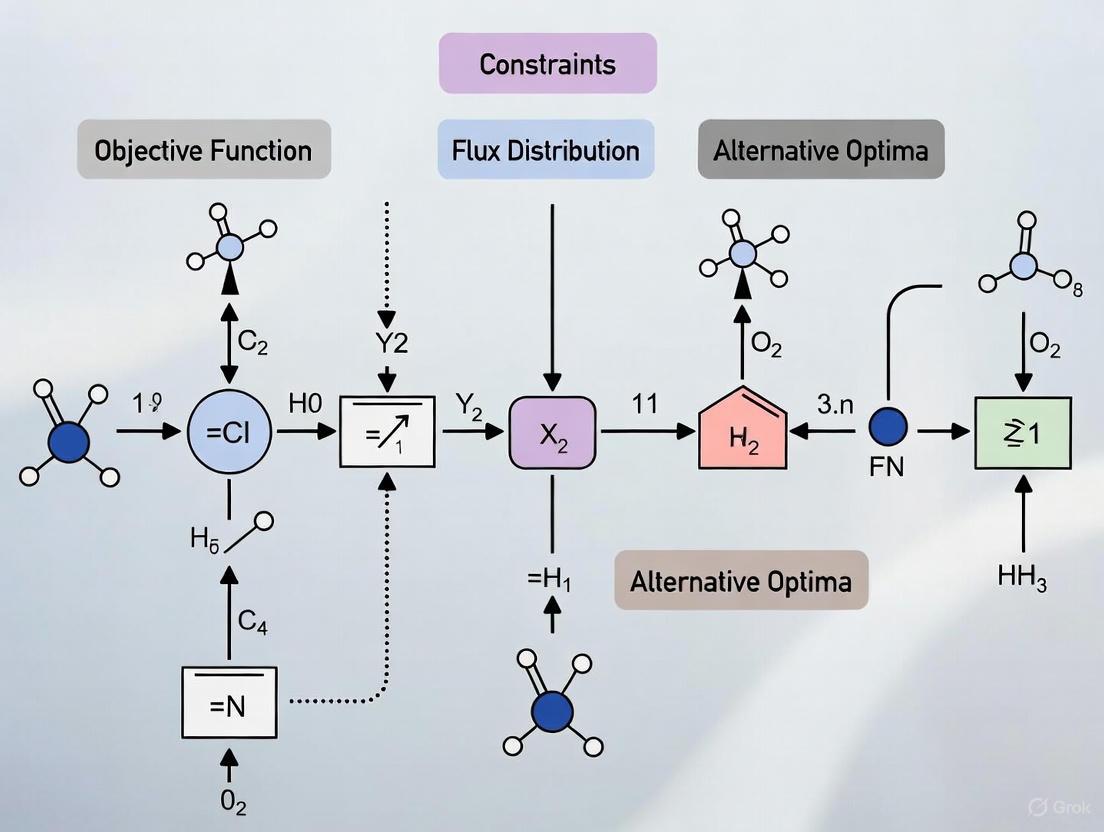
Flux Balance Analysis (FBA) is a cornerstone of constraint-based metabolic modeling, but its predictions are often non-unique, with numerous alternative optimal solutions yielding the same objective value.
Navigating Alternative Optimal Solutions in Flux Balance Analysis: From Foundational Concepts to Advanced Validation
Abstract
Flux Balance Analysis (FBA) is a cornerstone of constraint-based metabolic modeling, but its predictions are often non-unique, with numerous alternative optimal solutions yielding the same objective value. This phenomenon presents significant challenges in interpreting results for applications in systems biology, metabolic engineering, and drug development. This article provides a comprehensive framework for understanding, analyzing, and validating these alternative solutions. We explore the foundational concepts of optimal solution spaces and their biological implications, detail advanced methodological frameworks like TIObjFind and loopless FBA for solution refinement, discuss troubleshooting strategies to address thermodynamic infeasibility and overfitting, and finally, present rigorous validation and model selection techniques to ensure biological relevance. This integrated approach empowers researchers to move beyond single-solution predictions toward robust, biologically consistent flux distributions.
Understanding the Landscape of Alternative Optimality in Metabolic Networks
Frequently Asked Questions
1. What are alternative optimal solutions in Flux Balance Analysis (FBA)? In FBA, an alternative optimal solution occurs when multiple different distributions of metabolic fluxes (the rates at which metabolic reactions occur) yield the same optimal value for a biological objective, such as maximal biomass production [1]. The entire set of these optimal flux distributions forms a solution space known as a polyhedron [1].
2. Why do alternative optimal solutions pose a challenge? The existence of numerous alternative optimal solutions complicates the biological interpretation of FBA results [1]. Because thousands to millions of flux patterns can produce the same optimal performance, it can be difficult to identify the one actually used by a cell, which limits the predictive accuracy and practical utility of the model for applications like metabolic engineering or drug development [2] [1].
3. How can I identify if my FBA problem has alternative optimal solutions? Common computational methods to characterize the optimal solution space include:
- Flux Variability Analysis (FVA): Determines the minimum and maximum possible flux each reaction can carry while still achieving the optimal objective value [1].
- Comprehensive Polyhedra Enumeration FBA (CoPE-FBA): A method that fully characterizes the optimal solution space by enumerating its vertices, rays, and linealities [1].
4. What is the biological significance of these solutions? Alternative optimal solutions are not just mathematical artifacts; they reflect a cell's inherent metabolic flexibility [1]. Cells can use different pathways to achieve the same physiological goal, allowing them to adapt to various environmental conditions or genetic perturbations [2]. Analyzing these alternatives can reveal critical subnetworks and backup pathways within the metabolic network [1].
Troubleshooting Guide: Analyzing Alternative Optimal Solutions
| Problem Description | Symptoms | Recommended Solution |
|---|---|---|
| High Metabolic Flexibility | FVA shows a wide flux range for many reactions, making biological interpretation difficult. | Apply CoPE-FBA to decompose the solution space into its fundamental components (vertices, rays, linealities) to understand the underlying network topology causing the flexibility [1]. |
| Misalignment with Experimental Data | The single flux distribution predicted by a standard FBA does not match experimentally measured flux data. | Use a framework like TIObjFind, which integrates FBA with Metabolic Pathway Analysis (MPA) to infer a context-specific objective function that better aligns the model with experimental data [2]. |
| Computational Intractability | The model is too large for a complete enumeration of the optimal solution space. | Exploit the finding that optimal solution spaces are often determined by a few small subnetworks. Use preprocessing to fix invariable fluxes, then focus analysis on the remaining variable subnetwork [1]. |
Experimental Protocol: Characterizing the Optimal Solution Space with CoPE-FBA
1. Objective: To comprehensively characterize all optimal flux distributions in a genome-scale metabolic model.
2. Background: The CoPE-FBA method describes the entire optimal solution space in terms of three types of vectors [1]:
- Vertices: Represent fundamental pathways through the network that achieve the optimal yield.
- Rays: Represent irreversible thermodynamically infeasible cycles that can operate at any rate without affecting the objective.
- Linealities: Represent reversible internal cycles that can operate in either direction without affecting the objective.
3. Methodology:
- Step 1: Solve the Base FBA Problem. Maximize your biological objective (e.g., biomass growth) using a linear programming solver to find the optimal objective value.
- Step 2: Fix the Objective. Add a constraint to the model that forces the objective function to equal the optimal value found in Step 1. This defines the "optimal solution space" or polyhedron.
- Step 3: Preprocessing. Identify and fix the values of reactions that have identical fluxes across all optimal solutions. This reduces the problem's complexity [1].
- Step 4: Polyhedra Enumeration. Use a computational tool like Polco to enumerate the vertices, rays, and linealities of the resulting polyhedron [1].
- Step 5: Topological Analysis. Map the computed vertices, rays, and linealities back onto the metabolic network to identify the key subnetworks responsible for the alternative solutions.
4. Expected Outcome: A compact, network-topological understanding of the metabolic flexibility in optimal states, often arising from combinatorial flux patterns in just a few subnetworks [1].
Research Reagent Solutions
| Item | Function in Analysis |
|---|---|
| Genome-Scale Metabolic Model (e.g., Recon, iJO1366) | A stoichiometric representation of all known metabolic reactions in an organism. Serves as the core computational framework for performing FBA [1]. |
| Linear Programming (LP) Solver (e.g., COBRA Toolbox) | Software that performs the numerical optimization to find the flux distribution that maximizes or minimizes a defined objective function [1]. |
| CoPE-FBA Pipeline | Specialized computational software for the comprehensive enumeration of the optimal flux space, translating mathematical solutions into biologically interpretable subnetworks [1]. |
| TIObjFind Framework (MATLAB) | A data-driven optimization framework that integrates FBA with Metabolic Pathway Analysis to identify objective functions that align model predictions with experimental data [2]. |
Visualizing the Concepts
The following diagram illustrates the core components of an optimal solution space in FBA, as characterized by methods like CoPE-FBA.
In Flux Balance Analysis (FBA), the set of all possible metabolic flux distributions that satisfy stoichiometric, thermodynamic, and capacity constraints forms a solution space [3] [4]. This space represents all metabolic states available to a cell under given conditions. When an optimality criterion, such as maximizing biomass growth, is applied, this region is more specifically called the optimal solution space (OS) [3]. Understanding the complete geometry of this space is crucial for interpreting FBA results, as the single flux vector returned by a standard FBA calculation represents just one point within a potentially vast set of alternative optimal solutions [3] [1].
The solution space is mathematically defined as a convex polyhedron in a high-dimensional flux space [1] [4]. For realistic genome-scale models, this polyhedron can be enormously complex. Traditional FBA provides limited biological insight because it returns only a single flux vector, typically located at an extreme point (vertex) of the polyhedron [3]. Conversely, exhaustive methods like Elementary Mode or Extreme Pathway analysis generate an intractably large number of basis vectors [3] [1]. This guide explores the polyhedral structure of the solution space—characterized by its vertices, rays, and linealities—and provides methodologies for its analysis and troubleshooting.
Core Concepts: The Building Blocks of the Solution Space
The optimal solution space polyhedron can be described in terms of three fundamental topological features, each with a specific biological and mathematical interpretation [1].
Table 1: Core Components of an FBA Solution Space Polyhedron
| Component | Mathematical Definition | Biological Interpretation | Network Topology |
|---|---|---|---|
| Vertices | Corner points of the polyhedron; cannot be expressed as a convex combination of other points in the space. | Alternative metabolic pathways or routes that achieve the same optimal objective value (e.g., biomass yield) [1]. | Paths through the metabolic network [1]. |
| Rays | Directions v such that for any point v' in the polyhedron, v' + υv is also in the polyhedron for all υ ≥ 0. |
Irreversible metabolic cycles that can operate at any rate without affecting the objective function. Often correspond to thermodynamically infeasible loops [1]. | Irreversible cycles in the network [1]. |
| Linealities | Directions v such that for any point v' in the polyhedron, v' + µv is also in the polyhedron for all values of µ. |
Reversible metabolic cycles that can operate in either direction at any rate without affecting the objective function [1]. | Reversible cycles in the network [1]. |
Figure 1: The relationship between the mathematical description of a polyhedron and the topology of the underlying metabolic network. Vertices correspond to paths, while linealities and rays correspond to cycles.
Troubleshooting Guide: Common Issues and Solutions
FAQ 1: My FBA solution is not unique. How can I characterize the full range of alternative optimal solutions?
Issue: A single FBA solution often does not represent the complete biological reality, as many alternative flux distributions can achieve the same optimal objective value [1] [4]. Relying on a single solution can lead to incomplete or misleading conclusions.
Solution: Employ methods that characterize the entire optimal solution space rather than a single point. Two advanced methodologies are recommended:
- Comprehensive Polyhedra Enumeration FBA (CoPE-FBA): This method provides a complete description of the optimal solution space by enumerating its vertices, rays, and linealities. It reveals that the vast number of optimal flux patterns often results from a combinatorial explosion within just a few small subnetworks, allowing for a compact, topology-based understanding [1].
- Solution Space Kernel (SSK) Analysis: This approach characterizes the solution space by extracting a bounded, low-dimensional kernel (SSK). It separates fixed fluxes from variable ones and identifies a compact subregion containing the most biologically relevant flux variations, supplemented by rays that describe unbounded directions [3].
Experimental Protocol: CoPE-FBA Workflow
- Model Preparation: Start with a genome-scale stoichiometric model. Avoid using artificially high flux bounds, as this can cause rays and linealities to disappear and lead to a vertex explosion [1].
- Preprocessing: Identify and separate all reaction fluxes that are fixed across the entire optimal solution space. This step reduces the dimensionality of the problem [1].
- Polyhedron Enumeration: Use specialized software (e.g., Polco) to compute the vertices, rays, and linealities of the FBA polyhedron [1].
- Subnetwork Analysis: Analyze the resulting extremities to identify the key subnetworks where flux variability occurs. CoPE-FBA typically shows that the solution space is determined by only a few such subnetworks (often 5-10% of all reactions) [1].
- Interpretation: Biologically interpret the vertices as alternative pathways, and the rays/linealities as thermodynamically infeasible loops or permissible cycles [1].
FAQ 2: The solution space is too large to handle. How can I simplify it for interpretation?
Issue: The complete set of optimal flux distributions can contain millions of points, making it impossible to interpret manually [1] [4].
Solution: Leverage the insight that flux variability is typically confined to a small subset of the network. Both CoPE-FBA and SSK analysis provide simplified representations.
- CoPE-FBA Approach: This method demonstrates that the entire optimal solution space can be compactly described by the topology of a few small subnetworks. The reactions within each subnetwork have correlated fluxes, and the vast number of solutions arises from combinatorial possibilities within these modules [1].
- SSK Approach: This method constructs a bounded "kernel" that captures the core of the biologically relevant flux variations. The kernel is described by a manageable number of parameters and its shape can be delineated by a set of mutually orthogonal, maximal chords. For high-dimensional kernels, a "Peripheral Point Polytope" (PPP) with only ~4N to 6N vertices can approximate the central 80% of the kernel [3].
Table 2: Methods for Characterizing and Simplifying the FBA Solution Space
| Method | Key Principle | Primary Output | Handles Unbounded Spaces? | Ideal Use Case |
|---|---|---|---|---|
| CoPE-FBA [1] | Decomposes space into vertices, rays, and linealities from a few subnetworks. | Complete list of extremities (vertices, rays, linealities). | Yes, natively. | Topological understanding of all optimal states. |
| SSK Analysis [3] | Defines a bounded kernel and supplemental rays for unbounded directions. | Bounded kernel polytope and a set of ray vectors. | Yes, by separating bounded and unbounded parts. | Focusing on biologically plausible, bounded flux ranges. |
| Flux Variability Analysis (FVA) [4] | Finds min/max possible flux for each reaction individually. | A range for every reaction flux. | Only with artificial bounds. | Quick assessment of flux flexibility per reaction. |
| Random Sampling with FVA Bounds [4] | Fixes variable fluxes to random values within their FVA range and re-optimizes. | A collection of feasible flux distributions. | Depends on implementation. | Probing the space for correlated reactions without full enumeration. |
FAQ 3: My model contains thermodynamically infeasible cycles. How do I identify and remove them?
Issue: The solution space may contain rays and linealities that represent cycles capable of infinite flux without any net substrate consumption or product formation. These are often thermodynamically infeasible and can skew the interpretation of results [1].
Solution:
- Identification: Perform a CoPE-FBA analysis. The output will explicitly list ray and lineality vectors. Biologically, these correspond to the irreversible and reversible cycles, respectively, as shown in Figure 1 [1].
- Prevention during Modeling: A common practice that inadvertently creates these cycles is modeling reversible reactions as a single reaction with negative and positive bounds. Instead, split reversible reactions into separate forward and reverse reactions. This allows for the assignment of distinct catalytic constants (Kcat values) and helps prevent unrealistic flux loops [5].
- Constraining: Use the
SSKernelsoftware package to perform Solution Space Kernel analysis. A key stage in its algorithm is to identify directions in flux space for which the solution space is unbounded and to find the corresponding ray vectors. The kernel is then constructed to be bounded, separating these physically implausible unbounded aspects [3].
Figure 2: An example of an internal cycle (lineality) that can be identified and separated through polyhedral analysis.
FAQ 4: How can I validate that my FBA predictions are reliable given the large solution space?
Issue: The existence of a large solution space means that a single FBA-predicted flux distribution may not be a reliable representation of the in-vivo state [6].
Solution: Adopt a multi-faceted validation strategy that goes beyond reporting a single flux vector.
- Compare against 13C-MFA Data: The most robust validation involves comparing FBA predictions against intracellular fluxes estimated via 13C-Metabolic Flux Analysis (13C-MFA). This experimental technique uses isotopic labeling data to pin down a more specific flux map within the solution space [6].
- Inspect the Solution Space: Use the methods described above (e.g., CoPE-FBA, SSK, Sampling) to understand the range and correlations of possible optimal fluxes. Report on the robustness of your key predictions—is the flux through a target reaction stable across the entire solution space, or does it vary widely? [4]
- Incorporate Additional Constraints: Integrate experimental data such as transcriptomics, proteomics (enzyme abundance), and exometabolomics to further constrain the solution space and improve the biological relevance of predictions. Hybrid methods like NEXT-FBA use neural networks to relate exometabolomic data to intracellular flux constraints [7] [4].
- Test Multiple Objective Functions: Systematically evaluate alternative biological objective functions to identify those that generate flux predictions best aligned with experimental data [6].
The Scientist's Toolkit: Essential Research Reagents & Software
Table 3: Key Resources for Solution Space Analysis
| Resource Name | Type | Primary Function | Reference/Link |
|---|---|---|---|
| COBRApy | Software Toolbox | A widely used Python package for constraint-based modeling, including performing FBA and FVA. | [5] |
| SSKernel | Software Package | Publicly available tool for defining and computing the Solution Space Kernel (SSK) of an FBA model. | [3] |
| CoPE-FBA Pipeline | Computational Method | A pipeline for Comprehensive Polyhedra Enumeration in FBA, identifying vertices, rays, and linealities. | [1] |
| Polco | Software Tool | Used for determining Extreme Pathway Analysis and Elementary Flux Modes, which can be applied to FBA polyhedra. | [1] |
| NEXT-FBA | Computational Method | A hybrid approach that uses neural networks trained on exometabolomic data to derive improved constraints for intracellular fluxes. | [7] |
| ECMpy | Software Workflow | A workflow for incorporating enzyme constraints into genome-scale models without altering the stoichiometric matrix. | [5] |
| 13C-MFA | Experimental Technique | Provides estimated intracellular fluxes for validating FBA predictions and constraining solution spaces. | [6] |
Frequently Asked Questions (FAQs)
Q1: What are alternate optimal solutions in Flux Balance Analysis (FBA), and why do they matter? Alternate optimal solutions are distinct flux distributions through a metabolic network that all produce the same optimal biomass yield [8]. They are significant because they reveal the inherent redundancy in metabolic networks, allowing organisms to achieve the same growth outcome using different combinations of reaction fluxes. This redundancy is a key source of metabolic flexibility and robustness [8].
Q2: How does redundancy in metabolic networks contribute to metabolic flexibility? Redundancy, often in the form of alternative metabolic pathways, allows an organism to maintain growth even when a primary reaction is disrupted. For example, in the event of a gene deletion, flux can be "rerouted" through alternative pathways, a process known as metabolic plasticity. This is the basis for synthetic lethal pairs, where only the simultaneous deletion of two reactions abrogates growth [9].
Q3: What is the biological difference between a plastic synthetic lethal (PSL) and a redundant synthetic lethal (RSL)? These are two classes of synthetic lethal pairs that illustrate different redundancy mechanisms [9]:
- PSL (Plastic Synthetic Lethal): In a PSL pair, only one reaction is active at a time. The second reaction becomes active only when the first is deleted, demonstrating a switch-like, plastic response.
- RSL (Redundant Synthetic Lethal): In an RSL pair, both reactions are active simultaneously under normal conditions. The loss of one does not stop growth because the other is already carrying a portion of the flux, showing built-in redundancy.
Q4: My gapfilled metabolic model grows, but the flux distribution looks unusual. Is this an error? Not necessarily. The gapfilling algorithm finds a minimal set of reactions to enable growth but does not always select the most biologically relevant pathway [10]. The solution you see is one of potentially many alternate solutions. You can force the algorithm to find a different solution by manually constraining the flux of the unexpected reaction to zero and re-running the gapfilling process [10].
Q5: What is a high-flux backbone (HFB), and is it conserved across alternate optimal solutions? The high-flux backbone (HFB) is the subnetwork of reactions that carry high flux in a given condition [8]. Research shows that the HFB from one optimal solution is largely conserved across other alternate optimal solutions in E. coli, but only moderately conserved in S. cerevisiae [8]. However, the HFB can vary significantly when considering near-optimal solutions, highlighting the network's plasticity [8].
Troubleshooting Common Experimental Issues
Problem 1: Gapfilling produces a model that grows, but you suspect it is biologically inaccurate.
- Potential Cause: The gapfilling algorithm uses a cost function that penalizes certain reactions (e.g., transporters, non-KEGG reactions) but may still add them if they provide the shortest path to growth [10]. The solution is mathematically correct but may not reflect the organism's true biology.
- Solution:
- Change the Media: Gapfill on a minimal media instead of the default "complete" media. This forces the model to biosynthesize more compounds and can lead to a more accurate solution [10].
- Manual Curation: Inspect the added reactions. If a reaction's addition is not desired, use the "Custom flux bounds" feature to set its flux to zero and re-run the gapfilling to find an alternative solution [10].
- Stack Gapfillings: First, gapfill on a rich media to establish base growth, then gapfill the same model on your desired condition to add only the minimal set of reactions needed for that specific condition [10].
Problem 2: Flux Variability Analysis (FVA) shows a wide range of possible fluxes for many reactions.
- Potential Cause: This is a classic sign of extensive alternate optimal solutions and redundancy in the network. The model does not have enough constraints to uniquely determine the flux for these reactions [8].
- Solution:
- Add Transcriptomic Data: Integrate gene expression data to constrain the flux bounds of reactions associated with highly or lowly expressed genes.
- Use a Parsimonious FBA (pFBA): Apply an pFBA approach that minimizes the total sum of absolute flux while achieving optimal growth, which can select for a more biologically relevant solution from the set of alternates.
- Apply the minRerouting Algorithm: For synthetic lethal analysis, use a method like
minReroutingwhich finds a flux solution that minimizes the number of reactions with varying flux between wild-type and mutant states, helping to identify the core set of reactions vital for rewiring [9].
Problem 3: Difficulty identifying which reactions are essential for metabolic rewiring in a synthetic lethal pair.
- Potential Cause: Standard FBA may find a solution that achieves growth after a single reaction deletion but does not highlight which specific reaction flux changes are responsible for the rescue [9].
- Solution: Employ a constraint-based optimisation approach that explicitly minimizes the rerouting between the wild-type and mutant states [9]. This pipeline outputs a "synthetic lethal cluster," which is the set of reactions most vital for the metabolic rewiring that allows the organism to survive the single deletion.
Experimental Protocols for Key Analyses
Protocol 1: Analyzing a High-Flux Backbone (HFB) from an FBA Solution This protocol is based on the methodology described by Almaas et al. and subsequent analyses [8].
- Run FBA: Perform Flux Balance Analysis on your metabolic model for a specific environmental condition to obtain a reference flux distribution.
- Calculate Net Flux: For each metabolite in the network, identify all producing and consuming reactions.
- Identify Dominant Fluxes: For each metabolite, find the single reaction that maximally produces it and the single reaction that maximally consumes it within the solution.
- Construct the HFB: The High-Flux Backbone is the union of all reactions identified as dominant producers or consumers for all metabolites in the network. This forms a connected subnetwork representing the primary flux routes.
Protocol 2: A Workflow for Classifying Synthetic Lethal Pairs This protocol helps characterize the nature of redundancy in synthetic lethal pairs [9].
- Identify Synthetic Lethals: Use an algorithm like Fast-SL to find all synthetic lethal reaction pairs (SLPs) in your genome-scale metabolic model.
- Simulate Single Deletions: For a given SLP (Reaction A + Reaction B), run FBA on the single deletion mutants (ΔA and ΔB).
- Analyze Flux Distributions: Examine the flux distributions for reactions A and B in the wild-type model and in each single mutant.
- Classify the SLP:
- Plastic Synthetic Lethal (PSL): If, in the wild-type, one reaction has high flux and the other has zero (or negligible) flux.
- Redundant Synthetic Lethal (RSL): If, in the wild-type, both reactions carry significant, simultaneous flux.
Essential Research Reagent Solutions
The following table lists key computational tools and databases essential for research in this field.
| Item Name | Function/Brief Explanation |
|---|---|
| KBase | An integrated platform that provides apps for reconstructing, gapfilling, and analyzing metabolic models using FBA [10]. |
| Model SEED Biochemistry Database | A curated database that provides a consistent vocabulary of compounds, reactions, and roles used by KBase and other tools for model reconstruction and gapfilling [10]. |
| SCIP & GLPK Solvers | Optimization solvers used internally by tools like KBase to solve the linear and mixed-integer programming problems at the heart of FBA and gapfilling [10]. |
| FlexFlux | A tool that integrates FBA with regulatory network analysis, allowing users to find steady states of the regulatory network and use them as constraints for FBA [11]. |
| minRerouting Algorithm | A constraint-based optimization approach designed to identify the minimal set of flux changes (the synthetic lethal cluster) required for a network to adapt to a reaction deletion [9]. |
| Flux Variability Analysis (FVA) | A computational technique used to determine the minimum and maximum possible flux for each reaction across all alternate optimal solutions, quantifying the network's flexibility [8]. |
Visualizing Core Concepts and Workflows
Diagram 1: FBA and Alternate Solutions Workflow
Diagram 2: Synthetic Lethal Classification and Rewiring
Flux Balance Analysis (FBA) is a constraint-based computational method used to predict the flow of metabolites through a metabolic network, typically optimizing for an objective like biomass production [12]. A key challenge in FBA is the prevalence of alternate optimal solutions—different flux distributions that yield the identical optimal objective value [8]. The High-Flux Backbone (HFB) is a concept introduced to address this. It is a subnetwork comprising reactions that carry locally maximal flow for production and consumption of metabolites within a given flux distribution [8]. This technical support center provides guidelines for researchers grappling with the implications of alternate optima on the identification and interpretation of the HFB in their metabolic models.
Frequently Asked Questions (FAQs)
1. What is the High-Flux Backbone (HFB), and why is its conservation significant?
The High-Flux Backbone (HFB) is a subnetwork identified from a specific flux distribution. It contains the primary flow paths where, for most metabolites, one or two reactions dominantly handle production and consumption [8]. Its significance lies in revealing the core, high-activity routes in a metabolic network under specific conditions.
Investigating its conservation across alternate optimal solutions is crucial because it determines whether the HFB is a robust, invariant feature of the network or merely an artifact of a single solution selected by the FBA algorithm. Studies show HFB conservation varies by organism; it is largely conserved across alternate optima in E. coli but only moderately conserved in S. cerevisiae [8]. This variability underscores the need for careful analysis.
2. How do alternate optimal and near-optimal solutions affect the HFB?
- Alternate Optimal Solutions: These are flux distributions with the same optimal objective value (e.g., maximal growth rate). The HFB derived from one optimal solution can vary in other optimal solutions. Flux Variability Analysis (FVA) is a key technique to identify reactions guaranteed to be in the HFB across all alternate optima [8].
- Near-Optimal Solutions: These are flux distributions with a sub-optimal but biologically acceptable objective value. The HFB shows significantly greater variation across near-optima compared to alternate optima, revealing a high degree of redundancy and "flux plasticity" in metabolic networks [8]. This plasticity is a key mechanism for robustness.
3. What computational methods can I use to analyze alternate optima and the HFB?
- Flux Variability Analysis (FVA): This is a fundamental method. FVA determines the minimum and maximum possible flux for each reaction across all alternate optimal solutions without enumerating them all. Reactions with minimal flux variability are strong candidates for a conserved HFB [8].
- Mixed Integer Linear Programming (MILP): You can use MILP to explicitly enumerate a set of distinct alternate optimal solutions. A recursive MILP algorithm can systematically generate new solutions by forcing at least one previously high-flux reaction to be removed in subsequent iterations [8].
- Feature Barcoding Analysis (FBA - a different tool): For single-cell RNA-Seq experiments that include feature barcoding (e.g., for CRISPR perturbations or cell hashing), the "FBA" software package is a flexible tool for quantification and demultiplexing [13]. This is distinct from Flux Balance Analysis but can provide data on cellular heterogeneity that informs metabolic models.
4. Which reactions are most likely to be part of a conserved HFB?
Research indicates that the set of HFB reactions conserved across alternate near-optima has a large overlap with essential reactions [8]. Furthermore, reactions that are both the uniquely consuming (UC) and uniquely producing (UP) reaction for a metabolite are strong candidates for inclusion in a conserved backbone [8].
Troubleshooting Guides
Problem: Inconsistent HFB Identification
Symptoms: The calculated HFB changes drastically when using different FBA solvers or when the model is perturbed slightly, leading to unreliable biological conclusions.
Diagnosis and Resolution:
| Step | Action | Expected Outcome |
|---|---|---|
| 1 | Perform Flux Variability Analysis (FVA) | Identifies reactions with invariant fluxes across all alternate optima. A conserved HFB should be rich in these low-variability reactions [8]. |
| 2 | Check for Essential Reactions | Compare your HFB with a list of model-specific essential reactions (determined via in-silico knockouts). A robust HFB should have significant overlap [8]. |
| 3 | Analyze Near-Optimal Space | Instead of focusing only on the absolute optimum, calculate HFBs from a set of near-optimal flux distributions. The core conserved across these is a more robust indicator of critical network structure [8]. |
| 4 | Validate with Experimental Data | Where possible, correlate the predicted conserved HFB with experimental data (e.g., gene essentiality or reaction flux measurements) to confirm its biological relevance. |
Problem: Handling Computational Complexity
Symptoms: The analysis is too slow, or it is computationally infeasible to enumerate all alternate optimal solutions for a large, genome-scale model.
Diagnosis and Resolution:
| Step | Action | Expected Outcome | |
|---|---|---|---|
| 1 | Prioritize FVA | Use FVA instead of full enumeration. FVA efficiently characterizes the solution space by providing flux ranges without listing all solutions [8]. | |
| 2 | Use Sampling | If possible, employ metabolic flux sampling techniques to statistically explore the space of optimal and near-optimal solutions and build a probabilistic HFB. | A representative profile of the solution space is obtained. |
| 3 | Focus on a Subsystem | Restrict your HFB analysis to a subsystem of primary interest (e.g., central carbon metabolism) to reduce problem size. | A tractable analysis on a biologically relevant part of the network. |
Key Experimental Protocols and Workflows
Protocol 1: Flux Variability Analysis (FVA) to Identify a Conserved HFB
Objective: To find the set of reactions that consistently carry high flux and form a stable HFB across all alternate optimal flux distributions [8].
Methodology:
- Define the Metabolic Model and Medium: Start with a stoichiometric matrix (S) and define the environmental conditions (exchange reaction bounds) [8] [12].
- Solve the Base FBA Problem: Maximize for the objective (e.g., biomass). Record the optimal objective value, Z₀ [8].
- Perform Flux Variability Analysis: For each reaction (i) in the model, solve two Linear Programming (LP) problems:
- Minimize vi, subject to: S∙v = 0, α ≤ v ≤ β, and c(^T)v = Z₀.
- Maximize vi, subject to the same constraints. This yields the flux range [vimin, vimax] for each reaction across alternate optima [8].
- Identify the Conserved HFB:
- Calculate the HFB from a reference optimal flux distribution.
- The conserved HFB reactions are those in the reference HFB that also have consistently high flux values (e.g., |vimin| and |vimax| are both above a high-flux threshold) across the ranges computed by FVA.
Protocol 2: Analyzing HFB Conservation in Near-Optimal Space
Objective: To understand the redundancy and plasticity of metabolic networks by examining HFB variation in sub-optimal states [8].
Methodology:
- Generate Near-Optimal Flux Distributions: Using MILP or other techniques, generate a set of flux distributions where the objective function value is within a small percentage (δ) of the optimum (e.g., c(^T)v ≥ (1-δ)Z₀) [8].
- Calculate HFB for Each Distribution: Compute the HFB for each individual near-optimal flux distribution in the set.
- Determine the Conserved Core: Find the intersection of all HFBs from step 2. This core set of reactions is the conserved HFB across the near-optimal space.
- Correlate with Biological Features: Compare this conserved core to known essential reactions and uniquely consuming/producing (UC/UP) reactions [8].
Research Reagent Solutions
The following table lists key computational tools and resources essential for conducting HFB and alternate optima research.
| Item | Function in Research | Key Features / Notes |
|---|---|---|
| Stoichiometric Model | The foundational network structure for any FBA [12]. | Organism-specific (e.g., E. coli iJO1366, S. cerevisiae iMM904). Must include reaction stoichiometries, bounds, and a biomass objective function. |
| Linear Programming (LP) Solver | Computes the optimal flux distribution in the base FBA problem [8]. | Commercial (e.g., Gurobi, CPLEX) or open-source (e.g., GLPK) solvers integrated via modeling platforms like COBRApy. |
| Flux Variability Analysis (FVA) | Determines the range of possible fluxes for each reaction across alternate optima [8]. | A standard function in the COBRA Toolbox. Critical for assessing the uniqueness of a flux solution. |
| Mixed Integer Linear Programming (MILP) Solver | Enumerates distinct alternate optimal solutions [8]. | Used in recursive algorithms to generate new solutions by excluding parts of previous ones. More computationally intensive than LP. |
| Feature Barcoding Analysis (FBA) Package | For single-cell RNA-Seq data with feature barcodes (e.g., CITE-seq, CRISPR screens) [13]. | Note: This is distinct from Flux Balance Analysis. It performs quality control, quantification, and demultiplexing. Available on PyPi. |
The tables below summarize key quantitative findings from research on HFB conservation.
Table 1: HFB Conservation Across Organisms and Solution Types
| Organism | Solution Type | Degree of HFB Conservation | Key Observation |
|---|---|---|---|
| E. coli | Alternate Optima | Largely Conserved | The HFB from one optimum is largely maintained in other optimal solutions [8]. |
| S. cerevisiae | Alternate Optima | Moderately Conserved | The HFB shows only moderate conservation across different optimal solutions [8]. |
| E. coli & S. cerevisiae | Near-Optima | Large Variation | The HFB is highly variable, indicating significant flux plasticity and network redundancy [8]. |
Table 2: Performance Metrics from an Example FBA Application
The following data is derived from an example analysis of a single-cell CRISPR screening dataset using the feature barcoding "FBA" package, demonstrating typical outputs from such analytical tools [13].
| Metric | Value | Interpretation |
|---|---|---|
| Read Pairs with Valid Barcodes | ~65% | Indicates good library quality for the CRISPR screen [13]. |
| Average UMIs Detected Per Cell | ~477 | Reflects the sequencing depth and efficiency of perturbation detection [13]. |
| Cells with ≥1 Feature Barcode | ~90% | Shows successful detection of the CRISPR perturbation in most cells [13]. |
| Cells with >1 sgRNA (Multiplets) | ~10% | Indicates the level of co-occurrence of multiple perturbations, which can complicate analysis [13]. |
Technical Support Center
Flux Balance Analysis (FBA) Troubleshooting
Q: My FBA model has become infeasible after integrating known flux measurements. How can I resolve this?
A: Infeasibility occurs when known flux values violate steady-state or other constraints. You can resolve this using two primary methods to find minimal corrections to the given flux values [14]:
- Linear Programming (LP) Method: Finds the minimal set of flux value corrections using linear constraints to restore feasibility.
- Quadratic Programming (QP) Method: Finds corrections by minimizing the sum of squared deviations from the original measured values, often providing a more balanced solution.
The workflow below outlines the systematic approach to diagnosing and resolving an infeasible FBA problem.
Q: How do I calculate the growth rate of E. coli on different substrates under varying conditions?
A: You can calculate growth rates by setting up the model with specific boundary conditions and solving the optimization problem. Below is a protocol using the E. coli core model [15]:
- Load the Model: Load the stoichiometric model into your analysis environment (e.g., COBRA Toolbox).
- Set Substrate Uptake: Define the sole carbon source by setting its exchange reaction lower bound to a negative value (e.g., -18.5 mmol/gDW/hr for glucose) while setting other carbon exchange reactions to zero.
- Set Environmental Conditions:
- Aerobic: Set the oxygen exchange reaction (
EX_o2(e)) lower bound to a large negative value (e.g., -1000). - Anaerobic: Set the oxygen exchange reaction lower bound to zero.
- Aerobic: Set the oxygen exchange reaction (
- Set the Objective: Define the biomass reaction (e.g.,
Biomass_Ecoli_core_N(w/GAM)-Nmet2) as the linear objective to maximize. - Run FBA: Solve the linear programming problem using an FBA solver. The optimal objective value is the predicted growth rate.
The table below shows sample results from such an analysis [15]:
| Substrate | Condition | Uptake Rate (mmol/gDW/hr) | Predicted Growth Rate (1/hr) |
|---|---|---|---|
| Glucose | Aerobic | -18.5 | 1.65 |
| Glucose | Anaerobic | -18.5 | 0.47 |
| Succinate | Aerobic | -20.0 | 0.84 |
| Succinate | Anaerobic | -20.0 | 0.00 |
Q: What does it mean if my FBA solution is feasible but the objective value is not unique?
A: This indicates the presence of alternative optimal solutions. Your model has multiple flux distributions that achieve the same optimal objective value (e.g., growth rate). This is common in metabolic networks and highlights the network's redundancy and flexibility. To analyze this further, you can [14]:
- Identify the reactions that are uniquely determined versus those with variability.
- Use techniques like Flux Variability Analysis (FVA) to determine the range of possible fluxes for each reaction while maintaining the optimal objective.
- Analyze the nullspace of the stoichiometric matrix to understand the degrees of freedom in the system.
Strain Engineering Troubleshooting
Q: I have designed a metabolic strain for chemical production, but the yield is lower than predicted by FBA. What could be wrong?
A: Discrepancies between FBA predictions and real-world yields are common. Please investigate the following areas:
- Model Integrity: Ensure your model accurately reflects the genetic modifications (e.g., gene knock-outs). Verify that the Gene-Protein-Reaction (GPR) rules are correctly associated and that the intended reactions are indeed inactive.
- Measurement Fidelity: Re-check the measured uptake and secretion rates you use to constrain the model. Inconsistent measured fluxes are a primary cause of model infeasibility and incorrect predictions [14].
- Regulatory Effects: FBA does not account for transcriptional or enzymatic regulation. The cell may be employing regulatory mechanisms that divert flux away from the desired product, which are not captured in the model.
- Objective Function: Verify that the linear objective (e.g., maximizing biomass or product formation) is biologically relevant under your experimental conditions.
Drug Target Identification Troubleshooting
Q: I have a small molecule that shows a promising phenotypic effect in a cell-based assay. How can I identify its direct protein target?
A: Target identification, or deconvolution, is a major challenge. The following table summarizes the three primary, complementary approaches [16]:
| Approach | Description | Key Techniques |
|---|---|---|
| Direct Biochemical Methods | Physically isolating the target protein using the small molecule itself. | Affinity purification, photoaffinity labeling, affinity-based protein profiling |
| Genetic Interaction Methods | Using genetic manipulation to see if changes in a presumed target gene alter the cell's sensitivity to the small molecule. | CRISPR-Cas9, RNAi, resistance mutation mapping |
| Computational Inference Methods | Comparing the small molecule's effects or structure to large databases to generate a target hypothesis. | Gene expression profiling, chemical similarity searching, structural bioinformatics |
The following diagram illustrates how these methods can be integrated into a cohesive workflow for robust target identification.
Q: How can I improve the robustness of my target validation process to avoid late-stage failures?
A: The GOT-IT framework provides recommendations to improve target assessment [17]. Focus on these key areas early in research:
- Target Biology: Comprehensively understand the target's role in the disease and normal physiology, including potential safety issues.
- Druggability: Assess the likelihood of finding a small molecule that can effectively modulate the target.
- Assayability: Ensure you can develop robust assays to measure compound activity against the target.
- Differentiation Potential: Evaluate if modulating the target offers a clear advantage over existing therapies.
The Scientist's Toolkit: Essential Research Reagents & Materials
The table below lists key reagents and tools used in the experiments and methods cited in this guide.
| Reagent / Material | Function / Application |
|---|---|
| Immobilized Compound Beads | Solid support for affinity purification; used to pull down binding proteins from cell lysates [16]. |
| Photoaffinity Probes | Small molecules equipped with a photo-reactive crosslinker; used for covalent capture of low-affinity or transient protein targets [16]. |
| Inactive Analog Compound | A structurally similar but inactive molecule; serves as a critical negative control in affinity purification experiments to rule out non-specific binding [16]. |
| CRISPR-Cas9 Library | A pooled collection of guide RNAs for genome-wide screening; used in genetic interaction methods to identify genes that confer sensitivity/resistance to a compound [16]. |
| Gene Expression Microarray/RNA-Seq Kit | Tools for profiling global gene expression; used in computational inference to generate a "fingerprint" for a compound by comparing it to databases of known drug signatures [16]. |
| Stoichiometric Model (e.g., E. coli core) | A computational representation of a metabolic network; the primary tool for performing FBA and predicting phenotypic outcomes [15]. |
Frequently Asked Questions (FAQs)
Q1: In FBA, what is the difference between an underdetermined and a redundant system? A1: These are two key properties of a metabolic system. An underdetermined system has more unknown reaction rates than independent equations, meaning not all fluxes can be uniquely calculated. A redundant system has linear dependencies between the metabolite balances (rows in the stoichiometric matrix), which can lead to inconsistencies when integrating measured fluxes [14].
Q2: Why might a target identified by affinity purification still not be the correct target responsible for the phenotypic effect? A2: A compound can bind to multiple proteins. Affinity purification might identify the most abundant or highest-affinity binder, not the functionally relevant one. This is why using complementary approaches (genetic, computational) is critical for confirmation [16]. Furthermore, the immobilization process can sometimes alter the compound's activity, leading to false positives or negatives [16].
Q3: My FBA solution has a unique optimal growth rate, but the flux through many internal reactions is not unique. Is this a problem? A3: This is a normal and expected occurrence called alternative optimal solutions. It means the cell has multiple metabolic pathways to achieve the same maximum growth yield. This reflects the redundancy and robustness of metabolic networks. To analyze this, use Flux Variability Analysis (FVA) to find the range of possible fluxes for each reaction.
Advanced Frameworks and Algorithms for Solution Space Analysis
Frequently Asked Questions (FAQs)
1. What is Flux Variability Analysis (FVA) and why is it necessary after performing Flux Balance Analysis (FBA)?
Flux Balance Analysis (FBA) is an optimization-based technique that predicts the steady-state fluxes of reactions in a metabolic network at the optimum of a biological objective, such as biomass production [18]. However, the FBA solution is typically not unique; the problem is often degenerate, meaning multiple flux distributions can achieve the same optimal objective value [19]. Flux Variability Analysis (FVA) is a method to determine the range of possible reaction fluxes that still satisfy, within a defined optimality factor, the original FBA problem. It quantifies the feasible ranges of all reaction fluxes, thereby analyzing the flexibility and potential redundancy within the metabolic network [19].
2. My FVA results show a reaction with a range of zero. What does this mean, and how can I investigate further?
A reaction with a minimum and maximum flux of zero is considered a blocked reaction. This means the reaction cannot carry any flux under the given model and environmental conditions. To investigate, you can use the find_blocked_reactions function in COBRApy [20]. First, ensure your exchange reactions (which define nutrient availability) are correctly set. Opening all exchange reactions to high flux ranges (using the open_exchanges parameter) can help determine if the blockage is due to constrained nutrient uptake [20].
3. How does the choice of fraction_of_optimum parameter affect my FVA results?
The fraction_of_optimum parameter (often denoted as μ) requires that the objective value in the FVA constraints is at least a specified fraction (e.g., 0.90 for 90%) of the maximum objective value, Z_0, found by FBA [19] [20]. A value of 1.0 enforces exact optimality, meaning FVA will only explore flux distributions that achieve the absolute maximum growth rate or biomass yield. A value less than 1.0 allows for sub-optimal solutions, which can reveal a wider range of possible fluxes for reactions that are not directly coupled to the objective. This is useful for identifying alternate optimal and sub-optimal pathways.
4. What is the computational cost of FVA, and are there ways to make it faster?
The classic FVA approach requires solving 2n + 1 linear programs (LPs), where n is the number of reactions [19]. This can be computationally expensive for large, genome-scale models. Strategies to improve speed include:
- Algorithmic Improvements: Newer algorithms can reduce the number of LPs that need to be solved by inspecting intermediate solutions to see if flux bounds have already been reached, thus skipping redundant optimizations [19].
- Parallel Processing: COBRApy's
flux_variability_analysisfunction supports theprocessesparameter, which allows the computation to be distributed across multiple CPU cores, significantly reducing real-world computation time [20]. - Loopless FVA: While sometimes biologically necessary, requesting loopless solutions (via the
looplessparameter) leads to a significant increase in computation time (e.g., by a factor of 100) and should only be used when essential [20].
5. What is the difference between pfba_factor and fraction_of_optimum?
These parameters constrain the FVA problem in different ways:
fraction_of_optimum: Constraints the objective function value (e.g., growth) to be at least a fraction of its maximum [20].pfba_factor: Constraints the total sum of absolute fluxes in the network. It requires that the sum must not be larger than a given factor (e.g., 1.1) times the smallest possible sum found by parsimonious FBA (pFBA). This can lead to more realistic predictions by minimizing the total metabolic "cost" [20].
Troubleshooting Guides
Issue 1: Handling Infeasible FVA Problems
Problem: The FVA simulation returns an error stating the model is infeasible after adding the optimality constraint.
Solution:
- Verify Initial FBA: First, ensure your base FBA problem is feasible and returns a non-zero objective value (
Z_0). An infeasible FBA indicates a fundamental problem with the model or constraints. - Check Reaction Bounds: Review the lower and upper bounds (
lower_bound,upper_bound) for all reactions, especially exchange reactions, to ensure they allow a feasible solution. - Adjust
fraction_of_optimum: If yourfraction_of_optimumis set to 1.0, try a slightly lower value (e.g., 0.99). Numerical instabilities in the LP solver can sometimes make the exact optimal solution space infeasible.
Issue 2: Interpreting Essential Reactions and Genes
Problem: You need to identify which reactions or genes are critical for your objective function (e.g., growth).
Solution: Use the dedicated functions in COBRApy to perform essentiality analysis.
- Essential Reactions: A reaction is essential if setting its flux to zero reduces the objective function below a defined viability
threshold. Usefind_essential_reactions(model, threshold=0.01)to find them [20]. - Essential Genes: A gene is essential if knocking out all reactions dependent on that gene reduces the objective below the threshold. Use
find_essential_genes(model, threshold=0.01)[20]. By default, a threshold of 1% of the maximum objective is often used.
Issue 3: Implementing FVA in COBRApy
Problem: How to correctly set up and run an FVA simulation using the COBRApy toolbox.
Solution: Follow this detailed protocol and refer to the code example below.
Protocol: Flux Variability Analysis with COBRApy
- Model Loading: Load your model in Systems Biology Markup Language (SBML) format.
- FBA Pre-solve: It is good practice to first solve an FBA to verify the model state and obtain the maximum objective value.
- Parameter Configuration:
reaction_list: Specify a list of reactions to analyze. IfNone, FVA runs on all reactions.fraction_of_optimum: Set the desired fraction (default is 1.0 for exact optimality).loopless: Set toTrueor a specific method (e.g., "fastSNP") to enforce loopless solutions. Use with caution due to high computational cost.pfba_factor: Optionally provide a factor (e.g., 1.1) to constrain the total flux sum.processes: Set the number of CPU cores for parallel processing.
- Execution: Call the
flux_variability_analysisfunction. - Result Analysis: The result is a DataFrame with columns for the
maximumandminimumflux for each reaction.
Experimental Protocols & Data Presentation
Quantitative Data from FVA
The primary output of FVA is a table of minimum and maximum fluxes. The following table summarizes hypothetical FVA results for a core metabolic model, illustrating key concepts like blocked, essential, and flexible reactions.
Table 1: Example FVA Results for a Core Metabolic Network (Glucose Minimal Media)
| Reaction ID | Reaction Name | Minimum Flux | Maximum Flux | Interpretation |
|---|---|---|---|---|
| ATPM | Maintenance ATPase | 8.5 | 8.5 | Fixed flux |
| PFK | Phosphofructokinase | 10.2 | 10.2 | Fixed flux |
| GND | Phosphogluconate Dehydrogenase | 0.0 | 0.0 | Blocked reaction |
| BIOMASS | Biomass Reaction | 0.9 | 1.0 | Flexible flux (depends on fraction_of_optimum) |
| PGI | Phosphoglucose Isomerase | -5.1 | 5.1 | Reversible reaction |
| AKGDH | Oxoglutarate Dehydrogenase | 3.5 | 3.5 | Essential reaction |
Workflow Visualization
The following diagram illustrates the logical workflow and key decision points in a standard Flux Variability Analysis.
Relationship between FBA and FVA
This diagram illustrates how FBA and FVA work together to characterize the solution space of a metabolic network, especially in the context of dealing with alternative optimal solutions.
The Scientist's Toolkit: Research Reagent Solutions
Table 2: Essential Materials and Software for FVA
| Item Name | Function/Description | Example / Note |
|---|---|---|
| COBRApy | A Python package for constraint-based reconstruction and analysis (COBRA) of metabolic models. It contains the flux_variability_analysis function. |
Primary software tool for implementation [20]. |
| Metabolic Network Model | A computational reconstruction of an organism's metabolism, typically containing stoichiometric matrix (S), reaction bounds, and a biomass objective. | Models are often available in SBML format from repositories [18]. |
| Linear Programming (LP) Solver | An optimization engine used to solve the FBA and FVA linear programs. | COBRApy often uses the GNU Linear Programming Kit (GLPK) by default, but commercial solvers like CPLEX or Gurobi can be faster for large models. |
| Stoichiometric Matrix (S) | A mathematical matrix representing the metabolic network where rows are metabolites and columns are reactions. Entries are stoichiometric coefficients [18]. | Core data structure for any FBA/FVA calculation. |
| Objective Function (c) | A vector of coefficients defining the biological objective to be optimized, such as biomass production [19] [18]. | Defined in the model. For growth, this is often the biomass reaction. |
| Flux Bounds (lb, ub) | Vectors defining the lower and upper limits for the flux of each reaction in the network [19]. | Critical constraints that define the feasible solution space. |
Foundational Concepts: FBA and MPA
What is Flux Balance Analysis (FBA) and what are its core limitations?
Answer: Flux Balance Analysis is a constraint-based computational method used to predict the flow of metabolites through a metabolic network. It analyzes biochemical networks by applying mass balance constraints and optimization principles without requiring detailed kinetic parameters [18].
Core FBA Components:
- Stoichiometric Matrix (S): A mathematical representation where rows represent metabolites and columns represent reactions, with entries showing stoichiometric coefficients [18].
- Constraints: The system is constrained by mass balance (Sv = 0 at steady state) and flux bounds that define minimum and maximum reaction rates [18].
- Objective Function: A linear combination of fluxes (Z = cᵀv) that is maximized or minimized, such as biomass production or ATP synthesis [18].
Key Limitations: Traditional FBA faces challenges in capturing flux variations under different conditions and depends heavily on selecting an appropriate objective function. It may not fully account for metabolic flexibility or regulatory constraints without extensions [2].
What is Metabolic Pathway Analysis (MPA) and how does it complement FBA?
Answer: Metabolic Pathway Analysis comprises methods for functionally interpreting metabolic networks by examining pathway structures, connectivity, and topological properties. It helps unravel network complexity using graph theory concepts [21] [22].
MPA Methodologies:
- Topological Pathway Analysis (TPA): Converts metabolic networks to graphs and scores pathways using various measures, considering metabolite connectivity and betweenness centrality [21].
- Betweenness Centrality: A key metric measuring how often a node appears on shortest paths between other nodes, calculated as BC(v) = Σ(σₐₑ(v)/σₐₑ)/[(N-1)(N-2)] where σₐₑ is the total number of shortest paths and σₐₑ(v) is the subset passing through node v [21].
- Mass Flow Graph (MFG): A directed, weighted graph representation of metabolic fluxes between reactions derived from FBA solutions [2].
MPA complements FBA by providing pathway-centric insights, identifying critical connections, and enhancing interpretability of dense metabolic networks through topological examination [2].
Integration Framework and Implementation
What is the TIObjFind framework and how does it integrate FBA with MPA?
Answer: TIObjFind (Topology-Informed Objective Find) is a novel framework that systematically integrates Metabolic Pathway Analysis with Flux Balance Analysis to analyze adaptive shifts in cellular responses and identify appropriate objective functions [2].
Table: Key Components of the TIObjFind Framework
| Component | Function | Implementation in TIObjFind |
|---|---|---|
| Coefficients of Importance (CoIs) | Quantifies each reaction's contribution to objective function | Weights derived through optimization to align with experimental data |
| Mass Flow Graph (MFG) | Represents metabolic fluxes as a directed, weighted graph | Constructed from FBA solutions to visualize flux distributions |
| Minimum Cut Sets (MCs) | Identifies essential pathways for product formation | Applied via max-flow min-cut algorithms (e.g., Boykov-Kolmogorov) |
| Pathway-Specific Weighting | Distributes importance across metabolic pathways | Uses Coefficients of Importance to prioritize critical pathways |
Implementation Workflow:
- Optimization Problem Formulation: Reformulates objective function selection as an optimization problem minimizing differences between predicted and experimental fluxes while maximizing an inferred metabolic goal [2].
- Graph Construction: Maps FBA solutions onto a Mass Flow Graph for pathway-based interpretation of metabolic flux distributions [2].
- Pathway Extraction: Applies a minimum-cut algorithm to extract critical pathways and compute Coefficients of Importance as pathway-specific weights [2].
What computational tools and algorithms are used in topology-informed FBA-MPA integration?
Answer: Implementation requires specialized computational tools for optimization, graph analysis, and visualization:
Optimization and Solvers:
- Linear Programming (LP): Used for basic FBA computations, typically implemented with GLPK solver [10].
- Mixed-Integer Linear Programming (MILP): Employed for more complex problems with discrete variables, using SCIP solver [10].
- MATLAB Environment: TIObjFind was implemented in MATLAB with custom code for main analysis [2].
Graph Analysis Algorithms:
- Boykov-Kolmogorov Algorithm: Used for minimum cut set calculations due to superior computational efficiency with near-linear performance across graph sizes [2].
- Ford-Fulkerson and Edmonds-Karp: Alternative algorithms for solving max-flow min-cut problems [2].
Visualization Tools:
- Python with pySankey: Used for result visualization in TIObjFind implementation [2].
- Graph Theory Metrics: Betweenness centrality, connectivity analysis, and pathway impact scores [21].
Troubleshooting Common Issues
How can researchers address alternative optimal solutions in FBA?
Answer: Alternative optimal solutions occur when multiple flux distributions yield the same optimal objective value, which is a fundamental challenge in FBA research [18].
Solutions and Methodologies:
Flux Variability Analysis (FVA):
- Purpose: Identifies range of possible fluxes for each reaction while maintaining optimal objective value.
- Implementation: Uses FBA to maximize and minimize every reaction in the network to determine flux ranges [18].
- Application: Helps identify redundant pathways and reactions with flexible flux capacities.
TIObjFind's Coefficient of Importance Approach:
- Mechanism: Introduces Coefficients of Importance (CoIs) that quantify each reaction's contribution to the objective function [2].
- Advantage: Distributes weights across multiple reactions rather than assuming a single objective, reducing dependence on one optimal solution.
- Implementation: Uses optimization that minimizes squared deviations from experimental data while maximizing a weighted sum of fluxes [2].
Regulatory Constraints Integration:
What are common pitfalls in metabolic pathway analysis and how to avoid them?
Answer: Based on analysis of current practices in metabolomics research, several common pitfalls affect the reliability of MPA results [21] [23].
Table: Common MPA Pitfalls and Solutions
| Pitfall | Impact | Solution |
|---|---|---|
| Incorrect Background Metabolome | Over-optimistic P-values, false positives | Always upload reference metabolome (all identified metabolites in study) as background set [23] |
| Hub Metabolite Over-emphasis | Central compounds dominate results, masking pathway-specific signals | Implement hub penalization schemes to diminish hub compound effects [21] |
| Poor Pathway Definition | Arbitrary pathway boundaries affect interpretation | Use organism-specific pathways when available; acknowledge pathway arbitrariness [21] [23] |
| Ignoring Multiple Testing | Increased false discovery rates | Apply appropriate multiple testing corrections (FDR, Bonferroni) to pathway results [23] |
| Database Selection Bias | Results vary significantly between databases | Report specific database (KEGG, Reactome, Biocyc) with version information [23] |
Additional Recommendations:
- Connectivity Considerations: Evaluate both disconnected (pathway-independent) and connected (full-network) approaches, as each offers different insights [21].
- Non-Human Native Reactions: Include microbiota-related reactions for comprehensive analysis, particularly in environmental or host-microbiome studies [21].
- Transparency in Parameters: Report all analysis parameters, even default values, including P-value cutoffs, database versions, and organisms used for pathway definitions [23].
Experimental Protocols and Methodologies
What is the detailed protocol for implementing TIObjFind framework?
Answer: The TIObjFind implementation follows a structured three-step process with specific technical requirements [2].
Step 1: Optimization Problem Formulation
- Objective: Minimize difference between predicted and experimental fluxes while maximizing inferred metabolic goal.
- Mathematical Formulation: Solve optimization problem that minimizes Σ(vpredicted - vexperimental)² subject to stoichiometric constraints Sv = 0.
- Implementation: Use single-stage Karush-Kuhn-Tucker (KKT) formulation of FBA to evaluate candidate objectives.
- Output: Obtain best-fit FBA solutions that explain experimental flux data.
Step 2: Mass Flow Graph Construction
- Input: FBA solutions from Step 1.
- Graph Construction: Represent metabolic fluxes as directed, weighted graph G(V,E) where:
- Nodes (V) represent metabolic reactions
- Edges (E) represent flux relationships with weights corresponding to flux values
- Visualization: Use appropriate graph visualization tools to examine flux distributions.
Step 3: Metabolic Pathway Analysis with Minimum Cut Sets
- Algorithm Selection: Implement Boykov-Kolmogorov algorithm for computational efficiency.
- Pathway Identification: Apply minimum cut sets to identify essential pathways between:
- Start reactions (e.g., glucose uptake as primary metabolic input)
- Target reactions (e.g., product secretion)
- Coefficient Calculation: Compute Coefficients of Importance (CoIs) as pathway-specific weights.
- Validation: Compare predicted fluxes with experimental data and iterate if necessary.
How to validate topology-informed FBA-MPA integration results?
Answer: Validation requires multiple approaches to ensure biological relevance and predictive accuracy:
Quantitative Validation Metrics:
- Prediction Error Calculation: Compute sum of squared deviations between predicted and experimental fluxes [2].
- Coefficient of Importance Stability: Assess consistency of CoIs across different biological conditions or system states [2].
- Pathway Impact Scores: Calculate using betweenness centrality measures: Impact = Σ(BCsignificant)/Σ(BCtotal) where BC represents betweenness centrality [21].
Biological Validation Approaches:
- Case Study Applications: Implement framework on well-characterized systems like Clostridium acetobutylicum fermentation or multi-species IBE systems [2].
- Stage-Specific Analysis: Examine metabolic shifts across different biological stages (e.g., growth phases, environmental perturbations) [2].
- Comparison with Alternate Methods: Benchmark against traditional FBA, rFBA, and other constraint-based methods [2].
Sensitivity Analysis:
- Parameter Variations: Test sensitivity to objective function choices, constraint bounds, and algorithm parameters.
- Topology Robustness: Evaluate results against variations in network structure or pathway definitions.
Essential Research Tools and Reagents
Table: Research Reagent Solutions for Topology-Informed FBA-MPA Research
| Tool/Reagent | Function/Purpose | Implementation Notes |
|---|---|---|
| COBRA Toolbox | MATLAB package for constraint-based reconstruction and analysis | Primary tool for FBA implementations; supports SBML model format [18] |
| KEGG Database | Reference pathway database for metabolic network reconstruction | Provides generic and organism-specific pathway definitions [21] |
| ModelSEED | Biochemical database for metabolic model construction | Used in KBase for reaction annotation and model reconstruction [10] |
| SCIP Solver | Optimization solver for mixed-integer linear programming | Used for gapfilling and complex optimization problems [10] |
| GLPK Solver | Linear programming solver for basic FBA computations | Faster for pure-linear optimizations [10] |
| Boykov-Kolmogorov Algorithm | Graph algorithm for minimum cut calculations | Preferred for computational efficiency in pathway analysis [2] |
| Python with pySankey | Visualization package for metabolic flux distributions | Used for result visualization in TIObjFind framework [2] |
| MetaboAnalyst | Web-based suite for metabolomics data analysis | Includes pathway analysis tools but requires careful parameter setting [23] |
Implementation Considerations:
- Software Integration: TIObjFind was implemented in MATLAB with graph analysis using MATLAB's maxflow package [2].
- Data Compatibility: Ensure consistency between metabolic models, experimental data formats, and analysis tool requirements.
- Computational Resources: Large-scale metabolic networks may require significant memory and processing capacity, particularly for iterative optimization.
Frequently Asked Questions (FAQs)
Q1: What is the primary function of the TIObjFind framework? TIObjFind is a data-driven optimization framework that integrates Metabolic Pathway Analysis (MPA) with Flux Balance Analysis (FBA) to identify context-specific metabolic objective functions for biological systems. It calculates Coefficients of Importance (CoIs) that quantify each reaction's contribution to a cellular objective, enhancing the interpretability of complex metabolic networks and aligning model predictions with experimental flux data [2].
Q2: How does TIObjFind address the challenge of alternative optimal solutions in FBA? Standard FBA can produce multiple, equally optimal flux distributions (alternative optimal solutions) for a given objective, making biological interpretation difficult [24]. TIObjFind addresses this by using experimental data to infer a weighted combination of fluxes as the objective, thereby identifying a single, biologically relevant solution from the set of possibilities and reducing prediction errors [2].
Q3: What are the key inputs required to run a TIObjFind analysis? The framework requires two primary inputs:
- A genome-scale metabolic model for the organism, defining the stoichiometry of all known metabolic reactions.
- Experimental flux data (
vjexp), often obtained from techniques like isotopomer analysis, for the conditions being studied [2].
Q4: In which scenarios is TIObjFind particularly useful? TIObjFind is highly valuable for studying systems where metabolism adapts over time or under varying environmental conditions. This includes:
- Microbial fermentations with distinct metabolic phases (e.g., acidogenesis vs. solventogenesis in Clostridium acetobutylicum).
- Multi-species microbial communities, where each species may have different metabolic priorities.
- Any biological system where the assumption of a single, static objective function like biomass maximization fails to match experimental observations [2].
Troubleshooting Guides
Poor Alignment Between FBA Predictions and Experimental Data
Problem: The flux distribution predicted by a standard FBA (e.g., maximizing biomass) shows a significant deviation from your experimental flux data.
Solution:
- Action: Apply the TIObjFind framework to infer a more accurate, data-driven objective function.
- Methodology:
- Formulate the TIObjFind optimization problem to minimize the squared difference between predicted fluxes (
v) and experimental data (vjexp) while maximizing a weighted sum of fluxes (cobj · v). - Use the resulting flux distribution to construct a Mass Flow Graph (MFG).
- Apply a minimum-cut algorithm (e.g., Boykov-Kolmogorov) to this graph to identify critical pathways and compute the Coefficients of Importance (CoIs) for reactions.
- Formulate the TIObjFind optimization problem to minimize the squared difference between predicted fluxes (
- Expected Outcome: The CoIs serve as pathway-specific weights, refining the objective function and leading to flux predictions that are in closer agreement with your experimental data [2].
Interpreting Flux Variability and Alternative Optima
Problem: Your FBA model yields a high degree of flux variability, with many alternate optimal solutions, making it difficult to pinpoint the biologically relevant flux state.
Solution:
- Action: Use TIObjFind to resolve redundancies by leveraging experimental data.
- Background: Alternative optimal solutions arise from network redundancies, where different reaction sets can achieve the same objective value [24]. TIObjFind's CoIs quantify the importance of each reaction within these redundant pathways in the context of your specific experimental data.
- Methodology: The framework's topology-informed analysis prioritizes pathways that are not only stoichiometrically feasible but also consistent with the measured extracellular fluxes, effectively selecting one meaningful solution from the multiple alternatives [2].
Handling Errors in a Multi-Species Community Model
Problem: When modeling a multi-species community (e.g., a co-culture for IBE production), the combined model fails to predict the metabolite secretion profiles observed in the lab.
Solution:
- Action: Use TIObjFind to assign stage-specific or species-specific objective functions.
- Methodology:
- Obtain experimental flux data for each key stage of the co-culture process or for each species in isolation if possible.
- Run TIObjFind independently for each stage or species to derive distinct sets of Coefficients of Importance (CoIs).
- Implement these different objective functions in the community model to simulate the shifting metabolic priorities within the system.
- Expected Outcome: The model will more accurately capture the emergent metabolic behavior of the community, such as cross-feeding and division of labor, leading to better predictions of overall product synthesis [2].
Key Experimental Protocols
Protocol: Implementing the TIObjFind Framework
This protocol outlines the steps to infer an objective function using the TIObjFind method [2].
I. Prerequisites and Inputs
- Metabolic Model: A genome-scale metabolic reconstruction in a standard format (e.g., SBML).
- Experimental Data: Experimentally measured extracellular flux data (
vjexp), such as substrate uptake rates and product secretion rates.
II. Procedure
- Single-Stage Optimization:
- Set up and solve an optimization problem that minimizes the squared error between FBA-predicted fluxes (
v) and the experimental data (vjexp). - This step identifies a candidate flux distribution (
vj*) that best fits the data under a hypothesized objective.
- Set up and solve an optimization problem that minimizes the squared error between FBA-predicted fluxes (
Mass Flow Graph (MFG) Construction:
- Map the optimized flux distribution (
vj*) onto a directed, weighted graphG(V,E). - Nodes (V): Represent metabolic reactions.
- Edges (E): Represent metabolic flows between reactions, weighted by the flux value.
- Map the optimized flux distribution (
Metabolic Pathway Analysis (MPA) & Minimum Cut:
- Define a start reaction (e.g., glucose uptake,
s) and a target reaction (e.g., product secretion,t). - Apply a minimum-cut algorithm (e.g., Boykov-Kolmogorov) to the MFG to identify the most critical pathways connecting
stot. - The result of this analysis is used to calculate the Coefficients of Importance (CoIs) for the reactions.
- Define a start reaction (e.g., glucose uptake,
III. Output
- A set of Coefficients of Importance (CoIs) that define a weighted objective function (
cobj · v). This function can be used in subsequent FBA simulations to better reflect the cell's metabolic state under the tested conditions.
Workflow Visualization
Diagram Title: TIObjFind Framework Workflow
Research Reagent Solutions
The following table details key computational and data resources essential for conducting research with the TIObjFind framework.
Table: Essential Research Reagents and Resources for TIObjFind
| Item Name | Function / Description | Relevance to TIObjFind |
|---|---|---|
| COBRA Toolbox [18] | A MATLAB toolbox for performing constraint-based reconstructions and analysis, including FBA. | Provides the foundational computational environment to set up and solve FBA problems, which is a prerequisite for TIObjFind. |
| Genome-Scale Model | A stoichiometric matrix (S) of all metabolic reactions in an organism. | Serves as the core structural input representing the metabolic network to be analyzed. |
| Experimental Flux Data (vjexp) | Quantified rates of uptake, secretion, and/or intracellular fluxes from experiments. | Critical input used to guide the optimization and infer the correct objective function. |
| 13C-Labeled Substrates | Tracers (e.g., [1,2-13C]glucose) used in 13C-MFA to determine intracellular fluxes. | The gold-standard method for generating accurate experimental flux data (vjexp) for TIObjFind [25]. |
| SBML Format | Systems Biology Markup Language, a standard format for representing models. | Ensures the metabolic model is portable and can be used across different software tools [26] [18]. |
| Minimum-Cut Algorithm | A graph theory algorithm (e.g., Boykov-Kolmogorov) to find bottleneck pathways. | Used in TIObjFind to analyze the Mass Flow Graph and identify critical reactions for assigning CoIs [2]. |
Understanding FBA and Alternative Solutions
Flux Balance Analysis (FBA) is a constraint-based method that predicts the flow of metabolites through a metabolic network at steady state. It is defined by the mass balance equation Sv = 0, where S is the stoichiometric matrix and v is the flux vector. FBA uses linear programming to find a flux distribution that maximizes or minimizes a biological objective function, such as biomass production [18].
A common challenge in FBA is the existence of alternative optimal solutions—different flux distributions that yield the identical optimal value for the objective function [24]. This occurs because metabolic networks often contain redundancies, such as equivalent reaction sets, where multiple pathways can perform the same net conversion. This flux variability complicates the interpretation of results and the derivation of meaningful biological insights [24]. The table below summarizes the core concepts of FBA and the issue of alternative optima.
Table: Core Concepts of Flux Balance Analysis and Alternative Solutions
| Concept | Description | Mathematical Representation |
|---|---|---|
| Stoichiometric Matrix (S) | An m x n matrix tabulating the stoichiometric coefficients of m metabolites in n reactions. | Rows: MetabolitesColumns: Reactions |
| Mass Balance Constraint | The system is at steady state; the production and consumption of each metabolite are balanced. | S · v = 0 |
| Flux Constraints | Upper and lower bounds define the maximum and minimum allowable flux for each reaction. | v_min ≤ v ≤ v_max |
| Objective Function (Z) | A linear combination of fluxes to be maximized (e.g., biomass growth). | Z = c^T · v |
| Alternative Optimal Solutions | Multiple flux vectors (v) that satisfy all constraints and achieve the same optimal Z. |
S · v = 0, v_min ≤ v ≤ v_max, Z = Z_opt |
Loopless Flux Balance Analysis (ll-FBA) enhances classical FBA by eliminating thermodynamically infeasible internal cycles (loops) from predicted flux distributions [27]. While this leads to more biologically realistic predictions, the implementation presents specific computational and interpretability challenges that researchers frequently encounter.
Why does my ll-FBA model fail to solve or solve very slowly?
The primary cause is that ll-FBA is formulated as a Mixed-Integer Linear Program (MILP), which is computationally challenging for large-scale metabolic networks [27]. The table below summarizes common performance bottlenecks.
| Problem Cause | Description | Impact |
|---|---|---|
| Large Model Size | Genome-scale models with thousands of reactions and metabolites. | Dramatically increases problem complexity and memory usage. |
| Numerical Instability | Ill-conditioned matrices within the MILP solver. | Can cause solvers to fail or return non-optimal solutions. |
| Inefficient Formulation | Using a standard "Big-M" reformulation of the disjunctive constraints. | Leads to poor solver performance and long runtimes. |
How can I resolve ll-FBA performance issues?
Adopting advanced optimization strategies is the most effective way to tackle performance problems. Based on current research, the following method shows the greatest promise:
- Combinatorial Benders' Decomposition: This approach decomposes the problem into a master problem and sub-problems. It has been demonstrated as the most promising technique, enabling the solution of most problem instances that are intractable with standard methods [27].
Advanced Interpretation and Validation
My ll-FBA solution is optimal but doesn't match experimental data. Why?
This discrepancy can arise from the fundamental assumption that cells operate under a single, static objective. In reality, cellular objectives can shift with environmental conditions [28]. Your ll-FBA solution might be one of several Alternative Optimal Solutions—different flux distributions that all achieve the same optimal objective value (e.g., growth rate) and satisfy the loopless constraint [29].
How can I account for alternative optimal solutions in my analysis?
To investigate this, you can use Phenotype Phase Plane (PhPP) analysis. This technique analyzes how optimal growth depends on multiple environmental conditions. However, be aware that sometimes different phenotypes can share identical shadow prices and be missed by standard PhPP analysis. The existence of alternative optimal solutions is a root cause of these "hidden" phenotypes [29].
Quantitative Comparison of ll-FBA Reformulations
The table below summarizes key reformulations and solution approaches for ll-FBA, based on current research.
| Reformulation / Method | Key Principle | Pros | Cons | Best For |
|---|---|---|---|---|
| Standard Big-M | Uses large constants to enforce disjunctive logic. | Simple to implement. | Poor linear relaxation, leading to long solve times. | Smaller models, initial prototyping. |
| Combinatorial Benders' Decomposition | Decomposes problem into master and sub-problems. | Solves most instances; efficient for large models. | Can be affected by numerical instability. | Large, complex genome-scale models. |
| TIObjFind Framework | Integrates MPA with FBA to infer objective functions from data [28]. | Aligns predictions with experimental data; reveals shifting metabolic priorities. | Requires experimental flux data for calibration. | Data-driven discovery of context-specific objectives. |
Experimental Protocol: Implementing ll-FBA with Decomposition
This protocol provides a step-by-step guide for implementing ll-FBA using a decomposition strategy to enhance solvability.
Objective: To obtain a thermodynamically feasible, loopless flux distribution for a genome-scale metabolic model.
Materials: See the "Research Reagent Solutions" table for required software and models.
Method:
- Model and Solver Setup: Load your metabolic model (e.g., E. coli core model). Initialize your MILP solver (e.g., Gurobi, CPLEX).
- Apply Loopless Constraints: Incorporate the chosen mixed-integer constraints that eliminate thermodynamically infeasible cycles. This typically involves assigning integer variables to reaction directions and constraints on net flux.
- Implement Decomposition: For large models, avoid a monolithic MILP solve. Instead, implement the Combinatorial Benders' Decomposition [27]:
- Master Problem: Solves a relaxed problem to find a candidate flux distribution.
- Sub-Problem: Checks the candidate solution for the existence of loops.
- Iteration: If loops are found, "Benders cuts" are generated and added to the master problem to exclude that solution. The process repeats until a loopless solution is found.
- Solve and Validate: Execute the algorithm. Upon completion, validate the solution by checking for net flux through internal cycles (should be zero) and ensuring the objective function value remains biologically plausible.
Workflow Diagram
Research Reagent Solutions
Essential computational tools and resources for conducting ll-FBA research.
| Item | Function in ll-FBA Research |
|---|---|
| Genome-Scale Model (GEM) | A computational representation of an organism's metabolism; the core substrate for FBA and ll-FBA (e.g., E. coli core model). |
| Mixed-Integer Linear Programming (MILP) Solver | Software that performs the numerical optimization to solve the ll-FBA problem (e.g., Gurobi, CPLEX). |
| Combinatorial Benders' Decomposition Algorithm | A custom implementation of this algorithm is used to efficiently solve the ll-FBA MILP for large models [27]. |
| Flux Variability Analysis (FVA) | A technique used after obtaining an optimal solution to explore the range of possible fluxes in alternative optimal solutions. |
| TIObjFind Framework | An optimization-based framework that integrates metabolic pathway analysis to help identify objective functions that align with experimental data, providing insight into alternative solutions [28]. |
Frequently Asked Questions (FAQs)
Q1: What is the fundamental difference between CoPE-FBA and traditional FBA? Traditional Flux Balance Analysis (FBA) predicts a single optimal flux distribution that maximizes or minimizes a biological objective function, such as biomass production [18]. However, this approach has a significant limitation: there can be thousands to millions of different flux patterns that yield the same optimal performance, creating a massive optimal solution space that was previously computationally intractable to fully describe [30]. CoPE-FBA (Comprehensive Polyhedra Enumeration Flux Balance Analysis) solves this problem by completely characterizing the entire optimal solution space, revealing that this complexity arises from a combinatorial explosion of flux patterns in just a few metabolic subnetworks [30].
Q2: Why does traditional FBA often fail to accurately predict gene essentiality? Traditional FBA frequently fails to correctly identify essential genes because it relies on functional optimization in the face of biological redundancy [31]. Metabolic networks contain numerous isozymes and alternative pathways that can perform equivalent functions. When simulating a gene deletion, FBA can readily re-route metabolic flux through these redundant pathways and predict minimal growth impact, leading to false non-essential classifications [31]. This results in high specificity but very low sensitivity for essential gene prediction.
Q3: What specific computational challenges does CoPE-FBA address? CoPE-FBA addresses the computationally intractable problem of completely describing the optimal solution space of genome-scale stoichiometric models [30]. Before CoPE-FBA, the enormous number of optimal flux patterns made comprehensive analysis impossible. CoPE-FBA enables the compact description of the entire optimal solution space in terms of the topology of a few critical metabolic subnetworks, providing profound understanding of metabolic flexibility in optimal states [30].
Q4: How can researchers handle alternative optimal solutions when using FBA for metabolic engineering? When using FBA for metabolic engineering applications like predicting gene knockouts to enhance production of desirable compounds, researchers should employ flux variability analysis (FVA) to identify reactions with flexible fluxes across alternative optima [18]. For CoPE-FBA users, the method naturally identifies the subnetworks where this flexibility occurs, allowing engineers to target interventions more strategically. Tools like OptKnock can use this information to predict gene knockouts that force the organism to overproduce target metabolites while still achieving optimal growth [18].
Troubleshooting Guides
Problem: Inconsistent Gene Essentiality Predictions Between Methods
Symptoms: Traditional FBA predicts a gene is non-essential, while experimental evidence or topological analysis suggests it is essential.
Solution: Implement a hybrid validation approach:
- Run CoPE-FBA analysis to identify the critical subnetworks determining optimal flux spaces [30]
- Check gene association with keystone reactions in these subnetworks using centrality metrics
- Perform flux variability analysis (FVA) to identify alternate optimal flux distributions [18]
- Validate using machine learning approaches incorporating topological features [31]
Prevention: Always complement FBA simulations with topological analysis of the metabolic network structure, particularly examining betweenness centrality and PageRank of reactions associated with the genes of interest [31].
Problem: Computational Limitations in Large-Scale Metabolic Models
Symptoms: CoPE-FBA analysis becomes computationally intensive for genome-scale models.
Solution:
- Focus on core metabolic networks initially to identify principle subnetworks [31]
- Utilize optimized linear programming solvers such as QSopt_ex or lrs as referenced in CoPE-FBA methodology [30]
- Implement reaction pruning by filtering out currency metabolites (H₂O, ATP, ADP, NAD, NADH) to reduce network complexity [31]
- Apply network decomposition techniques to analyze subnetworks independently
Problem: Discrepancies Between Predicted and Experimental Growth Phenotypes
Symptoms: FBA or CoPE-FBA predictions don't match experimental growth rates or essentiality data.
Solution:
- Verify currency metabolite filtering - ensure proper exclusion of highly connected metabolites like H₂O, ATP, ADP, NAD, NADH during network representation [31]
- Check gene-protein-reaction (GPR) associations for completeness and accuracy [26]
- Validate constraint settings including reaction bounds and nutrient uptake rates [32]
- Compare with established benchmarks like the ecolicore model which has well-curated essentiality data [31]
Experimental Protocols
Protocol 1: Implementing CoPE-FBA for Metabolic Network Analysis
Purpose: To comprehensively characterize the optimal solution space of a metabolic network and identify critical subnetworks.
Materials:
- Stoichiometric metabolic model (SBML format)
- Linear programming solver (Gurobi, CPLEX, or open-source alternatives)
- CoPE-FBA computational framework
- Computing environment with sufficient RAM for polyhedra enumeration
Methodology:
- Model Preparation: Load the metabolic model ensuring proper stoichiometric matrix representation [18]
- Constraint Definition: Set mass balance constraints (Sv = 0) and reaction bounds [18]
- Objective Specification: Define biological objective function (e.g., biomass maximization)
- Polyhedra Enumeration: Execute CoPE-FBA algorithm to enumerate optimal flux distributions
- Subnetwork Identification: Analyze output to identify subnetworks responsible for combinatorial complexity
- Topological Analysis: Characterize the structural properties of identified subnetworks
Expected Output: Compact description of optimal solution space and identification of critical metabolic subnetworks that determine metabolic flexibility.
Protocol 2: Integrating Topological Features with FBA
Purpose: To enhance gene essentiality predictions by combining network topology with constraint-based modeling.
Materials:
- Genome-scale metabolic model
- COBRA Toolbox or COBRApy [18] [31]
- NetworkX library for graph analysis [31]
- Ground truth essentiality data for validation
Methodology:
- Graph Construction: Create a directed reaction-reaction graph excluding currency metabolites [31]
- Feature Calculation: Compute graph-theoretic metrics (betweenness centrality, PageRank, closeness centrality) for each reaction [31]
- Gene-Level Aggregation: Map reaction-level features to genes using GPR rules [31]
- Machine Learning Integration: Train classifier (e.g., Random Forest) on topological features [31]
- Validation: Compare predictions against experimental essentiality data
Research Reagent Solutions
Table: Essential Computational Tools for CoPE-FBA Research
| Tool Name | Function | Application Context |
|---|---|---|
| COBRA Toolbox | MATLAB-based suite for constraint-based reconstruction and analysis [18] | Performing FBA and related methods; includes functions for managing models and running simulations |
| COBRApy | Python package for constraint-based modeling of biological networks [31] | Manipulating metabolic models, running FBA, and integrating with machine learning pipelines |
| NetworkX | Python library for complex network analysis [31] | Calculating graph-theoretic metrics (betweenness centrality, PageRank) from metabolic networks |
| lrs | Reverse search vertex enumeration algorithm [30] | Implementing the polyhedra enumeration core of CoPE-FBA methodology |
| QSopt_ex | Rational LP solver [30] | Solving linear programming problems in FBA with exact rational arithmetic |
| Systems Biology Markup Language (SBML) | Standard format for representing biochemical models [18] | Exchanging and storing metabolic models between different software tools |
Table: Performance Comparison of FBA vs. Topological Machine Learning for Gene Essentiality Prediction
| Method | F1-Score | Precision | Recall | Key Strengths | Key Limitations |
|---|---|---|---|---|---|
| Traditional FBA | 0.000 [31] | Not achievable | Not achievable | High specificity; physics-based constraints | Very low sensitivity; fails with biological redundancy |
| Topological ML Model | 0.400 [31] | 0.412 [31] | 0.389 [31] | Learns structural signatures; overcomes redundancy limitations | Performance challenges expected on genome-scale networks |
| CoPE-FBA | Not quantitatively specified [30] | Not quantitatively specified [30] | Not quantitatively specified [30] | Comprehensive solution space analysis; identifies critical subnetworks | Computational intensity for large networks |
Workflow Visualization
CoPE-FBA Analysis Workflow
Metabolic Network Representation
Gene Essentiality Prediction Pipeline
Resolving Infeasibility and Enhancing Model Predictions
Identifying and Removing Thermodynamically Infeasible Loops
Frequently Asked Questions
What are thermodynamically infeasible cycles (TICs) and why are they a problem? Thermodynamically Infeasible Cycles (TICs), also known as loops, are pathways in a metabolic network that can carry a flux without any net consumption of substrates, violating the second law of thermodynamics [33]. Their presence in Genome-Scale Metabolic Models (GEMs) limits the predictive ability of models and leads to unreliable phenotype predictions, such as inaccurate growth rates or metabolite production yields [33].
How can I quickly check if my metabolic model contains TICs? The ThermOptCOBRA framework provides the algorithm ThermOptCC, which rapidly detects stoichiometrically and thermodynamically blocked reactions, a key indicator of TICs [33]. You can apply this to your model to identify these problematic loops.
What is the difference between a stoichiometrically blocked reaction and a thermodynamically blocked one? A stoichiometrically blocked reaction cannot carry any flux due to the network structure and mass-balance constraints alone. A thermodynamically blocked reaction is one that, while perhaps stoichiometrically possible, cannot proceed in the direction it is operating because it would create a TIC and violate energy conservation [33].
Does removing TICs affect the predictive accuracy of my model? Yes, correctly identifying and removing TICs significantly improves predictive accuracy. It leads to more refined models and enables loopless flux sampling, which generates more biologically realistic flux distributions [33].
Troubleshooting Guides
Problem: Model Predictions Include Infeasible Energy Generation
Symptoms: Your Flux Balance Analysis (FBA) predicts growth or metabolite production in the absence of any carbon source, or predicts energy (ATP) generation from internal cycles without substrate input.
Investigation & Solution:
- Run a Simulation: Perform a basic FBA simulation to maximize biomass with all exchange reactions closed (no nutrients provided).
- Check for Non-Zero Growth: If the model predicts non-zero growth under these conditions, it strongly indicates the presence of TICs.
- Identify the Loop:
- Use ThermOptCC from the ThermOptCOBRA suite to detect thermodynamically blocked reactions, which are often part of TICs [33].
- Alternatively, perform Flux Variability Analysis (FVA) and look for reactions that can carry flux in this unrealistic scenario. These reactions are likely participants in a TIC.
- Resolve the Issue: Apply thermodynamic constraints using ThermOptFlux to remove loop-containing flux distributions and re-run your simulation [33]. The growth prediction should now be zero.
Problem: Inconsistent Context-Specific Model Extraction
Symptoms: The context-specific model (e.g., extracted from omics data) contains an implausibly large number of reactions or performs poorly in predicting experimentally observed phenotypes.
Investigation & Solution:
- Compare Model Size: Compare the number of reactions in your extracted model to the original reconstruction. An unusually large model may be retaining reactions that only function within TICs.
- Use a Thermodynamically Aware Algorithm: Employ ThermOptiCS for model extraction. This algorithm builds compact and thermodynamically consistent models and has been shown to produce more refined models than Fastcore in 80% of cases [33].
- Validate Predictions: Test the phenotype predictions (e.g., growth on different carbon sources) of the new model against experimental data to confirm its improved accuracy.
Thermodynamics-Based Metabolic Flux Analysis (TMFA) at a Glance
The following table summarizes the core components of TMFA, which integrates thermodynamics directly into flux analysis [34].
| Component | Standard MFA | Thermodynamics-Based MFA (TMFA) |
|---|---|---|
| Core Constraints | Mass balance (Sv = 0) and enzyme capacity bounds [18]. | Mass balance, enzyme capacity bounds, and linear thermodynamic constraints [34]. |
| Primary Output | Reaction flux distribution (v). | Thermodynamically feasible flux distribution, metabolite activity ranges, and reaction Gibbs free energy (ΔrG′) [34]. |
| Handling of TICs | Does not explicitly forbid TICs; they can be present in flux solutions. | Eliminates TICs by ensuring all fluxes are thermodynamically feasible [34]. |
| Key Insight Provided | Network capabilities and maximum theoretical yields. | Identifies thermodynamic bottlenecks (reactions with ΔrG′ ≈ 0) and reactions that are always far from equilibrium [34]. |
Experimental Protocol: Implementing TMFA with ThermOptCOBRA
This protocol provides a methodology for applying thermodynamics-based flux analysis to a genome-scale metabolic model using the ThermOptCOBRA framework [33].
1. Model and Software Preparation
- Input: A genome-scale metabolic model in a standard format (e.g., SBML).
- Software: Install the ThermOptCOBRA toolbox. Ensure a compatible linear programming solver (e.g., Gurobi, CPLEX) is available.
2. Thermodynamic Curation (Optional but Recommended)
- Collect or estimate standard Gibbs free energy of formation (ΔfG'°) for as many metabolites in the network as possible. This data is crucial for calculating reaction ΔrG'°.
3. Detect and Analyze TICs
- Run the ThermOptCC algorithm on your model.
- Output: A list of stoichiometrically and thermodynamically blocked reactions.
- Analyze this list to understand the primary sources of infeasibility in your network.
4. Apply Thermodynamic Constraints
- Use the framework to apply linear constraints that couple reaction fluxes (v) with their thermodynamic driving force (ΔrG′). The core principle is that a reaction can only carry a positive flux if its ΔrG′ is negative, and vice versa.
5. Generate Thermodynamically Feasible Flux Distributions
- With constraints applied, perform FBA to find a flux distribution that maximizes your objective (e.g., biomass). The solution is now guaranteed to be free of TICs.
- For variability analysis, use ThermOptFlux to perform loopless flux sampling, generating a set of thermodynamically feasible flux distributions [33].
6. Extract Context-Specific Models (If Applicable)
- If creating a context-specific model from data, use the ThermOptiCS algorithm to ensure the extracted sub-network is thermodynamically consistent from the start [33].
The Scientist's Toolkit: Essential Research Reagents & Solutions
The following table details key computational tools and resources used in the field for identifying and removing TICs.
| Item Name | Function / Application |
|---|---|
| ThermOptCOBRA Suite | A comprehensive software toolbox containing algorithms like ThermOptCC and ThermOptFlux specifically designed to detect TICs and perform thermodynamically constrained flux analysis [33]. |
| COBRA Toolbox | A foundational MATLAB toolbox for constraint-based reconstruction and analysis, which provides the core functions for loading models and performing FBA, upon which tools like ThermOptCOBRA can build [18]. |
| Stoichiometric Matrix (S) | A mathematical representation of the metabolic network where rows are metabolites and columns are reactions. It is the foundation for applying mass-balance constraints (Sv = 0) [18]. |
| Linear Programming (LP) Solver | A computational engine (e.g., Gurobi) used to solve the optimization problem (e.g., maximize growth) within the defined constraints during FBA and TMFA [18]. |
| Gibbs Free Energy Data (ΔfG'°) | Curated databases of standard Gibbs free energy of formation for metabolites. This data is a critical input for calculating the thermodynamic feasibility of reactions [34]. |
Workflow for Identifying and Resolving TICs
The diagram below outlines the logical workflow for dealing with thermodynamically infeasible loops in metabolic models.
Workflow for Resolving TICs
Relationship Between FBA, TICs, and Thermodynamic Constraints
This diagram illustrates the conceptual relationship between standard FBA, the problem of TICs, and the solution provided by integrating thermodynamic constraints.
Integrating Thermodynamics into FBA
Addressing Overfitting in Data-Driven Objective Function Identification
Frequently Asked Questions (FAQs)
1. What are the primary symptoms of overfitting in my objective function identification? You can identify overfitting through several key symptoms: Your model shows an exceptionally close fit to a specific set of experimental data ( [2]) but fails to generalize when you change conditions slightly, such as using a different carbon source or applying a gene knockout. The identified objective function may assign non-zero "Coefficients of Importance" (weights) to a large number of reactions across the entire network without a clear biological rationale, many of which may be specific to noise in your training dataset ( [2] [35]). Finally, the model's flux predictions for new, unseen conditions have high error rates, indicating it has learned the noise in the training data rather than the underlying biological principles ( [2]).
2. My context-specific model reconstruction produces many different optimal models. Is this related to overfitting? Yes, this is a closely related issue of ambiguity rather than traditional overfitting. When integrating data like gene expression into a Genome-Scale Metabolic Model (GEM), the optimization problem can have numerous "alternative optimal" solutions ( [35]). These are different reaction sets or flux distributions that are all equally good at fitting your data. Relying on a single optimal solution can be misleading, as another equally valid solution might exclude many reactions you assumed were critical. This ambiguity means your specific solution may not be the general one you seek ( [35]).
3. What strategies can I use to make my identified objective function more robust? Instead of weighting all reactions in the network, use a topology-informed method like TIObjFind that focuses on weighting specific, critical metabolic pathways. This reduces the number of free parameters and aligns the model closer to known biology ( [2]). You can also integrate a regularization penalty (e.g., ℓ1-regularization) into your optimization. This penalizes overly complex models that use too many reactions, pushing the solution towards sparsity and simpler, more robust objective functions ( [35]). Furthermore, consider using hybrid neural-mechanistic models (e.g., MINN or AMN). These architectures use machine learning to predict inputs for the metabolic model but are constrained by the network stoichiometry, which helps prevent overfitting to small datasets ( [36] [37]).
4. How can I validate that my model is not overfitted? The most critical step is external validation. Hold out a portion of your experimental data (a "test set") from the model identification process. After training, check if the model's predictions on this unseen test set remain accurate ( [2]). You should also perform cross-validation across different physiological states. A robust objective function should perform well across various stages of growth (e.g., different fermentation phases) without needing re-parameterization for each stage ( [2]). Finally, analyze the alternative optima space for your context-specific model reconstruction. Tools like RegrExAOS can sample the space of equivalent optimal models. If these models share a consistent core of reactions, you can be more confident in those predictions ( [35]).
Troubleshooting Guide
Problem: Poor Generalization to New Conditions
Issue: Your data-derived objective function performs well on the original dataset but generates inaccurate flux predictions under new environmental or genetic perturbations.
Solutions:
- Action: Incorporate topological constraints.
- Protocol: Implement the TIObjFind framework. This method integrates Metabolic Pathway Analysis (MPA) with FBA. It uses a minimum-cut algorithm (like Boykov-Kolmogorov) on a Mass Flow Graph to identify and assign Coefficients of Importance only to reactions within essential pathways, rather than the entire network ( [2]).
- Rationale: This limits the solution space to biologically relevant pathways, reducing the model's capacity to overfit.
- Action: Apply ℓ1-regularization.
- Protocol: Add a regularization term to your objective function identification problem. For example, modify your optimization to
minimize( ||v_pred - v_exp|| + λ * ||v||1 ), whereλis a tunable hyperparameter. Start with a small λ and increase it until the model's performance on your validation set peaks ( [35]). - Rationale: This technique promotes sparsity, effectively forcing the model to explain the data using fewer active reactions, which improves generalizability.
- Protocol: Add a regularization term to your objective function identification problem. For example, modify your optimization to
Problem: Ambiguity from Alternative Optimal Solutions
Issue: Your data integration algorithm produces a multitude of different context-specific models or flux distributions that are all equally optimal, making biological conclusions unreliable.
Solutions:
- Action: Sample the alternative optima space.
- Protocol: For flux-centered approaches, use a method like RegrEx Alternative Optima Sampling (RegrExAOS) to generate a representative set of optimal flux distributions. For network-centered approaches (like FastCORE or CORDA), modify the optimization program to find multiple optimal reaction sets ( [35]).
- Rationale: This allows you to quantify the ambiguity of your predictions. You can report which reactions are consistently active/inactive across all optimal solutions, providing more robust findings.
- Action: Balance sparsity with functionality.
- Protocol: When reconstructing context-specific models, avoid seeking only the sparsest possible network. Instead, use a tiered approach that first ensures the model can perform key metabolic functions before applying sparsity constraints ( [35]).
- Rationale: A careful balance prevents the removal of biologically necessary reactions simply to achieve mathematical simplicity, leading to more physiologically accurate models.
Problem: Over-reliance on Single-Omics Datasets
Issue: Using only one type of data (e.g., transcriptomics) is insufficient to constrain the model, leading to overfitting or physiologically implausible predictions.
Solutions:
- Action: Employ hybrid neural-mechanistic models.
- Protocol: Implement a Metabolic-Informed Neural Network (MINN) or an Artificial Metabolic Network (AMN). These architectures use a neural network layer to map experimental conditions (e.g., medium composition, gene KO status) to inputs for the GEM. The GEM then solves the FBA problem, and the entire system is trained end-to-end ( [36] [37]).
- Rationale: This approach leverages the pattern recognition power of ML while strictly adhering to the mechanistic constraints of the metabolic network. It requires smaller datasets and inherently reduces overfitting by obeying biochemical laws.
Experimental Protocols
Protocol 1: Implementing the TIObjFind Framework This protocol helps identify a robust, pathway-weighted objective function from experimental data [2].
- Input Preparation: Compile your genome-scale metabolic model (in SBML format) and experimental flux data (
v_exp) for key reactions. - Single-Stage Optimization: Formulate and solve an optimization problem that minimizes the squared error between predicted fluxes (
v_pred) andv_exp, while simultaneously maximizing a weighted sum of fluxes (c · v). The coefficientscare the "Coefficients of Importance" to be identified. - Mass Flow Graph (MFG) Construction: Map the resulting flux distribution
v*onto a directed, weighted graph where nodes are metabolites/reactions and edge weights represent metabolic mass flow. - Pathway Analysis & Minimum Cut: On the MFG, apply a minimum-cut algorithm (e.g., Boykov-Kolmogorov) between a source (e.g., glucose uptake) and target (e.g., product secretion) to identify the critical pathway.
- Calculate Coefficients of Importance (CoIs): The CoIs are derived based on the contribution of each reaction to the identified critical pathway. These coefficients then serve as the pathway-specific weights in the final, robust objective function.
Protocol 2: Sampling Alternative Optima in Context-Specific Model Extraction This protocol assesses the ambiguity in network-centered model extraction methods like FastCORE [35].
- Problem Formulation: Start with the original mixed-integer linear program (MILP) or linear program (LP) used by the model extraction method (e.g., FastCORE).
- Find Initial Solution: Solve the optimization to obtain the first optimal context-specific model.
- Integer Cut Generation: To find a new, distinct model that is equally optimal, add an "integer cut" constraint to the problem. This constraint prevents the previous solution from being selected again.
- Iterate and Sample: Re-solve the modified optimization problem. Repeat steps 2 and 3 multiple times to generate a set of alternative optimal models.
- Analyze Consensus: Compare the set of models to identify a core set of reactions that are consistently present (or absent) across all alternative optima. This core represents the most reliable part of the prediction.
Table 1: Key Metrics for Evaluating Model Robustness and Overfitting
| Metric | Description | Calculation / Interpretation | Target Value |
|---|---|---|---|
| Test Set Error | Measures generalizability to unseen data. | Mean Squared Error (MSE) between predicted and experimental fluxes on a held-out test dataset. | A low value comparable to training error. A large gap suggests overfitting. |
| Flux Variability (FVA) | Quantifies the range of possible fluxes in alternative optima. | For each reaction, compute the difference between its maximum and minimum possible flux while maintaining optimality. | Lower variability indicates more reliable, unique predictions for that reaction [35]. |
| Coefficient Sparsity | Measures the simplicity of the identified objective function. | The percentage of reactions in the network with a Coefficient of Importance (c_j) effectively equal to zero. | A higher value indicates a less complex, more interpretable, and potentially more robust objective function [2] [35]. |
| Model Consensus | Assesses reliability of context-specific model extraction. | The fraction of reactions whose state (present/absent) is consistent across all sampled alternative optimal models. | A high consensus (e.g., >90%) for core reactions indicates low ambiguity and high confidence [35]. |
| Condition Shift Error | Evaluates performance across different biological stages. | The average increase in prediction error when the model trained on one condition (e.g., growth phase 1) is applied to another (e.g., growth phase 2). | A low value indicates the model has captured the true adaptive metabolic shifts, not just noise [2]. |
Research Reagent Solutions
Table 2: Essential Tools and Resources for Robust Objective Function Identification
| Research Reagent / Tool | Function / Application | Key Features |
|---|---|---|
| COBRA Toolbox [18] | A MATLAB suite for constraint-based reconstruction and analysis. | Performs core FBA, Flux Variability Analysis (FVA), and is essential for implementing many data integration algorithms. |
| TIObjFind Algorithm [2] | A framework for topology-informed objective function identification. | Integrates Metabolic Pathway Analysis (MPA) with FBA to assign Coefficients of Importance, reducing overfitting by focusing on pathways. |
| RegrExAOS Method [35] | A computational method for sampling alternative optimal flux distributions. | Allows quantification of prediction ambiguity in flux-centered data integration approaches. |
| MINN/AMN Architecture [36] [37] | A hybrid neural-mechanistic model for flux prediction. | Embeds GEM constraints into a neural network, improving predictive power and generalizability from small multi-omics datasets. |
| Fluxer [38] | A web application for computing, analyzing, and visualizing genome-scale metabolic flux networks. | Generates flux-spanning trees and calculates k-shortest paths, aiding in the visual identification of key pathways for topological weighting. |
| SBGN (Systems Biology Graphical Notation) [39] [40] | A standard for visualizing biological pathways. | Provides unambiguous graphical representations, improving model reuse, communication, and computational analysis. |
Workflow and Pathway Diagrams
Diagram 1: TIObjFind workflow for robust objective function identification.
Diagram 2: Strategy for analyzing alternative optimal solutions in model extraction.
Core Concepts and Troubleshooting FAQs
FAQ 1: Why should I use 13C-flux data with my constraint-based model, and what is the core problem it solves?
Flux Balance Analysis (FBA) often predicts multiple equivalent flux distributions, known as alternative optimal solutions [18]. This means that different internal flux patterns can produce the same optimal growth rate or product yield, creating uncertainty about the true physiological state of the cell. 13C Metabolic Flux Analysis (13C-MFA) directly addresses this by providing independent, experimental measurements of intracellular fluxes. By integrating these measured fluxes from 13C-tracer experiments as additional constraints, you can eliminate many theoretically possible but physiologically irrelevant solutions, resulting in a more accurate and biologically faithful model [41] [25].
FAQ 2: My 13C-MFA and FBA flux predictions are inconsistent. What are the primary sources of this discrepancy?
Discrepancies often arise from the fundamental assumptions of each method. The table below outlines common causes and solutions.
Table: Troubleshooting Discrepancies Between 13C-MFA and FBA Results
| Problem Area | Specific Issue | Diagnostic Steps & Solutions |
|---|---|---|
| Model Content | FBA model may be missing key reactions or contain incorrect gene-protein-reaction (GPR) rules. | Compare the 13C-MFA core model to the genome-scale FBA model. Use gap-filling algorithms (e.g., in the COBRA Toolbox) to identify and add missing essential reactions [10] [18]. |
| Objective Function | FBA's assumption of growth rate maximization may not reflect the experimental condition. | Test alternative biological objectives (e.g., ATP yield, nutrient efficiency) or use 13C-measured fluxes to infer context-specific objective functions [42] [18]. |
| Constraints | Incorrect or missing constraints on nutrient uptake, secretion, or thermodynamic feasibility in the FBA model. | Re-measure and verify all external exchange fluxes (e.g., glucose uptake, lactate secretion) used to constrain the FBA model. Apply 13C-MFA confidence intervals as flux bounds [43] [25]. |
| Cellular Compartmentalization | FBA model may not properly account for metabolite trafficking between organelles (e.g., cytosol and mitochondria). | Verify that the network model correctly reflects known compartmentalized pathways, such as transport reactions for cytosolic and mitochondrial acetyl-CoA [44] [41]. |
FAQ 3: How do I handle a situation where my cells are not in a metabolic or isotopic steady state?
Standard 13C-MFA requires both metabolic steady state (constant metabolite levels and fluxes) and isotopic steady state (stable 13C enrichment over time) [45]. Many systems, such as mammalian cell cultures or dynamic bioreactor processes, violate these assumptions.
- For Non-Steady-State Metabolism: Use Dynamic Metabolic Flux Analysis (DMFA) or Isotopically Non-Stationary MFA (INST-MFA). These techniques leverage time-series concentration and labeling data to estimate transient fluxes, capturing the dynamic nature of metabolism [25].
- For Slow-Labeling Pools: If a metabolite pool (e.g., certain amino acids) does not reach isotopic steady state due to exchange with an unlabeled extracellular pool, you must explicitly model this exchange in your network or employ INST-MFA frameworks that do not require isotopic steady state [45] [43].
Detailed Experimental Protocol: A Step-by-Step Guide
This protocol provides a robust methodology for generating 13C-flux data suitable for constraining FBA models.
Phase 1: Designing and Executing the Tracer Experiment
- Select Your Tracer(s): The choice of tracer is critical. For central carbon metabolism, common choices include [1,2-13C]glucose or [U-13C]glucose. For complex questions, use parallel labeling experiments with multiple tracers (e.g., [1,2-13C]glucose and [U-13C]glutamine) to decouple parallel pathways and significantly improve flux resolution [43] [25].
- Ensure Metabolic Steady State: Culture cells in a controlled system like a chemostat or during the exponential growth phase in batch culture where nutrient levels are not limiting and growth is constant. Document growth rates and cell viability throughout the experiment [45] [43].
- Achieve Isotopic Steady State: Introduce the 13C-labeled substrate and allow sufficient time for complete labeling of the target metabolite pools. This can take from minutes (glycolytic intermediates) to hours (TCA cycle intermediates) or longer (amino acids in protein biomass). Sample at multiple time points to confirm that isotopic enrichment has stabilized [45].
Phase 2: Quantifying External Rates and Isotopic Labeling
- Measure External Fluxes: Precisely measure the consumption of nutrients (e.g., glucose, glutamine) and the production of metabolites (e.g., lactate, ammonium). Calculate specific uptake/secretion rates (
r_i) using cell counts and concentration changes. For proliferating cells, the formula is: ( ri = 1000 \cdot \frac{\mu \cdot V \cdot \Delta Ci}{\Delta N_x} ) whereμis the growth rate,Vis culture volume,ΔC_iis metabolite concentration change, andΔN_xis the change in cell number [43]. - Quench Metabolism and Extract Metabolites: Rapidly quench cell metabolism (e.g., using cold methanol) to snapshot the metabolic state. Perform metabolite extraction to isolate intracellular metabolites for analysis [44].
- Acquire Mass Spectrometry Data: Analyze extracts using Gas Chromatography-Mass Spectrometry (GC-MS) or Liquid Chromatography-Mass Spectrometry (LC-MS). Measure the Mass Isotopomer Distribution (MID) or Mass Distribution Vector (MDV) for key metabolites, which describes the fractions of molecules with 0, 1, 2, ... n 13C atoms (M+0, M+1, M+2, ..., M+n) [45] [44].
Phase 3: Data Correction and Flux Calculation
- Correct for Natural Isotopes: The raw MID data must be corrected for the natural abundance of 13C and other isotopes (e.g., 2H, 18O) present in the metabolite and any derivatization agents used for GC-MS. Use a correction matrix to obtain the true 13C-labeling distribution [45].
- Perform 13C-MFA: Input the corrected MIDs and external flux data into a dedicated 13C-MFA software tool (see Section 4). The software will fit the data to a metabolic network model to estimate the intracellular flux map that best reproduces the measured labeling patterns [43] [25].
- Determine Confidence Intervals: Use statistical analysis within the 13C-MFA software (e.g., Monte Carlo sampling or goodness-of-fit testing) to determine reliable confidence intervals for each estimated flux. These intervals are crucial for defining the bounds to be applied in the FBA model [44] [25].
The workflow for this process is illustrated in the following diagram.
The Scientist's Toolkit: Research Reagent Solutions
Table: Essential Reagents and Software for 13C-Flux Constrained FBA
| Item | Function / Purpose | Key Considerations |
|---|---|---|
| 13C-Labeled Substrates | Serve as metabolic tracers to track carbon fate. | Purity is critical; verify isotopic purity (>99% 13C). Common examples: [1,2-13C]Glucose, [U-13C]Glucose, [U-13C]Glutamine. |
| Mass Spectrometer | Analytical instrument for measuring isotopic labeling in metabolites. | GC-MS is widely used for derivatized metabolites; LC-MS is suitable for underivatized analysis. High mass resolution and sensitivity are key [45] [44]. |
| 13C-MFA Software | Computational tools to convert labeling data into flux maps. | INCA & Metran: User-friendly tools implementing the EMU framework. Essential for model simulation, flux estimation, and statistical analysis [43] [25]. |
| FBA Software | Tools for constraint-based modeling and simulation. | COBRA Toolbox: A standard MATLAB toolbox for performing FBA, gap-filling, and analyzing genome-scale models with 13C-derived constraints [18]. |
| Stoichiometric Model | A mathematical representation (stoichiometric matrix S) of the metabolic network. | Must be comprehensive and accurate. Can be drafted from genome annotations and curated using 13C-flux data to fill knowledge gaps [10] [18]. |
Logical Workflow for Data Integration
The process of integrating 13C-flux data to constrain an FBA model follows a logical sequence of steps, from initial data collection to the final refinement of the model. This workflow ensures that the experimental data is properly translated into computational constraints.
Flux Balance Analysis (FBA) is a constraint-based mathematical approach used to analyze the flow of metabolites through metabolic networks. It calculates the flow of metabolites through metabolic networks, enabling predictions of growth rates or metabolite production [18]. The solution space comprises all possible flux distributions that satisfy the physiological and stoichiometric constraints of the model [3]. However, standard FBA identifies only a single optimal solution, typically at the edge of the solution space, ignoring the potentially vast range of alternative optimal solutions [3]. This guide provides a structured workflow for refining and analyzing this solution space, crucial for robust metabolic engineering and drug development decisions.
Core Concepts and Terminology
- Solution Space (SS): The set of all feasible flux vectors that satisfy the model's constraints (e.g., stoichiometry, reaction bounds) [3].
- Optimal Solution Space (OS): The subset of the solution space where a defined biological objective function (e.g., biomass growth) is optimized [3].
- Flux Variability Analysis (FVA): A method that determines the minimum and maximum possible flux for each reaction within the solution space while maintaining optimality of the objective [18] [3].
- Alternative Optimal Solutions: Different flux distributions that yield the same optimal value for the objective function.
- Solution Space Kernel (SSK): A bounded, low-dimensional geometric representation of the solution space that captures the meaningful flux variations, excluding unbounded and fixed fluxes [3].
Troubleshooting Guides & FAQs
FAQ 1: Why does my FBA model return a single flux distribution, and how can I discover if multiple solutions exist?
Answer: Standard FBA uses linear programming to find one solution that maximizes or minimizes an objective. Because the solution space is often underdetermined (more reactions than metabolites), multiple flux distributions can achieve the same objective value [3]. To investigate this, you must perform Flux Variability Analysis (FVA). FVA calculates the range of possible fluxes for each reaction while maintaining the optimal objective [18] [3]. A reaction with a non-zero flux range in FVA indicates the presence of alternative optimal solutions.
FAQ 2: The flux ranges from FVA are too large to be useful. How can I get a more physiologically realistic solution space?
Answer: Large flux ranges in FVA are common, especially in less constrained models. The FVA bounding box can be uninformative because the solution space polytope may occupy only a tiny fraction of this box in high-dimensional space [3]. To refine the space:
- Add Thermodynamic Constraints: Incorporate knowledge of reaction directionality (irreversibility) to reduce unrealistic cyclic fluxes.
- Integrate Omics Data: Use transcriptomic or proteomic data to constrain upper flux bounds for reactions associated with non-expressed genes.
- Apply the Solution Space Kernel (SSK): The SSK approach separates fixed and unbounded fluxes, focusing analysis on the compact, bounded region where biologically relevant flux variation occurs [3].
FAQ 3: How can I systematically analyze the entire solution space without being overwhelmed by its complexity?
Answer: The Solution Space Kernel (SSK) methodology is designed for this purpose. It characterizes the feasible flux region as a low-dimensional geometric object defined by a manageable number of parameters [3]. The process involves:
- Separating fixed fluxes.
- Identifying bounded faces and unbounded "ray" vectors.
- Constructing a bounded kernel (SSK) that contains the physically meaningful flux variations [3]. Tools like SSKernel software can perform these computations, providing a more tractable description than the intractable number of extreme pathways [3].
FAQ 4: What tools and software are available for solution space refinement?
Answer: Several specialized tools are available:
- COBRA Toolbox: A widely used MATLAB toolbox for constraint-based reconstruction and analysis, which includes functions for FBA and FVA [18].
- SSKernel: A specialized software package for calculating the Solution Space Kernel, providing an advanced geometric perspective of the flux space [3].
- Fluxer: A web application that performs FBA and visualizes genome-scale metabolic flux networks, helping to identify key pathways within the solution space [38].
Table 1: Software Tools for Solution Space Analysis
| Tool Name | Primary Function | Key Feature for Solution Space | Access |
|---|---|---|---|
| COBRA Toolbox [18] | Suite of constraint-based methods | Perform FVA and robustness analysis. | MATLAB package |
| SSKernel [3] | Kernel analysis | Characterizes the solution space as a compact, low-dimensional geometric object. | Standalone software |
| Fluxer [38] | FBA computation & visualization | Interactively visualizes flux graphs and identifies key metabolic routes. | Web application |
The Scientist's Toolkit: Essential Research Reagents & Materials
Table 2: Key Reagents and Computational Tools for Solution Space Refinement
| Item / Resource | Function / Purpose | Example / Note |
|---|---|---|
| Genome-Scale Model (GEM) | The foundational computational reconstruction of an organism's metabolism. | Models are available from databases like BiGG Models and must be in SBML format for use with most tools [38]. |
| Stoichiometric Matrix (S) | A mathematical matrix representing all metabolic reactions; the core of any constraint-based model. | Rows are metabolites, columns are reactions. It defines the mass-balance constraints Sv = 0 that shape the solution space [18] [46]. |
| Linear Programming (LP) Solver | The computational engine that solves the optimization problem in FBA and FVA. | Integrated into toolboxes like COBRA [18] [46]. |
| SSKernel Software | Computes the bounded kernel of the solution space, facilitating geometric analysis. | Used to explore effects of metabolic interventions and bioengineering strategies [3]. |
Detailed Experimental Protocol: From FBA to Solution Space Refinement
Objective: To identify a robust set of metabolic fluxes for a target phenotype by refining the FBA solution space.
Materials:
- A genome-scale metabolic model in SBML format (e.g., from BiGG Models [38]).
- Software: COBRA Toolbox [18] and/or SSKernel [3].
- Computing environment (e.g., MATLAB, Python).
Methodology:
Step 1: Perform Standard Flux Balance Analysis (FBA)
- Load your metabolic model into your chosen software.
- Define the objective function, typically the biomass reaction for growth simulations [18].
- Set constraints to reflect the biological condition (e.g., carbon source uptake rate, oxygen availability) [18].
- Run FBA to obtain a single, optimal flux distribution. This solution lies at a vertex of the solution space polyhedron [3].
Step 2: Identify Alternative Optimal Solutions with Flux Variability Analysis (FVA)
- Using the optimal objective value from Step 1 as a constraint, run FVA.
- For each reaction in the model, FVA will solve two linear programming problems: one to find the minimum possible flux and another to find the maximum possible flux, both while maintaining the optimal objective [18] [3].
- Analyze the results. Reactions with a large difference between their minimum and maximum flux indicate flexibility and the presence of alternative solutions.
Step 3: Refine the Solution Space with Additional Constraints
- Integrate Transcriptomic Data: If gene expression data is available, set the upper bound for reactions associated with lowly-expressed genes to zero or a low value.
- Apply Thermodynamic Constraints: Ensure all known irreversible reactions are correctly constrained to carry only non-negative fluxes.
Step 4: Characterize the Refined Space with the Solution Space Kernel (SSK)
- Use the SSKernel software to analyze your constrained model [3].
- The software will execute a multi-stage process:
- Fixation: Identify and separate reactions with fixed flux values.
- Ray Identification: Find directions in flux space where the solution is unbounded.
- Kernel Construction: Define the bounded kernel (SSK) by capping the rays and incorporating the bounded faces [3].
- The output will be a low-dimensional representation (the kernel) and a set of ray vectors, providing a complete and manageable description of the feasible flux states.
Step 5: Visualize and Interpret Key Pathways
- Use a visualization tool like Fluxer to map the flux distributions from the SSK analysis onto the metabolic network [38].
- Identify and analyze the most important pathways contributing to your objective, such as by generating a spanning tree rooted at the biomass reaction [38].
Diagram 1: Solution Space Refinement Workflow. This flowchart outlines the step-by-step process for moving from a single FBA solution to a robust, refined understanding of the metabolic solution space.
Diagram 2: Conceptual Breakdown of the Solution Space Kernel. This diagram illustrates the core principles of the SSK approach, showing how the complex, full solution space is decomposed into its key components to create a manageable kernel.
Frequently Asked Questions
1. What is the fundamental computational challenge that makes Loopless FBA (ll-FBA) more difficult than standard FBA? Standard Flux Balance Analysis (FBA) is a Linear Program (LP) that can be solved efficiently. In contrast, ll-FBA is a disjunctive program that must exclude thermodynamically infeasible internal cycles. Reformulating this requirement into a solvable model typically introduces binary variables, turning the problem into a Mixed-Integer Linear Program (MILP), which is NP-hard and challenging to solve for genome-scale models with thousands of reactions and metabolites [47].
2. My ll-FBA model is numerically unstable and fails to solve. What are common causes? Numerical instability in ll-FBA can arise from two primary sources:
- Model Size and Complexity: Genome-scale metabolic models create very large MILP instances. The sheer number of reactions and metabolites can push solvers to their limits in terms of both memory and computational time [47].
- Artificial Large Bounds: A common practice in FBA is to model unbounded fluxes by using artificially high numerical bounds. In ll-FBA, this can cause the disappearance of rays and linealities in the solution space, leading to an explosion in the number of vertices and severe numerical issues for the solver [1].
3. Are there solution algorithms that perform better than a standard MILP approach for ll-FBA? Yes, research indicates that a Combinatorial Benders' Decomposition is a promising solution approach. This method exploits the natural separation between the flux variables and the thermodynamic feasibility constraints. It has been shown to solve most ll-FBA instances more effectively than a straightforward MILP formulation, though challenges with model size and numerical instability remain [47].
4. How can I reduce the number of optimizations needed in dynamic simulations involving ll-FBA? For dynamic FBA, a naïve approach re-optimizes at every time step, which is computationally expensive. Advanced methods involve choosing an optimal basis for the LP problem and using it to simulate forward by solving a less expensive system of linear equations. Re-optimization is only required when the solution becomes infeasible, which can reduce the number of optimizations by over 90% [48]. While this was developed for dynamic FBA, the principle of basis reuse can inform strategies for managing solve times in iterative ll-FBA analyses.
5. The ll-FBA solution space is highly degenerate. How can I characterize it? A method called Comprehensive Polyhedra Enumeration FBA (CoPE-FBA) can fully characterize the optimal solution space. It describes the polyhedron in terms of its extremities: vertices (distinct metabolic pathways), rays (irreversible cycles), and linealities (reversible cycles). This approach reveals that the entire optimal solution space is often determined by a combinatorial explosion of flux patterns in just a few small subnetworks, simplifying biological interpretation [1].
Troubleshooting Guides
Issue 1: Prohibitively Long Solve Times for ll-FBA MILP Models
Problem Description: The mixed-integer solver runs for an excessively long time or fails to find a feasible solution for a genome-scale ll-FBA model within a reasonable timeframe.
Investigation and Diagnosis:
- Check Model Size: Determine the number of reactions, metabolites, and especially the number of binary variables introduced in your ll-FBA formulation.
- Verify Formulation: Review the specific disjunctive formulation you are using. Some reformulations avoid introducing artificially large bounds on continuous variables, which can improve performance [47].
Resolution:
- Algorithm Selection: Implement and test the Combinatorial Benders' Decomposition method, which has been demonstrated to be the most promising approach for many ll-FBA instances [47].
- Solver Parameters: Configure the MILP solver's parameters to focus on finding good solutions faster. This may include:
- Setting a feasibility tolerance.
- Focusing on heuristics to find initial solutions (
MIPFocus=1in Gurobi). - Relaxing the relative optimality gap tolerance to get a good-enough solution faster.
- Model Reduction: Before applying ll-FBA, pre-process your model to remove blocked reactions and dead-end metabolites, reducing the problem size.
Issue 2: Numerical Instabilities During Optimization
Problem Description: The solver returns warnings or errors related to numerical problems, ill-conditioning, or unstable solutions.
Investigation and Diagnosis:
- Inspect Flux Bounds: Identify reactions with extremely large upper or lower bounds (e.g.,
1e6or1e9). These are a primary cause of numerical instability [1]. - Check Solution Degeneracy: Use tools like flux variability analysis (FVA) to see if many flux distributions yield the same optimal objective value, indicating a degenerate solution space that can confuse solvers.
Resolution:
- Replace Artificial Bounds: Remove artificially large bounds from your model. For reversible reactions, consider splitting them into separate forward and backward reactions to avoid the need for large negative lower bounds [1].
- Scale the Model: Apply scaling factors to the constraint matrix and variable bounds to improve the numerical conditioning of the problem matrix. Aim for coefficients and bounds to be of a similar order of magnitude, ideally close to 1.
- Tighten Tolerances: If possible, tighten the solver's integrality and feasibility tolerances, though this may increase solve time.
Issue 3: Characterizing a Large and Complex Optimal Solution Space
Problem Description: After finding an optimal solution with ll-FBA, you discover that many alternative optimal flux distributions exist, and you need a comprehensive understanding of the solution space.
Investigation and Diagnosis:
- Perform Flux Variability Analysis (FVA): This is a first step to determine the minimum and maximum possible flux for each reaction across all optimal solutions [18] [1].
- Identify Fixed Fluxes: Reactions whose minimum and maximum fluxes from FVA are equal have a fixed value across the entire optimal solution space.
Resolution:
- Apply CoPE-FBA: Use the Comprehensive Polyhedra Enumeration FBA methodology. It provides a compact description of the entire optimal solution space by enumerating the vertices, rays, and linealities [1].
- Analyze Subnetworks: The output of CoPE-FBA will highlight the small number of key subnetworks responsible for the solution space's complexity. Focus your biological interpretation on the topology and alternative routes within these subnetworks.
Performance Comparison of ll-FBA Reformulations and Methods
The following table summarizes the key characteristics of different approaches to solving ll-FBA, based on current research.
| Method / Formulation | Computational Class | Key Characteristics | Reported Performance & Challenges |
|---|---|---|---|
| Standard MILP Reformulation | MILP (NP-Hard) | A direct reformulation of the disjunctive program into a mixed-integer problem. | Challenging to solve for genome-scale models. Performance highly dependent on the specific formulation and use of large bounds [47]. |
| Combinatorial Benders' Decomposition | LP & MILP Subproblems | Decomposes the problem, separating flux variables from thermodynamic constraints. Uses Benders cuts to iterate between subproblems. | Most promising approach; able to solve most tested instances. However, model size and numerical instability still pose challenges [47]. |
| Basis-Based Forward Simulation | LP & System of Linear Equations | Reuses an optimal basis from an initial FBA solve to simulate forward without re-optimization until a feasibility condition is triggered. | Developed for dynamic FBA; can reduce the number of optimizations by >90%. Highlights the value of basis reuse for computational efficiency [48]. |
Workflow for Computational Analysis of ll-FBA
The diagram below outlines a recommended workflow for setting up, solving, and analyzing ll-FBA problems, incorporating troubleshooting steps.
| Item / Resource | Function in ll-FBA Research |
|---|---|
| Stoichiometric Matrix (S) | The core of any constraint-based model, defining the mass-balance constraints for all metabolites and reactions at steady-state (Sv = 0) [18]. |
| Binary Variables | Mathematical entities (usually {0,1}) introduced in the MILP reformulation to enforce the loopless condition, typically linked to reaction directions [47]. |
| Combinatorial Benders' Decomposition | An advanced algorithm that separates the problem into a master problem (dealing with the discrete, loopless constraints) and subproblems (dealing with the continuous flux balances), often yielding superior performance [47]. |
| Flux Variability Analysis (FVA) | A computational method used to determine the range of possible fluxes for each reaction within the optimal solution space, helping to identify fixed and flexible reactions [18] [1]. |
| CoPE-FBA Software | A computational pipeline for the comprehensive enumeration of the optimal flux space, providing a topological understanding of alternative solutions in terms of vertices, rays, and linealities [1]. |
| Model Pre-processing Tools | Scripts or functions (e.g., in the COBRA Toolbox) to identify and remove blocked reactions and dead-end metabolites, simplifying the model before applying ll-FBA [18]. |
Ensuring Biological Relevance through Rigorous Validation and Model Selection
Troubleshooting Guide: Resolving Common FBA Prediction Errors
This guide addresses frequent challenges researchers encounter when validating Flux Balance Analysis (FBA) predictions of growth rates and gene essentiality.
FAQ 1: My FBA-predicted growth rates consistently deviate from experimentally measured values. What are the primary factors I should investigate?
Incorrect growth rate predictions often stem from limitations in the model's constraints or objective function.
- Troubleshooting Steps:
- Audit Biomass Composition: Verify that your model's biomass objective function (BOF) accurately reflects the organism's macromolecular composition (proteins, lipids, nucleic acids) under your specific experimental conditions. An inaccurate BOF is a major source of error [49].
- Review Exchange Reaction Constraints: Ensure that the constraints on substrate uptake and product secretion rates in your model match the actual conditions of your experiment. Overly restrictive or permissive bounds will skew predictions.
- Evaluate the Optimality Assumption: FBA assumes that metabolic networks operate optimally to maximize a defined objective (e.g., growth rate). This assumption may not hold for all strains or conditions, particularly for knockout mutants which may utilize suboptimal survival strategies [50].
- Consider Metabolite Dilution: Traditional FBA does not account for the growth-associated dilution of all intermediate metabolites. Implementing methods like Metabolite Dilution FBA (MD-FBA) can improve the biological realism of flux distributions and growth predictions in certain contexts [49].
FAQ 2: My FBA model incorrectly predicts a gene to be essential (or non-essential). What could be causing this discrepancy?
Gene essentiality prediction errors can arise from gaps in the model or incorrect simulation of mutant physiology.
- Troubleshooting Steps:
- Inspect Model Completeness: Check for gaps or errors in the network stoichiometry surrounding the gene's associated reaction. An incomplete pathway can force the model to rely on a single reaction, making it appear essential when it is not in vivo [50].
- Verify Gene-Protein-Reaction (GPR) Rules: Ensure the Boolean rules mapping the gene to its associated enzymatic reaction(s) are correct. An error here can lead to incorrect simulation of a gene knockout.
- Investigate Alternative Optimal Solutions: Your model may have multiple flux distributions that achieve the same optimal growth rate. A gene might be essential in one optimal solution but not in another. Use Flux Variability Analysis (FVA) to check the range of possible fluxes for a reaction when the model is forced to achieve near-optimal growth [6].
- Challenge the Objective Function: The assumption that knockout strains optimize the same objective (e.g., growth rate) as the wild type may be flawed. Consider integrating machine learning approaches that predict essentiality directly from wild-type flux distributions without assuming optimality for the mutant [50].
FAQ 3: What advanced techniques can I use to go beyond basic FBA and improve the robustness of my essentiality predictions?
Several methods combine FBA with other computational approaches to enhance predictive power.
- Troubleshooting Steps:
- Employ Hybrid Machine Learning Models: Frameworks like FlowGAT use FBA solutions from wild-type models to create graph networks of metabolism. Graph Neural Networks (GNNs) are then trained on experimental essentiality data to predict gene essentiality directly from network structure and flux, often outperforming FBA alone [50].
- Incorporate 13C-MFA Validation: Use 13C-Metabolic Flux Analysis to generate experimentally determined flux maps for key pathways. Comparing FBA predictions to these measured fluxes provides a strong, data-driven validation of your model's internal flux predictions [6].
- Utilize Flux Sampling: Instead of analyzing a single optimal flux solution, use sampling techniques to characterize the entire space of feasible flux distributions. This provides a more comprehensive view of metabolic capabilities and can reveal why certain genes are predicted as essential across many possible network states [6].
Experimental Protocols for Key Validation Methods
Protocol 1: Validating FBA Predictions Using 13C-Metabolic Flux Analysis (13C-MFA)
This protocol outlines a method for experimentally determining intracellular fluxes to validate FBA predictions [6].
- Principle: Cells are fed a 13C-labeled substrate (e.g., [1-13C]glucose). The resulting labeling patterns in intracellular metabolites are measured via mass spectrometry. A computational model then estimates the flux map that best fits the experimental labeling data.
- Procedure:
- Cultivation: Grow the organism in a controlled bioreactor with a defined medium containing the 13C-labeled substrate.
- Sampling and Quenching: Rapidly collect cell samples during steady-state growth and quench metabolism to preserve metabolic state.
- Metabolite Extraction: Disrupt cells and extract intracellular metabolites.
- Mass Spectrometry Analysis: Analyze metabolite extracts using GC-MS or LC-MS to measure mass isotopomer distributions (MIDs).
- Computational Flux Estimation:
- Use a 13C-MFA software package with a stoichiometric model of central metabolism.
- Fit the model to the experimental MIDs by minimizing the difference between measured and simulated labeling data.
- Perform statistical analysis (e.g., χ2-test) to evaluate the goodness-of-fit and quantify confidence intervals for the estimated fluxes [6].
- Comparison with FBA: Compare the fluxes estimated by 13C-MFA against the fluxes predicted by your FBA model under the same conditions.
Protocol 2: In Silico Gene Essentiality Screening with FBA
This protocol describes a computational workflow for predicting gene essentiality using a genome-scale model [50].
- Principle: The growth rate of a simulated gene knockout mutant is compared to the wild-type growth rate. A gene is typically predicted as essential if the knockout results in no growth or a growth rate below a defined threshold.
- Procedure:
- Simulate Wild-Type Growth: Perform FBA on your model with appropriate medium constraints to calculate the wild-type growth rate (μwt).
- Simulate Gene Knockouts: For each gene (or combination of genes) of interest, create a mutant model by constraining the flux through all reactions catalyzed by that gene to zero.
- Calculate Mutant Growth: Perform FBA on the mutant model to calculate its maximum growth rate (μmut).
- Determine Essentiality: Classify the gene based on the growth defect. A common threshold is: if μmut < 0.01 μwt or if no feasible solution exists, the gene is predicted as essential.
- Validation: Compare computational predictions against experimental essentiality data from knockout libraries or CRISPR screens.
Model Workflow and Logical Relationships
Diagram 1: FBA Gene Essentiality Prediction Workflow
Diagram 2: Hybrid FBA-Machine Learning Prediction
Research Reagent Solutions
Table 1: Key Computational and Experimental Resources for FBA Validation
| Item Name | Function/Description | Relevance to FBA Validation |
|---|---|---|
| Genome-Scale Metabolic Model | A stoichiometric matrix (S) representing all known metabolic reactions in an organism. | The core input for any FBA simulation. Accuracy is paramount for reliable predictions [50]. |
| 13C-Labeled Substrates | Isotopically enriched carbon sources (e.g., [1-13C]glucose). | Used in 13C-MFA experiments to generate experimental flux data for validating FBA-predicted internal fluxes [6]. |
| Mass Spectrometer | Instrument for measuring mass isotopomer distributions (MIDs) of metabolites. | Essential equipment for acquiring the labeling data required for 13C-MFA [6]. |
| Flux Variability Analysis (FVA) | A constraint-based method that calculates the minimum and maximum possible flux through each reaction. | Identifies alternative optimal solutions and assesses the flexibility and robustness of the metabolic network [6]. |
| Graph Neural Network (GNN) | A type of neural network that operates on graph-structured data. | Can be integrated with FBA (e.g., FlowGAT) to improve gene essentiality predictions by learning from network topology and wild-type flux patterns [50]. |
Statistical Goodness-of-Fit Tests for 13C-Metabolic Flux Analysis (13C-MFA)
Frequently Asked Questions (FAQs)
What is the primary purpose of a goodness-of-fit test in 13C-MFA?
The primary purpose is to evaluate how well the constructed metabolic model, with its estimated fluxes, can simulate the experimentally measured isotopic labeling data. A good fit indicates that the model is a plausible representation of the intracellular metabolic state, providing confidence in the inferred flux map [44] [51].
Which statistical test is most commonly used for goodness-of-fit in 13C-MFA?
The χ2-test (Chi-squared test) is the most commonly used and traditional method for evaluating goodness-of-fit in 13C-MFA studies [51]. This test quantitatively compares the measured mass isotopomer distributions (MIDs) with the MIDs simulated by the model.
What are the common pitfalls when using the χ2-test for model selection?
Relying solely on the χ2-test for iterative model development can be problematic. Key pitfalls include:
- Dependence on Measurement Error Accuracy: The test is highly sensitive to the accuracy of the estimated measurement errors (σ). If these errors are underestimated, the test may incorrectly reject a valid model; if overestimated, it may accept an overly simple model [51].
- Difficulty in Determining Degrees of Freedom: Correctly calculating the number of identifiable parameters (degrees of freedom) for a non-linear 13C-MFA model is challenging, which can affect the test's reliability [51].
- Risk of Overfitting: Informally cycling through models until one passes the χ2-test with a single dataset can lead to selecting a model that is overly complex and fits the noise in the data rather than the underlying metabolic phenomena [51].
Are there robust alternatives to the χ2-test for model validation?
Yes, validation-based model selection is a powerful alternative. This method involves using an independent set of labeling data (validation data) that was not used to fit the model. The model that best predicts this independent validation data is selected. This approach is more robust to uncertainties in measurement error estimates and helps prevent overfitting [51].
Troubleshooting Guides
Issue: Poor Goodness-of-Fit (Failed χ2-test)
A failed χ2-test indicates a significant discrepancy between your experimental data and the model's predictions.
Diagnosis and Resolution Steps:
- Verify Data Quality: Check for issues in your experimental data. Ensure isotopic steady-state was reached and confirm the accuracy of the measured mass isotopomer distributions (MIDs) and external flux rates [44] [52].
- Inspect the Metabolic Network:
- Check for Missing Reactions: The model might lack a key reaction or pathway active in your biological system. Review recent literature for non-canonical pathways (e.g., reductive glutamine metabolism, serine/glycine pathways in cancer cells) [52].
- Check for Incorrect Atom Transitions: Ensure the atom mapping for all reactions in your network is biochemically accurate [44].
- Re-estimate Fluxes: Use specialized 13C-MFA software to ensure the flux estimation algorithm has converged to a global solution [44] [53].
Issue: Good Fit but Biologically Implausible Fluxes
The model passes the goodness-of-fit test, but the resulting flux map is not physiologically reasonable.
Diagnosis and Resolution Steps:
- Check Model Overfitting: The model might be too complex, with unnecessary reactions that fit the noise. Use a validation-based approach with an independent dataset to test the model's predictive power [51].
- Apply a Parsimony Principle: Implement parsimonious 13C-MFA (p13CMFA). This technique performs a secondary optimization to find the flux solution within the feasible space that minimizes the total sum of absolute fluxes. This approach often selects more biologically realistic flux distributions [53].
- Integrate Additional Data: Incorporate transcriptomic or proteomic data as weights in the p13CMFA analysis, giving preference to flux solutions that require less activity from enzymes with low gene expression [53].
Issue: Wide Confidence Intervals on Estimated Fluxes
The model fits the data acceptably, but the confidence intervals for many fluxes are too wide to draw meaningful conclusions.
Diagnosis and Resolution Steps:
- Improve Experimental Design: The tracer experiment design may be suboptimal. Use simulation tools to design a new tracer mixture (e.g., a mix of [1,2-13C] and [U-13C] glucose) that provides more information to resolve the ambiguous fluxes [44] [52].
- Increase Measurement Data: Incorporate measurements from additional metabolites or use multiple tracing experiments with different isotopic tracers to provide more constraints for the model [44] [53].
Goodness-of-Fit Methodologies and Data Tables
The Standard χ2-Test Workflow
The following diagram illustrates the traditional, iterative model development and evaluation cycle centered on the χ2-test.
Validation-Based Model Selection Workflow
This diagram outlines the more robust validation-based method for model selection, which mitigates issues with the standard χ2-test.
The table below compares the key methods for evaluating and selecting models in 13C-MFA.
| Method | Key Principle | Advantages | Limitations |
|---|---|---|---|
| χ2-Test [51] | Tests if the difference between measured and simulated data is statistically significant. | Well-established, provides a clear pass/fail criterion. | Sensitive to measurement error inaccuracy; can promote overfitting during iterative use. |
| Validation-Based Selection [51] | Selects the model that best predicts an independent validation dataset. | Robust to measurement error uncertainty; reduces overfitting. | Requires additional, independent experimental data. |
| Parsimonious 13C-MFA (p13CMFA) [53] | Selects the flux solution with the minimum total flux from all feasible solutions that fit the data. | Yields more biologically realistic fluxes; can integrate transcriptomic data. | Assumes the cell operates in a metabolically economical state. |
Understanding and accurately estimating measurement errors (σ) is critical for reliable goodness-of-fit testing.
| Error Source | Description | Impact on Goodness-of-Fit |
|---|---|---|
| Technical Replicates [51] | Variance derived from repeated measurements of the same sample. | Underestimating this error can lead to an overly strict χ2-test, causing valid models to be rejected. |
| Instrument Bias [51] | Systematic errors from mass spectrometers (e.g., underestimation of minor isotopomers in orbitrap instruments). | If not accounted for, can cause a consistent misfit, leading to model rejection even with the correct network. |
| Deviation from Steady-State [51] | Metabolic transients in batch cultures that violate the steady-state assumption of the model. | Introduces bias that is not captured by replicate-based error estimates, invalidating the χ2-test. |
The Scientist's Toolkit
Research Reagent Solutions
The following table lists essential materials and information required for conducting a reliable 13C-MFA goodness-of-fit assessment.
| Item | Function / Purpose | Technical Notes |
|---|---|---|
| 13C-Labeled Tracers [52] | To introduce a measurable isotopic pattern into the metabolic network. | Use mixtures of tracers (e.g., [1,2-13C]glucose + [U-13C]glucose) for better flux resolution [52]. |
| Metabolic Network Model [44] | A mathematical representation of the metabolic system used to simulate isotopic labeling. | Must be complete with atom transitions for all reactions. Provide in tabular form for reproducibility [44]. |
| Isotopic Labeling Data (MIDs) [44] [51] | The primary dataset for flux estimation and goodness-of-fit evaluation. | Report uncorrected mass isotopomer distributions with standard deviations in tabular form [44]. |
| Specialized 13C-MFA Software (e.g., INCA, Metran, Iso2Flux) [52] [53] | To perform computational flux estimation, simulation, and statistical analysis. | Tools like Iso2Flux have implemented p13CMFA for parsimonious flux analysis [53]. |
| External Flux Data [44] [52] | Quantifies the exchange of metabolites between the cells and their environment. | Includes growth rate, substrate uptake, and product secretion rates. Critical for constraining the model [52]. |
What is Flux Balance Analysis (FBA) and how does it work?
Flux Balance Analysis (FBA) is a mathematical approach for analyzing the flow of metabolites through a metabolic network. It uses linear programming to predict steady-state reaction rates (fluxes) in biochemical networks, allowing researchers to predict cellular behaviors like growth rates or metabolite production. FBA operates on the principle of mass balance and constraints, without requiring difficult-to-measure kinetic parameters [18].
The core mathematical representation involves a stoichiometric matrix (S), where rows represent metabolites and columns represent reactions. The system assumes steady state (dx/dt = 0), represented by the equation Sv = 0, where v is the flux vector. Since metabolic networks typically have more reactions than metabolites, this system is underdetermined. FBA finds an optimal solution by maximizing or minimizing a chosen objective function Z = cTv, where c is a vector of weights indicating how much each reaction contributes to the objective [18].
Figure 1: FBA Workflow. The process begins with metabolic network reconstruction, leading to constraint definition and optimization to predict flux distributions.
Troubleshooting Common FBA Issues
Why does my FBA model produce biologically unrealistic flux distributions?
This common issue often stems from inappropriate objective function selection, incorrect constraint definitions, or network gaps. Different objective functions can produce dramatically different flux distributions, and the optimal choice may be condition-dependent [54] [55]. Solutions include:
- Validate with experimental data: Compare predictions with measured growth rates, gene essentiality data, or 13C-MFA flux estimates [6]
- Test multiple objectives: Systematically compare biomass maximization, ATP production, and other relevant functions [55]
- Check constraint realism: Ensure nutrient uptake and byproduct secretion bounds reflect physiological conditions
- Inspect for network gaps: Use gap-filling algorithms to identify missing essential reactions [10]
How do I handle alternative optimal solutions in FBA?
Alternative optimal solutions occur when multiple flux distributions yield the same optimal objective value, representing metabolic redundancy. For the E. coli core model, these alternatives often represent different strategies for achieving the same redox balance [56]. Address this by:
- Perform flux variability analysis (FVA): Determine the range of possible fluxes for each reaction while maintaining optimal objective value
- Use parsimonious FBA: Find the optimal solution that minimizes total flux
- Apply additional biological constraints: Incorporate enzyme capacity, thermodynamic, or regulatory constraints
- Compare solutions systematically: Use tools like KBase's Compare FBA Solutions app to analyze differences across multiple optimal distributions [57]
What objective function should I choose for my specific organism and condition?
The choice depends on your biological context and research question. Systematic studies show that the best objective function can be condition-dependent [54] [55]. Consider these evidence-based approaches:
- Growth predictions: Biomass maximization often works well for predicting growth rates [18] [55]
- Ageing studies: Combined maximal growth with energy production improved replicative lifespan predictions in yeast [55]
- Multi-objective optimization: Combine several functions using lexicographic optimization or weighted sums [55]
- Data-driven selection: Use frameworks like TIObjFind that infer objective functions from experimental flux data [28]
Figure 2: Addressing Alternative Optimal Solutions. A systematic approach to handling multiple optimal flux distributions.
Model Selection and Validation Methods
How can I validate my FBA model predictions?
Robust validation is essential for building confidence in FBA predictions. Several approaches exist [6]:
- Compare with 13C-MFA data: This provides the strongest validation by comparing predictions with experimentally estimated intracellular fluxes
- Test gene essentiality predictions: Compare predicted essential genes with experimental knockout studies
- Validate growth phenotypes: Compare predicted growth capabilities across different media conditions with experimental measurements
- Use statistical tests: Apply goodness-of-fit tests similar to those used in 13C-MFA, such as the χ²-test
What is the difference between FBA and 13C-MFA for flux prediction?
These are complementary approaches with distinct strengths [6]:
Table 1: Comparison of FBA and 13C-MFA Approaches
| Feature | Flux Balance Analysis (FBA) | 13C-Metabolic Flux Analysis (13C-MFA) |
|---|---|---|
| Basis | Optimization of objective function under constraints | Fitting to isotopic labeling data |
| Data Required | Network structure, constraints | 13C-labeling data, extracellular fluxes |
| Scale | Genome-scale possible | Typically core metabolism |
| Output | Predicted fluxes | Estimated fluxes with confidence intervals |
| Uncertainty | Solution space analysis | Statistical evaluation of flux uncertainty |
| Validation | Comparison with experimental data | Goodness-of-fit tests |
Advanced FBA Techniques
How can I improve my FBA predictions using machine learning?
Emerging approaches combine traditional FBA with machine learning. One study demonstrated that a topology-based machine learning model using graph-theoretic features (betweenness centrality, PageRank) significantly outperformed traditional FBA in predicting metabolic gene essentiality in E. coli [58]. The ML model achieved an F1-score of 0.400 while standard FBA failed to identify any known essential genes correctly [58].
What are the latest developments in objective function identification?
Recent frameworks like TIObjFind integrate Metabolic Pathway Analysis (MPA) with FBA to identify context-specific objective functions [28]. This approach:
- Uses optimization to minimize differences between predicted and experimental fluxes
- Maps FBA solutions onto Mass Flow Graphs for pathway-based interpretation
- Calculates Coefficients of Importance (CoIs) that quantify each reaction's contribution to objectives
- Identifies metabolic priorities that shift across different biological stages
Research Reagent Solutions
Table 2: Essential Tools and Resources for FBA Research
| Resource Type | Specific Tools/Platforms | Function/Purpose |
|---|---|---|
| Software Tools | COBRA Toolbox, KBase | Perform FBA simulations and analyses |
| Solvers | GLPK, SCIP | Linear programming optimization |
| Model Databases | ModelSEED, BiGG | Access curated metabolic models |
| Biochemistry Databases | KEGG, EcoCyc | Reaction and pathway information |
| Comparison Tools | KBase Compare FBA Solutions | Compare multiple flux distributions |
| Gap-filling Tools | KBase Gapfill Metabolic Models | Identify and add missing essential reactions |
Experimental Protocols
Protocol: Systematic Comparison of Objective Functions
- Define validation metrics: Select appropriate experimental data for comparison (growth rates, gene essentiality, flux measurements)
- Prepare model: Use a consistently constrained metabolic model across all tests
- Test objective functions: Implement multiple candidate functions (biomass max, ATP max, product max, etc.)
- Run simulations: Calculate flux distributions for each objective under standardized conditions
- Compare predictions: Use statistical measures to quantify agreement with experimental data
- Select optimal function: Choose the objective that best reproduces experimental observations [54] [55]
Protocol: Handling Alternative Optimal Solutions
- Identify optimal solution space: Determine all flux distributions yielding the optimal objective value
- Perform flux variability analysis: Calculate minimum and maximum possible fluxes for each reaction
- Apply additional biological constraints: Incorporate regulatory or thermodynamic constraints to reduce solution space
- Use comparison tools: Systematically analyze differences between alternative solutions [57]
- Interpret biological meaning: Identify the metabolic strategies represented by different solutions (e.g., redox balancing) [56]
MEMOTE and COBRApy FAQ & Troubleshooting Guide
This guide provides solutions for researchers and scientists working with genome-scale metabolic models (GEMs), focusing on the MEMOTE test suite and COBRApy toolbox. The content is framed within the challenge of ensuring model consistency and dealing with alternative optimal solutions in Flux Balance Analysis (FBA).
Frequently Asked Questions (FAQ)
1. What is the primary purpose of the MEMOTE tool? MEMOTE (the genome-scale metabolic model test suite) is designed to promote model quality and accessibility within the metabolic modeling community. Its core functions are to [59]:
- Generate a detailed and visually appealing report on a model's quality based on a standardized test suite.
- Compute test statistics for a version-controlled history of a model, allowing tracking of changes and their impact over time.
- Facilitate continuous integration by easily integrating with platforms like Travis CI, automatically running tests and generating reports whenever model changes are pushed to a repository like GitHub.
2. How can thermodynamically infeasible cycles (TICs) impact my FBA results? Thermodynamically infeasible cycles (TICs) are a significant source of error in GEM predictions. They can lead to phenotypes that are biologically impossible because they violate the second law of thermodynamics. The presence of TICs can cause [60]:
- Distorted flux distributions, where the model predicts maximum flux through reactions involved in the TIC without any net consumption of nutrients.
- Erroneous growth and energy predictions.
- Unreliable gene essentiality predictions.
- Compromised multi-omics integration.
3. My model contains blocked reactions. What tools can help identify and resolve them? Blocked reactions are common in GEMs and can arise from dead-end metabolites or thermodynamic infeasibility. You can use the following approaches:
- MEMOTE's Standard Tests: The MEMOTE test suite includes checks for model consistency that can help identify blocked reactions [59].
- Thermodynamic Optimal Consistency Check (ThermOptCC): This algorithm, part of the ThermOptCOBRA suite, is specifically designed to identify reactions blocked due to both dead-end metabolites and thermodynamic infeasibility. It is reported to be faster than existing loopless flux variability analysis (FVA) methods in 89% of tested models [60].
4. What is the difference between FBA, pFBA, and geometric FBA in COBRApy? These are three flavors of Flux Balance Analysis available in COBRApy. A known inconsistency exists in their function invocations [61]:
- The plain
model.optimise()function has araise_errorargument to control whether an exception is raised upon failure. - The pFBA and geometric FBA functions do not have this
raise_errorargument, which can lead to inconsistent error handling in workflows that use multiple FBA types.
Troubleshooting Common Issues
Issue 1: Inconsistent function invocation for different FBA types in COBRApy
- Problem: When switching between FBA, pFBA, and geometric FBA in a workflow, the error handling is inconsistent because only the plain FBA function has the
raise_errorargument [61]. - Solution: A consistent invocation pattern can be used for all three types, which involves calling
m.slim_optimize(error_value=None)and then obtaining the solution withget_solution(m, reactions=reactions). Note that theraise_errorparameter is only propagated in the plain FBA function. You may need to implement a wrapper function to ensure uniform error handling across all FBA flavors.
Issue 2: Model fails MEMOTE tests due to thermodynamically infeasible cycles (TICs)
- Problem: Your model contains TICs, which are causing it to fail certain consistency checks and produce thermodynamically infeasible flux predictions.
- Solution: Implement algorithms designed to detect and remove TICs.
- Detect TICs with ThermOptEnumerator: Use this tool from the ThermOptCOBRA suite to efficiently enumerate all TICs in your model. It is compatible with the COBRA Toolbox and achieves an average 121-fold reduction in computational runtime compared to previous methods [60].
- Construct Consistent Models with ThermOptiCS: When building context-specific models (CSMs) by integrating transcriptomic data, use the ThermOptiCS algorithm. It incorporates TIC removal constraints during model construction, resulting in compact, thermodynamically consistent models that are free of blocked reactions arising from thermodynamic infeasibility. In 80% of cases, ThermOptiCS produces more compact models than the Fastcore algorithm [60].
Issue 3: Flux sampling results contain thermodynamically infeasible loops
- Problem: Even after model curation, flux sampling analysis (e.g., using ll-ACHRB or ADSB) may still yield flux distributions that contain loops.
- Solution: Use the ThermOptFlux method. This approach uses a TIC matrix derived from ThermOptEnumerator to efficiently check for and remove loops from flux distributions. It projects a given flux distribution to the nearest distribution in the thermodynamically feasible flux space, ensuring more accurate and biologically relevant sampling results [60].
Experimental Protocols for Key Tests
Protocol 1: Standard MEMOTE Snapshot Test
- Purpose: To generate a comprehensive report on the quality and functionality of a single version of a metabolic model.
- Methodology:
- Install MEMOTE using the command
pip install memote. - Run a basic snapshot test on your model (in SBML format) with:
memote report snapshot your_model.xml. - The tool will run its suite of tests using
pytestand generate an HTML report detailing the model's metadata, stoichiometric consistency, metabolic tasks, and more [59].
- Install MEMOTE using the command
- Expected Output: An HTML report that provides a visual summary of the model's health, including a score and detailed pass/fail information for hundreds of tests.
Protocol 2: MEMOTE History Test
- Purpose: To track changes in model quality over time in a version-controlled repository.
- Methodology:
- Navigate to your git repository containing the model.
- Run the history test with:
memote report history --filename report_history.html. - MEMOTE uses
gitpythonto interact with the repository's history, running its test suite on each commit to compute the evolution of test statistics [59].
- Expected Output: An HTML report with graphs and tables showing how various model metrics have changed across different commits, helping to identify improvements or regressions.
Protocol 3: Detecting Thermodynamically Infeasible Cycles (TICs) with ThermOptCOBRA
- Purpose: To efficiently identify all TICs in a metabolic model to facilitate curation.
- Methodology:
- Ensure you have the COBRA Toolbox and the ThermOptCOBRA suite available.
- Use the ThermOptEnumerator algorithm. It operates primarily on the stoichiometric matrix, reaction directionality, and flux bounds, and does not require external experimental data like Gibbs free energy [60].
- The algorithm leverages network topology to rapidly identify cycles, significantly reducing computational time compared to older methods like OptFill-mTFP [60].
- Expected Output: A list of all TICs present in the model, detailing the reactions involved in each cycle.
Workflow Visualization
Quality Control and Analysis Workflow for GEMs
Example of a Thermodynamically Infeasible Cycle (TIC)
The Scientist's Toolkit: Essential Research Reagents & Software
The following table details key tools and resources used in metabolic model quality control and analysis.
| Tool/Resource Name | Type | Primary Function |
|---|---|---|
| MEMOTE [59] | Software Suite | Standardized testing and reporting for genome-scale metabolic model quality. |
| COBRA Toolbox [60] | Software Suite | Constraint-based reconstruction and analysis of metabolic models. |
| ThermOptCOBRA [60] | Algorithm Suite | A set of tools (ThermOptEnumerator, ThermOptCC, ThermOptiCS, ThermOptFlux) for optimal model construction and analysis integrating thermodynamic constraints. |
| SCIP Solver [10] | Optimization Solver | Used for larger, complex optimization problems in gapfilling that may involve integer variables. |
| GLPK Solver [10] | Optimization Solver | Used for most pure-linear optimization problems in metabolic modeling. |
| Git [59] | Version Control System | Tracks changes to model files, enabling MEMOTE history testing and collaborative curation. |
| SBML | Data Format | Standard Systems Biology Markup Language format for encoding and exchanging metabolic models. |
| ModelSEED Biochemistry | Database | Provides a consistent biochemistry database for reaction and compound information, used in KBase and for gapfilling [10]. |
Frequently Asked Questions (FAQs)
What is the primary challenge of alternative optimal solutions in FBA? Flux Balance Analysis (FBA) often predicts a single, optimal flux distribution for a given objective, such as biomass maximization. However, multiple, alternative flux distributions can achieve the same optimal objective value. These alternative optimal solutions represent a significant challenge because the predicted metabolic phenotype is non-unique, meaning the model may not accurately reflect the true intracellular state of the cell, which must be resolved through experimental validation [2].
Why is independent experimental validation crucial when using FBA for drug target identification? In drug discovery, the goal is often to identify essential metabolic reactions whose inhibition would disrupt a pathogen's growth. FBA can predict these essential reactions, but due to metabolic redundancy and the existence of alternative optimal solutions, the model might be incorrect. Independent experimental validation, such as gene knockout studies, is required to confirm that inhibiting a predicted target actually disrupts the metabolic network and prevents growth, thereby corroborating the model's predictions and ensuring the robustness of the proposed target [2].
How can I determine if my FBA model's objective function is biologically relevant? Selecting an appropriate objective function is critical for FBA predictions to be biologically accurate. Frameworks like TIObjFind have been developed to address this. You can assess the relevance of your objective function by comparing the model's flux predictions against experimental flux data, often obtained through 13C metabolic flux analysis (13C-MFA). The TIObjFind framework uses an optimization problem to minimize the difference between predicted and experimental fluxes, thereby identifying the objective function (or combination of reactions) that best aligns with the experimental data and reflects the cell's true metabolic objectives [2].
My FBA model predicts high product yields, but my lab results are much lower. What could be wrong? This common discrepancy can arise from several issues related to model constraints and biological reality:
- Incorrect constraints: The uptake or secretion rates applied to the model may not match your actual experimental conditions.
- Overly simplistic objective function: The cell may not be optimizing for the same single objective as your model (e.g., maximum product yield). In reality, cells balance multiple objectives like growth, maintenance, and stress response.
- Lack of enzyme constraints: Standard FBA does not account for the physical and proteomic limitations of the cell, such as enzyme availability and catalytic capacity. This can lead to predictions of unrealistically high fluxes. Incorporating enzyme constraints using methods like ECMpy can make the model more realistic by capping fluxes based on measured enzyme abundance and turnover numbers [5].
- Gaps in the metabolic network: The Genome-Scale Metabolic Model (GEM) might be missing key reactions or pathways relevant to your organism or product.
Troubleshooting Common FBA Validation Issues
Problem: Poor Match Between Predicted and Measured Growth Rates
Issue: Your FBA model predicts a specific growth rate under given conditions, but experimentally measured growth rates are significantly different.
Solution:
- Verify Medium Composition: Double-check that the exchange reaction bounds in your model (e.g., for glucose, oxygen, ammonium) accurately reflect the concentrations and uptake rates in your bioreactor or culture medium [5].
- Re-evaluate the Objective Function: Test if biomass maximization is the correct objective for your specific strain and condition. For industrial microbes, the objective might shift towards product formation. Use a framework like TIObjFind to identify a more suitable objective function from your data [2].
- Inspect the Biomass Reaction: Ensure the stoichiometry of your model's biomass reaction is representative of your organism's macromolecular composition.
Problem: FBA Predicts Non-Zero Flux Through a Gene-Knockout Reaction
Issue: After simulating a gene knockout in silico, the FBA solution still shows a non-zero flux through the reaction catalyzed by the deleted gene, suggesting a non-lethal knockout that is lethal in the lab.
Solution:
- Check for Isoenzymes and Parallel Pathways: The model may contain isoenzymes (different proteins catalyzing the same reaction) or alternative metabolic pathways that bypass the knockout. Verify the Gene-Protein-Reaction (GPR) associations in the model [5].
- Run Flux Variability Analysis (FVA): FVA will identify the range of fluxes each reaction can carry while still achieving optimal growth. A reaction with a non-zero minimum flux in the knockout model indicates the presence of a parallel pathway that you may need to constrain or remove based on genomic evidence.
- Validate Model Gaps: Use a database like EcoCyc to ensure the model does not include reactions not present in your specific strain [5].
Problem: Model Fails to Predict Known Metabolite Secretion
Issue: Your organism is known to secrete a particular metabolite (e.g., acetate) under certain conditions, but your FBA model does not predict this secretion.
Solution:
- Add Missing Transport Reactions: The model may lack the specific transport reaction (e.g.,
EX_ac_e) required for the metabolite to cross the cell membrane. Add the necessary exchange reaction based on genomic annotation or literature. - Apply Conditional Constraints: The secretion might only occur when another nutrient is limited (e.g., acetate overflow in E. coli under oxygen limitation). Simulate these specific environmental conditions by adjusting the relevant exchange reaction bounds (e.g., limiting oxygen uptake).
- Incorporate Regulatory Constraints: Standard FBA does not account for gene regulation. If the secretion is regulated, consider using rFBA (Regulatory FBA) if Boolean rules are available for your organism, to dynamically constrain reactions based on the simulated environment [2].
Experimental Protocols for FBA Validation
Protocol 1: Validating Flux Predictions with 13C-Metabolic Flux Analysis (13C-MFA)
Purpose: To obtain quantitative, experimentally derived intracellular metabolic fluxes for direct comparison with FBA predictions [7].
Materials:
- 13C-labeled substrate: e.g., [1-13C]glucose or [U-13C]glucose.
- Controlled bioreactor or chemostat.
- Gas Chromatography-Mass Spectrometry (GC-MS) or Liquid Chromatography-Mass Spectrometry (LC-MS).
- Software for 13C-MFA (e.g., INCA, OpenFlux).
Methodology:
- Cultivation: Grow the microorganism in a defined medium where the sole carbon source is a 13C-labeled substrate. Maintain steady-state growth in a chemostat if possible.
- Sampling and Quenching: Rapidly collect cell samples and quench metabolism to instantly halt all enzymatic activity (e.g., using cold methanol).
- Metabolite Extraction: Extract intracellular metabolites.
- Mass Spectrometry Analysis: Derivatize and analyze proteinogenic amino acids or central carbon metabolites using GC-MS/LC-MS to measure mass isotopomer distributions.
- Flux Calculation: Use 13C-MFA software to calculate the intracellular flux map that best fits the measured mass isotopomer data. This provides a set of experimentally determined fluxes (
vjexp). - Comparison with FBA: Input the known substrate uptake and product secretion rates from your experiment as constraints in the FBA model. Compare the FBA-predicted fluxes for central carbon metabolism against the 13C-MFA derived fluxes.
Protocol 2: Gene Essentiality Validation via Knockout Studies
Purpose: To experimentally test FBA predictions of which genes are essential for growth under a given condition.
Materials:
- Wild-type strain.
- Tools for genetic manipulation (e.g., CRISPR-Cas9, lambda Red recombinering).
- Solid and liquid growth media.
- Microplate reader or spectrophotometer for growth curve analysis.
Methodology:
- In Silico Prediction: Use your FBA model to simulate the knockout of a target gene. Predict the resulting growth rate or determine if growth is possible (essential gene).
- Strain Construction: Create a clean deletion of the target gene in the wild-type strain.
- Growth Phenotyping:
- Spot the wild-type and knockout strains on solid media plates and observe growth after incubation.
- Inoculate the strains into liquid media in a 96-well plate and monitor optical density (OD) over time using a microplate reader to generate growth curves.
- Validation: Compare the experimental growth phenotype (no growth, reduced growth, or unchanged growth) with the FBA prediction. A successful validation confirms the model's capability to predict gene essentiality.
Advanced Computational Workflows
Workflow: Integrating Exometabolomic Data to Constrain FBA using NEXT-FBA
Purpose: To improve the accuracy of intracellular flux predictions by using commonly measured extracellular metabolite data (exometabolomics) [7].
Methodology:
- Data Collection: Gather a dataset of exometabolomic measurements (extracellular substrate uptake and product secretion rates) from various cultivation experiments.
- ANN Training: Train an Artificial Neural Network (ANN) to learn the complex relationship between the exometabolomic data and the corresponding intracellular flux states. This training is done using a "training set" of data where both exometabolomic and 13C-fluxomic data are available [7].
- Flux Bound Prediction: Use the trained ANN model to predict biologically relevant lower and upper bounds (
vmin,vmax) for intracellular reaction fluxes based solely on new exometabolomic data. - Constrained FBA: Apply these ANN-predicted bounds to the GEM as additional constraints, thereby reducing the solution space.
- Flux Prediction and Validation: Perform FBA with the constrained model. The resulting flux predictions show closer alignment with experimentally measured 13C-flux data than standard FBA, providing a more reliable and validated model [7].
Workflow: Identifying Metabolic Objectives with TIObjFind
Purpose: To systematically identify the objective function that best explains experimental flux data, addressing the problem of alternative optimal solutions [2].
Methodology:
- Input Experimental Data: Obtain a set of experimentally measured fluxes (
vjexp). - Optimization Problem: TIObjFind solves an optimization problem that finds a set of Coefficients of Importance (CoIs). These coefficients form a weighted objective function (
c · v), whose maximization results in FBA-predicted fluxes (vpred) that are as close as possible to the experimental data (vjexp) [2]. - Pathway Analysis: The optimal flux distribution is mapped onto a Mass Flow Graph (MFG). A minimum-cut algorithm (like Boykov-Kolmogorov) is applied to this graph to identify critical pathways and refine the CoIs [2].
- Output Interpretation: Reactions with high CoIs are interpreted as key contributors to the cell's actual metabolic objective under the tested conditions. This provides a data-driven, validated objective function for future FBA simulations.
The Scientist's Toolkit: Research Reagent Solutions
| Item | Function in FBA Validation |
|---|---|
| 13C-Labeled Substrates (e.g., [U-13C] Glucose) | Serves as the tracer in 13C-MFA experiments. The incorporation of the 13C label into metabolic intermediates allows for the computational determination of in vivo metabolic flux maps [7]. |
| Genome-Scale Metabolic Model (GEM) (e.g., iML1515 for E. coli) | A computational representation of all known metabolic reactions in an organism. It serves as the core framework for performing FBA and testing in silico hypotheses [5]. |
| Enzyme Constraint Data (Kcat values from BRENDA, Protein Abundance from PAXdb) | Used to add proteomic constraints to FBA models (e.g., via ECMpy). This prevents predictions of unrealistically high fluxes by accounting for the limited capacity of available enzymes, improving model predictive accuracy [5]. |
| Stoichiometric Database (e.g., EcoCyc, KEGG) | Curated databases of metabolic pathways, reactions, and metabolites. Used for gap-filling GEMs, correcting GPR relationships, and ensuring network completeness [5] [2]. |
| Computational Tools (COBRApy, TIObjFind, NEXT-FBA) | Software packages and custom frameworks that implement FBA, advanced validation algorithms, and integration of omics data to improve flux predictions and identify cellular objectives [5] [2] [7]. |
Conclusion
Effectively navigating alternative optimal solutions in FBA is not merely a computational challenge but a necessity for generating biologically meaningful predictions. A robust strategy integrates foundational understanding of solution space geometry with advanced methodological frameworks like TIObjFind and ll-FBA to refine predictions. Crucially, this must be coupled with rigorous, multi-faceted validation against experimental data. Moving forward, the development of automated pipelines that seamlessly combine these approaches will be key. For biomedical and clinical research, this translates to increased confidence in identifying genuine drug targets, engineering high-yield microbial strains, and understanding metabolic adaptations in disease, ultimately bridging the gap between in silico predictions and real-world biological systems.
References
- 1. Optimal flux spaces of genome-scale stoichiometric models ... [https://www.nature.com/articles/srep00580]
- 2. Optimization-based framework with flux balance analysis (FBA ... [https://pmc.ncbi.nlm.nih.gov/articles/PMC12578352/]
- 3. The FBA solution space kernel: introduction and illustrative ... [https://bmcbioinformatics.biomedcentral.com/articles/10.1186/s12859-025-06216-y]
- 4. Inspecting the Solution Space of Genome-Scale Metabolic ... [https://www.mdpi.com/2218-1989/12/1/43]
- 5. Flux Balance Analysis | Virginia - iGEM 2025 [https://2025.igem.wiki/virginia/fba]
- 6. Model Validation and Selection in Metabolic Flux Analysis and ... [https://pmc.ncbi.nlm.nih.gov/articles/PMC10922127/]
- 7. NEXT-FBA: A hybrid stoichiometric/data-driven approach to ... [https://www.sciencedirect.com/science/article/pii/S1096717625000461]
- 8. Conservation of high-flux backbone in alternate optimal ... [https://pmc.ncbi.nlm.nih.gov/articles/PMC2735644/]
- 9. Understanding flux switching in metabolic networks ... [https://www.nature.com/articles/s41540-024-00426-5]
- 10. FAQ: Metabolic Modeling [https://docs.kbase.us/workflows/metabolic-models/faq-metabolic-modeling]
- 11. FlexFlux user documentation [http://lipm-bioinfo.toulouse.inrae.fr/flexflux/documentation.html]
- 12. Flux Balance Analysis (FBA) [https://www.creative-proteomics.com/metabolic-flux/flux-balance-analysis-fba.html]
- 13. FBA: feature barcoding analysis for single cell RNA-Seq [https://pmc.ncbi.nlm.nih.gov/articles/PMC9502162/]
- 14. Analyzing and Resolving Infeasibility in Flux Balance Analysis of Metabolic Networks - PMC [https://pmc.ncbi.nlm.nih.gov/articles/PMC9317134/]
- 15. Flux Balance Analysis (examples and answers) [https://opencobra.github.io/cobratoolbox/stable/tutorials/analysis/FBA/tutorial_FBA.html]
- 16. Target identification and mechanism of action in chemical ... [https://pmc.ncbi.nlm.nih.gov/articles/PMC5543995/]
- 17. Improving target assessment in biomedical research [https://www.nature.com/articles/s41573-020-0087-3]
- 18. What is flux balance analysis? - PMC [https://pmc.ncbi.nlm.nih.gov/articles/PMC3108565/]
- 19. An improved algorithm for flux variability analysis [https://bmcbioinformatics.biomedcentral.com/articles/10.1186/s12859-022-05089-9]
- 20. cobra.flux_analysis.variability - Documentation for COBRApy [https://cobrapy.readthedocs.io/en/latest/autoapi/cobra/flux_analysis/variability/index.html]
- 21. Metabolic Pathway Analysis: Advantages and Pitfalls for the ... [https://pmc.ncbi.nlm.nih.gov/articles/PMC9953275/]
- 22. Modelling Cell Metabolism: A Review on Constraint-Based ... [https://www.mdpi.com/2227-9717/9/2/322]
- 23. Avoiding the Misuse of Pathway Analysis Tools ... [https://pmc.ncbi.nlm.nih.gov/articles/PMC9583613/]
- 24. The effects of alternate optimal solutions in constraint ... [https://www.sciencedirect.com/science/article/abs/pii/S1096717603000582]
- 25. A guide to metabolic flux analysis in metabolic engineering [https://www.sciencedirect.com/science/article/abs/pii/S1096717620301683]
- 26. Flux Balance Analysis (FBA) Model [https://docs.kbase.us/data/upload-download-guide/fba-model]
- 27. [2502.00807] Mixed-Integer Optimization for Loopless Flux ... [https://arxiv.org/abs/2502.00807]
- 28. Optimization-based framework with flux balance analysis (FBA ... [https://journals.plos.org/ploscompbiol/article?id=10.1371/journal.pcbi.1013635]
- 29. Interplay of Shadow Price, Phenotype and Alternative ... [https://www.sciencedirect.com/science/article/pii/S2405896319301259]
- 30. Optimal flux spaces of genome-scale stoichiometric models ... [https://pubmed.ncbi.nlm.nih.gov/22896812/]
- 31. A Topology-Based Machine Learning Model Decisively ... [https://arxiv.org/html/2507.20406v1]
- 32. Flux balance analysis - Human-GEM Guide - GitHub Pages [https://sysbiochalmers.github.io/Human-GEM-guide/flux_balance_analysis/]
- 33. ThermOptCobra: Thermodynamically optimal construction ... [https://www.sciencedirect.com/science/article/pii/S2589004225012660]
- 34. Thermodynamics-Based Metabolic Flux Analysis [https://www.sciencedirect.com/science/article/pii/S0006349507709876]
- 35. On the effects of alternative optima in context-specific ... [https://pmc.ncbi.nlm.nih.gov/articles/PMC5469500/]
- 36. MINN: A metabolic-informed neural network for integrating ... [https://www.sciencedirect.com/science/article/pii/S2001037025003265]
- 37. A neural-mechanistic hybrid approach improving the ... [https://www.nature.com/articles/s41467-023-40380-0]
- 38. Fluxer: a web application to compute, analyze and ... [https://pmc.ncbi.nlm.nih.gov/articles/PMC7319574/]
- 39. Ten simple rules for creating reusable pathway models for ... [https://pmc.ncbi.nlm.nih.gov/articles/PMC8375987/]
- 40. Conversion of KEGG metabolic pathways to SBGN maps ... [https://bmcbioinformatics.biomedcentral.com/articles/10.1186/1471-2105-14-250]
- 41. 13 C Metabolic Flux Analysis for Systematic ... [https://www.frontiersin.org/journals/bioengineering-and-biotechnology/articles/10.3389/fbioe.2016.00076/full]
- 42. Guidelines for metabolic flux analysis in ... [https://www.biosynsis.com/blog/guidelines-for-metabolic-flux-analysis-in-metabolic-engineering-methods-tools-and-applications/]
- 43. A guide to 13C metabolic flux analysis for the cancer biologist [https://www.nature.com/articles/s12276-018-0060-y]
- 44. Publishing 13C metabolic flux analysis studies: A review and ... [https://pmc.ncbi.nlm.nih.gov/articles/PMC5866723/]
- 45. A roadmap for interpreting 13C metabolite labeling patterns ... [https://pmc.ncbi.nlm.nih.gov/articles/PMC4552607/]
- 46. Introduction to flux balance analysis (FBA) [https://www.protocols.io/view/introduction-to-flux-balance-analysis-fba-daz22f8e.html]
- 47. Mixed-Integer Optimization for Loopless Flux Distributions ... [https://arxiv.org/html/2502.00807v1]
- 48. Minimizing the number of optimizations for efficient community ... [https://pmc.ncbi.nlm.nih.gov/articles/PMC7546477/]
- 49. Flux balance analysis accounting for metabolite dilution [https://genomebiology.biomedcentral.com/articles/10.1186/gb-2010-11-4-r43]
- 50. Integration of graph neural networks and genome-scale ... [https://www.nature.com/articles/s41540-024-00348-2]
- 51. Validation-based model selection for 13C metabolic flux ... [https://journals.plos.org/ploscompbiol/article?id=10.1371/journal.pcbi.1009999]
- 52. A guide to 13C metabolic flux analysis for the cancer biologist [https://pmc.ncbi.nlm.nih.gov/articles/PMC5938039/]
- 53. p13CMFA: Parsimonious 13C metabolic flux analysis [https://journals.plos.org/ploscompbiol/article?id=10.1371/journal.pcbi.1007310]
- 54. Comparison and analysis of objective functions in flux ... [https://pubmed.ncbi.nlm.nih.gov/25044958/]
- 55. The choice of the objective function in flux balance analysis is ... [https://journals.plos.org/plosone/article?id=10.1371/journal.pone.0276112]
- 56. Revealing the Biological Meaning of Alternative Optimal ... [https://www.sciencedirect.com/science/article/pii/S2405896318316902]
- 57. Compare FBA Solutions | KBase App [https://kbase.us/applist/apps/fba_tools/compare_fba_solutions/release]
- 58. A Topology-Based Machine Learning Model Decisively ... [https://arxiv.org/abs/2507.20406]
- 59. memote – the genome-scale metabolic model test suite [https://github.com/opencobra/memote]
- 60. ThermOptCobra: Thermodynamically optimal construction and ... [https://pmc.ncbi.nlm.nih.gov/articles/PMC12329557/]
- 61. inconsistency in FBA flavour invocations · Issue #1248... [https://github.com/opencobra/cobrapy/issues/1248]